
South Korea Magnetic Current Sensor Market (2025-2030)

The South Korea Magnetic Current Sensor Market was valued at $112.2 Million in 2025 and projected to reach to $213.1 Million by 2030, representing a compound annual growth rate of 13.7%. South Korea's magnetic current sensor market is positioned for accelerated expansion through 2030, driven by the nation's strategic focus on electric vehicle production and advanced semiconductor manufacturing.


| Market Size in | USD 26.32 MN |
| Market Forecast in | |
| CAGR | |
| Forecast Period | |
| Units Considered | Value (USD MN) |
South Korea Magnetic Current Sensor Market Trends and Insights
- This 13.7% compound annual growth rate reflects South Korea's position as a leading semiconductor and electronics hub, driven by increasing demand from automotive electrification, industrial automation, and consumer electronics sectors.
- South Korea's advanced manufacturing infrastructure and strong R&D capabilities position the country as a critical player in sensor technology innovation. The forecast period through 2030 demonstrates South Korea's commitment to next-generation sensor applications, particularly in electric vehicle powertrains and smart grid systems.
- South Korea's electronics manufacturers and component suppliers are investing heavily in magnetic current sensor development to meet stringent performance and miniaturization requirements.
- South Korea's competitive advantage in semiconductor fabrication and integration technologies continues to accelerate market penetration across industrial and automotive segments..
Key Market Statistics
- CAGR (2025-2030) 13.7% CAGR
- Market Size, 2025 ~USD 112.2 Million
- Forecast, 2030 ~USD 213.1 Million
- Country South Korea
South Korea Magnetic Current Sensor Market Overview
Market Valuation Growth :
South Korea's magnetic current sensor market is valued at USD 112.2 million in 2025, with projections reaching USD 213.1 million by 2030, representing a robust 13.7% CAGR that outpaces the global average of 12.1%.
Automotive Electrification Driver :
South Korea's thriving EV and hybrid vehicle manufacturing sector, led by companies like Hyundai and Kia, is significantly boosting demand for advanced magnetic current sensors in battery management and power conversion systems.
Industrial Automation Expansion :
Rapid adoption of Industry 4.0 technologies across South Korean manufacturing facilities is accelerating the integration of magnetic current sensors in smart factory applications and predictive maintenance systems.
Consumer Electronics Leadership :
South Korea's dominance in semiconductor and consumer electronics manufacturing, including major players like Samsung and LG, creates substantial demand for magnetic current sensors in power supplies and IoT devices.
South Korea Magnetic Current Sensor Market Dynamics
- The country's established supply chain ecosystem and technological expertise create competitive advantages for sensor manufacturers and component suppliers.
- Government initiatives supporting green energy transition and smart manufacturing will further catalyze market penetration across automotive, industrial, and consumer electronics segments. The 13.7% CAGR reflects South Korea's commitment to technological innovation and industrial modernization.
- With increasing investments in EV infrastructure and factory automation, magnetic current sensor adoption will become increasingly critical for energy efficiency and system reliability.
- Market players targeting South Korea should prioritize partnerships with local OEMs and leverage the country's advanced manufacturing capabilities to capture growing opportunities in this high-growth regional market..
Market Ecosystem
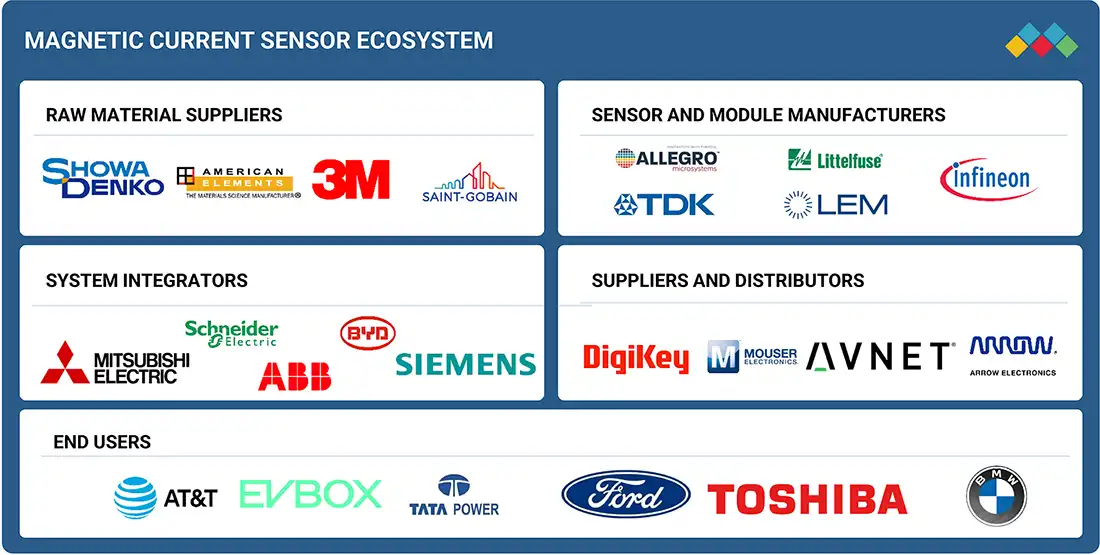
Magnetic Current Sensor Market: COMMERCIAL USE CASES ACROSS INDUSTRIES
| COMPANY | USE CASE DESCRIPTION | BENEFITS |
|---|---|---|
 |
Hall-effect and TMR magnetic current sensor ICs for EVs, industrial automation, power tools, and consumer electronics | Highly accurate, galvanically isolated current sensing; robust to stray fields; smaller footprint; efficient for high-power and wide-bandgap (SiC, GaN) power devices; suitable for compact, fast, and reliable system integration |
 |
Current sensors (Hall-effect and TMR) for electric drives, photovoltaic inverters, battery management, EV charging, and industrial automation | High precision and isolation, wide bandwidth, compact form factor, reduced power loss, SMD compatibility, and automotive-grade reliability with integrated overcurrent protection. |
 |
Multi-Hall-array and TMR-based magnetic current sensors for electric vehicles, power management, and industrial applications | Wide dynamic range up to 2000A, contactless measurement, ISO26262 (ASIL B) automotive compliance, high accuracy, stray field robustness, and miniaturization |
 |
Coreless current sensors for compact and efficient on-board EV chargers, traction inverters, and power modules | Ultra-fast (100 ns) response time, low heat, resilient to high-voltage and high-speed noise, optimal for next-gen SiC/GaN power modules, supports lightweight/downsized designs |
 |
High-precision current transducers for energy infrastructure, EVs, rail, smart grid, and industrial automation | Accurate real-time monitoring, digital output, robust performance in electrification, next-gen TMR ICs for automotive, energy management, and industrial sectors |
Logos and trademarks shown above are the property of their respective owners. Their use here is for informational and illustrative purposes only.
Related Ecosystem
Sensors And Control
- Sensors
- Image Sensors
- Temperature Sensors
- Pressure Sensors
- Flow Sensors
- BAUMER ELECTRIC AG
- HONEYWELL INTERNATIONAL INC.
- Lenovo
- Stmicroelectronics
- Texas Instruments Incorporated
Key Takeaways
- South Korea's magnetic current sensor market will nearly double from USD 112.2M (2025) to USD 213.1M (2030), representing a 13.7% CAGR.
- South Korea's automotive sector, particularly EV manufacturers, is the primary growth driver for magnetic current sensor adoption.
- South Korea's semiconductor expertise and manufacturing capabilities provide competitive advantages in sensor miniaturization and integration.
- South Korea's industrial automation and smart grid initiatives are expanding demand for high-precision current sensing solutions.
Magnetic Current Sensor Market Report Scope
| Report Metric | Details |
|---|---|
| Base Year | 2025 |
| Fastest Growing Segment | CONSUMER ELECTRONICS (Industry) |
| Forecast Period | 2025–2030 |
| Growth Rate | CAGR of 12.1% from 2025 to 2030 |
| Largest Segment | HALL-EFFECT CURRENT SENSORS (Type) |
| Market Size Base Year (Billions) | ~USD 1.98 (2025) |
| Revenue Forecast (Billions) | ~USD 3.51 (2030) |
| Segments Covered | Type, Loop Type, Industry, Energy Source, Renewable Type |
South Korea Magnetic Current Sensor Market Report Segmentation
5 segment dimensions are covered across the global market.
By Type
- Anisotropic Magnetoresistance (Amr)
- Fluxgate Current Sensors
- Giant Magnetoresistance (Gmr)
- Hall-Effect Current Sensors
- Tunnel Magnetoresistance (Tmr)
- Xmr Technologies
By Loop Type
- Closed-Loop
- Open-Loop
By Industry
- Automotive
- Consumer Electronics
- Energy & Power
- Healthcare
- Industrial
- Other Industries
- Telecom & Networking
By Energy Source
- Non-Renewable
- Renewable
By Renewable Type
- Solar/Photovoltaic
- Wind
Target Audience
- Automotive OEMs & Suppliers : South Korean automotive manufacturers and Tier-1 suppliers need detailed market intelligence to optimize magnetic current sensor sourcing strategies for EV and hybrid vehicle platforms in a rapidly electrifying market.
- Semiconductor & Sensor Manufacturers : Component manufacturers targeting South Korea require market data to identify growth opportunities, benchmark competitive positioning, and develop product strategies aligned with local customer requirements and industry standards.
- Industrial Automation Companies : Factory automation and Industry 4.0 solution providers need South Korea-specific insights to capitalize on the nation's smart manufacturing initiatives and integrate magnetic current sensors into advanced automation systems.
- Electronics & Consumer Device Makers : South Korean consumer electronics manufacturers and global companies operating in Korea need market forecasts to plan sensor integration strategies for power supplies, IoT devices, and smart home applications.
- Investment & Strategy Consultants : Business strategists, private equity firms, and management consultants require South Korea market data to advise clients on market entry, M&A opportunities, and growth strategies in the semiconductor and electronics sector.
Key Companies in the South Korea Magnetic Current Sensor Market
| Company | HQ | Ownership | Strongest segments |
|---|---|---|---|
| ALLEGRO MICROSYSTEMS, INC. | United States | Public Company | Hall-effect, Open-loop,Hall-effect, Closed-loop,AMR / GMR / TMR Current Sensors, |
| INFINEON TECHNOLOGIES AG | Germany | ||
| TDK CORPORATION | Japan | ||
| ASAHI KASEI CORPORATION | Japan | Public Company | Hall-effect,Flux Gate,Anisotropic Magnetoresistance (AMR), |
| MELEXIS | Belgium | ||
| HONEYWELL INTERNATIONAL INC. | United States | ||
| TEXAS INSTRUMENTS INCORPORATED | United States | ||
| TAMURA CORPORATION | Japan | Public Company | Hall-effect, open-loop,Hall-effect, closed-loop,Flux gate and high-precision types, |
| YAGEO GROUP | Taiwan | Public Company | Hall-effect, open-loop,Hall-effect, closed-loop,Flux Gate, |
| ANALOG DEVICES, INC. | United States | Public Company | Hall-effect magnetic current sensors,Flux Gate magnetic current sensors,Anisotropic Magnetoresistance (AMR) sensors, |
| LITTELFUSE, INC. | United States | Public Company | Hall-effect (Open-loop),Hall-effect (Closed-loop),Magnetoresistance (AMR/GMR/TMR), |
| BROADCOM | United States | Public Company | Hall-effect,Flux Gate,Anisotropic Magnetoresistance, |
ALLEGRO MICROSYSTEMS, INC.
Allegro Microsystems, Inc. is a U.S.-based public company founded in 1990 that employs 4,250 people. The company specializes in semiconductor solutions for sensing and power management applications.
INFINEON TECHNOLOGIES AG
Infineon Technologies AG is a German semiconductor manufacturer providing a broad range of products for automotive, industrial, and consumer applications.
TDK CORPORATION
TDK Corporation is a Japanese electronics company manufacturing passive components, sensors, and magnetic materials for various industrial and consumer markets.
ASAHI KASEI CORPORATION
Asahi Kasei Corporation is a Japanese public company founded in 1922 with 47,895 employees, operating across chemicals, materials, homes, and healthcare sectors.
MELEXIS
Melexis is a Belgian semiconductor company designing and manufacturing integrated circuits for automotive and industrial applications.
HONEYWELL INTERNATIONAL INC.
Honeywell International Inc. is a U.S.-based diversified technology and manufacturing company providing products and services across aerospace, building technologies, and industrial sectors.
TEXAS INSTRUMENTS INCORPORATED
Texas Instruments Incorporated is a U.S. semiconductor company designing and manufacturing analog and embedded processing chips for industrial, automotive, and consumer applications.
TAMURA CORPORATION
Tamura Corporation is a Japanese public company founded in 1924 with 4,137 employees, manufacturing electronic components and devices for telecommunications and industrial markets.
YAGEO GROUP
Yageo Group is a Taiwanese public company founded in 1977, a leading manufacturer of passive components including resistors, capacitors, and inductors.
ANALOG DEVICES, INC.
Analog Devices, Inc. is a U.S. public company founded in 1965 with 24,500 employees, specializing in analog, mixed-signal, and digital signal processing semiconductors.
LITTELFUSE, INC.
Littelfuse, Inc. is a U.S. public company founded in 1927 with 17,000 employees, manufacturing circuit protection devices and electrical components for automotive and industrial applications.
BROADCOM
Broadcom is a U.S. public company founded in 1961 with 33,000 employees, designing and manufacturing semiconductors for infrastructure, broadband, and wireless communications.
Reasons to Buy this Report
- Regional Market Specificity : Gain detailed insights exclusive to South Korea's magnetic current sensor market, including localized growth drivers, competitive landscape, and market dynamics specific to Korean manufacturers and end-users.
- Strategic Investment Planning : Leverage accurate market sizing (USD 112.2M in 2025) and forecasts (USD 213.1M by 2030) to make informed investment decisions and resource allocation in South Korea's high-growth semiconductor and electronics sector.
- Competitive Intelligence : Understand South Korea's unique position as a leading semiconductor hub and identify opportunities to partner with or compete against local industry leaders in automotive, industrial, and consumer electronics applications.
- Sector-Specific Opportunities : Identify high-potential segments including EV battery management systems, smart factory automation, and consumer electronics power management where South Korean demand is accelerating fastest.
- Market Entry Strategy : Develop targeted go-to-market strategies for South Korea by understanding regional supply chain dynamics, regulatory requirements, and customer preferences specific to Korean OEMs and manufacturers.
Frequently asked questions
What is the current market size of magnetic current sensors in South Korea?
South Korea's magnetic current sensor market was valued at USD 112.2 million in 2025 and is expected to grow significantly through 2030.
What is the projected growth rate for South Korea's magnetic current sensor market?
South Korea's magnetic current sensor market is projected to grow at a compound annual growth rate (CAGR) of 13.7% from 2025 to 2030.
What will be the market size of magnetic current sensors in South Korea by 2030?
South Korea's magnetic current sensor market is forecasted to reach USD 213.1 million by 2030, nearly doubling from 2025 levels.
Which industries are driving demand for magnetic current sensors in South Korea?
South Korea's automotive (especially electric vehicles), industrial automation, consumer electronics, and renewable energy sectors are primary demand drivers for magnetic current sensors.
Why is South Korea a significant market for magnetic current sensors?
South Korea's advanced semiconductor manufacturing capabilities, strong electronics industry, and leadership in EV production make it a critical hub for magnetic current sensor innovation and deployment.
RESEARCH METHODOLOGY
The study utilized four major activities to estimate the magnetic current sensor market size. Exhaustive secondary research was conducted to gather information on the market and its peer and parent markets. The next step was to validate these findings, assumptions, and sizing with industry experts across the value chain through primary research. Both top-down and bottom-up approaches were employed to estimate the total market size. Finally, market breakdown and data triangulation methods were utilized to estimate the market size for different segments and subsegments.
Secondary Research
Primary interviews were conducted to gather insights on market statistics, revenue data, market breakdowns, market size estimations, and forecasting. Additionally, primary research was used to comprehend various trends related to type, loop type, industry, and region. Interviews with stakeholders from the demand side, including CIOs, CTOs, CSOs, and customer/end-user installation teams using magnetic current sensor offerings and processes, were also conducted to understand their perspective on suppliers, products, component providers, and their current and future use of magnetic current sensor, which will impact the overall market. Several primary interviews were conducted across major countries in North America, Europe, Asia Pacific, and RoW.
List of key secondary sources
|
Source |
Web Link |
|
International Society of Automation |
|
|
International Federation of Robotics |
|
|
International Electrotechnical Commission |
|
|
Organisation Internationale des Constructeurs d'Automobiles |
Primary Research
Primary interviews were conducted to gather insights on market statistics, revenue data, market breakdowns, market size estimations, and forecasting. Additionally, primary research was used to comprehend various trends related to type, loop type, industry, and region. Interviews with stakeholders from the demand side, including CIOs, CTOs, CSOs, and customer/end-user installation teams using magnetic current sensor offerings and processes, were also conducted to understand their perspective on suppliers, products, component providers, and their current and future use of magnetic current sensor, which will impact the overall market. Several primary interviews were conducted across major countries in North America, Europe, Asia Pacific, and RoW.
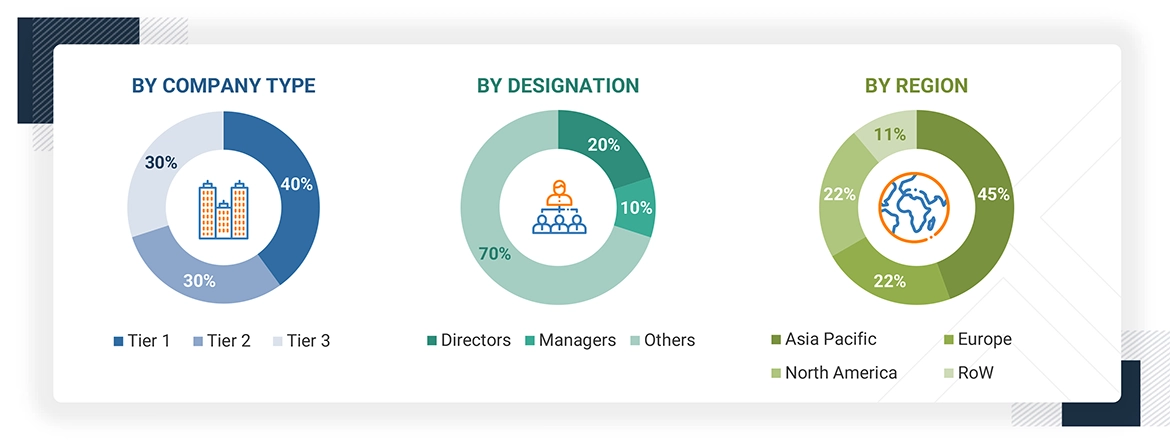
To know about the assumptions considered for the study, download the pdf brochure
Market Size Estimation
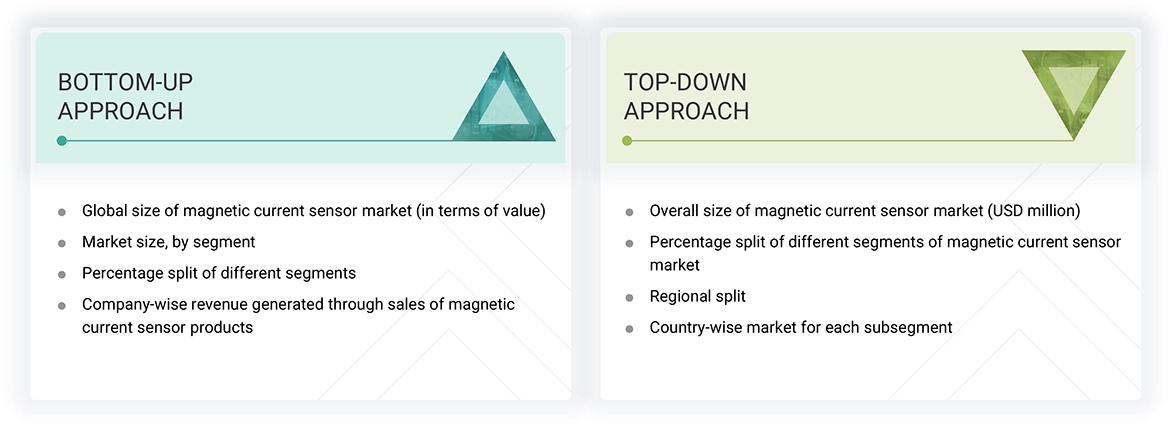
In the complete market engineering process, top-down and bottom-up approaches and several data triangulation methods have been used to estimate and forecast the overall market segments and subsegments listed in this report. Key players in the market have been identified through secondary research, and their market shares in the respective regions have been determined through primary and secondary research. This entire procedure includes the study of annual and financial reports of the top market players and extensive interviews for key insights (quantitative and qualitative) with industry experts (CEOs, VPs, directors, and marketing executives).
All percentage shares, splits, and breakdowns have been determined using secondary sources and verified through primary sources. All the parameters affecting the markets covered in this research study have been accounted for, viewed in detail, verified through primary research, and analyzed to obtain the final quantitative and qualitative data. This data has been consolidated and supplemented with detailed inputs and analysis from MarketsandMarkets and presented in this report. The following figure represents this study's overall market size estimation process.
Magnetic Current Sensor Market : Top-Down and Bottom-Up Approach
Data Triangulation
Once the overall size of the magnetic current sensor market was determined using the methods described above, it was divided into multiple segments and subsegments. Market engineering was performed for each segment and subsegment using market breakdown and data triangulation methods, as applicable, to obtain accurate statistics. Various factors and trends from the demand and supply sides were studied to triangulate the data. The market was validated using both the top-down and bottom-up approaches.
Market Definition
A magnetic current sensor is a device that measures electric current by detecting the magnetic field generated around a current-carrying conductor. It operates using principles such as the Hall Effect, flux gate, or magnetoresistance to convert the magnetic field into a proportional electrical signal. This non-contact method allows for safe, accurate, and efficient measurement of both AC and DC currents without physically disrupting the circuit. Magnetic current sensors are widely used in applications that require real-time current monitoring, including electric vehicles, power supplies, industrial automation, and renewable energy systems, where precision, reliability, and compact integration are critical for performance and safety.
The report comprehensively analyzes the magnetic current sensor market based on type, loop type, industry, and region. A few key manufacturers of magnetic current sensors are Allegro MicroSystems, Inc. (US), Infineon Technologies AG (Germany), TDK Corporation (Japan), Asahi Kasei Corporation (Japan), LEM International SA (Switzerland), Melexis (Belgium), and TAMURA Corporation (Japan).
Key Stakeholders
- Raw material suppliers
- Component manufacturers and providers
- Manufacturers and providers of magnetic current sensors
- Original equipment manufacturers (OEMs)
- Magnetic current sensor suppliers and distributors
- Market research and consulting firms
- Associations, organizations, forums, and alliances related to the magnetic current sensor industry
- Technology investors
- Governments and financial institutions
- Venture capitalists, private equity firms, and start-ups
- End users
Report Objectives
- To describe and forecast the magnetic current sensor market size by type, loop type, industry, and region, in terms of value
- To describe and forecast the market for various segments across four main regions, namely, North America, Europe, Asia Pacific, and RoW, in terms of value
- To describe and forecast the market for type, in terms of volume
- To strategically analyze micromarkets with regard to individual growth trends, prospects, and contributions to the markets
- To provide detailed information regarding drivers, restraints, opportunities, and challenges influencing market growth
- To analyze opportunities for stakeholders by identifying high-growth segments in the market
- To provide a detailed overview of the magnetic current sensor value chain
- To strategically analyze key technologies, average selling price trend, trends impacting customer business, ecosystem, regulatory landscape, patent landscape, Porter's five forces, import and export scenarios, key stakeholders and buying criteria, and case studies pertaining to the market under study
- To strategically profile key players in the magnetic current sensor market and comprehensively analyze their market share and core competencies
- To analyze competitive developments such as partnerships, acquisitions, expansions, collaborations, and product launches, along with R&D in the magnetic current sensor market
Available customizations:
With the given market data, MarketsandMarkets offers customizations according to the specific requirements of companies. The following customization options are available for the report:
- Detailed analysis and profiling of additional market players (up to 5)
- Additional country-level analysis of the magnetic current sensor market
Product Analysis
- The product matrix provides a detailed comparison of the product portfolio of each company in the magnetic current sensor market.
Get the Full Magnetic Current Sensor Market Report
Full forecast, segment splits, and company analysis for all Magnetic Current Sensor Market.
- Canada Magnetic Current Sensor Market
- Mexico Magnetic Current Sensor Market
- US Magnetic Current Sensor Market
- France Magnetic Current Sensor Market
- Germany Magnetic Current Sensor Market
- Italy Magnetic Current Sensor Market
- Rest Of Europe Magnetic Current Sensor Market
- UK Magnetic Current Sensor Market
- China Magnetic Current Sensor Market
- India Magnetic Current Sensor Market
- Japan Magnetic Current Sensor Market
- Rest Of Asia Pacific Magnetic Current Sensor Market
- GCC Magnetic Current Sensor Market
- Rest Of Middle East Magnetic Current Sensor Market
Need a Tailored Report?
Customize this report to your needs
Get 10% FREE Customization
Customize This Report
