
South Korea Managed Network Services Market (2025-2030)

The South Korea Managed Network Services Market was valued at $2370.7 Million in 2025 and projected to reach to $3910.5 Million by 2030, representing a compound annual growth rate of 10.5%. South Korea's Managed Network Services Market is positioned for sustained high-growth expansion through 2030, fueled by the nation's commitment to digital excellence and enterprise modernization.


| Market Size in | USD 26.32 MN |
| Market Forecast in | |
| CAGR | |
| Forecast Period | |
| Units Considered | Value (USD MN) |
South Korea Managed Network Services Market Trends and Insights
- This accelerated expansion in South Korea significantly outpaces the global average of 7.3%, reflecting the country's advanced digital infrastructure and heightened enterprise demand for network optimization.
- South Korea's technology-forward economy and rapid digital transformation initiatives are driving organizations across sectors to adopt managed network services for enhanced operational efficiency and security. The forecast period through 2030 demonstrates South Korea's strategic positioning as a key growth market within the Asia Pacific region.
- South Korea's enterprises are increasingly prioritizing network modernization and cloud integration, propelling investment in managed services.
- The 65% growth trajectory from 2025 to 2030 underscores South Korea's commitment to maintaining competitive advantage through sophisticated network management solutions and digital infrastructure enhancement..
Key Market Statistics
- CAGR (2025-2030) 10.5% CAGR
- Market Size, 2025 ~USD 2370.7 Million
- Forecast, 2030 ~USD 3910.5 Million
- Country South Korea
South Korea Managed Network Services Market Overview
Exceptional Growth Trajectory :
South Korea's Managed Network Services Market is expanding at 10.5% CAGR, significantly outpacing the global average of 7.3%, driven by digital transformation initiatives and enterprise modernization across the nation.
Market Valuation Surge :
The market is valued at USD 2,370.7 million in 2025 and is projected to reach USD 3,910.5 million by 2030, representing a 65% increase over the five-year forecast period.
Advanced Digital Infrastructure :
South Korea's world-class broadband penetration, 5G leadership, and tech-savvy enterprises create an ideal environment for managed network services adoption and innovation.
Enterprise Demand Acceleration :
Heightened focus on network security, cloud integration, and operational efficiency among South Korean enterprises is driving sustained demand for comprehensive managed network solutions.
South Korea Managed Network Services Market Dynamics
- The country's advanced technological infrastructure, coupled with increasing cybersecurity concerns and cloud adoption, creates a compelling environment for managed service providers.
- South Korean enterprises are increasingly outsourcing network management to focus on core business operations while leveraging specialized expertise.
- The market's 10.5% CAGR reflects strong investment in network optimization, hybrid IT environments, and digital transformation initiatives across manufacturing, finance, telecommunications, and public sectors..
Market Ecosystem
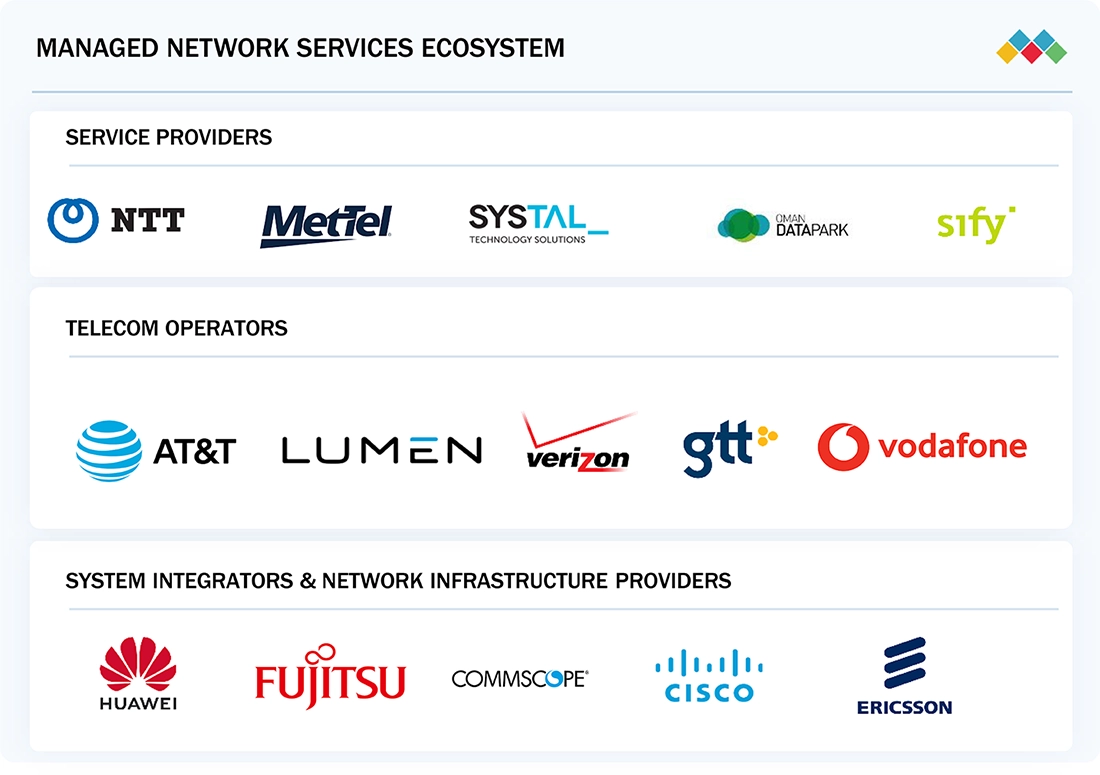
Managed Network Services Market: COMMERCIAL USE CASES ACROSS INDUSTRIES
| COMPANY | USE CASE DESCRIPTION | BENEFITS |
|---|---|---|
 |
Managed SD-WAN and SASE for retail, branch and hybrid enterprises (site onboarding, transport + security) | Centralized SD-WAN orchestration, integrated security, and faster site rollouts |
 |
Managed network services with application-aware SD-WAN and proactive performance monitoring for large enterprises | App-aware routing, performance assurance, and reduced network ops burden |
 |
Cloud-managed campus/branch networking + managed SD-WAN and partner MSP programs for multi-site customers | Cloud orchestration, automation, unified security, and telemetry |
 |
End-to-end managed LAN, WAN, SD-WAN, private wireless and edge services with global lifecycle delivery | Global operations, multi-vendor integration, faster incident resolution, and lower OPEX |
 |
Flexible SD-WAN / SD-Branch and managed global connectivity with cloud integration for multinational customers | Scalable secure connectivity, cloud on-ramps, and centralized global management |
Logos and trademarks shown above are the property of their respective owners. Their use here is for informational and illustrative purposes only.
Related Ecosystem
Data Centre And Networking
- Software-Defined Networking (SDN)
- Mid-Sized Data Centers
- Small Data Centers
- Remote Monitoring
- Smart Healthcare
- Cisco Systems, Inc.
- HUAWEI TECHNOLOGIES CO LTD
- Hewlett Packard Enterprise Company
- MITSUBISHI ELECTRIC INFORMATION SYSTEMS CORPORATION
- MITSUBISHI ELECTRIC INFORMATION NETWORK CORPORATION
Key Takeaways
- South Korea's Managed Network Services Market is valued at USD 2,370.7 million in 2025 with a 10.5% CAGR through 2030.
- South Korea's market growth rate of 10.5% significantly exceeds the global CAGR of 7.3%, positioning the country as a high-growth region.
- South Korea's market is projected to reach USD 3,910.5 million by 2030, representing 65% total growth over the forecast period.
- South Korea's advanced digital economy and enterprise cloud adoption are primary drivers of accelerated managed network services demand.
Managed Network Services Market Report Scope
| Report Metric | Details |
|---|---|
| Base Year | 2025 |
| Fastest Growing Segment | OTHER MANAGED NETWORK SECURITY (Managed Network Security) |
| Forecast Period | 2025–2039 |
| Growth Rate | CAGR of 7.3% from 2025 to 2039 |
| Largest Segment | MANAGED WAN (Type) |
| Market Size Base Year (Billions) | ~USD 120.96 (2025) |
| Revenue Forecast (Billions) | ~USD 172.04 (2039) |
| Segments Covered | Type, Managed Network Security, Vertical |
South Korea Managed Network Services Market Report Segmentation
3 segment dimensions are covered across the global market.
By Type
- Managed Lan
- Managed Network Security
- Managed Nfv
- Managed Vpn
- Managed Wan
- Managed Wi-Fi
- Network Monitoring
By Managed Network Security
- Managed Firewall
- Managed Ids/Ips
- Other Managed Network Security
By Vertical
- Bfsi
- Education
- Government
- Healthcare
- It & Telecom
- Manufacturing
- Media & Entertainment
- Other Verticals
- Retail & Ecommerce
Target Audience
- Managed Service Providers (MSPs) : MSPs targeting South Korea need market-specific data to assess growth opportunities, competitive landscape, and customer demand patterns to develop localized service offerings and expansion strategies.
- Network Technology Vendors : Vendors of networking solutions require South Korea market insights to identify enterprise adoption trends, technology preferences, and partnership opportunities with local service providers.
- Enterprise IT Decision-Makers : South Korean CIOs and IT directors use this market intelligence to benchmark managed services investments, evaluate provider capabilities, and align network strategies with industry trends.
- Investment & Private Equity Firms : Investors evaluating opportunities in South Korea's ICT sector need detailed market sizing and growth projections to assess portfolio companies and identify acquisition targets in managed services.
- Market Research & Consulting Firms : Research organizations require South Korea-specific market data to support client advisory services, competitive analysis, and strategic recommendations within the managed network services space.
Key Companies in the South Korea Managed Network Services Market
| Company | HQ | Ownership | Strongest segments |
|---|---|---|---|
| KPN | Netherlands | Public Company | Consumer,Business,Wholesale, |
| OOREDOO | Qatar | Public Company | Mobile Telecommunications,Broadband Services, |
| VIAVI SOLUTIONS | United States | Public Company | Network and Service Enablement,Optical Security and Performance Products, |
| ROGERS COMMUNICATIONS INC | Canada | Public Company | Wireless,Cable,Media, |
| ADLINK TECHNOLOGY INC. | Taiwan | Public Company | Edge Computing Platforms,Rugged Computing Solutions,GPU Solutions, |
| PCCW | Hong Kong | Public Company | Telecommunications,Media and OTT,IT and Enterprise Solutions, |
| DIMENSION DATA | United Kingdom | Private Company | Cloud Services,Managed Services,Unified Communications, |
| WINDSTREAM HOLDINGS | United States | Private Company | Managed Communications Services,High-Capacity Bandwidth,Consumer Broadband, |
| TURK TELEKOM | Turkey | Public Company | Fixed Broadband,Mobile Services, |
| MOBILY | Saudi Arabia | Public Company | Mobile Wireless,Fiber Optic,Cloud Services, |
| BHARTI AIRTEL LIMITED | India | Public Company | Mobile Services,Airtel Business, |
| EXTREME NETWORKS, INC. | United States | Public Company | Cloud Networking,Enterprise Campus Networks,Data Center Solutions, |
| SHAW COMMUNICATIONS INC | Canada | Private Company | Broadband Internet,Cable TV,Wireless Services, |
| CISCO | United States | Public Company | Data Center Switching,Network Security,Collaboration Tools, |
| AT&T | United States | Public Company | Wireless Services,Media & Entertainment,Broadband, |
| VERIZON | United States | Public Company | Wireless Services,Broadband,Enterprise Solutions, |
| NTT | Japan | Private Company | Cloud Services,Managed IT Solutions,Telecommunications, |
| DEUTSCHE TELEKOM | Germany | Public Company | Mobile Services,Fixed Network Services,ICT Solutions, |
| VODAFONE | United Kingdom | Public Company | Mobile Services,IoT Solutions,Fixed Services, |
| ERICSSON | Sweden | Public Company | Networks,Cloud Software and Services,Enterprise, |
| TELEFONICA | Spain | Public Company | Mobile Services,Broadband Internet, |
| LUMEN TECHNOLOGIES | United States | Public Company | Edge Cloud Services,Managed Security,Unified Communications, |
| FUJITSU | Japan | Public Company | Service Solutions,Hardware Solutions,Ubiquitous Solutions, |
| TATA COMMUNICATIONS | India | Public Company | Data Services,Voice Solutions,Cybersecurity, |
| TELSTRA | Australia | Public Company | Mobile Services,Broadband Services,Enterprise Solutions, |
KPN
KPN is a Dutch public telecommunications company established in 1881 with 9,293 employees.
OOREDOO
Ooredoo is a Qatari public telecommunications company founded in 1987, operating with 16,717 employees.
VIAVI SOLUTIONS
VIAVI Solutions is a U.S. public company founded in 1923 with 3,600 employees, specializing in network testing and software solutions.
ROGERS COMMUNICATIONS INC
Rogers Communications Inc. is a Canadian public telecommunications and media company founded in 1960 with 25,000 employees.
ADLINK TECHNOLOGY INC.
ADLINK Technology Inc. is a Taiwanese public company established in 1995 with 342 employees, focusing on industrial computing solutions.
PCCW
PCCW is a Hong Kong-based public telecommunications and media company founded in 1925 with 14,600 employees.
DIMENSION DATA
Dimension Data is a United Kingdom-based private IT services and systems integration company founded in 1983 with 11,032 employees.
WINDSTREAM HOLDINGS
Windstream Holdings is a U.S. private telecommunications company founded in 2000.
TURK TELEKOM
Turk Telekom is a Turkish public telecommunications company established in 1840 with 31,076 employees.
MOBILY
Mobily is a Saudi Arabian public telecommunications company founded in 2004 with 3,000 employees.
BHARTI AIRTEL LIMITED
Bharti Airtel Limited is an Indian public telecommunications company established in 1995 with 28,730 employees.
EXTREME NETWORKS, INC.
Extreme Networks, Inc. is a U.S. public networking equipment and software company founded in 1996 with 2,811 employees.
SHAW COMMUNICATIONS INC
Shaw Communications Inc. is a Canadian private telecommunications and media company founded in 1966 with 9,300 employees.
CISCO
Cisco is a U.S. public technology company founded in 1984 with 86,200 employees, specializing in networking and IT infrastructure.
AT&T
AT&T is a U.S. public telecommunications company founded in 1983 with 133,030 employees.
VERIZON
Verizon is a U.S. public telecommunications company founded in 1983 with 89,900 employees.
NTT
NTT is a Japanese private telecommunications company established in 1988 with 197,777 employees.
DEUTSCHE TELEKOM
Deutsche Telekom is a German public telecommunications company founded in 1995 with 196,586 employees.
VODAFONE
Vodafone is a United Kingdom-based public telecommunications company founded in 1984 with 91,128 employees.
ERICSSON
Ericsson is a Swedish public telecommunications equipment and services company founded in 1876 with 87,521 employees.
TELEFONICA
Telefónica is a Spanish public telecommunications company established in 1924 with 82,175 employees.
LUMEN TECHNOLOGIES
Lumen Technologies is a U.S. public telecommunications and IT services company founded in 1968 with 21,000 employees.
FUJITSU
Fujitsu is a Japanese public IT services and technology company founded in 1935 with 112,743 employees.
TATA COMMUNICATIONS
Tata Communications is an Indian public telecommunications company established in 1986 with 5,852 employees.
TELSTRA
Telstra is an Australian public telecommunications company founded in 1901 with 29,520 employees.
Reasons to Buy this Report
- Market-Specific Growth Intelligence : Gain detailed insights into South Korea's 10.5% CAGR trajectory, understanding the unique drivers and dynamics that differentiate this market from global trends and competing regions.
- Competitive Positioning Strategy : Identify market entry opportunities and competitive advantages specific to South Korea's advanced digital ecosystem, enabling data-driven strategic planning for service providers and technology vendors.
- Investment Decision Support : Leverage comprehensive market valuation data (2025-2030) to support investment decisions, resource allocation, and expansion planning within South Korea's high-growth managed services sector.
- Enterprise Customer Insights : Understand South Korean enterprise demand patterns, digital transformation priorities, and network service requirements to tailor solutions and marketing strategies effectively.
- Regulatory & Infrastructure Context : Access South Korea-specific analysis of regulatory environment, 5G adoption, cybersecurity mandates, and infrastructure advantages that shape managed network services demand.
Frequently asked questions
What is the current size of South Korea's Managed Network Services Market?
South Korea's Managed Network Services Market is valued at USD 2,370.7 million in 2025.
What is the projected market size for South Korea by 2030?
South Korea's Managed Network Services Market is forecast to reach USD 3,910.5 million by 2030.
What is the CAGR for South Korea's Managed Network Services Market?
South Korea's Managed Network Services Market is expected to grow at a compound annual growth rate of 10.5% from 2025 to 2030.
How does South Korea's growth rate compare to the global market?
South Korea's CAGR of 10.5% significantly outpaces the global CAGR of 7.3%, indicating stronger regional market momentum.
What factors are driving growth in South Korea's market?
South Korea's digital transformation initiatives, enterprise cloud adoption, network modernization priorities, and advanced technology infrastructure are primary growth drivers.
RESEARCH METHODOLOGY
The research study involved four major activities in estimating the managed network services market size. Exhaustive secondary research was conducted to gather key information about the market and its peer markets. The next step was to validate these findings and assumptions, and size them up with the help of primary research involving industry experts across the value chain. The top-down and bottom-up approaches were used to estimate the market size. After the market breakdown, data triangulation was utilized to estimate the sizes of segments and sub-segments.
Secondary Research
The revenue generated by the companies offering managed network services to various end users was determined based on the secondary data available through paid and unpaid sources, analyzing the product portfolios of major companies in the ecosystem, and rating companies based on their performance and quality. In the secondary research process, various sources were referred to identify and collect information for the study. These include annual reports, press releases, investor presentations of companies, white papers, certified publications, and articles from recognized associations and government publishing sources.
Secondary research was primarily used to gather critical information about industry insights, the market’s monetary chain, the overall pool of key players, market classification and segmentation based on industry trends, regional markets, and key developments from market- and technology-oriented perspectives.
Primary Research
In the primary research process, various sources from the supply and demand sides were interviewed to obtain qualitative and quantitative information for the report, such as Chief Experience Officers (CXOs), Vice Presidents (VPs), directors from business development, marketing, and product development/innovation teams, and related key executives from managed network services vendors, system integrators, professional and managed service providers, industry associations, independent consultants, and key opinion leaders.
Primary interviews were conducted to gather insights, such as market statistics, data on revenue collected from platforms and services, market breakups, market size estimations, market forecasts, and data triangulation. Stakeholders from the demand side, such as Chief Information Officers (CIOs), Chief Finance Officers (CFOs), Chief Strategy Officers (CSOs), and the installation team of end users who use managed network services solutions, were interviewed to understand buyers’ perspectives on suppliers, products, service providers, and their use of managed network services solutions which is expected to affect the overall managed network services market growth.
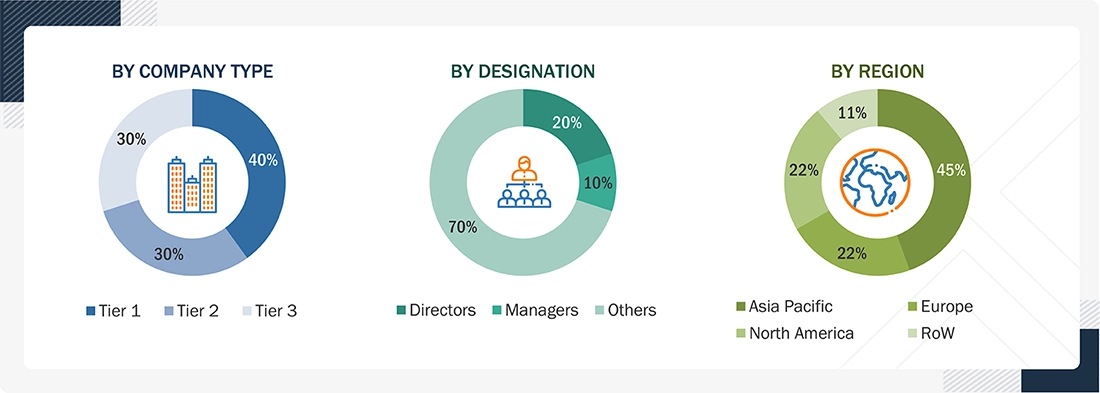
Note: Tier 1 companies have revenues over USD 1 billion, Tier 2 companies have revenues between USD
500 million and 1 billion, and Tier 3 companies have revenues less than USD 500 million.
Other designations include sales managers, marketing managers, and product managers.
Source: Industry Experts
To know about the assumptions considered for the study, download the pdf brochure
Market Size Estimation
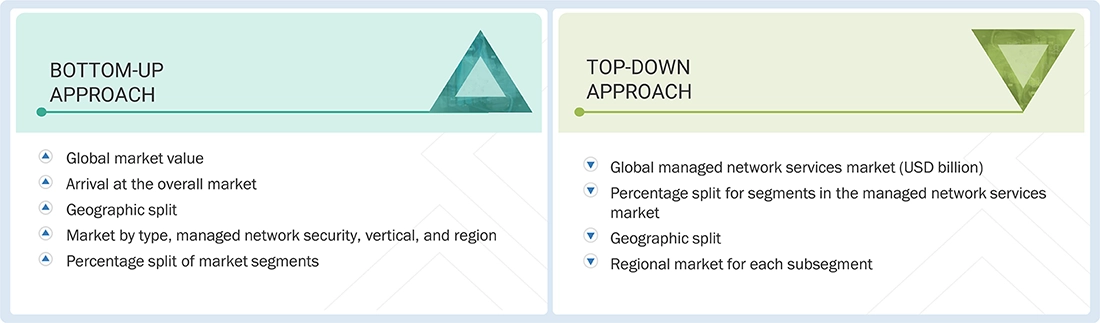
Both top-down and bottom-up approaches were used to estimate and validate the total size of the managed network services market. These methods were also used extensively to estimate the size of various subsegments in the market.
Managed Network Services Market : Top-Down and Bottom-Up Approach
Data Triangulation
The managed network services market was segmented into several categories and subcategories after determining the overall market size through the above estimation process. To complete the overall market engineering process and obtain precise statistics for all segments and sub-segments, data triangulation and market breakdown procedures were employed, as applicable. The data was triangulated by studying various factors and trends from the demand and supply sides. The managed network services market size was validated using top-down and bottom-up approaches.
Market Definition
Managed network services (MNS) are a type of IT service in which a third-party provider takes over the responsibility of managing, maintaining, and supporting an organization’s network. Instead of a company’s in-house IT team handling these tasks, they outsource them to a specialized provider. This provider uses its expertise, technology, and staff to ensure the network operates efficiently, securely, and reliably. Key aspects of MNS are outsourcing network management, network design and implementation, performance management, security management, and cloud connectivity.
Stakeholders
- Cloud Service Providers (CSPs)
- Independent Software Vendors (ISVs)
- System Integrators
- Value-added Resellers (VARs)
- Managed Service Providers (MSPs)
- Small and Medium-sized Enterprises (SMEs)
- IT Strategy Consultants
- Managed Service Consulting Vendors
- Technology Partners
- Research Organizations
- Enterprise Users
- Technology Providers
Report Objectives
- To determine and forecast the global managed network services market by type (managed LAN, managed Wi-Fi, managed VPN, managed WAN, network monitoring, managed NFV, and managed network security), managed network security, vertical, and region from 2025 to 2030, and analyze various macroeconomic and microeconomic factors that affect market growth
- To forecast the size of the market segments concerning North America, Europe, Asia Pacific, Latin America, and the Middle East and Africa (MEA)
- To provide detailed information about the major factors (drivers, restraints, opportunities, and challenges) influencing the growth of the managed network services market
- To strategically analyze the macro and micromarkets with concerning individual growth trends, prospects, and contributions to the total market
- To analyze the opportunities in the market for stakeholders by identifying the high-growth segments of the managed network services market
- To profile the key market players; provide a comparative analysis on the basis of business overviews, regional presence, product offerings, business strategies, and key financials; and illustrate the competitive landscape of the market
- To profile the key players in the market and comprehensively analyze their market share/ranking and core competencies
Available Customizations
With the given market data, MarketsandMarkets offers customizations based on the company’s specific needs. The following customization options are available for the report:
Geographic Analysis as per Feasibility
- Further break-up of the Asia Pacific market into countries contributing 75% to the regional market size
- Further break-up of the North American market into countries contributing 75% to the regional market size
- Further break-up of the Latin American market into countries contributing 75% to the regional market size
- Further break-up of the Middle East & African market into countries contributing 75% to the regional market size
- Further break-up of the European market into countries contributing 75% to the regional market size
Company Information
- Detailed analysis and profiling of additional market players (up to five)
Get the Full Managed Network Services Market Report
Full forecast, segment splits, and company analysis for all Managed Network Services Market.
- Africa Managed Network Services Market
- Middle East Managed Network Services Market
- Ksa Managed Network Services Market
- Rest Of Middle East Managed Network Services Market
- US Managed Network Services Market
- Canada Managed Network Services Market
- UK Managed Network Services Market
- Germany Managed Network Services Market
- France Managed Network Services Market
- Italy Managed Network Services Market
- Spain Managed Network Services Market
- China Managed Network Services Market
- Japan Managed Network Services Market
- India Managed Network Services Market
- Singapore Managed Network Services Market
- UAE Managed Network Services Market
- Kuwait Managed Network Services Market
- Bahrain Managed Network Services Market
- Brazil Managed Network Services Market
- Mexico Managed Network Services Market
- Rest Of Europe Managed Network Services Market
- Rest Of Asia Pacific Managed Network Services Market
Need a Tailored Report?
Customize this report to your needs
Get 10% FREE Customization
Customize This Report
