
South Korea Marine Engines Market (2026-2031)

The South Korea Marine Engines Market was valued at $2957.8 Million in 2026 and projected to reach to $3564.1 Million by 2031, representing a compound annual growth rate of 3.8%. South Korea's marine engines market is positioned for sustained growth through 2031, supported by the nation's advanced shipbuilding infrastructure and technological expertise.


| Market Size in | USD 26.32 MN |
| Market Forecast in | |
| CAGR | |
| Forecast Period | |
| Units Considered | Value (USD MN) |
South Korea Marine Engines Market Trends and Insights
- South Korea, a leading maritime nation with a robust shipbuilding industry, plays a critical role in the global marine engines sector.
- The market in South Korea is driven by increasing demand for fuel-efficient and environmentally compliant marine propulsion systems, supported by the country's advanced manufacturing capabilities and technological innovation. During the forecast period from 2026 to 2031, South Korea's marine engines market is expected to benefit from stricter international maritime regulations, including IMO 2030 and IMO 2050 standards, which mandate reduced emissions and improved fuel efficiency.
- South Korea's shipyards and marine engine manufacturers are investing heavily in developing next-generation engines, including LNG-powered and hybrid propulsion systems.
- The growth trajectory in South Korea reflects both domestic demand from its shipbuilding sector and export opportunities to global shipping operators seeking advanced marine propulsion solutions..
Key Market Statistics
- CAGR (2026-2031) 3.8% CAGR
- Market Size, 2026 ~USD 2957.8 Million
- Forecast, 2031 ~USD 3564.1 Million
- Country South Korea
South Korea Marine Engines Market Overview
Market Valuation Growth :
South Korea's marine engines market is valued at USD 2,957.8 million in 2026 and is projected to reach USD 3,564.1 million by 2031, demonstrating steady expansion in this critical maritime sector.
Strong CAGR Performance :
The South Korean market is growing at a CAGR of 3.8%, outpacing the global average of 3.5%, indicating robust domestic demand and competitive advantages in marine engine manufacturing.
Shipbuilding Industry Leadership :
As a leading maritime nation with world-class shipbuilding capabilities, South Korea maintains a dominant position in marine engine production, supplying both domestic and international markets.
Fuel Efficiency Focus :
South Korea's marine engines market is increasingly driven by demand for fuel-efficient and environmentally compliant engines, aligning with international maritime regulations and sustainability goals.
South Korea Marine Engines Market Dynamics
- The country's strategic focus on developing next-generation marine propulsion systems, including LNG-powered engines and hybrid technologies, will drive market expansion.
- Increasing investments in R&D and compliance with IMO 2030/2050 regulations are expected to create new opportunities for engine manufacturers and suppliers. The market will benefit from rising global demand for efficient maritime transport and South Korea's reputation for high-quality marine engineering.
- Domestic shipyards' continued dominance in constructing mega-container ships and LNG carriers will sustain demand for advanced marine engines.
- Additionally, retrofitting initiatives for existing vessels and the transition toward decarbonization will provide incremental growth opportunities throughout the forecast period..
Market Ecosystem

MARINE ENGINES MARKET SIZE, SHARE & INDUSTRY TRENDS: COMMERCIAL USE CASES ACROSS INDUSTRIES
| COMPANY | USE CASE DESCRIPTION | BENEFITS |
|---|---|---|
 |
Bisso Towboat upgraded its old fleet by adding a new ASD tractor tug (m.v. Mr. Brian) with support from Main Iron Works. The goal was to meet US Coast Guard Tier 4 emission rules and improve performance in narrow and busy river areas. The new tug uses a modern Caterpillar 3516E engine and advanced propulsion system, replacing older tugs that had low efficiency and high maintenance needs. | The upgrade improved maneuverability, reduced maintenance downtime, and ensured regulatory compliance. It also enhanced engine reliability and crew comfort, helping improve overall operations and market competitiveness. |
 |
Edda Wind expanded and upgraded its offshore service vessel fleet to support the growing offshore wind sector. The company added advanced marine engines, fuel-saving technologies, and alternative fuel readiness. This was done to meet rising demand for longer missions, lower emissions, and reliable operations in harsh offshore conditions. | The upgrade improved fuel efficiency, reduced emissions, and increased operational performance. It also supported long-term sustainability goals, strengthened Edda Wind’s position in offshore wind logistics, and built confidence among customers and investors. |
 |
Finnlines upgraded its RoPax ferries by adding Wärtsilä hybrid propulsion systems to improve environmental performance. The aim was to reduce fuel use, emissions, and port pollution while maintaining reliable passenger and cargo operations. The solution included hybrid engines, battery systems, and shore power connectivity to support cleaner and more efficient operations | The hybrid system reduced fuel consumption and emissions, enabled zero-emission operations at ports, and improved operational flexibility. It also helped Finnlines meet environmental regulations and strengthen its position in sustainable maritime transport. |
 |
Seaspan Ferries upgraded its fleet using hybrid propulsion, renewable fuels, and better operational practices. The goal was to reduce greenhouse gas emissions while maintaining reliable cargo transport. The company adopted LNG and biodiesel blends, installed emission reduction systems, and upgraded battery systems to improve efficiency. | The company achieved significant emission reductions (up to 90% in some cases), improved fuel efficiency, and maintained reliable operations. The strategy also reduced engine wear and strengthened Seaspan’s position in sustainable short-sea shipping. |
Logos and trademarks shown above are the property of their respective owners. Their use here is for informational and illustrative purposes only.
Related Ecosystem
Engines And Gensets
Oil And Gas Solutions
Power Infrastructure
Key Takeaways
- South Korea's marine engines market is valued at USD 2,957.8 million in 2026 and is expected to reach USD 3,564.1 million by 2031 at a CAGR of 3.8%.
- South Korea's advanced shipbuilding industry and technological expertise position it as a key hub for marine engine innovation and manufacturing.
- Regulatory compliance with IMO emissions standards is driving South Korea's adoption of cleaner propulsion technologies, including LNG and hybrid systems.
- South Korea's marine engines market benefits from strong export demand as global shipping operators seek high-quality, efficient propulsion solutions.
Marine Engines Market Report Scope
| Report Metric | Details |
|---|---|
| Base Year | 2026 |
| Fastest Growing Segment | FOUR-STROKE (Stroke Type) |
| Forecast Period | 2026–2031 |
| Growth Rate | CAGR of 3.5% from 2026 to 2031 |
| Largest Segment | PROPULSION (Engine Type) |
| Market Size Base Year (Billions) | ~USD 14.25 (2026) |
| Revenue Forecast (Billions) | ~USD 16.92 (2031) |
| Segments Covered | Stroke Type, Engine Type, Power Range, Fuel Type |
South Korea Marine Engines Market Report Segmentation
4 segment dimensions are covered across the global market.
By Stroke Type
- Four-Stroke
- Two-Stroke
By Engine Type
- Auxiliary
- Propulsion
By Power Range
- 1,001–5,000 Hp
- 10,001–20,000 Hp
- 5,001–10,000 Hp
- Above 20.000 Hp
- Up To 1,000 Hp
By Fuel Type
- Heavy Fuel Oil
- Marine Diesel Oil
- Marine Gas Oil
- Other Fuel Types
Target Audience
- Marine Engine Manufacturers : Manufacturers need South Korea-specific market data to benchmark performance, identify growth opportunities in Asia's leading shipbuilding nation, and develop localized product strategies.
- Shipbuilding Companies : South Korean and international shipyards require detailed market insights to forecast engine demand, optimize supply chain partnerships, and align procurement strategies with market projections.
- Investment & Private Equity Firms : Investors targeting the maritime and energy sectors need comprehensive South Korea market analysis to evaluate acquisition targets, assess growth potential, and make informed capital allocation decisions.
- Technology & Component Suppliers : Suppliers of marine engine components and systems need South Korea market intelligence to identify OEM partnerships, understand regulatory requirements, and capitalize on fuel-efficiency trends.
- Government & Policy Organizations : South Korean maritime authorities and policy makers require market data to inform industrial strategy, support domestic shipbuilding competitiveness, and align with international maritime regulations.
Key Companies in the South Korea Marine Engines Market
| Company | HQ | Ownership | Strongest segments |
|---|---|---|---|
| KONGSBERG GRUPPEN | Norway | Public Company | Air and naval defense systems (including missiles and C2),Remote weapon stations and land systems,Subsea positioning, sonars, and uncrewed platforms, |
| ALFA LAVAL AB | Sweden | Public Company | Heat transfer (plate, air-cooled, tubular, scraped-surface),Separation (decanters, separators, ballast water systems),Fluid handling (pumps, valves, tank equipment, mixers), |
| INTERTEK GROUP PLC | United Kingdom | Public Company | Consumer Products,Corporate Assurance,Health and Safety, |
| ACTUANT | United States | Public Company | High-force hydraulic tools (cylinders, pumps, valves),Bolting and torque solutions (torque wrenches, bolt tensioners),Engineered heavy lifting technology, |
| PETRONAS | Malaysia | Private Company | Upstream oil and gas (exploration, development, production, sale, export),LNG and gas value chain (including LNG bunkering, marine gas solutions),Refining, fuels, and retail networks, |
| HESS CORPORATION | United States | Private Company | Crude oil,Natural gas liquids (NGLs),Natural gas, |
| TOTAL SA | France | Public Company | Upstream oil,Natural gas & LNG,Refining & petrochemicals, |
| JXTG HOLDINGS | Japan | Public Company | Petroleum refining and product sales,Petrochemicals and functional materials,Lubricants, |
| IHI CORPORATION | Japan | Public Company | Resources, Energy and Environment (power systems, carbon solutions, LNG, process plants),Social Infrastructure (bridges, water gates, transport systems, shield systems, concrete materials),Industrial Systems and General-Purpose Machinery (turbochargers, logistics systems, rotating machinery, industrial equipment), |
| WALBRO CORPORATION | United States | Public Company | Automotive fuel pumps and modules (passenger vehicles, light trucks),Fuel tanks and storage systems,Motorcycle and powersports fuel systems, |
| MITSUI E&P AUSTRALIA PTY LTD. | Australia | Private Company | Domestic natural gas,Condensate and crude oil,LPG and associated products, |
| CATERPILLAR | United States | Public Company | Construction Industries equipment and parts,Resource Industries mining equipment and services,Energy & Transportation engines, turbines, and rail, |
| WÄRTSILÄ | Finland | Public Company | Engine and hybrid power plants,Energy storage (Quantum BESS),GEMS Digital Energy Platform and software, |
| ROLLS-ROYCE PLC | United Kingdom | Public Company | Civil Aerospace,Defence,Power Systems (mtu), |
| HD HYUNDAI HEAVY INDUSTRIES | South Korea | Public Company | Shipbuilding – general merchant vessels,Shipbuilding – LNG/LPG/LEG and specialized carriers,Naval and medium-size ships, |
| MITSUBISHI HEAVY INDUSTRIES, LTD. | Japan | Public Company | Thermal power generation systems (gas turbine combined cycle and steam),Nuclear power systems and post-operational services,Environmental and CO2 capture systems, water and sludge treatment, |
| CUMMINS INC. | United States | Public Company | Engine segment (on- and off-highway engines),Components (aftertreatment, turbo, fuel systems, valvetrain, controls),Power Systems (gensets, high-horsepower, alternators), |
| DEUTZ AG | Germany | Public Company | Diesel engines,Gas and gasoline engines,Hydrogen engines and NewTech (incl. electric systems, batteries, powertree), |
| FAIRBANKS MORSE DEFENSE | United States | Private Company | Medium-speed diesel propulsion engines,Aftermarket services, spares, and overhauls,Auxiliary power and gensets, |
| WABTEC CORPORATION | United States | Public Company | Freight locomotives, engines, propulsion, and modernizations,Freight car components and braking systems,Transit equipment and subsystems, |
KONGSBERG GRUPPEN
Kongsberg Gruppen is a Norwegian public company founded in 1814 with 7,586 employees, operating as a diversified industrial and defense technology group.
ALFA LAVAL AB
Alfa Laval AB is a Swedish public company established in 1883 with 24,832 employees, specializing in heat transfer, separation, and fluid handling technologies.
INTERTEK GROUP PLC
Intertek Group PLC is a United Kingdom-based public company founded in 1885 with 45,425 employees, providing quality and safety solutions across multiple industries.
ACTUANT
Actuant is a United States public company founded in 1910 with 2,100 employees, operating in the industrial tools and equipment sector.
PETRONAS
PETRONAS is a Malaysian private company established in 1974 with 49,000 employees, serving as the national oil and gas company.
HESS CORPORATION
Hess Corporation is a United States private company founded in 1919 with 1,797 employees, engaged in oil and gas exploration and production.
TOTAL SA
Total SA is a French public company established in 1924 with 94,847 employees, operating as a major integrated oil and gas company.
JXTG HOLDINGS
JXTG Holdings is a Japanese public company established in 1888 with 34,099 employees, engaged in energy and petroleum refining operations.
IHI CORPORATION
IHI Corporation is a Japanese public company founded in 1853 with 26,224 employees, specializing in industrial machinery, aerospace, and energy systems.
WALBRO CORPORATION
Walbro Corporation is a United States public company with incomplete founding and employee data, operating in the fuel systems and components industry.
MITSUI E&P AUSTRALIA PTY LTD.
Mitsui E&P Australia Pty Ltd. is an Australian private company founded in 1997 with 113 employees, engaged in oil and gas exploration and production.
CATERPILLAR
Caterpillar is a United States public company founded in 1925 with 118,000 employees, manufacturing heavy equipment and engines for construction and industrial markets.
WÄRTSILÄ
Wärtsilä is a Finnish public company established in 1834 with 17,938 employees, providing power solutions and marine technologies.
ROLLS-ROYCE PLC
Rolls-Royce PLC is a United Kingdom public company established in 1884 with 43,162 employees, specializing in aerospace and defense propulsion systems.
HD HYUNDAI HEAVY INDUSTRIES
HD Hyundai Heavy Industries is a South Korean public company founded in 1972 with 12,297 employees, engaged in shipbuilding and heavy industrial manufacturing.
MITSUBISHI HEAVY INDUSTRIES, LTD.
Mitsubishi Heavy Industries, Ltd. is a Japanese public company established in 1884 with 78,793 employees, operating across aerospace, defense, energy, and industrial sectors.
CUMMINS INC.
Cummins Inc. is a United States public company founded in 1919 with 67,400 employees, manufacturing engines, power generation, and related technologies.
DEUTZ AG
Deutz AG is a German public company founded in 1864 with 6,014 employees, specializing in diesel and gas engines for industrial applications.
FAIRBANKS MORSE DEFENSE
Fairbanks Morse Defense is a United States private company founded in 1871, engaged in defense and industrial engine manufacturing.
WABTEC CORPORATION
Wabtec Corporation is a United States public company founded in 1869 with 31,000 employees, providing equipment and services for the rail and transit industries.
Reasons to Buy this Report
- Market-Specific Sizing & Forecasts : Access precise valuation data for South Korea's marine engines market with detailed projections through 2031, enabling accurate business planning and investment decisions specific to this high-growth maritime economy.
- Competitive Landscape Intelligence : Understand South Korea's unique competitive positioning as a global shipbuilding leader and identify key domestic manufacturers, suppliers, and technology trends shaping the regional market.
- Regulatory & Compliance Insights : Gain detailed analysis of South Korea's approach to IMO regulations, environmental standards, and fuel efficiency requirements driving innovation in marine engine design and manufacturing.
- Growth Driver Analysis : Identify sector-specific growth catalysts including LNG carrier demand, mega-ship construction, retrofitting initiatives, and decarbonization trends unique to South Korea's maritime industry.
- Strategic Market Entry Planning : Leverage South Korea-focused market intelligence to develop targeted go-to-market strategies, partnership opportunities, and investment decisions in this critical Asian maritime hub.
Frequently asked questions
What is the current size of South Korea's marine engines market?
South Korea's marine engines market is valued at USD 2,957.8 million in 2026 and is projected to grow to USD 3,564.1 million by 2031.
What is the expected growth rate for South Korea's marine engines market?
South Korea's marine engines market is expected to grow at a CAGR of 3.8% from 2026 to 2031.
What factors are driving growth in South Korea's marine engines market?
Growth in South Korea's marine engines market is driven by stricter IMO emissions regulations, demand for fuel-efficient propulsion systems, and the country's advanced shipbuilding capabilities.
What types of marine engines are gaining traction in South Korea?
LNG-powered engines, hybrid propulsion systems, and fuel-efficient conventional engines are gaining significant traction in South Korea's marine engines market.
How does South Korea's marine engines market compare to the global market?
South Korea's marine engines market is growing at 3.8% CAGR, slightly outpacing the global market CAGR of 3.5%, reflecting South Korea's strong position in maritime technology and shipbuilding.
RESEARCH METHODOLOGY
This study encompassed significant efforts in determining the present size of the marine engines market. It commenced with a thorough secondary research process to gather data related to the market, similar markets, and the overarching industry. Subsequently, these findings, assumptions, and market size calculations were rigorously validated by consulting industry experts across the entire supply chain through primary research. The total market size was assessed by conducting an analysis specific to each country. Following that, the market was further dissected, and the data was cross-referenced to estimate the size of various segments and sub-segments within the market.
Secondary Research
In this research study, a wide range of secondary sources were utilized, including directories, databases, and reputable references such as Hoover’s, Bloomberg BusinessWeek, Factiva, World Bank, the US Department of Energy (DOE), and the International Energy Agency (IEA). These sources played a crucial role in gathering valuable data for a comprehensive analysis of the global marine engines market, covering technical, market-oriented, and commercial aspects. Additional secondary sources included annual reports, press releases, investor presentations, whitepapers, authoritative publications, articles authored by well-respected experts, information from industry associations, trade directories, and various database resources.
Primary Research
The marine engines market involves a range of stakeholders, including raw material suppliers, component manufacturers, marine engine manufacturers/assemblers, distributors, end users, and post-sale services within the supply chain. The demand for this market is primarily driven by end users such as shipbuilding, maritime logistics firms operating different types of vessels, and ferry & cruise operators. On the supply side, there is a notable trend of heightened demand for contracts from the industrial sector and a significant presence of investments and expansions among major players.
To gather qualitative and quantitative insights, various primary sources from both the supply and demand sides of the market were interviewed. The following breakdown presents the primary respondents involved in the research study.
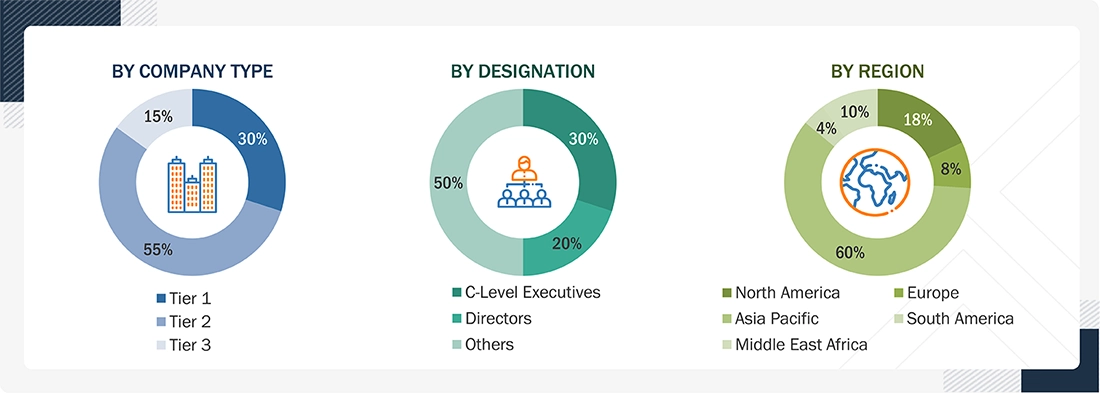
Note: “Others” include sales managers, engineers, and regional managers
The tiers of the companies are defined based on their total revenue as of 2021: Tier 1: >USD 1 billion, Tier 2: USD 500 million–1 billion, and Tier 3: <USD 500 million
To know about the assumptions considered for the study, download the pdf brochure
Market Size Estimation
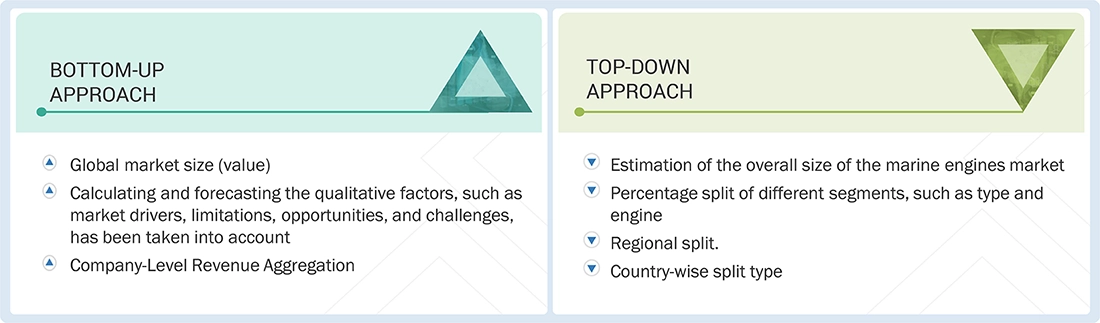
The estimation and validation of the marine engines market size have been conducted using a bottom-up approach. This approach was rigorously employed to ascertain the dimensions of multiple subsegments within the market. The research process comprises the following key stages. • In this method, the production statistics for each type of marine engines have been examined at both the country and regional levels.
- Thorough secondary and primary research has been conducted to gain a comprehensive understanding of the global market landscape for various segments of marine engines. Numerous primary interviews have been undertaken with key experts in the field of marine engine development, encompassing important OEMs and Tier I suppliers.
- When calculating and forecasting the market size, qualitative factors such as market drivers, limitations, opportunities, and challenges have been taken into account.
Marine Engines Market : Top-Down and Bottom-Up Approach
Data Triangulation
The process of determining the overall market size involved the methodologies described earlier, followed by segmenting the market into multiple segments and subsegments. To finalize the comprehensive market analysis and obtain precise statistics for each market segment and subsegment, data triangulation and market segmentation techniques were applied, as appropriate. Data triangulation was accomplished by examining various factors and trends from both the demand and supply perspectives within the ecosystem of the marine engines market.
Market Definition
Marine engines are specialized propulsion and power-generation systems designed to operate in maritime environments, where durability, fuel efficiency, and compliance with emissions regulations are critical. These engines convert chemical energy from fuels such as heavy fuel oil (HFO), marine diesel oil (MDO), marine gas oil (MGO), and increasingly alternative fuels like LNG, methanol, and biofuels into mechanical energy to drive vessels. Structurally, marine engines are categorized into two-stroke and four-stroke configurations, each suited to different vessel types and operational profiles. Two-stroke engines dominate large ocean-going vessels due to their high efficiency at low speeds, while four-stroke engines are commonly used in smaller vessels and auxiliary applications requiring higher operational flexibility.
Key Stakeholders
- Government & research organizations
- Institutional investors
- Investors/Shareholders
- Environmental research institutes
- Manufacturers’ associations
- Marine engine raw material and component manufacturers
- Marine engine manufacturers, dealers, and suppliers
- Consulting companies in shipping sector
- Shipbuilding and maritime industry associations
- Shipbuilding and shipyard industries
- State and national regulatory authorities
- Manufacturing industry
- Energy efficiency consultancies
- Vessel designers, owners, and operators
Report Objectives
- To define, describe, and forecast the marine engines market, in terms of value, by engine, power range, type, fuel, vessel, and region
- To provide detailed information about the key factors such as drivers, restraints, opportunities, and challenges influencing the growth of the market
- To strategically analyze the subsegments with respect to individual growth trends, prospects, and contributions of each segment to the overall market size
- To provide the trends/disruptions impacting customer business, market maps, ecosystem analysis, sustainability and regulatory landscape, pricing analysis, patent analysis, case study analysis, technology analysis, key conferences and events, Porter’s five forces analysis, macroeconomic outlook, customer landscape & buyer behavior, regulatory analysis, and AI/Gen AI impact on the market
- To forecast the market size for five key regions: North America, South America, Europe, Asia Pacific, and the Middle East & Africa, along with their key countries
- To study the complete value chain and allied industry segments, and perform a value chain analysis of the marine engines landscape
- To analyze the opportunities in the market for various stakeholders by identifying the high-growth segments of the market
- To profile the key players and comprehensively analyze their market positions in terms of ranking and core competencies, along with detailing the competitive landscape for the market leaders
- To analyze competitive developments, such as contracts, agreements, expansions, product launches, partnerships, joint ventures, investments, collaborations, and acquisitions, in the market
Available customizations:
With the given market data, MarketsandMarkets offers customizations based on the company’s specific needs. The following customization options are available for the report:
Product Analysis
- Product Matrix, which provides a detailed comparison of the product portfolio of each company
Company Information
-
Detailed analyses and profiling of additional market players (up to five)
Get the Full Marine Engines Market Report
Full forecast, segment splits, and company analysis for all Marine Engines Market.
- China Marine Engines Market
- Japan Marine Engines Market
- Philippines Marine Engines Market
- Vietnam Marine Engines Market
- Germany Marine Engines Market
- Italy Marine Engines Market
- Russia Marine Engines Market
- Finland Marine Engines Market
- France Marine Engines Market
- Canada Marine Engines Market
- Mexico Marine Engines Market
- UAE Marine Engines Market
- Turkey Marine Engines Market
- South Africa Marine Engines Market
- Egypt Marine Engines Market
- Brazil Marine Engines Market
- Argentina Marine Engines Market
- US Marine Engines Market
Need a Tailored Report?
Customize this report to your needs
Get 10% FREE Customization
Customize This Report
