
Latin America Medical Waste Management Market (2023-2028)

The Latin America Medical Waste Management Market was valued at $385.5 Million in 2023 and projected to reach to $510.6 Million by 2028, representing a compound annual growth rate of 5.8%. Latin America's medical waste management market is poised for steady growth driven by healthcare infrastructure modernization and regulatory tightening across major economies.


| Market Size in | USD 26.32 MN |
| Market Forecast in | |
| CAGR | |
| Forecast Period | |
| Units Considered | Value (USD MN) |
Latin America Medical Waste Management Market Trends and Insights
- Latin America's healthcare infrastructure expansion, coupled with stricter environmental regulations and increased awareness of biohazard disposal, is driving demand for compliant waste management solutions across hospitals, clinics, and diagnostic centers.
- Latin America's growing population and rising healthcare spending are accelerating the adoption of specialized waste segregation, treatment, and disposal technologies. Latin America faces unique challenges in medical waste management, including limited regulatory enforcement in some regions and infrastructure gaps in rural areas.
- However, Latin America is witnessing increased investment from both public and private healthcare providers to modernize waste handling systems and meet international standards.
- The forecast period through 2028 reflects Latin America's commitment to sustainable healthcare practices and compliance with evolving environmental directives..
Key Market Statistics
- CAGR (2023-2028) 5.8% CAGR
- Market Size, 2023 ~USD 385.5 Million
- Forecast, 2028 ~USD 510.6 Million
- Geography Latin America
Latin America Medical Waste Management Market Overview
Healthcare Infrastructure Expansion :
Latin America's growing healthcare sector is driving increased demand for medical waste management solutions as hospitals, clinics, and diagnostic centers expand operations across the region.
Regulatory Compliance Pressure :
Stricter environmental and biohazard disposal regulations across Latin American countries are compelling healthcare facilities to adopt certified waste management practices and compliant disposal methods.
Rising Biohazard Awareness :
Increased awareness among healthcare providers and government bodies in Latin America regarding proper biohazard disposal is accelerating adoption of professional medical waste management services.
Market Growth Trajectory :
The Latin America medical waste management market is expanding at 5.8% CAGR, growing from USD 385.5 million in 2023 to USD 510.6 million by 2028, outpacing many emerging markets.
Latin America Medical Waste Management Market Dynamics
- The region's expanding hospital networks, diagnostic centers, and surgical facilities are generating higher volumes of hazardous medical waste requiring professional management.
- Government initiatives promoting environmental sustainability and stricter enforcement of biohazard disposal standards are compelling healthcare providers to invest in compliant waste management solutions.
- The 5.8% CAGR reflects both the region's healthcare development and increasing institutional focus on safe waste handling practices.
- Market expansion will be supported by rising healthcare spending, growing private sector participation, and enhanced awareness of occupational safety among medical professionals..
Market Ecosystem
Related Ecosystem
Medical Devices
- Polymerase Chain Reaction (PCR)
- Magnetic Resonance Imaging (MRI)
- Disposable Autoinjectors
- Pulse Oximeters
- Blood Pressure Monitors
- Medtronic plc
- Abbott Laboratories
- Stryker Corporation
- Becton, Dickinson and Company
- CONMED Corporation
Key Takeaways
- Latin America's medical waste management market is projected to grow from USD 385.5 million in 2023 to USD 510.6 million by 2028 at a 5.8% CAGR.
- Latin America's expanding healthcare sector and stricter environmental regulations are primary drivers of market growth through 2028.
- Latin America faces infrastructure and regulatory enforcement challenges that create both barriers and opportunities for waste management providers.
- Latin America's increasing healthcare spending and population growth are accelerating demand for compliant and sustainable waste disposal solutions.
Medical Waste Management Market Report Scope
| Report Metric | Details |
|---|---|
| Base Year | 2023 |
| Fastest Growing Segment | OFFSITE TREATMENT (Treatment Site) |
| Forecast Period | 2023-2028 |
| Growth Rate | CAGR of 5.9% from 2023 to 2028 |
| Largest Segment | HOSPITALS & DIAGNOSTIC LABORATORIES (Waste Generator) |
| Market Size Base Year (Billions) | ~USD 9.16 (2023) |
| Revenue Forecast (Billions) | ~USD 12.2 (2028) |
| Segments Covered | Service, Type, Type Of Waste, Treatment Site, Waste Generator |
Latin America Medical Waste Management Market Report Segmentation
5 segment dimensions are covered across the global market.
By Service
- Collection, Transportation, And Storage Services
- Recycling Services
- Treatment & Disposal Services
By Type
- Autoclaving
- Chemical Treatment
- Incineration
- Infectious & Pathological Waste
- Other Hazardous Waste
- Other Treatments
- Pharmaceutical Waste
- Sharps Waste
By Type Of Waste
- Hazardous Waste
- Non-Hazardous Waste
By Treatment Site
- Offsite Treatment
- Onsite Treatment
By Waste Generator
- Hospitals & Diagnostic Laboratories
- Other Waste Generators
Target Audience
- Healthcare Facility Operators : Hospital administrators, clinic managers, and diagnostic center operators need market insights to evaluate waste management service providers and budget for compliant disposal solutions in Latin America.
- Medical Waste Management Companies : Service providers and waste management firms require regional market data to identify growth opportunities, assess competitive positioning, and develop expansion strategies across Latin American countries.
- Healthcare Investors & Consultants : Investment firms and management consultants need Latin America market analysis to evaluate sector opportunities, support due diligence, and guide healthcare infrastructure investment decisions.
- Regulatory & Government Bodies : Environmental agencies and health ministries across Latin America use market data to assess compliance trends, evaluate regulatory effectiveness, and plan policy initiatives for waste management.
- Medical Equipment & Supply Vendors : Manufacturers and distributors of medical waste handling equipment need regional market insights to identify customer segments, forecast demand, and develop targeted sales strategies in Latin America.
Countries within Latin America - compare and drill down
| Country | 2025 size (native) |
|---|
Country market size visualization
Reasons to Buy this Report
- Regional Market Sizing & Forecasts : Obtain precise market valuation for Latin America (USD 385.5M in 2023) with detailed 5-year forecasts to 2028, enabling accurate budget allocation and investment planning specific to the region.
- Regulatory Landscape Intelligence : Understand Latin America's evolving biohazard disposal regulations and environmental compliance requirements that directly impact service demand and operational strategies across the region.
- Growth Driver Analysis : Identify key growth catalysts including healthcare infrastructure expansion, regulatory tightening, and rising biohazard awareness to capitalize on emerging opportunities in Latin American markets.
- Competitive Positioning Strategy : Benchmark your organization against regional market trends and growth rates (5.8% CAGR) to develop targeted strategies for market penetration and service expansion in Latin America.
- Investment Decision Support : Make informed investment and partnership decisions with comprehensive Latin America market data, supporting business case development for regional expansion and facility establishment.
Frequently asked questions
What is the current size of the medical waste management market in Latin America?
The Latin America medical waste management market was valued at USD 385.5 million in 2023 and is expected to reach USD 510.6 million by 2028.
What is the projected growth rate for medical waste management in Latin America?
Latin America's medical waste management market is expected to grow at a compound annual growth rate (CAGR) of 5.8% from 2023 to 2028.
What factors are driving growth in Latin America's medical waste management market?
Latin America's market growth is driven by healthcare infrastructure expansion, stricter environmental regulations, increased biohazard awareness, rising healthcare spending, and growing population demands.
What challenges does Latin America face in medical waste management?
Latin America faces challenges including limited regulatory enforcement in some regions, infrastructure gaps in rural areas, and the need for modernized waste handling systems to meet international standards.
Which healthcare facilities in Latin America contribute most to medical waste generation?
Hospitals, clinics, diagnostic centers, and other healthcare providers across Latin America generate significant medical waste requiring specialized segregation, treatment, and disposal solutions.
RESEARCH METHODOLOGY
The objective of the study is to analyze the key market dynamics, such as drivers, opportunities, restraints, challenges and key player strategies. To track company developments such as service launch, acquisition, agreement and partnership of the leading players, the competitive landscape of the medical waste management market to analyze market players on various parameters within the broad categories of business and service strategy. Top-down and bottom-up approaches were used to estimate the market size. To estimate the market size of segments and subsegments, the market breakdown and data triangulation were used.
The four steps involved in estimating the market size are
Secondary Research
In the secondary research process, various secondary sources such as annual reports, press releases & investor presentations of companies, white papers, certified publications, articles by recognized authors, gold-standard & silver-standard websites, regulatory bodies, and databases (such as D&B Hoovers, Bloomberg Business, and Factiva) were referred to identify and collect information for this study.
Primary Research
In the primary research process, various sources from both the supply and demand sides were interviewed to obtain qualitative and quantitative information for this report. Primary sources were mainly industry experts from the core and related industries and preferred suppliers, manufacturers, distributors, service providers, technology developers, researchers, and organizations related to all segments of this industry’s value chain. In-depth interviews were conducted with various primary respondents, including key industry participants, subject-matter experts, C-level executives of key market players, and industry consultants, to obtain and verify critical qualitative and quantitative information as well as assess prospects.
The following is a breakdown of the primary respondents:
Breakdown of Primary Participants:
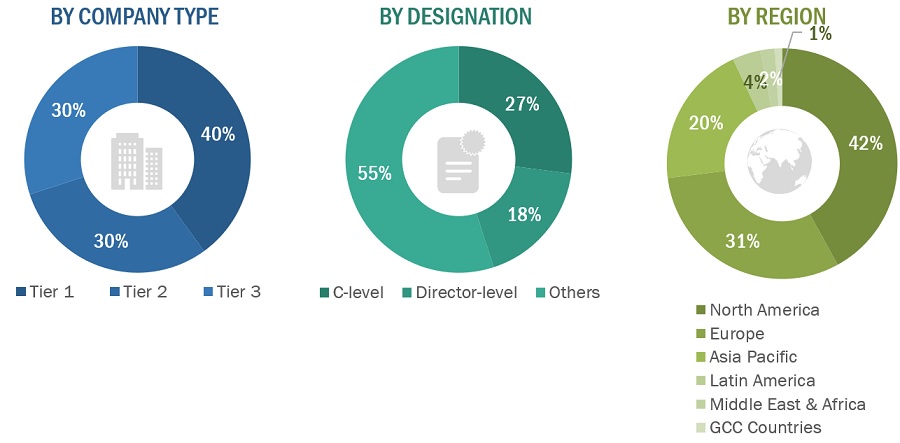
Note 1: Others include sales managers, marketing managers, and product managers.
Note 2: Companies are classified into tiers based on their total revenues. As of 2022, Tier 1 = >USD 100 million, Tier 2 = USD 10 million to USD 100 million, and Tier 3 = <USD 10 million.
To know about the assumptions considered for the study, download the pdf brochure
|
COMPANY NAME |
DESIGNATION |
|
Veolia Environnement S.A. |
Senior Product Manager |
|
Waste Management, Inc. |
Quality Control Manager |
|
Clean Harbor, Inc. |
Marketing Manager |
Market Size Estimation
Both top-down and bottom-up approaches were used to estimate and validate the medical waste management market's total size. These methods were also used extensively to estimate the size of various subsegments in the market. The research methodology used to estimate the market size includes the following:
- The key players in the industry have been identified through extensive secondary research
- The revenues generated by leading players operating in the medical waste management market have been determined through primary and secondary research.
- All percentage shares, splits, and breakdowns have been determined using secondary sources and verified through primary sources.
Global Medical Waste Management Market Size: Botton Up Approach
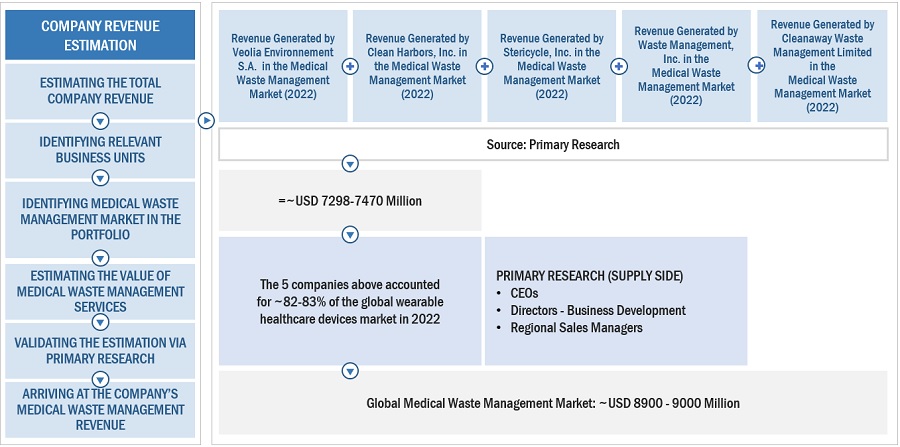
To know about the assumptions considered for the study, Request for Free Sample Report
Global Medical Waste Management Market Size: Top-Down Approach
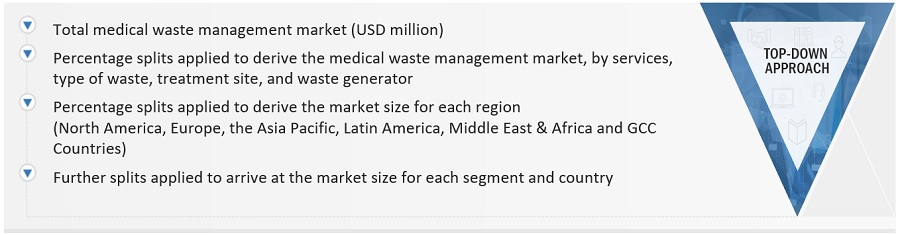
Data Triangulation
After arriving at the overall market size by applying the process mentioned above, the total market was split into several segments and subsegments. To complete the overall market engineering process and arrive at the exact statistics for all segments and subsegments, data triangulation and market breakdown procedures were employed, wherever applicable. The data was triangulated by studying various factors and trends from both the demand and supply sides.
Market Definition
Medical waste encompasses materials such as infectious waste, hazardous waste, sharps waste, cytotoxic waste, and any other waste produced by medical facilities such as hospitals, laboratories, or pharmaceutical companies. The process of managing medical waste, known as medical waste management, involves collecting, transporting, storing, treating, disposing, and recycling medical waste through methods such as incineration and autoclaving.
Key Stakeholders
- Medical Waste Treatment Device Manufacturers
- Medical Waste Management Service Providers
- Research Institutes
- Research and Consulting Firms
- Environment, Health, and Safety Organizations
- Regulatory Bodies
Report Objectives
- To define, describe, segment, and forecast the medical waste management market by services, type of waste, treatment site, waste generator and region.
- To provide detailed information regarding the major factors influencing the market growth (drivers, restraints, opportunities, and challenges).
- To analyze micromarkets1 with respect to individual growth trends, prospects, and contributions to the overall market.
- To analyze market opportunities for stakeholders and provide details of the competitive landscape for key players.
- To forecast the size of the market segments with respect to five regions, namely, North America, Europe, the Asia Pacific, Latin America, the Middle East & Africa and GCC Countries.
- To profile the key players and comprehensively analyze their service portfolios, market positions, and core competencies2.
- To track and analyze company developments such as Service launch, acquisition, agreement, Partnership in the medical waste management market.
- To benchmark players within the market using the proprietary “Competitive Leadership Mapping” framework, which analyzes market players on various parameters within the broad categories of business and service strategy.
Available Customizations
- MarketsandMarkets offers the following customizations for this market report.
Country Information
- Additional country-level analysis of the medical waste management market
Company profiles
- Additional five company profiles of players operating in the medical waste management market.
Product Analysis
- Service matrix, which provides a detailed comparison of the service portfolio of each company in the medical waste management market
Get the Full Medical Waste Management Market Report
Full forecast, segment splits, and company analysis for all Medical Waste Management Market.
- Canada Medical Waste Management Market
- US Medical Waste Management Market
- Germany Medical Waste Management Market
- UK Medical Waste Management Market
- France Medical Waste Management Market
- Italy Medical Waste Management Market
- Spain Medical Waste Management Market
- China Medical Waste Management Market
- Japan Medical Waste Management Market
- India Medical Waste Management Market
- Rest Of Europe Medical Waste Management Market
- Rest Of Asia Pacific Medical Waste Management Market
Need a Tailored Report?
Customize this report to your needs
Get 10% FREE Customization
Customize This Report
