
Japan Weather Forecasting Systems Market (2024-2029)

The Japan Weather Forecasting Systems Market was valued at $42.3 Million in 2024 and projected to reach to $66.3 Million by 2029, representing a compound annual growth rate of 9.4%. Japan's weather forecasting systems market is poised for sustained growth driven by defence sector modernization and increased investment in advanced meteorological capabilities.


| Market Size in | USD 26.32 MN |
| Market Forecast in | |
| CAGR | |
| Forecast Period | |
| Units Considered | Value (USD MN) |
Japan Weather Forecasting Systems Market Trends and Insights
- Valued at $42.3 million in 2024, Japan's market is projected to expand to $66.3 million by 2029, representing a compound annual growth rate of 9.4%.
- This expansion reflects Japan's increasing investment in advanced meteorological technologies and defence infrastructure modernization. The growth trajectory in Japan is driven by heightened demand for precision weather intelligence in military operations and aviation safety.
- Japan's strategic focus on enhancing disaster preparedness and climate resilience has accelerated adoption of sophisticated forecasting systems.
- Between 2024 and 2029, Japan's market is expected to capture significant opportunities through government defence spending and technological innovation in predictive analytics. Japan's position as a technology leader in Asia Pacific positions the country as a critical market for weather forecasting system providers.
- The integration of artificial intelligence and satellite technology into Japan's forecasting infrastructure underscores the nation's commitment to next-generation defence capabilities..
Key Market Statistics
- CAGR (2024-2029) 9.4% CAGR
- Market Size, 2024 ~USD 42.3 Million
- Forecast, 2029 ~USD 66.3 Million
- Country Japan
Japan Weather Forecasting Systems Market Overview
Strong CAGR Performance :
Japan's weather forecasting systems market is growing at 9.4% CAGR from 2024-2029, outpacing the global growth rate of 7%, indicating accelerating domestic demand and investment.
Defence Modernization Driver :
Japan's ongoing defence infrastructure modernization and increased military spending are propelling adoption of advanced meteorological systems for enhanced operational capabilities and strategic planning.
Significant Market Expansion :
The market is projected to grow from $42.3 million in 2024 to $66.3 million by 2029, representing a 56.8% increase in market value over the five-year forecast period.
Technological Investment Focus :
Japan's commitment to advanced meteorological technologies reflects broader aerospace and defence sector investments, positioning the country as a key growth market in Asia-Pacific.
Japan Weather Forecasting Systems Market Dynamics
- The country's strategic focus on enhancing military operational efficiency and disaster preparedness is accelerating adoption of sophisticated forecasting technologies.
- Government initiatives supporting aerospace and defence infrastructure upgrades are expected to maintain momentum through 2029. The 9.4% CAGR trajectory reflects Japan's commitment to technological advancement and regional security considerations.
- With rising climate-related challenges and evolving defence requirements, demand for precision weather forecasting systems will continue to strengthen.
- Market expansion will be supported by both government procurement programs and private sector investments in aerospace applications..
Market Ecosystem
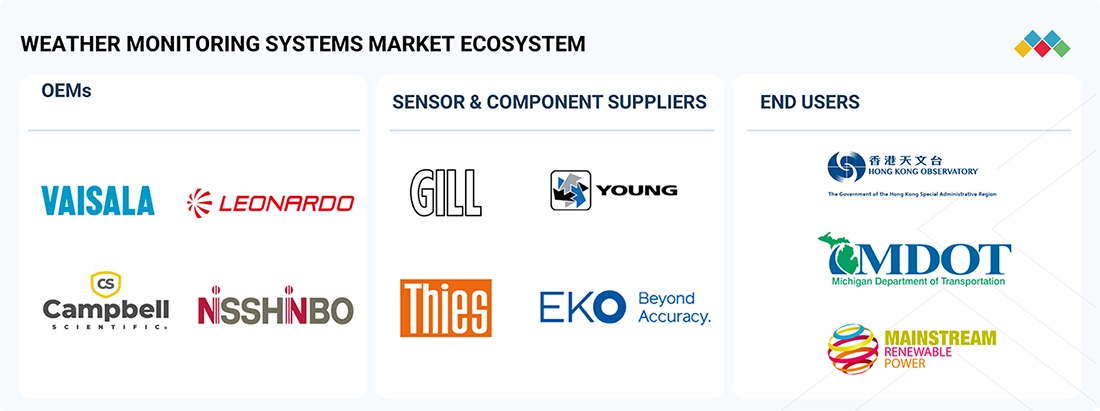
WEATHER FORECASTING SYSTEMS MARKET SIZE, SHARE, & GROWTH FORECAST: COMMERCIAL USE CASES ACROSS INDUSTRIES
| COMPANY | USE CASE DESCRIPTION | BENEFITS |
|---|---|---|
 |
Veralto’s OTT HydroMet/Lufft business supplied weather sensors for a road weather monitoring network used by the Michigan Department of Transportation. The network measures local wind and weather conditions along roads to support traffic and maintenance work. | Supports winter road maintenance decisions | Provides local weather data along highways | Helps crews plan road treatment and traffic controls |
 |
Mitsubishi Electric installed a Terminal Doppler Weather Radar at Kuala Lumpur International Airport. The radar monitors precipitation movement and wind shear near the airport to support aircraft take-off and landing. | Supports wind-shear warnings | Improves weather monitoring around runways | Helps pilots and airport teams manage unsafe wind conditions |
 |
Adolf Thies developed and tested a precipitation analyzer with the German Weather Service for airport use. The equipment detects freezing rain, freezing drizzle and ice conditions that can affect runways and aircraft operations. | Provides earlier notice of icing risk | Supports runway treatment and winter maintenance | Helps reduce weather-related disruption at airports |
Logos and trademarks shown above are the property of their respective owners. Their use here is for informational and illustrative purposes only.
Related Ecosystem
Marine
- Tankers
- Fuel Cell
- HVAC System
- Navigation Systems
- Sensors
- Wartsila
- Kongsberg Gruppen ASA
- L3Harris Technologies, Inc.
- ABB India Limited
- Thales group
Key Takeaways
- Japan's weather forecasting systems market will grow from $42.3M (2024) to $66.3M (2029) at a 9.4% CAGR.
- Japan's defence modernization and disaster preparedness initiatives are primary growth catalysts for the market.
- Japan is leveraging AI and satellite integration to enhance forecasting accuracy and operational capabilities.
- Japan's technology leadership positions it as a key regional hub for weather forecasting system innovation and adoption.
Weather Forecasting Systems Market Report Scope
| Report Metric | Details |
|---|---|
| Base Year | 2024 |
| Fastest Growing Segment | RENEWABLE ENERGY (Vertical) |
| Forecast Period | 2024–2029 |
| Growth Rate | CAGR of 7% from 2024 to 2029 |
| Largest Segment | HARDWARE (Solution) |
| Market Size Base Year (Billions) | ~USD 2.21 (2024) |
| Revenue Forecast (Billions) | ~USD 3.1 (2029) |
| Segments Covered | Solution, Type, Vertical, Application, Forecast Type, Purpose |
Japan Weather Forecasting Systems Market Report Segmentation
6 segment dimensions are covered across the global market.
By Solution
- Hardware
- Software
By Type
- Anemometers
- Barometers
- Big Data Analytics Software
- Communication & Data Loggers
- Data Collection & Processing Software
- Hygrometers
- Other Types
- Rain Gauges
- Satellite Sensors
- Sounding Systems & Radiosondes
- Super Computing Software
- Thermometers
- Weather Monitoring & Display Software
By Vertical
- Agriculture
- Aviation
- Marine
- Meteorology
- Military
- Oil & Gas
- Other Verticals
- Renewable Energy
- Renewables
- Transportation & Logistics
- Weather Forecasting Services
- Weather Service Providers
By Application
- Other Applications
- Weather Balloons
- Weather Drones
- Weather Lidar
- Weather Observing Systems
- Weather Radars
- Weather Satellites
- Weather Stations
By Forecast Type
- Extended-Range Forecasting
- Long-Range Forecasting
- Medium-Range Forecasting
- Nowcasting
- Short-Range Forecasting
By Purpose
- Operational Efficiency
- Other Purposes
- Safety
JAPAN: WEATHER FORECASTING SYSTEMS MARKET, BY VERTICAL, 2024–2029
| Segment | 2024 | 2025 | 2026 | 2027 | 2028 | 2029 | CAGR (%) |
|---|---|---|---|---|---|---|---|
| AGRICULTURE | 1.2 | 1.4 | 1.6 | 1.7 | 2 | 2.2 | 11.9 |
| AVIATION | 3.7 | 4.1 | 4.6 | 5.1 | 5.7 | 6.4 | 11.7 |
| MARINE | 3.9 | 4 | 4.2 | 4.3 | 4.4 | 4.5 | 2.6 |
| METEOROLOGY | 11.6 | 12.5 | 13.4 | 14.4 | 16.3 | 16.7 | 7.5 |
| MILITARY | 4.1 | 4.2 | 4.3 | 4.4 | 4.4 | 4.5 | 2.1 |
| OIL & GAS | 1.7 | 1.8 | 1.9 | 1.9 | 2 | 2.1 | 4.8 |
| OTHER VERTICALS | 1.4 | 1.4 | 1.5 | 1.5 | 1.6 | 1.6 | 2.5 |
| RENEWABLE ENERGY | 9.2 | 11.2 | 12.4 | 13.8 | 19.9 | 20.1 | 17.1 |
| TRANSPORTATION & LOGISTICS | 1.3 | 1.4 | 1.5 | 1.6 | 1.7 | 1.8 | 7.3 |
| WEATHER SERVICE PROVIDERS | 4.2 | 4.5 | 4.9 | 5.4 | 5.9 | 6.4 | 8.6 |
| TOTAL | 42.3 | 46.5 | 50.1 | 54.1 | 63.9 | 66.3 | 9.4 |
Target Audience
- Defence Contractors & Integrators : Japanese and international defence companies need market-specific data to identify procurement trends, competitive positioning, and growth opportunities within Japan's modernizing defence infrastructure.
- Aerospace Manufacturers : Aircraft and aerospace system manufacturers require Japan market insights to understand demand for integrated weather forecasting capabilities and align product development with regional requirements.
- Government & Military Procurement : Japanese Ministry of Defence and Self-Defence Force procurement teams use market analysis to inform budget planning, technology roadmaps, and vendor selection for meteorological system upgrades.
- Technology & Software Providers : Weather forecasting software and meteorological technology vendors need Japan-specific market data to develop localized solutions, identify customer segments, and forecast revenue potential.
- Investment & Strategy Consultants : Management consultants and investment firms advising on Japan's aerospace and defence sectors require detailed market metrics to support client strategy, M&A analysis, and market entry recommendations.
Key Companies in the Japan Weather Forecasting Systems Market
| Company | HQ | Ownership | Strongest segments |
|---|---|---|---|
| RIGNET | United States | Private Company | Managed Communications Services,Applications & IoT,Systems Integration, |
| FUGRO | United States | Public Company | Marine site characterization,Marine asset integrity & positioning,Land site characterization, |
| WARTSILA | United States | Public Company | Engine and hybrid power plants,Marine power and propulsion,Energy storage and GEMS digital platform, |
| PCTEL, INC. | United States | Private Company | Precision antennas (public safety, transportation, industrial OEM),Industrial IoT devices (access points, radio modules, sensors),RF test and measurement solutions, |
| L3HARRIS TECHNOLOGIES, INC. | United States | Public Company | Space & Mission Systems (SMS),Communications & Spectrum Dominance (CSD),Missile Solutions (MSL), |
| VAISALA | Finland | Public Company | Weather and environmental systems (stations, radars, sensors, API, mapping, Elements Lite),Industrial instruments and transmitters (HVAC, process refractometers, moisture and gas measurement),Wind and renewable energy solutions (WindCube lidars, solar irradiation, road and runway for energy-linked infrastructure), |
| THE WEATHER COMPANY LLC | United States | Public Company | Drilling and Evaluation,Well Construction and Completions,Production and Intervention, |
| STORMGEO | Norway | Private Company | Shipping (ship routing, on-board, fleet performance, weather routing),Offshore (meteorological ocean forecasting, routing and rig moves, response forecasting),Onshore & Business Continuity (weather alerting, road weather, sector-specific services), |
RIGNET
RigNet is a private company founded in 2000 that operates in the United States with 658 employees.
FUGRO
Fugro is a publicly traded company established in 1962 with 9,062 employees operating in the United States.
WARTSILA
Wärtsilä is a public company founded in 1834 with 17,938 employees based in the United States.
PCTEL, INC.
PCTEL, Inc. is a private company established in 1994 in the United States with 213 employees.
L3HARRIS TECHNOLOGIES, INC.
L3Harris Technologies, Inc. is a publicly traded defense and aerospace company founded in 1895 with 45,000 employees in the United States.
VAISALA
Vaisala is a Finnish public company established in 1936 with 2,446 employees.
THE WEATHER COMPANY LLC
The Weather Company LLC is a publicly traded company founded in 1972 with 16,700 employees in the United States.
STORMGEO
StormGeo is a Norwegian private company established in 1997 with 339 employees.
Reasons to Buy this Report
- Japan-Specific Market Sizing : Access precise valuation data for Japan's weather forecasting systems market with verified 2024 baseline ($42.3M) and 2029 projections ($66.3M), enabling accurate budget allocation and investment planning.
- Competitive Intelligence : Understand Japan's 9.4% CAGR advantage over global 7% growth rate, identifying market dynamics unique to Japanese aerospace and defence sectors for strategic positioning.
- Defence Sector Insights : Gain detailed analysis of Japan's defence modernization drivers and their impact on weather forecasting system adoption, critical for suppliers targeting military procurement opportunities.
- Investment Decision Support : Leverage comprehensive Japan market data to evaluate expansion opportunities, partnership potential, and revenue forecasts specific to the Japanese aerospace and defence landscape.
- Regional Growth Opportunity : Identify Japan as a high-growth market within Asia-Pacific, with outperformance metrics supporting market entry strategies and resource allocation decisions for regional expansion.
Frequently asked questions
What is the current size of Japan's weather forecasting systems market?
Japan's weather forecasting systems market was valued at $42.3 million in 2024 and is projected to reach $66.3 million by 2029.
What is the growth rate of Japan's weather forecasting systems market?
Japan's weather forecasting systems market is expected to grow at a compound annual growth rate (CAGR) of 9.4% from 2024 to 2029.
What factors are driving growth in Japan's weather forecasting systems market?
Key drivers include Japan's defence modernization efforts, increased investment in disaster preparedness, climate resilience initiatives, and adoption of AI and satellite technologies.
Which sectors in Japan are primary consumers of weather forecasting systems?
Japan's aerospace and defence sectors are the primary consumers, with applications in military operations, aviation safety, and national security infrastructure.
How is Japan integrating advanced technology into weather forecasting systems?
Japan is incorporating artificial intelligence, machine learning, and satellite-based technologies to enhance forecasting accuracy and operational decision-making capabilities.
RESEARCH METHODOLOGY
The study involved four major activities to estimate the current size of the Weather Monitoring Systems market. Exhaustive secondary research was conducted to gather information on the Weather Monitoring Systems market, its adjacent markets, and its parent market. The next step was to validate these findings, assumptions, and sizing with industry experts across the value chain through primary research. Demand-side analysis was conducted to estimate the overall market size. Thereafter, data triangulation procedures were employed to estimate the sizes of various segments and subsegments within the Weather Monitoring Systems market.
Secondary Research
During the secondary research process, various sources were consulted to identify and collect information for this study. The secondary sources included government sources, such as SIPRI; corporate filings, including annual reports, press releases, and investor presentations; white papers, journals, and certified publications; and articles from recognized authors, directories, and databases.
Primary Research
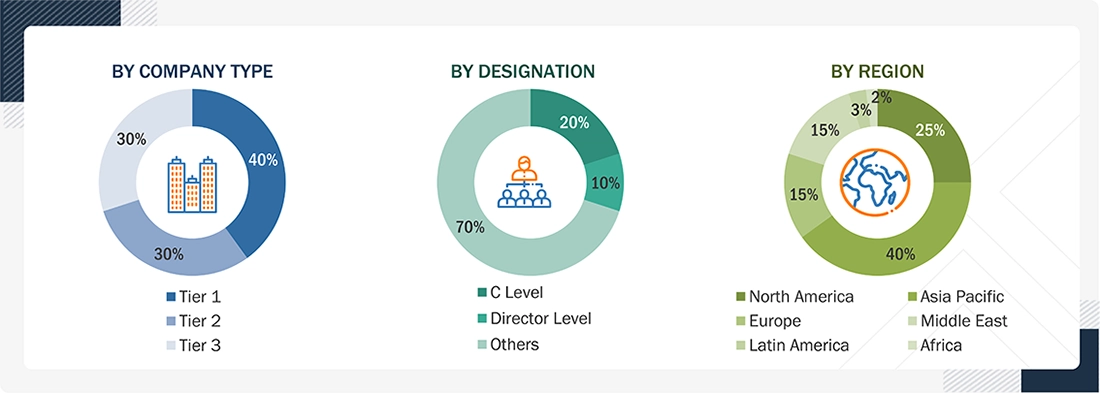
Extensive primary research was conducted after acquiring information on the Weather Monitoring Systems market through secondary research. Several primary interviews were conducted with market experts from the demand and supply sides across major countries of North America, Europe, the Asia Pacific, the Middle East & Africa, and Latin America. Primary data was collected through questionnaires, emails, and telephonic interviews.
Breakdown of Primary Interviews
To know about the assumptions considered for the study, download the pdf brochure
Market Size Estimation
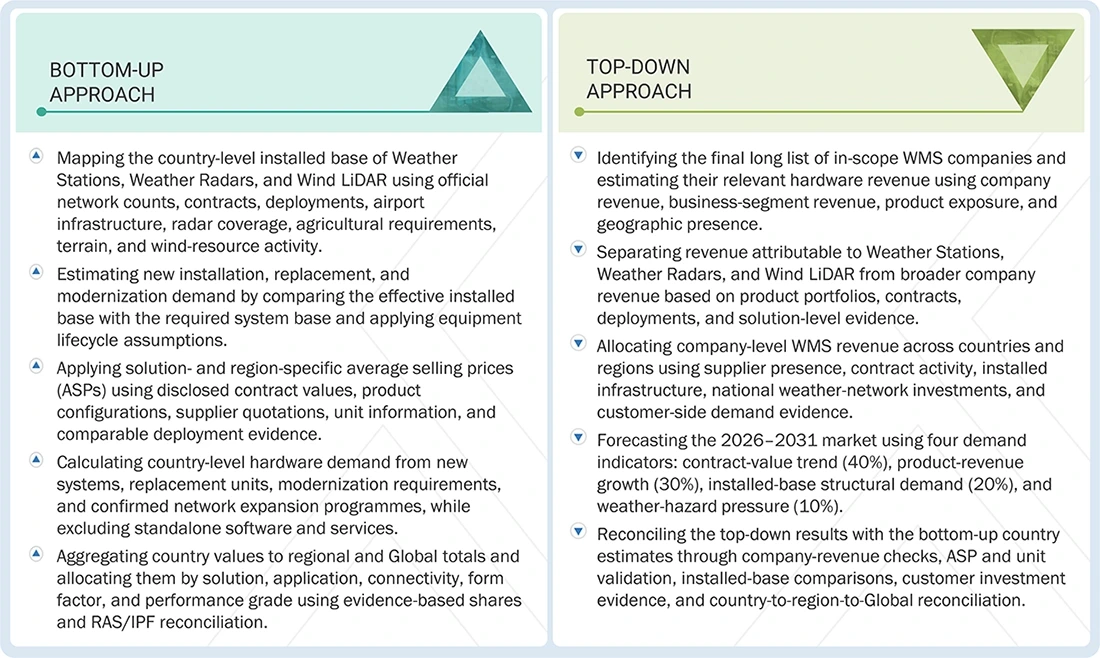
Top-down and bottom-up approaches were used to estimate and validate the size of the Weather Monitoring Systems market. The research methodology used to estimate the size of the market included the following details:
- Key players in the Weather Monitoring Systems market were identified through secondary research, and their market shares were determined through a combination of primary and secondary research. This included a study of the annual and financial reports of the top market players, as well as extensive interviews with leaders, including directors, engineers, marketing executives, and other key stakeholders of leading companies operating in the market.
- All percentage shares, splits, and breakdowns were determined using secondary sources and verified through primary sources.
- All possible parameters that affect the markets covered in this research study were accounted for, viewed in extensive detail, verified through primary research, and analyzed to obtain the final quantitative and qualitative data on the Weather Monitoring Systems market. This data was consolidated, enhanced with detailed input, analyzed by MarketsandMarkets, and presented in this report.
Weather Monitoring Systems Market : Top-Down and Bottom-Up Approach
Data Triangulation
After determining the overall market size, the total market was classified into several segments and subsegments. The data triangulation and market breakdown procedures explained below were implemented, wherever applicable, to complete the overall market engineering process and arrive at the estimated market numbers for the market segments and subsegments. The data was triangulated by examining various factors and trends on both the demand and supply sides. Additionally, the market size was validated using top-down and bottom-up approaches.
Market Definition
The Weather Monitoring Systems Market covers hardware systems and associated lifecycle services used to automatically measure, monitor, record and transmit real time or near real time weather and atmospheric conditions. It includes weather stations, ground-based S band, C band, and X band weather radars, spatial-scanning and vertical-profiling wind LiDAR systems, along with installation, commissioning, calibration, preventive and corrective maintenance, repair, overhaul, upgrades, spare parts, field service and system support. It excludes standalone software, forecasting and weather data services, satellites, airborne weather platforms, radiosonde systems and manual or semi-automatic weather stations as core segments.
Key Stakeholders
- Equipment Manufacturers
- Sensor and Component Suppliers
- System Integrators and Installation Partners
- Government and Meteorological Agencies
- End Users
- Connectivity and Infrastructure Providers
- Regulators and Standards Bodies
- Research and Testing Organizations
Report Objectives
- To define, describe, and forecast the Weather Monitoring Systems market based on solution, application, form factor, connectivity, performance grade, system component, and region in terms of value
- To forecast the size of various segments of the market across North America, Europe, the Asia Pacific, the Middle East & Africa, and Latin America in terms of value
- To identify and analyze the drivers, restraints, opportunities, and challenges influencing the growth of the market
- To identify industry trends, market trends, and technology trends currently prevailing in the market
- To provide an overview of the regulatory landscape with respect to Weather Monitoring Systems across regions
- To analyze micromarkets with respect to individual growth trends, prospects, and their contribution to the overall market
- To analyze opportunities in the market for stakeholders by identifying key market trends
- To profile key market players and comprehensively analyze their market share and core competencies
- To evaluate the degree of competition in the market by analyzing recent developments, such as contracts, agreements, and acquisitions adopted by leading market players
- To identify detailed financial positions, key products, and unique selling points of leading companies in the market
- To provide a detailed competitive landscape of the market, along with market share analysis and revenue analysis of key players
Available customizations:
MarketsandMarkets offers the following customizations for this market report:
- Additional country-level analysis of the Weather Monitoring Systems market
- Profiling of other market players (up to five)
Product Analysis
-
Product matrix, which provides a detailed comparison of the product portfolios of each company in the Weather Monitoring Systems market
Get the Full Weather Forecasting Systems Market Report
Full forecast, segment splits, and company analysis for all Weather Forecasting Systems Market.
- Canada Weather Forecasting Systems Market
- US Weather Forecasting Systems Market
- UK Weather Forecasting Systems Market
- Germany Weather Forecasting Systems Market
- France Weather Forecasting Systems Market
- Italy Weather Forecasting Systems Market
- Russia Weather Forecasting Systems Market
- China Weather Forecasting Systems Market
- India Weather Forecasting Systems Market
- South Korea Weather Forecasting Systems Market
- Australia Weather Forecasting Systems Market
- Brazil Weather Forecasting Systems Market
- Mexico Weather Forecasting Systems Market
- Saudi Arabia Weather Forecasting Systems Market
- UAE Weather Forecasting Systems Market
Need a Tailored Report?
Customize this report to your needs
Get 10% FREE Customization
Customize This Report
