
US Motion Control Market (2024-2029)

The US Motion Control Market was valued at $2660.9 Million in 2024 and projected to reach to $3478.5 Million by 2029, representing a compound annual growth rate of 5.5%. The US motion control market is poised for sustained growth as manufacturers prioritize automation and Industry 4.0 initiatives.


| Market Size in | USD 26.32 MN |
| Market Forecast in | |
| CAGR | |
| Forecast Period | |
| Units Considered | Value (USD MN) |
US Motion Control Market Trends and Insights
- The US market is experiencing steady growth driven by increasing automation across manufacturing, robotics, and industrial applications.
- By 2029, the US motion control market is forecast to expand to $3,478.5 million, representing a compound annual growth rate of 5.5% over the five-year period. In the US, motion control technologies are becoming essential for precision positioning, speed regulation, and directional control across diverse sectors including automotive, aerospace, and consumer electronics.
- The US market benefits from strong technological innovation, established supply chains, and significant investment in Industry 4.0 initiatives.
- Growth in the US is supported by rising demand for electric vehicles, advanced manufacturing systems, and robotics automation, positioning the country as a key driver of motion control adoption in North America..
Key Market Statistics
- CAGR (2024-2029) 5.5% CAGR
- Market Size, 2024 ~USD 2660.9 Million
- Forecast, 2029 ~USD 3478.5 Million
- Country US
US Motion Control Market Overview
US Market Valuation :
The US motion control market reached $2,660.9 million in 2024, establishing itself as a significant segment within North American semiconductor and electronics industries with substantial growth potential.
Manufacturing Automation Surge :
US manufacturers are increasingly adopting motion control systems to enhance operational efficiency, reduce labor costs, and improve precision in production processes across automotive, aerospace, and consumer electronics sectors.
Robotics Integration Expansion :
The proliferation of industrial robots and collaborative automation solutions in US facilities is driving demand for advanced motion control technologies that enable precise positioning and movement control.
5.5% CAGR Growth Trajectory :
The US market is projected to grow at a steady 5.5% compound annual growth rate through 2029, reaching $3,478.5 million, reflecting consistent investment in industrial modernization and automation infrastructure.
US Motion Control Market Dynamics
- Key drivers include rising labor costs, demand for precision manufacturing, and the integration of IoT and AI technologies in production environments.
- The market's 5.5% CAGR reflects steady adoption across diverse industrial verticals. Looking ahead to 2029, the US market will benefit from continued investments in smart manufacturing, robotics advancement, and digital transformation initiatives.
- Supply chain resilience efforts and nearshoring trends are expected to accelerate domestic automation spending, while emerging technologies in motion control systems will create new opportunities for market participants and end-users seeking competitive advantages..
Market Ecosystem
Related Ecosystem
Industrial Automation
- Sensors
- Image Sensors
- Manufacturing Execution System (MES)
- Actuators
- Flow Sensors
- Siemens ag
- ABB India Limited
- Emerson Electric Co.
- HONEYWELL INTERNATIONAL INC.
- SCHNEIDER ELECTRIC SE
Industrial Iot
- Sensors
- Pressure Sensors
- Flow Sensors
- Gas Sensors
- Image Sensors
- Siemens ag
- ABB India Limited
- HONEYWELL INTERNATIONAL INC.
- Emerson Electric Co.
- SCHNEIDER ELECTRIC SE
Electric Hybrid Vehicles
- Battery Electric Vehicle (BEV)
- Fuel Cell Electric Vehicle (FCEV)
- Light Commercial Vehicles (LCVs)
- Hybrid Electric Vehicle (HEV)
- Agricultural Tractors
- Visteon Corporation
- Byd company ltd.
- BOSCH LIMITED
- Tesla, Inc.
- FORD MOTOR COMPANY
Key Takeaways
- The US motion control market is valued at $2,660.9 million in 2024 and is projected to reach $3,478.5 million by 2029.
- The US market is growing at a steady 5.5% CAGR, driven by automation and Industry 4.0 adoption across manufacturing sectors.
- In the US, electric vehicle production and advanced robotics are major catalysts for motion control technology demand.
- The US maintains a competitive advantage through technological innovation and established semiconductor and electronics infrastructure.
Motion Control Market Report Scope
| Report Metric | Details |
|---|---|
| Base Year | 2024 |
| Fastest Growing Segment | CONSUMER ELECTRONICS (Application) |
| Forecast Period | 2024-2029 |
| Growth Rate | CAGR of 5.5% from 2024 to 2029 |
| Largest Segment | CLOSED-LOOP SYSTEMS (System) |
| Market Size Base Year (Billions) | ~USD 16.53 (2024) |
| Revenue Forecast (Billions) | ~USD 21.6 (2029) |
| Segments Covered | Offering, Industry, Type, System, Application |
US Motion Control Market Report Segmentation
5 segment dimensions are covered across the global market.
By Offering
- Actuators And Mechanical Systems
- Drives
- Motion Controllers
- Motors
- Sensors And Feedback Devices
- Software And Services
By Industry
- Aerospace
- Automotive
- Food & Beverages
- Medical Devices
- Metals & Machinery
- Other Industries
- Pharmaceuticals & Cosmetics
- Printing & Paper
- Semiconductor & Electronics
By Type
- Linear
- Rotary
- Servo Motors
- Stepper Motors
By System
- Closed-Loop Systems
- Open-Loop Systems
By Application
- Aerospace
- Automotive
- Consumer Electronics
- Food & Beverage
- Healthcare
- Industrial
- Other Applications
- Power
- Printing
- Textile
Target Audience
- US Manufacturing Executives : Decision-makers overseeing automation investments need US market data to justify capital expenditures, evaluate technology partnerships, and align production modernization strategies with market growth opportunities.
- Motion Control Equipment Manufacturers : Suppliers and OEMs require detailed US market intelligence to optimize product development, identify emerging customer needs, forecast demand, and develop targeted go-to-market strategies for North American expansion.
- Industrial Automation Integrators : Systems integrators and solution providers need US-specific market insights to identify growth sectors, understand customer investment patterns, and position service offerings within the expanding automation ecosystem.
- Investment & Private Equity Firms : Investors evaluating opportunities in US industrial technology require market sizing, growth projections, and sector analysis to assess portfolio companies, identify acquisition targets, and evaluate market attractiveness.
- Technology Strategy Consultants : Consulting firms advising US industrial clients need authoritative market data to support strategic recommendations, validate business cases for automation initiatives, and benchmark client performance against market trends.
Reasons to Buy this Report
- US-Specific Market Sizing : Obtain precise valuation data for the US motion control market with verified 2024 baseline ($2,660.9M) and 2029 forecasts ($3,478.5M), enabling accurate budget allocation and market entry strategies tailored to North American conditions.
- Regional Growth Insights : Understand the 5.5% CAGR trajectory specific to the US market, identifying growth drivers unique to American manufacturing, labor economics, and automation adoption patterns that differ from global trends.
- Competitive Positioning : Benchmark your US operations against market size and growth metrics to identify competitive gaps, market share opportunities, and strategic positioning within the North American motion control landscape.
- Investment Decision Support : Make informed capital allocation decisions for US facilities, R&D investments, and market expansion initiatives backed by comprehensive market data and reliable forecast projections through 2029.
- Sector-Specific Applications : Access insights into motion control adoption across US manufacturing verticals including automotive, aerospace, electronics, and industrial robotics to identify high-potential customer segments and application areas.
Frequently asked questions
What is the current size of the US motion control market?
The US motion control market is valued at $2,660.9 million in 2024 and represents a significant portion of the North American semiconductor and electronics sector.
What is the projected growth rate for the US motion control market?
The US motion control market is expected to grow at a compound annual growth rate of 5.5% from 2024 to 2029, reaching $3,478.5 million by the forecast year.
Which industries are driving demand for motion control in the US?
In the US, key industries driving motion control demand include automotive manufacturing, electric vehicle production, aerospace, industrial robotics, and consumer electronics.
What factors are contributing to growth in the US motion control market?
Growth in the US is driven by increased factory automation, Industry 4.0 initiatives, rising EV production, advanced robotics adoption, and demand for precision manufacturing technologies.
How does the US motion control market compare to global trends?
The US market grows at the same 5.5% CAGR as the global average, reflecting strong domestic demand and technological leadership in motion control solutions within North America.
RESEARCH METHODOLOGY
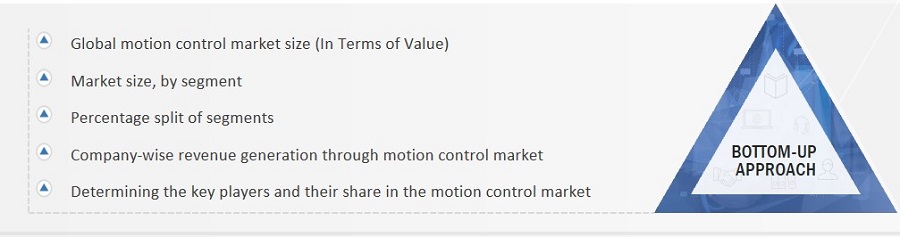
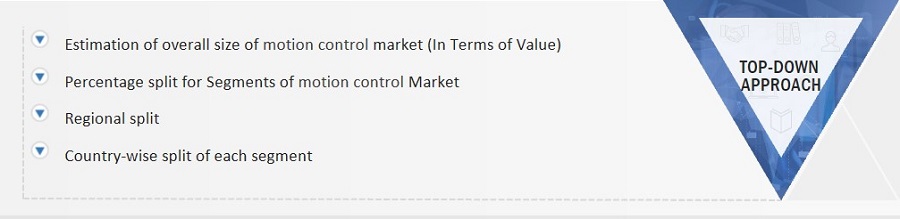
The study involves four major activities that estimate the size of the motion control market. Exhaustive secondary research was conducted to collect information related to the market. Following this was validating these findings, assumptions, and sizing with the industry experts across the value chain through primary research. Both top-down and bottom-up approaches were employed to estimate the overall size of the motion control market. Subsequently, market breakdown and data triangulation procedures were used to determine the extent of different segments and subsegments of the market.
Secondary Research
Secondary sources in this research study include corporate filings (such as annual reports, investor presentations, and financial statements); trade, business, and professional associations; white papers, certified publications, articles from recognized authors; directories; and databases. The secondary data were collected and analyzed to estimate the overall market size, further validated by primary research.
Primary Research
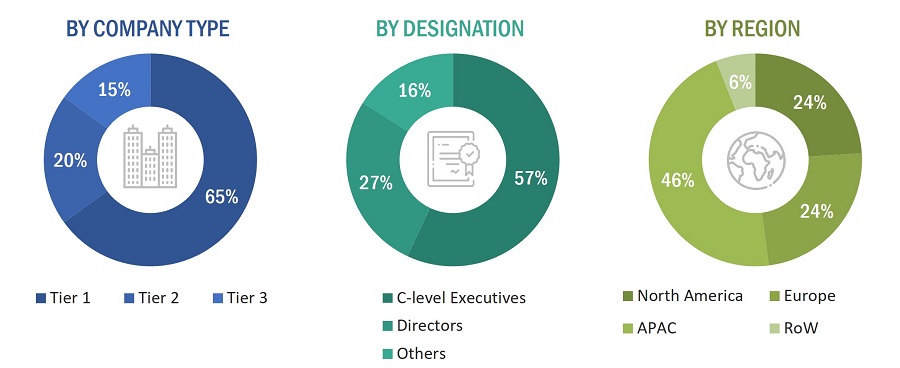
In the primary research process, numerous sources from both the supply and demand sides were interviewed to obtain qualitative and quantitative information about this report. The primary sources from the supply side included various industry experts such as Chief X Officers (CXOs), Vice Presidents (VPs), and Directors from business development, marketing, product development/innovation teams, and related key executives from motion control system providers, such as ABB (Switzerland), FANUC Corporation (Japan), Siemens (Germany), Yaskawa Electric Corporation (Japan), and Mitsubishi Electric Corporation (Japan); research organizations, distributors, professional and managed service providers, industry associations, and key opinion leaders. Approximately 25% of the primary interviews were conducted with the demand side and 75% with the supply side. These data were collected mainly through questionnaires, emails, and telephonic interviews, accounting for 80% of the primary interviews.
To know about the assumptions considered for the study, download the pdf brochure
Market Size Estimation
In the market engineering process, both top-down and bottom-up approaches were implemented, along with several data triangulation methods, to estimate and validate the size of the market and other dependent submarkets listed in this report.
- The key players in the industry and markets were identified through extensive secondary research.
- Both the supply chain of the industry and the market size, in terms of value, were determined through primary and secondary research.
- All percentage shares, splits, and breakdowns were determined using secondary sources and verified through primary sources.
Motion Control Market: Bottom-Up Approach
Motion Control Market: Top-Down Approach
Data Triangulation
After estimating the overall market size, the total market was split into several segments. The market breakdown and data triangulation procedures were employed wherever applicable to complete the overall market engineering process and gauge exact statistics for all segments. The data were triangulated by studying various factors and trends from both the demand and supply sides. The market was also validated using both top-down and bottom-up approaches.
Market Definition
Motion control refers to the field of engineering and technology dedicated to the precise management and regulation of the movement of machinery, equipment, and automated systems. It involves the utilization of various motion control systems, sensors, and actuators to govern the speed, position, and acceleration of mechanical components. Motion control is integral to a diverse array of industries, including manufacturing, robotics, automotive, aerospace, and healthcare, where exact and coordinated movement is essential for operational efficiency. The goal is to achieve accurate and reliable control over the motion of machinery, ensuring optimal performance, increased productivity, and enhanced overall operational effectiveness. Motion control systems can range from basic open-loop systems to more sophisticated closed-loop systems that incorporate feedback mechanisms to continuously adjust and refine the control process.
Stakeholders
- Semiconductor product designers and fabricators
- Connectivity providers
- Application providers
- Automation consultants
- Automation system integrators
- Platform providers
- Business providers
- Motion control distributors and providers
- Professional service/solution providers
- Research organizations
- Technology standard organizations, forums, alliances, and associations
- Technology investors
The main objectives of this study are as follows:
- To define, describe, and forecast the motion control market based on offering, system, and industry
- To estimate and forecast the market size, in terms of value, of various segments with regard to four main regions—North America, Europe, Asia Pacific, and the Rest of the World (RoW)
- To provide detailed information regarding the major factors influencing the growth of the motion control market (drivers, restraints, opportunities, industry-specific challenges)
- To study and analyze Trends and Emerging Applications of Motion Control Technology and Trends and Emerging Implementation Areas of Motion Control Systems
- To strategically analyze the micromarkets1 with respect to individual growth trends, future prospects, and contribution to the total market
- To analyze the opportunities in the market for various stakeholders by identifying the high-growth segments of the motion control market
- To strategically profile the key players and comprehensively analyze their market shares and core competencies2 and provide a detailed competitive landscape for the market leaders
- To analyze various development strategies such as mergers and acquisitions, new product launches and developments, and research and development implemented by the key market players in the motion control markets
Available Customizations:
With the given market data, MarketsandMarkets offers customizations according to the specific requirements of companies. The following customization options are available for the report:
Country-wise Information:
- Analysis for additional countries (up to five)
Company Information:
- Detailed analysis and profiling of different market players (up to five)
Get the Full Motion Control Market Report
Full forecast, segment splits, and company analysis for all Motion Control Market.
- Canada Motion Control Market
- Mexico Motion Control Market
- Germany Motion Control Market
- UK Motion Control Market
- France Motion Control Market
- Rest Of Europe Motion Control Market
- China Motion Control Market
- Japan Motion Control Market
- South Korea Motion Control Market
- India Motion Control Market
- Rest Of Asia Pacific Motion Control Market
Need a Tailored Report?
Customize this report to your needs
Get 10% FREE Customization
Customize This Report
