
US Multimodal Transport Market (2025-2030)

The US Multimodal Transport Market was valued at $1065.8 Million in 2025 and projected to reach to $1423.28 Million by 2030, representing a compound annual growth rate of 4.2%. The US multimodal transport market is positioned for steady growth as businesses increasingly recognize the value of integrated logistics solutions.


| Market Size in | USD 26.32 MN |
| Market Forecast in | |
| CAGR | |
| Forecast Period | |
| Units Considered | Value (USD MN) |
US Multimodal Transport Market Trends and Insights
- The US market reflects steady expansion driven by increasing demand for integrated logistics solutions and supply chain optimization across the country.
- In 2025, the US multimodal transport sector is characterized by growing adoption of digital platforms and real-time tracking technologies that enable seamless coordination between different transport modes. By 2030, the US multimodal transport market is expected to benefit from infrastructure investments, regulatory support for sustainable logistics, and the rise of e-commerce requiring flexible last-mile delivery solutions.
- The US continues to lead in technological innovation within multimodal networks, with companies investing in intermodal terminals and automated freight management systems.
- Growth in the US market is supported by the need for cost-effective transportation alternatives and environmental compliance, positioning the country as a key hub for multimodal logistics development through 2030..
Key Market Statistics
- CAGR (2025-2030) 4.2% CAGR
- Market Size, 2025 ~USD 1065.8 Million
- Forecast, 2030 ~USD 1423.28 Million
- Country US
US Multimodal Transport Market Overview
Market Valuation :
The US multimodal transport market is valued at $1,065.8 million in 2025, with strong growth trajectory expected through 2030.
Growth Trajectory :
US market demonstrates a 4.2% CAGR from 2025-2030, reflecting steady expansion driven by integrated logistics solutions and supply chain optimization initiatives.
Supply Chain Integration :
Increasing adoption of multimodal transport solutions across US industries as companies prioritize cost efficiency and seamless logistics coordination.
2030 Forecast :
Market projected to reach $1,423.28 million by 2030, indicating sustained demand for comprehensive transportation and logistics services across North America.
US Multimodal Transport Market Dynamics
- Supply chain optimization remains a critical priority for US enterprises, driving adoption of multimodal transport services that combine rail, road, air, and maritime capabilities.
- E-commerce expansion and last-mile delivery demands continue to fuel market expansion across major metropolitan areas and regional hubs. Looking ahead to 2030, the US market will benefit from technological advancements in fleet management, real-time tracking systems, and digital logistics platforms.
- Regulatory support for sustainable transportation and infrastructure investments will further accelerate market penetration.
- Companies seeking competitive advantages through operational efficiency will increasingly turn to multimodal solutions, supporting the projected growth to $1,423.28 million..
Market Ecosystem
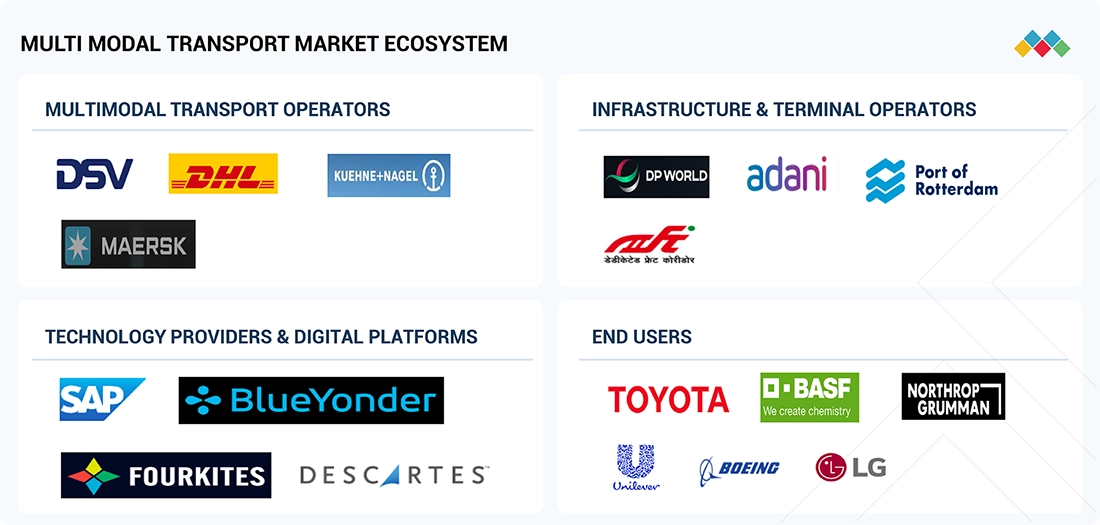
multimodal-transport-market: COMMERCIAL USE CASES ACROSS INDUSTRIES
| COMPANY | USE CASE DESCRIPTION | BENEFITS |
|---|---|---|
 |
Shift from air-only China–Brazil lane to multimodal MIMEX solution; major emission reduction while maintaining service levels | Single coordinated ocean–road–air flow under DHL management; lower logistics costs and improved supply-chain reliability |
 |
End-to-end UK logistics support covering inbound warehousing, e-commerce fulfilment, store deliveries, and returns via DSV | Streamlined operations with improved service responsiveness; dedicated account management, flexible drop-ship adaptation, and eVisibility-based real-time tracking |
 |
Consolidation of fragmented shipments from 100+ brands into ~5,000 full truckloads via C.H. Robinson; optimization of seasonal beauty displays and fixture distribution with drayage and transloading support | Achieved ~98% on-time delivery across consolidated loads; saved ~12,000 labor hours annually by reducing in-store handling effort |
Logos and trademarks shown above are the property of their respective owners. Their use here is for informational and illustrative purposes only.
Related Ecosystem
Logistics And Transportation
- Internal Combustion Engine (ICE)
- Crawler Excavator
- Fuel Cell
- Light Commercial Vehicles (LCVs)
- Sensors
- Siemens ag
- Alstom s.a.
- Hitachi, Ltd.
- Godrej Industries Limited
- ABB India Limited
Key Takeaways
- The US multimodal transport market will grow from $1,065.8M (2025) to $1,423.28M (2030) at a 4.2% CAGR.
- The US market is driven by e-commerce expansion and the need for integrated supply chain solutions.
- Digital transformation and real-time tracking technologies are reshaping the US multimodal transport landscape.
- Infrastructure investments and sustainability regulations are key growth catalysts for the US market through 2030.
Multimodal Transport Market Report Scope
| Report Metric | Details |
|---|---|
| Base Year | 2025 |
| Fastest Growing Segment | RETAIL (End-Use Industry) |
| Forecast Period | 2025–2030 |
| Growth Rate | CAGR of 7.1% from 2025 to 2030 |
| Largest Segment | TWO-MODE (Configuration) |
| Market Size Base Year (Billions) | ~USD 98.56 (2025) |
| Revenue Forecast (Billions) | ~USD 138.88 (2030) |
| Segments Covered | Configuration, End-Use Industry |
US Multimodal Transport Market Report Segmentation
2 segment dimensions are covered across the global market.
By Configuration
- Hybrid/Other
- Hybrid/Others
- Three Mode
- Three-Mode
- Two Mode
- Two-Mode
By End-Use Industry
- Chemicals & Materials
- Food & Beverages
- Manufacturing
- Oil & Gas
- Pharmaceuticals & Healthcare
- Retail
Target Audience
- Logistics & Transportation Companies : Need US market data to assess growth opportunities, competitive positioning, and strategic expansion plans within the multimodal transport sector.
- Supply Chain Managers : Require insights into US multimodal solutions and market trends to optimize logistics networks, reduce costs, and improve operational efficiency.
- Investment & Private Equity Firms : Seek detailed US market analysis and growth forecasts to evaluate investment opportunities and identify acquisition targets in the transportation industry.
- Technology & Software Providers : Need understanding of US market dynamics and customer requirements to develop relevant logistics platforms, fleet management, and tracking solutions.
- Government & Policy Makers : Require market intelligence on US transportation trends to inform infrastructure investments, regulatory frameworks, and sustainable logistics initiatives.
Key Companies in the US Multimodal Transport Market
| Company | HQ | Ownership | Strongest segments |
|---|---|---|---|
| DSV | Denmark | Public Company | Two Mode,Three Mode,Hybrid / Others, |
| DEUTSCHE POST AG | Germany | Public Company | Two Mode,Three Mode,Hybrid/ Others, |
| KUEHNE+NAGEL | Switzerland | Public Company | Two Mode (Sea-Air, Road-Sea, Road-Air),Three Mode,Hybrid / Others (4PL, Control Tower, Value-Added), |
| NIPPON EXPRESS HOLDINGS | Japan | Public Company | Two Mode,Three Mode,Hybrid / Others, |
| A.P. MOLLER - MAERSK | Denmark | Public Company | Two Mode,Three Mode,Hybrid / Others, |
| CMA CGM GROUP | France | Private Company | Two Mode,Three Mode,Hybrid / Others, |
| MARUBENI CORPORATION | Japan | Public Company | Two Mode,Three Mode,Hybrid/ Others, |
| C.H. ROBINSON WORLDWIDE, INC. | United States | Public Company | Two Mode,Three Mode,Hybrid/ Others, |
| GEODIS | France | Private Company | Two Mode,Three Mode,Hybrid/ Others, |
| XPO, INC. | United States | Public Company | Two Mode,Three Mode,Hybrid/ Others, |
| NYK LINE | Japan | Public Company | Two Mode,Three Mode,Hybrid/ Others, |
| EXPEDITORS INTERNATIONAL OF WASHINGTON, INC. | United States | Public Company | Two Mode,Three Mode,Hybrid/Others, |
| HAPAG-LLOYD AG | Germany | Public Company | Two Mode (Ocean + Truck/Rail),Three Mode,Hybrid / Others (incl. barge, specialized, and flexible routing), |
| KLN LOGISTICS GROUP LIMITED | Hong Kong | Public Company | Integrated Logistics (warehousing, inventory, value-added, trucking & distribution, returns),International Freight Forwarding (air, ocean, rail, cross-border road),Pharmaceutical & Healthcare Logistics, |
DSV
DSV is a Danish public company founded in 1976 that operates as a global transport and logistics provider with 147,222 employees.
DEUTSCHE POST AG
Deutsche Post AG is a German public company established in 1995 with 579,479 employees, operating in the postal and logistics sector.
KUEHNE+NAGEL
Kuehne+Nagel is a Swiss public company founded in 1890 that provides logistics and supply chain management services with 82,400 employees.
NIPPON EXPRESS HOLDINGS
Nippon Express Holdings is a Japanese public company established in 1872 with 77,925 employees, specializing in transportation and logistics services.
A.P. MOLLER - MAERSK
A.P. Moller - Maersk is a Danish public company founded in 1904 with 100,000 employees, operating as a global shipping and logistics conglomerate.
CMA CGM GROUP
CMA CGM Group is a French private company established in 1936 with 158,307 employees, operating as a major international shipping and logistics provider.
MARUBENI CORPORATION
Marubeni Corporation is a Japanese public company founded in 1858 with 42,882 employees, engaged in trading and logistics operations.
C.H. ROBINSON WORLDWIDE, INC.
C.H. Robinson Worldwide, Inc. is a United States public company founded in 1905 with 11,599 employees, providing transportation and logistics services.
GEODIS
GEODIS is a French private company established in 1904 that operates as a global supply chain and logistics solutions provider.
XPO, INC.
XPO, Inc. is a United States public company founded in 1989 with 38,000 employees, offering transportation and logistics services.
NYK LINE
NYK Line is a Japanese public company established in 1885 with 39,830 employees, operating as a major international shipping company.
EXPEDITORS INTERNATIONAL OF WASHINGTON, INC.
Expeditors International of Washington, Inc. is a United States public company founded in 1979 with 19,800 employees, providing freight forwarding and logistics services.
HAPAG-LLOYD AG
Hapag-Lloyd AG is a German public company founded in 1847 with 15,765 employees, specializing in container shipping and logistics services.
KLN LOGISTICS GROUP LIMITED
KLN Logistics Group Limited is a Hong Kong public company established in 1981 with 18,618 employees, providing logistics and supply chain services.
Reasons to Buy this Report
- Market Size & Growth Data : Access precise US market valuation ($1,065.8M in 2025) and 2030 forecasts with 4.2% CAGR to benchmark competitive positioning and investment decisions.
- Regional Demand Insights : Understand US-specific drivers of multimodal transport adoption, including supply chain optimization trends and integrated logistics requirements across industries.
- Strategic Planning : Leverage detailed market projections to identify growth opportunities, plan capacity expansion, and allocate resources effectively within the US transportation sector.
- Competitive Intelligence : Gain actionable insights into US market dynamics, customer preferences, and emerging logistics solutions to maintain competitive advantage in North America.
- Investment Justification : Support capital allocation decisions and business case development with credible US market data, growth forecasts, and industry trend analysis through 2030.
Frequently asked questions
What is the current size of the US multimodal transport market in 2025?
The US multimodal transport market is valued at $1,065.8 million in 2025.
What is the projected size of the US multimodal transport market by 2030?
The US multimodal transport market is projected to reach $1,423.28 million by 2030.
What is the CAGR for the US multimodal transport market?
The US multimodal transport market is expected to grow at a compound annual growth rate of 4.2% from 2025 to 2030.
What are the main drivers of growth in the US multimodal transport market?
Key drivers include e-commerce expansion, digital transformation, infrastructure investments, sustainability regulations, and the demand for integrated supply chain solutions in the US.
How is technology impacting the US multimodal transport market?
Technology is enabling real-time tracking, automated freight management, digital platforms, and intermodal terminal optimization, transforming how the US manages multimodal logistics operations.
RESEARCH METHODOLOGY
The research study extensively utilizes secondary sources, including company annual reports/presentations, industry association publications, magazine articles, directories, technical handbooks, the World Economic Outlook, trade websites, technical articles, and databases, to identify and collect information on the multimodal transport market. In-depth interviews have been conducted with various primary sources, experts from related industries, multimodal operators, and service providers, to obtain and verify critical information, as well as assess the growth prospects and market estimations.
Secondary Research
Secondary sources for this research study include corporate filings, such as annual reports, investor presentations, and financial statements; trade, business, and professional associations; whitepapers and trade-related journals; certified publications; articles by recognized authors; directories; and databases. Secondary data have been collected and analyzed to determine the overall market size, which has been further validated by primary research.
Primary Research
Extensive primary research has been conducted following the development of a comprehensive understanding of the multimodal transport market through secondary research. Multiple interviews have been held with stakeholders from both the demand and supply sides. Demand-side participants include manufacturers, retail and e-commerce logistics teams, and global shippers responsible for planning inbound and outbound distribution. Supply-side respondents comprise freight forwarders, integrated logistics providers, port and terminal operators, rail and inland transport companies, and industry associations involved in corridor development and policy. The study covers respondents across North America, Europe, the Asia Pacific, and emerging trade markets in the Middle East and South Asia. Approximately one-third of interviews have represented the demand side, while the remaining share has come from service providers and infrastructure operators. Primary insights have been collected through structured questionnaires, virtual discussions, and email interactions with experts in network planning, procurement, digital transformation, and operations, capturing their perspectives on service requirements, capacity constraints, technology adoption, and future investment priorities.
Following these interviews, brief validation sessions have been conducted with independent logistics consultants, and the findings have been further reviewed by in-house subject matter specialists to ensure accuracy and alignment with industry developments.
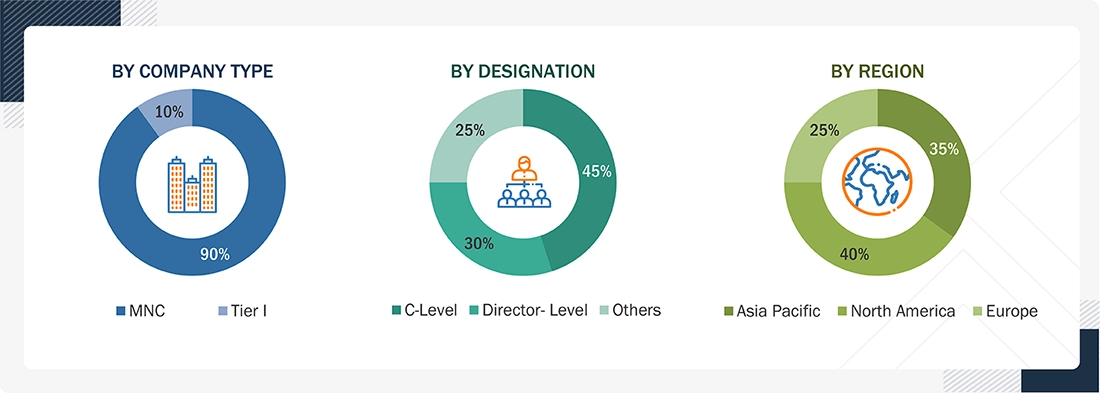
Note: Others include sales, managers, and product managers.
Company tiers are based on the value chain; the company's revenue is not considered.
To know about the assumptions considered for the study, download the pdf brochure
Market Size Estimation
As outlined below, a comprehensive market estimation methodology has been applied to assess and validate the volume and value of the multimodal transport market, as well as its associated subsegments.
- Mapped country-level freight transport volumes (in billion ton-kilometers) using data from national transport authorities, logistics associations, paid databases, and global sources such as the World Bank, UNCTAD, and OECD
- Calculated multimodal freight penetration for each country and region based on mapped freight movement and modal usage patterns
- Developed multimodal freight forecasts using macroeconomic indicators, international trade growth, infrastructure investments, logistics performance indices, and government initiatives supporting intermodal connectivity and sustainable transport
- Derived market segments by mapping across transport modes (road, rail, sea, air) and evaluating freight volumes, network connectivity, infrastructure capacity, and integration efficiency for each country/region
- Refined segment estimates using insights from primary interviews with logistics providers, infrastructure operators, and industry experts
- Aggregated country-level freight volumes to determine total regional and global multimodal transport volumes
- Converted volumes to market value by multiplying average freight rates (USD per ton or TEU) for each mode with corresponding multimodal freight volumes at the country level
- Summed regional and service type values to derive the final global market size for the multimodal transport market
Multimodal Transport Market : Top-Down and Bottom-Up Approach

Data Triangulation
After determining the overall market size using the outlined methodology, the multimodal transport market has been further segmented across configuration types, end-use industries, and regions. A data triangulation process has been applied to validate these breakdowns and ensure accuracy in the final market figures. This involved cross-verifying extrapolated estimates through multiple lenses, including regional trade flows, infrastructure capacity, policy developments, and service adoption trends, utilizing inputs from both demand-side stakeholders (shippers and manufacturers) and supply-side participants (logistics providers and corridor operators). By reconciling insights from secondary datasets, primary interviews, and macro-economic indicators, the final values for each segment and subsegment have been refined to reflect a consistent and reliable market assessment./p>
Market Definition
The multimodal transport market refers to the integrated movement of freight using two or more modes of transportation, such as road, rail, air, or inland waterways, under a single contract or operator with standardized units, such as containers (20ft or 40ft), to ensure seamless handoffs. Multimodal transport enables efficient transit across multiple transport systems, reducing handling time, transit delays, and overall logistics costs. Multimodal transport leverages the strengths of each mode, combining flexibility, cost efficiency, and environmental benefits to optimize end-to-end supply chain operations. This approach is increasingly adopted in global trade, urban mobility, and logistics networks, supported by growing infrastructure investments, digital tracking systems, and sustainable transportation initiatives. Rail manages the longest leg in multimodal freight transport, accounting for the bulk of freight volume.
Key Stakeholders
- Government & Regulatory Bodies
- Infrastructure Developers & Operators
- Logistics & Transport Service Providers
- Technology & Solution Providers
- Financial & Investment Institutions
- Trade Associations & Multilateral Organizations
- End-use Industries
Report Objectives
- To analyze and forecast the multimodal transport market in terms of volume (billion-ton-km) and value (USD billion) from 2025 to 2032
-
To segment and forecast the multimodal transport market size in terms of volume and value based on the following:
- By configuration type (two-mode, three-mode, hybrid/others)
- By end-use industry (retail, food & beverages, chemicals & materials, pharmaceuticals & healthcare, manufacturing, oil & gas, and other end-use industries)
- By region (North America, Europe, the Asia Pacific, and the Rest of the World)
- To understand the dynamics (drivers, restraints, opportunities, and challenges) of the market
- To analyze the evaluation matrix of leading players operating in the market
- To strategically analyze the key player strategies and company revenue analysis of key players in the market from 2021 to 2025
-
To study the following aspects of the report
- Trends/Disruptions Impacting Multimodal Transport Market
- Market Ecosystem
- Technology Analysis
- Patent Analysis
- Regulatory Landscape
- Case Study Analysis
- Key Stakeholders and Buying Criteria
- Key Conferences and Events
- Pricing Analysis
- Macroeconomic Outlook
- Company Valuation and Financial Metrics
- Brand and Product Comparison
- To strategically profile the key players and comprehensively analyze their market share and core competencies
- To track and analyze competitive developments such as deals (joint ventures, mergers & acquisitions, partnerships, collaborations), product developments and launches, and other activities undertaken by the key industry participants
Available Customizations:
With the given market data, MarketsandMarkets offers customizations in accordance with the company's specific needs.
- Additional Company Profiles (Up to 5)
- Multimodal Transport Market, By Container Freight, At Regional Level
Get the Full Multimodal Transport Market Report
Full forecast, segment splits, and company analysis for all Multimodal Transport Market.
- China Multimodal Transport Market
- Japan Multimodal Transport Market
- India Multimodal Transport Market
- South Korea Multimodal Transport Market
- France Multimodal Transport Market
- Germany Multimodal Transport Market
- Spain Multimodal Transport Market
- Italy Multimodal Transport Market
- Poland Multimodal Transport Market
- Canada Multimodal Transport Market
- Mexico Multimodal Transport Market
- Argentina Multimodal Transport Market
- Brazil Multimodal Transport Market
- Saudi Arabia Multimodal Transport Market
- Turkey Multimodal Transport Market
- Rest Of Europe Multimodal Transport Market
- Rest Of Asia Pacific Multimodal Transport Market
Need a Tailored Report?
Customize this report to your needs
Get 10% FREE Customization
Customize This Report
