
Australia Near-Eye Display Market (2025-2030)

The Australia Near-Eye Display Market was valued at $2.61 Million in 2025 and projected to reach to $31.97 Million by 2030, representing a compound annual growth rate of 65.0%. Australia's near-eye display market is positioned for transformative growth through 2030, driven by increasing adoption of augmented and virtual reality technologies across enterprise, consumer, and industrial applications.


| Market Size in | USD 26.32 MN |
| Market Forecast in | |
| CAGR | |
| Forecast Period | |
| Units Considered | Value (USD MN) |
Australia Near-Eye Display Market Trends and Insights
- This remarkable 65% compound annual growth rate significantly outpaces global trends, positioning Australia as a high-growth market within the Asia Pacific region.
- Australia's adoption of near-eye display technologies is driven by increasing demand for augmented reality, virtual reality, and mixed reality applications across consumer, enterprise, and industrial sectors. The near-eye display market in Australia reflects strong momentum in wearable technology and immersive computing solutions.
- Between 2025 and 2030, Australia is expected to capture substantial market share as local enterprises and consumers embrace next-generation display innovations.
- Australia's tech-savvy population and robust digital infrastructure support rapid commercialization of near-eye display devices, from smart glasses to head-mounted displays, creating significant opportunities for manufacturers and solution providers targeting the Australian market..
Key Market Statistics
- CAGR (2025-2030) 65.0% CAGR
- Market Size, 2025 ~USD 2.61 Million
- Forecast, 2030 ~USD 31.97 Million
- Country Australia
Australia Near-Eye Display Market Overview
Exceptional Growth Trajectory :
Australia's near-eye display market is projected to grow from $2.61 million in 2025 to $31.97 million by 2030, representing a 65% CAGR that significantly exceeds the global average of 25.1%.
Asia Pacific Leadership :
Australia is emerging as a high-growth market within the Asia Pacific region, driven by early adoption of AR/VR technologies and increasing consumer demand for immersive experiences.
Technology Adoption Drivers :
Growing investment in enterprise AR applications, gaming, and spatial computing solutions is accelerating near-eye display adoption across Australian industries and consumer segments.
Market Expansion Potential :
With a 12x market size increase projected over five years, Australia presents significant opportunities for technology vendors, manufacturers, and solution providers entering the Asia Pacific region.
Australia Near-Eye Display Market Dynamics
- The market's 65% CAGR reflects strong demand from tech-forward Australian businesses and consumers seeking immersive digital experiences, supported by improving infrastructure and declining device costs. Key growth catalysts include expanding enterprise use cases in manufacturing and logistics, rising gaming and entertainment consumption, and government initiatives supporting digital innovation.
- As major technology companies increase regional investments and local startups develop specialized applications, Australia's near-eye display ecosystem will mature, attracting further capital and talent to establish the country as a significant Asia Pacific hub for immersive technologies..
Market Ecosystem
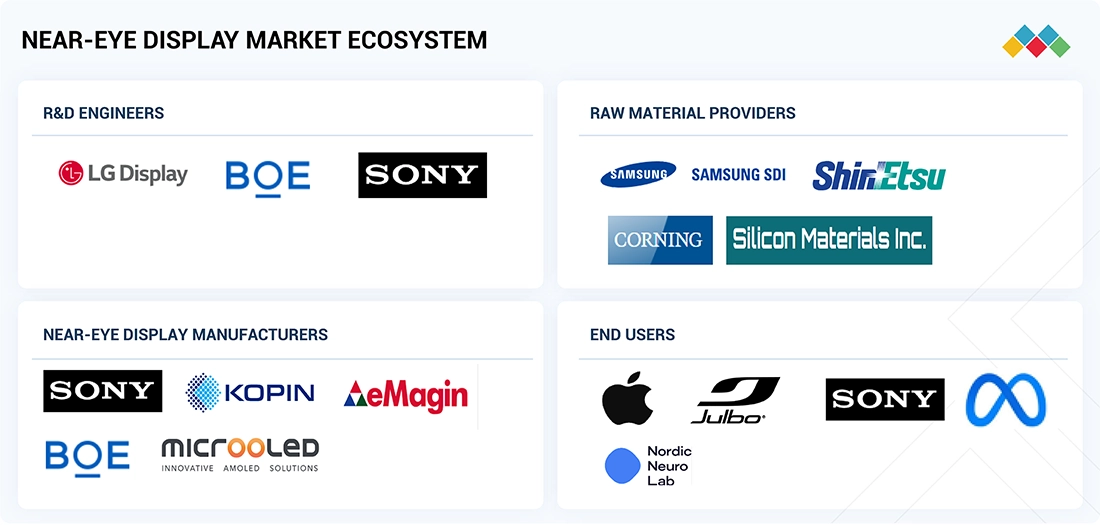
Near-Eye Display Market Trends: COMMERCIAL USE CASES ACROSS INDUSTRIES
| COMPANY | USE CASE DESCRIPTION | BENEFITS |
|---|---|---|
 |
Incorporates OLED microdisplay panels in electronic viewfinders (EVFs) of digital cameras, enabling high brightness, contrast, and color accuracy for precise image framing | Delivers sharp visuals, fast response times, and improved user experience for professional photography and videography. |
 |
Utilizes high-resolution micro-OLED panels in Vision Pro headsets to enable lifelike AR and VR visuals for spatial computing and immersive content interaction | Provides superior image clarity, wide color gamut, and enhanced visual realism, improving comfort and immersion |
 |
Uses Si-OLED display panels in Moverio smart glasses to project transparent, high-brightness AR visuals for industrial and enterprise operations | Ensures clear image projection, energy efficiency, and stable performance in varying light environments |
 |
Integrates micro-OLED panels in HoloLens headsets to deliver high-definition mixed-reality overlays and precise holographic visualization for enterprise use | Enables accurate 3D visualization, minimizes motion blur, and enhances user engagement during extended operation |
 |
Employs OLED panels in Vive VR headsets to achieve high refresh rates and wide field-of-view visuals for immersive VR environments | Offers low latency, smooth motion rendering, and deeper visual immersion for gaming and simulation applications |
Logos and trademarks shown above are the property of their respective owners. Their use here is for informational and illustrative purposes only.
Related Ecosystem
Display Technology
Key Takeaways
- Australia's near-eye display market will grow from $2.61M (2025) to $31.97M (2030), representing a 65% CAGR.
- Australia's growth rate significantly exceeds the global average of 25.1%, making it a priority market for near-eye display vendors.
- Australia's strong digital infrastructure and tech-savvy consumer base accelerate adoption of AR, VR, and MR near-eye display solutions.
- Australia's enterprise and industrial sectors are increasingly investing in near-eye display technologies for training, design, and operational applications.
Near-Eye Display Market Report Scope
| Report Metric | Details |
|---|---|
| Base Year | 2025 |
| Fastest Growing Segment | MICROLED (Technology) |
| Forecast Period | 2025–2030 |
| Growth Rate | CAGR of 25.1% from 2025 to 2030 |
| Largest Segment | VR & MR (Device Type) |
| Market Size Base Year (Billions) | ~USD 2.17 (2025) |
| Revenue Forecast (Billions) | ~USD 6.65 (2030) |
| Segments Covered | Technology, Device Type, Vertical, Resolution |
Australia Near-Eye Display Market Report Segmentation
4 segment dimensions are covered across the global market.
By Technology
- Amoled
- Laser Beam Scanning
- Lcos
- Micro Led
- Microled
- Oledos
- Tft Lcd
By Device Type
- Ar
- Evf
- Evfs
- Vr & Mr
By Vertical
- Automotive
- Consumer
- Education
- Industrial & Enterprise
- Medical
- Military, Aerospace, & Defense
- Military, Defense, And Aerospace
- Other Verticals
- Retail & Hospitality
- Sports & Entertainment
By Resolution
- Fhd
- Hd
- Higher Than Fhd
- Lower Than Hd
Target Audience
- Technology Manufacturers & OEMs : Manufacturers of AR/VR headsets and near-eye display devices need Australia-specific market data to assess demand, plan production capacity, and develop localized product strategies for this high-growth market.
- Enterprise Solution Providers : Companies developing AR/VR enterprise applications require detailed Australian market insights to identify industry verticals with highest adoption potential and tailor solutions for local business requirements.
- Investment & Private Equity Firms : Investors evaluating opportunities in Australia's immersive technology sector need comprehensive market analysis, growth projections, and competitive landscape data to guide funding and acquisition decisions.
- Semiconductor & Component Suppliers : Suppliers of displays, processors, and optical components need Australia market forecasts to plan supply chain strategies, negotiate partnerships, and position products for regional demand growth.
- Government & Policy Organizations : Australian government agencies and industry bodies require market intelligence to develop technology policies, innovation initiatives, and regulatory frameworks supporting the emerging near-eye display ecosystem.
Key Companies in the Australia Near-Eye Display Market
| Company | HQ | Ownership | Strongest segments |
|---|---|---|---|
| SONY GROUP CORPORATION | Japan | Public Company | Electronic Viewfinders (EVFs) and camera near-eye modules,VR & MR device near-eye displays,AR device near-eye displays, |
| SEIKO EPSON CORPORATION | Japan | Public Company | AR Devices (smart glasses and optical engines),VR & MR Device Components,Electronic Viewfinders (EVFs), |
| BOE TECHNOLOGY GROUP CO., LTD. | China | Public Company | TFT LCD near-eye (VR, EVF, low-end MR),AMOLED near-eye (VR & MR headsets),Microdisplays (LCOS, OLEDOS) for AR and EVF, |
| SEEYA TECHNOLOGY | China | Public Company | AR Devices (OLEDoS-based),VR & MR Devices (OLEDoS-based),Electronic Viewfinders (EVFs), |
| KOPIN CORPORATION | United States | Public Company | TFT LCD microdisplays,LCOS / ferroelectric LCOS,OLED / OLEDOS, |
| HIMAX TECHNOLOGIES, INC. | Taiwan | Public Company | AR Devices (LCoS microdisplays, wafer-level optics, WiseEye-enabled modules),VR & MR Devices (OLED/TFT drivers, timing controllers),Electronic Viewfinders (EVFs) and industrial near-eye modules, |
| YUNNAN OLIGHTEK OPTO-ELECTRONIC TECHNOLOGY CO., LTD. | China | Private Company | AMOLED microdisplays for EVFs and optical viewfinders,AMOLED microdisplays for AR/MR/VR near-eye devices,AMOLED driver boards and modules, |
| LG DISPLAY CO., LTD. | South Korea | Public Company | TFT LCD near-eye panels,AMOLED near-eye panels,LCOS / OLEDOS microdisplays, |
| WISECHIP SEMICONDUCTOR INC. | Taiwan | Public Company | Monochrome / area-color and mini-OLED near-eye modules,Full-color and round/touch OLEDs for AR/VR peripherals,Transparent, bendable, and wide-temperature OLEDs, |
| OMNIVISION | United States | Private Company | AR Devices,VR & MR Devices,Electronic Viewfinders (EVFs), |
SONY GROUP CORPORATION
Sony Group Corporation is a Japanese public company founded in 1946 with 94,900 employees. The company operates as a diversified multinational conglomerate.
SEIKO EPSON CORPORATION
Seiko Epson Corporation is a Japanese public company founded in 1942 with 74,619 employees. The company operates in manufacturing and technology sectors.
BOE TECHNOLOGY GROUP CO., LTD.
BOE Technology Group Co., Ltd. is a Chinese public company founded in 1993 with 109,895 employees. The company is a major technology manufacturer.
SEEYA TECHNOLOGY
Seeya Technology is a Chinese public company founded in 2016. The company operates in the technology sector.
KOPIN CORPORATION
Kopin Corporation is a United States-based public company founded in 1984 with 145 employees. The company operates in the technology sector.
HIMAX TECHNOLOGIES, INC.
Himax Technologies, Inc. is a Taiwanese public company founded in 2001 with 2,200 employees. The company operates in the semiconductor and technology sectors.
YUNNAN OLIGHTEK OPTO-ELECTRONIC TECHNOLOGY CO., LTD.
Yunnan Olightek Opto-Electronic Technology Co., Ltd. is a Chinese private company founded in 2008 with 138 employees. The company operates in opto-electronic technology.
LG DISPLAY CO., LTD.
LG Display Co., Ltd. is a South Korean public company founded in 1985 with 25,057 employees. The company is a major display technology manufacturer.
WISECHIP SEMICONDUCTOR INC.
Wisechip Semiconductor Inc. is a Taiwanese public company founded in 2005 with 298 employees. The company operates in the semiconductor industry.
OMNIVISION
OmniVision is a United States-based private company founded in 1995 with 2,176 employees. The company operates in the technology and imaging sectors.
Reasons to Buy this Report
- Market-Specific Growth Intelligence : Gain detailed insights into Australia's 65% CAGR trajectory and understand the unique drivers propelling this market to outpace global growth rates, enabling strategic market entry and expansion planning.
- Competitive Positioning Data : Access comprehensive analysis of Australia's near-eye display ecosystem to identify competitive gaps, emerging players, and market opportunities specific to the Australian technology landscape.
- Investment Decision Support : Leverage detailed market forecasts and segment analysis to make informed investment decisions, capital allocation strategies, and partnership opportunities within Australia's high-growth immersive technology sector.
- Regional Expansion Strategy : Utilize Australia-specific market data to develop targeted go-to-market strategies for Asia Pacific expansion, understanding local demand patterns, regulatory environment, and customer preferences.
- Technology Roadmap Alignment : Align product development and innovation roadmaps with Australia's emerging near-eye display applications and use cases, ensuring solutions meet regional market demands and competitive requirements.
Frequently asked questions
What is the current size of Australia's near-eye display market?
Australia's near-eye display market was valued at $2.61 million in 2025 and is projected to reach $31.97 million by 2030.
What is the CAGR for Australia's near-eye display market?
Australia's near-eye display market is expected to grow at a compound annual growth rate of 65% between 2025 and 2030.
How does Australia's near-eye display market compare to global growth?
Australia's 65% CAGR significantly outpaces the global average of 25.1%, making Australia one of the fastest-growing markets for near-eye display technology.
What applications are driving Australia's near-eye display market growth?
Australia's market growth is driven by increasing adoption of augmented reality, virtual reality, and mixed reality applications in consumer, enterprise, and industrial sectors.
Which sectors in Australia are investing most in near-eye display technology?
Australia's enterprise and industrial sectors are leading investment in near-eye display technologies for training, design, simulation, and operational efficiency applications.
RESEARCH METHODOLOGY
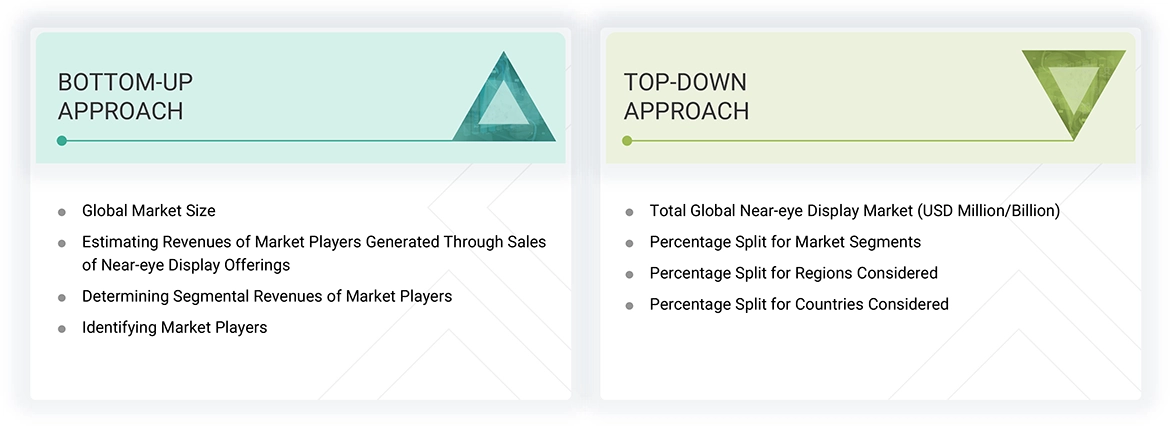
The research study involved four major activities in estimating the size of the near-eye display market. Exhaustive secondary research has been done to collect important information about the market and peer markets. The next step has been to validate these findings, assumptions, and sizing with the help of primary research with industry experts across the value chain. Both top-down and bottom-up approaches have been used to estimate the market size. The market breakdown and data triangulation techniques have been adopted to estimate the market sizes of segments and subsegments
Secondary Research
In the secondary research process, various secondary sources have been referred to for identifying and collecting information required for this study. The secondary sources include annual reports, press releases, investor presentations of companies, white papers, and articles from recognized authors. Secondary research has been done to obtain key information about the market’s value chain, the pool of key market players, market segmentation according to industry trends, regional outlook, and developments from both market and technology perspectives.
The near-eye display market report estimates the global market size using both top-down and bottom-up approaches and several other dependent submarkets. The major players in the market have been identified using extensive secondary research, and their presence in the market has been determined using secondary and primary research. All the percentage share splits and breakdowns have been determined using secondary sources and verified through primary sources.
Primary Research
Extensive primary research has been conducted after understanding the near-eye display market scenario through secondary research. Several primary interviews have been conducted with key opinion leaders from both demand- and supply-side vendors across four major regions—North America, Europe, Asia Pacific, and Rest of the World (RoW). Approximately 25% of the primary interviews have been conducted with the demand-side vendors and 75% with the supply-side vendors. Primary data has been collected mainly through telephonic interviews, which consist of 80% of the total primary interviews; questionnaires and emails have also been used to collect the data.
After successfully interacting with industry experts, brief sessions have been conducted with highly experienced independent consultants to reinforce our primary research findings. This, along with the opinions of the in-house subject-matter experts, has led us to the findings described in the report.
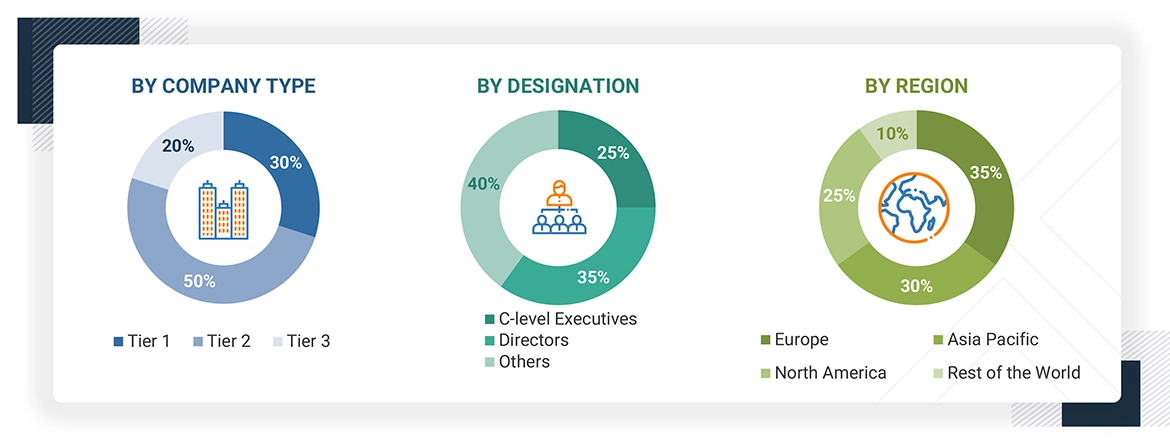
Note: Other designations include sales, marketing, and product managers.
The three tiers of the companies are based on their total revenues as of 2024: Tier 1: >USD 1 billion, Tier 2: USD 500 million-1 billion, and Tier 3: USD 500 million.
To know about the assumptions considered for the study, download the pdf brochure
Market Size Estimation
In the market engineering process, both top-down and bottom-up approaches, along with data triangulation methods, have been used to estimate and validate the size of the near-eye display market and other dependent submarkets. The research methodology used to estimate the market sizes includes the following:
- Identifying top-line investments and spending in the ecosystem and considering segment-level splits and major market developments
- Identifying different stakeholders in the near-eye display market that influence the entire market, along with participants across the supply chain
- Analyzing major manufacturers in the near-eye display market and studying their product portfolio
- Analyzing trends related to the adoption of near-eye display products
- Tracking recent and upcoming market developments, including investments, R&D activities, product launches, expansions, acquisitions, partnerships, collaborations, agreements, and investments, as well as forecasting the market size based on these developments and other critical parameters
- Carrying out multiple discussions with key opinion leaders to identify the adoption trends of near-eye displays
- Segmenting the overall market into various other market segments
- Validating the estimates at every level through discussions with key opinion leaders, such as chief executives (CXOs), directors, and operation managers, and finally with the domain experts at MarketsandMarkets
Near-Eye Display Market : Top-Down and Bottom-Up Approach
Data Triangulation
After arriving at the overall market size by the market size estimation process explained in the earlier section, the overall near-eye display market has been divided into several segments and subsegments. The data triangulation and market breakdown procedures have been used to complete the overall market engineering process and arrive at the exact statistics for all segments, wherever applicable. The data has been triangulated by studying various factors and trends from both the demand- and supply-side perspectives. Along with data triangulation and market breakdown, the market has been validated by top-down and bottom-up approaches.
Market Definition
Near-eye displays are advanced microdisplay technologies designed to be placed close to the user’s eyes, delivering immersive and vivid visual experiences in near-eye devices. Near-eye displays are used in augmented reality (AR) glasses, virtual reality (VR) head-mounted displays, mixed reality (MR) devices, and electronic viewfinders (EVFs). They provide high pixel density, low latency, lightweight, and the ability to project 2D or 3D content directly into the wearer's field of view, adding to interaction with digital environments.
The near-eye display market has been segmented by technology, device type, and vertical. Based on technology, the market has been segmented into OLED-on-Silicon (OLEDoS), Liquid Crystal on Silicon (LCoS), microLED, TFT LCD, AMOLED, and laser beam scanning, which present distinct advantages such as brightness, power efficiency, contrast, and resolution specific to certain applications. Displays based on these technologies are used in devices such as AR glasses, VR & MR HMDs, and electronic viewfinders (EVFs), and these devices are utilized in various verticals from consumer electronics to military, aerospace & defense, industrial & enterprise, retail & hospitality, medical, education, sports & entertainment, and more. Near-eye displays make it possible for immersive, high-resolution imagery and real-time interaction, so they play a critical role in uses such as training, simulation, remote guidance, gaming, and professional purposes in various industries.
Key Stakeholders
- Raw material suppliers
- Technology investors
- Original equipment manufacturers (OEMs)
- System integrators
- Distributors, resellers, and traders
- Research institutions and organizations
- Near-eye display forums, alliances, consortia, and associations
- Market research and consulting firms
- End users
Report Objectives
- To describe and forecast the overall near-eye display market, by technology, device type, resolution, and vertical, in terms of value
- To forecast the market for device type, in terms of volume
- To describe different components of near-eye displays, namely image generators, optical combiners, and imaging optics
- To describe the brightness levels of near-eye displays having less than 500 nits, 500 to 1,000 nits, and more than 1,000 nits
- To evaluate the market for four key regions: North America, Europe, Asia Pacific, and the Rest of the World, in terms of value
- To provide detailed information regarding the drivers, restraints, opportunities, and challenges influencing the growth of the market
- To give a detailed overview of the supply chain of the near-eye display ecosystem, along with the average selling prices of display technologies
- To strategically analyze the ecosystem, Porter's five forces, tariffs and regulations, patent landscape, trade landscape, trends and disruptions impacting customer business, technology landscape, key stakeholders & buying criteria, key conferences & events, and case studies pertaining to the market under study.
- To strategically analyze micromarkets with regard to individual growth trends, prospects, and contributions to the overall market
- To analyze opportunities in the market for stakeholders and provide a competitive landscape of the market
- To analyze competitive developments such as product launches, expansions, partnerships, collaborations, and agreements in the market
- To strategically profile the key players in the market and comprehensively analyze their market ranking and core competencies
- To strategically analyze the impact of the 2025 US tariff on the near-eye display market
- To analyze the impact of AI/Gen AI on the near-eye display market
Available Customizations:
With the given market data, MarketsandMarkets offers customizations according to the specific requirements of companies. The following customization options are available for the report:
Country-wise Information:
- Country-wise breakdown for North America, Europe, Asia Pacific, and Rest of the World
Company Information:
- Detailed analysis and profiling of additional market players (up to five)
Get the Full Near-Eye Display Market Report
Full forecast, segment splits, and company analysis for all Near-Eye Display Market.
- US Near-Eye Display Market
- Canada Near-Eye Display Market
- Mexico Near-Eye Display Market
- Germany Near-Eye Display Market
- UK Near-Eye Display Market
- France Near-Eye Display Market
- Spain Near-Eye Display Market
- Italy Near-Eye Display Market
- Nordics Near-Eye Display Market
- Poland Near-Eye Display Market
- Rest Of Europe Near-Eye Display Market
- China Near-Eye Display Market
- Japan Near-Eye Display Market
- South Korea Near-Eye Display Market
- India Near-Eye Display Market
- Indonesia Near-Eye Display Market
- Thailand Near-Eye Display Market
- Vietnam Near-Eye Display Market
- Malaysia Near-Eye Display Market
- Rest Of Asia Pacific Near-Eye Display Market
- Saudi Arabia Near-Eye Display Market
- UAE Near-Eye Display Market
- Qatar Near-Eye Display Market
- Kuwait Near-Eye Display Market
- Oman Near-Eye Display Market
- Bahrain Near-Eye Display Market
- Rest Of Middle East Near-Eye Display Market
- South Africa Near-Eye Display Market
- Rest Of African Countries Near-Eye Display Market
- South America Near-Eye Display Market
- Africa Near-Eye Display Market
- Middle East Near-Eye Display Market
Need a Tailored Report?
Customize this report to your needs
Get 10% FREE Customization
Customize This Report
