
South Korea Next-generation Sequencing Market (2026-2031)

The South Korea Next-generation Sequencing Market was valued at $117.4 Million in 2026 and projected to reach to $201 Million by 2031, representing a compound annual growth rate of 11.4%. South Korea's next-generation sequencing market demonstrates strong growth potential, supported by the country's commitment to advancing genomic medicine and precision healthcare.


| Market Size in | USD 26.32 MN |
| Market Forecast in | |
| CAGR | |
| Forecast Period | |
| Units Considered | Value (USD MN) |
South Korea Next-generation Sequencing Market Trends and Insights
- This 11.4% compound annual growth rate reflects South Korea's advancing healthcare infrastructure, increasing adoption of precision medicine, and strong government support for genomic research initiatives.
- South Korea's investment in biotechnology and genomic sequencing technologies is accelerating clinical applications across oncology, rare disease diagnosis, and personalized medicine. The South Korea NGS market benefits from a highly educated workforce, robust pharmaceutical and biotech sectors, and rising healthcare expenditure.
- Between 2026 and 2031, South Korea is expected to see expanded integration of NGS in diagnostic laboratories and research institutions, driven by declining sequencing costs and growing awareness among healthcare providers.
- South Korea's regulatory environment and public health initiatives further support market penetration, positioning the country as a regional leader in genomic medicine adoption and innovation..
Key Market Statistics
- CAGR (2026-2031) 11.4% CAGR
- Market Size, 2026 ~USD 117.4 Million
- Forecast, 2031 ~USD 201 Million
- Country South Korea
South Korea Next-generation Sequencing Market Overview
Market Valuation Growth :
South Korea's NGS market is valued at $117.4 million in 2026 and is projected to reach $201.0 million by 2031, representing a robust 11.4% CAGR driven by increasing genomic research investments and precision medicine adoption.
Government Support & Infrastructure :
South Korea's government-backed genomic research initiatives and advanced healthcare infrastructure create a favorable environment for NGS technology deployment, positioning the country as a regional innovation hub in Asia Pacific.
Precision Medicine Adoption :
Rising demand for personalized treatment approaches in South Korea's healthcare system is accelerating NGS adoption across oncology, rare disease diagnosis, and pharmacogenomics applications among leading medical institutions.
Regional Leadership Position :
South Korea serves as a key growth driver within the Asia Pacific region, leveraging its technological expertise, skilled workforce, and competitive healthcare ecosystem to establish itself as a regional NGS market leader.
South Korea Next-generation Sequencing Market Dynamics
- The 11.4% CAGR reflects increasing investments in research infrastructure, growing adoption among hospitals and diagnostic centers, and expanding applications in cancer genomics and rare disease identification. Looking ahead to 2031, South Korea's NGS market will benefit from continued government funding for genomic research programs, rising healthcare expenditure, and increasing patient awareness of personalized medicine.
- The convergence of technological advancement, regulatory support, and clinical integration positions South Korea as a critical market within Asia Pacific's genomic revolution..
Market Ecosystem
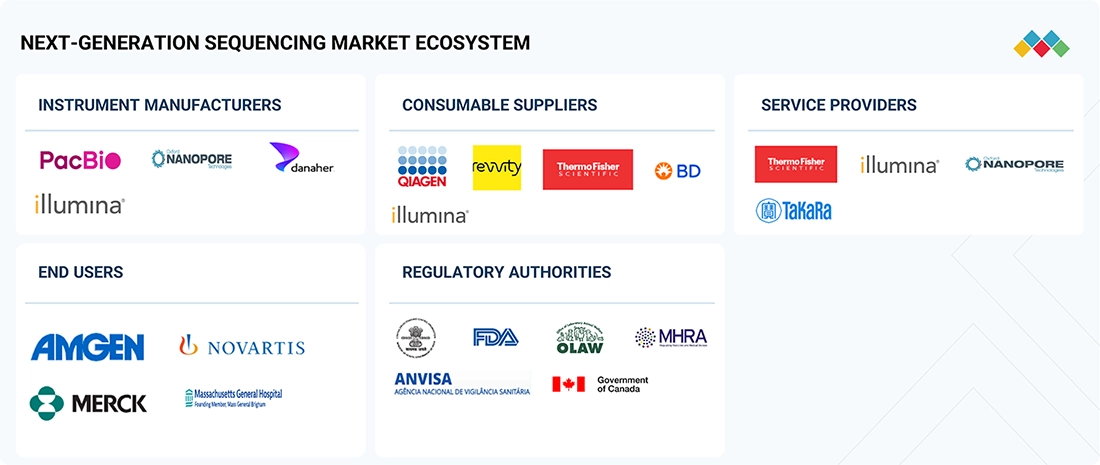
NEXT GENERATION SEQUENCING MARKET: COMMERCIAL USE CASES ACROSS INDUSTRIES
| COMPANY | USE CASE DESCRIPTION | BENEFITS |
|---|---|---|
 |
Nationwide clinical whole genome sequencing (WGS) for rare disease & cancer using Illumina NovaSeq/HiSeq + DRAGEN pipelines. | Higher diagnostic yield | Shorter diagnostic odyssey | Scalable national service. |
 |
Targeted oncology/constitutional testing on Thermo Fisher Ion Torrent (Oncomine/AmpliSeq) panels within a CLIA lab. | Rapid panel TAT | Cost-effective targeted profiling with established QC. |
 |
Clinical WGS service on Illumina platforms integrated with lab LIMS and confirmatory orthogonal tests. | Broader diagnostic yield | Standardized clinical reporting. |
Logos and trademarks shown above are the property of their respective owners. Their use here is for informational and illustrative purposes only.
Related Ecosystem
Key Takeaways
- South Korea's NGS market is valued at $117.4 million in 2026, growing at an 11.4% CAGR through 2031.
- South Korea's market is projected to reach $201.0 million by 2031, driven by precision medicine adoption and genomic research investment.
- South Korea's advanced healthcare infrastructure and biotech sector support rapid NGS technology integration across diagnostic and research applications.
- South Korea's government initiatives and declining sequencing costs are accelerating clinical adoption of NGS in oncology and rare disease diagnosis.
Next-generation Sequencing Market Report Scope
| Report Metric | Details |
|---|---|
| Base Year | 2026 |
| Fastest Growing Segment | SERVICES (Offering) |
| Forecast Period | 2026–2031 |
| Growth Rate | CAGR of 14.5% from 2026 to 2031 |
| Largest Segment | PRODUCTS (Offering) |
| Market Size Base Year (Billions) | ~USD 13.93 (2026) |
| Revenue Forecast (Billions) | ~USD 27.41 (2031) |
| Segments Covered | Offering, Type, Technology, Workflow, End User, Application |
South Korea Next-generation Sequencing Market Report Segmentation
6 segment dimensions are covered across the global market.
By Offering
- Products
- Services
By Type
- Bioinformatics Tools
- Cancer Diagnostics
- Consumables
- Data Analysis Services
- Data Analysis Software & Workbenches
- Data Storage & Management Services
- Data Visualization & Interpretation Services
- Data Visualization Tools
- Illumina
- Infectious Disease Diagnostics
- Library Preparation & Target Enrichment Services
- Library Preparation Kits & Reagents
- Library Preparation Platforms
- Miniseq/Iseq
- Miseq/ Miseq I100
- Nextseq 1K/2K And 550
- Novaseq 6000
- Novaseq Series (X/ X Plus)
- Other Bioinformatics Tools
- Other Consumables
- Other Diagnostic Applications
- Other Drug Discovery & Development Applications
- Other Sequencing Platforms
- Oxford Nanopore Technologies
- Pacbio
- Pharmacogenomics
- Platforms
- Quality Control Services
- Reproductive Health Diagnostics
- Sample Preparation Services
- Sequencing Kits & Reagents
- Sequencing Platforms
- Thermo Fisher Scientific
By Technology
- Ion Semiconductor Sequencing
- Nanopore Sequencing
- Other Sequencing Technologies
- Sequencing By Synthesis
- Smrt Sequencing
By Workflow
- Data Analysis
- Presequencing
- Sequencing
By End User
- Academic & Research Institutes
- Clinical & Diagnostic Laboratories
- Hospitals & Clinical Laboratories
- Other End Users
- Pharmaceutical & Biotechnology Companies
By Application
- Agriculture & Animal Research
- Diagnostics
- Drug Discovery & Development
- Other Applications
Target Audience
- NGS Technology Providers : Equipment manufacturers and sequencing platform developers need South Korea market data to assess market size, identify growth opportunities, understand competitive positioning, and develop localized go-to-market strategies.
- Diagnostic & Clinical Laboratories : Hospital-based and independent diagnostic centers require market insights to evaluate NGS service expansion opportunities, benchmark against competitors, and align investments with South Korea's precision medicine adoption trends.
- Pharmaceutical & Biotech Companies : Drug developers and biotech firms need South Korea NGS market intelligence to identify companion diagnostic opportunities, understand pharmacogenomics adoption, and support precision medicine drug development strategies.
- Healthcare Investors & Consultants : Investment firms and management consultants require detailed South Korea market forecasts and growth drivers to evaluate investment opportunities, assess portfolio companies, and guide strategic healthcare sector decisions.
- Government & Research Institutions : Public health agencies and academic research centers need market data to inform genomic research funding priorities, benchmark South Korea's position globally, and align policy initiatives with market growth trajectories.
Key Companies in the South Korea Next-generation Sequencing Market
| Company | HQ | Ownership | Strongest segments |
|---|---|---|---|
| DNA LINK | South Korea | Public Company | Whole genome and De Novo sequencing,Whole exome and targeted sequencing,Transcriptome and single-cell RNA sequencing, |
| WUXI APPTEC | China | Public Company | WuXi Chemistry (small molecules, oligos, peptides, conjugates),WuXi Testing (toxicology, DMPK, bioanalytical, other lab testing),WuXi Biology (discovery biology, target-to-candidate services), |
| THERAGEN ETEX CO., LTD. | South Korea | Public Company | Circulatory and metabolic drugs,Respiratory and digestive therapies,Antibiotics and antifungals, |
| SYSMEX CORPORATION | Japan | Public Company | Hematology analyzers and reagents (XN-Series, XN-V, ProCyte Dx),Coagulation diagnostics,Blood gas, electrolyte, and urinalysis systems, |
| GENOMICS BIOSCI & TECH. CO., LTD. | Taiwan | Public Company | Clinical testing (reproductive health and cancer),Sequencing, synthesis, genomics and proteomics services,CDMO (contract development and manufacturing), |
| INTEGRAGEN SA | France | Public Company | Genomic pharma and research sequencing services (oncology and rare disease),MERCURY oncology interpretation platform,Galileo RNA-Seq exploration and related analytics, |
| CENTOGENE AG | Germany | Public Company | Genetic sequencing and diagnostics (WES, WGS, NGS assays including NEW CentoGenome),Multiomic solutions (CENTOGENE MOx 2.0 and biochemical/RNA integration),Pharma solutions (target/drug screening, clinical development, market access, patient recruitment), |
| PERSONALIS, INC. | United States | Public Company | Pharma and biopharma services (ImmunoID NeXT, WES/WGS, translational research and clinical trials),MRD and therapy monitoring (NeXT Personal, NeXT Personal Dx),Clinical tumor profiling and Dx (NeXT Dx and related physician-ordered tests), |
| BIOMERIEUX S.A. | France | Public Company | Clinical microbiology (culture media, VITEK, VIRTUO, ETEST, API, VITEK REVEAL),Syndromic and molecular diagnostics (BIOFIRE, SPOTFIRE, ARGENE, EMAG/NUCLISENS),Immunoassays and CLIA (VIDAS, Hybiome), |
| ILLUMINA, INC. | United States | Public Company | Sequencing instruments,Sequencing consumables (reagents, flow cells, library prep),Array-based instruments and consumables, |
| THERMO FISHER SCIENTIFIC INC. | United States | Public Company | Life Sciences Solutions,Analytical Instruments,Specialty Diagnostics, |
| AGILENT TECHNOLOGIES, INC. | United States | Public Company | Life Sciences and Diagnostics Markets,Agilent CrossLab,Applied Markets, |
| QIAGEN | Netherlands | Public Company | Sample technology consumables and instruments,Immune response and infectious disease diagnostics,Oncology and sexual & reproductive health assays, |
| DANAHER CORPORATION | United States | Public Company | Biotechnology (bioprocessing and related solutions),Life Sciences (instruments, genomics, and reagents),Diagnostics (clinical instruments and consumables), |
| REVVITY | United States | Public Company | Diagnostics instruments and reagents (prenatal, neonatal, infectious disease, specialty immunodiagnostics),Life science reagents and assay platforms (immunology, cell analysis, proteomics),Genomic workflows and NGS-related tools, |
| EUROFINS SCIENTIFIC | Luxembourg | Public Company | Food and Feed Testing, Assurance, and Certification,Environment and Maritime Testing,Biopharma Testing and PSS Insourcing, |
| PACBIO | United States | Public Company | Long-read instruments (Revio, Sequel, Vega),Long-read consumables and SMRT reagents,Short-read sequencing (Onso) and related consumables, |
| OXFORD NANOPORE TECHNOLOGIES PLC | United Kingdom | Public Company | PromethION systems and consumables,MinION and portable platforms,GridION and mid-throughput systems, |
| TAKARA BIO INC. | Japan | Private Company | Genetic and cellular research reagents,Instruments (PCR and cellular analysis devices),In vitro diagnostics (including COVID-19 testing), |
| BD | United States | Public Company | Medical Essentials (vascular access, syringes, needles, sharps, enteral),Connected Care (infusion therapy, medication management, pharmacy automation, informatics),BioPharma Systems (prefillable drug delivery systems), |
| 10X GENOMICS | United States | Public Company | Chromium instruments,Chromium consumables & kits (incl. QuantumScale),Visium spatial platform (instruments, slides, assays), |
DNA LINK
DNA LINK is a South Korean public company founded in 2000 with 84 employees, operating in the genomics and biotechnology sector.
WUXI APPTEC
WUXI APPTEC is a Chinese public company founded in 2000 with 33,834 employees, providing pharmaceutical research and development services.
THERAGEN ETEX CO., LTD.
THERAGEN ETEX CO., LTD. is a South Korean public company founded in 1987 with 224 employees, specializing in genomics and genetic testing.
SYSMEX CORPORATION
SYSMEX CORPORATION is a Japanese public company founded in 1968 with 10,861 employees, providing diagnostic and laboratory equipment solutions.
GENOMICS BIOSCI & TECH. CO., LTD.
GENOMICS BIOSCI & TECH. CO., LTD. is a Taiwanese public company founded in 2001, operating in the genomics and biotechnology industry.
INTEGRAGEN SA
INTEGRAGEN SA is a French public company founded in 2000 with 37 employees, specializing in genomics and genetic analysis.
CENTOGENE AG
CENTOGENE AG is a German public company founded in 2006 with 384 employees, providing genetic testing and diagnostic services.
PERSONALIS, INC.
PERSONALIS, INC. is a United States-based public company founded in 2011 with 260 employees, specializing in genomic sequencing and analysis.
BIOMERIEUX S.A.
BIOMERIEUX S.A. is a French public company founded in 1963 with 14,894 employees, providing in vitro diagnostics and microbiology solutions.
ILLUMINA, INC.
ILLUMINA, INC. is a United States-based public company founded in 1998 with 8,625 employees, a leading provider of DNA sequencing and genetic analysis platforms.
THERMO FISHER SCIENTIFIC INC.
THERMO FISHER SCIENTIFIC INC. is a United States-based public company founded in 1956 with 125,000 employees, providing life sciences research and diagnostic products and services.
AGILENT TECHNOLOGIES, INC.
AGILENT TECHNOLOGIES, INC. is a United States-based public company founded in 1999 with 18,000 employees, offering analytical instruments and life sciences solutions.
QIAGEN
QIAGEN is a Netherlands-based public company founded in 1984 with 5,500 employees, providing molecular diagnostics and life sciences research tools.
DANAHER CORPORATION
DANAHER CORPORATION is a United States-based public company founded in 1969 with 59,000 employees, operating a diversified conglomerate including life sciences and diagnostics.
REVVITY
REVVITY is a United States-based public company founded in 1937 with 11,000 employees, providing analytical instruments and life sciences solutions.
EUROFINS SCIENTIFIC
EUROFINS SCIENTIFIC is a Luxembourg-based public company founded in 1987 with 65,694 employees, providing laboratory testing and scientific services globally.
PACBIO
PACBIO is a United States-based public company founded in 2000 with 485 employees, specializing in long-read DNA sequencing technology.
OXFORD NANOPORE TECHNOLOGIES PLC
OXFORD NANOPORE TECHNOLOGIES PLC is a United Kingdom-based public company founded in 2005 with 1,316 employees, developing nanopore-based DNA and RNA sequencing technology.
TAKARA BIO INC.
TAKARA BIO INC. is a Japanese private company founded in 2002 with 1,779 employees, providing biotechnology products and services for research and diagnostics.
BD
BD is a United States-based public company founded in 1897 with 72,000 employees, providing medical devices, diagnostics, and life sciences solutions.
10X GENOMICS
10X GENOMICS is a United States-based public company founded in 2012 with 1,178 employees, developing single-cell and spatial genomics technologies.
Reasons to Buy this Report
- Market-Specific Growth Projections : Access detailed South Korea NGS market forecasts from $117.4M (2026) to $201.0M (2031), enabling accurate business planning and investment decisions tailored to this high-growth Asia Pacific market.
- Competitive Landscape Intelligence : Understand South Korea's unique competitive dynamics, key players, market consolidation trends, and strategic positioning within the regional genomic sequencing ecosystem to identify partnership and expansion opportunities.
- Government Policy & Regulatory Insights : Gain comprehensive analysis of South Korea's government support mechanisms, genomic research initiatives, healthcare regulations, and reimbursement policies driving NGS market expansion and clinical adoption.
- Application-Specific Demand Analysis : Identify high-demand NGS applications in South Korea including oncology, rare disease diagnosis, and pharmacogenomics, with detailed insights into clinical adoption rates and growth drivers by segment.
- Strategic Market Entry Framework : Develop informed market entry strategies with South Korea-specific data on healthcare infrastructure, hospital networks, diagnostic center distribution, and key opinion leader networks for successful commercialization.
Frequently asked questions
What is the current size of South Korea's NGS market in 2026?
South Korea's next-generation sequencing market is valued at $117.4 million in 2026, reflecting strong adoption of genomic technologies in healthcare and research sectors.
What is the projected market size for South Korea's NGS market by 2031?
South Korea's NGS market is forecast to reach $201.0 million by 2031, representing significant growth driven by precision medicine and diagnostic applications.
What is the CAGR for South Korea's NGS market from 2026 to 2031?
South Korea's NGS market is expected to grow at a compound annual growth rate of 11.4% between 2026 and 2031.
What factors are driving growth in South Korea's NGS market?
South Korea's NGS market growth is driven by advancing healthcare infrastructure, government support for genomic research, declining sequencing costs, and increasing adoption of precision medicine in clinical practice.
How does South Korea's NGS market compare to other Asia Pacific countries?
South Korea's NGS market represents a significant segment within Asia Pacific, supported by its robust biotech sector, educated workforce, and strong healthcare investment, positioning it as a regional leader in genomic medicine adoption.
RESEARCH METHODOLOGY
This study of the next-generation sequencing market relied on secondary sources, directories, and databases to gather pertinent information. To collect and validate key qualitative and quantitative data and to evaluate market growth prospects, in-depth interviews were conducted with numerous primary respondents, including key industry participants, subject-matter experts (SMEs), C-level executives from key market players, and industry consultants. After estimating the next-generation sequencing market using several research strategies, the final market size was derived by triangulating data from primary research.
Secondary Research
Secondary sources for this research study include publications from government sources. These include the Centers for Disease Control and Prevention (CDC), the US Food and Drug Administration (FDA), the World Health Organization (WHO), the American Cancer Society (ACS), the National Center for Biotechnology Information (NCBI), the National Institutes of Health (NIH), the National Human Genome Research Institute (NHGRI), the International Agency for Research on Cancer (IARC), the National Institute for Infectious Diseases (IRCCS), the Association for Clinical Genomic Science (ACGS), the American Society of Human Genetics (ASHG), the European Society of Human Genetics (ESHG), the Asia Pacific Society of Human Genetics (APSHG), Nature Reviews Genetics, Nature Methods, the Biotechnology and Biological Sciences Research Council (BBSRC), the Organisation for Economic Co-operation and Development (OECD), Genome Research, the National Cancer Institute (NCI), the European Medicines Agency (EMA), the Population Health Research Institute (PHRI), PubMed, the World Bank, and the World Health Organization (WHO), among others. Secondary sources also included corporate and regulatory filings, such as annual reports, SEC filings, investor presentations, and financial statements; business magazines and research journals; press releases; and trade, business, and professional associations. Secondary data were collected and analyzed to determine the overall size of the global next-generation sequencing market, which was validated through primary research.
Primary Research
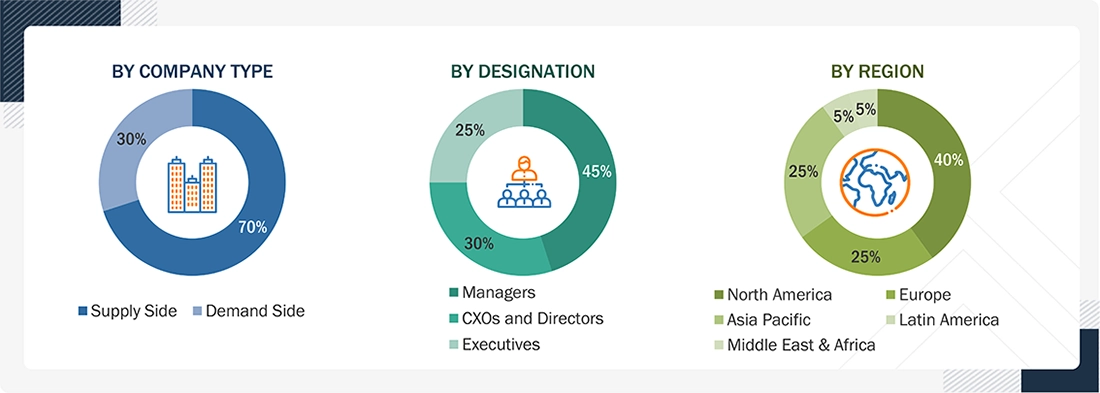
Extensive primary research was conducted after acquiring basic knowledge of the global next-generation sequencing market through secondary research. Several primary interviews were conducted with market experts from the supply side, including C-level and D-level executives, operational managers, and marketing & sales managers at key manufacturers, distributors, and channel partners of companies providing NGS; and from the demand side, including personnel from academic & research institutes, hospitals, clinics and diagnostic labs, pharmaceutical & biopharmaceutical industries, CROs, and other end users. These interviews were conducted across six major regions, including North America, Europe, the Asia-Pacific, Latin America, the Middle East, and Africa. Approximately 70% and 30% of the primary interviews were conducted with supply-side and demand-side participants, respectively. This primary data was collected through questionnaires, e-mails, online surveys, personal interviews, and telephonic interviews.
The following is a breakdown of the primary respondents:
To know about the assumptions considered for the study, download the pdf brochure
Market Size Estimation
Both, the top-down and bottom-up approaches were used to estimate and validate the total size of the next-generation sequencing market. These methods were also used extensively to estimate the size of various subsegments within the market. The research methodology for estimating market size includes the following.
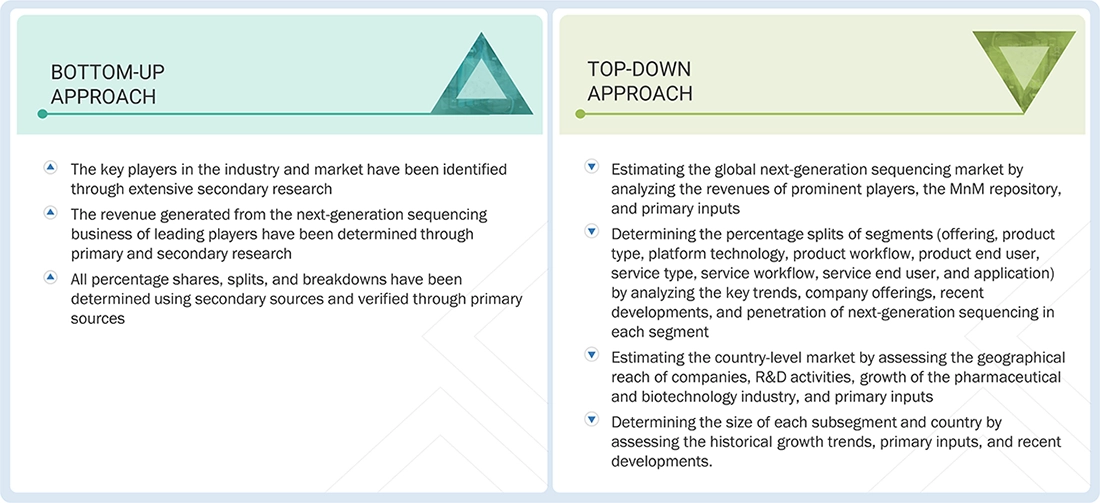
Data Triangulation
To complete the overall market engineering process and arrive at the exact statistics for all segments and subsegments, data triangulation and market breakdown procedures were employed, wherever applicable. The data was triangulated by studying various factors and trends from both the demand and supply sides.
Market Definition
Next-generation sequencing (NGS) refers to non-Sanger-based, high-throughput DNA sequencing technologies. These technologies sequence DNA strands simultaneously, yielding substantially higher throughput and reducing the need for fragment-cloning methods often used in Sanger genome sequencing. NGS is fundamentally based on sequencing by synthesis (SBS), ion semiconductor sequencing, single-molecule real-time (SMRT) sequencing, and nanopore sequencing.
Key Stakeholders
- NGS instrument manufacturers, vendors, and distributors
- NGS service providers
- NGS bioinformatics/data analysis companies
- Research laboratories and academic institutes
- Venture capitalists and other government funding organizations
- Research and consulting firms
- Healthcare institutions (hospitals and diagnostic clinics)
- Pharmaceutical and biotechnology companies
- Academic and government research institutes
- Life science companies
Report Objectives
- To define, describe, and forecast the next-generation sequencing market based on offering, product type, platform technology, product workflow, product end user, service type, service workflow, service end user, application, and region
- To provide detailed information regarding the major factors influencing market growth (such as drivers, restraints, opportunities, and challenges)
- To strategically analyze micro markets with respect to individual growth trends, prospects, and contributions to the overall next-generation sequencing market
- To analyze opportunities in the market for stakeholders and provide details of the competitive landscape for market leaders
- To forecast the size of the market segments with respect to six main regions, namely, North America, Europe, Asia Pacific, Latin America, the Middle East, and Africa
- To profile key players in the global next-generation sequencing market and comprehensively analyze their platforms, reagents, kits, consumables, and service portfolios, market position, and core competencies
- To track and analyze competitive developments such as product & service launches, expansions, agreements, and collaborations in the next-generation sequencing market
- To benchmark players within the next-generation sequencing market using the ‘Company Evaluation Matrix' framework, which analyzes market players based on various parameters within the broad categories of business and service strategy.
Available customizations:
With the given market data, MarketsandMarkets offers customizations as per the company’s specific needs. The following customization options are available for the report:
Geographical Analysis
- Further breakdown of the Rest of Europe next-generation sequencing market, by country
- Further breakdown of the Rest of Asia Pacific next-generation sequencing market, by country
- Further breakdown of the Rest of Latin America next-generation sequencing market, by country
- Further breakdown of the Rest of Middle East next-generation sequencing market, by country
Company Information
- Detailed analysis and profiling of additional market players (up to five)
Segment Analysis
- Further breakdown of the other application and other end users area into subsegments
- Cross-segment analysis.
Get the Full Next-generation Sequencing Market Report
Full forecast, segment splits, and company analysis for all Next-generation Sequencing Market.
- Canada Next-generation Sequencing Market
- US Next-generation Sequencing Market
- Germany Next-generation Sequencing Market
- UK Next-generation Sequencing Market
- France Next-generation Sequencing Market
- Italy Next-generation Sequencing Market
- Spain Next-generation Sequencing Market
- Netherlands Next-generation Sequencing Market
- China Next-generation Sequencing Market
- Japan Next-generation Sequencing Market
- India Next-generation Sequencing Market
- Australia Next-generation Sequencing Market
- Brazil Next-generation Sequencing Market
- Mexico Next-generation Sequencing Market
- Saudi Arabia Next-generation Sequencing Market
- UAE Next-generation Sequencing Market
Need a Tailored Report?
Customize this report to your needs
Get 10% FREE Customization
Customize This Report
