
India Next-Generation Sequencing (NGS) Services Market (2017-2022)

The India Next-Generation Sequencing (NGS) Services Market was valued at $7.4 Million in 2017 and projected to reach to $16.6 Million by 2022, representing a compound annual growth rate of CAGR 17.7%. India's NGS services market is poised for significant growth as healthcare providers increasingly recognize the value of genomic testing in clinical decision-making.


| Market Size in | USD 26.32 MN |
| Market Forecast in | |
| CAGR | |
| Forecast Period | |
| Units Considered | Value (USD MN) |
India Next-Generation Sequencing (NGS) Services Market Trends and Insights
- India is experiencing rapid expansion in genomic research and personalized medicine adoption, driven by increasing healthcare investments and growing awareness of precision diagnostics.
- The market in India reflects strong momentum as diagnostic laboratories, research institutions, and pharmaceutical companies expand NGS capabilities to support cancer genomics, rare disease identification, and infectious disease surveillance. India's NGS services sector is benefiting from declining sequencing costs, government initiatives in genomic research, and rising demand for advanced diagnostic solutions across urban healthcare centers.
- The country's large patient population and growing prevalence of genetic disorders create substantial opportunities for NGS service providers.
- Between 2017 and 2022, India's market is expected to more than double, positioning the nation as a key growth hub within the Asia Pacific region for next-generation sequencing applications..
Key Market Statistics
- CAGR (2017-2022) CAGR 17.7%
- Market Size, 2017 ~USD 7.4 Million
- Forecast, 2022 ~USD 16.6 Million
- Country India
India Next-Generation Sequencing (NGS) Services Market Overview
Rapid Market Expansion :
India's NGS services market is projected to grow from $7.4 million in 2017 to $16.6 million by 2022, with a robust CAGR of 17.7%, outpacing many emerging markets in genomic adoption.
Precision Medicine Adoption :
Growing awareness and adoption of personalized medicine in India is driving demand for NGS services, particularly in oncology, rare disease diagnosis, and pharmacogenomics applications.
Healthcare Investment Surge :
Increased government and private sector investments in healthcare infrastructure and genomic research facilities are accelerating NGS service availability across major Indian cities.
Genomic Research Growth :
India's expanding genomic research initiatives and collaborations with international institutions are establishing the country as a key hub for NGS-based diagnostics and research services.
India Next-Generation Sequencing (NGS) Services Market Dynamics
- The convergence of rising healthcare expenditure, growing patient awareness, and technological accessibility is creating favorable conditions for market expansion.
- Major metropolitan areas are witnessing increased adoption of NGS for cancer diagnostics, inherited disease screening, and infectious disease identification. Looking ahead, India's NGS market will be shaped by regulatory framework development, cost reduction through local capacity building, and integration of genomic data into mainstream healthcare systems.
- Strategic partnerships between diagnostic centers and research institutions, combined with government support for precision medicine initiatives, are expected to drive sustained growth through 2022 and beyond..
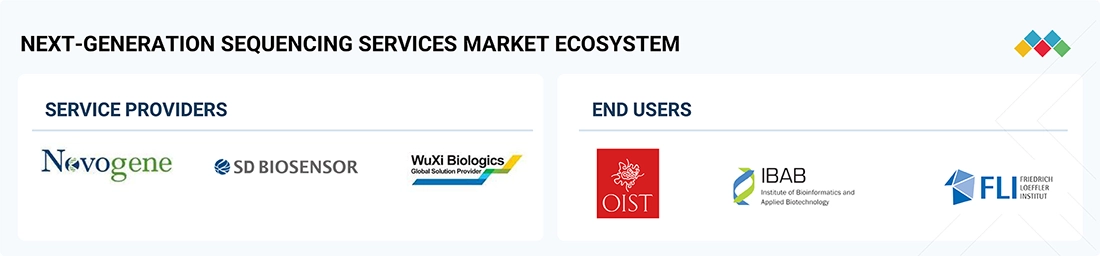
Market Ecosystem
NEXT-GENERATION SEQUENCING (NGS) SERVICES MARKET: COMMERCIAL USE CASES ACROSS INDUSTRIES
| COMPANY | USE CASE DESCRIPTION | BENEFITS |
|---|---|---|
 |
Scientists studying Usutu virus sent viral nucleic acid to Eurofins Genomics for a dedicated RNA-virus sequencing service (INVIEW virus sequencing) on an Illumina NovaSeq 6000 to generate whole-genome data for analysis and comparison with other methods | Quick access to high-quality viral genomes | High-throughput sequencing without adding lab capacity | Supports surveillance and phylogenetics | Clean data for downstream bioinformatics |
Logos and trademarks shown above are the property of their respective owners. Their use here is for informational and illustrative purposes only.
Related Ecosystem
Advanced Genetic Sequencing
- Polymerase Chain Reaction (PCR)
- Reagents
- Assay Kits
- Bioinformatics
- Flow Cytometry
- Thermo Fisher Scientific Inc.
- Illumina, Inc.
- Agilent Technologies, Inc.
- Qiagen N.V.
- Danaher Corporation
Key Takeaways
- India's NGS Services Market grew from $7.4 million (2017) to $16.6 million (2022) at a 17.7% CAGR, more than doubling in size over five years.
- India's market expansion is driven by declining sequencing costs, increased adoption of precision medicine, and growing diagnostic laboratory infrastructure.
- Government support for genomic research initiatives and rising prevalence of genetic disorders in India's large population fuel sustained market growth.
- India represents a high-growth opportunity within Asia Pacific, with NGS adoption accelerating across cancer diagnostics, rare disease identification, and infectious disease surveillance.
Next-Generation Sequencing (NGS) Services Market Report Scope
| Report Metric | Details |
|---|---|
| Base Year | 2017 |
| Fastest Growing Segment | AGRICULTURE & ANIMAL RESEARCH (Application) |
| Forecast Period | 2017–2022 |
| Growth Rate | CAGR of 21% from 2017 to 2022 |
| Largest Segment | DIAGNOSTICS (Application) |
| Market Size Base Year (Billions) | ~USD 1.06 (2017) |
| Revenue Forecast (Billions) | ~USD 2.748 (2022) |
| Segments Covered | Type, Application, End User, Technology |
India Next-Generation Sequencing (NGS) Services Market Report Segmentation
4 segment dimensions are covered across the global market.
By Type
- Chip-Seq
- De Novo Sequencing
- Exome Sequencing
- Methyl-Seq
- Other Ngs Services
- Other Services
- Rna-Seq
- Targeted Sequencing/Custom Gene Panels
- Targeted Sequencing/Gene Panels
- Whole-Genome Sequencing
By Application
- Agriculture & Animal Research
- Biomarker Discovery
- Diagnostics
- Drug Discovery
- Infectious Diseases
- Oncology
- Other Applications
- Other Applications*
- Other Diagnostic Applications
- Rare Genetic Disorders
- Reproductive Health
By End User
- Academic & Government
- Academic & Government Institutes And Research Centers
- Hospitals & Clinics
- Other End Users
- Other End Users*
- Pharmaceutical & Biotechnology Companies
By Technology
- Ion Semiconductor Sequencing
- Nanopore Sequencing
- Sequencing By Synthesis
- Single-Molecule Real-Time Sequencing
Target Audience
- Diagnostic Laboratory Operators : Need India-specific market data to assess expansion opportunities, understand competitive landscape, and plan NGS service offerings in high-growth Indian healthcare markets.
- Healthcare Investment Firms : Require detailed India market analysis to evaluate investment opportunities in genomic diagnostics, identify promising startups, and forecast returns on healthcare technology investments.
- Medical Device & Reagent Manufacturers : Seek India market insights to develop localized product strategies, understand demand patterns, and identify distribution partnerships for NGS equipment and consumables.
- Hospital & Healthcare Networks : Need market intelligence to justify NGS service integration, benchmark against peers, and plan genomic medicine programs aligned with India's precision medicine adoption trends.
- Pharmaceutical & Biotech Companies : Require India NGS market data to support clinical trial planning, companion diagnostic development, and pharmacogenomics research initiatives in the Indian healthcare sector.
Key Companies in the India Next-Generation Sequencing (NGS) Services Market
| Company | HQ | Ownership | Strongest segments |
|---|---|---|---|
| ILLUMINA, INC. | United States | Public Company | Targeted sequencing services,RNA-Seq services,Exome sequencing services, |
| PERKINELMER, INC. | United States | Public Company | Targeted sequencing services,RNA-Seq services,Exome sequencing services, |
| EUROFINS SCIENTIFIC SE | Luxembourg | Public Company | Targeted sequencing services,RNA-Seq services,Exome sequencing services, |
| MACROGEN, INC. | South Korea | Public Company | Targeted sequencing services,RNA-Seq services,Exome sequencing services, |
| QIAGEN N.V. | Netherlands | Public Company | Targeted sequencing services (panels, amplicon, gene panels),RNA-Seq services,Exome and de novo sequencing services, |
| DNA LINK, INC. | South Korea | Public Company | Whole genome & De Novo sequencing services,Whole exome & targeted sequencing services,Transcriptome & single-cell RNA sequencing, |
| TAKARA BIO INC. (PART OF TAKARA HOLDING COMPANY INC.) | Japan | ||
| NOVOGENE CORPORATION | China | Public Company | Whole genome and targeted sequencing services (incl. human/animal/plant/microbial WGS and targeted panels),Transcriptomics and single-cell sequencing (mRNA, lncRNA, small RNA, single-cell, spatial),De novo, metagenomics, and microbiome sequencing, |
| PERSONALIS, INC. | United States | Public Company | Oncology MRD and monitoring (NeXT Personal, NeXT Personal Dx),Comprehensive tumor profiling (ImmunoID NeXT, NeXT Dx),Population and research sequencing (WES/WGS services), |
ILLUMINA, INC.
Illumina, Inc. is a public company founded in 1998 and headquartered in the United States with 8,625 employees. The company is a leader in DNA sequencing and genetic analysis technologies.
PERKINELMER, INC.
PerkinElmer, Inc. is a public company founded in 1937 and based in the United States with 11,000 employees. The company provides diagnostic and research solutions across life sciences and environmental testing.
EUROFINS SCIENTIFIC SE
Eurofins Scientific SE is a public company founded in 1987 and headquartered in Luxembourg with 65,694 employees. The company operates a network of laboratories providing testing and analytical services across multiple industries.
MACROGEN, INC.
Macrogen, Inc. is a public company founded in 2000 and based in South Korea with 293 employees. The company provides genomic research services including DNA sequencing and analysis.
QIAGEN N.V.
QIAGEN N.V. is a public company founded in 1984 and headquartered in the Netherlands with 5,500 employees. The company develops and manufactures molecular diagnostics and life sciences tools.
DNA LINK, INC.
DNA Link, Inc. is a public company founded in 2000 and based in South Korea with 84 employees. The company offers genomic analysis and genetic testing services.
TAKARA BIO INC. (PART OF TAKARA HOLDING COMPANY INC.)
Takara Bio Inc. is a company based in Japan and operates as part of Takara Holding Company Inc. The company specializes in biotechnology and life sciences research products.
NOVOGENE CORPORATION
Novogene Corporation is a public company founded in 2011 and based in China with 2,225 employees. The company provides genomic sequencing and bioinformatics analysis services.
PERSONALIS, INC.
Personalis, Inc. is a public company founded in 2011 and based in the United States with 260 employees. The company develops genomic testing and analysis solutions for precision medicine.
Reasons to Buy this Report
- Market Size & Growth Validation : Obtain precise market valuation data for India's NGS services sector with verified CAGR of 17.7%, enabling accurate business planning and investment decisions for the Indian market.
- Competitive Positioning Strategy : Understand India-specific market dynamics, growth drivers, and regional adoption patterns to develop targeted strategies for market entry or expansion within the Indian healthcare ecosystem.
- Investment & Funding Insights : Access comprehensive data on India's NGS market trajectory to support venture capital decisions, partnership evaluations, and resource allocation for genomic diagnostic ventures.
- Regulatory & Operational Planning : Leverage India-focused market intelligence to navigate local regulatory requirements, identify key stakeholders, and plan operational infrastructure for NGS service delivery.
- Revenue Forecasting Accuracy : Utilize detailed India market projections through 2022 to build accurate financial models, revenue forecasts, and performance benchmarks specific to the Indian NGS services landscape.
Frequently asked questions
What was India's NGS Services Market size in 2017?
India's NGS Services Market was valued at $7.4 million in 2017, establishing the baseline for market growth analysis.
What is the projected market size for India's NGS Services by 2022?
India's NGS Services Market is forecast to reach $16.6 million by 2022, representing more than a doubling of market value from 2017.
What is the CAGR for India's NGS Services Market?
India's NGS Services Market is expected to grow at a compound annual growth rate (CAGR) of 17.7% between 2017 and 2022.
What are the primary drivers of NGS market growth in India?
Key growth drivers in India include declining sequencing costs, government genomic research initiatives, rising precision medicine adoption, and increasing prevalence of genetic disorders.
Which applications are driving NGS adoption in India?
Primary applications driving India's NGS market include cancer genomics, rare disease identification, infectious disease surveillance, and personalized medicine diagnostics.
RESEARCH METHODOLOGY
This study on the Next-Generation Sequencing (NGS) Services Market employed secondary sources, directories, and databases to gather pertinent information. To gather and validate important qualitative and quantitative data and evaluate market growth prospects, in-depth interviews were conducted with many primary respondents including key industry participants, subject-matter experts (SMEs), C-level executives from key market players, and industry consultants. After estimating the Next-Generation Sequencing (NGS) Services Market using several research strategies, the size of the final market was obtained by triangulating data from primary research.
Secondary Research
The secondary sources referred to for this research study include publications from government sources. These include the Centers for Disease Control and Prevention (CDC), the US Food and Drug Administration (FDA), the World Health Organization (WHO), the American Cancer Society (ACS), the National Center for Biotechnology Information (NCBI), the National Institutes of Health (NIH), National Human Genome Research Institute (NHGRI), International Agency for Research on Cancer (IARC), National Institute for Infectious Diseases (IRCCS), Association for Clinical Genomic Science (ACGS), American Society of Human Genetics (ASHG), European Society of Human Genetics (ESHG), Asia Pacific Society of Human Genetics (APSHG), Nature Reviews Genetics, Nature Methods, Biotechnology and Biological Sciences Research Council (BBSRC), Organisation for Economic Co-operation and Development (OECD), Genome Research, National Cancer Institute (NCI), European Medicines Agency (EMA), Population Health Research Institute (PHRI), PubMed, World Bank, and the World Health Organization (WHO), among others. Secondary sources also included corporate & regulatory filings, such as annual reports, SEC filings, investor presentations, and financial statements; business magazines & research journals; press releases; and trade, business, and professional associations. Secondary data was collected and analyzed to arrive at the overall size of the global Next-Generation Sequencing (NGS) Services Market , which was validated through primary research.
Primary Research
Extensive primary research was conducted after acquiring basic knowledge about the global Next-Generation Sequencing (NGS) Services Market scenario through secondary research. Several primary interviews were conducted with market experts from the supply side, such as C-level and D-level executives, operational managers, marketing & sales managers of key manufacturers, distributors, and channel partners of companies providing NGS; experts from the demand side, such as personnel from academic & research institutes, hospitals, clinics and diagnostic labs, pharmaceutical & biopharmaceutical industries, CROs, and other end users. These interviews were conducted across six major regions, including North America, Europe, the Asia Pacific, Latin America, the Middle East, and Africa. Approximately 70% and 30% of the primary interviews were conducted with supply-side and demand-side participants, respectively. This primary data was collected through questionnaires, e-mails, online surveys, personal interviews, and telephonic interviews.
Market Size Estimation
Both top-down and bottom-up approaches were used to estimate and validate the total size of the Next-Generation Sequencing (NGS) Services Market . These methods were also used extensively to estimate the size of various subsegments in the market. The research methodology used to estimate the market size includes the following:
Data Triangulation
To complete the overall market engineering process and arrive at the exact statistics for all segments and subsegments, data triangulation and market breakdown procedures were employed, wherever applicable. The data was triangulated by studying various factors and trends from both the demand and supply sides.
Market Definition
NGS refers to non-Sanger-based, high-throughput DNA sequencing technologies. DNA strands can be sequenced simultaneously, yielding substantially more throughput and minimizing the need for fragment-cloning methods often used in the Sanger sequencing of genomes. NGS is fundamentally based on sequencing by synthesis (SBS), ion semiconductor sequencing, single-molecule real-time (SMRT) sequencing, and nanopore sequencing.
Stakeholders
- NGS instrument manufacturers, vendors, and distributors
- NGS service providers
- NGS bioinformatics/data analysis companies
- Research laboratories and academic institutes
- Venture capitalists and other government funding organizations
- Research and consulting firms
- Healthcare institutions (hospitals and diagnostic clinics)
- Pharmaceutical and biotechnology companies
- Academic and government research institutes
- Life science companies
Report Objectives
- To define, describe, and forecast the Next-Generation Sequencing (NGS) Services Market based on offerings, product type, platform technology, product workflow, product end user, service type, service workflow, service end user, application, and region
- To provide detailed information regarding the major factors influencing the market growth (such as drivers, restraints, opportunities, and challenges)
- To strategically analyze micro markets with respect to individual growth trends, prospects, and contributions to the overall next-generation sequencing market
- To analyze the opportunities in the market for stakeholders and provide details of the competitive landscape for market leaders
- To forecast the size of the market segments with respect to six main regions, namely, North America, Europe, the Asia Pacific, Latin America, the Middle East, and Africa
- To profile the key players in the global Next-Generation Sequencing (NGS) Services Market and comprehensively analyze their platforms, reagents, kits, consumables, and services portfolios, market positions, and core competencies
- To track and analyze competitive developments such as product & service launches, expansions, agreements, and collaborations in the next-generation sequencing market
- To benchmark players within the Next-Generation Sequencing (NGS) Services Market using the ‘Company Evaluation Matrix' framework, which analyzes market players based on various parameters within the broad categories of business and service strategy
Get the Full Next-Generation Sequencing (NGS) Services Market Report
Full forecast, segment splits, and company analysis for all Next-Generation Sequencing (NGS) Services Market.
- Canada Next-Generation Sequencing (NGS) Services Market
- Germany Next-Generation Sequencing (NGS) Services Market
- France Next-Generation Sequencing (NGS) Services Market
- China Next-Generation Sequencing (NGS) Services Market
- Japan Next-Generation Sequencing (NGS) Services Market
- U.S. Next-Generation Sequencing (NGS) Services Market
- Roe Next-Generation Sequencing (NGS) Services Market
- U.K. Next-Generation Sequencing (NGS) Services Market
- Roapac Next-Generation Sequencing (NGS) Services Market
Need a Tailored Report?
Customize this report to your needs
Get 10% FREE Customization
Customize This Report
