Japan Nuclear Power Market (2024-2029)

The Japan Nuclear Power Market was valued at $1642.3 Million in 2024 and projected to reach to $1765.8 Million by 2029, representing a compound annual growth rate of CAGR 1.5%. Japan's nuclear power market is positioned for steady, measured growth as the nation navigates post-Fukushima recovery and regulatory normalization.


| Market Size in | USD 26.32 MN |
| Market Forecast in | |
| CAGR | |
| Forecast Period | |
| Units Considered | Value (USD MN) |
Japan Nuclear Power Market Trends and Insights
- Japan maintains a strategic focus on nuclear energy as part of its long-term energy security and decarbonization objectives.
- The market reflects Japan's commitment to balancing renewable energy expansion with stable baseload power generation through nuclear capacity. The modest growth trajectory in Japan reflects the country's mature nuclear infrastructure and regulatory environment established post-Fukushima.
- Japan continues to restart previously halted reactors while investing in advanced safety technologies and next-generation nuclear solutions.
- Between 2024 and 2029, Japan's nuclear power market will be shaped by government policy support, aging reactor management, and the integration of nuclear energy within Japan's broader clean energy transition strategy. Japan's nuclear sector remains pivotal to Asia Pacific's energy landscape, with the country balancing operational efficiency, public acceptance, and technological innovation.
- Japan's measured growth rate reflects both the opportunities and challenges inherent in maintaining and modernizing an established nuclear fleet while pursuing sustainable energy goals..
Key Market Statistics
- CAGR (2024-2029) CAGR 1.5%
- Market Size, 2024 ~USD 1642.3 Million
- Forecast, 2029 ~USD 1765.8 Million
- Country Japan
Japan Nuclear Power Market Overview
Post-Fukushima Recovery :
Japan's nuclear sector is experiencing gradual recovery following the 2011 Fukushima disaster, with stricter safety regulations now in place and reactor restarts progressing under enhanced security protocols.
Energy Security Priority :
Japan relies on nuclear power as a critical component of its energy independence strategy, reducing dependence on fossil fuel imports and supporting long-term energy stability amid geopolitical uncertainties.
Decarbonization Commitment :
Japan's 2050 carbon neutrality target positions nuclear energy as essential infrastructure, with the government actively promoting reactor modernization and advanced reactor technologies to meet climate goals.
Moderate Growth Trajectory :
With a CAGR of 1.5% through 2029, Japan's nuclear market reflects cautious expansion driven by regulatory approvals, aging reactor replacements, and balanced renewable energy integration.
Japan Nuclear Power Market Dynamics
- The government's commitment to nuclear energy as a baseload power source, combined with Japan's ambitious decarbonization targets, supports continued investment in reactor operations and safety upgrades.
- However, growth remains constrained by public sentiment concerns, lengthy regulatory approval processes, and competition from expanding renewable energy capacity. Looking ahead to 2029, Japan's nuclear sector will likely benefit from reactor restarts, life extension programs for existing facilities, and potential development of next-generation reactor technologies.
- The market's 1.5% CAGR reflects a pragmatic approach balancing nuclear's role in energy security with Japan's broader transition toward a diversified, low-carbon energy portfolio..
Market Ecosystem
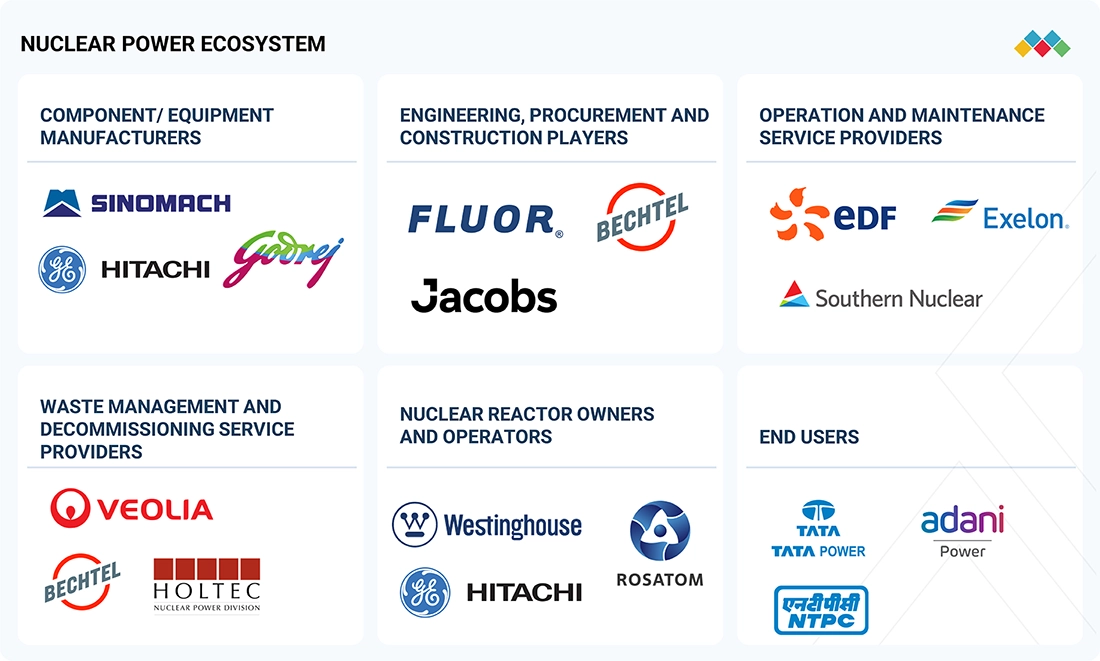
NUCLEAR POWER MARKET SIZE, SHARE, GROWTH, ANALYSIS: COMMERCIAL USE CASES ACROSS INDUSTRIES
| COMPANY | USE CASE DESCRIPTION | BENEFITS |
|---|---|---|
 |
Qinshan Nuclear Power Plant operates multiple nuclear reactor units to provide stable, low-carbon electricity while maintaining high safety and operational reliability. The plant focuses on meeting regulatory standards, extending reactor lifetimes, and ensuring consistent power generation to support China’s electricity needs. | The plant delivers reliable baseload power with low emissions, supports long-term energy security, and contributes to carbon reduction through sustained nuclear generation. |
 |
ORLEN Synthos Green Energy is developing small modular reactor projects in Poland to support the transition away from coal and provide reliable, low-carbon electricity, particularly for industrial users. The initiative focuses on replacing aging coal assets and meeting future energy demand. | The SMR projects are expected to reduce coal dependence, lower emissions, and improve energy security while supporting Poland’s long-term decarbonization goals. |
Logos and trademarks shown above are the property of their respective owners. Their use here is for informational and illustrative purposes only.
Related Ecosystem
Decarbonization
- Battery Electric Vehicle (BEV)
- Energy Management Systems
- Fuel Cell
- Fuel Cell Electric Vehicle (FCEV)
- Geographical Information System (GIS)
- TotalEnergies SE
- Siemens ag
- Mitsui & Co., Ltd.
- General Electric Company
- Thyssenkrupp ag
Key Takeaways
- Japan's nuclear power market is valued at $1,642.3 million in 2024 and will reach $1,765.8 million by 2029 with a 1.5% CAGR.
- Japan's growth is constrained by a mature nuclear fleet and post-Fukushima regulatory frameworks that prioritize safety over rapid expansion.
- Japan is strategically restarting previously halted reactors and investing in advanced safety technologies to modernize its nuclear infrastructure.
- Japan's nuclear sector is integral to the country's energy security and decarbonization strategy within the Asia Pacific region.
Nuclear Power Market Report Scope
| Report Metric | Details |
|---|---|
| Base Year | 2024 |
| Fastest Growing Segment | DECOMMISSIONING (Plant Lifecycle Stage) |
| Forecast Period | 2024-2029 |
| Growth Rate | CAGR of 2.9% from 2024 to 2029 |
| Largest Segment | ENGINEERING, PROCUREMENT, AND CONSTRUCTION (EPC) (Plant Lifecycle Stage) |
| Market Size Base Year (Billions) | ~USD 38.76 (2024) |
| Revenue Forecast (Billions) | ~USD 44.71 (2029) |
| Segments Covered | Type, Nuclear Power Plant Type, Plant Lifecycle Stage, Equipment Type, Nuclear Island, Conventional, Connectivity, Capacity, Application, Small Modular Reactor Type |
Japan Nuclear Power Market Report Segmentation
10 segment dimensions are covered across the global market.
By Type
- Fast Neutron Reactors
- Heavy Water Reactors
- High-Temperature Reactors
- Light Water Reactors
- Molten Salt Reactors
- New Build
- Nuclear Power Plants
- Refurbishment & Modernization
- Small Modular Reactors
By Nuclear Power Plant Type
- Boiling Water Reactors (Bwr)
- Other Nuclear Power Plants
- Pressurized Heavy Water Reactor (Phwr)
- Pressurized Water Reactor (Pwr)
- Pressurized Water Reactors (Pwr)
By Plant Lifecycle Stage
- Decommissioning
- Decommissioning (Mwe)
- Engineering, Procurement, And Construction (Epc)
- Engineering, Procurement, And Construction (Epc) (Mwe)
- Maintenance & Operation Services
- Maintenance & Operation Services (Mwh)
By Equipment Type
- Balance Of Plant
- Conventional (Turbine) Island
- Nuclear Island
By Nuclear Island
- Control Rod Device Mechanism
- Other Nuclear Islands
- Reactor Pressure Vessel
- Steam Generator
By Conventional
- Generator
- Instrumentation And Control Systems
- Other Conventional Islands
- Turbine
By Connectivity
- Grid-Connected
- Off-Grid
By Capacity
- Large (Above 1,000 Mw)
- Medium (500-1,000 Mw)
- Small (Less Than 500 Mw)
By Application
- Desalination
- Industrial
- Power Generation
By Small Modular Reactor Type
- Fast Neutron Reactors
- Heavy Water Reactors
- High-Temperature Reactors
- Light Water Reactors
- Molten Salt Reactors
JAPAN: NUCLEAR POWER MARKET, BY APPLICATION, 2024–2029
| Segment | 2024 | 2025 | 2026 | 2027 | 2028 | 2029 | CAGR (%) |
|---|---|---|---|---|---|---|---|
| DESALINATION | 127 | 130.8 | 134.7 | 138.9 | 143.3 | 147.8 | 3.1 |
| INDUSTRIAL | 352.8 | 361.2 | 369.8 | 379 | 388.5 | 398.4 | 2.5 |
| POWER GENERATION | 1162.5 | 1184.7 | 1201 | 1208.3 | 1214.9 | 1219.5 | 1 |
| TOTAL | 1642.3 | 1676.6 | 1705.6 | 1726.2 | 1746.7 | 1765.8 | 1.5 |
Target Audience
- Nuclear Utility Operators : Japanese and international nuclear operators need market data to optimize reactor operations, plan maintenance schedules, and evaluate expansion opportunities within Japan's regulated environment.
- Equipment & Technology Suppliers : Manufacturers of nuclear components, safety systems, and advanced reactor technologies require detailed market insights to identify procurement opportunities and develop Japan-specific product strategies.
- Energy Policy Makers : Government agencies and energy planners use market intelligence to inform nuclear energy policy, allocate resources for reactor restarts, and align nuclear strategy with decarbonization objectives.
- Investment & Financial Institutions : Investors, private equity firms, and financial analysts need comprehensive market forecasts and growth drivers to evaluate nuclear sector investments and funding opportunities in Japan.
- Consulting & Engineering Firms : Strategic consultants and engineering companies require detailed market analysis to advise clients on nuclear sector opportunities, regulatory compliance, and technology deployment in Japan.
Reasons to Buy this Report
- Regulatory Landscape Intelligence : Gain detailed insights into Japan's evolving nuclear regulatory framework, reactor restart timelines, and safety compliance requirements essential for market entry and operational planning.
- Investment Opportunity Assessment : Identify high-potential investment segments within Japan's nuclear sector, including reactor modernization, decommissioning services, and advanced fuel technologies aligned with government priorities.
- Competitive Market Positioning : Understand Japan's competitive dynamics, key market players, technology partnerships, and strategic initiatives to effectively position products and services in this specialized market.
- Policy & Decarbonization Alignment : Access comprehensive analysis of Japan's carbon neutrality targets, nuclear energy policy roadmaps, and government incentives driving market growth through 2029 and beyond.
- Risk Mitigation Strategies : Evaluate public perception trends, regulatory risks, and operational challenges specific to Japan's nuclear sector to develop informed risk management and stakeholder engagement strategies.
Frequently asked questions
What is the current size of Japan's nuclear power market?
Japan's nuclear power market was valued at $1,642.3 million in 2024 and is expected to grow to $1,765.8 million by 2029.
What is the growth rate of Japan's nuclear power market?
Japan's nuclear power market is projected to grow at a compound annual growth rate (CAGR) of 1.5% from 2024 to 2029.
Why is Japan's nuclear market growth relatively modest?
Japan's growth is constrained by its mature nuclear infrastructure, stringent post-Fukushima safety regulations, and the time required to restart previously halted reactors.
What are Japan's key nuclear energy priorities?
Japan prioritizes reactor restarts, advanced safety technology investments, aging fleet modernization, and integrating nuclear energy into its clean energy transition strategy.
How does Japan's nuclear market compare to global trends?
Japan's 1.5% CAGR is lower than the global nuclear power market CAGR of 2.9%, reflecting Japan's mature market status and regulatory constraints.
RESEARCH METHODOLOGY
This research study involves the use of extensive secondary sources, directories, and databases, such as Hoovers, Bloomberg L.P., Factiva, ICIS, and OneSource, to identify and collect information useful for this technical, market-oriented, and commercial study of the global nuclear power market. Primary sources are mainly industry experts from core and related industries, preferred suppliers, manufacturers, distributors, service providers, and organizations related to all segments of the value chain of this industry. In-depth interviews were conducted with various primary respondents, including key industry participants, subject matter experts, C-level executives of key market players, and industry consultants, among other experts, to obtain and verify critical qualitative and quantitative information as well as assess growth prospects of the market.
Secondary Research
The secondary sources for this research study include annual reports, press releases, investor presentations of companies, white papers, certified publications, articles by recognized authors, and databases of various companies and associations. Secondary research was mainly used to obtain key information about the supply chain and identify the key players offering nuclear power, market classification, and segmentation according to the offerings of the leading players, along with the industry trends to the bottom-most level, regional markets, and key developments from both, market- and technology oriented perspectives.
Primary Research
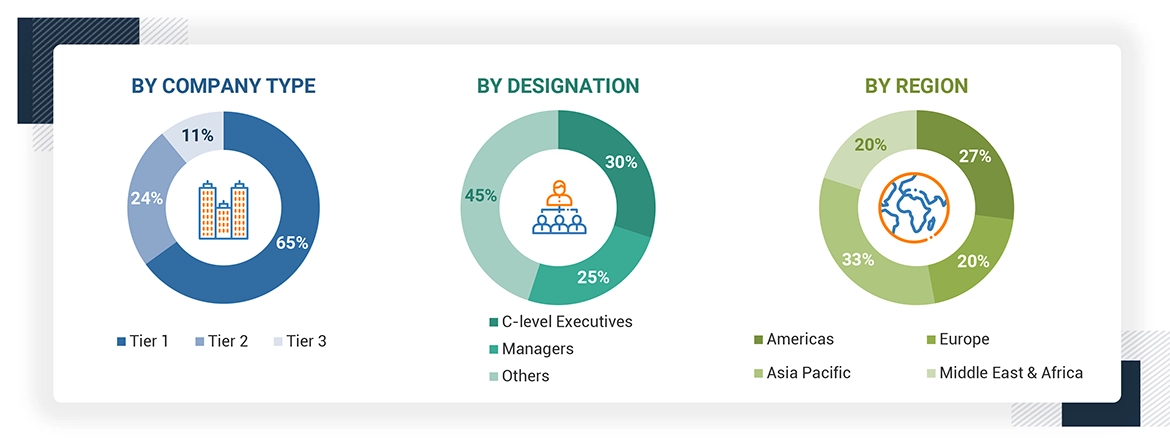
In the primary research process, various sources from the supply and demand sides were interviewed to obtain qualitative and quantitative information for this report. Primary sources from the supply side include industry experts such as chief executive officers (CEOs), vice presidents (VPs), marketing directors, and related key executives from various companies and organizations operating in the nuclear power market.
In the complete market engineering process, the top-down and bottom-up approaches and several data triangulation methods were extensively used to perform the market size estimations and forecasts for all segments and subsegments listed in this report. Extensive qualitative and quantitative analyses were conducted to complete the market engineering process and list key information/insights throughout the report.
To know about the assumptions considered for the study, download the pdf brochure
Market Size Estimation
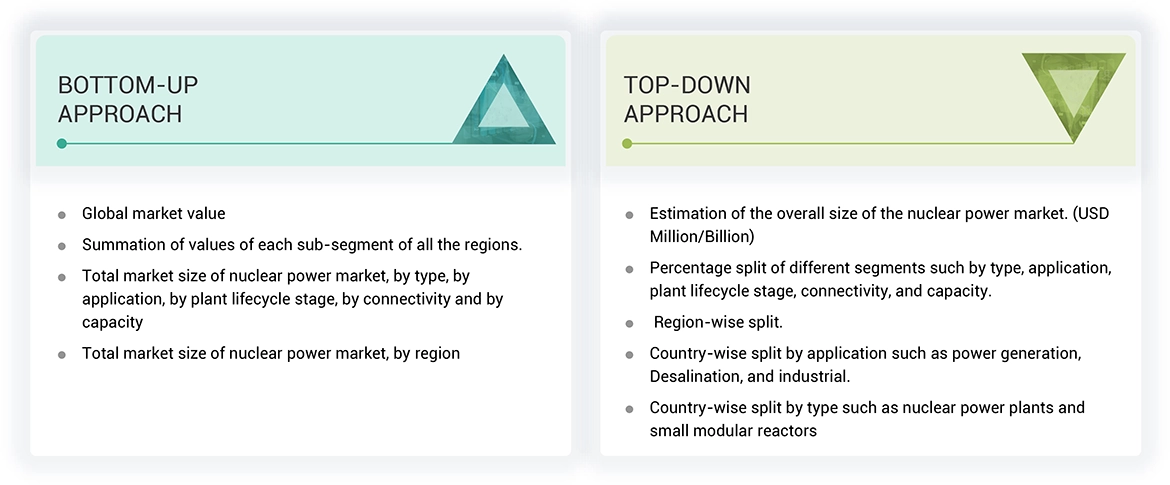
Both the top-down and bottom-up approaches were used to estimate and validate the size of the nuclear power market and its dependent submarkets. The key players in the market were identified through secondary research, and their market share in the respective regions was obtained through primary and secondary research. The research methodology includes the study of the annual and financial reports of top market players and interviews with industry experts, such as chief executive officers, vice presidents, directors, sales managers, and marketing executives, for key quantitative and qualitative insights related to the market.
Nuclear Power Market : Top-Down and Bottom-Up Approach
Data Triangulation
After arriving at the overall market size from the estimation process explained above, the total market has been split into several segments and sub-segments. Data triangulation and market breakdown procedures have been used wherever applicable to complete the overall market engineering process and to arrive at the exact statistics for all segments and sub-segments. The data has been triangulated by studying various factors and trends from both the demand and supply sides. The market has been validated using both the top-down and bottom-up approaches. Then, it was verified through primary interviews. Hence, for every data segment, there are three sources—the top-down approach, the bottom-up approach, and expert interviews. When the values arrived at from the three points matched, the data was assumed to be correct.
Market Definition
Nuclear power is produced through the energy released during nuclear fission. In nuclear power plants, electricity is generated by harnessing this process, where heavy atoms such as uranium-235 split when struck by a neutron. This splitting triggers a chain reaction, releasing more neutrons and significant heat. The heat is then used to produce steam, which drives turbines connected to generators, ultimately producing electricity.
The nuclear power market represents the sum of year-on-year installation of nuclear reactor capacities by global companies and electricity generated by nuclear power plants each year, covering the entire plant lifecycle stages. In this study, the sum of the year-on-year cost of decommissioning and maintenance & operation services has been considered. Additionally, the study also includes the revenues of the companies that are considered during the study period. In EPC segment, the equipment cost is also considered.
Stakeholders
- Companies in the energy & power sector
- Government and research organizations
- Investment banks
- Engineering, Procurement, and Construction companies
- Decommissioning service providers
- Maintenance & Operations services providers
- Nuclear power plant owners/operators
- Power and energy associations
- Nuclear power plant equipment support service providers
- Manufacturers of nuclear power plant equipment
- Nuclear power plant equipment component manufacturers
- Power generation companies
- Heavy industries
Report Objectives
- To define, describe, and forecast the nuclear power market based on type, connectivity, capacity, plant lifecycle stage, application, and region in terms of value
- To forecast the market by type and region in terms of volume
- To describe and forecast the market for four key regions: Americas, Europe, Asia Pacific, Middle East & Africa, along with their country-level market sizes in terms of value
- To provide detailed information on the major factors influencing the growth of the market (drivers, restraints, opportunities, and challenges)
- To strategically analyze the micromarkets1 with respect to individual growth trends, prospects, and contributions to the overall market size
- To provide market dynamics, trends/disruptions impacting customer business, supply chain analysis, ecosystem analysis, case study analysis, investment and funding scenario, patent analysis, trade analysis, technology analysis, key conferences & events, regulatory landscape, pricing analysis, key stakeholders and buying criteria, global macroeconomic outlook for nuclear power market, Porter’s five forces analysis, pertaining to the nuclear power plant market
- To benchmark players within the market using the company evaluation matrix, which analyzes market players on various parameters within the broad categories of business and product strategies
- To compare key market players with respect to their market share, product specifications, and applications
- To strategically profile key players and comprehensively analyze their market rankings and core competencies2
- To analyze competitive developments, such as contracts & agreements, investments & expansions, mergers & acquisitions, partnerships, and collaborations, in the market
- To study the impact of AI/Gen AI on the market under study, along with the global macroeconomic outlook
Note: 1. Micromarkets are defined as the further segments and subsegments of the nuclear power market included in the report.
2. Core competencies of companies are captured in terms of their key developments and product portfolios, as well as key strategies adopted to sustain their position in the market.
Available Customizations
MarketsandMarkets offers customizations according to the specific needs of the companies with the given market data.
The following customization options are available for the report:
Product Analysis
- Product matrix, which gives a detailed comparison of the product portfolio of each company
Regional Analysis
- Further breakdown of the nuclear power market, by country
Company Information
- Detailed analysis and profiling of additional market players (up to five)
Get the Full Nuclear Power Market Report
Full forecast, segment splits, and company analysis for all Nuclear Power Market.
- China Nuclear Power Market
- India Nuclear Power Market
- South Korea Nuclear Power Market
- Russia Nuclear Power Market
- France Nuclear Power Market
- UK Nuclear Power Market
- Canada Nuclear Power Market
- Argentina Nuclear Power Market
- UAE Nuclear Power Market
- Saudi Arabia Nuclear Power Market
- South Africa Nuclear Power Market
- US Nuclear Power Market
- Rest Of Europe Nuclear Power Market
- Rest Of Asia Pacific Nuclear Power Market
- GCC Countries Nuclear Power Market
Need a Tailored Report?
Customize this report to your needs
Get 10% FREE Customization
Customize This Report
