
GCC Occupancy Sensor Market (2024-2029)

The GCC Occupancy Sensor Market was valued at $13.4 Million in 2024 and projected to reach to $17.4 Million by 2029, representing a compound annual growth rate of 4.5%. The GCC occupancy sensor market is positioned for steady expansion as regional governments prioritize smart building technologies and energy conservation measures.


| Market Size in | USD 26.32 MN |
| Market Forecast in | |
| CAGR | |
| Forecast Period | |
| Units Considered | Value (USD MN) |
GCC Occupancy Sensor Market Trends and Insights
- Africa & Rest Of Middle East represents a developing segment within the broader semiconductor and electronics industry, driven by increasing adoption of smart building technologies and energy efficiency initiatives across commercial and residential sectors.
- The region's growth trajectory reflects rising awareness of occupancy-based automation solutions, though Africa & Rest Of Middle East continues to lag behind more mature markets due to infrastructure and investment constraints. During the forecast period from 2024 to 2029, Africa & Rest Of Middle East is expected to maintain a compound annual growth rate of 4.5%, indicating moderate but consistent market expansion.
- This growth in Africa & Rest Of Middle East is supported by gradual urbanization, government sustainability mandates, and the increasing cost of energy management.
- Africa & Rest Of Middle East presents emerging opportunities for sensor manufacturers and system integrators willing to address the region's unique infrastructure and affordability requirements..
Key Market Statistics
- CAGR (2024-2029) 4.5% CAGR
- Market Size, 2024 ~USD 13.4 Million
- Forecast, 2029 ~USD 17.4 Million
- Country GCC
GCC Occupancy Sensor Market Overview
Market Valuation :
The GCC occupancy sensor market is valued at $13.4 million in 2024, with a projected growth to $17.4 million by 2029, representing a steady CAGR of 4.5% over the forecast period.
Growth Drivers :
GCC market growth is fueled by increasing investments in smart building infrastructure, government sustainability initiatives, and rising energy efficiency awareness across commercial and residential sectors.
Regional Position :
While GCC's 4.5% CAGR is moderate compared to the global 11.2% CAGR, the region represents a developing but strategically important market for occupancy sensor adoption in the Middle East.
Technology Adoption :
GCC countries are progressively integrating occupancy sensors into smart city projects and modern building management systems, driven by Vision 2030 initiatives and digital transformation agendas.
GCC Occupancy Sensor Market Dynamics
- Key drivers include increasing urbanization, rising commercial real estate development, and growing awareness of operational cost reduction through automated lighting and HVAC systems.
- The region's focus on sustainable development and smart city initiatives creates favorable conditions for occupancy sensor deployment across office buildings, retail spaces, and hospitality sectors. Despite a moderate 4.5% CAGR compared to global benchmarks, GCC presents significant untapped potential.
- Increasing foreign direct investment in commercial infrastructure, coupled with mandatory energy efficiency standards in new construction projects, will accelerate market penetration.
- The region's affluent consumer base and emphasis on premium building automation solutions position GCC as a growing hub for advanced occupancy sensing technologies through 2029..
Market Ecosystem
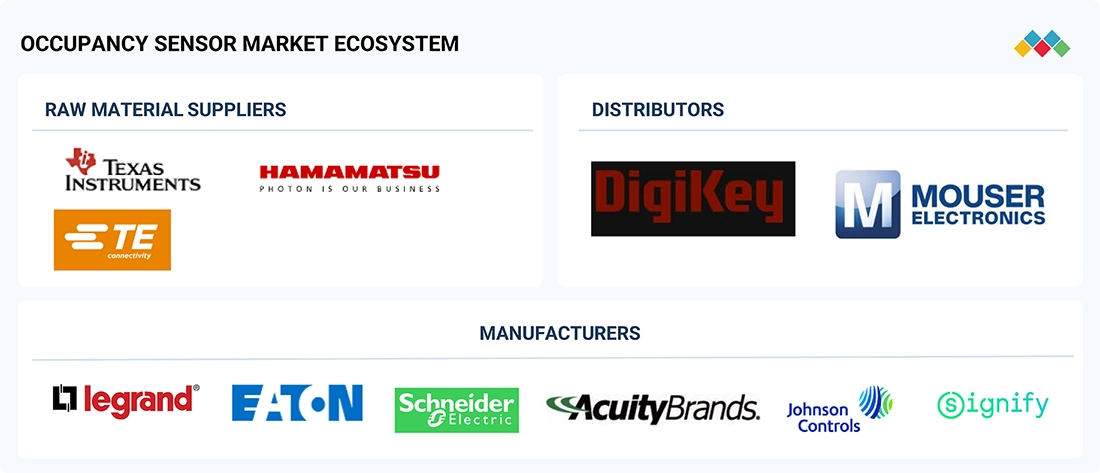
OCCUPANCY SENSOR MARKET SIZE, SHARE & ANALYSIS: COMMERCIAL USE CASES ACROSS INDUSTRIES
| COMPANY | USE CASE DESCRIPTION | BENEFITS |
|---|---|---|
 |
Deployment of PIR, ultrasonic, and dual-technology occupancy sensors in commercial buildings, office spaces, and educational institutions. | Enhances energy efficiency by automating lighting and HVAC, reduces operational costs, and improves overall building comfort. |
 |
Integration of smart occupancy sensors with building management systems (BMS) for real-time monitoring of space usage and automated environmental control | Improves space optimization, increases energy savings, and enables intelligent facility management through data-driven insights. |
 |
Use of wired and wireless occupancy sensors in industrial facilities and commercial lighting systems for automated control and safety compliance. | Reduces energy waste in large facilities, enhances worker safety, and supports compliance with energy and building codes |
 |
Advanced occupancy and presence sensors integrated into HVAC, security, and smart building platforms for industrial, commercial, and healthcare environments | Increases operational efficiency, enables predictive building control, and enhances comfort with precise occupancy-based adjustments. |
 |
Deployment of networked lighting control sensors and ceiling-mounted occupancy detectors in retail, office, and residential applications. | Delivers high energy savings, supports smart lighting ecosystems, and enhances user experience with seamless automation. |
Logos and trademarks shown above are the property of their respective owners. Their use here is for informational and illustrative purposes only.
Related Ecosystem
Sensors And Control
- Sensors
- Image Sensors
- Temperature Sensors
- Pressure Sensors
- Flow Sensors
- BAUMER ELECTRIC AG
- HONEYWELL INTERNATIONAL INC.
- Stmicroelectronics
- Lenovo
- Texas Instruments Incorporated
Digitalization And Iot
- Sensors
- Remote Monitoring
- Supply Chain Management
- Passenger Information System (PIS)
- Platform as A Service (PaaS)
- International Business Machines Corporation
- Cisco Systems, Inc.
- MICROSOFT CORPORATION
- Oracle Corporation
- SAP SE
Key Takeaways
- Africa & Rest Of Middle East occupancy sensor market valued at $13.4 million in 2024, growing to $17.4 million by 2029 at 4.5% CAGR
- Africa & Rest Of Middle East growth driven by urbanization, energy efficiency mandates, and smart building adoption in commercial sectors
- Africa & Rest Of Middle East faces infrastructure and investment barriers that constrain market expansion compared to developed regions
- Africa & Rest Of Middle East presents emerging opportunities for manufacturers targeting cost-effective and scalable sensor solutions
Occupancy Sensor Market Report Scope
| Report Metric | Details |
|---|---|
| Base Year | 2024 |
| Fastest Growing Segment | OUTDOOR (Operation) |
| Forecast Period | 2024–2029 |
| Growth Rate | CAGR of 11.2% from 2024 to 2029 |
| Largest Segment | INDOOR (Operation) |
| Market Size Base Year (Billions) | ~USD 2.75 (2024) |
| Revenue Forecast (Billions) | ~USD 4.68 (2029) |
| Segments Covered | Type, Installation Type, Operation, Technology, Coverage Area, Network Connectivity, Protocol, Application, End Use, Residential Building Type, Commercial Building Type |
GCC Occupancy Sensor Market Report Segmentation
11 segment dimensions are covered across the global market.
By Type
- Ceiling-Mounted
- Desk
- Wall-Mounted
By Installation Type
- New
- Retrofit
By Operation
- Indoor
- Outdoor
By Technology
- Dual Technology
- Other Technologies
- Pir
- Ultrasonic
By Coverage Area
- 180–360°
- 90–179°
- Less Than 90°
By Network Connectivity
- Wired
- Wireless
By Protocol
- Enocean
- Other Protocols
- Wi-Fi
- Z-Wave
- Zigbee
By Application
- Hvac Systems
- Lighting Systems
- Other Applications
- Security And Surveillance Systems
By End Use
- Commercial Building
- Commercial Buildings
- Residential Buildings
By Residential Building Type
- Apartments
- Independent Homes
By Commercial Building Type
- Educational Institutions
- Healthcare Facilities
- Industrial Facilities
- Offices
- Other Commercial Building Types
Target Audience
- Semiconductor Manufacturers : Need GCC-specific demand forecasts and regional specifications to optimize product development, supply chain planning, and distribution strategies for occupancy sensor components.
- Building Automation Integrators : Require market sizing and growth projections for GCC to identify expansion opportunities, assess competitive positioning, and develop localized smart building solutions.
- Real Estate Developers : Seek GCC market intelligence to understand occupancy sensor adoption trends, regulatory requirements, and cost-benefit analyses for incorporating sensors into new commercial projects.
- Energy Management Consultants : Need regional market data to advise GCC clients on occupancy sensor ROI, energy savings potential, and alignment with local sustainability and efficiency standards.
- Government & Policy Makers : Require market analysis to inform building code development, sustainability initiatives, and smart city planning decisions specific to GCC's occupancy sensor market landscape.
Key Companies in the GCC Occupancy Sensor Market
| Company | HQ | Ownership | Strongest segments |
|---|---|---|---|
| LENOVO | China | Public Company | Wall and ceiling mount–linked controllers (indoor),Desk-level and workspace management deployments,Outdoor and edge signage / kiosk deployments, |
| FIRST SENSOR AG | Germany | Public Company | Sensor chips and components for occupancy detection (PIR, ultrasonic, dual-tech),Integrated sensor systems for intelligent buildings and industrial automation,Custom sensor manufacturing and design services for occupancy-enabled devices, |
| LEGRAND | France | Public Company | Wall Mount Occupancy Sensors,Ceiling Mount Occupancy Sensors,Desk and Workstation Sensors, |
| JOHNSON CONTROLS INC. | Ireland | Public Company | Ceiling mount indoor sensors (PIR, ultrasonic, dual-technology),Wall mount indoor sensors,Desk and workstation-level sensors, |
| EATON | Ireland | Public Company | Wall Mount Sensors,Ceiling Mount Sensors,Desk and Task Sensors, |
| HONEYWELL INTERNATIONAL INC. | United States | Public Company | Wall Mount Occupancy Sensors,Ceiling Mount Occupancy Sensors,Desk and Task-level Sensors, |
| SCHNEIDER ELECTRIC | Canada | Public Company | Wall Mount Sensors,Ceiling Mount Sensors,Desk and Task-level Sensors, |
| ACUITY BRANDS, INC. | United States | Public Company | Wall-mount indoor PIR sensors,Ceiling-mount indoor PIR and dual-technology sensors,Outdoor occupancy and daylight sensors, |
| HUBBELL | United States | Public Company | Wall Mount Sensors,Ceiling Mount Sensors,Desk / Task Sensors, |
| SIEMENS | Germany | Public Company | Ceiling Mount Indoor Sensors,Wall Mount Indoor Sensors,Desk and Workspace Sensors, |
LENOVO
Lenovo is a public company founded in 1984 and based in China.
FIRST SENSOR AG
First Sensor AG is a public company founded in 1991 and based in Germany, with 538 employees.
LEGRAND
Legrand is a public company founded in 1865 and based in France, with 35,410 employees.
JOHNSON CONTROLS INC.
Johnson Controls Inc. is a public company founded in 1885 and based in Ireland, with 87,000 employees.
EATON
Eaton is a public company founded in 1911 and based in Ireland, with 97,303 employees.
HONEYWELL INTERNATIONAL INC.
Honeywell International Inc. is a public company founded in 1885 and based in the United States, with 101,000 employees.
SCHNEIDER ELECTRIC
Schneider Electric is a public company founded in 1836 and based in Canada, with 158,122 employees.
ACUITY BRANDS, INC.
Acuity Brands, Inc. is a public company founded in 2001 and based in the United States, with 13,800 employees.
HUBBELL
Hubbell is a public company founded in 1888 and based in the United States, with 18,200 employees.
SIEMENS
Siemens is a public company founded in 1847 and based in Germany, with 310,312 employees.
Reasons to Buy this Report
- Market-Specific Sizing : Access precise valuation data for GCC occupancy sensors ($13.4M in 2024), enabling accurate budget allocation and revenue forecasting tailored to this specific regional market.
- Competitive Landscape Intelligence : Understand GCC-specific competitive dynamics, local player strategies, and market entry barriers to develop targeted go-to-market approaches for the region.
- Growth Opportunity Assessment : Identify high-potential segments within GCC's 4.5% CAGR trajectory, including smart city projects, commercial real estate, and government sustainability mandates driving sensor adoption.
- Regional Trend Analysis : Gain insights into GCC-specific adoption drivers such as Vision 2030 initiatives, building code requirements, and local regulatory frameworks shaping market demand.
- Investment Decision Support : Make informed decisions on market entry, partnership development, and resource allocation in GCC based on comprehensive regional forecasts and opportunity mapping through 2029.
Frequently asked questions
What is the market size of occupancy sensors in Africa & Rest Of Middle East?
Africa & Rest Of Middle East occupancy sensor market was valued at $13.4 million in 2024 and is forecast to reach $17.4 million by 2029.
What is the growth rate for occupancy sensors in Africa & Rest Of Middle East?
Africa & Rest Of Middle East occupancy sensor market is expected to grow at a compound annual growth rate of 4.5% from 2024 to 2029.
What factors are driving growth in Africa & Rest Of Middle East occupancy sensor market?
Africa & Rest Of Middle East market growth is driven by urbanization, government sustainability mandates, smart building adoption, and rising energy management costs.
What challenges does Africa & Rest Of Middle East occupancy sensor market face?
Africa & Rest Of Middle East faces infrastructure limitations, lower investment levels, affordability constraints, and slower technology adoption compared to developed markets.
What opportunities exist for vendors in Africa & Rest Of Middle East occupancy sensor market?
Africa & Rest Of Middle East offers opportunities for manufacturers offering cost-effective, scalable, and locally-adapted occupancy sensor solutions for emerging commercial and residential segments.
RESEARCH METHODOLOGY
The study used four major activities to estimate the market size of the occupancy sensor. Exhaustive secondary research was conducted to gather information on the market and its peer and parent markets. The next step was to validate these findings, assumptions, and sizing with industry experts across the value chain through primary research. Both top-down and bottom-up approaches were employed to estimate the total market size. Finally, market breakdown and data triangulation methods were utilized to estimate the market size for different segments and subsegments.
Secondary Research
The research methodology used to estimate and forecast the size of the occupancy sensor market began with the acquisition of data related to the revenues of key vendors in the market through secondary research. Various secondary sources have been referred to in the secondary research process for identifying and collecting information for this study. Secondary sources include annual reports, press releases, and investor presentations of companies; white papers, journals, certified publications, and articles by recognized authors; websites; directories; and databases. Secondary research has mainly been used to obtain key information about the value chain of the occupancy sensor market, key players, market classification, and segmentation according to the industry trends to the bottom-most level, geographic markets, and key developments from both market and technology-oriented perspectives. Secondary data has been collected and analyzed to determine the overall market size, further validated through primary research. The secondary research referred to for this research study involves the Semiconductor Industry Association (SIA), Electronic System Design Alliance (ESD Alliance), Institute of Electrical and Electronics Engineers (IEEE), Taiwan Semiconductor Industry Association (TSIA), European Semiconductor Industry Association (ESIA), and Korea Semiconductor Industry Association (KSIA). Moreover, the study involved extensive use of secondary sources, directories, and databases, such as Hoovers, Bloomberg Businessweek, Factiva, and OneSource, to identify and collect valuable information for a technical, market-oriented, and commercial study of the occupancy sensor market. Vendor offerings have been taken into consideration to determine market segmentation.
Primary Research
In the primary research, various primary sources from both the supply and demand sides have been interviewed to obtain the qualitative and quantitative information relevant to this report. Primary sources from the supply side include the key industry participants, subject-matter experts (SMEs), and C-level executives and consultants from various key companies and organizations in the occupancy sensor ecosystem. After the complete market engineering (including calculations for the market statistics, the market breakdown, the market size estimations, the market forecasting, and the data triangulation), extensive primary research has been conducted to verify and validate the critical market numbers obtained. Extensive qualitative and quantitative analyses have been performed during the market engineering process to list key information/insights throughout the report. Extensive primary research has been conducted after understanding the occupancy sensor market scenario through secondary research. Several primary interviews have been conducted with market experts from the demand and supply-side players across key regions, namely, North America, Europe, Asia Pacific, and the Rest of the World (Middle East, Africa, and South America). Various primary sources from both the supply and demand sides of the market have been interviewed to obtain qualitative and quantitative information. Following is the breakdown of the primary respondents.
Primary data has been collected through questionnaires, emails, and telephonic interviews. In the canvassing of primaries, various departments within organizations, such as sales, operations, and administration, were covered to provide a holistic viewpoint in our report. After interacting with industry experts, brief sessions were conducted with highly experienced independent consultants to reinforce the findings from our primaries. This and the in-house subject matter experts’ opinions have led us to the findings described in the remainder of this report.
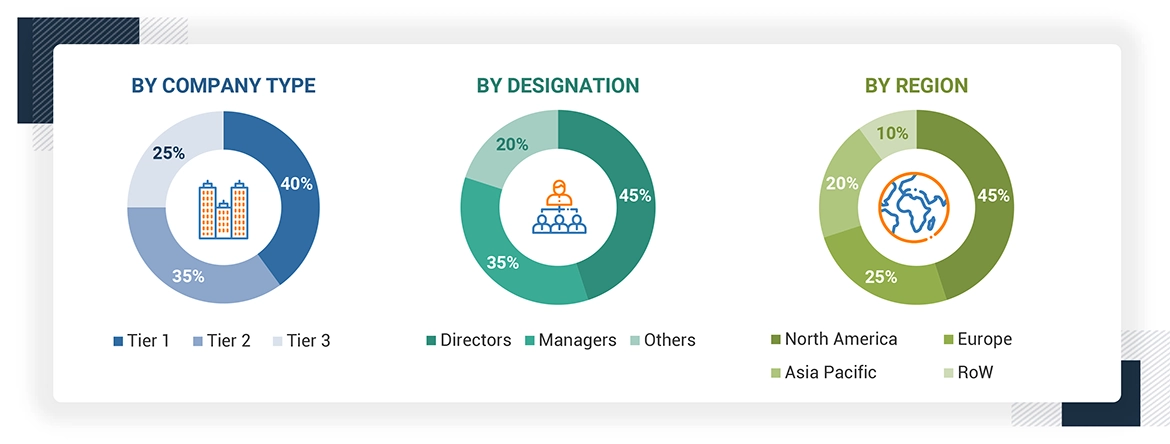
Note: The three tiers of the companies are defined based on their total revenue in 2023: Tier 1 - revenue greater than or equal to USD 1 billion; Tier 2 - revenue between USD 100 million and USD 1 billion; and Tier 3 revenue less than or equal to USD 100 million. Other designations include sales managers, marketing managers, and product managers.
About the assumptions considered for the study, To know download the pdf brochure
Market Size Estimation
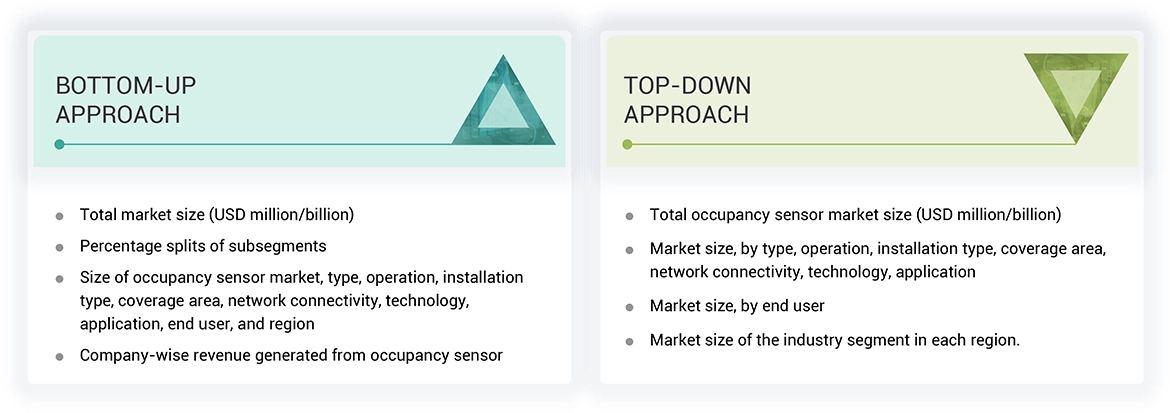
To estimate and validate the size of the occupancy sensor market and its submarkets, both top-down and bottom-up approaches were utilized. Secondary research was conducted to identify the key players in the market, and primary and secondary research was used to determine their market share in specific regions. The entire process involved studying top players' annual and financial reports and conducting extensive interviews with industry leaders such as CEOs, VPs, directors, and marketing executives. Secondary sources were used to determine all percentage shares and breakdowns, which were verified through primary sources. All parameters that could impact the markets covered in this research study were accounted for, analyzed in detail, verified through primary research, and consolidated to obtain the final quantitative and qualitative data.
Occupancy Sensor Market : Top-Down and Bottom-Up Approach
Data Triangulation
Once the overall size of the occupancy sensor market was determined using the methods described above, it was divided into multiple segments and subsegments. Market engineering was performed for each segment and subsegment using market breakdown and data triangulation methods, as applicable, to obtain accurate statistics. To triangulate the data, various factors and trends from the demand and supply sides were studied. The market was validated using both top-down and bottom-up approaches.
Market Definition
Occupancy sensor a device that detects the presence of people in a given area and controls devices such as lighting, HVAC (heating, ventilation, and air conditioning), or security related to whether it is occupied or vacant. These sensors automatically perform certain functions to prevent energy wastage, increase safety, and increase efficiency. They work based on the use of technologies of passive infrared (PIR) and ultrasonic detection. Occupancy sensors are controlling devices on energy use for many applications such as lighting, HVAC, and security systems. They can be mounted in walls, such as corner post or as wall switches, or on ceilings in order to detect the occupancy of a space. It can be deployed in residential and commercial settings to save energy and enhance automation systems. The sensors, by adjusting parameters automatically based on real time detection of an individual's presence, save operational cost and promote user comfort and security.
Key Stakeholders
- Raw material & manufacturing equipment suppliers
- Property and building developers
- Original equipment manufacturers (end-user applications/electronic product manufacturers)
- Distributors and retailers
- Network providers
- Research organizations
- System integrators
- Technology investors
- Lighting companies
Report Objectives
- To describe and forecast the occupancy sensor market, by type, operation, installation type, coverage area, network connectivity, technology, application, end user and region, in terms of value
- To describe and forecast the market for various segments across four central regions, namely, North America, Europe, Asia Pacific, and Rest of the World (RoW), in terms of value
- To strategically analyze the micro markets with regard to the individual growth trends, prospects, and contribution to the market
- To provide detailed information regarding drivers, restraints, opportunities, and challenges influencing the growth of the market
- To analyze opportunities for stakeholders by identifying high-growth segments in the market
- To provide a detailed overview of the value chain
- To strategically analyze the ecosystem, regulatory landscape, patent landscape, Porter’s five forces, import and export scenarios trade landscape, and case studies pertaining to the market under study
- To strategically profile key players in the occupancy sensor market and comprehensively analyze their market shares and core competencies
- To strategically profile the key players and provide a detailed competitive landscape of the market
- To analyze competitive developments such as partnerships, acquisitions, expansions, collaborations, and product launches, along with research and development (R&D) in the occupancy sensor market
Available Customizations
With the given market data, MarketsandMarkets offers customizations according to the specific requirements of companies. The following customization options are available for the report:
- Detailed analysis and profiling of additional market players (up to 5)
- Additional country-level analysis of the occupancy sensor market
Product Analysis
- Product matrix, which provides a detailed comparison of the product portfolio of each company in the occupancy sensor market.
Get the Full Occupancy Sensor Market Report
Full forecast, segment splits, and company analysis for all Occupancy Sensor Market.
- US Occupancy Sensor Market
- Canada Occupancy Sensor Market
- Mexico Occupancy Sensor Market
- Germany Occupancy Sensor Market
- UK Occupancy Sensor Market
- France Occupancy Sensor Market
- Rest Of Europe Occupancy Sensor Market
- China Occupancy Sensor Market
- Japan Occupancy Sensor Market
- South Korea Occupancy Sensor Market
- Australia Occupancy Sensor Market
- Rest Of Asia Pacific Occupancy Sensor Market
- South America Occupancy Sensor Market
Need a Tailored Report?
Customize this report to your needs
Get 10% FREE Customization
Customize This Report
