
Asia Pacific Oil Condition Monitoring Market (2025-2030)

The Asia Pacific Oil Condition Monitoring Market was valued at $451.5 Million in 2025 and projected to reach to $674.7 Million by 2030, representing a compound annual growth rate of 8.4%. The Asia Pacific oil condition monitoring market is poised for sustained growth, driven by rapid industrialization across manufacturing, power generation, and automotive sectors.


| Market Size in | USD 26.32 MN |
| Market Forecast in | |
| CAGR | |
| Forecast Period | |
| Units Considered | Value (USD MN) |
Asia Pacific Oil Condition Monitoring Market Trends and Insights
- Asia Pacific's growth trajectory reflects increasing industrialization across manufacturing, power generation, and automotive sectors, where predictive maintenance technologies are becoming critical for operational efficiency.
- The region's rapid adoption of IoT-enabled monitoring solutions and digital transformation initiatives are driving demand for advanced oil analysis capabilities. Asia Pacific's 8.4% compound annual growth rate outpaces global benchmarks, underscoring the region's strategic importance in the oil condition monitoring ecosystem.
- Between 2025 and 2030, Asia Pacific is expected to capture significant market share as enterprises prioritize equipment longevity and downtime reduction.
- The semiconductor and electronics industry's expansion within Asia Pacific further accelerates adoption of condition-based maintenance strategies, positioning the region as a key growth engine for global market expansion..
Key Market Statistics
- CAGR (2025-2030) 8.4% CAGR
- Market Size, 2025 ~USD 451.5 Million
- Forecast, 2030 ~USD 674.7 Million
- Geography Asia Pacific
Asia Pacific Oil Condition Monitoring Market Overview
Rapid Industrialization Drive :
Asia Pacific's manufacturing and power generation sectors are accelerating adoption of oil condition monitoring technologies to enhance operational efficiency and reduce unplanned downtime across factories and utilities.
Predictive Maintenance Adoption :
Industries across the region are shifting from reactive to predictive maintenance strategies, with oil condition monitoring becoming essential for extending equipment lifespan and optimizing maintenance budgets in competitive markets.
Automotive Sector Expansion :
The region's booming automotive industry is driving demand for advanced oil monitoring solutions to ensure vehicle reliability, meet stringent emission standards, and support the transition toward electric and hybrid technologies.
Digital Transformation Integration :
Asia Pacific manufacturers are integrating IoT and AI-enabled oil condition monitoring systems into their operations, enabling real-time diagnostics and data-driven decision-making for enhanced asset management.
Asia Pacific Oil Condition Monitoring Market Dynamics
- Countries like China and India are investing heavily in infrastructure and industrial modernization, creating significant demand for predictive maintenance technologies.
- The region's focus on operational efficiency and cost reduction is accelerating the adoption of advanced monitoring solutions. By 2030, the market is expected to reach $674.7 million, reflecting an 8.4% CAGR—outpacing the global average of 7%.
- This growth is supported by increasing digitalization, rising energy costs, and regulatory pressures to minimize equipment failures.
- As industries across Asia Pacific embrace Industry 4.0 principles, oil condition monitoring will become integral to smart manufacturing and asset optimization strategies..
Market Ecosystem
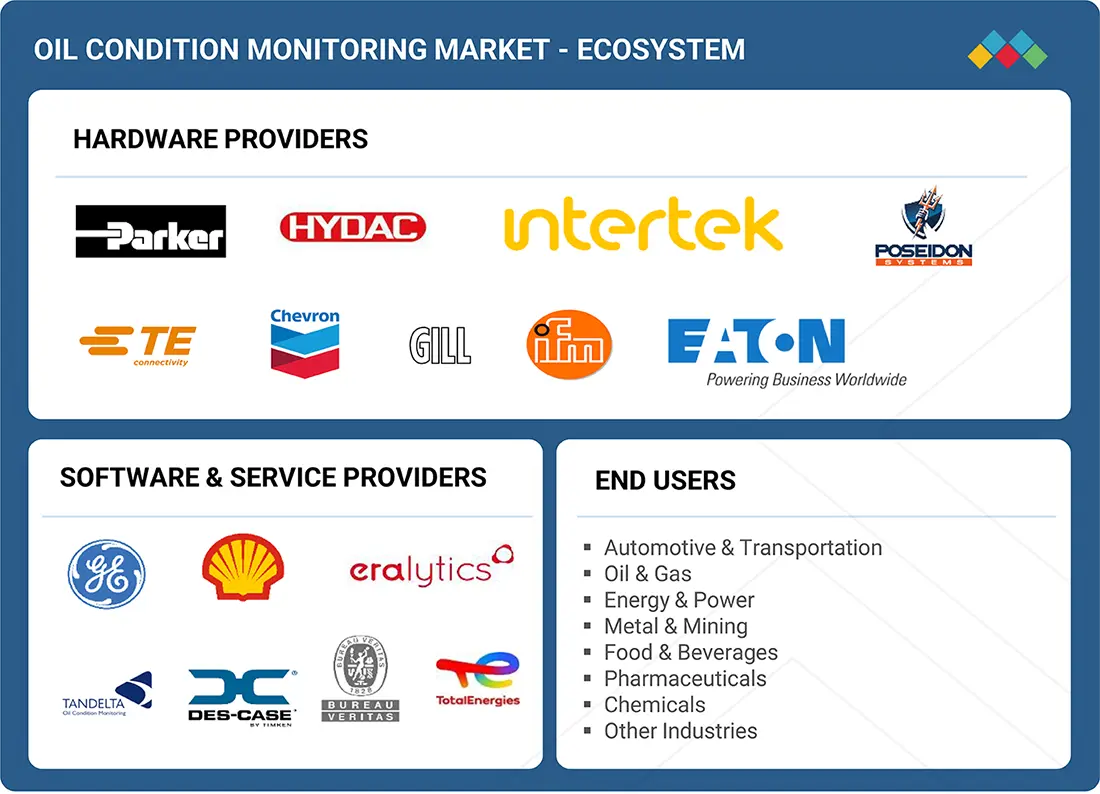
Oil Condition Monitoring Market: COMMERCIAL USE CASES ACROSS INDUSTRIES
| COMPANY | USE CASE DESCRIPTION | BENEFITS |
|---|---|---|
 |
Fluid condition sensor and on-site test kits for monitoring oil quality, moisture, temperature, and dilution | Real-time oil analysis, reduced downtime, elimination of routine testing, improved asset reliability |
 |
GreaseCheck and Wear Debris sensors to detect contamination, water content, and particulate matter in lubricants | Extended bearing life, reduced lubrication costs, early detection of gearbox damage, optimized maintenance |
 |
Optical particle and oil humidity sensors for real-time monitoring of oil cleanliness and humidity in hydraulic systems | Early detection of contamination, prevention of moisture-related failures, robust performance in harsh conditions |
 |
OPS3 multiparametric oil quality sensors measuring viscosity, density, and dielectric constant for predictive maintenance | Reliable performance in high-pressure environments, optimized maintenance scheduling, improved operational safety |
 |
Aerospace oil condition and debris monitoring sensors integrated in engine and transmission systems | Real-time detection of oxidation and debris, reduced reliance on offline sampling, enhanced reliability of aircraft systems |
Logos and trademarks shown above are the property of their respective owners. Their use here is for informational and illustrative purposes only.
Related Ecosystem
Industrial Automation
- Sensors
- Image Sensors
- Manufacturing Execution System (MES)
- Actuators
- Flow Sensors
- ABB India Limited
- Siemens ag
- Emerson Electric Co.
- HONEYWELL INTERNATIONAL INC.
- SCHNEIDER ELECTRIC SE
Key Takeaways
- Asia Pacific oil condition monitoring market valued at $451.5M in 2025, expanding to $674.7M by 2030 at 8.4% CAGR
- Asia Pacific's growth rate exceeds global average, driven by industrial digitalization and predictive maintenance adoption
- Asia Pacific semiconductor and electronics sector expansion accelerates demand for advanced oil analysis solutions
- Asia Pacific enterprises increasingly prioritize condition-based maintenance to reduce equipment downtime and extend asset lifespan
Oil Condition Monitoring Market Report Scope
| Report Metric | Details |
|---|---|
| Base Year | 2025 |
| Fastest Growing Segment | SOFTWARE (Offering) |
| Forecast Period | 2025-2030 |
| Growth Rate | CAGR of 7% from 2025 to 2030 |
| Largest Segment | HARDWARE (Offering) |
| Market Size Base Year (Billions) | ~USD 1.27 (2025) |
| Revenue Forecast (Billions) | ~USD 1.78 (2030) |
| Segments Covered | Offering, End Use, Industry, Offering 2021-2024 |
Asia Pacific Oil Condition Monitoring Market Report Segmentation
4 segment dimensions are covered across the global market.
By Offering
- Hardware
- Services
- Software
By End Use
- Compressors
- Engines
- Hydraulic Systems
- Other Systems
- Turbines
By Industry
- Automotive & Transportation
- Chemicals
- Energy & Power
- Food & Beverages
- Metal & Mining
- Oil & Gas
- Other Industries
- Pharmaceuticals
By Offering 2021-2024
- Hardware
- Services
- Software
Target Audience
- Industrial Equipment Manufacturers : Manufacturers need Asia Pacific market insights to integrate oil condition monitoring into their product portfolios and capitalize on the region's growing demand for predictive maintenance solutions.
- Monitoring Technology Providers : Solution providers require regional market data to identify growth opportunities, understand competitive positioning, and develop localized strategies for China, India, and Southeast Asian markets.
- Maintenance Service Companies : Service providers need market forecasts and regional trends to expand their predictive maintenance offerings and align service portfolios with Asia Pacific industrial sector requirements.
- Investment & Private Equity Firms : Investors require detailed market analysis and growth projections for Asia Pacific to evaluate acquisition targets, fund allocation decisions, and portfolio company expansion strategies in the region.
- Corporate Strategy & Operations Teams : Enterprise decision-makers need regional market intelligence to optimize asset management strategies, justify technology investments, and align operational efficiency initiatives with market trends.
Countries within Asia Pacific - compare and drill down
| Country | 2025 size (native) |
|---|---|
| China | USD 79.9 Million |
| Japan | USD 22.9 Million |
| India | USD 28.4 Million |
| South Korea | USD 11.8 Million |
| Rest Of Asia Pacific | USD 33.3 Million |
Country market size visualization
Reasons to Buy this Report
- Regional Market Sizing & Forecasts : Access detailed market valuations for Asia Pacific and individual country breakdowns, enabling precise investment decisions and resource allocation across the region's high-growth markets.
- Competitive Landscape Analysis : Understand key players, market share distribution, and competitive strategies specific to Asia Pacific, helping you identify partnership and acquisition opportunities in this dynamic region.
- Growth Driver Identification : Gain insights into sector-specific drivers—manufacturing, power, automotive—and regulatory trends unique to Asia Pacific that are accelerating oil condition monitoring adoption.
- Country-Level Intelligence : Detailed analysis of China, India, Japan, and South Korea markets, including local demand patterns, industrial maturity levels, and investment priorities for targeted market entry strategies.
- Technology & Innovation Trends : Discover emerging technologies, IoT integration, and AI-driven monitoring solutions gaining traction in Asia Pacific, positioning your business ahead of market evolution.
Frequently asked questions
What is the current market size of oil condition monitoring in Asia Pacific?
Asia Pacific's oil condition monitoring market is valued at $451.5 million in 2025, representing significant regional demand for predictive maintenance technologies.
What is the projected market size for Asia Pacific oil condition monitoring by 2030?
Asia Pacific's oil condition monitoring market is forecast to reach $674.7 million by 2030, reflecting sustained growth across the region's industrial sectors.
What is the CAGR for Asia Pacific oil condition monitoring market?
Asia Pacific's oil condition monitoring market is growing at a compound annual growth rate of 8.4% from 2025 to 2030, outpacing global market expansion.
Which industries drive oil condition monitoring demand in Asia Pacific?
Asia Pacific's manufacturing, power generation, automotive, and semiconductor sectors are primary drivers of oil condition monitoring adoption and investment.
Why is Asia Pacific's growth rate higher than the global average?
Asia Pacific's rapid industrialization, digital transformation initiatives, and emphasis on predictive maintenance strategies position the region for accelerated market growth compared to global benchmarks.
RESEARCH METHODOLOGY
The study involved four major activities in estimating the current size of the oil condition monitoring market. Exhaustive secondary research has been conducted to gather information on the market, adjacent markets, and the overall oil condition monitoring landscape. These findings, along with assumptions and projections, were validated through primary research involving interviews with industry experts and key stakeholders across the value chain. Both top-down and bottom-up approaches were utilized to estimate the overall market size. Subsequently, market breakdown and data triangulation techniques were applied to determine the sizes of various segments and subsegments. Two key sources, secondary and primary, were leveraged to conduct a comprehensive technical and commercial assessment of the oil condition monitoring market.
Secondary Research
Various secondary sources have been referred to in the secondary research process to identify and collect important information for this study. The secondary sources include annual reports, press releases, and investor presentations of companies; white papers; journals and certified publications; and articles from recognized authors, websites, directories, and databases. Secondary research has been conducted to obtain key information about the industry’s supply chain, the market’s value chain, the total pool of key players, market segmentation according to the industry trends (to the bottom-most level), regional markets, and key developments from market- and technology-oriented perspectives. The secondary data has been collected and analyzed to determine the overall market size, further validated by primary research.
Primary Research
Extensive primary research was conducted after gaining knowledge about the current scenario of the oil condition monitoring market through secondary research. Several primary interviews were conducted with experts from the demand and supply sides across four major regions—North America, Europe, Asia Pacific, and RoW. This primary data was collected through questionnaires, emails, and telephone interviews.
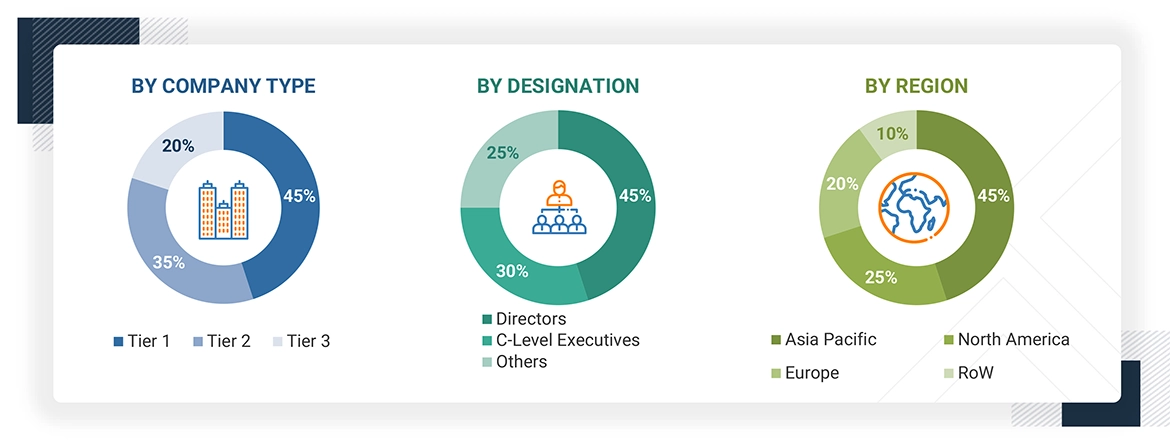
Other designations include sales and product managers.
The three tiers of the companies are defined based on their total revenue in 2024: Tier 1 - revenue greater than or equal to USD 1 billion; Tier 2 - revenue between USD 500 million and USD 1 billion; and Tier 3 revenue less than or equal to USD 500 million.
To know about the assumptions considered for the study, download the pdf brochure
Market Size Estimation
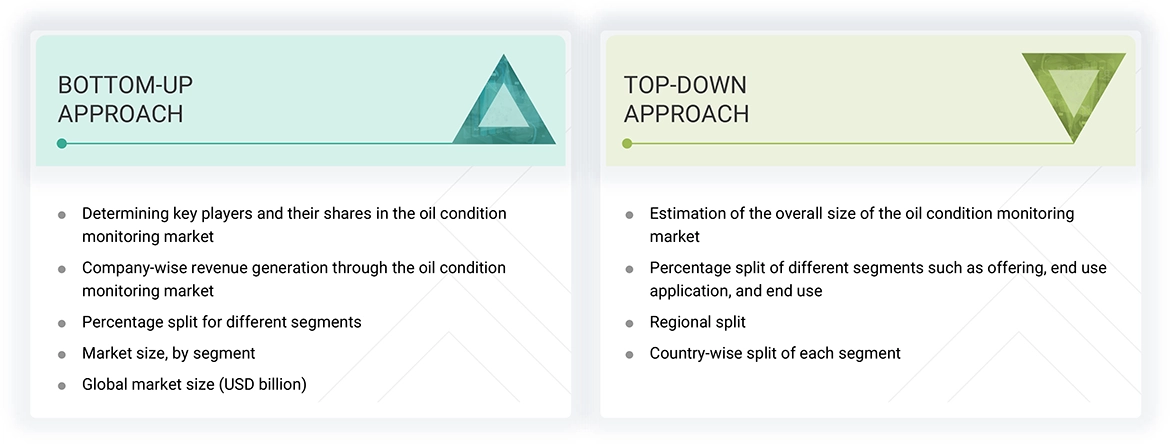
Both top-down and bottom-up approaches have been used to estimate and validate the total size of the oil condition monitoring market. These methods have also been used extensively to estimate the size of various subsegments in the market. The following research methodology has been used to estimate the market size:
- Major players in the industry and markets have been identified through extensive secondary research.
- The industry’s value chain and market size (in terms of value) have been determined through primary and secondary research processes.
- All percentage shares, splits, and breakdowns have been determined using secondary sources and verified through primary sources.
Oil Condition Monitoring Market : Top-Down and Bottom-Up Approach
Data Triangulation
After arriving at the overall size of the oil condition monitoring market from the market size estimation process explained above, the total market has been split into several segments and subsegments. Data triangulation and market breakdown procedures have been employed, wherever applicable, to complete the overall market engineering process and arrive at the exact statistics for all segments and subsegments of the market. The data has been triangulated by studying various factors and trends from both the demand and supply sides. Along with this, the market size has been validated using both top-down and bottom-up approaches.
Market Definition
The oil condition monitoring market encompasses solutions that assess and track the quality, performance, and health of lubricants used in machinery and equipment across industries. These solutions include hardware, software, and services designed to provide real-time insights into oil properties such as viscosity, oxidation, contamination, and additive depletion, enabling proactive maintenance and minimizing equipment failures. By offering predictive and condition-based maintenance capabilities, oil condition monitoring helps optimize operational efficiency, reduce maintenance costs, and extend equipment life. The market serves diverse sectors, including automotive and transportation, energy & power, industrial manufacturing, oil and gas, and is increasingly driven by digitalization, IoT integration, and growing emphasis on reliability, efficiency, and cost-effective operations.
Key Stakeholders
- Suppliers of raw materials
- Manufacturers and providers of components
- Manufacturers and providers of oil condition monitoring systems/solutions
- Original equipment manufacturers (OEMs)
- Market research and consulting firms
- Associations, organizations, forums, and alliances related to the oil condition monitoring industry
- Technology investors
- Governments and financial institutions
- Venture capitalists, private equity firms, and startups
- Maintenance service providers and third-party service contractors
- End users
Report Objectives
- To define, describe, and forecast the oil condition monitoring market, in terms of offering, end use, industry, and region
- To describe and forecast the market, in terms of value, with regard to four main regions: North America, Europe, Asia Pacific, and Rest of the World (RoW), along with their respective countries
- To provide detailed information regarding major factors influencing the market growth (drivers, restraints, opportunities, and challenges)
- To provide a detailed overview of the value chain of the oil condition monitoring market.
- To strategically analyze micromarkets with respect to individual growth trends, prospects, and contributions to the oil condition monitoring market
- To analyze opportunities in the market for stakeholders by identifying high-growth segments of the oil condition monitoring market
- To strategically profile key players and comprehensively analyze their market position in terms of ranking and core competencies, along with detailing the competitive landscape for market leaders
- To analyze competitive strategies, such as product launches, expansions, mergers, and acquisitions, adopted by key market players in the oil condition monitoring market
Available Customizations:
With the given market data, MarketsandMarkets offers customizations according to the company’s specific needs. The following customization options are available for the report:
Company Information:
- Detailed analysis and profiling of additional market players (up to 5)
Get the Full Oil Condition Monitoring Market Report
Full forecast, segment splits, and company analysis for all Oil Condition Monitoring Market.
- US Oil Condition Monitoring Market
- Canada Oil Condition Monitoring Market
- Mexico Oil Condition Monitoring Market
- Germany Oil Condition Monitoring Market
- UK Oil Condition Monitoring Market
- France Oil Condition Monitoring Market
- Italy Oil Condition Monitoring Market
- Spain Oil Condition Monitoring Market
- China Oil Condition Monitoring Market
- Japan Oil Condition Monitoring Market
- India Oil Condition Monitoring Market
- South Korea Oil Condition Monitoring Market
- Rest Of Europe Oil Condition Monitoring Market
- Rest Of Asia Pacific Oil Condition Monitoring Market
Need a Tailored Report?
Customize this report to your needs
Get 10% FREE Customization
Customize This Report
