
Latin America Open Radio Access Network (Open RAN) Market (2024-2029)

The Latin America Open Radio Access Network (Open RAN) Market was valued at $105.5 Million in 2024 and projected to reach to $680.9 Million by 2029, representing a compound annual growth rate of 36.5%. Latin America's Open RAN market is positioned for exceptional growth through 2029, driven by regional telecom operators' commitment to network modernization and cost efficiency.


| Market Size in | USD 26.32 MN |
| Market Forecast in | |
| CAGR | |
| Forecast Period | |
| Units Considered | Value (USD MN) |
Latin America Open Radio Access Network (Open RAN) Market Trends and Insights
- This represents a compound annual growth rate (CAGR) of 36.5%, reflecting strong regional momentum in telecom infrastructure modernization.
- Latin America is increasingly adopting Open RAN solutions to reduce vendor lock-in, lower capital expenditures, and accelerate 5G deployment across diverse markets. The growth trajectory in Latin America is driven by regulatory support, rising demand for cost-effective network solutions, and investment from both incumbent operators and new market entrants.
- Latin America's telecommunications sector is leveraging Open RAN to enhance network flexibility and enable faster innovation cycles.
- Between 2024 and 2029, Latin America is expected to capture significant market share as operators prioritize interoperable, disaggregated RAN architectures to compete in an increasingly digital economy..
Key Market Statistics
- CAGR (2024-2029) 36.5% CAGR
- Market Size, 2024 ~USD 105.5 Million
- Forecast, 2029 ~USD 680.9 Million
- Geography Latin America
Latin America Open Radio Access Network (Open RAN) Market Overview
Rapid Market Expansion :
Latin America's Open RAN market is growing at 36.5% CAGR, expanding from USD 105.5 million in 2024 to USD 680.9 million by 2029, outpacing many global regions in adoption velocity.
Vendor Lock-in Reduction :
Telecom operators across Latin America are prioritizing Open RAN to break free from proprietary vendor dependencies, enabling greater flexibility and cost optimization in network infrastructure investments.
5G Infrastructure Modernization :
Latin American carriers are leveraging Open RAN as a strategic enabler for 5G deployment, allowing faster rollout with reduced capital expenditure compared to traditional closed RAN architectures.
Regional Investment Momentum :
Major telecom operators in Brazil, Mexico, and Colombia are leading Open RAN pilot projects and commercial deployments, driving ecosystem maturation and attracting international technology vendors to the region.
Latin America Open Radio Access Network (Open RAN) Market Dynamics
- The region's major carriers are actively transitioning from legacy infrastructure to open, interoperable solutions, creating substantial opportunities for vendors, system integrators, and infrastructure providers.
- Government initiatives supporting digital transformation and 5G expansion further accelerate adoption across the region. The competitive landscape in Latin America is intensifying as global and regional players establish local partnerships and manufacturing capabilities.
- Investment in Open RAN ecosystem development, including testing facilities and developer communities, is strengthening the region's position as a key growth market.
- By 2029, Open RAN is expected to represent a significant portion of new telecom infrastructure deployments across Latin America, fundamentally reshaping the regional RAN market dynamics..
Market Ecosystem
Related Ecosystem
Mobility And Telecom
- Smart Utilities
- Smart Healthcare
- Sensors
- Parking Management System
- Passenger Information System (PIS)
- AT&T Inc.
- Cisco Systems, Inc.
- HUAWEI TECHNOLOGIES CO LTD
- Telefonaktiebolaget LM Ericsson (publ)
- International Business Machines Corporation
Key Takeaways
- Latin America's Open RAN market is projected to grow from USD 105.5 million in 2024 to USD 680.9 million by 2029, representing a 36.5% CAGR.
- Latin America is adopting Open RAN to reduce vendor dependency and lower total cost of ownership for 5G network deployments.
- Regulatory initiatives and government support in Latin America are accelerating Open RAN adoption among telecom operators.
- Latin America's competitive telecom landscape is driving operators to invest in disaggregated, interoperable RAN solutions for faster innovation.
Open Radio Access Network (Open RAN) Market Report Scope
| Report Metric | Details |
|---|---|
| Base Year | 2024 |
| Fastest Growing Segment | 5G (Network Type) |
| Forecast Period | 2024-2029 |
| Growth Rate | CAGR of 39.4% from 2024 to 2029 |
| Largest Segment | 4G (Network Type) |
| Market Size Base Year (Billions) | ~USD 2.85 (2024) |
| Revenue Forecast (Billions) | ~USD 14.99 (2029) |
| Segments Covered | Offering, Type, Network Deployment, Frequency Band, Deployment Phase, Hardware, Software, Service, Component, Network Type, Deployment, End User, Use Case, Bandwidth, Application |
Latin America Open Radio Access Network (Open RAN) Market Report Segmentation
15 segment dimensions are covered across the global market.
By Offering
- Hardware
- Services
- Software
By Type
- Consulting Services
- Cus/Dus
- Deployment & Integration
- Implementation Services
- Managed Services
- Network Orchestration & Management Software
- Network Planning & Optimization
- Other Hardware
- Other Software
- Professional Services
- Radio Units
- Ran Intelligent Controller
- Support & Maintenance
- Support Services
By Network Deployment
- Private Networks
- Public Networks
By Frequency Band
- Mmwave
- Other Frequency Bands
- Sub-6Ghz
By Deployment Phase
- Brownfield
- Greenfield
By Hardware
- Cus/Dus
- Other Hardware
- Radio Units
By Software
- Network Orchestration & Management Software
- Other Software
- Ran Intelligent Controller
By Service
- Deployment & Integration
- Network Planning & Optimization
- Support & Maintenance
By Component
- Hardware
- Services
- Solutions
By Network Type
- 3G And 2G
- 4G
- 5G
By Deployment
- Centralized
- Cloud
By End User
- Aerospace And Defense
- Automotive And Transportation
- Enterprises
- Healthcare And Life Sciences
- Media And Entertainment
- Other End Users
- Public Safety
- Telecom
- Telecom Operators
By Use Case
- Embb
- Fwa
- Mmtc
- Urllc
By Bandwidth
- 24Ghz To 57Ghz
- 57Ghz To 95Ghz
- 95Ghz To 300Ghz
By Application
- Ar/Vr
- Industry 4.0
- Live Streaming
- Other Applications
- Real-Time Surveillance Cameras
- Transport Connectivity
- Ultra-High-Definition Video
Target Audience
- Telecom Operators & Service Providers : Latin American carriers need detailed market intelligence to evaluate Open RAN investments, benchmark competitive positioning, and optimize network modernization roadmaps.
- RAN Equipment Vendors & Suppliers : Global and regional technology providers require market insights to identify growth opportunities, assess regional demand, and develop localized product strategies for Latin America.
- System Integrators & Consultants : Implementation partners need comprehensive market data to advise clients on Open RAN adoption, identify emerging opportunities, and position service offerings in the Latin American market.
- Investment & Private Equity Firms : Financial investors require market forecasts and competitive analysis to evaluate investment opportunities in Latin American telecom infrastructure and Open RAN ecosystem companies.
- Government & Regulatory Bodies : Regional policymakers need market intelligence to inform 5G strategy, spectrum allocation, and digital infrastructure policies supporting Open RAN adoption across Latin America.
Countries within Latin America - compare and drill down
| Country | 2025 size (native) |
|---|
Country market size visualization
Reasons to Buy this Report
- Regional Market Sizing & Forecasts : Obtain precise market valuations and growth projections specific to Latin America, enabling accurate budget allocation and investment planning for regional expansion strategies.
- Competitive Landscape Intelligence : Identify key players, partnerships, and competitive dynamics within the Latin American Open RAN ecosystem to inform go-to-market strategies and partnership opportunities.
- Country-Level Insights : Access granular analysis of major Latin American markets including Brazil, Mexico, Colombia, and Chile to prioritize market entry and resource deployment decisions.
- Technology Adoption Trends : Understand regional preferences for Open RAN vendors, deployment models, and use cases to align product offerings and marketing messaging with local market demands.
- Investment & Growth Opportunities : Identify high-potential segments, emerging players, and funding trends in Latin America's Open RAN market to guide investment decisions and partnership development.
Frequently asked questions
What is the current market size of Open RAN in Latin America?
Latin America's Open RAN market was valued at USD 105.5 million in 2024 and is expected to grow significantly through 2029.
What is the projected growth rate for Open RAN in Latin America?
Latin America's Open RAN market is expected to grow at a compound annual growth rate (CAGR) of 36.5% from 2024 to 2029.
What will be the market size of Open RAN in Latin America by 2029?
Latin America's Open RAN market is projected to reach USD 680.9 million by 2029, up from USD 105.5 million in 2024.
Why is Latin America adopting Open RAN technology?
Latin America is adopting Open RAN to reduce vendor lock-in, lower capital expenditures, accelerate 5G deployment, and enable faster network innovation.
Which factors are driving Open RAN growth in Latin America?
Latin America's Open RAN growth is driven by regulatory support, cost-efficiency demands, competitive telecom markets, and operator investments in disaggregated network architectures.
RESEARCH METHODOLOGY
This research study involved the extensive use of secondary sources, directories, and databases, such as Dun & Bradstreet (D&B) Hoovers and Bloomberg BusinessWeek, to identify and collect information useful for a technical, market-oriented, and commercial study of the open RAN market. The primary sources have been mainly industry experts from the core and related industries and preferred suppliers, manufacturers, distributors, service providers, technology developers, alliances, and organizations related to all segments of the value chain of this market. In-depth interviews have been conducted with various primary respondents, including key industry participants, subject matter experts, C-level executives of key market players, and industry consultants to obtain and verify critical qualitative and quantitative information.
Secondary Research
The market for companies offering open RAN solutions and services to different verticals has been estimated and projected based on the secondary data made available through paid and unpaid sources, as well as by analyzing their product portfolios in the ecosystem of the open RAN market. It also involved rating company products based on their performance and quality. In the secondary research process, various sources such as 1st Global OTIC Summit 2023, Open Air Interface (OAI) workshop 2023, and Open RAN Technical Summit at SCTE Cable-Tec Expo’23 have been referred to for identifying and collecting information for this study on the open RAN market. The secondary sources included annual reports, press releases investor presentations of companies, white papers, journals, and certified publications and articles by recognized authors, directories, and databases. Secondary research has been mainly used to obtain key information about the supply chain of the market, the total pool of key players, market classification, segmentation according to industry trends to the bottommost level, regional markets, and key developments from both market- and technology-oriented perspectives that have been further validated by primary sources.
Primary Research
In the primary research process, various primary sources from both the supply and demand sides were interviewed to obtain qualitative and quantitative information on the market. The primary sources from the supply side included various industry experts, including Chief Experience Officers (CXOs); Vice Presidents (VPs); directors from business development, marketing, and product development/innovation teams; related key executives from open RAN solution vendors, SIs, professional service providers, and industry associations; and key opinion leaders. Primary interviews were conducted to gather insights, such as market statistics, revenue data collected from solutions and services, market breakups, market size estimations, market forecasts, and data triangulation. Primary research also helped understand various trends related to technologies, applications, deployments, and regions. Stakeholders from the demand side, such as Chief Information Officers (CIOs), Chief Technology Officers (CTOs), Chief Strategy Officers (CSOs), and end users using open RAN solutions, were interviewed to understand the buyer’s perspective on suppliers, products, service providers, and their current usage of open RAN solutions which would impact the overall open RAN market.
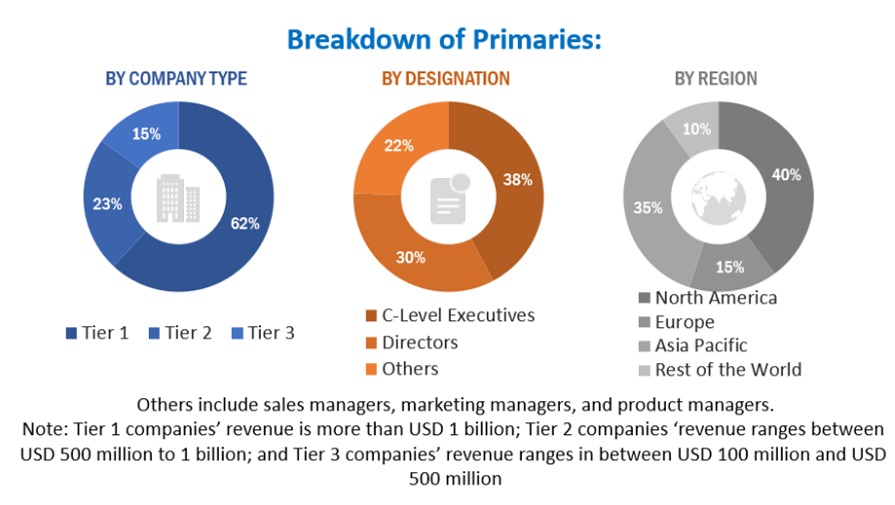
To know about the assumptions considered for the study, download the pdf brochure
Market Size Estimation
Multiple approaches were adopted to estimate and forecast the size of the open RAN market. The first approach involves estimating market size by summing up the revenue generated by companies through the sale of open RAN offerings.
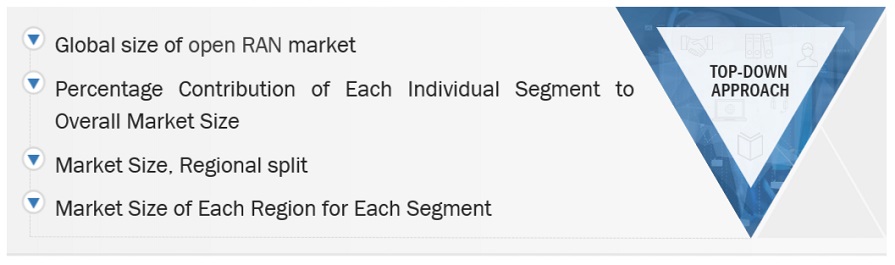
Both top-down and bottom-up approaches were used to estimate and validate the total size of the open RAN market. These methods were extensively used to estimate the size of various segments in the market. The research methodology used to estimate the market size includes the following:
- Key players in the market have been identified through extensive secondary research.
- In terms of value, the industry’s supply chain and market size have been determined through primary and secondary research processes.
- All percentage shares, splits, and breakups have been determined using secondary sources and verified through primary sources.
Open RAN Market Size: Bottom-Up Approach
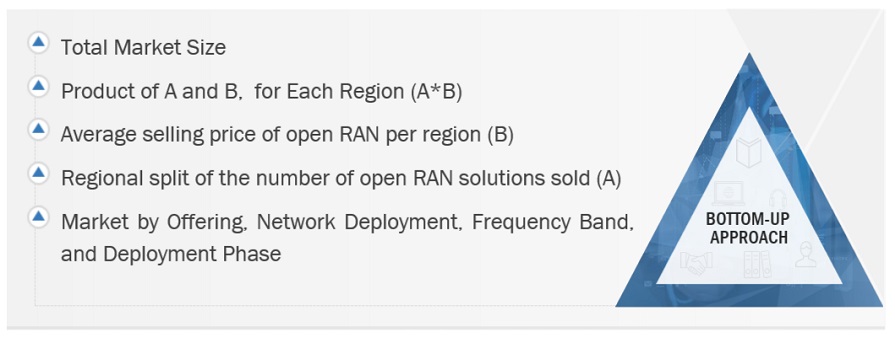
To know about the assumptions considered for the study, Request for Free Sample Report
Open RAN Market Size: Top-Down Approach
Data Triangulation
After arriving at the overall market size, the open RAN market was divided into several segments and subsegments. A data triangulation procedure was used to complete the overall market engineering process and arrive at the exact statistics for all segments and subsegments, wherever applicable. The data was triangulated by studying various factors and trends from the demand and supply sides. Along with data triangulation and market breakdown, the market size was validated by the top-down and bottom-up approaches.
Market Definition
As defined by VIAVI Solutions, Open Radio Access Network (RAN) is a concept based on interoperability and standardization of RAN elements, including a unified interconnection standard for white-box hardware and open-source software elements from different vendors. Open RAN architecture integrates a modular base station software stack on off-the-shelf hardware, which allows baseband and radio unit components from different suppliers to operate seamlessly together.
According to Cisco, an Open RAN is a nonproprietary version of the RAN system that allows interoperation between cellular network equipment provided by different vendors.
Key Stakeholders
- Government Bodies and Public Safety Agencies
- IT and Telecommunication Companies
- Network Infrastructure Developers
- Mobile Network Operators
- Software and Hardware Manufacturers
- Communication and Computing Device Manufacturers
- Emergency Public Safety Service Providers
- Chief Information/Technology Officers
- State Broadband Task Force
- Commercial Broadband Vendors
- Urban Area Security Imitative (UASI) Representative
- Regional Interoperability Committees
- Statewide Interoperability Governing Body (SIGB)
- Federal Agencies, especially Federal Emergency Responders
Report Objectives
- To determine, segment, and forecast the Open RAN market based on offering (hardware, software, and services), network deployment, deployment phase, frequency band, and region in terms of value
- To forecast the size of the market segments with respect to 5 main regions: North America, Europe, Asia Pacific, Middle East & Africa, and Latin America
- To provide detailed information about the major factors (drivers, restraints, opportunities, and challenges) influencing the growth of the market
- To study the complete value chain and related industry segments and perform a value chain analysis of the market landscape
- To strategically analyze the macro and micromarkets with respect to individual growth trends, prospects, and contributions to the total market
- To analyze the industry trends, pricing data, patents, and innovations related to the market
- To analyze the opportunities for stakeholders by identifying the high-growth segments of the market
- To profile the key players in the market and comprehensively analyze their market share/ranking and core competencies
- To track and analyze competitive developments, such as mergers & acquisitions, product launches & developments, partnerships, agreements, collaborations, business expansions, and R&D activities
Available Customizations
With the given market data, MarketsandMarkets offers customizations as per the company’s specific needs. The following customization options are available for the report:
Company Information
- Detailed analysis and profiling of additional market players (up to 5)
Get the Full Open Radio Access Network (Open RAN) Market Report
Full forecast, segment splits, and company analysis for all Open Radio Access Network (Open RAN) Market.
Need a Tailored Report?
Customize this report to your needs
Get 10% FREE Customization
Customize This Report
