
South Korea Ophthalmic Equipment Market (2025-2030)

The South Korea Ophthalmic Equipment Market was valued at $293.9 Million in 2025 and projected to reach to $352.4 Million by 2030, representing a compound annual growth rate of 3.7%. South Korea's ophthalmic equipment market is positioned for steady growth driven by demographic shifts and increasing healthcare awareness.


| Market Size in | USD 26.32 MN |
| Market Forecast in | |
| CAGR | |
| Forecast Period | |
| Units Considered | Value (USD MN) |
South Korea Ophthalmic Equipment Market Trends and Insights
- South Korea's aging population and rising prevalence of refractive errors and age-related eye conditions are driving steady demand for diagnostic and surgical ophthalmic devices.
- The country's advanced healthcare infrastructure and high adoption of cutting-edge medical technologies position South Korea as a mature market within the Asia Pacific region. South Korea's ophthalmic equipment sector benefits from strong domestic manufacturing capabilities, significant investment in healthcare innovation, and a well-established distribution network.
- Between 2025 and 2030, South Korea is expected to see moderate but consistent growth, supported by increasing awareness of eye health, expanding geriatric demographics, and rising disposable incomes.
- South Korea's regulatory environment and emphasis on quality standards further strengthen market competitiveness and attract both local and international ophthalmic device manufacturers..
Key Market Statistics
- CAGR (2025-2030) 3.7% CAGR
- Market Size, 2025 ~USD 293.9 Million
- Forecast, 2030 ~USD 352.4 Million
- Country South Korea
South Korea Ophthalmic Equipment Market Overview
Aging Population Driving Growth :
South Korea's rapidly aging demographic is significantly increasing demand for ophthalmic equipment, particularly diagnostic and surgical devices for age-related eye conditions such as cataracts and presbyopia.
Rising Refractive Error Prevalence :
High rates of myopia and other refractive errors among South Korea's population, exacerbated by increased screen time, are fueling consistent demand for diagnostic equipment and corrective optical devices.
Advanced Healthcare Infrastructure :
South Korea's well-developed healthcare system and high adoption of cutting-edge medical technologies create a favorable environment for premium ophthalmic equipment manufacturers and service providers.
Steady Market Growth Trajectory :
With a CAGR of 3.7% from 2025 to 2030, South Korea's ophthalmic equipment market is projected to grow from USD 293.9 million to USD 352.4 million, reflecting consistent investment in eye care infrastructure.
South Korea Ophthalmic Equipment Market Dynamics
- The aging population combined with high prevalence of refractive errors creates sustained demand for both diagnostic and surgical ophthalmic devices.
- South Korea's advanced healthcare infrastructure and strong adoption of medical technology innovations support market expansion. The market's 3.7% CAGR reflects moderate but consistent growth opportunities.
- Key drivers include rising disposable incomes, improved access to eye care services, and growing investment in ophthalmology clinics and hospitals.
- As South Korea continues to prioritize preventive healthcare and early diagnosis, demand for advanced diagnostic equipment is expected to remain robust through 2030..
Market Ecosystem
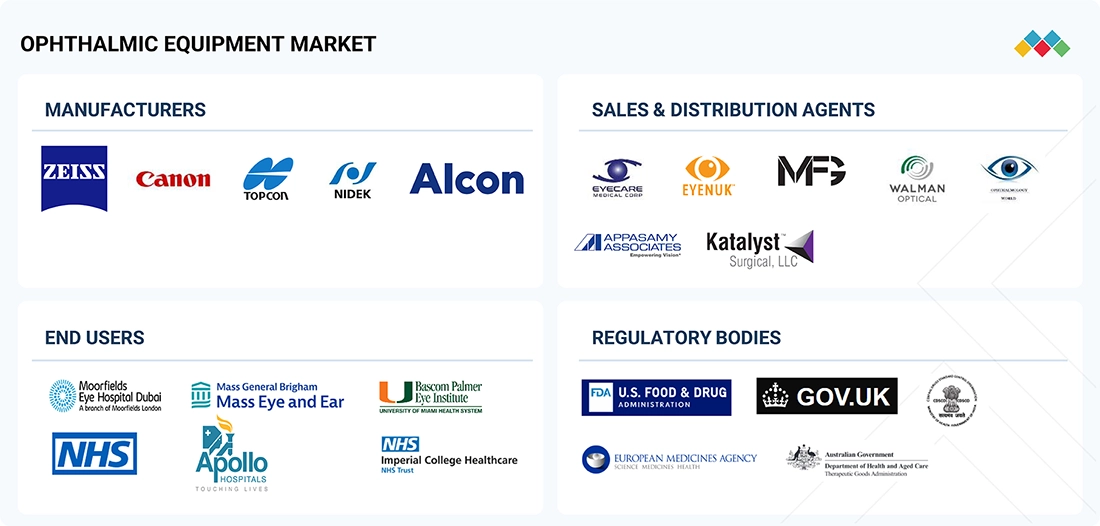
Ophthalmic Equipment Market: COMMERCIAL USE CASES ACROSS INDUSTRIES
| COMPANY | USE CASE DESCRIPTION | BENEFITS |
|---|---|---|
 |
Develops advanced surgical systems, visualization platforms, and phacoemulsification technologies for cataract and refractive procedures. | Improves surgical precision, reduces procedure time, and enhances postoperative outcomes for ophthalmic surgeries. |
 |
Provides high-resolution diagnostic imaging systems such as OCT, fundus cameras, and slit lamps with AI integration. | Enables early and accurate detection of retinal and glaucoma disorders, supporting data-driven clinical decision-making. |
 |
Offers ophthalmic surgical equipment and intraocular lenses with advanced material technology and digital integration. | Enhances visual outcomes, increases patient satisfaction, and streamlines surgical workflow efficiency. |
 |
Manufactures diagnostic and monitoring systems including digital fundus cameras and refraction systems. | Facilitates non-invasive eye examinations, supports teleophthalmology, and improves access to eye care in remote settings. |
 |
Designs ophthalmic diagnostic instruments and laser systems for refractive correction and retinal therapy. | Ensures precise visual correction, minimizes patient recovery time, and provides versatility across multiple ophthalmic applications. |
Logos and trademarks shown above are the property of their respective owners. Their use here is for informational and illustrative purposes only.
Related Ecosystem
Medical Devices
- Polymerase Chain Reaction (PCR)
- Magnetic Resonance Imaging (MRI)
- Disposable Autoinjectors
- Pulse Oximeters
- Blood Pressure Monitors
- Medtronic plc
- Abbott Laboratories
- Stryker Corporation
- Becton, Dickinson and Company
- JOHNSON & JOHNSON
Key Takeaways
- South Korea's ophthalmic equipment market is valued at USD 293.9 million in 2025 and will reach USD 352.4 million by 2030.
- South Korea exhibits a 3.7% CAGR, reflecting steady but moderate growth driven by aging demographics and rising eye health awareness.
- South Korea's advanced healthcare infrastructure and strong manufacturing base position it as a mature, competitive market in Asia Pacific.
- South Korea's market growth is supported by increasing prevalence of refractive errors, age-related conditions, and high disposable incomes.
Ophthalmic Equipment Market Report Scope
| Report Metric | Details |
|---|---|
| Base Year | 2025 |
| Fastest Growing Segment | GLAUCOMA SURGICAL DEVICES (Type) |
| Forecast Period | 2025–2030 |
| Growth Rate | CAGR of 5.9% from 2025 to 2030 |
| Largest Segment | SURGICAL DEVICES (Product) |
| Market Size Base Year (Billions) | ~USD 19.63 (2025) |
| Revenue Forecast (Billions) | ~USD 26.14 (2030) |
| Segments Covered | Technology, Product, Type, End User |
South Korea Ophthalmic Equipment Market Report Segmentation
4 segment dimensions are covered across the global market.
By Technology
- AI-Enabled Equipment
- Non-AI-Enabled Equipment
By Product
- Diagnostic & Monitoring Devices
- Surgical Devices
By Type
- Autorefractors & Keratometers
- Backflushes
- Cataract Surgical Devices
- Cataract Surgical Lasers
- Chandeliers
- Chart Projectors
- Corneal Topography Systems
- Excimer Lasers
- Femtosecond Lasers
- Fundus Cameras
- Glaucoma Drainage Devices
- Glaucoma Laser Systems
- Glaucoma Surgical Devices
- Handheld Oct
- Illumination Devices
- Intraocular Lenses (Iols)
- Iol Injectors
- Lensmeters
- Macular Lenses
- Microinvasive Glaucoma Surgery Devices
- Ophthalmic A-Scan Ultrasound
- Ophthalmic B-Scan Ultrasound
- Ophthalmic Cannulas
- Ophthalmic Forceps
- Ophthalmic Microscopes
- Ophthalmic Pachymeters
- Ophthalmic Scissors
- Ophthalmic Spatulas
- Ophthalmic Surgical Accessories
- Ophthalmic Tips & Handles
- Ophthalmic Ultrasound Biomicroscopes
- Ophthalmic Ultrasound Imaging Systems
- Ophthalmic Viscoelastic Devices (Ovds)
- Ophthalmoscopes
- Optical Biometry Systems
- Optical Coherence Tomography Scanners
- Other Diagnostic & Monitoring Devices
- Other Ophthalmic Surgical Accessories
- Other Ophthalmic Ultrasound Imaging Systems
- Other Refractive Surgical Lasers
- Perimeters/Visual Field Analyzers
- Phacoemulsification Devices
- Phoropters
- Photocoagulation Lasers
- Refractive Surgical Devices
- Retinoscopes
- Slit Lamps
- Spectral-Domain Oct (Sd-Oct)
- Specular Microscopes
- Surgical Instruments & Kits
- Swept-Source Oct (Ss-Oct)
- Tonometers
- Vitrectomy Machines
- Vitrectomy Probes
- Vitreoretinal Packs
- Vitreoretinal Surgical Devices
- Wavefront Aberrometers
By End User
- Hospitals
- Other End Users
- Specialty Clinics & Ambulatory Surgery Centers
Target Audience
- Ophthalmic Equipment Manufacturers : Manufacturers need South Korea-specific market data to assess market entry feasibility, identify distribution partnerships, and develop localized product strategies for this advanced healthcare market.
- Healthcare Investors & Private Equity : Investors require detailed South Korea market projections to evaluate acquisition targets, fund ophthalmology clinics, and identify growth opportunities in this aging population segment.
- Medical Device Distributors : Distributors need South Korea market insights to forecast demand, optimize inventory management, and negotiate supplier agreements based on accurate regional growth projections.
- Ophthalmology Clinic Operators : Clinic operators require market data to justify equipment investments, plan facility expansions, and understand competitive dynamics within South Korea's eye care landscape.
- Healthcare Consultants & Analysts : Consultants need South Korea-specific market intelligence to advise clients on market entry strategies, competitive positioning, and long-term viability of ophthalmic business ventures.
Key Companies in the South Korea Ophthalmic Equipment Market
| Company | HQ | Ownership | Strongest segments |
|---|---|---|---|
| ATS AUTOMATION TOOLING SYSTEMS INC | Canada | Public Company | Life sciences automation systems and services,Transportation and mobility automation,Consumer, electronics, and packaging automation, |
| ABBOTT LABORATORIES | United States | Public Company | Diagnostic Products,Medical Devices,Nutritional Products, |
| HENRY SCHEIN | United States | Public Company | Global Distribution and Value-Added Services,Global Specialty Products,Global Technology, |
| HILL-ROM HOLDINGS, INC. | United States | Private Company | Patient Support Systems (beds, surfaces, mobility),Front Line Care (monitoring, diagnostics, respiratory health),Surgical Solutions (tables, lights, pendants, positioning), |
| HALMA PLC | United Kingdom | Public Company | Safety,Environmental & Analysis,Healthcare, |
| NOVANTA, INC | United States | Public Company | Precision Medicine and Manufacturing (lasers, beam steering, motion, robotic tooling),Medical Solutions (insufflators, pumps, disposables, imaging, RFID, OR integration), |
| ALCON INC. | Switzerland | Public Company | Cataract surgical ecosystem (equipment, diagnostics, IOLs, consumables),Vitreoretinal and refractive surgery,Contact lenses (daily, reusable, color-enhancing), |
| ALCON | Switzerland | Public Company | Cataract surgery systems, IOLs, and consumables,Vitreoretinal and refractive surgery (Constellation, Hypervit, WaveLight, Contoura),Contact lenses (daily, reusable, color-enhancing), |
| JOHNSON & JOHNSON | United States | Public Company | Innovative Medicine – Oncology & Immunology,Innovative Medicine – Neuroscience, Pulmonary Hypertension, Infectious, CV & Metabolism,MedTech – Surgery & Interventional (open, laparoscopic, robotic, energy, stapling, wound closure, biosurgery), |
| BAUSCH HEALTH COMPANIES INC. | Canada | Public Company | Bausch + Lomb (eye health: pharma, contact lenses, surgical devices),Salix (gastroenterology and hepatology),Solta Medical (aesthetic medical devices), |
| HOYA CORPORATION | Japan | Public Company | Eyeglasses and ophthalmic lenses,Contact lenses and Eyecity retail,Medical endoscopes and surgical instruments, |
| ESSILORLUXOTTICA | France | Public Company | Ophthalmic lenses (single vision, progressive, coatings),Branded frames and sunglasses,Instruments, diagnostics, and equipment (incl. Satisloh, SPECTRALIS, ANTERION), |
| CANON | Japan | Public Company | Printing Business Unit,Imaging Business Unit,Medical Business Unit, |
| GLAUKOS CORPORATION | United States | Public Company | iStent / iStent inject W (MIGS devices),iStent infinite and advanced glaucoma devices,iDose TR (intracameral drug delivery), |
| TOPCON CORPORATION | Japan | Private Company | Positioning – Construction & Survey (total stations, GNSS, 3D scanners, software),Positioning – Agriculture & Smart Infrastructure IT systems,Eye Care – Diagnostic Imaging (OCT, retinal cameras, slit lamps), |
| STAAR SURGICAL | United States | Public Company | EVO / EVO+ ICL for myopia and myopic astigmatism,EVO Visian ICL legacy portfolio,EVO Viva ICL and presbyopia-focused lenses, |
| SHANGHAI MEDIWORKS PRECISION INSTRUMENTS CO., LTD. | China | Private Company | Slit lamps,Fundus cameras,Surgical microscopes (ophthalmic and dental), |
ATS AUTOMATION TOOLING SYSTEMS INC
ATS Automation Tooling Systems Inc. is a Canadian public company founded in 1978 that employs 7,000 people. The company specializes in automation and tooling systems for industrial applications.
ABBOTT LABORATORIES
Abbott Laboratories is a U.S.-based public company founded in 1888 with 115,000 employees. The company is a diversified healthcare manufacturer producing pharmaceuticals, diagnostics, and nutritional products.
HENRY SCHEIN
Henry Schein is a U.S. public company established in 1932 with 25,000 employees. The company is a leading distributor of healthcare products and services to dental, medical, and veterinary markets.
HILL-ROM HOLDINGS, INC.
Hill-Rom Holdings, Inc. is a U.S. private company founded in 1915 with 10,000 employees. The company manufactures and distributes medical devices and equipment for healthcare facilities.
HALMA PLC
Halma PLC is a United Kingdom-based public company founded in 1894 with 9,000 employees. The company operates in the safety, health, and environmental technology sectors.
NOVANTA, INC
Novanta, Inc. is a U.S. public company established in 1968 with 3,000 employees. The company designs and manufactures precision motion control and imaging technology for medical and industrial applications.
ALCON INC.
Alcon Inc. is a Switzerland-based public company founded in 1945 with 25,000 employees. The company is a global leader in eye care products and surgical equipment.
ALCON
Alcon is a Switzerland-based public company founded in 1945 with 25,000 employees. The company is a global leader in eye care products and surgical equipment.
JOHNSON & JOHNSON
Johnson & Johnson is a U.S. public company founded in 1886 with 138,200 employees. The company is a diversified healthcare manufacturer producing pharmaceuticals, medical devices, and consumer health products.
BAUSCH HEALTH COMPANIES INC.
Bausch Health Companies Inc. is a Canadian public company with 20,300 employees. The company operates in the pharmaceutical, medical device, and eye care sectors.
HOYA CORPORATION
Hoya Corporation is a Japanese public company founded in 1941 with 37,752 employees. The company manufactures optical products, medical devices, and imaging equipment.
ESSILORLUXOTTICA
EssilorLuxottica is a French public company founded in 1849 with 155,975 employees. The company is a global leader in eyewear and optical lens manufacturing.
CANON
Canon is a Japanese public company founded in 1933 with 165,547 employees. The company manufactures imaging, optical, and precision equipment for various industries including medical technology.
GLAUKOS CORPORATION
Glaukos Corporation is a U.S. public company founded in 1998 with 1,094 employees. The company develops and markets minimally invasive glaucoma surgery devices.
TOPCON CORPORATION
Topcon Corporation is a Japanese private company founded in 1932 with 5,327 employees. The company manufactures optical and precision instruments for medical and industrial applications.
STAAR SURGICAL
STAAR Surgical is a U.S. public company founded in 1982 with 921 employees. The company designs and manufactures implantable devices for vision correction.
SHANGHAI MEDIWORKS PRECISION INSTRUMENTS CO., LTD.
Shanghai Mediworks Precision Instruments Co., Ltd. is a Chinese private company founded in 2004. The company operates in the medical device and precision instruments sector.
Reasons to Buy this Report
- Precise Market Sizing for South Korea : Obtain accurate 2025 baseline (USD 293.9M) and 2030 forecast (USD 352.4M) data specific to South Korea's ophthalmic equipment market, enabling confident investment and expansion decisions.
- Demographic Insights & Opportunity Mapping : Understand South Korea's aging population dynamics and rising refractive error prevalence to identify high-potential customer segments and tailor product offerings accordingly.
- Competitive Positioning Strategy : Benchmark against South Korea's advanced healthcare infrastructure and technology adoption rates to develop competitive strategies that align with local market expectations and regulatory standards.
- Growth Trajectory Analysis : Leverage the 3.7% CAGR projection to forecast revenue potential, plan resource allocation, and set realistic performance targets for South Korea market penetration over the next five years.
- Regional Market Differentiation : Compare South Korea's 3.7% CAGR against the global 5.9% CAGR to understand local market dynamics and identify whether to prioritize this market or allocate resources to faster-growing regions.
Frequently asked questions
What is the current size of South Korea's ophthalmic equipment market?
South Korea's ophthalmic equipment market is estimated at USD 293.9 million in 2025.
What is the projected market size for South Korea by 2030?
South Korea's ophthalmic equipment market is projected to reach USD 352.4 million by 2030.
What is the CAGR for South Korea's ophthalmic equipment market?
South Korea's ophthalmic equipment market is expected to grow at a CAGR of 3.7% from 2025 to 2030.
What factors are driving growth in South Korea's ophthalmic equipment market?
South Korea's market growth is driven by an aging population, rising prevalence of refractive and age-related eye conditions, advanced healthcare infrastructure, and increasing eye health awareness.
How does South Korea's ophthalmic equipment market compare to other Asia Pacific countries?
South Korea represents a mature, well-developed market within Asia Pacific, characterized by strong manufacturing capabilities, high healthcare standards, and steady moderate growth compared to faster-growing emerging markets in the region.
RESEARCH METHODOLOGY
The study involved key activities in estimating the current market size of the ophthalmic equipment market. Extensive secondary research was conducted to gather information on this market. The next step was to validate these findings, assumptions, and size estimates with industry experts across the value chain through primary research. Different methods, such as top-down and bottom-up approaches, were used to estimate the total market size. Following that, market segmentation and data triangulation procedures were employed to determine the sizes of segments and subsegments within the ophthalmic equipment market.
Secondary Research
This research study involved extensive use of secondary sources, including directories, databases such as Dun & Bradstreet, Bloomberg Businessweek, Factiva, whitepapers, and companies’ house documents. Secondary research was conducted to gather information for this detailed, technical, market-oriented, and commercial analysis of the ophthalmic equipment industry. It was also used to obtain key details about the top players, market classification, and segmentation based on industry trends, geographic markets, and significant developments. A database of leading industry players was also created using secondary sources research.
Primary Research
In the primary research process, various supply- and demand-side sources were interviewed to gather both qualitative and quantitative information for this report. Primary sources from the supply side included industry experts such as CEOs, VPs/Managing Directors, Marketing Heads/Directors, Sales Directors, Marketing/Sales Managers, Regional/Area Sales Managers, Export/Import Heads/Managers, and other ophthalmic market-related personnel from various companies and organizations operating in the ophthalmic equipment market. Primary sources from the demand side included hospitals & clinics' vice presidents, C-level executives, department heads, doctors/eye physicians, supply management teams of hospitals, clinic personnel, and laboratory personnel.
The following is a breakdown of the primary respondents:
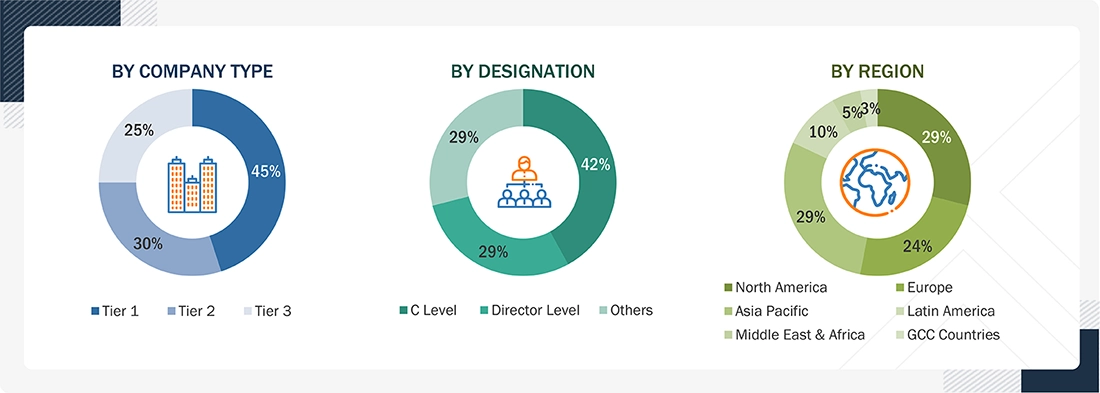
Note 1: C-level primaries include CEOs, COOs, and CTOs.
Note 2: Others include sales managers, marketing managers, and product managers.
Note 3: Companies are classified into tiers based on their total revenue. As of 2024: Tier 1=>USD 1 billion, Tier 2 = USD 500 million to USD 1 billion, Tier 3=< USD 500 million
To know about the assumptions considered for the study, download the pdf brochure
Market Size Estimation
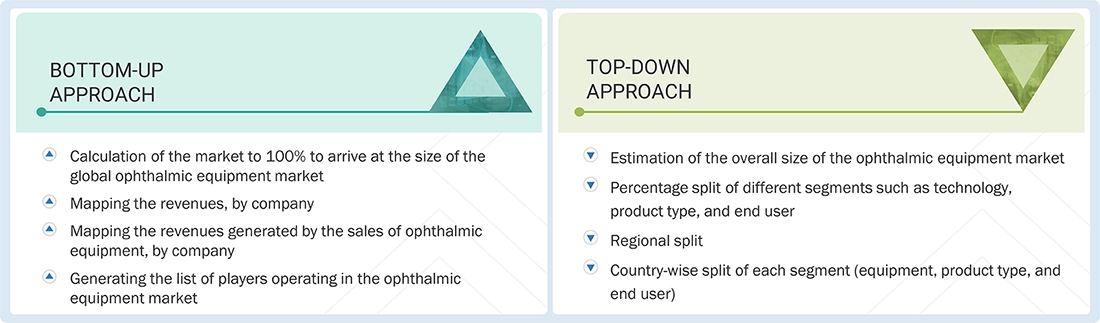
Both top-down and bottom-up approaches were used to estimate and validate the total size of the ophthalmic equipment market. These methods were also widely used to estimate the size of various subsegments in the market. The research methodology used to estimate the market size includes the following:
Data Triangulation
When estimating the market size, the entire market was divided into three segments. Data triangulation and market breakdown methods were used as needed to complete the overall market engineering process and obtain accurate statistics for all segments.
Approach to derive the market size and estimate market growth.
Using secondary data from both paid and unpaid sources, the market rankings for the major players were determined after a detailed analysis of their ophthalmic equipment sales. Due to data restrictions, the revenue share was estimated in some cases through a thorough review of the product portfolios of large corporations and their individual sales performances. This information was confirmed at each step by in-depth interviews with industry professionals.
Market Definition
Ophthalmology is a specialized branch of medicine that focuses on the anatomy of the eyes and the diseases that affect them. Ophthalmic equipment is essential for diagnosing and treating eye conditions. This includes surgical instruments and diagnostic and monitoring devices that help diagnose, treat, and manage issues such as cataracts, glaucoma, refractive errors, vitreoretinal disorders, and other eye problems.
Stakeholders
- Ophthalmology Device Manufacturers
- Ophthalmology Surgical Devices Manufacturers
- Ophthalmology Diagnostic & Monitoring Devices Manufacturers
- Vision Care Products Manufacturers
- Suppliers and Distributors of Ophthalmology Devices
- Original Equipment Manufacturers
- Ophthalmologists and Consumers
- Healthcare Service Providers (including hospitals, independent physicians, laboratories, and private eye care centers)
- Medical Institutes
- Research Institutes
- Health Insurance Players
- Research and Consulting Firms
- Venture Capitalists and Investors
Report Objectives
- To describe, analyze, and forecast the ophthalmic equipment market, by technology, product type, end user, and region
- To describe and forecast the ophthalmic equipment market for key regions, namely, North America, Europe, the Asia Pacific, Latin America, the Middle East & Africa, and GCC Countries
- To provide detailed information regarding drivers, restraints, opportunities, and challenges influencing the growth of the ophthalmic equipment market
- To strategically analyze the ecosystem, regulations, patenting trend, value chain, Porter’s five forces, and prices pertaining to the market under study
- To strategically analyze micromarkets1 with respect to individual growth trends, prospects, and contributions to the overall market
- To analyze market opportunities for stakeholders and provide details of the competitive landscape for market players
- To profile key players and comprehensively analyze their market shares and core competencies2 in the ophthalmic equipment market
- To analyze competitive developments such as collaborations, acquisitions, product launches, expansions, and R&D activities in the ophthalmic equipment market
Get the Full Ophthalmic Equipment Market Report
Full forecast, segment splits, and company analysis for all Ophthalmic Equipment Market.
- Canada Ophthalmic Equipment Market
- US Ophthalmic Equipment Market
- Germany Ophthalmic Equipment Market
- UK Ophthalmic Equipment Market
- France Ophthalmic Equipment Market
- Italy Ophthalmic Equipment Market
- Spain Ophthalmic Equipment Market
- China Ophthalmic Equipment Market
- Japan Ophthalmic Equipment Market
- India Ophthalmic Equipment Market
- Australia Ophthalmic Equipment Market
- Brazil Ophthalmic Equipment Market
- Mexico Ophthalmic Equipment Market
- Argentina Ophthalmic Equipment Market
Need a Tailored Report?
Customize this report to your needs
Get 10% FREE Customization
Customize This Report
