
GCC Countries Oxygen Scavenger Market (2024-2029)

The GCC Countries Oxygen Scavenger Market was valued at $235.5 Million in 2024 and projected to reach to $328.9 Million by 2029, representing a compound annual growth rate of 6.9%. The GCC Countries oxygen scavenger market is positioned for sustained expansion through 2029, driven by rising consumer demand for extended shelf-life products and stringent preservation requirements across food, beverage, and pharmaceutical sectors.


| Market Size in | USD 26.32 MN |
| Market Forecast in | |
| CAGR | |
| Forecast Period | |
| Units Considered | Value (USD MN) |
GCC Countries Oxygen Scavenger Market Trends and Insights
- GCC Countries' market is driven by increasing demand from food and beverage packaging, pharmaceutical applications, and industrial preservation sectors.
- The region's robust petrochemical infrastructure and growing manufacturing base position GCC Countries as a key market for oxygen scavenger solutions across the Middle East and Africa region. GCC Countries' oxygen scavenger adoption is accelerating due to rising consumer awareness of product shelf-life extension and quality preservation.
- The market in GCC Countries benefits from strategic investments in packaging innovation and stringent food safety regulations that mandate advanced preservation technologies.
- With a compound annual growth rate of 6.9%, GCC Countries demonstrates strong market fundamentals supported by regional trade hubs and export-oriented industries that require reliable oxygen scavenging solutions..
Key Market Statistics
- CAGR (2024-2029) 6.9% CAGR
- Market Size, 2024 ~USD 235.5 Million
- Forecast, 2029 ~USD 328.9 Million
- Country GCC Countries
GCC Countries Oxygen Scavenger Market Overview
Market Valuation :
GCC Countries oxygen scavenger market valued at USD 235.5 million in 2024, with projected growth to USD 328.9 million by 2029, representing a robust 6.9% CAGR.
Key Growth Drivers :
Increasing demand from food and beverage packaging, pharmaceutical applications, and industrial preservation sectors are propelling market expansion across GCC nations.
Regional Infrastructure Advantage :
GCC Countries' well-established petrochemical infrastructure and expanding manufacturing base provide competitive advantages for oxygen scavenger production and distribution.
Outpacing Global Growth :
GCC Countries market CAGR of 6.9% demonstrates strong regional performance, slightly below the global CAGR of 7.3%, indicating steady localized demand.
GCC Countries Oxygen Scavenger Market Dynamics
- The region's strategic location, advanced petrochemical capabilities, and growing manufacturing investments create favorable conditions for market players.
- Increasing adoption of oxygen scavenger technology in premium packaging solutions and industrial applications will further accelerate growth.
- The market's trajectory reflects GCC Countries' commitment to modernizing supply chains and enhancing product quality standards across multiple industries..
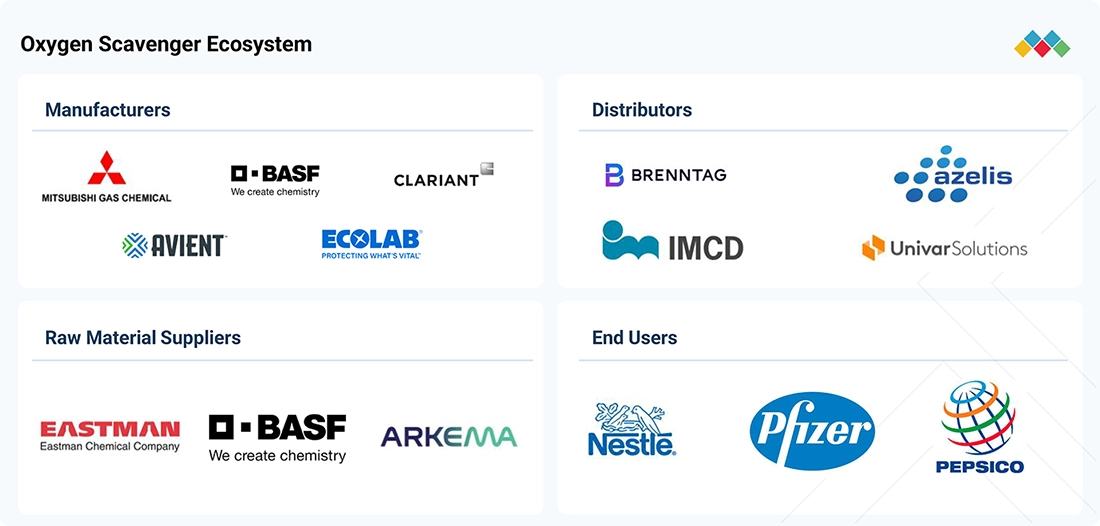
Market Ecosystem
OXYGEN SCAVENGER MARKET: COMMERCIAL USE CASES ACROSS INDUSTRIES
| COMPANY | USE CASE DESCRIPTION | BENEFITS |
|---|---|---|
 |
Utilizes oxygen scavenger technologies such as AGELESS oxygen absorbers and oxygen-scavenging films for food, pharmaceutical, and other oxygen-sensitive packaging applications. | Extended shelf life | Effective oxygen removal | Protection of product quality |
 |
Provides oxygen scavenger solutions for food packaging and industrial water-treatment applications, including OXY-GUARD and TROS oxygen scavenger technologies. | Effective oxygen control | Oxidation and corrosion protection | Application-specific performance |
 |
Provides oxygen scavenger solutions through Nalco Water for boiler water treatment and industrial water systems to control dissolved oxygen. | Corrosion prevention | Improved system reliability | Effective dissolved-oxygen control |
 |
Provides oxygen-removal technologies and materials for industrial applications, including copper oxide-based oxygen-scavenging materials for removing trace oxygen from inert gas streams. | High oxygen removal efficiency | Protection against oxidation | Reliable industrial performance |
 |
Provides ColorMatrix oxygen scavenger technologies, including Amosorb solutions, for PET packaging used in food and beverage applications. | Extended shelf life | Improved oxygen barrier performance | Recyclable PET packaging |
Logos and trademarks shown above are the property of their respective owners. Their use here is for informational and illustrative purposes only.
Related Ecosystem
Resins And Polymers
- Polycarbonate
- Acrylonitrile Butadiene Styrene (ABS)
- Epoxy Resin
- Light Commercial Vehicles (LCVs)
- Polypropylene (PP)
- Basf se
- DOW CHEMICAL COMPANY
- Solvay sa
- Saudi arabia basic industries corporation (sabic)
- DuPont de Nemours, Inc.
Key Takeaways
- GCC Countries' oxygen scavenger market is valued at USD 235.5 million in 2024 with projected growth to USD 328.9 million by 2029.
- The 6.9% CAGR in GCC Countries reflects strong demand from food packaging, pharmaceuticals, and industrial applications.
- GCC Countries' petrochemical infrastructure and manufacturing capabilities provide competitive advantages for market expansion.
- Food safety regulations and consumer preference for extended shelf-life products are primary growth catalysts in GCC Countries.
Oxygen Scavenger Market Report Scope
| Report Metric | Details |
|---|---|
| Base Year | 2024 |
| Fastest Growing Segment | RESINS (Form) |
| Forecast Period | 2024–2029 |
| Growth Rate | CAGR of 7.3% from 2024 to 2029 |
| Largest Segment | INORGANIC OXYGEN SCAVENGERS (Type) |
| Market Size Base Year (Billions) | ~USD 3.04 (2024) |
| Revenue Forecast (Billions) | ~USD 4.32 (2029) |
| Segments Covered | Type, Form, End-Use Industry |
GCC Countries Oxygen Scavenger Market Report Segmentation
3 segment dimensions are covered across the global market.
By Type
- Inorganic Oxygen Scavengers
- Organic Oxygen Scavengers
By Form
- Canisters
- Films & Laminates
- Liquids
- Other Forms
- Resins
- Sachets
By End-Use Industry
- Chemicals
- Food & Beverage
- Oil & Gas
- Other End-Use Industries
- Pharmaceuticals
- Power
- Pulp & Paper
Target Audience
- Chemical Manufacturers : Producers of oxygen scavengers need GCC-specific market data to assess regional demand, identify growth opportunities, and develop localized product strategies for food, pharma, and industrial sectors.
- Packaging Companies : Packaging solution providers require detailed insights into GCC Countries' oxygen scavenger adoption rates and preferences to innovate products meeting regional preservation and quality standards.
- Food & Beverage Processors : F&B manufacturers in GCC Countries need market intelligence to optimize oxygen scavenger sourcing, understand pricing trends, and ensure compliance with regional preservation regulations.
- Pharmaceutical Companies : Pharma firms operating in GCC Countries require market analysis to evaluate oxygen scavenger requirements, supplier capabilities, and cost structures for drug packaging and stability.
- Investment & Strategy Consultants : Business consultants and investors need comprehensive GCC Countries market data to guide M&A decisions, market entry strategies, and portfolio optimization in the oxygen scavenger sector.
Key Companies in the GCC Countries Oxygen Scavenger Market
| Company | HQ | Ownership | Strongest segments |
|---|---|---|---|
| HEXION INC | United States | Private Company | Engineered wood adhesives and forest products resins,Formaldehyde and derivative products,Specialty resins, monomers, and wax emulsions, |
| MITSUBISHI GAS CHEMICAL COMPANY, INC. | Japan | Public Company | Green Energy & Chemicals (methanol, basic chemicals, natural gas, hydrogen peroxide, formalins),Functional Chemicals (performance chemicals, oxygen/gas absorbers, polyhydric alcohols, fine chemicals),Engineering Plastics and Functional Materials (polycarbonate, polyacetal, nylons, copper-clad laminates, electronic materials), |
| CLARIANT | Switzerland | Public Company | Care Chemicals,Catalysts,Adsorbents & Additives, |
| ECOLAB | United States | Public Company | Global Water,Global Institutional & Specialty,Global Pest Elimination, |
| BASF | Germany | Public Company | Chemicals (petrochemicals and intermediates),Materials (isocyanates, polyamides, plastics specialties),Industrial Solutions (dispersions, resins, additives, catalysts), |
| AVIENT CORPORATION | United States | Public Company | Color, Additives and Inks,Specialty Engineered Materials, |
| VEOLIA | France | Public Company | Water (municipal and industrial),Waste and hazardous waste,Energy services and networks, |
| INDORAMA VENTURES PUBLIC COMPANY LIMITED | Thailand | Public Company | Combined PET (PX, PTA, PET, recycling, specialty PET chemicals),Fibers (polyester, rayon, nylon, PP, composites, wool),Indovinya (specialty chemicals and surfactants), |
| THE SHERWIN-WILLIAMS COMPANY | United States | Public Company | Paint Stores Group (architectural, protective, OEM finishes via company stores),Performance Coatings Group (industrial, automotive refinish, packaging, coil, marine),Consumer Brands Group (retailers, private label, DIY), |
| EASTMAN CHEMICAL COMPANY | United States | Public Company | Additives & Functional Products,Advanced Materials,Chemical Intermediates, |
| ARKEMA | France | Public Company | Adhesive Solutions,Advanced Materials,Coating Solutions, |
| PLASTIPAK HOLDINGS, INC. | United States | Private Company | Beverage packaging (CSD, water, juice, dairy, alcoholic),Household, personal care, and consumer cleaning packaging,Food and industrial/automotive/agricultural packaging, |
HEXION INC
HEXION INC is a private chemical company founded in 1857 and based in the United States, employing 2,600 people.
MITSUBISHI GAS CHEMICAL COMPANY, INC.
Mitsubishi Gas Chemical Company, Inc. is a Japanese public company established in 1918 with 8,319 employees.
CLARIANT
Clariant is a Swiss public company founded in 1886 with approximately 10,000 employees.
ECOLAB
Ecolab is a United States-based public company founded in 1923 that employs 48,000 people.
BASF
BASF is a German public company established in 1865 and is one of the world's largest chemical manufacturers with 106,428 employees.
AVIENT CORPORATION
Avient Corporation is a United States public company founded in 1885 with 9,000 employees.
VEOLIA
Veolia is a French public company founded in 1853 with 203,100 employees, making it one of the largest employers in its sector.
INDORAMA VENTURES PUBLIC COMPANY LIMITED
Indorama Ventures Public Company Limited is a Thai public company founded in 1994 with 22,027 employees.
THE SHERWIN-WILLIAMS COMPANY
The Sherwin-Williams Company is a United States public company established in 1866 with 64,249 employees.
EASTMAN CHEMICAL COMPANY
Eastman Chemical Company is a United States public company established in 1920 with 13,000 employees.
ARKEMA
Arkema is a French public company founded in 2003 with 20,648 employees.
PLASTIPAK HOLDINGS, INC.
Plastipak Holdings, Inc. is a private United States company founded in 1967 with 3,865 employees.
Reasons to Buy this Report
- Regional Market Sizing : Accurate valuation data specific to GCC Countries enables precise budget allocation and investment decisions tailored to this high-growth regional market.
- Sector-Specific Insights : Detailed analysis of food & beverage, pharmaceutical, and industrial applications within GCC Countries helps identify the most lucrative market segments and opportunities.
- Competitive Positioning : Understand GCC Countries' market dynamics, petrochemical advantages, and manufacturing capabilities to benchmark against regional competitors and optimize market entry strategies.
- Growth Trajectory Forecasting : Five-year forecast data (2024-2029) with 6.9% CAGR provides reliable projections for strategic planning, capacity expansion, and long-term business development in GCC markets.
- Supply Chain Optimization : Leverage insights on GCC Countries' infrastructure and distribution networks to streamline supply chains, reduce costs, and enhance market penetration across the region.
Frequently asked questions
What is the current market size of oxygen scavengers in GCC Countries?
The oxygen scavenger market in GCC Countries was valued at USD 235.5 million in 2024 and is expected to grow to USD 328.9 million by 2029.
What is the projected growth rate for oxygen scavengers in GCC Countries?
GCC Countries' oxygen scavenger market is projected to grow at a compound annual growth rate (CAGR) of 6.9% from 2024 to 2029.
Which industries drive oxygen scavenger demand in GCC Countries?
GCC Countries' oxygen scavenger demand is primarily driven by food and beverage packaging, pharmaceutical preservation, and industrial applications requiring extended product shelf-life.
Why is GCC Countries a strategic market for oxygen scavengers?
GCC Countries benefits from advanced petrochemical infrastructure, strong manufacturing capabilities, regional trade hub status, and stringent food safety regulations that support oxygen scavenger adoption.
What factors are accelerating oxygen scavenger adoption in GCC Countries?
Rising consumer awareness of product quality preservation, investments in packaging innovation, regulatory compliance requirements, and export-oriented industries are key drivers accelerating adoption in GCC Countries.
RESEARCH METHODOLOGY
The study involved four major activities to estimate the current size of the global oxygen scavenger market. The team conducted exhaustive secondary research to gather information on the market, the peer product market, and the parent product group market. The next step was to validate these findings, assumptions, and sizes with industry experts across the oxygen scavenger value chain through primary research. The report used top-down and bottom-up approaches to estimate the overall size of the oxygen scavenger market. The report then used market breakdown and data triangulation to determine the size of different market segments and subsegments.
Secondary Research
The market for companies offering oxygen scavengers was derived from secondary data available through paid and unpaid sources by analyzing the product portfolios of major companies in the ecosystem and rating companies based on performance and quality. This study used secondary sources such as Business Standard, Bloomberg, the World Bank, and Factiva to identify and collect information on the oxygen scavenger market. In the secondary research process, the study referred to various sources to identify and collect information related to the study. Secondary sources included annual reports, press releases, and investor presentations of vendors, forums, certified publications, and whitepapers. Secondary research was used to obtain critical information on the industry’s value chain, the total pool of key players, market classification, and segmentation from market- and technology-oriented perspectives.
Primary Research
In the primary research process, various primary sources from both the supply and demand sides were interviewed to obtain qualitative and quantitative information for this report. Primary sources on the supply side included industry experts such as Chief Executive Officers (CEOs), Vice Presidents (VPs), marketing directors, technology and innovation directors, and other key executives from several companies and organizations operating in the oxygen scavenger market. After the complete market engineering (calculations for market statistics, market breakdown, market size estimations, market forecasting, and data triangulation), extensive primary research was conducted to gather information and verify and validate the critical numbers arrived at. Primary research was also conducted to identify segmentation types, industry trends, the competitive landscape of oxygen scavengers offered by various market players, and key market dynamics such as drivers, restraints, opportunities, challenges, and key player strategies. In the complete market engineering process, the top-down and bottom-up approaches and several data triangulation methods were extensively used to perform the market estimation and market forecasting for the overall market segments and subsegments listed in this report. Extensive qualitative and quantitative analysis was performed on the complete market engineering process to list the key information/insights throughout the report.
The following is the breakdown of primary respondents:
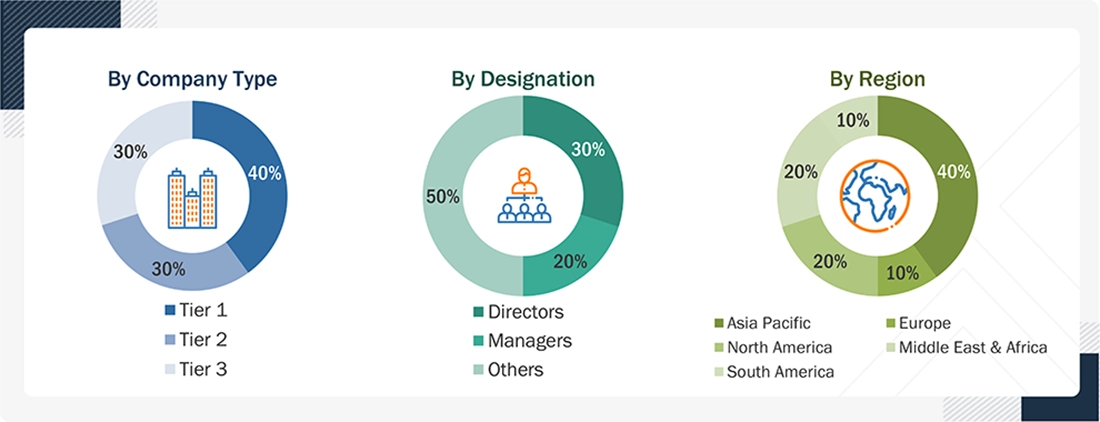
Notes: Other designations include sales, marketing, and product managers.
Tier 1: >USD 1 billion; Tier 2: USD 500 million–1 billion; and Tier 3: USD 500 million.
To know about the assumptions considered for the study, download the pdf brochure
Market Size Estimation
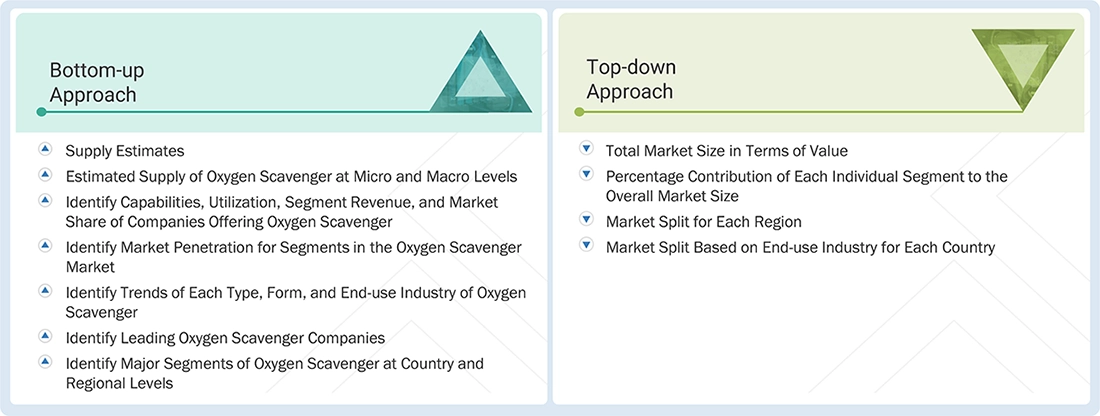
The top-down and bottom-up approaches were used to estimate and validate the size of the global oxygen scavenger market. These approaches were also used extensively to estimate the size of various dependent market segments. The research methodology used to estimate the market size included the following:
Oxygen Scavenger Market : Top-Down and Bottom-Up Approach
Data Triangulation
After arriving at the overall market size using the market size estimation processes, the market was split into several segments and subsegments. The data triangulation and market breakup procedures were employed, wherever applicable, to complete the overall market engineering process and arrive at the exact statistics of each market segment and subsegment. The data were triangulated by studying various factors and trends from both the demand and supply sides.
Market Definition
An oxygen scavenger is a technology used to remove or control oxygen to prevent or inhibit the attack of oxygen-sensitive products and materials in varied industrial and commercial applications. An oxygen scavenger is a material or chemical formulation that depletes oxygen through chemical action or absorption and protects products against oxidation, spoilage, degradation, and corrosion. In addition, oxygen scavengers offer high oxygen absorption capacity, good compatibility with packaging and processing systems, and work normally under hostile conditions. Oxygen scavengers are classified by chemical composition (inorganic or organic), and they come in films & laminates, sachets, canisters, liquids, and resins, depending on the end-use application. Different formulations offer different properties, such as additional active ingredients, absorption capacity, activation features, and compatibility with packaging or industrial systems. Developing oxygen scavenger technologies involves balancing formulation, absorption capacity, activation features, and compatibility with packaging or industrial systems. Oxygen scavengers are used in food & beverage, pharmaceutical, power, oil & gas, chemical, and pulp & paper applications. Oxygen scavengers reduce oxygen exposure and extend the shelf life, quality, and freshness of food and pharmaceutical products while reducing corrosion and degradation in industrial processes.
Key Stakeholders
- Oxygen scavenger manufacturers
- Raw material and chemical suppliers
- Packaging material and active packaging manufacturers
- Distributors and packaging solution suppliers
- End-use industries and industrial customers
- Regulatory bodies and industry associations
- Research and development (R&D) institutions
Report Objectives
- To define, describe, and forecast the size of the global oxygen scavenger market, by type, form, end-use industry, and region, in value terms
- To provide detailed information on the significant drivers, restraints, opportunities, and challenges influencing the market
- To strategically analyze micro markets concerning individual growth trends, prospects, and their contribution to the market
- To assess the growth opportunities in the market for stakeholders and provide details on the competitive landscape for market leaders
- To forecast the market size of segments and subsegments for North America, Europe, Asia Pacific, South America, and the Middle East & Africa
- To strategically profile key players and comprehensively analyze their market shares and core competencies
- To analyze competitive developments such as product launches, acquisitions, expansions, partnerships, and agreements in the oxygen scavenger market
- To assess the impact of AI/Gen AI on the market
Customizations Options:
With the given market data, MarketsandMarkets offers customizations according to client-specific needs.
The following customization options are available for the oxygen scavenger market report:
Product Analysis
- A product matrix that gives a detailed comparison of the product portfolio of each company
Regional Analysis
- A further breakdown of the oxygen scavenger market for additional countries
Company Information
- Detailed analysis and profiling of additional market players (up to five)
Get the Full Oxygen Scavenger Market Report
Full forecast, segment splits, and company analysis for all Oxygen Scavenger Market.
- US Oxygen Scavenger Market
- Canada Oxygen Scavenger Market
- Mexico Oxygen Scavenger Market
- Germany Oxygen Scavenger Market
- France Oxygen Scavenger Market
- Spain Oxygen Scavenger Market
- UK Oxygen Scavenger Market
- Italy Oxygen Scavenger Market
- Russia Oxygen Scavenger Market
- China Oxygen Scavenger Market
- Japan Oxygen Scavenger Market
- India Oxygen Scavenger Market
- Australia Oxygen Scavenger Market
- South Korea Oxygen Scavenger Market
- South Africa Oxygen Scavenger Market
- Brazil Oxygen Scavenger Market
- Argentina Oxygen Scavenger Market
- Rest Of Europe Oxygen Scavenger Market
- Rest Of Asia Pacific Oxygen Scavenger Market
- –Rest Of GCC Countries Oxygen Scavenger Market
- Rest Of South America Oxygen Scavenger Market
Need a Tailored Report?
Customize this report to your needs
Get 10% FREE Customization
Customize This Report
