
US Patient Handling Equipment Market (2025-2030)

The US Patient Handling Equipment Market was valued at $188.3 Million in 2025 and projected to reach to $265.9 Million by 2030, representing a compound annual growth rate of 7.1%. The US Patient Handling Equipment Market is poised for sustained growth through 2030, reaching $265.9 million as healthcare providers prioritize ergonomic investments to address nursing shortages and reduce musculoskeletal injuries.


| Market Size in | USD 26.32 MN |
| Market Forecast in | |
| CAGR | |
| Forecast Period | |
| Units Considered | Value (USD MN) |
US Patient Handling Equipment Market Trends and Insights
- This robust expansion reflects the US healthcare system's increasing investment in ergonomic solutions and worker safety initiatives across hospitals, long-term care facilities, and rehabilitation centers.
- The US market is driven by an aging population, rising prevalence of mobility-related conditions, and heightened regulatory focus on preventing caregiver injuries. In the US, patient handling equipment adoption is accelerating due to labor shortages in healthcare and the need to reduce workers' compensation claims.
- The US market encompasses mechanical lifts, transfer boards, repositioning devices, and powered mobility aids that enhance both patient safety and caregiver well-being.
- Between 2025 and 2030, the US is expected to see significant investment in advanced handling technologies, including smart lifts and IoT-enabled devices that improve operational efficiency in US healthcare facilities. The US competitive landscape features both established medical device manufacturers and emerging innovators focused on automation and user-friendly designs.
- Regulatory compliance with OSHA standards and reimbursement policies continue to shape purchasing decisions across the US healthcare sector, positioning patient handling equipment as a critical component of institutional risk management strategies..
Key Market Statistics
- CAGR (2025-2030) 7.1% CAGR
- Market Size, 2025 ~USD 188.3 Million
- Forecast, 2030 ~USD 265.9 Million
- Country US
US Patient Handling Equipment Market Overview
Market Valuation :
The US Patient Handling Equipment Market is valued at $188.3 million in 2025, with strong growth trajectory driven by healthcare facility modernization and compliance with OSHA ergonomic standards.
Accelerated Growth Rate :
The US market is expanding at a 7.1% CAGR, outpacing the global growth rate of 5.8%, indicating robust domestic demand and higher adoption rates compared to international markets.
Healthcare Facility Investment :
US hospitals, long-term care facilities, and rehabilitation centers are significantly increasing capital expenditure on ergonomic patient handling solutions to reduce worker injuries and improve patient outcomes.
Worker Safety Focus :
Growing emphasis on occupational safety initiatives and worker compensation cost reduction is driving widespread adoption of mechanical lifts, transfer devices, and mobility aids across US healthcare settings.
US Patient Handling Equipment Market Dynamics
- Regulatory pressures from OSHA and state-level safety mandates are compelling facilities to upgrade aging equipment and implement comprehensive patient handling programs.
- The aging US population and increased prevalence of mobility-related conditions further amplify demand for advanced handling solutions.
- Healthcare systems are increasingly recognizing that equipment investments yield significant returns through reduced worker compensation claims, improved staff retention, and enhanced patient safety outcomes..
Market Ecosystem
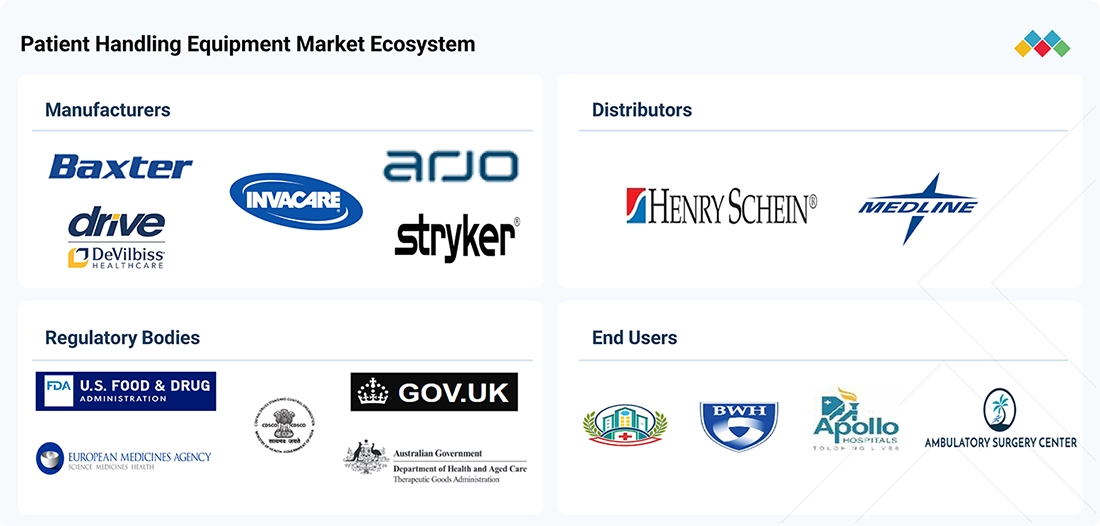
PATIENT HANDLING EQUIPMENT MARKET: COMMERCIAL USE CASES ACROSS INDUSTRIES
| COMPANY | USE CASE DESCRIPTION | BENEFITS |
|---|---|---|
 |
Stryker’s patient-handling equipment supports lateral patient transfers, positioning, transportation, and emergency/acute-care mobility, including operating-room transfers, through its MATS systems and hospital stretchers. Its Prime Series integrates advanced mobility, electric functionality, bed-exit alerts, and pressure-redistribution surfaces. | Reduces caregiver physical strain, facilitates safer and more efficient patient transfers, supports fall prevention, improves patient positioning and comfort, and enhances workflow efficiency during hospital transportation and surgical procedures. |
 |
Baxter’s Hillrom portfolio supports lifting, repositioning, transferring, transporting, and supporting patients across critical care, acute care, rehabilitation, and other healthcare environments. Its portfolio includes overhead, mobile and sit-to-stand lifts, beds, surfaces, stretchers, and related patient-mobility equipment. | Helps reduce caregiver injury risk, supports earlier and more frequent patient mobility, improves patient positioning and transfer safety, and provides healthcare facilities with integrated equipment for different patient acuity and mobility needs. |
 |
Arjo’s patient handling equipment supports safe patient mobilization, transfers, repositioning, and lifting across hospitals, long-term care, rehabilitation, and home-care environments. Its portfolio includes floor lifts, ceiling lifts, slings, and transfer equipment, including the Maxi Move 5 for multiple transfer and care tasks. | Supports safe and dignified patient mobility, reduces physical demands on caregivers, enables more efficient transfers, and can support single-caregiver workflows when appropriate equipment and procedures are in place. |
 |
Savaria Patient Care equipment is used for patient lifting, transferring, repositioning, pressure management, and mobility support across acute care, long-term care, rehabilitation, and home care settings. Its portfolio includes ceiling lifts, floor lifts, slings, therapeutic surfaces, transfer aids, and medical beds. | Improves patient and caregiver safety, supports ergonomic handling, enhances patient comfort and positioning, facilitates safe transfers, and provides integrated equipment supported by clinical education and service capabilities. |
 |
Invacare’s patient-handling portfolio is used primarily to lift and transfer people with mobility impairments in medical and home-care settings. Its equipment supports transfers from beds, chairs, floors, and toilets, while its broader portfolio includes electric medical beds and mobility equipment for home and institutional care. | Enables safer patient transfers, improves caregiver convenience, supports patients with mobility limitations, and provides equipment suitable for home-care environments, including equipment for disabled, bariatric, elderly, and post-surgical users. |
Logos and trademarks shown above are the property of their respective owners. Their use here is for informational and illustrative purposes only.
Related Ecosystem
Medical Devices
- Polymerase Chain Reaction (PCR)
- Magnetic Resonance Imaging (MRI)
- Disposable Autoinjectors
- Pulse Oximeters
- Blood Pressure Monitors
- Medtronic plc
- Abbott Laboratories
- Stryker Corporation
- Becton, Dickinson and Company
- JOHNSON & JOHNSON
Key Takeaways
- The US Patient Handling Equipment Market is valued at $188.3 million in 2025 and will reach $265.9 million by 2030, growing at 7.1% CAGR.
- US healthcare facilities are prioritizing ergonomic solutions to reduce caregiver injuries and comply with OSHA regulations.
- The US market is driven by an aging population, labor shortages, and increased focus on worker safety and risk mitigation.
- Advanced technologies including smart lifts and IoT-enabled devices are expected to reshape the US patient handling equipment landscape through 2030.
Patient Handling Equipment Market Report Scope
| Report Metric | Details |
|---|---|
| Base Year | 2025 |
| Fastest Growing Segment | PATIENT TRANSFER DEVICES (Type) |
| Forecast Period | 2025–2030 |
| Growth Rate | CAGR of 5.8% from 2025 to 2030 |
| Largest Segment | ACUTE CARE (Application) |
| Market Size Base Year (Billions) | ~USD 12.37 (2025) |
| Revenue Forecast (Billions) | ~USD 16.4 (2030) |
| Segments Covered | Type, Application, End User |
US Patient Handling Equipment Market Report Segmentation
3 segment dimensions are covered across the global market.
By Type
- Accessories
- Air-Assisted Lateral Transfer Mattresses
- Ambulatory Aids
- Bath & Pool Lifts
- Bathroom & Toilet Assist Equipment
- Canes
- Ceiling Lifts
- Commode Chairs
- Crutches
- Electric Beds
- Manual Beds
- Manual Wheelchairs
- Medical Beds
- Mobile Lifts
- Mobility Equipment
- Mobility Scooters
- Patient Lifts
- Patient Transfer Devices
- Powered Wheelchairs
- Reusable Air-Assisted Mattresses
- Semi-Electric Beds
- Shower Chairs
- Sit-To-Stand Lifts
- Sliding Sheets
- Slings
- Smart Beds
- Smart Wheelchairs
- Spu Air-Assisted Mattress
- Spu Air-Assisted Mattresses
- Stair & Wheelchair Lifts
- Stretchers & Transport Chairs
- Transfer Benches
- Walkers
- Wheelchair & Scooters
- Wheelchairs & Scooters
By Application
- Acute Care
- Bariatric Care
- Long-Term Care
- Other Applications
- Rehabilitation Care
By End User
- Home Healthcare
- Hospitals
- Other End Users
- Rehabilitation Facilities
- Senior Care Facilities
US: PATIENT HANDLING EQUIPMENT MARKET, BY END USER, 2025–2030
| Segment | 2025 | 2026 | 2027 | 2028 | 2029 | 2030 | CAGR (%) |
|---|---|---|---|---|---|---|---|
| HOME HEALTHCARE | 791.9 | 835 | 882.6 | 934 | 990.5 | 1052.2 | 5.8 |
| HOSPITALS | 1350.2 | 1416.9 | 1490.5 | 1569.8 | 1656.8 | 1751.4 | 5.3 |
| OTHER END USERS | 204.9 | 214 | 224 | 234.8 | 246.7 | 259.6 | 4.8 |
| REHABILITATION FACILITIES | 293.4 | 310.8 | 330 | 350.9 | 373.8 | 398.9 | 6.3 |
| SENIOR CARE FACILITIES | 507.7 | 530.3 | 555.3 | 582.2 | 611.6 | 643.6 | 4.9 |
| TOTAL | 3148.1 | 3307 | 3482.4 | 3671.7 | 3879.4 | 4105.7 | 5.5 |
Target Audience
- Healthcare Equipment Manufacturers : Manufacturers need US-specific market data to optimize product development, pricing strategies, and distribution channels while understanding facility-level demand drivers and competitive positioning.
- Hospital & Facility Administrators : Decision-makers require market insights to justify capital expenditures on patient handling equipment, benchmark against peer facilities, and align investments with safety compliance requirements.
- Medical Device Distributors : Distributors need detailed US market segmentation and growth forecasts to allocate inventory, identify high-growth facility segments, and develop targeted sales strategies for regional expansion.
- Healthcare Investors & PE Firms : Investment professionals require comprehensive US market analysis to evaluate acquisition targets, assess portfolio company growth potential, and identify emerging opportunities in the patient handling sector.
- Occupational Safety Consultants : Safety professionals need market data to recommend evidence-based equipment solutions, demonstrate ROI to healthcare clients, and stay current with US regulatory trends and best practices.
Key Companies in the US Patient Handling Equipment Market
| Company | HQ | Ownership | Strongest segments |
|---|---|---|---|
| KINDRED HEALTHCARE INC. | United States | Private Company | Long-term acute care hospitals (LTACH) – drug-intensive inpatient care,Inpatient rehabilitation facilities – chronic disease and recovery pathways,Contract rehabilitation and ancillary services, |
| GODREJ GROUP | India | Private Company | Home appliances (refrigerators, washing machines, ACs, microwaves, coolers),Commercial appliances (medical refrigerators, deep freezers, vending, institutional cooling),Locks, architectural hardware, security products, and kitchen fittings, |
| TENET HEALTHCARE CORPORATION | United States | Public Company | Hospital Operations and Services (acute and specialty hospitals, trauma, tertiary/quaternary care),Ambulatory Care (ambulatory surgery centers, surgical hospitals, outpatient services),Other Services (imaging centers, urgent care, micro-hospitals, telemedicine and ancillary), |
| ARJO | Sweden | Public Company | Medical beds and surfaces,Patient handling and mobility solutions,Hygiene and disinfection, |
| BAXTER INTERNATIONAL, INC. | United States | Public Company | Medical Products & Therapies (IV, infusion, parenteral nutrition, renal-related),Healthcare Systems & Technologies (smart beds, monitoring, OR integration, respiratory),Pharmaceuticals (generic injectables, inhaled anesthetics, specialty injectables, compounding), |
| SAVARIA | Canada | Public Company | Accessibility – elevators and platform lifts,Accessibility – stairlifts and dumbwaiters,Wheelchair accessible and adapted vehicles, |
| STRYKER CORPORATION | United States | Public Company | Orthopaedic Implants (Hip, Knee, Shoulder, Ankle, Trauma & Extremities),MedSurg Equipment & Patient Handling,Neurotechnology & Stroke / VTE Intervention, |
| GF HEALTH PRODUCTS, INC. | United States | Private Company | Beds and extended care products,Mobility products and wheelchairs,Bathroom safety and home care products, |
KINDRED HEALTHCARE INC.
Kindred Healthcare Inc. is a private healthcare company founded in 1985 and based in the United States, operating with a workforce of 64,200 employees.
GODREJ GROUP
Godrej Group is an Indian private company established in 1897 with 13,316 employees, representing over a century of business operations.
TENET HEALTHCARE CORPORATION
Tenet Healthcare Corporation is a publicly traded U.S. healthcare company founded in 1967 with 88,500 employees.
ARJO
Arjo is a Swedish public company established in 1957 with 7,000 employees.
BAXTER INTERNATIONAL, INC.
Baxter International, Inc. is a publicly traded U.S. company founded in 1931 with 37,500 employees.
SAVARIA
Savaria is a Canadian public company founded in 1979 with 2,550 employees.
STRYKER CORPORATION
Stryker Corporation is a publicly traded U.S. company established in 1941 with 56,000 employees.
GF HEALTH PRODUCTS, INC.
GF Health Products, Inc. is a private U.S. company founded in 1946 with 2,023 employees.
Reasons to Buy this Report
- Market Size & Growth Validation : Confirm the US market opportunity at $188.3M (2025) with 7.1% CAGR through 2030, enabling accurate revenue forecasting and investment prioritization for US-focused business strategies.
- Competitive Landscape Intelligence : Understand US-specific market dynamics, key player positioning, and regional adoption patterns to identify competitive advantages and market entry opportunities in the American healthcare sector.
- Regulatory & Compliance Insights : Access detailed analysis of OSHA standards, state-level safety mandates, and compliance drivers specific to US healthcare facilities that influence purchasing decisions and equipment specifications.
- Facility-Type Segmentation : Gain granular insights into demand patterns across US hospitals, long-term care facilities, and rehabilitation centers to tailor product offerings and marketing strategies by facility type.
- Investment Decision Support : Leverage comprehensive US market data to support capital allocation decisions, partnership evaluations, and go-to-market strategies with confidence in localized market intelligence.
Frequently asked questions
What is the current size of the US Patient Handling Equipment Market?
The US Patient Handling Equipment Market is valued at $188.3 million in 2025 and is expected to grow to $265.9 million by 2030.
What is the growth rate of the US Patient Handling Equipment Market?
The US market is projected to grow at a compound annual growth rate (CAGR) of 7.1% from 2025 to 2030.
What factors are driving growth in the US Patient Handling Equipment Market?
Key drivers include an aging US population, healthcare labor shortages, regulatory compliance requirements, and increased focus on reducing caregiver injuries and workers' compensation claims.
What types of patient handling equipment are included in the US market?
The US market encompasses mechanical lifts, transfer boards, repositioning devices, powered mobility aids, and emerging smart lift technologies with IoT capabilities.
How are regulatory standards impacting the US Patient Handling Equipment Market?
OSHA standards and reimbursement policies significantly influence purchasing decisions in the US, making regulatory compliance a critical factor for market participants.
RESEARCH METHODOLOGY
The study focused on estimating the current market size for the patient handling equipment sector. Extensive secondary research was conducted to gather information about the patient handling equipment industry. The next step involved validating the findings, assumptions, and estimates through primary research with industry experts across the value chain. Various approaches were used to estimate the total market size, including top-down and bottom-up methods. Next, market segmentation and data triangulation procedures were used to determine the sizes of the segments and subsegments within the patient handling equipment market.
Secondary Research
The secondary research process relies heavily on secondary sources, including directories and databases such as Bloomberg Businessweek, Factiva, and D&B Hoovers. It also includes white papers, annual reports, investor presentations, SEC filings, and publications from government sources. Notable examples include the National Institutes of Health (NIH), the United States Food and Drug Administration (US FDA), the US Census Bureau, the World Health Organization (WHO), the International Trade Administration (ITA), the Global Burden of Disease Study, and the Centers for Medicare and Medicaid Services (CMS). These sources were utilized to gather information for the global patient handling equipment market study. The process aimed to provide insights into key players, market classification and segmentation based on industry trends, down to the most detailed level. It also focused on significant developments from both market and technological perspectives. A comprehensive database of key industry leaders was also created using the information obtained through secondary research.
Primary Research
In the primary research process for this report, various sources from both the supply and demand sides were interviewed to gather qualitative and quantitative information. The supply-side primary sources included industry experts such as CEOs, vice presidents, marketing and sales directors, technology and innovation directors, and other key executives from major companies and organizations in the patient handling equipment market. On the demand side, primary sources included pharmaceutical companies, vaccination centers, hospitals and clinics, pharmacies, and university researchers and academics. This primary research validated the market segmentation, identified key players, and gathered insights on major industry trends and market dynamics.
A breakdown of the primary respondents is provided below:
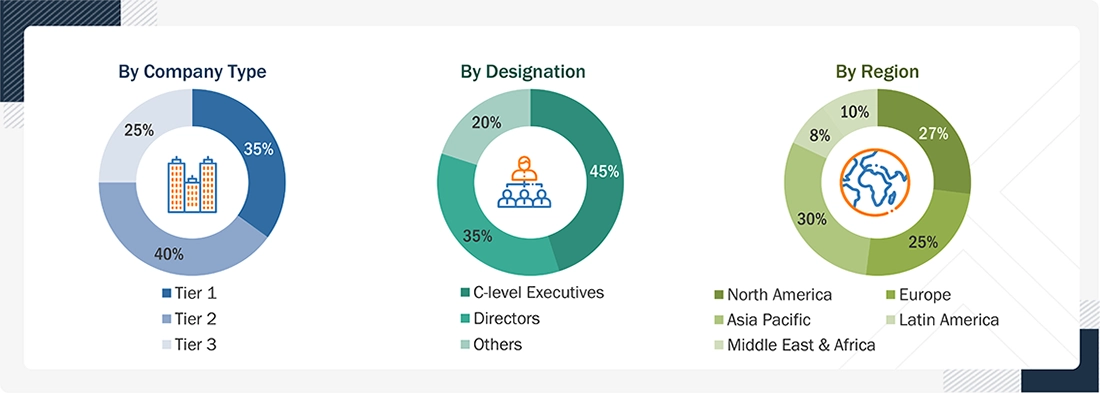
Note 1: C-level primaries include CEOs, CFOs, COOs, and VPs.
Note 2: Others include sales managers, marketing managers, business development managers, product managers, distributors, and suppliers.
Note 3: Companies are classified into tiers based on their total revenue. As of 2024, Tier 1 = >USD 10.00 billion, Tier 2 = USD 1.00 billion to USD 10.00 billion, and Tier 3 = <USD 1.00 billion.
Source: MarketsandMarkets Analysis
To know about the assumptions considered for the study, download the pdf brochure
Market Size Estimation
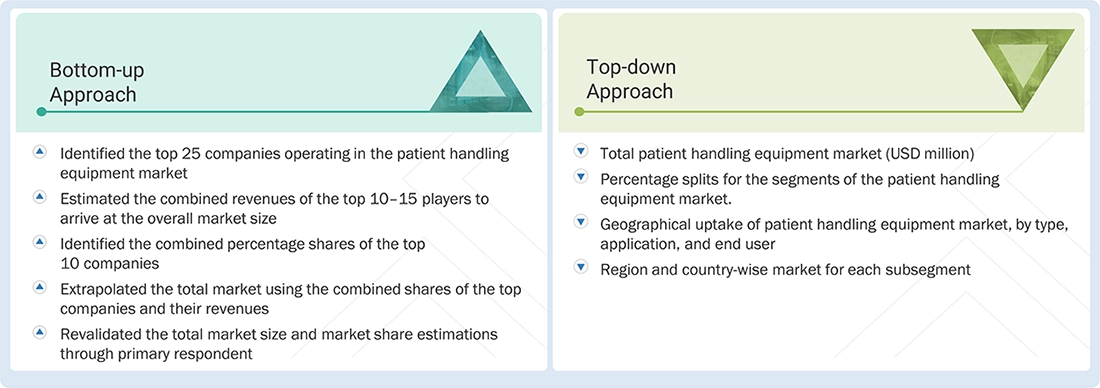
For the global market value, annual revenues were calculated based on the revenue mapping of major product manufacturers and OEMs active in the global patient handling equipment market. All the major product manufacturers were identified at the global and/or country/regional level. Revenue mapping for the respective business segments/sub-segments was done for the major players. Also, the global patient handling equipment market was split into various segments and sub-segments based on:
- List of major players operating in the products market at the regional and/or country level
- Product mapping of various patient handling equipment manufacturers at the regional and/or country level
- Mapping of annual revenue generated by listed major players from patient handling equipment (or the nearest reported business unit/product category)
- Extrapolation of the revenue mapping of the listed major players to derive the global market value of the respective segments/subsegments
- Summation of the market value of all segments/subsegments to arrive at the global patient handling equipment market
The above data was consolidated, along with detailed inputs and analysis from MarketsandMarkets, and presented in this report.
Patient Handling Equipment Market : Top-Down and Bottom-Up Approach
Data Triangulation
After arriving at the overall size of the global patient handling equipment market through the methodology mentioned above, this market was split into several segments and subsegments. Where applicable, the data triangulation and market breakdown procedures were employed to complete the overall market engineering process and arrive at the exact market value data for the key segments and subsegments. The extrapolated market data was triangulated by studying various macro indicators and regional trends from both demand- and supply-side participants.
Market Definition
Patient handling equipment refers to specialized medical devices designed to safely lift, move, reposition, or support patients during mobility. These devices, including mobility devices, medical beds, patient transfer devices, and others, are crucial for reducing caregiver injury risk and improving patient care quality. These devices ensure compliance with safety regulations and support high-quality patient care delivery across healthcare environments. The primary end users of patient handling equipment are hospitals, home care settings, emergency medical services, elderly care facilities, residential care communities, trauma centers, and nursing homes.
Key Stakeholders
- Healthcare Service Providers
- Patient Handling Equipment Manufacturers
- Ambulatory Surgery Centers
- Health Insurance Payers
- Medical Device Companies
- Research & Consulting Firms
- Vendors/Service Providers of Patient Handling Equipment
Report Objectives
- To describe, analyze, and forecast the patient handling equipment market by type, application, end user, and region
- To describe and forecast the patient handling equipment market for key regions—North America, Europe, the Asia Pacific, Latin America, and the Middle East & Africa.
- To provide detailed information regarding drivers, restraints, opportunities, and challenges influencing market growth
- To strategically analyze micromarkets with respect to individual growth trends, prospects, and contributions to the overall market
- To analyze market opportunities for stakeholders and provide details of the competitive landscape for market players
- To profile key players and comprehensively analyze their market shares and core competencies in the patient handling equipment market
- To analyze competitive developments such as collaborations, acquisitions, product launches, expansions, and R&D activities in the patient handling equipment market
Available customizations:
With the given market data, MarketsandMarkets offers customizations that meet your company’s needs. The following customization options are available for the report:
Competitive Landscape Assesment
-
Market share analysis by region (North America and Europe), which provides market shares of the top 3−5 key players in the patient handling equipment market
-
Competitive leadership mapping for established players in the US
Geographic Analysis
- Further breakdown of the Rest of Europe’s patient handling equipment market into Switzerland, Denmark, and Austria, among others
- Further breakdown of the Rest of Asia Pacific’s patient handling equipment market into Vietnam and Taiwan, among others
- Further breakdown of the Rest of Latin America’s patient handling equipment market into Argentina, Colombia, Chile, and Ecuador
- Further breakdown of the Southeast Asia patient handling equipment market into Malaysia, Singapore, Australia, and New Zealand
Get the Full Patient Handling Equipment Market Report
Full forecast, segment splits, and company analysis for all Patient Handling Equipment Market.
- Canada Patient Handling Equipment Market
- Germany Patient Handling Equipment Market
- UK Patient Handling Equipment Market
- France Patient Handling Equipment Market
- Italy Patient Handling Equipment Market
- Spain Patient Handling Equipment Market
- China Patient Handling Equipment Market
- India Patient Handling Equipment Market
- Japan Patient Handling Equipment Market
- Australia Patient Handling Equipment Market
- South Korea Patient Handling Equipment Market
- Brazil Patient Handling Equipment Market
- Mexico Patient Handling Equipment Market
Need a Tailored Report?
Customize this report to your needs
Get 10% FREE Customization
Customize This Report
