
UAE Patient Temperature Monitoring Market (2025-2030)

The UAE Patient Temperature Monitoring Market was valued at $3.24 Million in 2025 and projected to reach to $5.03 Million by 2030, representing a compound annual growth rate of 6.5%. The UAE patient temperature monitoring market is poised for sustained growth, supported by the nation's robust healthcare infrastructure and strategic investments in digital health technologies.


| Market Size in | USD 26.32 MN |
| Market Forecast in | |
| CAGR | |
| Forecast Period | |
| Units Considered | Value (USD MN) |
UAE Patient Temperature Monitoring Market Trends and Insights
- The UAE's advanced healthcare infrastructure and increasing adoption of digital health technologies are driving demand for non-invasive and continuous temperature monitoring solutions.
- In the UAE, hospitals and clinics are increasingly integrating smart thermometers and wearable temperature sensors into patient care protocols, supported by the nation's commitment to healthcare digitalization and innovation. The UAE market benefits from high healthcare spending, a growing geriatric population, and rising prevalence of chronic diseases requiring continuous monitoring.
- By 2030, the UAE is expected to see accelerated adoption of IoT-enabled temperature monitoring devices in both hospital and home-care settings.
- The UAE's regulatory environment and emphasis on precision medicine are creating favorable conditions for market expansion, with healthcare providers investing in real-time patient monitoring systems to improve clinical outcomes and operational efficiency..
Key Market Statistics
- CAGR (2025-2030) 6.5% CAGR
- Market Size, 2025 ~USD 3.24 Million
- Forecast, 2030 ~USD 5.03 Million
- Country UAE
UAE Patient Temperature Monitoring Market Overview
Market Valuation :
The UAE patient temperature monitoring market is valued at USD 3.24 million in 2025, with a projected CAGR of 6.5% through 2030, reaching USD 5.03 million by forecast end.
Healthcare Infrastructure Advancement :
UAE's state-of-the-art healthcare facilities and government initiatives promoting digital health adoption are accelerating the integration of advanced temperature monitoring technologies across hospitals and clinics.
Non-Invasive Technology Adoption :
Healthcare providers in UAE are increasingly shifting toward non-invasive and continuous temperature monitoring solutions, driven by patient comfort preferences and clinical efficacy demands.
Digital Health Integration :
The UAE's commitment to smart healthcare ecosystems and IoT-enabled medical devices is creating significant opportunities for connected temperature monitoring solutions in both hospital and home care settings.
UAE Patient Temperature Monitoring Market Dynamics
- Government initiatives promoting smart healthcare adoption, combined with increasing prevalence of chronic diseases and post-operative care requirements, are driving demand for advanced monitoring solutions.
- Healthcare facilities across Dubai, Abu Dhabi, and other emirates are prioritizing continuous patient monitoring to enhance clinical outcomes and operational efficiency.
- The market will benefit from rising healthcare expenditure, growing medical tourism, and the integration of AI-powered analytics in temperature monitoring devices.
- By 2030, the market is expected to reach USD 5.03 million, reflecting the UAE's position as a regional healthcare innovation hub and the increasing adoption of remote patient monitoring technologies..
Market Ecosystem
Related Ecosystem
Medical Devices
- Polymerase Chain Reaction (PCR)
- Magnetic Resonance Imaging (MRI)
- Disposable Autoinjectors
- Pulse Oximeters
- Blood Pressure Monitors
- Medtronic plc
- Abbott Laboratories
- Stryker Corporation
- Becton, Dickinson and Company
- JOHNSON & JOHNSON
Key Takeaways
- The UAE patient temperature monitoring market is valued at USD 3.24 million in 2025 and is forecast to reach USD 5.03 million by 2030, representing a 6.5% CAGR.
- The UAE's advanced healthcare infrastructure and digital health initiatives are accelerating the adoption of smart temperature monitoring devices across hospitals and clinics.
- In the UAE, wearable and IoT-enabled temperature sensors are gaining traction for both acute care and chronic disease management applications.
- The UAE's regulatory support and emphasis on precision medicine are creating a favorable environment for innovative temperature monitoring solutions through 2030.
Patient Temperature Monitoring Market Report Scope
| Report Metric | Details |
|---|---|
| Base Year | 2025 |
| Fastest Growing Segment | HANDHELD TEMPERATURE MONITORING DEVICES (Product) |
| Forecast Period | 2025–2030 |
| Growth Rate | CAGR of 6.7% from 2025 to 2030 |
| Largest Segment | HANDHELD TEMPERATURE MONITORING DEVICES (Product) |
| Market Size Base Year (Billions) | ~USD 2.45 (2025) |
| Revenue Forecast (Billions) | ~USD 3.38 (2030) |
| Segments Covered | Product |
UAE Patient Temperature Monitoring Market Report Segmentation
1 segment dimensions are covered across the global market.
By Product
- Handheld Temperature Monitoring Devices
- Invasive Temperature Monitoring Devices
- Smart Temperature Monitoring Patches
- Tabletop Temperature Monitoring Devices
- Wearable Continuous Monitoring Sensors
UAE: PATIENT TEMPERATURE MONITORING MARKET, BY END USER, 2023–2032
| Segment | 2023 | 2024 | 2025 | 2029 | 2030 | 2031 | 2032 | CAGR (%) |
|---|---|---|---|---|---|---|---|---|
| AMBULATORY CARE CENTERS | 2.22 | 2.4 | 2.51 | 3.04 | 3.21 | 3.39 | 3.59 | 5.2 |
| HOME CARE SETTINGS | 3.25 | 3.56 | 3.77 | 4.79 | 5.11 | 5.46 | 5.86 | 6.5 |
| HOSPITALS | 7.05 | 7.73 | 8.16 | 10.3 | 10.96 | 11.7 | 12.5 | 6.3 |
| OTHER END USERS | 0.74 | 0.8 | 0.82 | 0.93 | 0.96 | 1 | 1.04 | 3.5 |
| PRIMARY CENTERS | 1.4 | 1.5 | 1.55 | 1.8 | 1.87 | 1.96 | 2.05 | 4 |
| URGENT CARE CENTERS | 1.2 | 1.3 | 1.35 | 1.59 | 1.67 | 1.75 | 1.85 | 4.6 |
| TOTAL | 15.86 | 17.3 | 18.16 | 22.45 | 23.78 | 25.26 | 26.89 | 5.8 |
Target Audience
- Medical Device Manufacturers : Manufacturers need UAE market data to assess demand for temperature monitoring devices, identify distribution partnerships, and develop localized product strategies for the Gulf region.
- Healthcare Facility Operators : Hospital administrators and clinic managers require market insights to make informed procurement decisions, evaluate technology ROI, and benchmark against regional healthcare standards.
- Healthcare Technology Investors : Investment firms and venture capitalists need comprehensive market analysis to identify growth opportunities, assess market potential, and evaluate investment risks in UAE's digital health sector.
- Healthcare Consultants & Advisors : Consulting firms advising healthcare organizations require detailed market intelligence to provide strategic recommendations on technology adoption, competitive positioning, and market expansion.
- Government & Policy Makers : UAE healthcare authorities and policy makers need market data to inform digital health initiatives, regulatory frameworks, and strategic healthcare technology procurement decisions.
Key Companies in the UAE Patient Temperature Monitoring Market
| Company | HQ | Ownership | Strongest segments |
|---|---|---|---|
| GODREJ GROUP | India | Private Company | Home appliances (refrigerators, ACs, washing machines, small appliances),Commercial appliances and cooling (medical refrigerators, deep freezers, vending, institutional coolers),Construction, civil engineering, and green building services, |
| ENDRESS + HAUSER AG | Switzerland | Private Company | Process instrumentation (flow, level, pressure, temperature, analytical),Laboratory and bioanalytical instruments,Sensors (physical, chemical, biosensors) as components, |
| DRÄGERWERK AG & CO. KGAA | Germany | Public Company | Acute-care ventilation and respiratory support,Anaesthesia workstations and perioperative solutions,Patient monitoring and IT connectivity, |
| HELEN OF TROY | United States | Public Company | Home & Outdoor – OXO kitchen and organization,Home & Outdoor – Hydro Flask and insulated beverageware,Home & Outdoor – Osprey and outdoor packs/luggage, |
| MASIMO | United States | Private Company | SET & Rainbow SET pulse oximetry (devices + sensors),Advanced monitoring (brain, hemodynamic, regional oximetry, gas),Hospital Automation & connectivity (Patient SafetyNet, Iris, iSirona, UniView, Replica), |
| SOLVENTUM | United States | Public Company | Medsurg,Dental Solutions,Health Information Systems, |
| TERUMO CORPORATION | Japan | Public Company | Cardiac and Vascular Company,Medical Care Solutions Company,Blood and Cell Technologies Company, |
| PAUL HARTMANN AG | Germany | Public Company | Wound Care,Incontinence Management,Infection Management, |
| MICROLIFE CORPORATION | Taiwan | Private Company | Blood pressure monitors and accessories,Digital and infrared thermometers,Asthma and respiratory monitoring (peak flow, oximeters, nebulizers, software), |
GODREJ GROUP
Godrej Group is a private Indian conglomerate founded in 1897 with 13,316 employees, operating across multiple business sectors.
ENDRESS + HAUSER AG
Endress + Hauser AG is a Swiss private company established in 1953 with 17,046 employees, specializing in measurement and automation technology.
DRÄGERWERK AG & CO. KGAA
Drägerwerk AG & Co. KGaA is a German public company founded in 1889 with 16,033 employees, operating in medical and safety technology sectors.
HELEN OF TROY
Helen of Troy is a United States-based public company founded in 1968 with 1,854 employees, engaged in consumer products manufacturing and distribution.
MASIMO
Masimo is a United States-based private company founded in 1989 with 2,200 employees, focused on non-invasive monitoring technologies.
SOLVENTUM
Solventum is a United States-based public company founded in 2023 with 20,584 employees, operating in healthcare and industrial sectors.
TERUMO CORPORATION
Terumo Corporation is a Japanese public company founded in 1921 with 30,591 employees, specializing in medical devices and blood transfusion products.
PAUL HARTMANN AG
Paul Hartmann AG is a German public company founded in 1818 with 10,066 employees, manufacturing medical and hygiene products.
MICROLIFE CORPORATION
Microlife Corporation is a Taiwan-based private company with 74 employees, engaged in medical device manufacturing.
Reasons to Buy this Report
- Market-Specific Growth Insights : Gain detailed understanding of UAE's 6.5% CAGR trajectory and identify high-growth segments within the country's patient temperature monitoring landscape through comprehensive market analysis.
- Competitive Landscape Intelligence : Understand key players, market consolidation trends, and competitive positioning specific to UAE's healthcare sector, enabling informed strategic decisions for market entry or expansion.
- Regulatory & Healthcare Policy Context : Access insights into UAE's healthcare regulations, government digital health initiatives, and reimbursement frameworks that directly impact market opportunities and investment decisions.
- Investment & Expansion Strategy : Leverage market forecasts and opportunity analysis to identify optimal entry points, partnership opportunities, and revenue streams within the UAE's growing healthcare technology sector.
- Customer Demand & Adoption Patterns : Understand hospital procurement preferences, end-user adoption drivers, and clinical requirements specific to UAE healthcare providers to tailor product offerings and marketing strategies.
Frequently asked questions
What is the current size of the patient temperature monitoring market in the UAE?
The UAE patient temperature monitoring market is valued at USD 3.24 million in 2025 and is expected to grow to USD 5.03 million by 2030.
What is the projected growth rate for the UAE patient temperature monitoring market?
The UAE market is projected to grow at a compound annual growth rate (CAGR) of 6.5% from 2025 to 2030.
What factors are driving growth in the UAE patient temperature monitoring market?
Growth in the UAE is driven by advanced healthcare infrastructure, digital health adoption, rising chronic disease prevalence, and government support for precision medicine initiatives.
Which temperature monitoring technologies are gaining adoption in the UAE?
In the UAE, smart thermometers, wearable temperature sensors, and IoT-enabled monitoring devices are increasingly being adopted in hospitals, clinics, and home-care settings.
How is the UAE healthcare sector supporting temperature monitoring innovation?
The UAE's regulatory environment, emphasis on digital health transformation, and high healthcare spending are creating favorable conditions for the development and deployment of advanced temperature monitoring solutions.
RESEARCH METHODOLOGY
This study extensively used primary and secondary sources. The research process involved studying various factors affecting the industry to identify segmentation types, industry trends, key players, competitive landscape, fundamental market dynamics, and key player strategies.
Secondary Research
The secondary research process involves the widespread use of secondary sources, directories, databases (such as Bloomberg Businessweek, Factiva, and D&B Hoovers), white papers, annual reports, investor presentations, SEC filings of companies and publications from government sources such as National Institutes of Health (NIH), US FDA, World Health Organization (WHO), International Trade Administration (ITA), US Census Bureau, and Centers for Medicare and Medicaid Services (CMS) was referred to identify and collect information for the global patient temperature monitoring market study. It was also used to obtain important information about the key players and market classification & segmentation according to industry trends, to the bottom-most level, and key developments related to market and technology perspectives. A database of the key industry leaders was also prepared using secondary research.
Primary Research
In the primary research phase, a comprehensive approach was employed, involving the interviewing of several sources from the supply and demand sides. These interviews aimed to obtain the quantitative and qualitative information needed to put up this report. Industry experts from core and associated industries, as well as preferred manufacturers, distributors, suppliers, technological innovators, and organizations involved in all facets of this industry's value chain, served as the primary information sources. Numerous primary respondents, including important industry participants, subject-matter specialists, C-level executives of the major market companies, and industry advisers, were the focus of extensive inquiry. The objective was to comprehensively evaluate potential futures and collect and validate significant qualitative and quantitative insights.
A breakdown of the primary respondents is provided below:
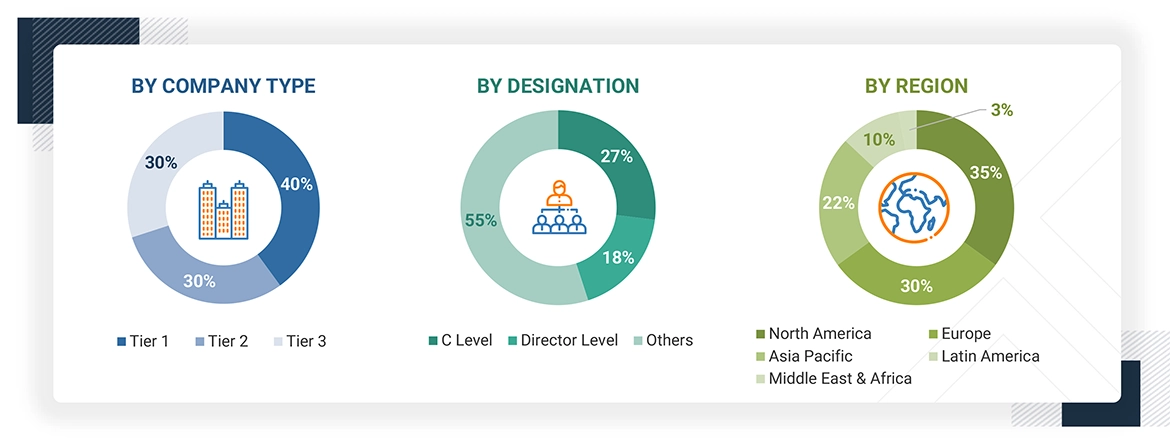
Note 1: C-level primaries include CEOs, CFOs, COOs, and VPs.
Note 2: Other designations include sales managers, marketing managers, business development managers, product managers, distributors, and suppliers.
Note 3: Companies are classified into tiers based on their total revenue. As of 2024, Tier 1 = >USD 10.00 billion, Tier 2 = USD 1.00 billion to USD 10.00 billion, and Tier 3 = < USD 1.00 billion.
Source: MarketsandMarkets Analysis
To know about the assumptions considered for the study, download the pdf brochure
Market Size Estimation
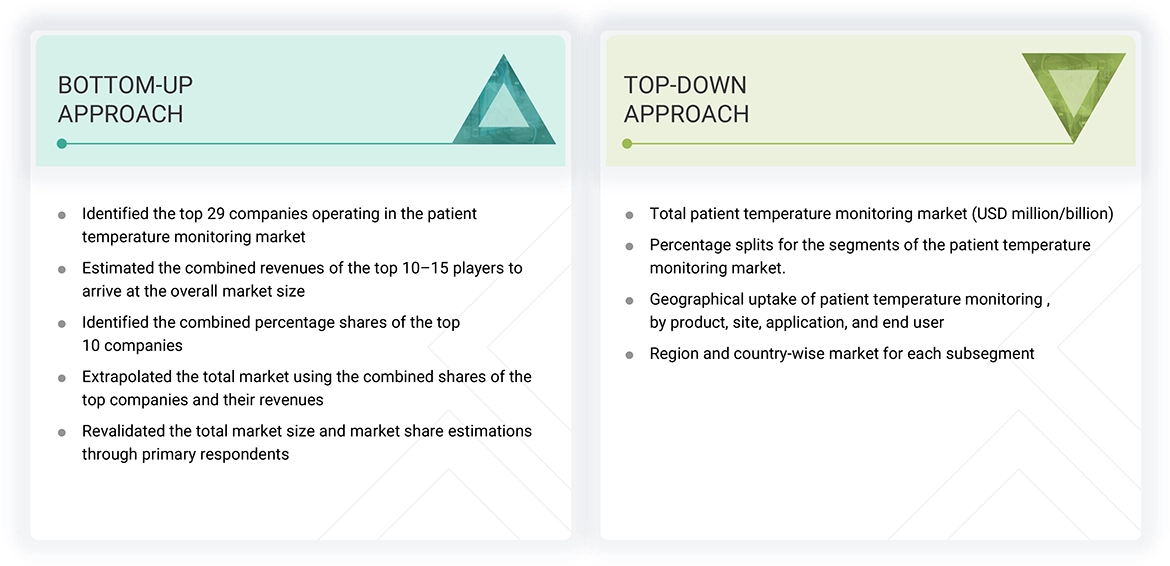
For the global market value, annual revenues were calculated based on the revenue mapping of major product manufacturers and OEMs active in the global patient temperature monitoring market. All the major product manufacturers were identified at the global and/or country/regional level. Revenue mapping for the respective business segments/subsegments was done for the major players. The global patient temperature monitoring market was split into various segments and sub-segments based on:
- List of major players operating in the patient temperature monitoring market at the regional and/or country level
- Product mapping of various patient temperature monitoring product manufacturers at the regional and/or country level
- Mapping of annual revenue generated by listed major players in the overall patient temperature monitoring market (or the nearest reported business unit/product category)
- Extrapolation of the revenue mapping of the listed major players to derive the global market value of the respective segments/subsegments
- Summation of the market value of all segments/subsegments to arrive at the global patient temperature monitoring market
The above-mentioned data was consolidated and added with detailed inputs and analysis from MarketsandMarkets and presented in this report.
Data Triangulation
After arriving at the overall size of the global patient temperature monitoring market through the above-mentioned methodology, this market was split into several segments and subsegments. Where applicable, the data triangulation and market breakdown procedures were employed to complete the overall market engineering process and arrive at the exact market value data for the key segments and subsegments. The extrapolated market data was triangulated by studying various macro indicators and regional trends from both demand- and supply-side participants.
Market Definition
Patient temperature monitoring involves the continuous or periodic assessment of an individual’s core body temperature to evaluate their physiological status, identify early manifestations of illness or infection, and inform clinical decision-making. This practice is integral to patient management across diverse healthcare environments, from primary care consultations to critical care units. It enables prompt recognition and intervention for thermoregulatory disturbances such as pyrexia or hypothermia, thereby enhancing overall patient outcomes through timely and targeted therapeutic responses.
Stakeholders
- Manufacturers and Vendors of Patient Temperature Monitoring Products
- Pharmaceutical & Biopharmaceutical Companies
- Distributors of Patient Temperature Monitoring Products
- Healthcare Institutions
- Government Bodies/Municipal Corporations
- Regulatory Bodies
- Business Research and Consulting Service Providers
- Venture Capitalists and Investors
- Market Research and Consulting Firms
- Healthcare Providers
Report Objectives
- To describe, analyze, and forecast the patient temperature monitoring market by product, site, application, end user, and region
- To describe and forecast the patient temperature monitoring market in key regions—North America, Europe, the Asia Pacific, Latin America, and the Middle East & Africa.
- To provide detailed information regarding the drivers, restraints, opportunities, and challenges influencing the market growth
- To strategically analyze micromarkets1 with respect to individual growth trends, prospects, and contributions to the overall market
- To analyze market opportunities for stakeholders and provide details of the competitive landscape for market players
- To profile key players and comprehensively analyze their market shares and core competencies2 in the patient temperature monitoring market
- To analyze competitive developments such as product approvals, partnerships, expansions, spinoffs, and collaborations in the patient temperature monitoring market
- To analyze the impact of AI/Gen AI on the patient temperature monitoring market in terms of its capabilities, potential, use cases, and future
Get the Full Patient Temperature Monitoring Market Report
Full forecast, segment splits, and company analysis for all Patient Temperature Monitoring Market.
- Spain Patient Temperature Monitoring Market
- China Patient Temperature Monitoring Market
- Japan Patient Temperature Monitoring Market
- India Patient Temperature Monitoring Market
- Australia Patient Temperature Monitoring Market
- South Korea Patient Temperature Monitoring Market
- Brazil Patient Temperature Monitoring Market
- Mexico Patient Temperature Monitoring Market
- Rest Of Europe Patient Temperature Monitoring Market
- Rest Of Asia Pacific Patient Temperature Monitoring Market
- Rest Of Latin America Patient Temperature Monitoring Market
- Kingdom Of Saudi Arabia Patient Temperature Monitoring Market
- Rest Of GCC Countries Patient Temperature Monitoring Market
- US Patient Temperature Monitoring Market
- Canada Patient Temperature Monitoring Market
- UK Patient Temperature Monitoring Market
- Germany Patient Temperature Monitoring Market
- France Patient Temperature Monitoring Market
- Italy Patient Temperature Monitoring Market
Need a Tailored Report?
Customize this report to your needs
Get 10% FREE Customization
Customize This Report
