
Germany Pedestrian Protection System Market (2026-2031)

The Germany Pedestrian Protection System Market was valued at $4436 Million in 2026 and projected to reach to $4677 Million by 2031, representing a compound annual growth rate of 0.8%. Germany's pedestrian protection system market is expected to grow modestly from USD 4,436 million in 2026 to USD 4,677 million by 2031, with a CAGR of 0.8%.


| Market Size in | USD 26.32 MN |
| Market Forecast in | |
| CAGR | |
| Forecast Period | |
| Units Considered | Value (USD MN) |
Germany Pedestrian Protection System Market Trends and Insights
- This modest growth trajectory reflects Germany's mature automotive market and stringent regulatory environment, where pedestrian safety technologies are already widely integrated into vehicle platforms.
- Germany's leadership in automotive engineering and its commitment to EU safety directives continue to drive steady adoption of advanced pedestrian detection and collision avoidance systems across the country's vehicle fleet. The German market benefits from strong OEM presence and established supply chains, with major automotive manufacturers headquartered in the region investing in next-generation pedestrian protection technologies.
- Germany's focus on autonomous vehicle development and Vision Zero initiatives further supports incremental market expansion through 2031.
- However, the relatively low growth rate reflects market saturation in premium segments and the gradual nature of fleet turnover in a developed economy where pedestrian safety systems are already standard equipment..
Key Market Statistics
- CAGR (2026-2031) 0.8% CAGR
- Market Size, 2026 ~USD 4436 Million
- Forecast, 2031 ~USD 4677 Million
- Country Germany
Germany Pedestrian Protection System Market Overview
Mature Market Saturation :
Germany's pedestrian protection system market is characterized by high penetration rates, with advanced safety technologies already standard across most vehicle platforms, limiting aggressive expansion opportunities.
Regulatory Leadership :
Germany's stringent EU safety regulations and Euro NCAP standards drive continuous innovation in pedestrian protection, positioning the country as a benchmark for automotive safety compliance.
Premium Manufacturer Dominance :
German automotive giants like BMW, Mercedes-Benz, Audi, and Volkswagen lead pedestrian protection system adoption, integrating cutting-edge technologies across their global vehicle portfolios.
Modest Growth Trajectory :
With a CAGR of 0.8% from 2026 to 2031, Germany's market reflects incremental improvements rather than disruptive growth, driven by replacement cycles and technology refinements rather than new adoption.
Germany Pedestrian Protection System Market Dynamics
- This subdued growth reflects the market's maturity, where pedestrian safety technologies are already deeply embedded in vehicle design standards.
- The market will be sustained by vehicle replacement cycles, regulatory updates, and incremental technology enhancements rather than new market penetration. Future growth will be driven by integration of advanced driver assistance systems (ADAS), autonomous vehicle development, and evolving Euro NCAP testing protocols.
- German manufacturers will continue investing in sensor fusion, AI-powered collision avoidance, and pedestrian detection systems to maintain competitive advantage.
- However, market expansion will remain constrained by the already-high baseline adoption rates and the shift of innovation focus toward autonomous driving capabilities..
Market Ecosystem

PEDESTRIAN PROTECTION SYSTEM MARKET: COMMERCIAL USE CASES ACROSS INDUSTRIES
| COMPANY | USE CASE DESCRIPTION | BENEFITS |
|---|---|---|
 |
Providing integrated pedestrian detection systems using radar and camera for real-time collision mitigation | Enabling automatic emergency braking, reducing collision severity, and improving safety outcomes |
 |
Providing radar and camera-based perception systems for pedestrian detection and situational awareness | Supporting accurate object detection, enabling automatic emergency braking, and reducing pedestrian collision risk |
 |
Delivering sensor fusion systems combining radar, camera, and ECU for pedestrian detection systems | Providing high detection accuracy, faster response time, and improved system reliability |
 |
Offering integrated braking and pedestrian detection systems for active safety | Improving response efficiency, enabling real time intervention, and reducing accident risks |
 |
Providing ADAS platforms with AI-based perception for pedestrian detection and tracking | Enhancing object recognition, enabling predictive safety features, and improving urban driving safety |
Logos and trademarks shown above are the property of their respective owners. Their use here is for informational and illustrative purposes only.
Related Ecosystem
Automotive Advance Technologies
- Battery Electric Vehicle (BEV)
- Light Commercial Vehicles (LCVs)
- Fuel Cell Electric Vehicle (FCEV)
- Hybrid Electric Vehicle (HEV)
- Internal Combustion Engine (ICE)
- BOSCH LIMITED
- Continental ag
- Visteon Corporation
- DENSO Corporation
- ZF FRIEDRICHSHAFEN AG
Automotive Systems
- Light Commercial Vehicles (LCVs)
- Battery Electric Vehicle (BEV)
- Hybrid Electric Vehicle (HEV)
- Agricultural Tractors
- Fuel Cell Electric Vehicle (FCEV)
- BOSCH LIMITED
- DENSO Corporation
- Continental ag
- ZF FRIEDRICHSHAFEN AG
- GORKOVSKY AVTOMOBILNY ZAVOD
Driving Support Security
- Battery Electric Vehicle (BEV)
- Hybrid Electric Vehicle (HEV)
- Light Commercial Vehicles (LCVs)
- Fuel Cell Electric Vehicle (FCEV)
- Blind Spot Detection (BSD)
- BOSCH LIMITED
- Continental ag
- DENSO Corporation
- Magna International Inc.
- ZF FRIEDRICHSHAFEN AG
Key Takeaways
- Germany's pedestrian protection system market reaches USD 4,436 million in 2026 with projected growth to USD 4,677 million by 2031.
- The 0.8% CAGR in Germany reflects a mature, saturated market where pedestrian safety technologies are already standard across most vehicle segments.
- Germany's strong automotive manufacturing base and EU regulatory compliance drive consistent demand for advanced pedestrian detection and collision mitigation systems.
- Market growth in Germany is constrained by high market penetration and slow fleet replacement cycles, typical of developed automotive economies.
Pedestrian Protection System Market Report Scope
| Report Metric | Details |
|---|---|
| Base Year | 2026 |
| Fastest Growing Segment | RADAR (Component) |
| Forecast Period | 2026–2031 |
| Growth Rate | CAGR of 4.1% from 2026 to 2031 |
| Largest Segment | ULTRASONIC (Component) |
| Market Size Base Year (Billions) | ~USD 6.46 (2026) |
| Revenue Forecast (Billions) | ~USD 7.9 (2031) |
| Segments Covered | Component, Vehicle Type, Ev Type |
Germany Pedestrian Protection System Market Report Segmentation
3 segment dimensions are covered across the global market.
By Component
- Camera
- Ecu
- Lidar
- Radar
- Ultrasonic
By Vehicle Type
- Heavy Commercial Vehicle
- Light Commercial Vehicle
- Passenger Car
By Ev Type
- Bev
- Hev
- Phev
Target Audience
- Automotive OEMs : German and international vehicle manufacturers need market intelligence to optimize pedestrian protection system integration, meet regulatory requirements, and maintain competitive positioning in Europe's largest automotive market.
- Tier-1 & Tier-2 Suppliers : Component manufacturers and system integrators require detailed market forecasts to plan production capacity, R&D investments, and supplier partnerships aligned with German OEM demand.
- Technology & Sensor Companies : ADAS and sensor technology providers need insights into German market adoption rates, technology preferences, and integration trends to guide product development and go-to-market strategies.
- Regulatory & Compliance Bodies : Government agencies, testing organizations, and compliance consultants use market data to understand technology adoption rates and inform future safety standard development in Germany.
- Investment & Strategy Consultants : Private equity firms, management consultants, and strategic investors require market forecasts and competitive analysis to evaluate acquisition targets and investment opportunities in Germany's automotive safety sector.
Key Companies in the Germany Pedestrian Protection System Market
| Company | HQ | Ownership | Strongest segments |
|---|---|---|---|
| ROBERT BOSCH GMBH | India | Private Company | Active pedestrian protection (sensors, ECUs, software, actuators),Passive pedestrian protection (hood lifters, energy-absorbing structures),Cameras, |
| AUMOVIO SE | Germany | Public Company | Active pedestrian protection systems (software-defined ADAS stack),Passive pedestrian protection (mechanical and mechatronic elements),Cameras, radar, LiDAR, ultrasonic integration and sensor fusion software, |
| DENSO CORPORATION | Japan | Public Company | Active technology – camera and radar-based pedestrian protection,Active technology – ultrasonic, LiDAR, and sensor suites,Passive technology – actuators and collision safety modules, |
| ZF FRIEDRICHSHAFEN AG | Germany | Private Company | Active technology – camera-based systems,Active technology – radar and LiDAR,Active technology – ECU and software, |
| APTIV | Ireland | Public Company | Active technology (camera, radar, LiDAR, ultrasonic, ECU, software),Passive technology (actuators, pyrotechnic and structural elements),Sensors and interconnect (standalone sensors, harnesses, connectors), |
| VALEO | France | Public Company | Active pedestrian protection – sensors (camera, radar, LiDAR, ultrasonic),Active pedestrian protection – ECU and domain controllers,Passive pedestrian protection – actuators and sensors, |
| MOBILEYE | United States | Public Company | Active pedestrian protection – camera-centric ADAS (Base ADAS, Cloud-Enhanced, SuperVision/Surround ADAS share),Active pedestrian protection – SoC (EyeQ) silicon content sold via Tier-1s,Active pedestrian protection – full-stack autonomous/Chauffeur/Drive for robotaxis and fleets, |
| HYUNDAI MOBIS | South Korea | Public Company | Passive pedestrian protection (airbags, bumpers, front-end modules),Active pedestrian protection (AEB, detection, active hood),Cameras and in-cabin/forward sensing, |
| MAGNA INTERNATIONAL INC. | Canada | Public Company | Active technology – cameras, radar, LiDAR, ultrasonic, ECUs,Passive technology – energy management, body structures, bumpers,Sensors and interior/thermal sensing for vulnerable road users, |
| AUTOLIV | Sweden | Public Company | Passive pedestrian protection systems (hood airbags, pyrotechnic actuators, structural modules),Sensors (pressure, contact, and basic detection sensors for pedestrian impact),ECU and control units for pedestrian protection logic, |
| NXP SEMICONDUCTORS | Netherlands | Public Company | ECU & Microcontrollers for Pedestrian Protection / ADAS,Automotive Radar (77 GHz) for VRU / AEB,Sensors (Inertial, Environmental, Magnetic) supporting Protection Functions, |
| TEXAS INSTRUMENTS | United States | Public Company | Analog signal chain & power for sensors (camera, radar, ultrasonic, LiDAR),Embedded MCUs and processors for ADAS ECUs,Automotive radar front-end and transceivers, |
| ONSEMI | United States | Public Company | Active pedestrian protection – camera-based (CMOS sensors, ISPs, interfaces),Active pedestrian protection – radar, ultrasonic, LiDAR signal chain,ECU, power management, actuator drivers, |
ROBERT BOSCH GMBH
Robert Bosch GmbH is a private company headquartered in India with a rich history dating back to 1886. The organization operates with a substantial workforce of 412,774 employees, making it one of the largest industrial enterprises globally.
AUMOVIO SE
Aumovio SE is a publicly traded company based in Germany that was founded in 2024. The company employs 31,054 people and operates in the automotive sector.
DENSO CORPORATION
Denso Corporation is a Japanese public company established in 1949 that specializes in automotive components and systems. With 154,716 employees, it is a major player in the global automotive supply industry.
ZF FRIEDRICHSHAFEN AG
ZF Friedrichshafen AG is a private German company founded in 1915 with a workforce of 145,909 employees. The company is a leading global supplier of driveline and chassis technology for the automotive industry.
APTIV
Aptiv is a publicly traded company incorporated in Ireland and founded in 2011, employing 140,000 people worldwide. The company specializes in automotive technology and mobility solutions.
VALEO
Valeo is a French public company established in 1923 with 87,115 employees. The company is a leading automotive supplier specializing in lighting systems, thermal systems, and autonomous driving technologies.
MOBILEYE
Mobileye is a United States-based public company founded in 1999 with 4,200 employees. The company specializes in autonomous driving technology and computer vision solutions for the automotive industry.
HYUNDAI MOBIS
Hyundai Mobis is a South Korean public company founded in 1977. The company is a major automotive parts supplier serving the global automotive market.
MAGNA INTERNATIONAL INC.
Magna International Inc. is a Canadian public company established in 1957 with 156,000 employees. The company is a leading global automotive supplier providing a wide range of components and systems.
AUTOLIV
Autoliv is a Swedish public company established in 1953 with 56,515 employees. The company is a global leader in automotive safety systems, including airbags and seatbelts.
NXP SEMICONDUCTORS
NXP Semiconductors is a Dutch public company founded in 2006 with 32,169 employees. The company is a leading semiconductor manufacturer serving the automotive and industrial markets.
TEXAS INSTRUMENTS
Texas Instruments is a United States-based public company established in 1930 with 33,000 employees. The company is a major semiconductor manufacturer providing analog and embedded processing solutions.
ONSEMI
Onsemi is a United States-based public company founded in 1992 with 22,635 employees. The company is a semiconductor manufacturer specializing in power management and analog solutions for automotive and industrial applications.
Reasons to Buy this Report
- Competitive Benchmarking : Understand how German premium manufacturers are positioning pedestrian protection technologies and identify competitive gaps in your product portfolio relative to market leaders.
- Regulatory Compliance Strategy : Navigate Germany's stringent EU safety standards and Euro NCAP requirements with detailed insights into compliance pathways and regulatory evolution through 2031.
- Market Entry & Expansion Planning : Identify growth opportunities within Germany's mature market through replacement cycles, technology upgrades, and emerging autonomous vehicle integration strategies.
- Technology Investment Decisions : Make informed R&D investment decisions by understanding which pedestrian protection technologies are gaining traction in Germany's premium automotive segment.
- Supply Chain Optimization : Optimize supplier relationships and manufacturing strategies by analyzing demand patterns and growth projections specific to the German market through 2031.
Frequently asked questions
What is the current size of Germany's pedestrian protection system market?
Germany's pedestrian protection system market is valued at USD 4,436 million in 2026, according to verified market data.
What is the projected market size for pedestrian protection systems in Germany by 2031?
Germany's pedestrian protection system market is forecast to reach USD 4,677 million by 2031, representing growth of approximately USD 241 million over the five-year period.
What is the CAGR for Germany's pedestrian protection system market?
Germany's pedestrian protection system market is expected to grow at a compound annual growth rate of 0.8% from 2026 to 2031.
Why is Germany's pedestrian protection system market growth relatively low compared to global trends?
Germany's low growth rate reflects a mature, highly penetrated market where pedestrian safety technologies are already standard equipment, combined with gradual vehicle fleet replacement cycles typical of developed economies.
What factors support demand for pedestrian protection systems in Germany?
Germany's strong automotive manufacturing base, stringent EU safety regulations, Vision Zero initiatives, and investment in autonomous vehicle technologies all support steady demand for pedestrian protection systems.
RESEARCH METHODOLOGY
The study involved four major activities in estimating the current size of the pedestrian protection system market. Exhaustive secondary research was done to collect information on the market, the peer market, and the parent market. The next step was to validate these findings, assumptions, and sizing with the industry experts across value chains through primary research. The top-down approach was employed to estimate the complete market size. Thereafter, market breakdown and data triangulation processes were used to estimate the market size of segments and subsegments.
Secondary Research
In the secondary research process, various secondary sources, such as company annual reports/presentations, industry association publications, magazine articles, directories, technical handbooks, World Economic Outlook reports, trade websites, technical articles, and databases, were referred to. The secondary data was collected and analyzed to arrive at the overall market size, which was further validated by primary research for an extensive commercial study of the pedestrian protection system market.
Primary Research
Extensive primary research has been conducted after acquiring an understanding of the pedestrian protection system market scenario through secondary research. Several primary interviews have been conducted with market experts from the demand and supply sides across Asia Pacific, Europe, North America, and the Rest of the World. Primary data was collected through questionnaires, emails, and telephonic interviews. In the canvassing of primaries, various departments within organizations, such as sales, operations, and marketing departments, have been covered to provide a holistic viewpoint in the report. After interacting with industry experts, brief sessions have been conducted with highly experienced independent consultants to reinforce the findings from primaries.
The following is a breakdown of the primary respondents:
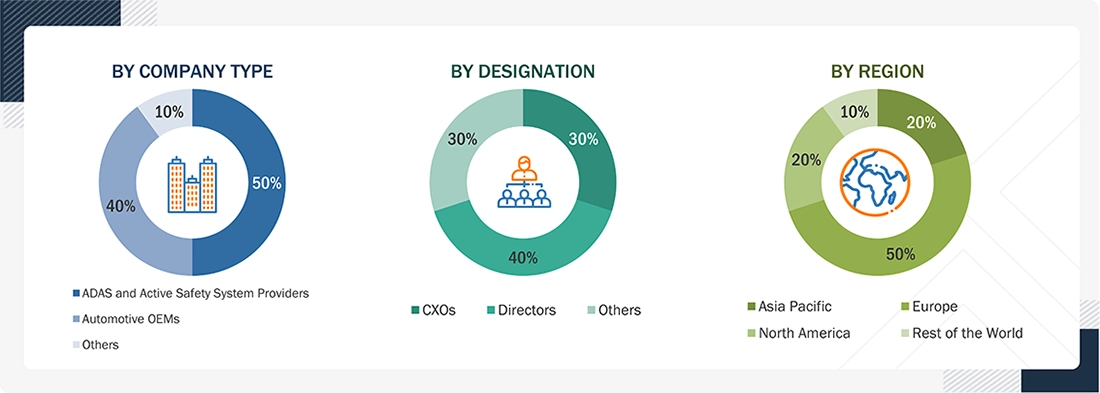
Note: Others include purchase and sales managers, marketing managers, and product managers.
To know about the assumptions considered for the study, download the pdf brochure
Market Size Estimation
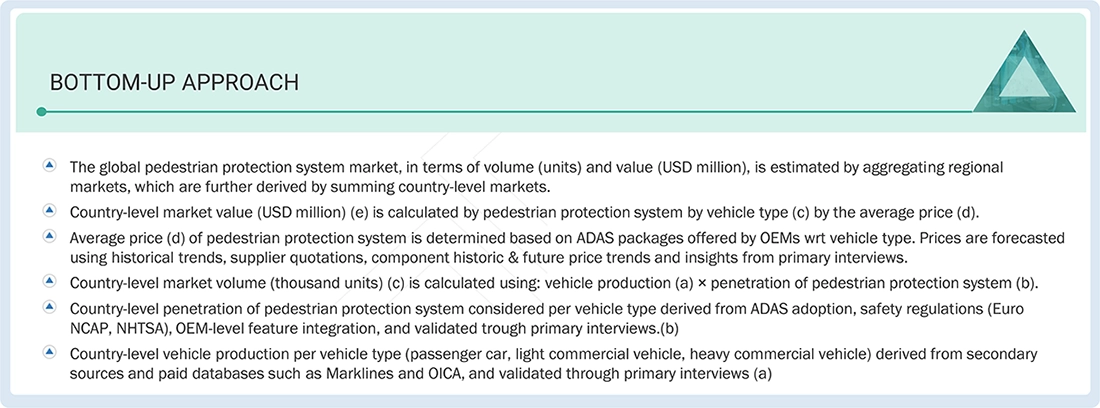
The bottom-up methodology was followed to estimate the size of the pedestrian protection system market in terms of volume (units) and value (USD million). The global market was derived by aggregating regional markets, which were further built using country-level data. At the country level, market volume was calculated by multiplying vehicle production across passenger cars, light commercial vehicles, and heavy commercial vehicles by the penetration rate of pedestrian protection systems. Vehicle production data was sourced from secondary databases such as OICA and MarkLines and validated through primary interviews with industry experts.
Data Triangulation
After arriving at the overall market size using the market size estimation processes explained above, the market was split into several segments and subsegments. To complete the overall market engineering process and arrive at the exact statistics of each market segment and subsegment, data triangulation and market breakdown procedures were employed, wherever applicable. The data was triangulated by studying various factors and trends from both the demand and supply sides.
Market Definition
Pedestrian protection systems refer to vehicle-integrated safety technologies such as automatic emergency braking, pedestrian detection systems, and pedestrian airbags designed to lessen pedestrian injuries during collisions. These systems utilize radar, cameras, sensors, and electronic control units to detect pedestrian presence and collision risks in real time.
Report Objectives
- To define, describe, segment, and forecast the pedestrian protection system market based on technology, component, vehicle type, EV type, and region
- To analyze regional markets for growth trends, prospects, and their contribution to the overall market
- To identify and analyze key drivers, restraints, opportunities, and challenges influencing market growth
- To strategically analyze markets with respect to individual growth trends, prospects, and contribution to the total market
- To analyze opportunities for stakeholders and the competitive landscape for market leaders
- To study the following with respect to the market -
- Value chain analysis
- Ecosystem analysis
- Technology analysis
- Trade analysis
- Case study analysis
- Patent analysis
- Regulatory landscape
- Key stakeholders and buying criteria
- Key conferences and events
- To strategically profile key players and comprehensively analyze their market share and core competencies
- To track and analyze competitive developments such as deals, product developments, and other activities carried out by key industry participants
Available customizations:
With the given market data, MarketsandMarkets offers customizations in line with company-specific needs.
- Pedestrian Protection System Market, by Level of Autonomy, at Regional Level (For regions covered in report)
- Pedestrian Protection System Market, by Price Segment, at Regional Level (For regions covered in report)
- Company Information
- Profiling of additional market players (up to five)
Get the Full Pedestrian Protection System Market Report
Full forecast, segment splits, and company analysis for all Pedestrian Protection System Market.
- China Pedestrian Protection System Market
- Japan Pedestrian Protection System Market
- India Pedestrian Protection System Market
- South Korea Pedestrian Protection System Market
- France Pedestrian Protection System Market
- Spain Pedestrian Protection System Market
- UK Pedestrian Protection System Market
- Mexico Pedestrian Protection System Market
- Canada Pedestrian Protection System Market
- US Pedestrian Protection System Market
- Brazil Pedestrian Protection System Market
- South Africa Pedestrian Protection System Market
- Rest Of Europe Pedestrian Protection System Market
Need a Tailored Report?
Customize this report to your needs
Get 10% FREE Customization
Customize This Report
