
Asia Pacific Persulfates Market (2025-2030)

The Asia Pacific Persulfates Market was valued at $321.5 Million in 2025 and projected to reach to $438.2 Million by 2030, representing a compound annual growth rate of 6.4%. The Asia Pacific persulfates market is positioned for sustained growth through 2030, driven by the region's position as the global manufacturing hub and increasing environmental consciousness.


| Market Size in | USD 26.32 MN |
| Market Forecast in | |
| CAGR | |
| Forecast Period | |
| Units Considered | Value (USD MN) |
Asia Pacific Persulfates Market Trends and Insights
- Asia Pacific's persulfates demand is driven by expanding electronics manufacturing, water treatment applications, and polymer production across the region.
- The region's rapid industrialization and increasing environmental regulations are accelerating adoption of persulfates in Asia Pacific, particularly in China, India, and Southeast Asia. Asia Pacific's persulfates market is benefiting from strong demand in semiconductor and PCB manufacturing, where persulfates serve as critical oxidizing agents.
- The region's growing middle class and urbanization are fueling water treatment investments, further supporting Asia Pacific's market expansion.
- With a compound annual growth rate of 6.4%, Asia Pacific is positioned as a key growth engine for the global persulfates industry through 2030..
Key Market Statistics
- CAGR (2025-2030) 6.4% CAGR
- Market Size, 2025 ~USD 321.5 Million
- Forecast, 2030 ~USD 438.2 Million
- Geography Asia Pacific
Asia Pacific Persulfates Market Overview
Electronics Manufacturing Surge :
Asia Pacific's booming electronics sector, particularly in China, Japan, and South Korea, is driving significant persulfates demand for circuit board manufacturing and semiconductor processing applications.
Water Treatment Expansion :
Rapid industrialization across India, Thailand, and Southeast Asia is accelerating water treatment investments, creating substantial demand for persulfates as oxidizing agents in municipal and industrial water purification systems.
Polymer Production Growth :
The region's expanding polymer and plastics industry, supported by China's manufacturing dominance and India's emerging production capacity, is fueling persulfates consumption as initiators in polymerization processes.
Environmental Regulation Compliance :
Stricter environmental standards across Asia Pacific nations are pushing industries toward persulfate-based solutions for cleaner production methods and enhanced waste treatment capabilities.
Asia Pacific Persulfates Market Dynamics
- China's continued industrial dominance, coupled with India's rapid industrialization and Japan's advanced electronics sector, creates a diversified demand base.
- Water treatment infrastructure investments across emerging economies and stringent pollution control regulations are accelerating persulfates adoption.
- The region's 6.4% CAGR outpaces the global average of 5.9%, reflecting Asia Pacific's critical role in persulfates consumption and market expansion opportunities. Key growth catalysts include expanding semiconductor fabrication facilities, rising municipal water treatment projects, and polymer production capacity increases.
- Investment in green chemistry and sustainable manufacturing practices is further boosting persulfates demand as preferred oxidizing agents.
- Strategic market consolidation and capacity expansions by major chemical manufacturers in the region are expected to enhance supply chain efficiency and market accessibility for end-users across diverse industrial applications..
Market Ecosystem
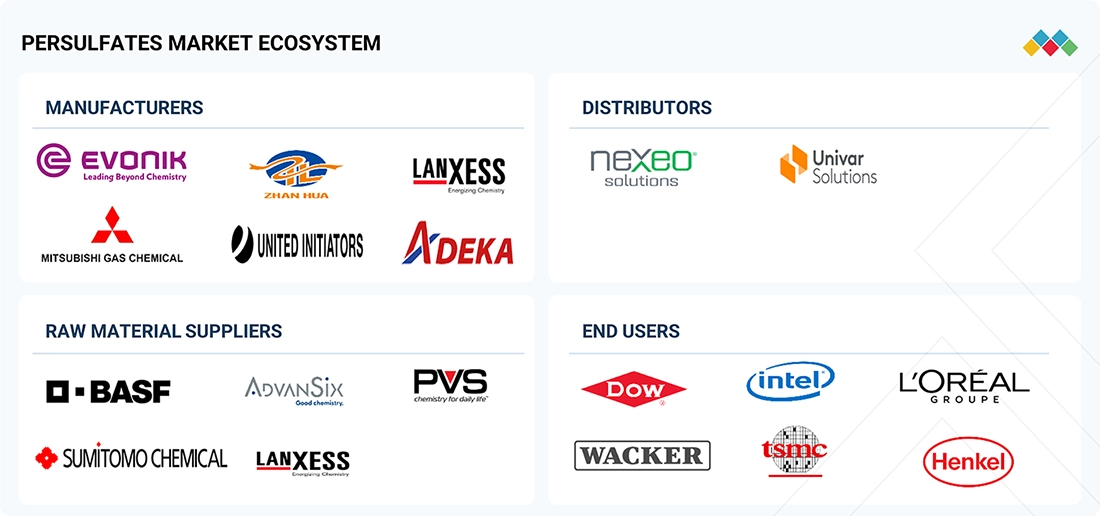
PERSULFATES MARKET: COMMERCIAL USE CASES ACROSS INDUSTRIES
| COMPANY | USE CASE DESCRIPTION | BENEFITS |
|---|---|---|
 |
Uses ammonium persulfate in PCB micro-etching, synthetic resin polymerization, and metal surface treatment for electronics and industrial materials. | Enables precise surface cleaning, improves adhesion in electronic components, and ensures consistent polymer reaction control for high-performance materials. |
 |
Applies KLOZUR® persulfates in in situ chemical oxidation (ISCO) to remediate hydrocarbon-contaminated soil and groundwater across industrial sites. | Achieves rapid contaminant reduction (often within days), supports site redevelopment, and lowers environmental remediation time and cost. |
 |
Supplies persulfates for emulsion polymerization in latex, synthetic rubber, and coatings used in automotive, paints, and industrial materials. | Ensures controlled free-radical reactions, improves polymer consistency, and enhances the performance of coatings, adhesives, and rubber products. |
Logos and trademarks shown above are the property of their respective owners. Their use here is for informational and illustrative purposes only.
Related Ecosystem
Bulk Chemicals And Inorganics
- Corrosion Inhibitors
- Glycol Ethers
- Acetic Acid
- Acetone
- Ammonium Nitrate
- Basf se
- DOW CHEMICAL COMPANY
- Exxon Mobil Corporation
- AZELIS HOLDINGS SA
- Sinopec limited
Water Purification
- Corrosion Inhibitors
- Cartridge Filters
- Fiberglass
- Reverse Osmosis
- Acetone
- Veolia
- SOLENIS
- Kemira oyj
- CALGON CARBON CORPORATION
- Basf se
Key Takeaways
- Asia Pacific persulfates market will grow from $321.5M (2025) to $438.2M (2030) at a 6.4% CAGR
- Electronics and semiconductor manufacturing are primary demand drivers in Asia Pacific
- Water treatment and environmental compliance initiatives are accelerating persulfates adoption across Asia Pacific
- China, India, and Southeast Asia represent the highest-growth markets within Asia Pacific
Persulfates Market Report Scope
| Report Metric | Details |
|---|---|
| Base Year | 2025 |
| Fastest Growing Segment | WATER TREATMENT (End-Use Industry) |
| Forecast Period | 2025–2030 |
| Growth Rate | CAGR of 5.9% from 2025 to 2030 |
| Largest Segment | POLYMER INITIATOR (Application) |
| Market Size Base Year (Billions) | ~USD 0.57 (2025) |
| Revenue Forecast (Billions) | ~USD 0.76 (2030) |
| Segments Covered | Type, Application, End-Use Industry |
Asia Pacific Persulfates Market Report Segmentation
3 segment dimensions are covered across the global market.
By Type
- Ammonium Persulfates
- Potassium Persulfates
- Sodium Persulfates
By Application
- Downhole
- Other Applications
- Oxidation, Bleaching, And Sizing Agents
- Polymer Initiator
By End-Use Industry
- Cosmetics & Personal Care
- Electronics
- Oil & Gas
- Other End-Use Industries
- Polymer
- Pulp, Paper, And Textile
- Soil Remediation
- Water Treatment
Target Audience
- Chemical Manufacturers & Producers : Require detailed market sizing, growth forecasts, and regional demand patterns to optimize production capacity, plan facility expansions, and identify high-potential geographic markets in Asia Pacific.
- Electronics & Semiconductor Companies : Need insights into persulfates supply chains, regional availability, pricing trends, and supplier capabilities to secure reliable sourcing for circuit board and semiconductor manufacturing operations.
- Water Treatment & Environmental Services : Seek market intelligence on persulfates adoption rates, regulatory drivers, and competitive offerings across Asia Pacific to develop targeted solutions and expand service portfolios in growing markets.
- Investment & Private Equity Firms : Require comprehensive market analysis, growth trajectories, and competitive dynamics to evaluate investment opportunities, identify acquisition targets, and assess portfolio company growth potential.
- Polymer & Plastics Manufacturers : Need regional persulfates market data, supplier landscapes, and application-specific insights to optimize raw material sourcing, manage costs, and support production scaling initiatives.
Key Companies in the Asia Pacific Persulfates Market
| Company | HQ | Ownership | Strongest segments |
|---|---|---|---|
| EVONIK INDUSTRIES AG | Germany | Public Company | Advanced Technologies,Custom Solutions,Infrastructure, |
| MITSUBISHI GAS CHEMICAL COMPANY, INC. | Japan | Public Company | Green Energy & Chemicals (methanol, natural gas, basic chemicals),Functional Chemicals (performance chemicals, engineering plastics, resins),Electronic Materials and Copper-Clad Laminates, |
| ADEKA CORPORATION | Japan | Public Company | Polymer additives (antioxidants, UV/HALS, nucleating agents, PVC stabilizers, flame retardants),Electronic and semiconductor materials (photo/thermal curing, resist, LCD, circuit, resin materials),Resins and adhesives (water-borne, epoxy, low-chlorine, urethane, epoxy adhesives), |
| LANXESS AG | Germany | Public Company | Specialty Additives,Advanced Intermediates,Consumer Protection, |
| MERCK KGAA | Germany | Public Company | Life Science (tools, reagents, bioprocessing, CDMO),Healthcare (innovative pharma and biologics),Electronics (semiconductor and display materials), |
| YATAI ELECTROCHEMICAL CO., LTD. | China | Caustic soda (solid and liquid),Chlorine and derivatives,Hydrochloric acid and by-products, |
EVONIK INDUSTRIES AG
Evonik Industries AG is a German public company founded in 1847 with 30,643 employees. The company operates as a global specialty chemicals manufacturer and supplier.
MITSUBISHI GAS CHEMICAL COMPANY, INC.
Mitsubishi Gas Chemical Company, Inc. is a Japanese public company founded in 1918 with 8,319 employees. The company operates in the chemical manufacturing and specialty chemicals sector.
ADEKA CORPORATION
Adeka Corporation is a Japanese public company founded in 1917 with 5,434 employees. The company operates as a specialty chemicals manufacturer.
LANXESS AG
Lanxess AG is a German public company founded in 1863 with 11,630 employees. The company is a specialty chemicals manufacturer serving various industrial sectors.
MERCK KGAA
Merck KGaA is a German public company founded in 1668 with 59,077 employees. The company operates as a global science and technology company in pharmaceuticals, chemicals, and life sciences.
YATAI ELECTROCHEMICAL CO., LTD.
Insufficient data available for company description.
Countries within Asia Pacific - compare and drill down
| Country | 2025 size (native) |
|---|---|
| China | USD 234581.5 Million |
| Japan | USD 18586.3 Million |
| India | USD 22709.3 Million |
| South Korea | USD 13778.9 Million |
| Taiwan | USD 14870.6 Million |
| Thailand | USD 2057.7 Million |
Country market size visualization
Reasons to Buy this Report
- Regional Market Sizing & Forecasts : Access precise market valuations for Asia Pacific persulfates at USD 321.5M (2025) and USD 438.2M (2030), with country-level breakdowns enabling targeted investment and expansion strategies.
- Country-Specific Intelligence : Detailed analysis of China, India, Japan, South Korea, Taiwan, and Thailand markets reveals distinct growth drivers, competitive landscapes, and regulatory environments unique to each economy.
- Application & End-Use Insights : Comprehensive understanding of persulfates demand across electronics manufacturing, water treatment, and polymer production sectors helps identify high-growth opportunities and customer segments.
- Competitive Landscape Analysis : Strategic intelligence on regional market players, capacity expansions, and competitive positioning enables informed decision-making for market entry, partnerships, and competitive differentiation.
- Regulatory & Sustainability Trends : In-depth coverage of environmental regulations and green chemistry adoption across Asia Pacific markets guides product development and compliance strategies for long-term market success.
Frequently asked questions
What is the current size of the Asia Pacific persulfates market?
The Asia Pacific persulfates market is valued at USD 321.5 million in 2025.
What is the projected market size for Asia Pacific persulfates by 2030?
The Asia Pacific persulfates market is forecast to reach USD 438.2 million by 2030.
What is the growth rate for Asia Pacific persulfates?
Asia Pacific persulfates market is expected to grow at a CAGR of 6.4% from 2025 to 2030.
Which industries drive demand for persulfates in Asia Pacific?
Electronics manufacturing, semiconductor production, water treatment, and polymer processing are the primary demand drivers in Asia Pacific.
Which countries are leading the Asia Pacific persulfates market?
China, India, and Southeast Asian nations are the leading markets for persulfates in Asia Pacific due to rapid industrialization and manufacturing expansion.
RESEARCH METHODOLOGY
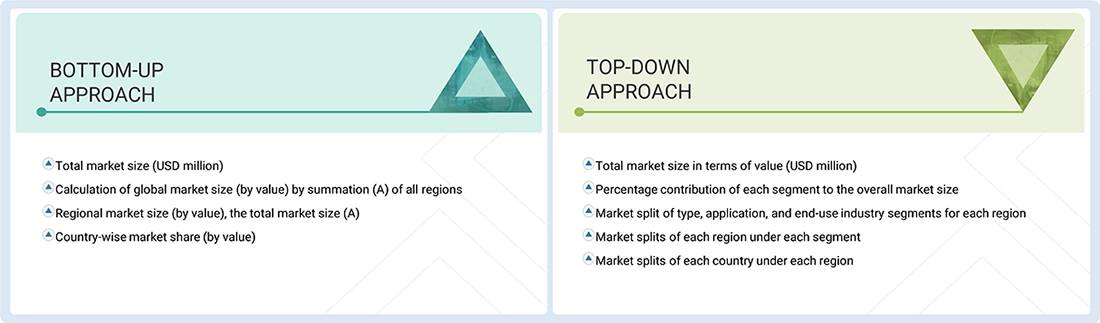
The study involved four major activities to estimate the current size of the global persulfates market. Exhaustive secondary research was carried out to collect information on the market, the peer product market, and the parent product group market. The next step was to validate these findings, assumptions, and sizes with the industry experts across the value chain of persulfates through primary research. The top-down and bottom-up approaches were employed to estimate the overall size of the persulfates market. After that, market breakdown and data triangulation procedures were used to determine the size of different segments of the market.
Secondary Research
The market for companies offering persulfates is arrived at by secondary data available through paid and unpaid sources, analyzing the product portfolios of the major companies in the ecosystem, and rating the companies by their performance and quality. For this study, various secondary sources, such as Business Standard, Bloomberg, the World Bank, and Factiva, were referred to in order to identify and collect information on the persulfates market. In the secondary research process, various secondary sources were referred to in order to identify and collect information related to the study. Secondary sources included annual reports, press releases, and investor presentations of persulfates vendors, forums, certified publications, and whitepapers. The secondary research was used to obtain critical information on the industry’s value chain, the total pool of key players, market classification, and segmentation from the market and technology-oriented perspectives.
Primary Research
In the primary research process, various primary sources from the supply and demand sides were interviewed to obtain qualitative and quantitative information for this report. The primary sources from the supply side included industry experts, such as chief executive officers (CEOs), vice presidents (VPs), marketing directors, technology & innovation directors, and related key executives from several key companies and organizations operating in the persulfates market. After the complete market engineering (calculations for market statistics, market breakdown, market size estimations, market forecasting, and data triangulation), extensive primary research was conducted to gather information and verify and validate the critical numbers arrived at.
Primary research was also conducted to identify the segmentation types, industry trends, competitive landscape of persulfates offered by various market players, and key market dynamics, such as drivers, restraints, opportunities, challenges, trends, and key player strategies. In the complete market engineering process, the top-down and bottom-up approaches and several data triangulation methods were extensively used to perform the market estimation and market forecasting for the overall market segments and subsegments listed in this report. Extensive qualitative and quantitative analysis was performed on the complete market engineering process to list the key information/insights throughout the report.
The following is the breakdown of primary respondents:
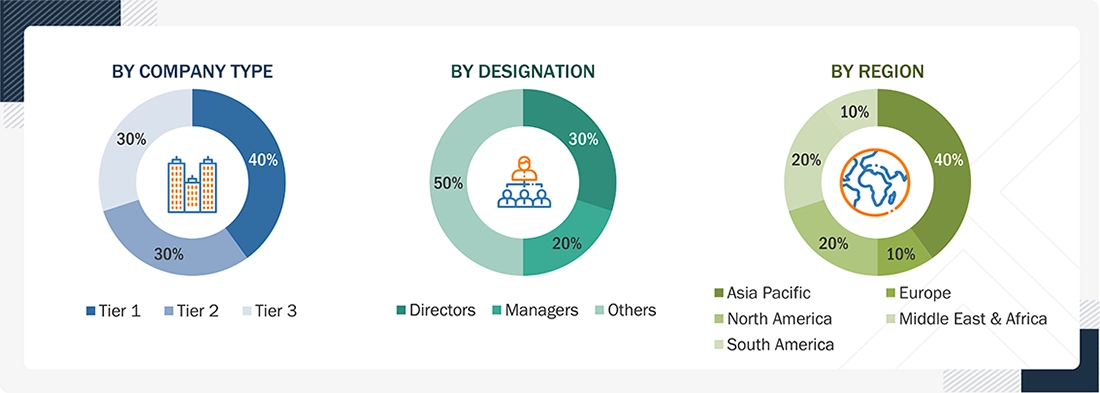
Note 1: Other designations include sales, marketing, and product managers.
Note 2: Tier 1: >USD 1 Billion; Tier 2: USD 500 million–1 Billion; and Tier 3: <USD 500 million.
To know about the assumptions considered for the study, download the pdf brochure
Market Size Estimation
The top-down and bottom-up approaches were used to estimate and validate the size of the global persulfates market. These approaches were also used extensively to estimate the size of various dependent market segments. The research methodology used to estimate the market size included the following:
Data Triangulation
After arriving at the overall market size using the market size estimation processes, the market was split into several segments and subsegments. The data triangulation and market breakup procedures were employed, wherever applicable, to complete the overall market engineering process and arrive at the exact statistics of each market segment and subsegment. The data was triangulated by studying various factors and trends from the demand and supply sides.
Market Definition
Persulfates are inorganic oxidizing compounds that are highly soluble in water and widely valued for their strong reactivity. They are typically produced through the electrolysis of corresponding sulfates and are available mainly as ammonium, sodium, and potassium persulfate. These compounds possess powerful oxidizing properties, a relatively good shelf life when stored correctly, and are cost-effective, making them suitable for diverse industrial and commercial applications.
The three main persulfates are ammonium persulfate, potassium persulfate, and sodium persulfate. Ammonium persulfate is the most widely consumed grade and is primarily used as a polymerization initiator in the production of latex, acrylics, and synthetic rubber. It is also applied as an etchant and cleaner in printed circuit board manufacturing, a booster in hair bleaching formulations, and a gel breaker in oil and gas operations. Its high solubility and reliable decomposition characteristics make it suitable for large-volume industrial processes.
Potassium persulfate is especially used in emulsion polymerization for producing acrylics, vinyls, styrene-butadiene rubber, neoprene, and other resins. It is also important in starch modification and depolymerization processes, in cosmetics for hair bleaching, and as a gel breaker in oil and gas applications. Compared with other persulfates, potassium persulfate exhibits higher thermal stability, making it useful in reactions requiring longer processing time and controlled radical release.
Sodium persulfate is recognized as one of the strongest oxidizing agents in this group and is widely applied in soil and groundwater remediation, where it destroys organic contaminants through in situ chemical oxidation. It is also used as a polymerization initiator, an etchant and cleaner for printed circuit boards, and in wastewater treatment, textiles, and cosmetics. Its strong oxidation capability, high solubility, and versatility across environmental and industrial applications make sodium persulfate a preferred choice in many treatment and manufacturing processes.
Persulfates play a key role as polymerization initiators, etching and cleaning agents in electronics manufacturing, oxidants for soil and groundwater remediation, and bleaching agents in cosmetics and personal care. They are also used in oil and gas operations as gel breakers, in wastewater treatment, textile and pulp processing, organic synthesis, and photographic solutions. Their ability to release the highly reactive persulfate anion underlies their effectiveness across these applications.
Key Stakeholders
- Persulfate Manufacturers and Suppliers
- Raw Material Providers
- Distributors and Traders of Persulfates
- Government and Regulatory Bodies
- Environmental and Safety Authorities
- Investors and Financial Institutions
- Research Institutes and Laboratories
- End-use Customers across Industrial Sectors
Report Objectives
- To define, describe, and forecast the size of the global persulfates market, by type, application, and end-use industry in terms of value and volume
- To forecast the market size of segments for North America, Europe, Asia Pacific, South America, and the Middle East & Africa, along with their respective countries, in terms of value and volume
- To provide detailed information on the significant drivers, restraints, opportunities, and challenges influencing the market
- To strategically analyze micromarkets concerning individual growth trends, prospects, and their contribution to the market
- To assess the growth opportunities in the market for stakeholders and provide details on the competitive landscape for market leaders
- To strategically profile key players and comprehensively analyze their market shares and core competencies
- To analyze competitive developments, such as product launches, expansions, acquisitions, and agreements in the persulfates market
- To provide the impact of AI/Gen AI on the market
- To provide the macroeconomic outlook for each region covered under the study, and the impact of the 2025 US tariffs on the market
Available customizations:
With the given market data, MarketsandMarkets offers customizations according to client-specific needs.
The following customization options are available for the persulfates report:
Product Analysis
- A product matrix that gives a detailed comparison of the product portfolio of each company
Regional Analysis
- A further breakdown of the persulfates market for additional countries
Company Information
- Detailed analysis and profiling of additional market players (up to five)
Get the Full Persulfates Market Report
Full forecast, segment splits, and company analysis for all Persulfates Market.
- China Persulfates Market
- Japan Persulfates Market
- India Persulfates Market
- South Korea Persulfates Market
- Taiwan Persulfates Market
- Thailand Persulfates Market
- Germany Persulfates Market
- France Persulfates Market
- Italy Persulfates Market
- Turkey Persulfates Market
- Canada Persulfates Market
- Mexico Persulfates Market
- Brazil Persulfates Market
- Argentina Persulfates Market
- South Africa Persulfates Market
- US Persulfates Market
- Rest Of Europe Persulfates Market
- Rest Of Asia Pacific Persulfates Market
Need a Tailored Report?
Customize this report to your needs
Get 10% FREE Customization
Customize This Report
