
South Korea Pharmaceutical Metal Detector Market (2025-2030)

The South Korea Pharmaceutical Metal Detector Market was valued at $0.85 Million in 2025 and projected to reach to $1 Million by 2030, representing a compound annual growth rate of CAGR 3.2%. South Korea's pharmaceutical metal detector market is poised for steady growth through 2030, supported by the country's robust pharmaceutical manufacturing sector and commitment to quality excellence.


| Market Size in | USD 26.32 MN |
| Market Forecast in | |
| CAGR | |
| Forecast Period | |
| Units Considered | Value (USD MN) |
South Korea Pharmaceutical Metal Detector Market Trends and Insights
- South Korea's advanced pharmaceutical manufacturing infrastructure and stringent regulatory compliance requirements drive demand for contamination detection solutions.
- South Korea's commitment to quality assurance in drug production positions the country as a key market within the Asia Pacific region, with steady adoption of metal detection technologies across manufacturing facilities. The growth trajectory in South Korea reflects increasing investments in pharmaceutical production capacity and heightened focus on product safety standards.
- South Korea's regulatory environment mandates rigorous quality control measures, compelling manufacturers to integrate metal detection systems into their production lines.
- Between 2025 and 2030, South Korea's market will benefit from technological advancements and the expansion of the pharmaceutical sector, supporting consistent market expansion..
Key Market Statistics
- CAGR (2025-2030) CAGR 3.2%
- Market Size, 2025 ~USD 0.85 Million
- Forecast, 2030 ~USD 1 Million
- Country South Korea
South Korea Pharmaceutical Metal Detector Market Overview
Market Size & Growth :
South Korea's pharmaceutical metal detector market is valued at USD 0.85 million in 2025, with projected growth to USD 1.0 million by 2030, representing a steady CAGR of 3.2%.
Regulatory Compliance Driver :
Stringent South Korean pharmaceutical regulations and GMP standards mandate contamination detection solutions, creating consistent demand from manufacturers seeking compliance assurance.
Advanced Manufacturing Base :
South Korea's sophisticated pharmaceutical manufacturing infrastructure and export-oriented industry require high-precision metal detection equipment to maintain product quality and international competitiveness.
Quality Assurance Focus :
South Korean pharmaceutical companies prioritize contamination prevention and product safety, driving adoption of advanced metal detection technologies across production lines.
South Korea Pharmaceutical Metal Detector Market Dynamics
- The market benefits from South Korea's position as a major pharmaceutical exporter and the government's emphasis on maintaining high industry standards.
- Increasing investments in pharmaceutical production capacity and modernization of existing facilities will sustain demand for contamination detection solutions.
- The 3.2% CAGR reflects moderate but consistent expansion driven by regulatory compliance requirements and manufacturers' focus on product integrity and safety standards..
Market Ecosystem
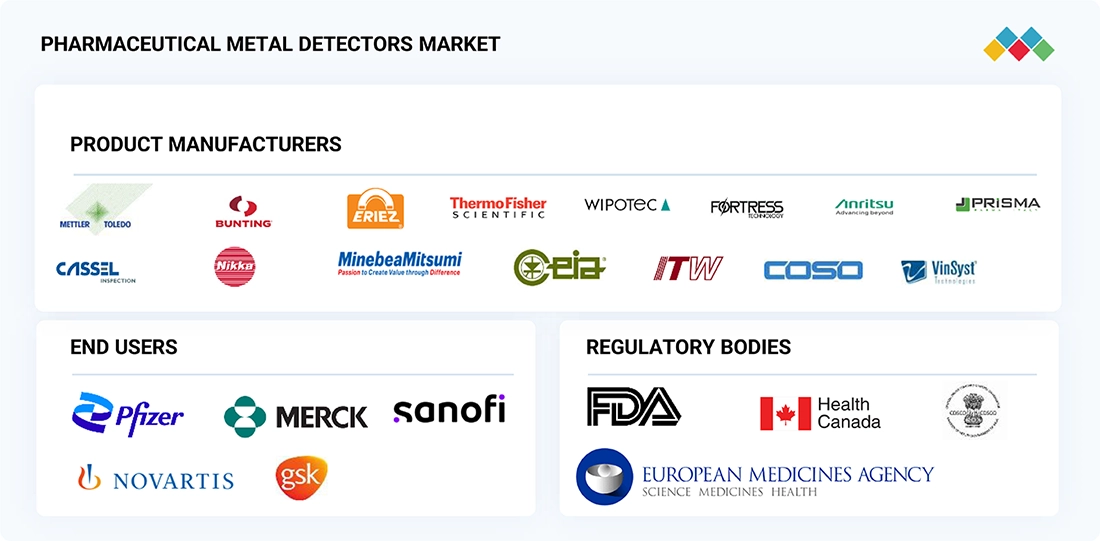
Pharmaceutical Metal Detector Market: COMMERCIAL USE CASES ACROSS INDUSTRIES
| COMPANY | USE CASE DESCRIPTION | BENEFITS |
|---|---|---|
 |
High-sensitivity pharmaceutical metal detectors integrated into tablet and capsule production lines | Ensures precise detection of ferrous, non-ferrous, and stainless-steel contaminants, maintaining compliance with FDA and EU GMP standards while reducing product recalls |
 |
Metal detectors embedded in packaging and quality control systems for solid dosage pharmaceuticals | Improves patient safety by preventing contaminated batches, enhances process reliability, and supports regulatory audits with automated data logging |
 |
Advanced multi-frequency metal detectors tailored for high-speed pharmaceutical blister packs and sachets | Enables accurate detection of minute contaminants in fast-moving production lines, minimizing false rejects and maintaining high production efficiency |
 |
Precision metal detection systems integrated with weighing and inspection solutions for pharmaceuticals | Provides combined quality assurance by detecting contaminants and ensuring accurate dosage weight, thereby reducing waste and improving manufacturing yield |
 |
Compact and customizable metal detection systems for small-batch and contract pharmaceutical manufacturers | Offers flexible solutions for diverse production scales, ensuring contaminant-free products, cost efficiency, and adaptability to varied pharmaceutical formulations |
Logos and trademarks shown above are the property of their respective owners. Their use here is for informational and illustrative purposes only.
Related Ecosystem
Pharmaceuticals
- Bioreactors
- Analytical Testing
- Bioanalytical Testing Services
- Cell Counters
- Data Management Services
- Thermo Fisher Scientific Inc.
- Merck KGaA
- SANOFI
- Pfizer Inc.
- NOVARTIS
Key Takeaways
- South Korea's pharmaceutical metal detector market is valued at USD 0.85 million in 2025 with projected growth to USD 1.0 million by 2030.
- South Korea maintains a 3.2% CAGR, reflecting steady demand driven by regulatory compliance and quality assurance requirements.
- South Korea's advanced manufacturing infrastructure and stringent safety standards support consistent adoption of metal detection technologies.
- South Korea's pharmaceutical sector expansion between 2025 and 2030 will drive incremental market growth and technology integration.
Pharmaceutical Metal Detector Market Report Scope
| Report Metric | Details |
|---|---|
| Base Year | 2025 |
| Fastest Growing Segment | X-RAY INSPECTION WITH METAL DETECTORS (Technology) |
| Forecast Period | 2025-2030 |
| Growth Rate | CAGR of 4.7% from 2025 to 2030 |
| Largest Segment | PHARMACEUTICAL COMPANIES (End User) |
| Market Size Base Year (Billions) | ~USD 0.16 (2025) |
| Revenue Forecast (Billions) | ~USD 0.2 (2030) |
| Segments Covered | Product, Technology, Application, End User |
South Korea Pharmaceutical Metal Detector Market Report Segmentation
4 segment dimensions are covered across the global market.
By Product
- Capsule Metal Detectors
- Liquid Metal Detectors
- Pipeline Metal Detectors
- Powder Metal Detectors
- Tablet Metal Detectors
By Technology
- Magnetic Field Detectors
- Multi-Frequency Detectors
- Other Technologies
- X-Ray Inspection With Metal Detectors
By Application
- Compliance
- Contaminant Detection
- Packaging
- Quality Control
By End User
- Biopharmaceutical Companies
- Contract Development And Manufacturing Organizations (Cdmo)
- Contract Development And Manufacturing Organizations (Cdmos)
- Other End Users
- Pharmaceutical Companies
Target Audience
- Pharmaceutical Manufacturers : South Korean pharmaceutical producers need market data to benchmark contamination detection investments, optimize production line equipment, and ensure regulatory compliance with local GMP standards.
- Equipment Suppliers & Distributors : Metal detector manufacturers and distributors require South Korea-specific market insights to develop localized sales strategies, identify growth segments, and establish partnerships with local pharmaceutical facilities.
- Quality Assurance Professionals : QA managers in South Korean pharmaceutical companies need market intelligence to justify equipment upgrades, evaluate technology solutions, and maintain compliance with evolving contamination detection standards.
- Investment & Business Analysts : Investors and consultants analyzing South Korea's pharmaceutical sector require country-specific market data to assess industry growth potential, identify investment opportunities, and evaluate market dynamics.
- Regulatory & Compliance Officers : Compliance professionals need South Korea market insights to understand regulatory drivers, benchmark industry practices, and ensure pharmaceutical facilities meet local contamination detection requirements.
Reasons to Buy this Report
- Market-Specific Sizing : Obtain precise market valuation for South Korea (USD 0.85M in 2025) with country-specific growth projections through 2030, enabling accurate budget allocation and investment planning.
- Regulatory Landscape Insights : Understand South Korea's stringent pharmaceutical compliance requirements and how they drive metal detector adoption, helping you align products with local regulatory standards.
- Competitive Positioning : Gain intelligence on South Korea's advanced manufacturing base and quality-focused industry dynamics to identify competitive advantages and market entry strategies.
- Growth Opportunity Assessment : Evaluate the 3.2% CAGR trajectory specific to South Korea against global 4.7% growth to identify localized expansion opportunities and market gaps.
- Strategic Decision Support : Access country-specific data to support market entry decisions, partnership development, and resource allocation for pharmaceutical equipment suppliers targeting South Korea.
Frequently asked questions
What is the current market size of pharmaceutical metal detectors in South Korea?
South Korea's pharmaceutical metal detector market is estimated at USD 0.85 million in 2025.
What is the projected market size for South Korea by 2030?
South Korea's pharmaceutical metal detector market is forecast to reach USD 1.0 million by 2030.
What is the CAGR for South Korea's pharmaceutical metal detector market?
South Korea's pharmaceutical metal detector market is expected to grow at a CAGR of 3.2% from 2025 to 2030.
What factors drive demand for metal detectors in South Korea's pharmaceutical industry?
South Korea's stringent regulatory compliance requirements, advanced manufacturing infrastructure, and emphasis on product safety standards drive demand for metal detection solutions.
How does South Korea's market compare to the broader Asia Pacific region?
South Korea represents a key market within Asia Pacific due to its advanced pharmaceutical manufacturing capabilities and rigorous quality control standards.
RESEARCH METHODOLOGY
This study extensively utilized both primary and secondary sources. The research process examined various factors affecting the industry to identify segmentation types, industry trends, key players, the competitive landscape, key market dynamics, and strategies employed by major players.
Secondary Research
This research study utilized a variety of comprehensive secondary sources, including directories and databases such as Bloomberg Business, Factiva, and Dun & Bradstreet. It also incorporated white papers, annual reports, company house documents, investor presentations, and SEC filings from companies. Secondary research was conducted to gather valuable information for an extensive, technical, market-oriented, and commercial analysis of the pharmaceutical metal detectors market. Additionally, this research helped obtain crucial insights about key players, market classification, and segmentation according to industry trends down to the most detailed level, as well as key developments related to both market and technological perspectives. A database of the key industry leaders was also created through secondary research.
Primary Research
During the primary research process for this report, various supply and demand sources were interviewed to gather both qualitative and quantitative information. On the supply side, primary sources included project, sales, marketing, business development managers, as well as executives such as presidents, CEOs, vice presidents, chairpersons, chief operating officers, chief strategy officers, directors, chief information officers, and chief medical information officers, all related to the pharmaceutical metal detectors market. On the demand side, the primary sources consisted of pharmaceutical companies, contract development and manufacturing organizations (CDMOs), and biopharmaceutical companies.
A breakdown of the primary respondents is provided below:
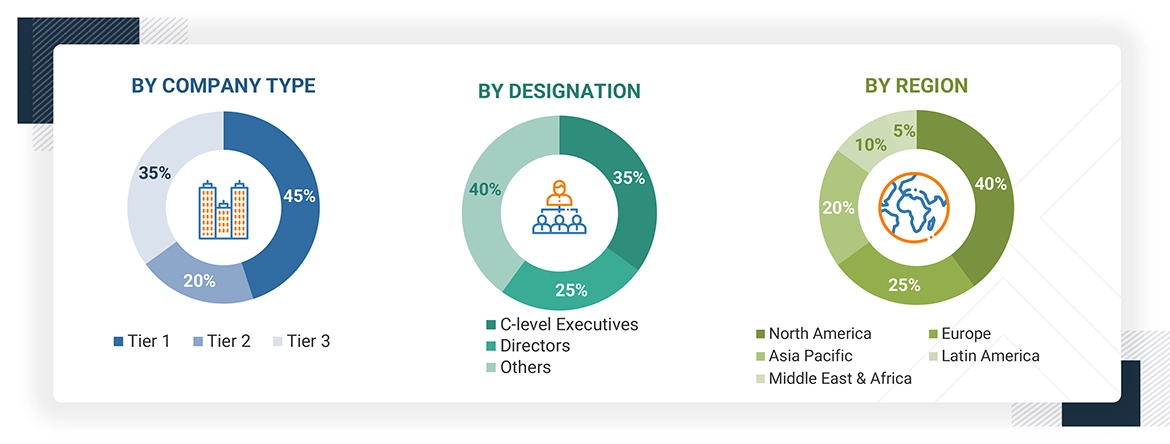
Note 1: C-level executives include CEOs, COOs, CTOs, and VPs.
Note 2: Others include sales, marketing, and product managers.
Note 3: Tiers are defined based on a company’s total revenue. As of 2024: Tier 1 = >USD 1 billion, Tier 2 = USD 500 million to USD 1 billion, and Tier 3 = < USD 500 million.
To know about the assumptions considered for the study, download the pdf brochure
Market Size Estimation
The overall size of the pharmaceutical metal detectors market was determined through data triangulation using three different approaches. After analyzing each approach, we calculated a weighted average based on the assumptions applied in each method.
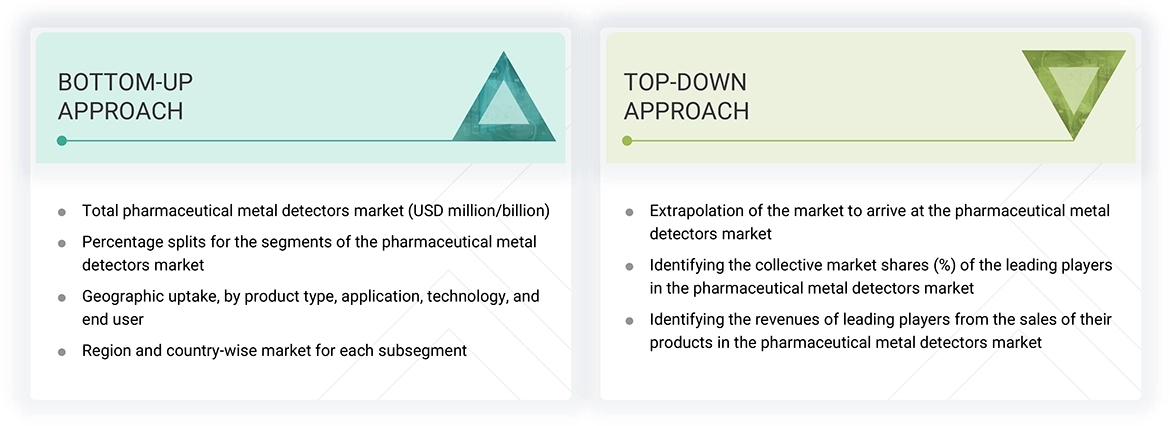
Data Triangulation
After determining the total market size, we divided it into several segments and subsegments. Whenever applicable, we utilized data triangulation and market breakdown procedures to refine the overall market engineering process and obtain accurate statistics for each segment and subsegment.
Market Definition
The pharmaceutical metal detectors comprises systems and technologies designed to detect and eliminate metal contaminants during pharmaceutical manufacturing processes. These detectors play a crucial role in maintaining product purity, patient safety, and regulatory compliance. They are commonly integrated into production lines handling tablets, capsules, powders, and liquids. The market serves pharmaceutical companies, contract manufacturers, and packaging units aiming to prevent contamination-related risks and ensure high product standards.
Stakeholders
- Pharmaceutical Manufacturers
- Contract Development and Manufacturing Organizations (CDMOs)
- Biopharmaceutical Companies
- Contract Manufacturing Organizations (CMOs)
- Clinical Research Organizations (CROs)
- Packaging Line Managers
- Quality Assurance Managers
- Regulatory Compliance Officers
- Validation Engineers
- Equipment Procurement Managers
- Process Engineers
- Maintenance Managers
- R&D Scientists (Pharmaceutical)
- GMP Auditors
- Production Supervisors
- Instrumentation Engineers
- Regulatory Authorities (e.g., FDA, EMA)
- Metal Detector Manufacturers
- Cleanroom Equipment Suppliers
- Pharmaceutical Packaging Companies
- Industry Consultants and Auditors
Report Objectives
- To define, describe, and forecast the pharmaceutical metal detectors market by product, technology, application, end user, and region
- To provide detailed information about the key factors influencing market growth, such as drivers, restraints, opportunities, challenges, and industry trends
- To strategically analyze the technology analysis, regulatory scenario, value chain analysis, Porter’s five forces analysis, ecosystem analysis, trade analysis, pricing analysis, patent analysis, impact of AI on the pharmaceutical metal det ctors market, and trends/disruption impacting customers’ businesses in the market.
- To analyze the micromarkets with respect to individual growth trends, prospects, and contributions to the overall pharmaceutical metal detectors market
- To analyze market opportunities for stakeholders and provide details of the competitive landscape for key players
- To strategically profile the key players in this market and comprehensively analyze their market shares and core competencies
- To strategically analyze the pharmaceutical metal detectors market in four regions: North America, Europe, Asia Pacific, and the Rest of the World
- To track and analyze competitive developments such as product launches & approvals, acquisitions, partnerships, collaborations, and expansions in the pharmaceutical metal detectors market
Get the Full Pharmaceutical Metal Detector Market Report
Full forecast, segment splits, and company analysis for all Pharmaceutical Metal Detector Market.
- US Pharmaceutical Metal Detector Market
- Canada Pharmaceutical Metal Detector Market
- Germany Pharmaceutical Metal Detector Market
- UK Pharmaceutical Metal Detector Market
- France Pharmaceutical Metal Detector Market
- Italy Pharmaceutical Metal Detector Market
- Spain Pharmaceutical Metal Detector Market
- China Pharmaceutical Metal Detector Market
- Japan Pharmaceutical Metal Detector Market
- India Pharmaceutical Metal Detector Market
- Australia Pharmaceutical Metal Detector Market
- Rest Of Europe Pharmaceutical Metal Detector Market
- Rest Of Asia Pacific Pharmaceutical Metal Detector Market
Need a Tailored Report?
Customize this report to your needs
Get 10% FREE Customization
Customize This Report
