
Latin America Pharmaceutical Quality Management Software (QMS) Market (2025-2030)

The Latin America Pharmaceutical Quality Management Software (QMS) Market was valued at $8.2 Million in 2025 and projected to reach to $14.8 Million by 2030, representing a compound annual growth rate of 12.4%. Latin America's Pharmaceutical QMS market is positioned for sustained growth as regulatory bodies intensify compliance requirements and manufacturers seek digital transformation solutions.


| Market Size in | USD 26.32 MN |
| Market Forecast in | |
| CAGR | |
| Forecast Period | |
| Units Considered | Value (USD MN) |
Latin America Pharmaceutical Quality Management Software (QMS) Market Trends and Insights
- Latin America's pharmaceutical sector is increasingly adopting digital quality management solutions to meet stringent regulatory requirements and improve operational efficiency.
- This expansion in Latin America reflects growing investments in healthcare infrastructure and rising compliance pressures across the region's pharmaceutical manufacturing and distribution networks. Latin America's QMS market growth is driven by regulatory harmonization efforts, increased foreign direct investment in pharmaceutical manufacturing, and the region's commitment to aligning with international quality standards.
- Between 2025 and 2030, Latin America is expected to see accelerated adoption of cloud-based and integrated QMS platforms among mid-sized and large pharmaceutical enterprises.
- The 12.4% compound annual growth rate in Latin America underscores the region's strategic importance as a pharmaceutical hub and the critical need for advanced quality management capabilities..
Key Market Statistics
- CAGR (2025-2030) 12.4% CAGR
- Market Size, 2025 ~USD 8.2 Million
- Forecast, 2030 ~USD 14.8 Million
- Geography Latin America
Latin America Pharmaceutical Quality Management Software (QMS) Market Overview
Strong Regional Growth Trajectory :
Latin America's Pharmaceutical QMS market is expanding at 12.4% CAGR, growing from $8.2 million in 2025 to $14.8 million by 2030, driven by increasing regulatory compliance demands across the region.
Regulatory Compliance Acceleration :
Latin American pharmaceutical manufacturers are rapidly adopting digital QMS solutions to meet stringent ANVISA (Brazil), COFEPRIS (Mexico), and other regional regulatory requirements, creating sustained market demand.
Operational Efficiency Focus :
Companies across Latin America are leveraging QMS software to streamline quality control processes, reduce manual documentation, and improve traceability in pharmaceutical manufacturing and distribution.
Market Consolidation Opportunities :
Brazil and Mexico lead the region's adoption, with emerging opportunities in Colombia, Argentina, and Chile as local pharmaceutical sectors modernize their quality management infrastructure.
Latin America Pharmaceutical Quality Management Software (QMS) Market Dynamics
- The region's pharmaceutical sector, particularly in Brazil and Mexico, is increasingly recognizing QMS software as essential for meeting international quality standards and improving operational efficiency.
- Investment in cloud-based and integrated quality management platforms is accelerating across the region. By 2030, Latin America's market is expected to reach $14.8 million, reflecting growing adoption among mid-sized and large pharmaceutical manufacturers.
- Key drivers include stricter regulatory enforcement, supply chain transparency demands, and the need for real-time quality monitoring.
- Emerging markets within the region present significant expansion opportunities as local manufacturers upgrade legacy systems and adopt modern QMS solutions to compete globally..
Market Ecosystem
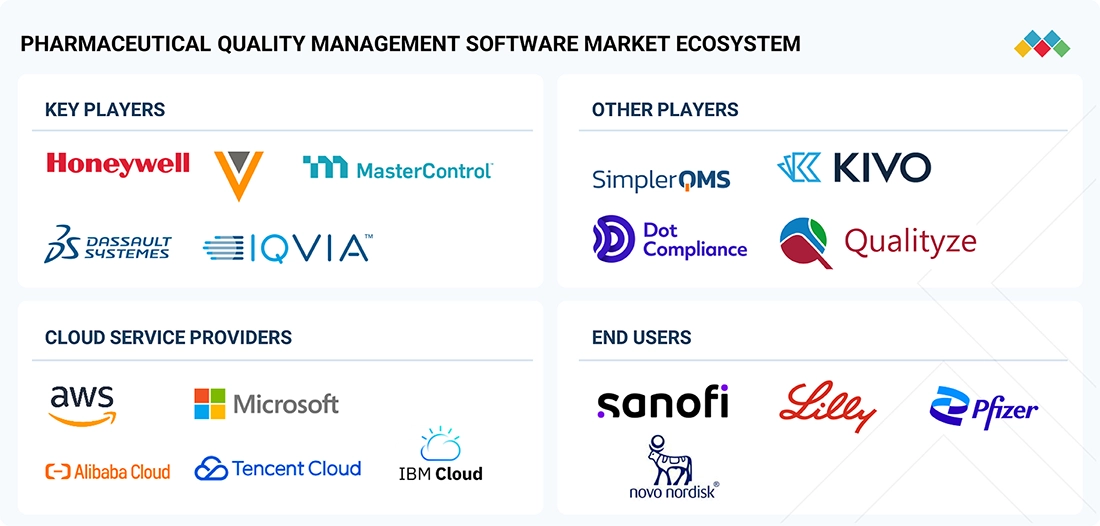
pharmaceutical quality management software market: COMMERCIAL USE CASES ACROSS INDUSTRIES
| COMPANY | USE CASE DESCRIPTION | BENEFITS |
|---|---|---|
 |
Cloud-based QMS unifying quality, CAPA, and supplier oversight across global pharma operations. | Faster audit readiness, enterprise-wide visibility, and stronger regulatory confidence. |
 |
Integrated QMS and batch record automation replacing paper-heavy QA workflows. | Shortens release cycles, reduces manual errors, and ensures end-to-end compliance. |
 |
Enterprise QMS connecting audits, complaints, and supplier quality across multi-site networks. | Standardizes global quality operations and accelerates product approvals. |
 |
Provides an integrated digital QMS through the BIOVIA platform for managing compliance, CAPA, and laboratory quality processes in pharma manufacturing. | Enhances regulatory compliance, data integrity, and product quality through unified digital workflows. |
 |
Delivers cloud-based QMS and manufacturing execution solutions enabling pharma companies | Improves process efficiency, real-time visibility, and reduces deviation and batch-release cycle times |
Logos and trademarks shown above are the property of their respective owners. Their use here is for informational and illustrative purposes only.
Related Ecosystem
Healthcare Analytics
- Machine Learning
- Natural Language Processing (NLP)
- Blood Pressure Monitors
- Computed Tomography (CT)
- Magnetic Resonance Imaging (MRI)
- Oracle Corporation
- PHILIPS HEALTHCARE
- Siemens healthineers
- Zensar Technologies Limited
- International Business Machines Corporation
Healthcare It
- Computed Tomography (CT)
- Machine Learning
- Magnetic Resonance Imaging (MRI)
- Natural Language Processing (NLP)
- Predictive Analytics
- CERNER CORPORATION
- PHILIPS HEALTHCARE
- Oracle Corporation
- GE HealthCare Technologies Inc.
- Siemens healthineers
Key Takeaways
- Latin America's Pharmaceutical QMS market is valued at $8.2 million in 2025 and will reach $14.8 million by 2030, representing an 80.5% total growth over five years.
- Latin America is experiencing a 12.4% CAGR, driven by regulatory compliance requirements and increased pharmaceutical manufacturing investments across the region.
- Cloud-based and integrated QMS solutions are gaining traction in Latin America as enterprises seek scalable, cost-effective quality management platforms.
- Latin America's pharmaceutical sector is prioritizing digital transformation to meet international quality standards and enhance operational transparency.
Pharmaceutical Quality Management Software (QMS) Market Report Scope
| Report Metric | Details |
|---|---|
| Base Year | 2025 |
| Fastest Growing Segment | BIOTECHNOLOGY COMPANIES (End User) |
| Forecast Period | 2025–2030 |
| Growth Rate | CAGR of 13.3% from 2025 to 2030 |
| Largest Segment | LARGE ENTERPRISES (Enterprise Size) |
| Market Size Base Year (Billions) | ~USD 1.6 (2025) |
| Revenue Forecast (Billions) | ~USD 2.98 (2030) |
| Segments Covered | Process, Application, Enterprise Size, End User, End User 2023–2030 |
Latin America Pharmaceutical Quality Management Software (QMS) Market Report Segmentation
5 segment dimensions are covered across the global market.
By Process
- Clinical Trials
- Commercialization, Marketing, & Sales
- Commercialization, Marketing, And Sales
- Distribution & Supply Chain
- Manufacturing/ Production
- Other Processes
- Post-Market Surveillance
- Quality Assurance/ Quality Control
- Quality Assurance/Quality Control
- Regulatory Compliance
By Application
- Audit & Inspection Management
- Capa (Corrective & Preventive Action) Management
- Change Control Management
- Document Control & Esop
- Other Applications
- Regulatory & Compliance Management
- Risk Management
- Supplier Quality Management
- Training Management
By Enterprise Size
- Large Enterprises
- Small & Medium Enterprises
By End User
- Biotechnology Companies
- Contract Development & Manufacturing Organizations (Cdmo)
- Contract Development And Manufacturing Organization (Cdmo)
- Contract Development And Manufacturing Organization (Cdmos)
- Contract Development And Manufacturing Organizations (Cdmo)
- Contract Research Organization (Cro)
- Contract Research Organizations (Cro)
- Contract Research Organizations (Cros)
- Other End Users
- Pharmaceutical Companies
By End User 2023–2030
- Biotechnology Companies
- Contract Development And Manufacturing Organizations (Cdmo)
- Contract Research Organizations (Cro)
- Other End Users
- Pharmaceutical Companies
Target Audience
- QMS Software Vendors : Vendors need Latin America market intelligence to develop region-specific solutions, understand regulatory requirements, identify distribution partners, and prioritize market entry in high-growth countries like Brazil and Mexico.
- Pharmaceutical Manufacturers : Latin American pharmaceutical companies require QMS market insights to evaluate software solutions, benchmark against competitors, understand compliance obligations, and optimize quality management investments.
- Healthcare IT Consultants : Consultants advising pharmaceutical clients in Latin America need detailed market data to recommend appropriate QMS solutions, assess vendor capabilities, and guide digital transformation initiatives aligned with regional regulations.
- Investment & Private Equity Firms : Investors evaluating pharmaceutical sector opportunities in Latin America require market sizing, growth forecasts, and competitive landscape data to assess QMS software companies and healthcare IT investments.
- Regulatory & Compliance Officers : Compliance professionals in Latin American pharmaceutical organizations need market insights on QMS best practices, regulatory trends, and software capabilities to ensure adherence to ANVISA, COFEPRIS, and other regional standards.
Key Companies in the Latin America Pharmaceutical Quality Management Software (QMS) Market
| Company | HQ | Ownership | Strongest segments |
|---|---|---|---|
| HONEYWELL INTERNATIONAL INC. | United States | Public Company | Industrial Automation (control, instrumentation, smart energy, sensing, PPE, software and analytics),Building Automation (building control software, energy management, security, fire, services),Energy and Sustainability Solutions / UOP (licensed process technologies, equipment, catalysts, software), |
| IQVIA | United States | Public Company | Technology & Analytics Solutions,Research & Development Solutions,Contract Sales & Medical Solutions, |
| VEEVA SYSTEMS INC. | United States | Public Company | Veeva Commercial Cloud (Vault CRM, Medical, PromoMats, Crossix, CRM Pulse),Veeva Development Cloud (Clinical Platform, Clinical Data Management, Safety, RIM),Veeva Quality Cloud, |
| DASSAULT SYSTèMES | France | Public Company | 3D Modeling (CATIA, SOLIDWORKS, GEOVIA, BIOVIA),PLM & Collaboration (ENOVIA, CENTRIC PLM, 3DEXCITE, 3DEXPERIENCE platform),Simulation & Manufacturing (SIMULIA, DELMIA, 3DVIA), |
| HEXAGON AB | Sweden | Public Company | Manufacturing Intelligence (metrology, CAD/CAM, CAE, quality software),Geosystems (surveying, mapping, laser scanning, AEC solutions),Autonomous Solutions and Positioning (GNSS, anti-jam, machine control, autonomy), |
| IDEAGEN | United Kingdom | Private Company | Regulatory Compliance & GRC Platforms,Operational Performance & Quality Management,Workplace Health & Safety (incl. Reactec), |
| SOFTEXPERT | Brazil | Private Company | Business Process & Corporate Performance Management,Enterprise Quality, Risk & GRC,Enterprise Content & Asset Management, |
| INSTEM | United Kingdom | Private Company | Research study management software (discovery, preclinical, early clinical),Regulatory submission solutions (SEND generation, conversion, validation),In silico and data insights solutions, |
| INTELLECT, INC | India | Public Company | Wholesale & Corporate Banking (lending, payments, liquidity, trade, treasury),Consumer Banking (core, lending, cards, digital engagement),Wealth, Capital Markets, and Insurance Platforms, |
HONEYWELL INTERNATIONAL INC.
Honeywell International Inc. is a diversified technology and manufacturing company founded in 1885 and headquartered in the United States. With 101,000 employees, the publicly traded company operates across multiple industrial sectors including aerospace, building technologies, and performance materials.
IQVIA
IQVIA is a United States-based public company with 93,000 employees that provides integrated information and technology solutions to the life sciences industry.
VEEVA SYSTEMS INC.
Veeva Systems Inc. is a United States public company founded in 2007 with 7,928 employees that provides cloud-based software solutions for the life sciences industry.
DASSAULT SYSTèMES
Dassault Systèmes is a French public company founded in 1981 with 25,724 employees that provides 3D design, digital mock-up, and product lifecycle management software solutions.
HEXAGON AB
Hexagon AB is a Swedish public company founded in 1975 with 16,118 employees that provides digital solutions and software for industrial and geospatial applications.
IDEAGEN
Ideagen is a United Kingdom-based private company founded in 1993 with 697 employees that develops software solutions for quality, risk, and compliance management.
SOFTEXPERT
SoftExpert is a Brazil-based private company founded in 1995 with 170 employees that provides software solutions for process management, quality, and compliance.
INSTEM
Instem is a United Kingdom-based private company founded in 1969 with 510 employees that provides software and services for the life sciences and pharmaceutical industries.
INTELLECT, INC
Intellect, Inc. is an India-based public company founded in 2011 with 6,876 employees that provides software and IT solutions for various industries.
Countries within Latin America - compare and drill down
| Country | 2025 size (native) |
|---|---|
| Brazil | USD 57.6 Million |
| Mexico | USD 29.2 Million |
| Rest Of Latin America | USD 35 Million |
Country market size visualization
Reasons to Buy this Report
- Regional Market Sizing & Forecasts : Obtain precise market valuations for Latin America ($8.2M in 2025) with country-level breakdowns for Brazil, Mexico, and Rest of Latin America, enabling targeted investment and expansion strategies.
- Regulatory Landscape Intelligence : Understand region-specific compliance requirements (ANVISA, COFEPRIS, INVIMA) and how QMS adoption addresses local regulatory mandates, critical for market entry and product positioning.
- Competitive Positioning Analysis : Identify key market players and their strategies in Latin America, assess competitive gaps, and determine optimal positioning for QMS solutions tailored to regional pharmaceutical manufacturers.
- Growth Opportunity Identification : Leverage 12.4% CAGR insights to identify high-potential segments, emerging markets within Latin America, and underserved pharmaceutical manufacturers ready for QMS adoption.
- Strategic Partnership & Investment Decisions : Make informed decisions on partnerships, acquisitions, and market entry strategies in Latin America with comprehensive data on market dynamics, growth drivers, and regional pharmaceutical sector trends.
Frequently asked questions
What is the current size of the Pharmaceutical QMS market in Latin America?
The Pharmaceutical QMS market in Latin America is valued at $8.2 million in 2025 and is projected to grow to $14.8 million by 2030.
What is the expected growth rate for Latin America's Pharmaceutical QMS market?
Latin America's Pharmaceutical QMS market is expected to grow at a compound annual growth rate (CAGR) of 12.4% from 2025 to 2030.
What factors are driving QMS adoption in Latin America?
Key drivers in Latin America include regulatory harmonization, increased pharmaceutical manufacturing investments, compliance pressures, and the need to align with international quality standards.
Which QMS solutions are most popular in Latin America?
Cloud-based and integrated QMS platforms are gaining significant traction in Latin America due to their scalability, cost-effectiveness, and ability to support remote quality management operations.
How does Latin America's QMS market growth compare to global trends?
Latin America's 12.4% CAGR is slightly below the global average of 13.3%, reflecting the region's developing market status while still demonstrating strong growth momentum.
RESEARCH METHODOLOGY
The study involved several key activities to estimate the current size of the pharmaceutical quality management software (QMS) market. Extensive secondary research was conducted to gather information on this market. The next step was to validate the findings, assumptions, and size estimates by consulting industry experts throughout the value chain through primary research. We employed various methods, including top-down and bottom-up approaches, to estimate the overall market size. Following this, we utilized market segmentation and data triangulation techniques to determine the size of specific segments and subsegments within the pharmaceutical quality management softwarecare market.
Secondary Research
This research study involved the wide use of secondary sources, directories, and databases such as Dun & Bradstreet, Bloomberg Business, and Factiva; white papers, annual reports, and companies’ house documents; investor presentations; and the SEC filings of companies. The market for companies providing pharmaceutical quality management software care solutions is assessed using secondary data from both paid and free sources. This involves analysing the product portfolios of major players in the industry and evaluating these companies based on their performance and quality. Various resources were utilized in the secondary research process to gather information for this study. The sources include annual reports, press releases, investor presentations, white papers, academic journals, certified publications, articles by recognized authors, directories, and databases.
Secondary research was used to identify and collect information useful for the extensive, technical, market-oriented, and commercial study of the pharmaceutical quality management software market. It was also used to obtain important information about the key players and market classification and segmentation according to industry trends to the bottom-most level, and key developments related to market and technology perspectives. A database of the key industry leaders was also prepared using secondary research.
Primary Research
In the primary research process, various primary sources from both the supply and demand sides were interviewed to obtain qualitative and quantitative information for this report. Primary sources are mainly industry experts from the core and related industries and preferred suppliers, manufacturers, distributors, technology developers, researchers, and organizations related to all segments of this industry’s value chain. In-depth interviews were conducted with various primary respondents, including key industry participants, subject-matter experts (SMEs), C-level executives of key market players, and industry consultants, among other experts, to obtain and verify the critical qualitative and quantitative information as well as assess prospects.
Primary research was conducted to identify segmentation types; industry trends; key players; and key market dynamics such as drivers, restraints, opportunities, challenges, industry trends, and strategies adopted by key players.
After completing the market engineering process, which includes calculations for market statistics, market breakdown, size estimations, forecasting, and data triangulation, extensive primary research was conducted. This research aimed to gather information and verify the critical numbers obtained during the market analysis. Additionally, primary research was conducted to identify different types of market segmentation, analyse industry trends, evaluate the competitive landscape of pharmaceutical quality management software care offered by various players, and understand key market dynamics such as drivers, restraints, opportunities, challenges, industry trends, and strategies employed by key market participants.
In the complete market engineering process, the top-down and bottom-up approaches and several data triangulation methods were extensively used to perform the market estimation and market forecasting for the overall market segments and subsegments listed in this report. Extensive qualitative and quantitative analysis was performed on the complete market engineering process to list the key information/insights throughout the report.
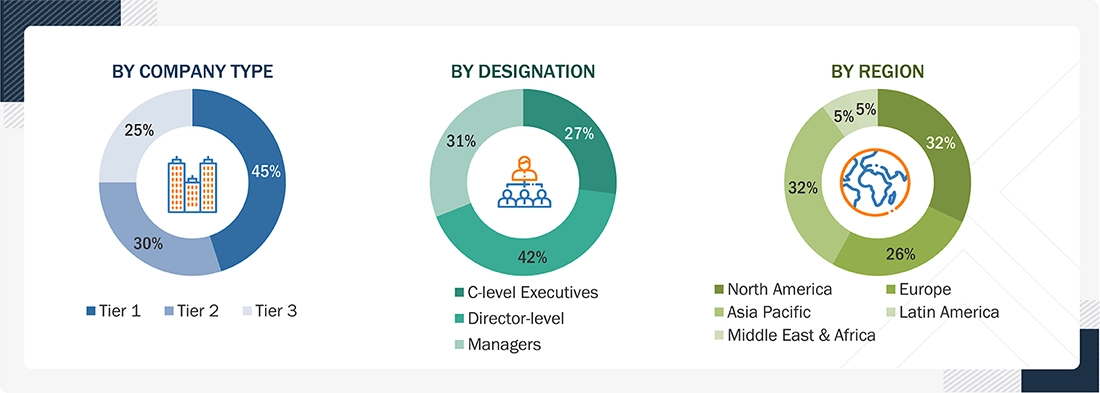
Others include sales managers, marketing managers, and product managers.
Note: Tiers are defined based on a company’s total revenue, as of 2024: Tier 1 = >USD 1 billion, Tier 2 = USD 500 million to USD 1 billion, and Tier 3 = USD 500 million.
To know about the assumptions considered for the study, download the pdf brochure
Market Size Estimation
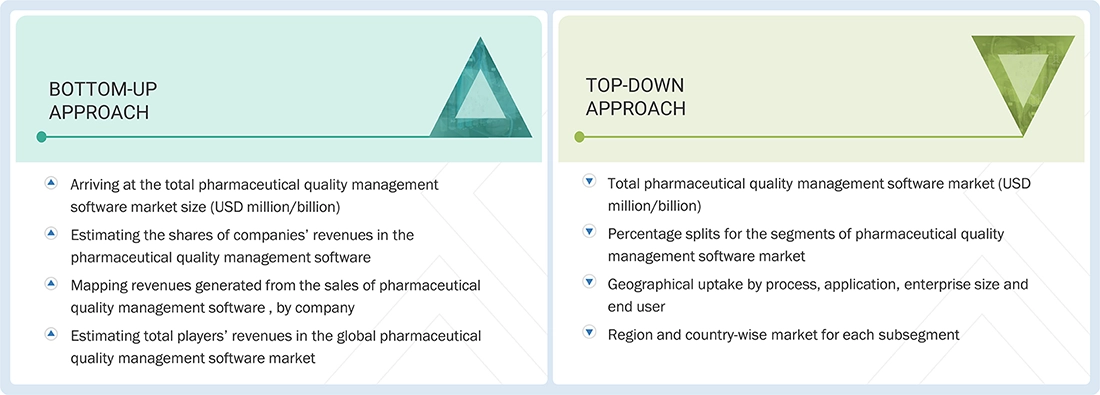
The market size estimates and forecasts provided in this study are derived through a mix of the bottom-up approach (revenue share analysis of leading players) and top-down approach (assessment of utilization/adoption/penetration trends, by process, application, enterprise size, end users, and region).
Pharmaceutical Quality Management Software Market: Top-Down and Bottom-Up Approach
Data Triangulation
After arriving at the overall market size, using the market size estimation processes, the market was split into several segments and subsegments. To complete the overall market engineering process and arrive at the exact statistics of each market segment and subsegment, the data triangulation and market breakdown procedures were employed, wherever applicable. The data was triangulated by studying various factors and trends from both the demand and supply sides in the pharmaceutical quality management software market.
Market Definition
Pharmaceutical quality management software is a formalized, electronic system designed to document, automate, and manage all processes, procedures, and responsibilities associated with ensuring the quality and regulatory compliance of pharmaceutical products throughout their lifecycle. It serves as a centralized platform for managing critical quality activities including document control, SOPs, CAPA, audits, training, risk management, and supplier quality to ensure product safety, efficacy, and regulatory compliance..
Key Stakeholders
- Pharmaceutical companies
- Pharmaceutical quality management software Providers
- Biotechnology firms
- Academic Research Institutes
- Contract Manufacturing Organizations
- Contract Research Organizations
- Market Research and Consulting Firms
- Regulatory Authorities / Agencies
- Quality Assurance & Quality Control Departments
- Research & Development (R&D) Teams
- Third-party Auditors / Inspections Bodies
- Suppliers / Raw Material Vendors
Report Objectives
- To define, describe, and forecast the global pharmaceutical quality management software market based on process, application, enterprise size, end users, and region.
- To provide detailed information regarding the factors influencing the growth of the market (such as the drivers, restraints, opportunities, and challenges)
- To strategically analyze micromarkets with respect to individual growth trends, prospects, and contributions to the overall pharmaceutical quality management software market
- To analyze market opportunities for stakeholders and provide details of the competitive landscape for market leaders
- To forecast the size of the pharmaceutical quality management software market in five main regions (along with their respective key countries): North America, Europe, the Asia Pacific, Latin America, and the Middle East & Africa
- To profile key players and comprehensively analyze their product portfolios, market positions, and core competencies in the market
- To track and analyze competitive developments such as product & service launches; expansions; partnerships, agreements, and collaborations; and acquisitions in the pharmaceutical quality management software market
- To benchmark players within the pharmaceutical quality management software market using the Company Evaluation Matrix framework, which analyzes market players on various parameters within the broad categories of business strategy, market share, and product offering
Available Customizations
With the given market data, MarketsandMarkets offers customizations as per your company’s specific needs. The following customization options are available for the report:
Company Information
- Detailed analysis and profiling of additional market players (up to 5)
Geographic Analysis
- Further breakdown of the Rest of Europe Pharmaceutical quality management software Market into Denmark, Norway, and others
- Further breakdown of the Rest of Asia Pacific Pharmaceutical quality management software Market into Vietnam, Pakistan, New Zealand, and others
- Further breakdown of the Rest of Latin America Pharmaceutical quality management software Market into Argentina, Chile, Colombia, and others
- Further breakdown of the Rest of Middle East & Africa Pharmaceutical quality management software Market into Egypt, Nigeria, Israel, and others
Get the Full Pharmaceutical Quality Management Software (QMS) Market Report
Full forecast, segment splits, and company analysis for all Pharmaceutical Quality Management Software (QMS) Market.
- Canada Pharmaceutical Quality Management Software (QMS) Market
- US Pharmaceutical Quality Management Software (QMS) Market
- Germany Pharmaceutical Quality Management Software (QMS) Market
- UK Pharmaceutical Quality Management Software (QMS) Market
- France Pharmaceutical Quality Management Software (QMS) Market
- Italy Pharmaceutical Quality Management Software (QMS) Market
- Spain Pharmaceutical Quality Management Software (QMS) Market
- China Pharmaceutical Quality Management Software (QMS) Market
- Japan Pharmaceutical Quality Management Software (QMS) Market
- India Pharmaceutical Quality Management Software (QMS) Market
- Australia Pharmaceutical Quality Management Software (QMS) Market
- South Korea Pharmaceutical Quality Management Software (QMS) Market
- Brazil Pharmaceutical Quality Management Software (QMS) Market
- Mexico Pharmaceutical Quality Management Software (QMS) Market
- Saudi Arabia Pharmaceutical Quality Management Software (QMS) Market
- UAE Pharmaceutical Quality Management Software (QMS) Market
- South Africa Pharmaceutical Quality Management Software (QMS) Market
- Rest Of Europe Pharmaceutical Quality Management Software (QMS) Market
- Rest Of Asia Pacific Pharmaceutical Quality Management Software (QMS) Market
- Rest Of Latin America Pharmaceutical Quality Management Software (QMS) Market
- GCC Countries Pharmaceutical Quality Management Software (QMS) Market
- Rest Of GCC Countries Pharmaceutical Quality Management Software (QMS) Market
Need a Tailored Report?
Customize this report to your needs
Get 10% FREE Customization
Customize This Report
