
UK Photoelectric Sensor Market (2025-2030)

The UK Photoelectric Sensor Market was valued at $98.4 Million in 2025 and projected to reach to $164.3 Million by 2030, representing a compound annual growth rate of 7.6%. The UK photoelectric sensor market is positioned for sustained growth through 2030, driven by widespread automation adoption across manufacturing, logistics, and retail sectors.


| Market Size in | USD 26.32 MN |
| Market Forecast in | |
| CAGR | |
| Forecast Period | |
| Units Considered | Value (USD MN) |
UK Photoelectric Sensor Market Trends and Insights
- The UK market is driven by increasing automation across manufacturing, logistics, and retail sectors, where photoelectric sensors play a critical role in object detection and positioning applications.
- The UK's strong industrial base and investment in Industry 4.0 technologies are accelerating adoption of advanced sensing solutions. The UK photoelectric sensor market benefits from the country's emphasis on smart factory initiatives and digital transformation across enterprises.
- Key end-use industries in the UK, including automotive, food and beverage, and pharmaceuticals, are integrating photoelectric sensors to enhance operational efficiency and product quality.
- The 7.6% compound annual growth rate reflects the UK's steady demand for reliable, cost-effective sensing technologies through 2030. The UK market landscape is characterized by a mix of established multinational sensor manufacturers and innovative local suppliers.
- The UK's regulatory environment and focus on sustainability are encouraging development of energy-efficient photoelectric sensor solutions.
- As the UK continues to modernize its industrial infrastructure, photoelectric sensors remain essential components in automated systems and quality control processes..
Key Market Statistics
- CAGR (2025-2030) 7.6% CAGR
- Market Size, 2025 ~USD 98.4 Million
- Forecast, 2030 ~USD 164.3 Million
- Country UK
UK Photoelectric Sensor Market Overview
Market Valuation Growth :
The UK photoelectric sensor market is valued at $98.4 million in 2025, with a projected CAGR of 7.6%, reaching $164.3 million by 2030, demonstrating strong double-digit expansion opportunities.
Manufacturing Automation Surge :
UK manufacturing sector's accelerated digital transformation and Industry 4.0 adoption is driving demand for advanced photoelectric sensors in production lines, quality control, and automated assembly processes.
Logistics & Retail Integration :
E-commerce growth and warehouse automation across the UK are creating significant demand for photoelectric sensors in sorting systems, conveyor belts, and inventory management applications.
Industrial Investment Momentum :
Government initiatives supporting UK industrial modernization and smart manufacturing are accelerating sensor adoption across automotive, food & beverage, and pharmaceutical sectors.
UK Photoelectric Sensor Market Dynamics
- Industrial facilities increasingly rely on these sensors for precision object detection, positioning, and quality assurance applications.
- The UK's commitment to industrial modernization and digital transformation initiatives further supports market expansion.
- Investment in smart factories and warehouse automation technologies continues to create new deployment opportunities, particularly in the Midlands and Northern industrial hubs..
Market Ecosystem
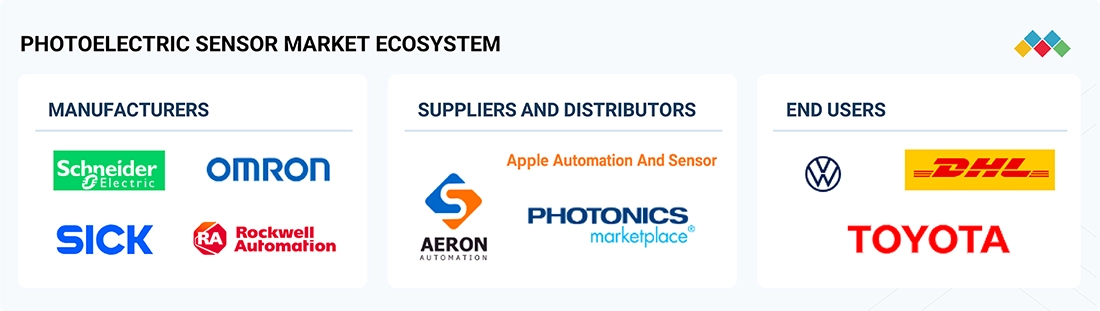
Photoelectric Sensor Market Growth: COMMERCIAL USE CASES ACROSS INDUSTRIES
| COMPANY | USE CASE DESCRIPTION | BENEFITS |
|---|---|---|
 |
Photoelectric sensors for material handling and conveyor line detection in food & beverage packaging facilities | Ensures reliable object detection in dusty/wet environments, reducing false triggers and downtime while complying with hygiene standards for efficient throughput |
 |
Fiber-optic photoelectric sensors for high-precision inspection and edge detection in semiconductor production | Achieves sub-millimeter accuracy with fast response times, enabling defect-free processes and real-time analytics for superior yield and compliance |
 |
Through-beam photoelectric sensors for position monitoring and safety zoning in automotive assembly lines | Provides high-speed, accurate sensing with IIoT integration, enabling predictive maintenance and seamless automation for enhanced productivity and safety |
 |
Diffuse photoelectric sensors for object recognition and hazard avoidance in logistics and warehouse automation | Offers compact, rugged design for harsh conditions, with background suppression for reliable detection, improving operational efficiency and worker safety |
 |
Retro-reflective photoelectric sensors for proximity detection in electronics manufacturing and robot guarding | Delivers long-range, non-contact monitoring with adjustable sensitivity, minimizing errors and supporting dynamic workflows for precise quality control |
Logos and trademarks shown above are the property of their respective owners. Their use here is for informational and illustrative purposes only.
Related Ecosystem
Sensors And Control
- Sensors
- Image Sensors
- Temperature Sensors
- Pressure Sensors
- Flow Sensors
- BAUMER ELECTRIC AG
- HONEYWELL INTERNATIONAL INC.
- Lenovo
- Stmicroelectronics
- Texas Instruments Incorporated
Key Takeaways
- The UK photoelectric sensor market is valued at $98.4 million in 2025 and is forecast to reach $164.3 million by 2030, representing a 7.6% CAGR.
- The UK market is driven by automation adoption in manufacturing, logistics, and retail sectors, with strong support from Industry 4.0 initiatives.
- Key UK end-use industries including automotive, food and beverage, and pharmaceuticals are primary growth drivers for photoelectric sensor demand.
- The UK market features a competitive landscape of multinational and local suppliers focused on energy-efficient and sustainable sensing solutions.
Photoelectric Sensor Market Report Scope
| Report Metric | Details |
|---|---|
| Base Year | 2025 |
| Fastest Growing Segment | SLOT/FORK MODULES (Mounting Type) |
| Forecast Period | 2025–2030 |
| Growth Rate | CAGR of 8.1% from 2025 to 2030 |
| Largest Segment | LED (Beam Source) |
| Market Size Base Year (Billions) | ~USD 2.33 (2025) |
| Revenue Forecast (Billions) | ~USD 3.44 (2030) |
| Segments Covered | Sensing Mode, Sensing Range, End User, Structural Type, Mounting Type, Type, Beam Source |
UK Photoelectric Sensor Market Report Segmentation
7 segment dimensions are covered across the global market.
By Sensing Mode
- Diffuse Reflective
- Retro Reflective
- Through Beam
By Sensing Range
- Long Range (1 M–30 M)
- Mid Range (100 Mm–1 M)
- Mid Range(100 Mm–1 M)
- Short Range (< 100 Mm)
- Short Range (<100 Mm)
- Short Range(< 100 Mm)
- Ultra Long Range (> 30 M)
- Ultra Long Range(> 30 M)
By End User
- Automotive Manufacturing
- Consumer Goods
- Energy & Utilities
- Food & Beverage
- Packaging And Printing & E-Commerce Logistics
- Packaging And Printing, And E-Commerce Logistics
- Pharmaceutical & Medical
- Pharmaceuticals & Medical
- Semiconductor & Electronics
By Structural Type
- Fiber-Optic Photoelectric Sensors
- Multi-Beam/Array Sensors
- Slot/Fork/Interrupter Sensors
By Mounting Type
- Cylindrical
- Rectangular
- Slot/Fork Modules
By Type
- M12
- M18
- M30
- M5
- M8
By Beam Source
- Laser
- Led
Target Audience
- UK Manufacturing Executives : Decision-makers in UK manufacturing facilities need market intelligence to justify automation investments, benchmark sensor adoption rates against competitors, and plan digital transformation roadmaps.
- Logistics & Warehouse Operators : UK logistics companies require detailed market data to evaluate sensor technology investments for warehouse automation, conveyor systems, and inventory management efficiency improvements.
- Sensor Manufacturers & Suppliers : Global and regional sensor manufacturers need UK-specific market analysis to assess growth potential, identify customer segments, and develop localized product strategies for the British market.
- Industrial Automation Integrators : UK-based systems integrators and automation consultants need market forecasts to advise clients on sensor technology adoption, recommend solutions, and plan project pipelines.
- Investment & Private Equity Firms : Investors evaluating UK industrial technology companies require market sizing and growth projections to assess investment opportunities and portfolio company valuations in the automation sector.
Key Companies in the UK Photoelectric Sensor Market
| Company | HQ | Ownership | Strongest segments |
|---|---|---|---|
| FIRST SENSOR AG | Germany | Public Company | Through-beam photoelectric sensors,Retroreflective photoelectric sensors,Diffuse reflective photoelectric sensors, |
| OMRON CORPORATION | Japan | Public Company | Through-beam photoelectric sensors,Retroreflective photoelectric sensors,Diffuse reflective photoelectric sensors, |
| SCHNEIDER ELECTRIC | Canada | Public Company | Through-beam sensing mode,Retroreflective sensing mode,Diffuse reflective sensing mode, |
| KEYENCE CORPORATION | Japan | Public Company | Through-beam photoelectric sensors,Retroreflective photoelectric sensors,Diffuse reflective photoelectric sensors, |
| ROCKWELL AUTOMATION | United States | Public Company | Through-beam sensing mode,Retroreflective sensing mode,Diffuse reflective sensing mode, |
| SICK AG | Germany | Private Company | Through-beam photoelectric sensors,Retroreflective photoelectric sensors,Diffuse reflective photoelectric sensors, |
| PANASONIC CORPORATION | Japan | Public Company | Through-beam photoelectric sensors,Retroreflective photoelectric sensors,Diffuse reflective photoelectric sensors, |
| EATON | Ireland | Public Company | Through-beam sensing mode,Retroreflective sensing mode,Diffuse reflective sensing mode, |
FIRST SENSOR AG
First Sensor AG is a German public company founded in 1991 that employs 538 people. The company operates in the sensor technology sector.
OMRON CORPORATION
Omron Corporation is a Japanese public company established in 1933 with 26,050 employees. It is a major global manufacturer of automation and sensing technology.
SCHNEIDER ELECTRIC
Schneider Electric is a Canadian public company with roots dating back to 1836 and a workforce of 158,122 employees. It is a leading provider of energy management and automation solutions.
KEYENCE CORPORATION
Keyence Corporation is a Japanese public company founded in 1972 with 12,784 employees. The company specializes in factory automation and inspection equipment.
ROCKWELL AUTOMATION
Rockwell Automation is a United States-based public company established in 1903 with 26,000 employees. It provides industrial automation and information technology solutions.
SICK AG
Sick AG is a German private company founded in 1946 with 11,804 employees. The company is a leading manufacturer of sensors and sensor solutions for industrial applications.
PANASONIC CORPORATION
Panasonic Corporation is a Japanese public company established in 1918 with 183,685 employees. It is a diversified electronics manufacturer with operations across multiple industries.
EATON
Eaton is an Irish public company founded in 1911 with 97,303 employees. It provides diversified industrial manufacturing and technology solutions.
Reasons to Buy this Report
- UK-Specific Market Sizing : Access precise market valuation data for the UK photoelectric sensor market with detailed forecasts through 2030, enabling accurate budget allocation and investment planning for UK operations.
- Regional Growth Drivers Analysis : Understand UK-specific factors driving sensor adoption including manufacturing automation trends, logistics sector expansion, and government industrial modernization initiatives unique to the British market.
- Competitive Landscape Intelligence : Identify key players and competitive dynamics within the UK photoelectric sensor market, including local suppliers, distribution channels, and market consolidation trends affecting UK procurement strategies.
- Sector-Specific Opportunity Mapping : Discover high-growth segments within UK manufacturing, automotive, food & beverage, and pharmaceutical industries where photoelectric sensor deployment is accelerating most rapidly.
- Strategic Market Entry Planning : Leverage UK market insights to develop targeted go-to-market strategies, identify partnership opportunities, and optimize product positioning for the British industrial automation sector.
Frequently asked questions
What is the current size of the UK photoelectric sensor market?
The UK photoelectric sensor market is valued at $98.4 million in 2025 and is expected to grow to $164.3 million by 2030.
What is the growth rate of the UK photoelectric sensor market?
The UK photoelectric sensor market is growing at a compound annual growth rate (CAGR) of 7.6% from 2025 to 2030.
Which industries drive demand for photoelectric sensors in the UK?
The UK automotive, food and beverage, pharmaceutical, manufacturing, logistics, and retail sectors are primary drivers of photoelectric sensor demand.
What factors are contributing to growth in the UK photoelectric sensor market?
Key growth factors in the UK include increased industrial automation, Industry 4.0 adoption, smart factory initiatives, and digital transformation across enterprises.
Who are the main competitors in the UK photoelectric sensor market?
The UK photoelectric sensor market includes established multinational manufacturers and innovative local suppliers focused on delivering energy-efficient and sustainable solutions.
RESEARCH METHODOLOGY
The study involved four major activities in estimating the current size of the photoelectric sensor market. Exhaustive secondary research was conducted to gather information on the market, adjacent markets, and the overall photoelectric sensor landscape. These findings, along with assumptions and projections, were validated through primary research involving interviews with industry experts and key stakeholders across the value chain. Both top-down and bottom-up approaches were utilized to estimate the overall market size. Subsequently, market breakdown and data triangulation techniques were applied to determine the sizes of various segments and subsegments. Two key sources, secondary and primary, were leveraged to conduct a comprehensive technical and commercial assessment of the photoelectric sensor market.
Secondary Research
The secondary research process referred to various secondary sources to identify and collect necessary information for this study. The secondary sources included annual reports, press releases, and investor presentations of companies; white papers; journals and certified publications; and articles from recognized authors, websites, directories, and databases. Secondary research was conducted to obtain key information about the industry’s supply chain, the market’s value chain, the total pool of key players, market segmentation according to the industry trends (to the bottom-most level), regional markets, and key developments from market- and technology-oriented perspectives. The secondary data was collected and analyzed to determine the overall market size, which is further validated through primary research.
Primary Research
Extensive primary research was conducted after gaining knowledge about the current scenario of the photoelectric sensor market through secondary research. Several primary interviews were conducted with experts from the demand and supply sides across four major regions—North America, Europe, Asia Pacific, and RoW. This primary data was collected through questionnaires, emails, and telephonic interviews.
Breakdown of Primary Interviews
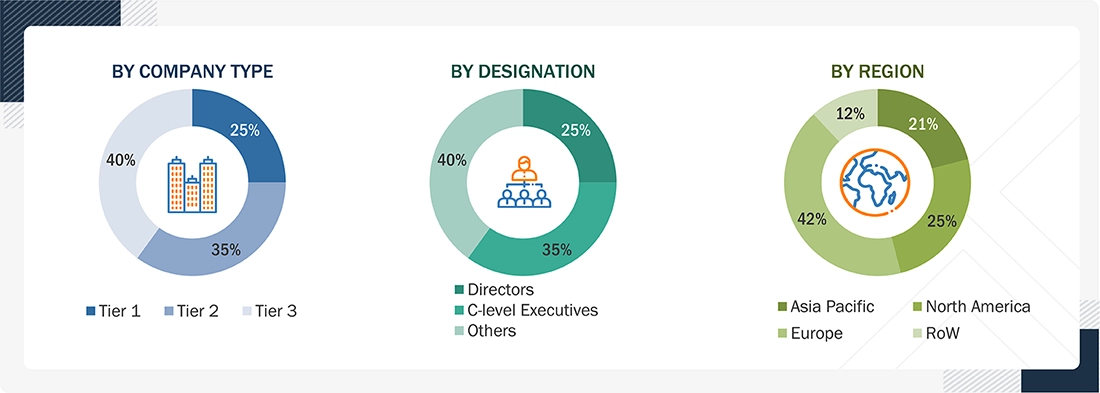
Notes: Three tiers of companies have been defined based on their total revenue as of 2024
Tier 1: >USD 500 million, Tier 2: USD 100 million–USD 500 million, and Tier 3: < USD 100 million.
Other designations include sales managers, marketing managers, and product managers.
To know about the assumptions considered for the study, download the pdf brochure
Market Size Estimation
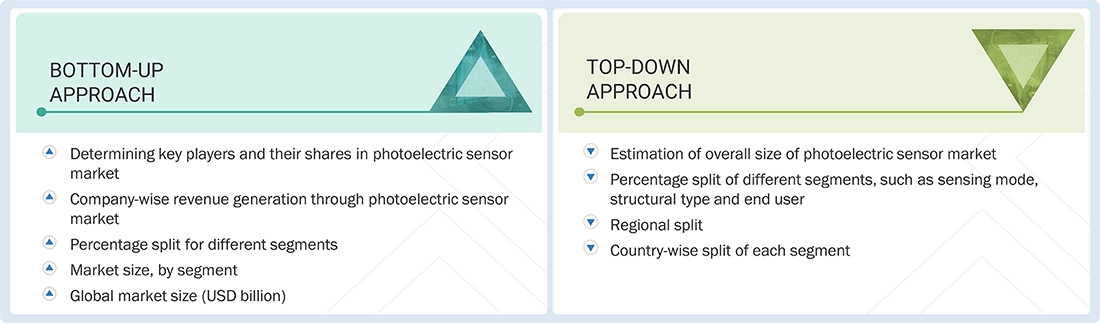
Both top-down and bottom-up approaches were used to estimate and validate the total size of the photoelectric sensor market. These methods have also been used extensively to estimate the size of various subsegments in the market. The following research methodology was used to estimate the market size:
- Major players in the markets were identified through extensive secondary research.
- The industry’s value chain and market size (in terms of value) were determined through primary and secondary research processes.
- All percentage shares, splits, and breakdowns were determined using secondary sources and verified through primary sources.
The market sizing includes the following:
Data Triangulation
After arriving at the overall size of the photoelectric sensor market using the market size estimation process explained above, the total market was split into several segments and subsegments. Data triangulation and market breakdown procedures were employed, wherever applicable, to complete the overall market engineering process and arrive at the exact statistics for all segments and subsegments of the market. The data was triangulated by studying various factors and trends from the demand and supply sides. The market size was also validated using the top-down and bottom-up approaches.
Market Definition
Photoelectric sensors detect objects, as well as changes in surface conditions, through their optical properties. They emit light beams (visible or infrared) from their emitters (light-emitting elements) and receive them at receivers (light-receiving elements). When emitted light is interrupted or reflected by the objects to be sensed, the amount of light that arrives at the receivers is changed. These receivers detect this change and convert it to an electrical output. Photoelectric sensors are not limited to detecting metal objects only. For instance, proximity sensors operate on the principle of light being interrupted or reflected by the targeted objects, which can be glass, plastic, wood, or liquid. Various types of photoelectric sensors, including through beam, retroreflective, and reflective, are used in numerous applications, such as consumer electronics, industrial manufacturing, and food & beverages. The photoelectric sensor market is diversified, with the presence of various established, as well as emerging players operating across its value chain.
Stakeholders
- Photoelectric sensor manufacturers
- Automotive and consumer electronics companies
- Semiconductor component suppliers
- Photoelectric sensor distributors and sales firms
- Electronic system assemblers
- Technology solution providers and design contractors
- Electronics and semiconductor companies
- Photoelectric sensor material suppliers
- Technology standards organizations, forums, alliances, and associations
- Universities and research organizations
- Government bodies
Report Objectives
- To describe and forecast the photoelectric sensor market, by sensing mode, structural type, sensing range, mounting type, beam source, end user, and region, in terms of value
- To describe and forecast the market with regard to four main regions: North America, Europe, Asia Pacific, and RoW, along with their respective countries, in terms of value
- To forecast the photoelectric sensor market, by sensing mode, in terms of volume
- To provide detailed information regarding major factors, such as drivers, restraints, opportunities, and challenges, influencing the market growth
- To provide a detailed overview of the photoelectric sensor value chain
- To strategically analyze micromarkets with respect to individual growth trends, prospects, and contributions to the photoelectric sensor market
- To analyze opportunities in the market for stakeholders by identifying high-growth segments of the photoelectric sensor market
- To strategically profile key players and comprehensively analyze their market position in terms of ranking and core competencies, along with detailing the competitive landscape for market leaders
- To analyze competitive strategies, such as product launches and developments, adopted by key players in the photoelectric sensor market
Get the Full Photoelectric Sensor Market Report
Full forecast, segment splits, and company analysis for all Photoelectric Sensor Market.
- US Photoelectric Sensor Market
- Canada Photoelectric Sensor Market
- Mexico Photoelectric Sensor Market
- Germany Photoelectric Sensor Market
- France Photoelectric Sensor Market
- Spain Photoelectric Sensor Market
- Italy Photoelectric Sensor Market
- Nordics Photoelectric Sensor Market
- Rest Of Europe Photoelectric Sensor Market
- China Photoelectric Sensor Market
- Japan Photoelectric Sensor Market
- India Photoelectric Sensor Market
- South Korea Photoelectric Sensor Market
- Australia Photoelectric Sensor Market
- Vietnam Photoelectric Sensor Market
- Thailand Photoelectric Sensor Market
- Indonesia Photoelectric Sensor Market
- Malaysia Photoelectric Sensor Market
- Rest Of Asia Pacific Photoelectric Sensor Market
- Saudi Arabia Photoelectric Sensor Market
- UAE Photoelectric Sensor Market
- Qatar Photoelectric Sensor Market
- Kuwait Photoelectric Sensor Market
- Bahrain Photoelectric Sensor Market
- Oman Photoelectric Sensor Market
- Rest Of Middle East Photoelectric Sensor Market
- South Africa Photoelectric Sensor Market
- Other African Countries Photoelectric Sensor Market
Need a Tailored Report?
Customize this report to your needs
Get 10% FREE Customization
Customize This Report
