
Singapore Physical Security Market (2025-2030)

The Singapore Physical Security Market was valued at $2934 Million in 2025 and projected to reach to $4337 Million by 2030, representing a compound annual growth rate of 8.1%. Singapore's physical security market is poised for sustained expansion through 2030, with the market growing from USD 2,934 million in 2025 to USD 4,337 million by 2030.


| Market Size in | USD 26.32 MN |
| Market Forecast in | |
| CAGR | |
| Forecast Period | |
| Units Considered | Value (USD MN) |
Singapore Physical Security Market Trends and Insights
- This acceleration significantly outpaces the global market average of 4.6%, reflecting Singapore's strategic importance as a regional financial and logistics hub.
- Singapore's advanced infrastructure, stringent regulatory environment, and high security standards drive sustained investment in physical security solutions across commercial, government, and critical infrastructure sectors. The forecast period through 2030 demonstrates Singapore's commitment to modernizing its security ecosystem through integrated surveillance, access control, and perimeter protection technologies.
- Singapore's position as a global trade gateway and financial center necessitates continuous upgrades to physical security systems to protect high-value assets and ensure business continuity.
- Market growth in Singapore is underpinned by increasing urbanization, rising crime prevention awareness, and mandatory compliance with international security standards that position the nation as a leader in Asia Pacific physical security adoption..
Key Market Statistics
- CAGR (2025-2030) 8.1% CAGR
- Market Size, 2025 ~USD 2934 Million
- Forecast, 2030 ~USD 4337 Million
- Country Singapore
Singapore Physical Security Market Overview
Exceptional Growth Trajectory :
Singapore's physical security market is expanding at 8.1% CAGR, nearly double the global rate of 4.6%, driven by increasing urbanization, smart city initiatives, and heightened security concerns across commercial and residential sectors.
Regional Financial Hub Status :
As a leading financial and logistics center in Southeast Asia, Singapore's critical infrastructure protection demands are driving substantial investments in advanced surveillance, access control, and integrated security solutions across banking, ports, and commercial districts.
Technology-Driven Market Evolution :
Singapore's adoption of AI-powered surveillance, IoT-enabled security systems, and cloud-based monitoring platforms reflects the nation's commitment to smart city development and positions it as a testbed for next-generation physical security technologies.
Regulatory and Compliance Drivers :
Stringent government regulations, data protection mandates, and building safety standards are compelling enterprises and property developers to upgrade security infrastructure, creating sustained demand for compliant, integrated solutions.
Singapore Physical Security Market Dynamics
- This robust 8.1% CAGR reflects the city-state's strategic positioning as a regional economic powerhouse and its aggressive smart city transformation agenda.
- Key growth catalysts include rising commercial real estate development, increased port and airport security investments, and enterprise adoption of integrated security ecosystems. The market will be shaped by technological convergence, with AI, analytics, and cloud integration becoming standard offerings.
- Government initiatives promoting cybersecurity and physical security integration, combined with growing awareness of sophisticated threats, will drive premium solution adoption.
- Singapore's mature market characteristics and high purchasing power ensure sustained investment in advanced, enterprise-grade security infrastructure across financial services, hospitality, retail, and critical infrastructure sectors..
Market Ecosystem
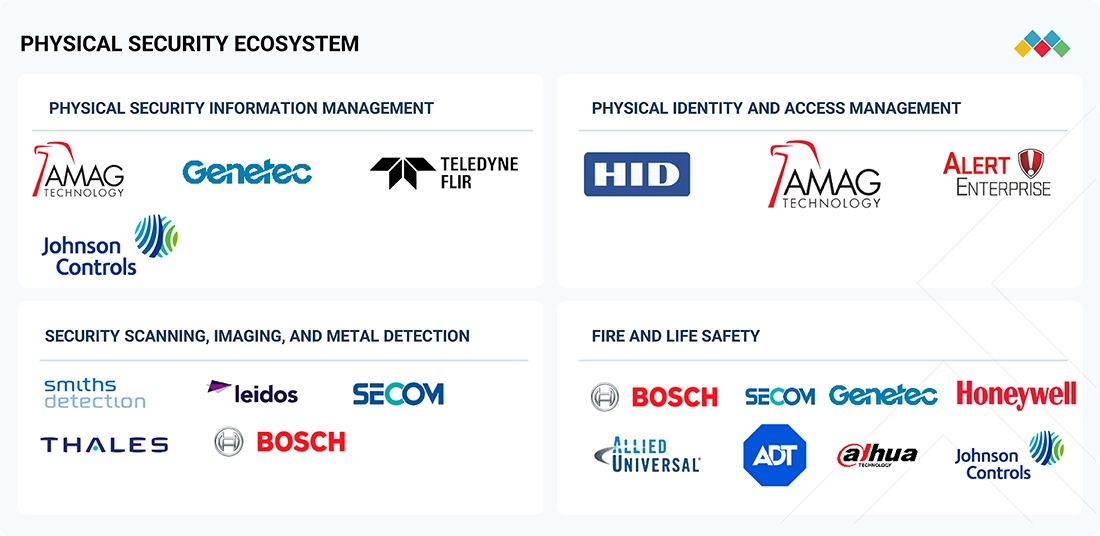
Physical Security Market: COMMERCIAL USE CASES ACROSS INDUSTRIES
| COMPANY | USE CASE DESCRIPTION | BENEFITS |
|---|---|---|
 |
Integrated physical security solutions, including video surveillance, access control, and building management systems across commercial, industrial, and critical infrastructure environments | Enhanced situational awareness, centralized monitoring, streamlined security operations, and improved safety and compliance across multi-site facilities |
 |
AI-powered video surveillance, intrusion detection, and access control solutions for enterprise, retail, and industrial sectors | Proactive threat detection, reduced response times, seamless integration of security systems, and improved operational efficiency and safety |
 |
Smart building security and integrated monitoring solutions with video analytics, access control, and alarm management | Real-time threat detection, automated alerts, centralized command capabilities, and enhanced protection for employees, assets, and facilities |
 |
Comprehensive residential and commercial security services including intrusion detection, video monitoring, and emergency response | Rapid incident response, increased safety for occupants, reduced losses, and scalable security management for homes and businesses |
 |
IP-based networked surveillance, video analytics, and security integration for enterprise and government facilities | Improved situational awareness, remote monitoring, real-time threat detection, and operational efficiency through centralized and intelligent security management |
Logos and trademarks shown above are the property of their respective owners. Their use here is for informational and illustrative purposes only.
Related Ecosystem
Cyber Security
- Cloud Security
- Biometric Systems
- Multi-Factor Authentication
- Security Analytics
- Data Loss Prevention (DLP)
- International Business Machines Corporation
- Cisco Systems, Inc.
- MITSUI BUSSAN SECURE DIRECTIONS INC
- MICROSOFT CORPORATION
- Allot Ltd.
Public Safety
- Face Recognition
- Cloud Security
- Surveillance System
- Voice Recognition
- Biometric Security and Authentication System
- Zensar Technologies Limited
- International Business Machines Corporation
- Allot Ltd.
- Cisco Systems, Inc.
- MICROSOFT CORPORATION
Key Takeaways
- Singapore's physical security market will grow from USD 2,934M (2025) to USD 4,337M (2030) at 8.1% CAGR, outpacing global growth.
- Singapore's role as a financial and logistics hub drives elevated demand for advanced surveillance and access control systems.
- Regulatory compliance and international security standards create sustained investment requirements across Singapore's commercial and government sectors.
- Singapore leads Asia Pacific in physical security technology adoption, supported by infrastructure modernization and urbanization trends.
Physical Security Market Report Scope
| Report Metric | Details |
|---|---|
| Base Year | 2025 |
| Fastest Growing Segment | RETAIL & ECOMMERCE (Vertical) |
| Forecast Period | 2025–2030 |
| Growth Rate | CAGR of 4.6% from 2025 to 2030 |
| Largest Segment | SYSTEMS (Offering) |
| Market Size Base Year (Billions) | ~USD 120.99 (2025) |
| Revenue Forecast (Billions) | ~USD 151.5 (2030) |
| Segments Covered | Offering, System, Service, Organization Size, Vertical, Professional Service |
Singapore Physical Security Market Report Segmentation
6 segment dimensions are covered across the global market.
By Offering
- Services
- Systems
By System
- Fire & Life Safety
- Fire And Life Safety
- Pacs
- Perimeter Intrusion Detection & Prevention
- Perimeter Intrusion Detection And Prevention
- Piam
- Psim
- Security Scanning, Imaging, And Metal Detection
- Video Surveillance System
- Video Surveillance Systems
By Service
- Managed Services
- Professional Services
By Organization Size
- Large Enterprises
- Smes
By Vertical
- Aerospace & Defense
- Bfsi
- Education
- Government
- Healthcare
- It & Ites
- Other Verticals
- Residential
- Retail & Ecommerce
- Transportation & Logistics
By Professional Service
- Design, Consulting, And Implementation
- Risk Assessment
- Support & Maintenance
- Training & Education
SINGAPORE: PHYSICAL SECURITY MARKET, BY VERTICAL, 2025–2030
| Segment | 2025 | 2026 | 2027 | 2028 | 2029 | 2030 | CAGR (%) |
|---|---|---|---|---|---|---|---|
| AEROSPACE & DEFENSE | 135.6 | 147.1 | 159.5 | 172.8 | 187.1 | 202.5 | 8.3 |
| BFSI | 401.9 | 441 | 483.7 | 530.1 | 580.3 | 634.8 | 9.6 |
| EDUCATION | 160.8 | 174.2 | 188.6 | 204 | 220.6 | 238.4 | 8.2 |
| GOVERNMENT | 283.6 | 308 | 334.2 | 362.4 | 392.7 | 425.2 | 8.4 |
| HEALTHCARE | 245.9 | 267.8 | 291.5 | 317 | 344.5 | 374.2 | 8.8 |
| IT & ITES | 310.4 | 329.8 | 350.2 | 371.7 | 393.8 | 416.8 | 6.1 |
| OTHER VERTICALS | 204.2 | 221.6 | 239.5 | 257.7 | 278.7 | 300.6 | 8 |
| RESIDENTIAL | 643.9 | 690.8 | 740.7 | 793.7 | 849.8 | 909.1 | 7.1 |
| RETAIL & ECOMMERCE | 197.6 | 223.4 | 252.4 | 285.1 | 320.3 | 359.4 | 12.7 |
| TRANSPORTATION & LOGISTICS | 350 | 372.8 | 396.8 | 422.1 | 448.4 | 475.9 | 6.3 |
| TOTAL | 2934 | 3176.6 | 3437.1 | 3716.5 | 4016.1 | 4337 | 8.1 |
Target Audience
- Security Solution Providers & Integrators : Require detailed Singapore market data to assess growth opportunities, identify customer segments, benchmark competitive positioning, and develop localized product strategies for this high-value, technology-forward market.
- Enterprise Security Decision-Makers : Need market intelligence to justify security infrastructure investments, understand technology trends, evaluate vendor options, and align physical security strategies with Singapore's regulatory environment and smart city initiatives.
- Investment & Private Equity Firms : Seek validated market forecasts, growth drivers, and competitive landscape data to evaluate acquisition targets, assess portfolio company growth potential, and identify emerging opportunities in Singapore's expanding security sector.
- Government & Infrastructure Planners : Require market insights to inform procurement strategies, infrastructure security standards, smart city technology integration, and policy development aligned with Singapore's critical infrastructure protection objectives.
- Technology & Hardware Manufacturers : Need Singapore-specific demand forecasts, application trends, and customer requirements to guide R&D priorities, supply chain planning, and market positioning for surveillance, access control, and integrated security solutions.
Key Companies in the Singapore Physical Security Market
| Company | HQ | Ownership | Strongest segments |
|---|---|---|---|
| QINETIQ GROUP PLC | United Kingdom | Public Company | Test and Training,Mission Support and Operations,Research and Development Services, |
| OBERTHUR TECHNOLOGIES | France | Private Company | Financial Services Institutions (payment cards, personalization, mobile payments),Mobile Network Operators (SIM, eSIM, mobile money, remote management),Connected Devices and Identity Markets (secure devices, IoT, identity documents, access), |
| PERSISTENT SYSTEMS | India | Public Company | BFSI solutions and services,Healthcare & Life Sciences,Technology Companies & Software/Hi-tech, |
| HCL TECHNOLOGIES LIMITED | India | Public Company | IT and Business Services,Engineering and R&D Services,HCL Software and IP-led Offerings, |
| NOKIA CORPORATION | Finland | Public Company | Mobile Networks (RAN and microwave transport),Network Infrastructure (Fixed, IP Networks, Optical Networks),Cloud and Network Services, |
| TELIA COMPANY | Sweden | Public Company | Consumer mobile (voice, data, MVNO brands),Fixed broadband and TV (fiber, cable, IPTV, TV4/MTV-related),Enterprise networking and cloud (LAN, WiFi, SD-WAN, colocation, security), |
| RELIANCE INDUSTRIES LTD | India | Public Company | Oil to Chemicals (refining, fuels, petrochemicals, aromatics),Retail (supermarkets, hypermarkets, specialty, online),Digital Services (connectivity, fiber, devices, apps), |
| GODREJ GROUP | India | Private Company | Home appliances (refrigerators, washing machines, ACs, microwaves, coolers, disinfecting appliances),Locks, architectural hardware, kitchen fittings, and home/institutional security products,Construction, civil engineering, green building, MEP, rooftop solar, and landscape services, |
| ALLOT COMMUNICATIONS LTD. | Israel | Public Company | Allot Secure platform (NetworkSecure, HomeSecure, DNSecure, IoTSecure, EndpointSecure, BusinessSecure, Secure Cloud),DDoS Secure, NetProtect, 5GNetProtect,AllotSmart (Smart5G, SmartVisibility, SmartTraffic QoE, SmartPCC, SmartSentinel), |
| ZENSAR TECHNOLOGIES LTD | India | Public Company | Digital and Application Services,Cloud Infrastructure Services, |
| JOHNSON CONTROLS | Ireland | Public Company | HVAC equipment and systems,Building management and controls / digital solutions,Fire detection and suppression, |
| HONEYWELL | United States | Public Company | Industrial Automation,Building Automation,Energy and Sustainability Solutions (UOP and related), |
| ADT | United States | Public Company | Residential monitored security and life safety,Small business security and automation,Smart home, interactive, and ADT+ app services, |
| CISCO | United States | Public Company | Switching and Routing (Campus, Data Center, Branch, Carrier/Webscale),Security (Network Security, SASE, Identity, Threat Detection and Response),Collaboration and Contact Center (Webex Suite, Devices, CPaaS), |
| TELUS | Canada | Public Company | Mobile services and equipment,Fixed broadband, TV, and IP services,TELUS Health solutions and services, |
| WESCO | United States | Public Company | Electrical & Electronic Solutions (EES),Utility & Broadband Solutions (UBS),Communications & Security Solutions (CSS), |
| HIKVISION | China | Public Company | Video surveillance hardware (cameras, recorders, CCTV accessories),Access control, entrance control, and intercom,Displays and visualization (interactive flat panels, LED, LCD walls), |
| GALLAGHER | United States | Public Company | Retail Commercial Brokerage (P&C and Benefits),Wholesale, MGA, and MGU,Reinsurance Brokerage, |
| SECOM | Japan | Public Company | Security Services (online, static guard, armored car, merchandise),Fire Protection Services,Medical Services, |
| ZHEJIANG DAHUA TECHNOLOGY | China | Public Company | Video surveillance hardware (cameras, recorders, storage),Integrated security and building solutions,Intelligent traffic, smart parking, and mobility, |
QINETIQ GROUP PLC
QinetiQ Group PLC is a United Kingdom-based defense and security company founded in 2001, employing 7,378 people. Operating as a public company, it provides technology and services to government and commercial clients.
OBERTHUR TECHNOLOGIES
Oberthur Technologies is a French private company founded in 2011 with 6,127 employees, operating in the technology and security solutions industry.
PERSISTENT SYSTEMS
Persistent Systems is an Indian public company founded in 1990 with 22,205 employees, providing IT services and solutions to global clients.
HCL TECHNOLOGIES LIMITED
HCL Technologies Limited is an Indian public company founded in 1976, providing IT services, consulting, and software solutions to enterprises worldwide.
NOKIA CORPORATION
Nokia Corporation is a Finnish public company founded in 1865 with 78,005 employees, operating in telecommunications infrastructure and technology sectors.
TELIA COMPANY
Telia Company is a Swedish public company founded in 1853 with 14,552 employees, providing telecommunications and digital services across the Nordic and Baltic regions.
RELIANCE INDUSTRIES LTD
Reliance Industries Ltd is an Indian public company founded in 1957 with 404,501 employees, operating as a diversified conglomerate in energy, petrochemicals, and telecommunications.
GODREJ GROUP
Godrej Group is an Indian private company founded in 1897 with 13,316 employees, operating across consumer goods, real estate, and industrial sectors.
ALLOT COMMUNICATIONS LTD.
Allot Communications Ltd is an Israeli public company founded in 1996 with 362 employees, specializing in network intelligence and cybersecurity solutions.
ZENSAR TECHNOLOGIES LTD
Zensar Technologies Ltd is an Indian public company founded in 1963 with 10,066 employees, providing IT services and digital transformation solutions.
JOHNSON CONTROLS
Johnson Controls is an Irish-domiciled public company founded in 1885 with 87,000 employees, providing building technologies and solutions globally.
HONEYWELL
Honeywell is a United States-based public company founded in 1885 with 101,000 employees, operating in aerospace, building technologies, and industrial solutions.
ADT
ADT is a United States-based public company founded in 1874 with 12,200 employees, providing security and monitoring services to residential and commercial customers.
CISCO
Cisco is a United States-based public company founded in 1984 with 86,200 employees, specializing in networking, cybersecurity, and IT infrastructure solutions.
TELUS
TELUS is a Canadian public company founded in 1998 with 111,500 employees, providing telecommunications, digital services, and technology solutions.
WESCO
WESCO is a United States-based public company founded in 1922 with 21,000 employees, distributing electrical, communications, and utility products.
HIKVISION
Hikvision is a Chinese public company founded in 2001 with 57,202 employees, operating as a leading provider of video surveillance and security products.
GALLAGHER
Gallagher is a United States-based public company founded in 1927 with 72,000 employees, providing insurance brokerage and risk management services.
SECOM
SECOM is a Japanese public company founded in 1962 with 65,094 employees, offering security services, systems, and solutions.
ZHEJIANG DAHUA TECHNOLOGY
Zhejiang Dahua Technology is a Chinese public company founded in 2002 with 22,131 employees, specializing in video surveillance and security solutions.
Reasons to Buy this Report
- Precise Market Sizing & Forecasts : Obtain validated market size data for Singapore (USD 2,934M in 2025) with detailed 5-year projections to 2030, enabling accurate budgeting, investment planning, and revenue forecasting specific to this high-growth market.
- Competitive Intelligence for Singapore : Identify key players, market share dynamics, and competitive positioning within Singapore's physical security landscape to inform go-to-market strategies, partnership opportunities, and differentiation tactics in this premium market.
- Segment & Application Breakdown : Access detailed segmentation by security type (surveillance, access control, perimeter security), end-user verticals (BFSI, retail, hospitality, critical infrastructure), and technology adoption trends specific to Singapore's market structure.
- Regional Growth Context : Understand Singapore's 8.1% CAGR advantage over the global 4.6% average, identifying the unique drivers—smart city initiatives, regulatory mandates, infrastructure investments—that differentiate this market from broader regional trends.
- Strategic Market Entry & Expansion : Leverage Singapore-specific insights on regulatory requirements, customer preferences, technology adoption rates, and emerging opportunities to develop localized strategies for market entry, product launches, or expansion initiatives.
Frequently asked questions
What is the projected size of Singapore's physical security market by 2030?
Singapore's physical security market is projected to reach USD 4,337 million by 2030, growing from USD 2,934 million in 2025 at a CAGR of 8.1%.
How does Singapore's physical security market growth compare to global trends?
Singapore's 8.1% CAGR significantly exceeds the global physical security market CAGR of 4.6%, reflecting stronger regional demand and investment dynamics.
What sectors drive physical security demand in Singapore?
Singapore's financial services, logistics, government, and critical infrastructure sectors are primary drivers of physical security investment due to high-value asset protection requirements.
Why is Singapore a leader in physical security adoption in Asia Pacific?
Singapore's advanced regulatory framework, stringent compliance standards, strategic geographic position, and high urbanization rates position it as a regional leader in security technology deployment.
What technologies are driving growth in Singapore's physical security market?
Integrated surveillance systems, AI-enabled access control, perimeter protection technologies, and cloud-based security management solutions are key growth drivers in Singapore's market.
RESEARCH METHODOLOGY
The study involved estimating the current physical security market size significantly. Exhaustive secondary research was done to collect information on the physical security industry. The next step was to validate these findings, assumptions, and sizing with industry experts across the value chain using primary research. Different approaches, such as top-down and bottom-up, were employed to estimate the total market size. After that, the market breakup and data triangulation procedures were used to estimate the market size of the segments and subsegments of the physical security market.
Secondary Research
The market for the companies offering physical security systems and services is arrived at by secondary data available through paid and unpaid sources, analyzing the product portfolios of the major companies in the ecosystem, and rating the companies by their performance and quality. Various sources were referred to in the secondary research process to identify and collect information for this study. The secondary sources include annual reports, press releases, investor presentations of companies, white papers, journals, certified publications, and articles from recognized authors, directories, and databases.
In the secondary research process, various secondary sources were referred to identify and collect information related to the study. Secondary sources included annual reports, press releases, and investor presentations of physical security vendors, forums, certified publications, and whitepapers. The secondary research was used to obtain essential information on the industry’s value chain, the total pool of key players, market classification, and segmentation from the market and technology-oriented perspectives.
Primary Research
In the primary research process, various supply and demand sources were interviewed to obtain qualitative and quantitative information for this report. The primary sources from the supply side included industry experts, such as Chief Executive Officers (CEOs), Vice Presidents (VPs), marketing directors, technology and innovation directors, and related key executives from various key companies and organizations operating in the physical security market.
After the complete market engineering (calculations for market statistics, market breakdown, market size estimations, market forecasting, and data triangulation), extensive primary research was conducted to gather information and verify and validate the critical numbers arrived at. Primary research was also undertaken to identify the segmentation types, industry trends, competitive landscape of physical security systems and services offered by various market players, and fundamental market dynamics, such as drivers, restraints, opportunities, challenges, industry trends, and key player strategies.
In the complete market engineering process, the top-down and bottom-up approaches and several data triangulation methods were extensively used to perform the market estimation and market forecasting for the overall market segments and subsegments listed in this report. Extensive qualitative and quantitative analysis was performed on the complete market engineering process to list the key information/insights throughout the report.
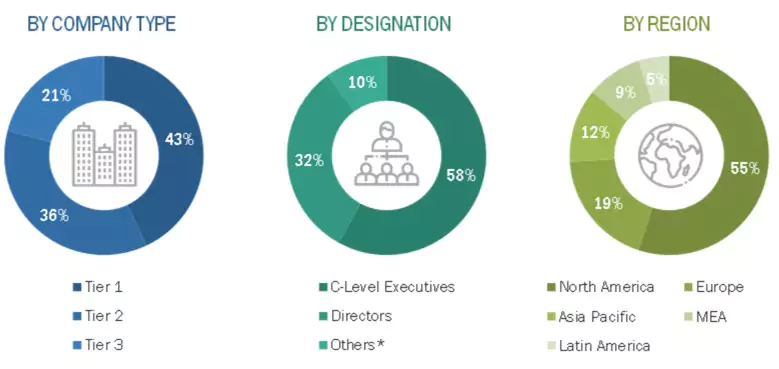
Note: The companies have been categorized based on their total annual revenue; tier 1 companies = revenue
greater than USD 10 billion; tier 2 companies = revenue between USD 1 billion and USD 10 billion; tier
3 companies = revenue between USD 500 million and USD 1 billion.
Other levels include sales managers, marketing managers, and product managers.
Source: MarketsandMarkets Analysis
To know about the assumptions considered for the study, download the pdf brochure
Market Size Estimation
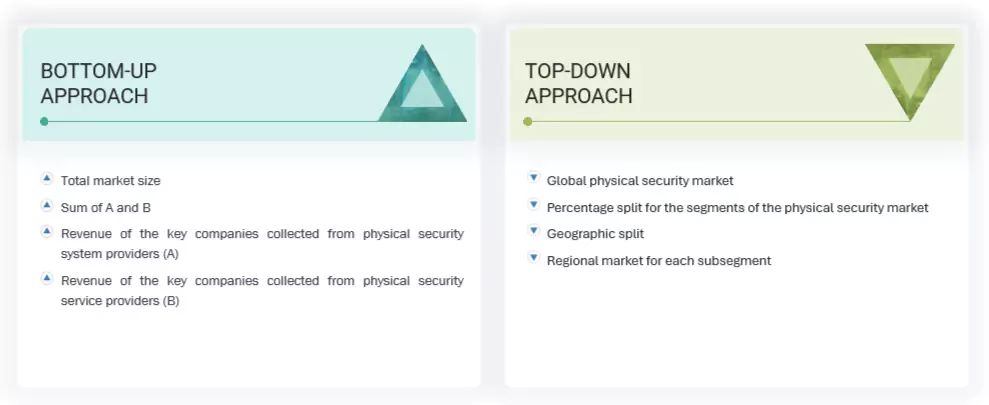
Top-down and bottom-up approaches were used to estimate and validate the size of the global physical security market and the size of various other dependent sub-segments in the overall physical security market. The research methodology used to estimate the market size includes the following details: key players in the market were identified through secondary research, and their market shares in the respective regions were determined through primary and secondary research. This entire procedure included the study of the annual and financial reports of the top market players, and extensive interviews were conducted for key insights from the industry leaders, such as CEOs, VPs, directors, and marketing executives.
All percentage splits and breakdowns were determined using secondary sources and verified through primary sources. All possible parameters that affect the market covered in this research study have been accounted for, viewed in extensive detail, verified through primary research, and analyzed to get the final quantitative and qualitative data. This data is consolidated and added to detailed inputs and analysis from MarketsandMarkets.
Physical Security Market : Top-Down and Bottom-Up Approach
Data Triangulation
After arriving at the overall market size using the market size estimation processes explained above, the market was split into several segments and subsegments. The data triangulation and market breakup procedures were employed, wherever applicable, to complete the overall market engineering process and arrive at the exact statistics of each market segment and subsegment. The data was triangulated by studying various factors and trends from both the demand and supply sides.
Market Definition
According to MarketsandMarkets, physical security refers to restricting physical access by unauthorized individuals in controlled facilities to prevent damage to valuable hardware, software, network infrastructure, and other assets. Physical security includes security layers that protect personnel, network, and data in physical spaces, such as campuses, buildings, banks, and offices, from internal or external physical threats (natural disasters, fire, theft, burglary, vandalism, and terrorist attacks).
Stakeholders
- Physical security service vendors
- Physical security system providers
- Security system integrators
- Value-added resellers (VARs)
- Distributors
- Research organizations
- Security agencies
- Investors and venture capitalists
- Security management service providers
- Security equipment providers
- Information security consultants
- Government agencies
- Managed security service providers (MSSPs)
Report Objectives
- To define, describe, and forecast the physical security market based on offering, system, service, organization size, vertical, and region
- To forecast the market size of the five main regions: North America, Europe, Asia Pacific (APAC), Middle East & Africa (MEA), and Latin America
- To analyze the subsegments of the market concerning individual growth trends, prospects, and contributions to the overall market
- To provide detailed information related to the primary factors (drivers, restraints, opportunities, and challenges) influencing the growth of the physical security market
- To analyze opportunities in the market for stakeholders by identifying high-growth segments of the physical security market
- To profile the key players of the physical security market and comprehensively analyze their market size and core competencies
- Track and analyze competitive developments, such as product launches, mergers and acquisitions, partnerships, agreements, and collaborations in the global physical security market
Available Customizations
With the given market data, MarketsandMarkets offers customizations based on company-specific needs. The following customization options are available for the report:
Geographic Analysis as per Feasibility
- Further breakup of the Asia Pacific market into countries contributing 75% to the regional market size
- Further breakup of the North American market into countries contributing 75% to the regional market size
- Further breakup of the Latin American market into countries contributing 75% to the regional market size
- Further breakup of the Middle East and African market into countries contributing 75% to the regional market size
- Further breakup of the European market into countries contributing 75% to the regional market size
Company Information
- Detailed analysis and profiling of additional market players (up to 5)
Get the Full Physical Security Market Report
Full forecast, segment splits, and company analysis for all Physical Security Market.
- Canada Physical Security Market
- US Physical Security Market
- UK Physical Security Market
- Germany Physical Security Market
- France Physical Security Market
- Italy Physical Security Market
- China Physical Security Market
- Japan Physical Security Market
- India Physical Security Market
- UAE Physical Security Market
- Brazil Physical Security Market
- Mexico Physical Security Market
- Rest Of Europe Physical Security Market
Need a Tailored Report?
Customize this report to your needs
Get 10% FREE Customization
Customize This Report
