
South Korea Piezoelectric Ceramics Market (2026-2031)

The South Korea Piezoelectric Ceramics Market was valued at $79.3 Million in 2026 and projected to reach to $96.9 Million by 2031, representing a compound annual growth rate of 4.1%. South Korea's piezoelectric ceramics market is poised for steady growth through 2031, driven by the country's dominant electronics manufacturing sector and accelerating adoption in consumer devices, automotive systems, and industrial applications.


| Market Size in | USD 26.32 MN |
| Market Forecast in | |
| CAGR | |
| Forecast Period | |
| Units Considered | Value (USD MN) |
South Korea Piezoelectric Ceramics Market Trends and Insights
- South Korea's advanced manufacturing ecosystem and strong electronics sector position the country as a key regional player in piezoelectric ceramic applications, particularly in consumer electronics, automotive sensors, and industrial automation.
- The market in South Korea is driven by increasing demand for miniaturized components and precision engineering across multiple end-use industries. South Korea's piezoelectric ceramics sector benefits from the country's robust semiconductor and display manufacturing base, which creates sustained demand for high-performance ceramic materials.
- Between 2026 and 2031, South Korea is expected to maintain steady growth through technological innovation and expansion into emerging applications such as energy harvesting and medical devices.
- South Korea's investment in R&D and its position within the Asia Pacific supply chain reinforce its importance as both a producer and consumer of piezoelectric ceramic solutions..
Key Market Statistics
- CAGR (2026-2031) 4.1% CAGR
- Market Size, 2026 ~USD 79.3 Million
- Forecast, 2031 ~USD 96.9 Million
- Country South Korea
South Korea Piezoelectric Ceramics Market Overview
Market Size & Growth :
South Korea's piezoelectric ceramics market is valued at USD 79.3 million in 2026, expanding to USD 96.9 million by 2031 at a CAGR of 4.1%, driven by robust demand from the electronics and automotive sectors.
Electronics Manufacturing Hub :
South Korea's advanced manufacturing ecosystem and leadership in consumer electronics, semiconductors, and display technologies create substantial demand for piezoelectric ceramics in actuators, sensors, and precision components.
Automotive & Industrial Applications :
Growing adoption of piezoelectric ceramics in automotive fuel injectors, vibration control systems, and industrial automation reflects South Korea's expanding EV and smart manufacturing initiatives.
Regional Competitive Position :
South Korea's 4.1% CAGR positions it as a steady performer in the Asia-Pacific region, supported by major electronics manufacturers and increasing R&D investments in advanced materials and sensor technologies.
South Korea Piezoelectric Ceramics Market Dynamics
- The market benefits from South Korea's technological expertise, strong supply chain infrastructure, and continuous innovation in smart devices and electric vehicles.
- Government support for advanced manufacturing and green technology initiatives further strengthens market prospects.
- However, growth remains moderate at 4.1% CAGR compared to global rates, reflecting market maturity and competitive pressures.
- Strategic investments in next-generation piezoelectric materials and applications in IoT devices, wearables, and autonomous vehicles will be critical for sustained expansion through the forecast period..
Market Ecosystem
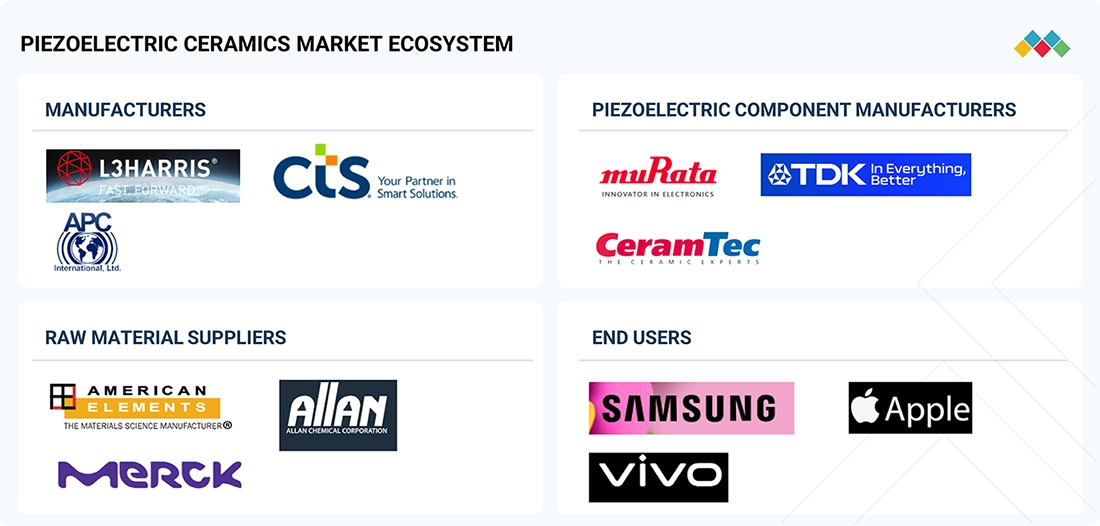
PIEZOELECTRIC CERAMICS MARKET: COMMERCIAL USE CASES ACROSS INDUSTRIES
| COMPANY | USE CASE DESCRIPTION | BENEFITS |
|---|---|---|
 |
Utilizes piezoelectric ceramic-based acoustic components, haptic feedback systems, and MEMS sensors in smartphones and wearable devices to enable precise touch response, miniaturization, and enhanced user experience | Supports compact device design, low power consumption, and high-precision sensing capabilities |
 |
Uses piezoelectric ceramic transducers in ultrasound imaging systems for medical diagnostics and real-time imaging applications | Enables high-resolution imaging, improved diagnostic accuracy, and efficient energy conversion in ultrasound devices |
 |
Integrates piezoelectric ceramic technologies into sonar systems, vibration monitoring devices, and advanced aerospace sensing platforms for defense and surveillance applications | Supports high-frequency sensing, enhanced situational awareness, and improved operational reliability in defense systems |
Logos and trademarks shown above are the property of their respective owners. Their use here is for informational and illustrative purposes only.
Related Ecosystem
Ceramics And Glass
- Zirconia
- Alumina Ceramics
- Silicon Carbide
- Silicon Nitride
- Titanate Ceramics
- Saint-gobain
- 3M COMPANY
- CERAMTEC GMBH
- Kyocera Corporation
- COORSTEK INCORPORATED
Infrastructure Material
- Alumina Ceramics
- Ceramic Coatings
- Monolithic Ceramics
- Polyphenylene Sulfide (PPS)
- Titanate Ceramics
- Saint-gobain
- Simpson Manufacturing Co., Inc.
- Sika ag
- DOW CHEMICAL COMPANY
- Basf se
Key Takeaways
- South Korea's piezoelectric ceramics market is valued at USD 79.3 million in 2026 and will reach USD 96.9 million by 2031 at a 4.1% CAGR.
- South Korea's electronics and automotive sectors are primary drivers of piezoelectric ceramic demand, particularly for sensors and actuators.
- South Korea's advanced manufacturing capabilities and R&D investments position it as a regional innovation hub for piezoelectric applications.
- South Korea's market growth is supported by expansion into emerging applications including energy harvesting, medical devices, and IoT sensors.
Piezoelectric Ceramics Market Report Scope
| Report Metric | Details |
|---|---|
| Base Year | 2026 |
| Fastest Growing Segment | –SONAR & UNDERWATER SYSTEMS (End-Use Industry) |
| Forecast Period | 2026–2031 |
| Growth Rate | CAGR of 5.1% from 2026 to 2031 |
| Largest Segment | LEAD ZIRCONATE TITANATE (Type) |
| Market Size Base Year (Billions) | ~USD 1.64 (2026) |
| Revenue Forecast (Billions) | ~USD 2.1 (2031) |
| Segments Covered | Type, End-Use Industry |
South Korea Piezoelectric Ceramics Market Report Segmentation
2 segment dimensions are covered across the global market.
By Type
- Barium Titanate
- Lead Zirconate Titanate
- Potassium Niobate
- Sodium Tungstate
By End-Use Industry
- Automotive
- Consumer Electronics
- Defense
- Industry & Manufacturing
- Medical
- –Aerospace Actuators
- –Sensing & Monitoring Systems & Others
- –Sonar & Underwater Systems
Target Audience
- Electronics Manufacturers : South Korean and international electronics companies need detailed market data to optimize piezoelectric ceramic sourcing, component design, and production planning for consumer devices and industrial applications.
- Automotive OEMs & Suppliers : Automotive manufacturers and Tier-1 suppliers operating in South Korea require market insights to support EV development, fuel injection systems, and advanced sensor integration strategies.
- Materials & Component Suppliers : Piezoelectric ceramic manufacturers and material suppliers need South Korea-specific demand forecasts, application trends, and competitive positioning to optimize production and sales strategies.
- Investment & Private Equity Firms : Investors evaluating opportunities in South Korea's advanced materials and electronics sectors require accurate market sizing, growth projections, and competitive analysis for due diligence and portfolio decisions.
- Government & Policy Organizations : South Korean government agencies, trade bodies, and research institutions need market data to inform industrial policy, R&D funding, and strategic initiatives in advanced manufacturing and green technology.
Key Companies in the South Korea Piezoelectric Ceramics Market
| Company | HQ | Ownership | Strongest segments |
|---|---|---|---|
| KYOCERA CORPORATION | Japan | Public Company | Core Components (fine ceramics, packages, optical, medical devices),Electronic Components (sensors, capacitors, crystal devices, connectors, power semiconductors),Solutions (cutting tools, printers, MFPs, communication terminals, ICT and smart energy solutions), |
| CTS CORPORATION | United States | Public Company | Transportation sensing and controls (pedals, sensors, switches),Industrial and factory automation components,Medical, aerospace, and defense components, |
| MURATA MANUFACTURING CO., LTD. | Japan | Public Company | Capacitors (MLCC and related ceramic capacitors),Inductors and noise suppression components,High-frequency devices and RF/communication modules, |
| TDK CORPORATION | Japan | Public Company | Passive Components,Sensor Application Products,Magnetic Application Products, |
| L3HARRIS TECHNOLOGIES, INC. | United States | Public Company | Communications & Spectrum Dominance (CSD),Space & Mission Systems (SMS),Missile Solutions (MSL), |
| TAYCA CO. LTD. | Japan | Public Company | General-purpose titanium dioxide,Specialty oxides (micro TiO2, micro ZnO, photocatalytic and IR-reflective TiO2, aluminum triphosphate),Surfactants and sulfuric acid, |
KYOCERA CORPORATION
Kyocera Corporation is a Japanese public company founded in 1946 that employs 73,856 people. The company operates as a diversified manufacturer with significant global operations.
CTS CORPORATION
CTS Corporation is a United States public company founded in 1896 with 3,492 employees. The company has a long history of manufacturing and industrial operations.
MURATA MANUFACTURING CO., LTD.
Murata Manufacturing Co., Ltd. is a Japanese public company founded in 1944 that employs 74,302 people. The company is a major manufacturer with extensive global operations.
TDK CORPORATION
TDK Corporation is a Japanese public company founded in 1935 with 106,545 employees. The company is a large-scale manufacturer operating internationally.
L3HARRIS TECHNOLOGIES, INC.
L3Harris Technologies, Inc. is a United States public company founded in 1895 with 45,000 employees. The company is a major industrial and technology manufacturer.
TAYCA CO. LTD.
Tayca Co. Ltd. is a Japanese public company founded in 1919 with 862 employees. The company has a long operational history in manufacturing.
Reasons to Buy this Report
- Market-Specific Sizing & Forecasts : Obtain precise market valuations for South Korea (USD 79.3M in 2026, USD 96.9M in 2031) with country-specific CAGR of 4.1%, enabling accurate budgeting and investment planning for regional operations.
- Competitive Landscape Intelligence : Understand South Korea's unique competitive dynamics, major manufacturers, and market positioning relative to global players, critical for market entry or expansion strategies in this advanced manufacturing hub.
- Sector-Specific Application Insights : Identify high-growth applications within South Korea's electronics, automotive, and industrial sectors, including consumer devices, EV fuel injectors, and sensor technologies driving regional demand.
- Strategic Growth Opportunities : Discover emerging opportunities in IoT, wearables, autonomous vehicles, and smart manufacturing initiatives specific to South Korea's innovation ecosystem and government support programs.
- Risk & Regulatory Assessment : Access South Korea-specific market risks, regulatory environment, supply chain considerations, and competitive pressures to inform go/no-go decisions and localization strategies.
Frequently asked questions
What is the current market size of piezoelectric ceramics in South Korea?
South Korea's piezoelectric ceramics market is estimated at USD 79.3 million in 2026.
What is the projected market size for piezoelectric ceramics in South Korea by 2031?
South Korea's piezoelectric ceramics market is forecast to reach USD 96.9 million by 2031.
What is the CAGR for South Korea's piezoelectric ceramics market?
South Korea's piezoelectric ceramics market is expected to grow at a CAGR of 4.1% from 2026 to 2031.
Which industries drive demand for piezoelectric ceramics in South Korea?
South Korea's primary demand drivers include consumer electronics, automotive sensors, industrial automation, and emerging applications in energy harvesting and medical devices.
Why is South Korea significant in the piezoelectric ceramics market?
South Korea's advanced manufacturing infrastructure, strong semiconductor and display sectors, and significant R&D investments make it a key regional producer and consumer of piezoelectric ceramic materials.
RESEARCH METHODOLOGY
The study involves two major activities to estimate the current market size for piezoelectric ceramics. Exhaustive secondary research was conducted to gather information on the market, peer market, and parent market. The next step was to validate these findings, assumptions, and sizing with industry experts across the value chain through primary research. Both top-down and bottom-up approaches were used to estimate the total market size. Following this, market breakdown and data triangulation were used to determine the market size of segments and subsegments.
Secondary Research
Secondary sources for this research study include financial statements of companies offering piezoelectric ceramics and information from various trade, business, and professional associations. Secondary research was used to obtain critical information about the industry's value chain, the total pool of key players, market classification, and segmentation by industry trends down to the most granular level and by regional markets. Secondary data were collected and analyzed to determine the overall size of the piezoelectric ceramics market, and this estimate was validated by primary respondents.
Primary Research
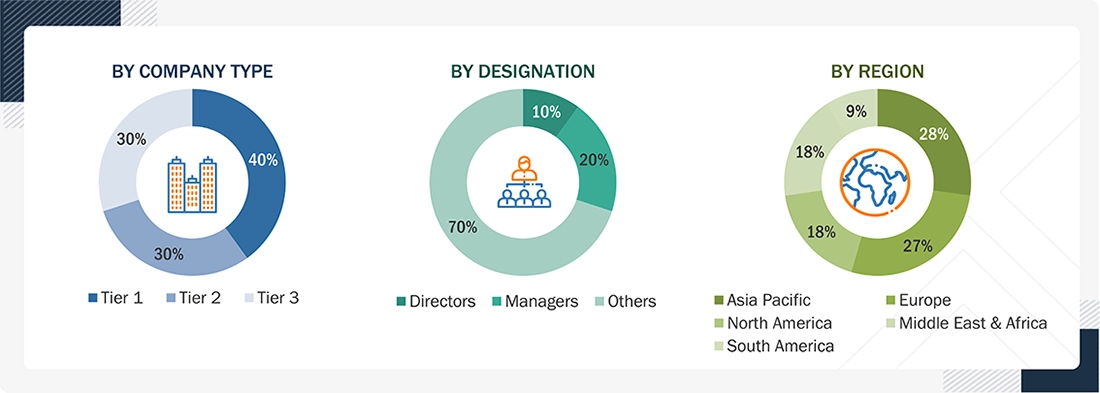
Extensive primary research was conducted after gathering information on the piezoelectric ceramics market through secondary research. Several primary interviews were conducted with market experts from both the demand and supply sides across major countries in North America, Europe, Asia Pacific, the Middle East & Africa, and South America. Primary data was collected through questionnaires, emails, and telephone interviews. Primary sources from the supply side included industry experts such as Chief X Officers (CXOs), Vice Presidents (VPs), Directors from business development, marketing, and product development/innovation teams, and related key executives from piezoelectric ceramics industry vendors, material providers, distributors, and key opinion leaders. Primary interviews were conducted to gather insights, including market statistics, revenue data for products and services, market breakdowns, market size estimates, market forecasts, and data triangulation. Primary research also helped in understanding trends related to materials, sources, manufacturing processes, end-use industries, and regions. Stakeholders from the demand side, such as CIOs, CTOs, CSOs, and installation teams of customers/end users seeking piezoelectric ceramics, were interviewed to understand the buyer's perspective on suppliers, products, component providers, current usage of piezoelectric ceramics, and the future outlook of their business, which will affect the overall market.
BREAKDOWN OF PRIMARY INTERVIEW PARTICIPANTS
To know about the assumptions considered for the study, download the pdf brochure
Market Size Estimation
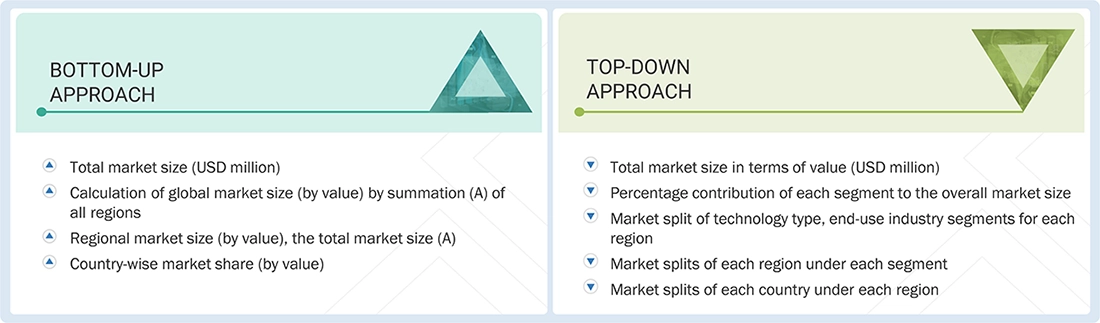
The research methodology used to estimate the size of the piezoelectric ceramics market includes the following details. Market sizing was undertaken from the demand side. The market was upsized based on demand for piezoelectric ceramics across different end-use applications at the regional level. These procurement data provide information on demand for piezoelectric ceramics in each end-use industry. For each end-use industry, all possible segments of the piezoelectric ceramics market were integrated and mapped.
Data Triangulation
After determining the overall market size through the market size estimation process described above, the total market was segmented into several segments and subsegments. The data triangulation and market breakdown procedures described below were implemented, wherever applicable, to complete the overall market engineering process and arrive at the exact statistics for various market segments and subsegments. The data was triangulated by analyzing factors and trends from both the demand and supply sides. In addition, the market size was validated using both the top-down and bottom-up approaches.
Market Definition
Piezoelectric ceramics are smart, anisotropic materials that generate an electric charge under mechanical stress and deform when exposed to an electric field. This behavior, known as the piezoelectric effect, is quantified by parameters such as piezoelectric charge and voltage coefficients and coupling factors, which define electromechanical efficiency. Common materials include lead zirconate titanate (PZT), barium titanate (BT), and potassium niobate. Owing to their precise, rapid response, piezoelectric ceramics are widely used in sensors, actuators, ultrasonic transducers, and other applications.
Key Stakeholders
- Piezoelectric Ceramics Manufacturers
- Piezoelectric Ceramics Distributors and Suppliers
- Universities, Governments, and Research Organizations
- Associations and Industrial Bodies
- R&D Institutes
- Environmental Support Agencies
- Investment Banks and Private Equity Firms
- Research and Consulting Firms
Report Objectives
- To define, describe, and forecast the piezoelectric ceramics market size in terms of value
- To provide detailed information regarding the key factors, such as drivers, restraints, opportunities, and challenges influencing market growth
- To analyze and project the global piezoelectric ceramics market by type, by end-use industry, and region
- To forecast the market size concerning five main regions (along with country-level data), namely, North America, Europe, Asia Pacific, Middle East & Africa, and South America, and analyze the significant region-specific trends
- To strategically analyze micromarkets with respect to individual growth trends, prospects, and contributions of the submarkets to the overall market
- To analyze the market opportunities and the competitive landscape for stakeholders and market leaders
- To assess recent market developments and competitive strategies, such as agreements, contracts, acquisitions, partnerships & collaboration, and new product developments/new product launches, to draw the competitive landscape
- To strategically profile the key market players and comprehensively analyze their core competencies
Available customizations:
MarketsandMarkets offers the following customizations for this market report:
- Additional country-level analysis of the piezoelectric ceramics market
Product Analysis
- Product matrix, which provides a detailed comparison of the product portfolio of each company's market
Get the Full Piezoelectric Ceramics Market Report
Full forecast, segment splits, and company analysis for all Piezoelectric Ceramics Market.
- US Piezoelectric Ceramics Market
- Canada Piezoelectric Ceramics Market
- Mexico Piezoelectric Ceramics Market
- Germany Piezoelectric Ceramics Market
- UK Piezoelectric Ceramics Market
- France Piezoelectric Ceramics Market
- Italy Piezoelectric Ceramics Market
- Spain Piezoelectric Ceramics Market
- China Piezoelectric Ceramics Market
- Japan Piezoelectric Ceramics Market
- India Piezoelectric Ceramics Market
- Australia Piezoelectric Ceramics Market
- Saudi Arabia Piezoelectric Ceramics Market
- South Africa Piezoelectric Ceramics Market
- Brazil Piezoelectric Ceramics Market
- Argentina Piezoelectric Ceramics Market
- Rest Of Europe Piezoelectric Ceramics Market
- Rest Of Asia Pacific Piezoelectric Ceramics Market
- Rest Of South America Piezoelectric Ceramics Market
Need a Tailored Report?
Customize this report to your needs
Get 10% FREE Customization
Customize This Report
