
South Korea Piezoelectric Polymers Market (2025-2030)

The South Korea Piezoelectric Polymers Market was valued at $25.2 Million in 2025 and projected to reach to $39.3 Million by 2030, representing a compound annual growth rate of 9.3%. South Korea's piezoelectric polymers market is positioned for sustained growth driven by the country's robust electronics sector and commitment to technological innovation.


| Market Size in | USD 26.32 MN |
| Market Forecast in | |
| CAGR | |
| Forecast Period | |
| Units Considered | Value (USD MN) |
South Korea Piezoelectric Polymers Market Trends and Insights
- South Korea's advanced manufacturing ecosystem and strong electronics sector are driving demand for piezoelectric polymers in sensors, actuators, and energy harvesting applications.
- The country's commitment to innovation in smart devices and automotive electrification is accelerating adoption across industrial and consumer segments. South Korea's 9.3% compound annual growth rate significantly outpaces the global average of 7.5%, reflecting the nation's leadership in semiconductor and display technologies.
- South Korea's investment in next-generation wearables, IoT devices, and flexible electronics is creating substantial opportunities for piezoelectric polymer integration.
- By 2030, South Korea is positioned to capture growing market share as manufacturers leverage the material's lightweight, flexible, and durable properties in high-performance applications..
Key Market Statistics
- CAGR (2025-2030) 9.3% CAGR
- Market Size, 2025 ~USD 25.2 Million
- Forecast, 2030 ~USD 39.3 Million
- Country South Korea
South Korea Piezoelectric Polymers Market Overview
Market Valuation Growth :
South Korea's piezoelectric polymers market is valued at USD 25.2 million in 2025, with a projected CAGR of 9.3% through 2030, reaching USD 39.3 million. This outpaces the global CAGR of 7.5%, reflecting South Korea's accelerated adoption.
Electronics Sector Leadership :
South Korea's world-class electronics manufacturing base drives significant demand for piezoelectric polymers in consumer devices, smartphones, and wearables. The country's tech giants are integrating these materials into next-generation smart devices.
Innovation in Smart Devices :
South Korean manufacturers are pioneering applications in sensors, actuators, and energy harvesting technologies. Government support for R&D and smart device development creates a favorable ecosystem for piezoelectric polymer adoption.
Advanced Manufacturing Ecosystem :
South Korea's precision manufacturing capabilities and supply chain infrastructure enable efficient production and integration of piezoelectric polymers. This competitive advantage supports rapid commercialization of innovative applications.
South Korea Piezoelectric Polymers Market Dynamics
- The 9.3% CAGR reflects strong demand from manufacturers developing smart devices, IoT solutions, and advanced sensor technologies.
- South Korea's leadership in semiconductor and consumer electronics manufacturing creates substantial opportunities for piezoelectric polymer integration across multiple applications. The market outlook remains positive as South Korean companies invest heavily in R&D for next-generation wearables, haptic feedback systems, and energy harvesting devices.
- Government initiatives supporting smart manufacturing and green energy technologies further bolster market expansion.
- With established supply chains and manufacturing expertise, South Korea is well-positioned to capture growing demand for piezoelectric polymers in both domestic and export markets through 2030..
Market Ecosystem

PIEZOELECTRIC POLYMERS MARKET: COMMERCIAL USE CASES ACROSS INDUSTRIES
| COMPANY | USE CASE DESCRIPTION | BENEFITS |
|---|---|---|
 |
Provides Solef PVDF grades suitable for conversion into piezoelectric films used in structural health monitoring (SHM) systems and composite-embedded sensing applications | Lightweight alternative to ceramic piezo materials, compatible with composite integration, corrosion-resistant and suitable for distributed sensing concepts |
 |
Supplies Neoflon PVDF resin suitable for industrial film applications, including vibration sensing and harsh-environment monitoring systems | Supplies Neoflon PVDF resin suitable for industrial film applications, including vibration sensing and harsh-environment monitoring systems |
 |
Develops polymer-based piezo film sensors for vibration detection, impact sensing, and medical monitoring devices | Lightweight and low-profile sensor integration, flexible sensing format suitable for dynamic measurement, and supports compact device design | Lightweight and low-profile sensor integration, flexible sensing format, suitable for dynamic measurement, and supports compact device design |
Logos and trademarks shown above are the property of their respective owners. Their use here is for informational and illustrative purposes only.
Related Ecosystem
Fibers And Composites
- Polyetheretherketone (PEEK)
- Polyphenylene Sulfide (PPS)
- Epoxy Resin
- Polycarbonate
- Polyester Resin
- Toray Industries, Inc.
- Teijin Limited
- Sgl carbon se
- Hexcel Corporation
- Solvay sa
Infrastructure Material
- Alumina Ceramics
- Ceramic Coatings
- Monolithic Ceramics
- Polyphenylene Sulfide (PPS)
- Titanate Ceramics
- Saint-gobain
- Simpson Manufacturing Co., Inc.
- DOW CHEMICAL COMPANY
- Basf se
- Sika ag
Renewable Energy Material
- HVAC System
- Actuators
- Aramid Fiber
- Electrical Insulation
- Electrochemical BioSensor
- Basf se
- Wacker chemie ag
- Evonik industries ag
- Borealis ag
- MOMENTIVE PERFORMANCE MATERIALS INC.
Key Takeaways
- South Korea's piezoelectric polymers market will grow from USD 25.2M (2025) to USD 39.3M (2030) at a 9.3% CAGR, outpacing global growth.
- South Korea's electronics and automotive sectors are primary demand drivers for piezoelectric polymer applications in sensors and actuators.
- South Korea's focus on wearable technology and IoT innovation is creating new market opportunities for flexible piezoelectric materials.
- South Korea's advanced manufacturing capabilities position the country as a key hub for piezoelectric polymer development and commercialization.
Piezoelectric Polymers Market Report Scope
| Report Metric | Details |
|---|---|
| Base Year | 2025 |
| Fastest Growing Segment | CONSUMER ELECTRONICS (End-Use Industry) |
| Forecast Period | 2025–2030 |
| Growth Rate | CAGR of 7.5% from 2025 to 2030 |
| Largest Segment | PVDF (Polymer Type) |
| Market Size Base Year (Billions) | ~USD 0.45 (2025) |
| Revenue Forecast (Billions) | ~USD 0.64 (2030) |
| Segments Covered | Polymer Type, Material Form, Application, End-Use Industry |
South Korea Piezoelectric Polymers Market Report Segmentation
4 segment dimensions are covered across the global market.
By Polymer Type
- Other Polymer Types
- Pvdf
- Pvdf-Hfp & Other Pvdf Copolymers
- Pvdf-Hfp And Other Pvdf Copolymers
- Pvdf-Trfe
By Material Form
- Coatings & Thin Layers
- Fibers & Non-Woven Mats
- Films & Sheets
- Granules & Semi-Finished Materials
- Molded Components
- Other Material Forms
By Application
- Acoustic
- Acoustic Devices
- Actuators
- Generators
- Motors
- Other Applications
- Sensors
- Sonar
- Transducers
By End-Use Industry
- Aerospace & Defense
- Automotive
- Consumer Electronics
- Healthcare & Medical
- Industrial & Manufacturing
- Other End-Use Industries
Target Audience
- Electronics Manufacturers : South Korean electronics companies need market intelligence to integrate piezoelectric polymers into consumer devices, smartphones, and wearables while maintaining competitive advantage in global markets.
- Material Suppliers & Producers : Piezoelectric polymer manufacturers require South Korea-specific demand forecasts and application insights to optimize production capacity, develop localized products, and establish strategic partnerships with Korean OEMs.
- Investment & Private Equity Firms : Investors evaluating opportunities in South Korea's advanced materials sector need detailed market sizing, growth projections, and competitive landscape analysis to assess portfolio companies and acquisition targets.
- Technology & Innovation Consultants : Consulting firms advising Korean tech companies on smart device development and sensor integration require market data and application trends specific to South Korea's innovation ecosystem.
- Government & Policy Makers : South Korean government agencies and economic development organizations need market intelligence to support industrial policy, R&D funding decisions, and strategic initiatives in advanced materials and smart manufacturing.
Key Companies in the South Korea Piezoelectric Polymers Market
| Company | HQ | Ownership | Strongest segments |
|---|---|---|---|
| SYENSQO | Belgium | Public Company | Specialty Polymers (aromatics, sulfones, fluoropolymers, high-performance polyester, polyolefin),Amines and Derivatives (amine ether, fatty and specialty amines),Surfactants (amphoteric, anionic, cationic, non-ionic, blends), |
| ARKEMA | France | Public Company | Advanced Materials (high-performance polymers and additives),Adhesive Solutions,Coating Solutions (acrylics, resins, additives, paints), |
| KUREHA CORPORATION | Japan | Public Company | Advanced Materials (PPS, PVDF, PGA, carbon, activated carbon),Specialty Chemicals (pharma, agrochemicals, basic chlor-alkali and aromatics),Specialty Plastics (consumer wraps, films, containers, auto-pack machinery), |
| DAIKIN INDUSTRIES, LTD. | Japan | Public Company | Residential and Light-Commercial Split/Multi-Split AC,VRV/VRF and Packaged Commercial Systems,Chillers, Rooftops, and Airside Equipment, |
| TORAY INDUSTRIES, INC. | Japan | Public Company | Fibers and Textiles (filament, staple, spun yarns, woven/knitted fabrics, non-wovens, apparel),Performance Chemicals (resins, molded products, foams, films, fine chemicals, electronic materials),Carbon Fiber Composite Materials and Molded Products, |
| TE CONNECTIVITY | Ireland | Public Company | Transportation Solutions (automotive, e-mobility, commercial and industrial vehicles, autosport, rail),Industrial Solutions (industrial machinery, automation and control, intelligent buildings, energy, aerospace, defense, medical, oil and gas/marine, space, rail non-rolling stock),Services and value-added solutions (application tooling, 3D printing, design services, training, software, sensor manufacturing services), |
| UNICTRON TECHNOLOGIES CORPORATION | Taiwan | Public Company | External and embedded antennas (chip, PCB/FPC, patch, combo, GNSS),Antenna modules, trackers, and receivers,Piezoceramic elements and ultrasonic transducers, |
SYENSQO
Syngenta is a Belgian public company founded in 1863 with 13,000 employees, operating as a major player in the chemical and specialty materials industry.
ARKEMA
Arkema is a French public company founded in 2003 with 20,700 employees, specializing in specialty chemicals and advanced materials.
KUREHA CORPORATION
Kureha Corporation is a Japanese public company founded in 1944 with 3,941 employees, engaged in the manufacture of specialty chemicals and materials.
DAIKIN INDUSTRIES, LTD.
Daikin Industries, Ltd. is a Japanese public company founded in 1924 with 104,095 employees, a global leader in air conditioning, refrigeration, and chemical products.
TORAY INDUSTRIES, INC.
Toray Industries, Inc. is a Japanese public company founded in 1926 with 46,294 employees, specializing in advanced fibers, films, resins, and chemical products.
TE CONNECTIVITY
TE Connectivity is an Irish public company founded in 1941 with 80,000 employees, a global leader in connectivity and sensor solutions.
UNICTRON TECHNOLOGIES CORPORATION
Unictron Technologies Corporation is a Taiwanese public company founded in 1988 with 517 employees, operating in the electronics and technology sector.
Reasons to Buy this Report
- Market-Specific Growth Data : Access precise valuation metrics for South Korea's piezoelectric polymers market with country-specific CAGR of 9.3%, enabling accurate forecasting and investment planning tailored to this high-growth region.
- Competitive Intelligence : Understand South Korea's advanced manufacturing advantages and electronics sector dynamics to benchmark against competitors and identify market entry strategies specific to Korean manufacturers and supply chains.
- Application Insights : Gain detailed knowledge of piezoelectric polymer applications in South Korean smart devices, sensors, and actuators to align product development with regional demand patterns and technology trends.
- Strategic Investment Guidance : Make informed decisions about market expansion, partnerships, and R&D investments in South Korea with comprehensive forecasts through 2030 and understanding of local innovation ecosystems.
- Supply Chain Optimization : Leverage insights into South Korea's manufacturing capabilities and supply chain infrastructure to optimize sourcing, production, and distribution strategies for piezoelectric polymer products.
Frequently asked questions
What is the current market size of piezoelectric polymers in South Korea?
South Korea's piezoelectric polymers market was valued at USD 25.2 million in 2025 and is projected to grow to USD 39.3 million by 2030.
What is the growth rate for piezoelectric polymers in South Korea?
South Korea's piezoelectric polymers market is expected to grow at a compound annual growth rate (CAGR) of 9.3% from 2025 to 2030.
Which industries in South Korea are driving piezoelectric polymer demand?
South Korea's electronics, automotive, consumer devices, and wearable technology sectors are the primary drivers of piezoelectric polymer demand.
How does South Korea's growth compare to the global market?
South Korea's 9.3% CAGR significantly exceeds the global piezoelectric polymers market CAGR of 7.5%, demonstrating stronger regional growth momentum.
What applications are most prominent for piezoelectric polymers in South Korea?
South Korea's primary applications include sensors, actuators, energy harvesting devices, flexible electronics, and smart wearable technologies.
RESEARCH METHODOLOGY
The study involved four major activities to estimate the current size of the global piezoelectric polymers market. Exhaustive secondary research was conducted to gather information on the market, the peer product market, and the parent product group market. The next step was to validate these findings, assumptions, and sizes with the industry experts across the value chain of piezoelectric polymers through primary research. The top-down and bottom-up approaches were employed to estimate the overall size of the piezoelectric polymers market. After that, market breakdown and data triangulation procedures were used to determine the size of different segments of the market.
Secondary Research
The market for companies offering piezoelectric polymers is arrived at by secondary data available through paid and unpaid sources, analyzing the product portfolios of the major companies in the ecosystem, and rating the companies by their performance and quality. Various secondary sources, such as Business Standard, Bloomberg, World Bank, and Factiva, were referred to identify and collect information for this study on the piezoelectric polymers market. In the secondary research process, various secondary sources were referred to identify and collect information related to the study. Secondary sources included annual reports, press releases, and investor presentations of door vendors, forums, certified publications, and whitepapers. The secondary research was used to obtain critical information on the industry’s value chain, the total pool of key players, market classification, and segmentation from the market and technology-oriented perspectives.
Primary Research
In the primary research process, various primary sources from both the supply and demand sides were interviewed to obtain qualitative and quantitative information for this report. The primary sources from the supply side included industry experts, such as chief executive officers (CEOs), vice presidents (VPs), marketing directors, technology and innovation directors, and related key executives from several key companies and organizations operating in the piezoelectric polymers market. After the complete market engineering (calculations for market statistics, market breakdown, market size estimations, market forecasting, and data triangulation), extensive primary research was conducted to gather information and verify and validate the critical numbers arrived at. Primary research was also conducted to identify the segmentation types, industry trends, competitive landscape of piezoelectric polymers offered by various market players, and key market dynamics, such as drivers, restraints, opportunities, challenges, industry trends, and key player strategies. In the complete market engineering process, the top-down and bottom-up approaches and several data triangulation methods were extensively used to perform the market estimation and market forecasting for the overall market segments and subsegments listed in this report. Extensive qualitative and quantitative analysis was performed on the complete market engineering process to list the key information/insights throughout the report.
The following is a breakdown of the primary respondents:
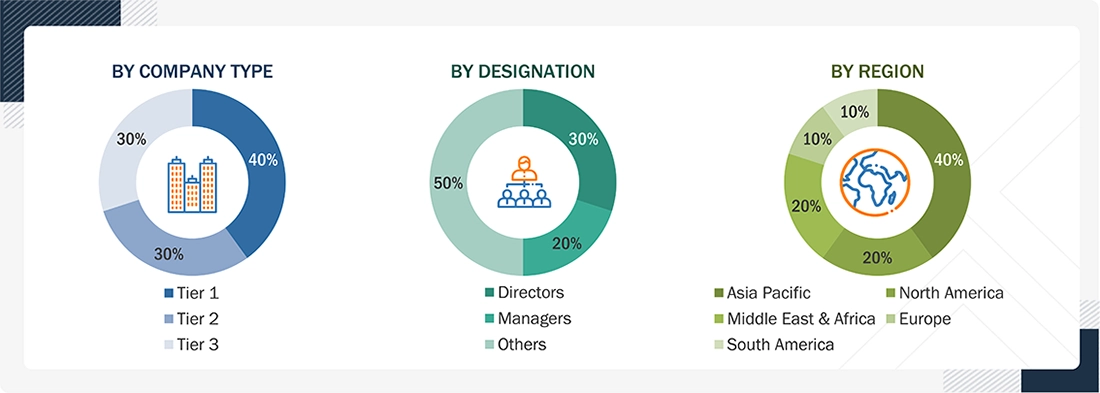
Notes: Other designations include sales, marketing, and product managers.
Tier 1: >USD 1 billion, Tier 2: USD 500 million–1 billion, and Tier 3: <USD 500 million.
To know about the assumptions considered for the study, download the pdf brochure
Market Size Estimation
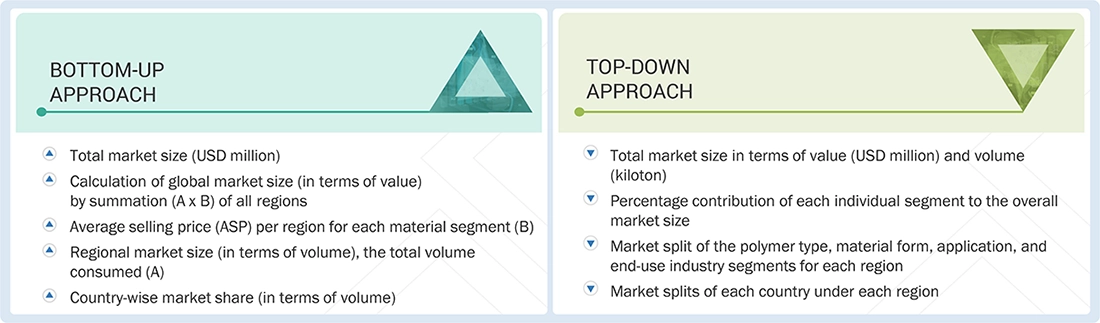
The top-down and bottom-up approaches were used to estimate and validate the size of the global piezoelectric polymers market. These approaches were also used extensively to estimate the size of various dependent market segments. The research methodology used to estimate the market size included the following:
Data Triangulation
After arriving at the overall market size using the market size estimation processes, the market was split into several segments. The data triangulation and market breakup procedures were employed, wherever applicable, to complete the overall market engineering process and arrive at the exact statistics of each market segment. The data was triangulated by studying various factors and trends from both the demand and supply sides.
Market Definition
The piezoelectric polymers market involves the manufacturing, design, and commercialization of polymeric materials that generate an electric charge when mechanically stressed and conversely deform when an electric field is applied. The main types of piezoelectric polymers include polyvinylidene fluoride (PVDF) and PVDF-based copolymers, such as PVDF-TrFE. These materials offer several advantages, including being lightweight, flexible, and durable in mechanical applications, and they can be produced more easily than traditional ceramic piezoelectrics. The piezoelectric polymer market encompasses all suppliers of raw materials for polymer manufacturers, manufacturers of compound materials, and end-use industries that utilize these polymers to create products or systems. These applications include sensors, actuators, energy harvesters, wearables, medical devices, automotive components, and industrial monitoring systems. The growth of this market is driven by an increasing demand for flexible electronics, miniaturized devices, smart materials, and advanced sensing systems in various high-performance applications.
Key Stakeholders
- Piezoelectric Polymer Manufacturers
- Raw Material Suppliers
- Converters & Processors
- Distributors & Traders
- Industry Associations & Regulatory Bodies
- End Users
Report Objectives
- To define, describe, and forecast the size of the piezoelectric polymers market, based on polymer type, material form, application, end-use industry, and region in terms of value and volume
- To provide detailed information on the significant drivers, restraints, opportunities, and challenges influencing the market
- To strategically analyze micromarkets concerning individual growth trends, prospects, and their contribution to the market
- To assess the growth opportunities in the market for stakeholders and provide details on the competitive landscape for market leaders
- To forecast the market size of segments and subsegments for North America, Europe, Asia Pacific, South America, and the Middle East & Africa
- To strategically profile the key players and comprehensively analyze their market shares and core competencies
- To analyze competitive developments such as product launches, expansions, partnerships, and agreements in the piezoelectric polymers market
- To provide the impact of AI/Gen AI on the market.
Available customizations:
With the given market data, MarketsandMarkets offers customizations according to client-specific needs.
The following customization options are available for the piezoelectric polymers market report:
Product Analysis
A product matrix that gives a detailed comparison of the product portfolio of each company
Regional Analysis
A further breakdown of the piezoelectric polymers market for additional countries
Company Information
Detailed analysis and profiling of additional market players (up to five)
Get the Full Piezoelectric Polymers Market Report
Full forecast, segment splits, and company analysis for all Piezoelectric Polymers Market.
- US Piezoelectric Polymers Market
- Canada Piezoelectric Polymers Market
- Mexico Piezoelectric Polymers Market
- Germany Piezoelectric Polymers Market
- France Piezoelectric Polymers Market
- UK Piezoelectric Polymers Market
- Italy Piezoelectric Polymers Market
- Spain Piezoelectric Polymers Market
- China Piezoelectric Polymers Market
- Japan Piezoelectric Polymers Market
- India Piezoelectric Polymers Market
- Brazil Piezoelectric Polymers Market
- Rest Of Europe Piezoelectric Polymers Market
- Rest Of Asia Pacific Piezoelectric Polymers Market
Need a Tailored Report?
Customize this report to your needs
Get 10% FREE Customization
Customize This Report
