
Brazil Pigment Dispersion Market (2025-2030)

The Brazil Pigment Dispersion Market was valued at $1036 Million in 2025 and projected to reach to $1286.4 Million by 2030, representing a compound annual growth rate of 4.4%. Brazil's pigment dispersion market is positioned for steady growth through 2030, supported by industrial recovery and increased manufacturing activity across key sectors.


| Market Size in | USD 26.32 MN |
| Market Forecast in | |
| CAGR | |
| Forecast Period | |
| Units Considered | Value (USD MN) |
Brazil Pigment Dispersion Market Trends and Insights
- This growth trajectory reflects Brazil's expanding demand across coatings, plastics, and printing ink applications, driven by industrial recovery and increased manufacturing activity.
- Brazil's market expansion is supported by rising construction activity, automotive production, and consumer goods manufacturing, which collectively drive pigment dispersion consumption across multiple end-use sectors. The pigment dispersion market in Brazil is characterized by steady demand from both domestic and export-oriented industries.
- Brazil's strategic position as South America's largest economy positions it as a critical hub for pigment dispersion applications throughout the region.
- Between 2025 and 2030, Brazil is expected to maintain consistent growth momentum, with market participants capitalizing on infrastructure development and industrial modernization initiatives.
- Brazil's competitive landscape includes both multinational suppliers and regional manufacturers, creating a dynamic environment for market participants seeking to expand their footprint in the South American pigment dispersion sector..
Key Market Statistics
- CAGR (2025-2030) 4.4% CAGR
- Market Size, 2025 ~USD 1036 Million
- Forecast, 2030 ~USD 1286.4 Million
- Country Brazil
Brazil Pigment Dispersion Market Overview
Market Size & Growth :
Brazil's pigment dispersion market is valued at USD 1,036.0 million in 2025, with projected growth to USD 1,286.4 million by 2030, driven by a robust 4.4% CAGR outpacing the global average of 4.1%.
Industrial Recovery Driver :
Brazil's manufacturing sector recovery is fueling increased demand for pigment dispersions across coatings, plastics, and printing ink applications, supporting sustained market expansion through 2030.
Key Application Segments :
Coatings, plastics, and printing inks represent the primary end-use sectors in Brazil, with growing adoption in automotive, construction, and consumer goods manufacturing driving pigment dispersion consumption.
Regional Market Position :
As Latin America's largest economy, Brazil commands significant influence in the regional pigment dispersion market, with expanding industrial capacity and infrastructure investments supporting long-term growth potential.
Brazil Pigment Dispersion Market Dynamics
- The 4.4% CAGR reflects growing demand from coatings manufacturers, plastic processors, and printing ink producers responding to domestic and export market opportunities.
- Infrastructure investments and automotive sector expansion are expected to sustain demand momentum. The market outlook remains positive as Brazil's economy strengthens and industrial production scales.
- Rising consumer spending on construction and automotive products will drive pigment dispersion consumption.
- However, currency volatility and raw material price fluctuations may present challenges.
- Strategic investments in sustainable and high-performance pigment dispersions will be critical for market participants seeking competitive advantage in Brazil's evolving landscape..
Market Ecosystem
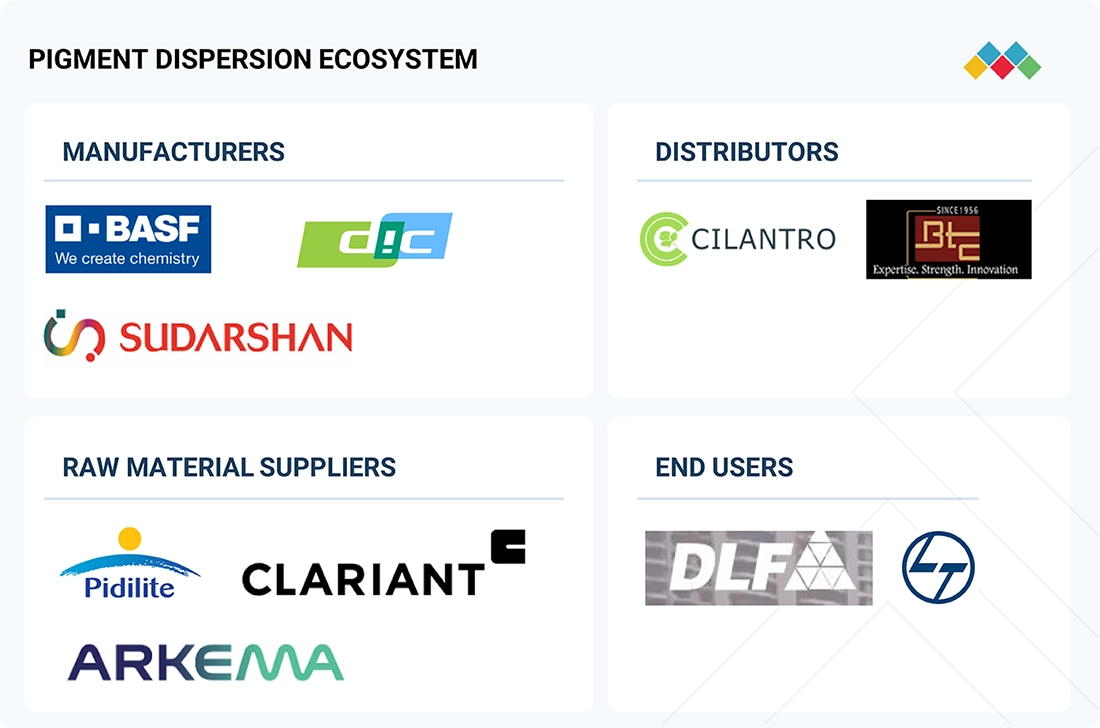
Pigment Dispersion Market: COMMERCIAL USE CASES ACROSS INDUSTRIES
| COMPANY | USE CASE DESCRIPTION | BENEFITS |
|---|---|---|
 |
Use of pigment dispersions in decorative and industrial paints | Provides vibrant color consistency, durability against weathering, and eco-friendly low-VOC options for consumers |
 |
Integration of aqueous pigment dispersions in protective coatings and architectural paints | Enhanced coverage, long-lasting finish, and compliance with sustainability certifications |
 |
Use of dispersions in commercial and industrial paints | Improved pigment stability, lower maintenance costs, and premium appearance for large infrastructure and industrial projects |
 |
Deployment of dispersions in wood coatings and interior wall paints | Smooth finish, wide color palette, and environmentally safe formulations meeting green building standards |
Logos and trademarks shown above are the property of their respective owners. Their use here is for informational and illustrative purposes only.
Related Ecosystem
Paints And Coatings
- Polyurethane Resin
- Alkyd Resins
- Epoxy Resin
- Polyester Resin
- Acrylics
- Basf se
- JOTUN
- PPG Industries, Inc.
- DOW CHEMICAL COMPANY
- Akzonobel n.v.
Speciality Chemicals
- Corrosion Inhibitors
- Polyetheretherketone (PEEK)
- Acrylonitrile Butadiene Styrene (ABS)
- Epoxy Resin
- Polycarbonate
- Basf se
- DOW CHEMICAL COMPANY
- Evonik industries ag
- Clariant ag.
- Solvay sa
Key Takeaways
- Brazil's pigment dispersion market is valued at USD 1,036.0 million in 2025 and will reach USD 1,286.4 million by 2030, growing at a 4.4% CAGR.
- Brazil's market growth is driven by expanding demand from coatings, plastics, and printing ink industries supported by construction and automotive sectors.
- Brazil's position as South America's largest economy makes it a critical regional hub for pigment dispersion applications and supply chain development.
- Brazil's competitive landscape features both multinational corporations and regional manufacturers, creating diverse opportunities for market expansion through 2030.
Pigment Dispersion Market Report Scope
| Report Metric | Details |
|---|---|
| Base Year | 2025 |
| Fastest Growing Segment | WATER-BASED (Dispersion Type) |
| Forecast Period | 2025-2030 |
| Growth Rate | CAGR of 4.1% from 2025 to 2030 |
| Largest Segment | WATER-BASED (Dispersion Type) |
| Market Size Base Year (Billions) | ~USD 43.35 (2025) |
| Revenue Forecast (Billions) | ~USD 53 (2030) |
| Segments Covered | Dispersion Type, Application, End-Use Industry |
Brazil Pigment Dispersion Market Report Segmentation
3 segment dimensions are covered across the global market.
By Dispersion Type
- Solvent-Based
- Water-Based
By Application
- Automotive Paints & Coatings
- Decorative Paints & Coatings
- Industrial Paints & Coatings
- Inks
- Other Applications
- Plastics
By End-Use Industry
- Automotive
- Building & Construction
- Other End-Use Industries
- Packaging
- Paper & Printing
- Textiles
BRAZIL: PIGMENT DISPERSIONS MARKET, BY END-USE INDUSTRY, 2025–2030
| Segment | 2025 | 2026 | 2027 | 2028 | 2029 | 2030 | CAGR (%) |
|---|---|---|---|---|---|---|---|
| AUTOMOTIVE | 126.5 | 129.5 | 132.8 | 136.4 | 140.3 | 147.9 | 3.2 |
| BUILDING & CONSTRUCTION | 493 | 513.8 | 536.4 | 560.4 | 586.3 | 629 | 5 |
| OTHER END-USE INDUSTRIES | 55.7 | 57.6 | 59.6 | 61.7 | 64 | 68.1 | 4.1 |
| PACKAGING | 130.3 | 136.2 | 142.6 | 149.5 | 156.9 | 168.9 | 5.3 |
| PAPER & PRINTING | 154.3 | 158.6 | 163.3 | 168.3 | 173.7 | 183.9 | 3.6 |
| TEXTILES | 76.3 | 78 | 79.9 | 82 | 84.2 | 88.7 | 3.1 |
| TOTAL | 1036 | 1073.6 | 1114.6 | 1158.3 | 1205.4 | 1286.4 | 4.4 |
Target Audience
- Chemical Manufacturers : Pigment dispersion producers need Brazil-specific market data to assess production capacity requirements, distribution strategies, and competitive positioning in this growing regional market.
- Coatings & Paint Companies : Coating manufacturers require detailed insights into Brazil's pigment dispersion demand to optimize supply chain management, product formulations, and market share strategies.
- Plastics & Polymer Processors : Plastic manufacturers need Brazil market intelligence to forecast pigment dispersion requirements, evaluate supplier relationships, and plan production expansion initiatives.
- Printing Ink Producers : Ink manufacturers require Brazil-specific data to understand regional demand trends, competitive dynamics, and growth opportunities in the printing and packaging sectors.
- Investment & Strategy Teams : Corporate strategists and investors need Brazil market analysis to evaluate market entry opportunities, assess growth potential, and make informed decisions on regional expansion and acquisitions.
Reasons to Buy this Report
- Localized Market Intelligence : Gain Brazil-specific insights on market size, growth rates, and forecasts that enable accurate business planning and investment decisions tailored to Latin America's largest economy.
- Competitive Positioning : Understand Brazil's pigment dispersion landscape, including application segments and end-user demand patterns, to identify competitive advantages and market entry opportunities.
- Growth Opportunity Assessment : Evaluate the 4.4% CAGR growth trajectory and USD 250.4 million market expansion opportunity through 2030 to prioritize resource allocation and expansion strategies in Brazil.
- Sector-Specific Demand Analysis : Access detailed insights into coatings, plastics, and printing ink applications in Brazil to align product development and marketing strategies with regional demand drivers.
- Strategic Decision Support : Leverage Brazil market data to support M&A decisions, partnership evaluations, and capacity planning initiatives with confidence in regional market fundamentals and growth projections.
Frequently asked questions
What is the current market size of pigment dispersion in Brazil?
Brazil's pigment dispersion market is estimated at USD 1,036.0 million in 2025, with verified data from market research sources.
What is the projected market size for pigment dispersion in Brazil by 2030?
Brazil's pigment dispersion market is forecast to reach USD 1,286.4 million by 2030, representing growth from the 2025 baseline.
What is the CAGR for Brazil's pigment dispersion market?
Brazil's pigment dispersion market is expected to grow at a compound annual growth rate (CAGR) of 4.4% between 2025 and 2030.
Which industries drive demand for pigment dispersions in Brazil?
Brazil's pigment dispersion demand is primarily driven by coatings, plastics, printing inks, construction, and automotive manufacturing sectors.
Why is Brazil significant for the South American pigment dispersion market?
Brazil is South America's largest economy and serves as a critical regional hub for pigment dispersion applications, supply chain development, and market innovation.
RESEARCH METHODOLOGY
The study involved four major activities for estimating the current size of the global pigment dispersion market. Exhaustive secondary research was conducted to obtain information on the market, the peer product market, and the parent product group market. The next step was to validate these findings, assumptions, and sizes with industry experts across the pigment dispersion value chain through primary research. Both the top-down and bottom-up approaches were used to estimate the overall market size. Then, market breakdown and data triangulation procedures were applied to determine the sizes of different segments and sub-segments of the market.
Secondary Research
In the secondary research process, various secondary sources such as Hoovers, Factiva, Bloomberg BusinessWeek, and Dun & Bradstreet were used to identify and collect information for this study on the pigment dispersion market. These sources included annual reports, press releases and investor presentations of companies; white papers; certified publications; articles by recognized authors; regulatory bodies, trade directories, and databases.
Primary Research
The pigment dispersion market involves several stakeholders in the supply chain, including raw material suppliers, equipment providers, distributors, end-product manufacturers, buyers, and regulatory organizations. Different primary sources from both the supply and demand sides of the market have been interviewed to gather both qualitative and quantitative information. On the demand side, key participants include opinion leaders, executives, vice presidents, and CEOs of companies in the pigment dispersion market. On the supply side, primary sources include industry associations, institutions involved in the pigment dispersion market, key opinion leaders, and processing companies.
Following is the breakdown of primary respondents:
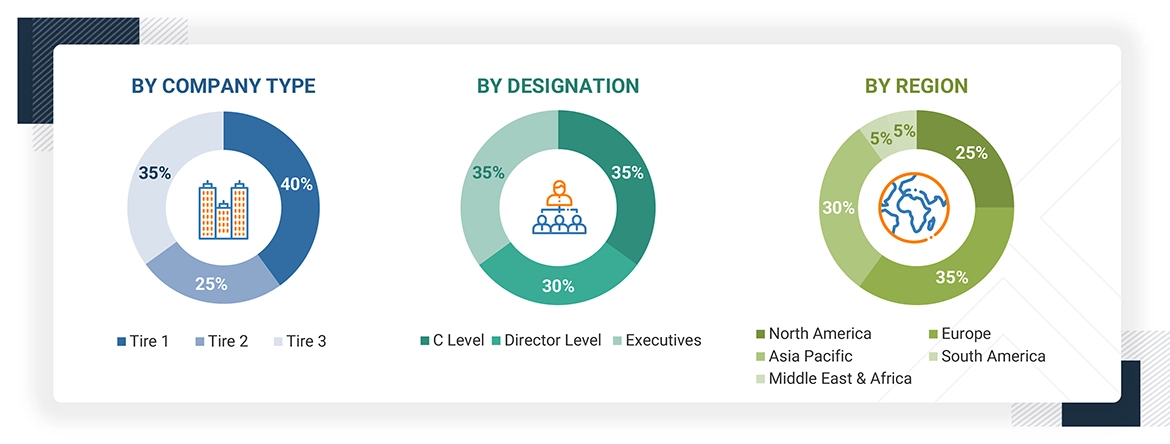
To know about the assumptions considered for the study, download the pdf brochure
Market Size Estimation
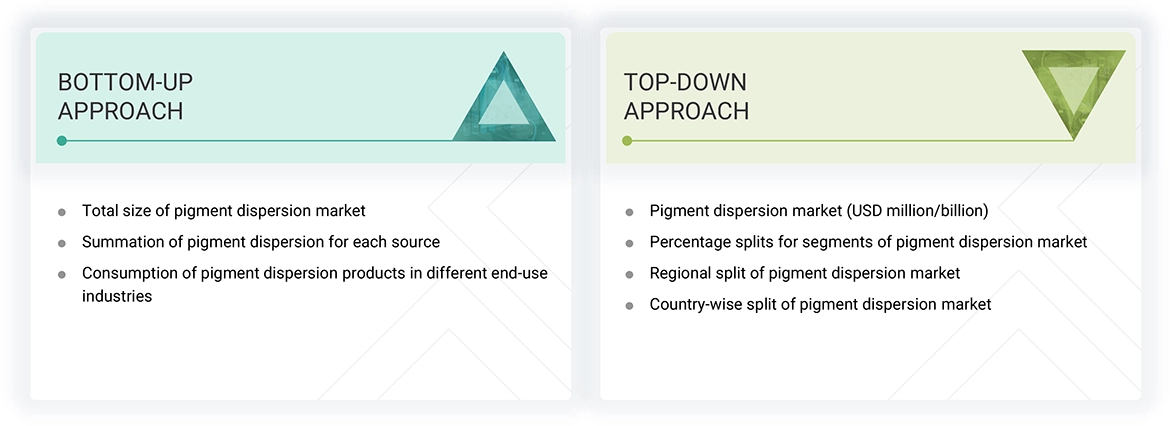
The bottom-up and top-down approaches have been used to estimate the pigment dispersion market by type, application, end-use industry, and region. The research methodology used to calculate the market size includes the following steps:
- The key players in the industry and markets were identified through extensive secondary research.
- In terms of value, the industry’s supply chain and market size were determined through primary and secondary research processes.
- All percentage shares, splits, and breakdowns were determined using secondary sources and verified through primary sources.
- All possible parameters that affect the markets covered in this research study were accounted for, viewed in extensive detail, verified through primary research, and analyzed to obtain the final quantitative and qualitative data.
- The research involved reviewing reports, reviews, and newsletters of leading market players, as well as conducting extensive interviews with leaders such as directors and marketing executives to gather their opinions.
The following figure illustrates the overall market size estimation process employed for this study.
Data Triangulation
After estimating the overall size of the pigment dispersion market using the process described above, the total market was divided into several segments and sub-segments. Data triangulation and market breakdown methods were used, where applicable, to finalize the overall market analysis and determine precise statistics for all segments and sub-segments. The data was triangulated by examining various factors and trends from both demand and supply perspectives. Additionally, the market size was validated using both top-down and bottom-up approaches.
Market Definition
Pigment dispersion is the process of evenly distributing pigment particles within a liquid or solid medium to achieve consistent color, stability, and performance in the final product. This process ensures that the pigments are finely broken down and evenly mixed without clumping or settling, making them suitable for use in paints, coatings, inks, plastics, and other applications where vibrant and stable coloration is needed.
Stakeholders
- Pigment Dispersion Manufacturers
- Raw Material Suppliers
- Equipment Suppliers
- Regulatory Bodies and Government Agencies
- Distributors and Suppliers
- End-use Industries
- Associations and Industrial Bodies
Report Objectives
- To define, describe, and forecast the size of the pigment dispersion market in terms of value and volume
- To provide detailed information regarding the key factors influencing the growth of the market (drivers, restraints, opportunities, and challenges)
- To forecast the market size based on type, application, end-use industry, and region
- To forecast the market size for the five main regions—North America, Europe, Asia Pacific, South America, and the Middle East & Africa, along with their key countries
- To strategically analyze micromarkets with respect to individual growth trends, prospects, and contributions to the total market
- To analyze opportunities for stakeholders and provide details of the competitive landscape for market leaders
- To strategically profile leading players and comprehensively analyze their key developments such as new product launches, expansions, and deals in the pigment dispersion market
- To strategically profile key players and comprehensively analyze their market shares and core competencies
- To study the impact of AI/Gen AI on the market under study, along with the macroeconomic outlook
Get the Full Pigment Dispersion Market Report
Full forecast, segment splits, and company analysis for all Pigment Dispersion Market.
- China Pigment Dispersion Market
- India Pigment Dispersion Market
- Japan Pigment Dispersion Market
- South Korea Pigment Dispersion Market
- Indonesia Pigment Dispersion Market
- Canada Pigment Dispersion Market
- Mexico Pigment Dispersion Market
- US Pigment Dispersion Market
- Germany Pigment Dispersion Market
- France Pigment Dispersion Market
- UK Pigment Dispersion Market
- Italy Pigment Dispersion Market
- Spain Pigment Dispersion Market
- South Africa Pigment Dispersion Market
- Argentina Pigment Dispersion Market
- Rest Of Europe Pigment Dispersion Market
- Rest Of Asia Pacific Pigment Dispersion Market
- GCC Countries Pigment Dispersion Market
- -Rest Of GCC Countries Pigment Dispersion Market
- Rest Of South America Pigment Dispersion Market
Need a Tailored Report?
Customize this report to your needs
Get 10% FREE Customization
Customize This Report
