
North America Pigment Dispersion Market (2025-2030)

The North America Pigment Dispersion Market was valued at $10805 Million in 2025 and projected to reach to $12785.4 Million by 2030, representing a compound annual growth rate of 3.4%. North America's pigment dispersion market demonstrates steady growth momentum, supported by sustained demand from the coatings and plastics sectors.


| Market Size in | USD 26.32 MN |
| Market Forecast in | |
| CAGR | |
| Forecast Period | |
| Units Considered | Value (USD MN) |
North America Pigment Dispersion Market Trends and Insights
- North America maintains a significant share of the global pigment dispersion market, driven by robust demand from coatings, plastics, and printing industries.
- The region's mature manufacturing base and technological advancement position North America as a key market for high-performance pigment dispersions. Growth in North America is supported by increasing adoption of eco-friendly dispersions and stringent environmental regulations that encourage innovation in formulation technologies.
- North America's automotive and construction sectors continue to drive demand for advanced pigment dispersions with superior color consistency and durability.
- The forecast period through 2030 reflects steady expansion as North America balances sustainability requirements with performance demands across end-use applications..
Key Market Statistics
- CAGR (2025-2030) 3.4% CAGR
- Market Size, 2025 ~USD 10805 Million
- Forecast, 2030 ~USD 12785.4 Million
- Geography North America
North America Pigment Dispersion Market Overview
Market Valuation :
North America's pigment dispersion market is valued at $10.8 billion in 2025, representing a significant portion of global demand driven by established manufacturing and consumer industries.
Growth Trajectory :
The region is projected to reach $12.8 billion by 2030, expanding at a CAGR of 3.4%, outpacing mature market averages while remaining below the global growth rate of 4.1%.
Key End-Use Industries :
North America's pigment dispersion demand is primarily driven by coatings, plastics, and printing industries, supported by a mature and diversified manufacturing base across multiple sectors.
Regional Market Position :
The region maintains a substantial share of the global pigment dispersion market, leveraging advanced production capabilities, stringent quality standards, and established supply chains.
North America Pigment Dispersion Market Dynamics
- The region's mature industrial infrastructure and technological advancement enable consistent market expansion, though growth rates remain moderate compared to emerging markets.
- Regulatory compliance and sustainability initiatives are shaping product innovation and manufacturing practices across the region. Looking ahead to 2030, North America is expected to maintain its market leadership through continued investment in high-performance pigment technologies and eco-friendly dispersions.
- The region's focus on quality, innovation, and environmental standards positions it favorably for capturing premium market segments, despite facing competition from lower-cost producers in Asia-Pacific regions..
Market Ecosystem
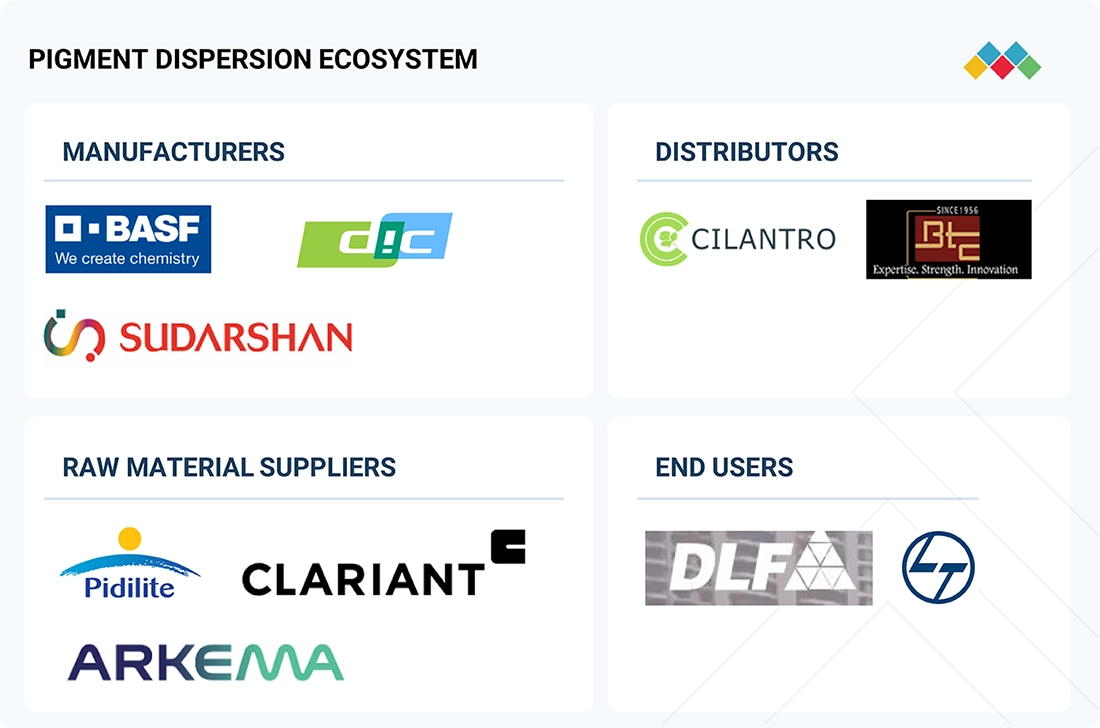
Pigment Dispersion Market: COMMERCIAL USE CASES ACROSS INDUSTRIES
| COMPANY | USE CASE DESCRIPTION | BENEFITS |
|---|---|---|
 |
Use of pigment dispersions in decorative and industrial paints | Provides vibrant color consistency, durability against weathering, and eco-friendly low-VOC options for consumers |
 |
Integration of aqueous pigment dispersions in protective coatings and architectural paints | Enhanced coverage, long-lasting finish, and compliance with sustainability certifications |
 |
Use of dispersions in commercial and industrial paints | Improved pigment stability, lower maintenance costs, and premium appearance for large infrastructure and industrial projects |
 |
Deployment of dispersions in wood coatings and interior wall paints | Smooth finish, wide color palette, and environmentally safe formulations meeting green building standards |
Logos and trademarks shown above are the property of their respective owners. Their use here is for informational and illustrative purposes only.
Related Ecosystem
Paints And Coatings
- Polyurethane Resin
- Alkyd Resins
- Epoxy Resin
- Polyester Resin
- Acrylics
- Basf se
- JOTUN
- PPG Industries, Inc.
- DOW CHEMICAL COMPANY
- Akzonobel n.v.
Speciality Chemicals
- Corrosion Inhibitors
- Polyetheretherketone (PEEK)
- Acrylonitrile Butadiene Styrene (ABS)
- Epoxy Resin
- Polycarbonate
- Basf se
- DOW CHEMICAL COMPANY
- Evonik industries ag
- Clariant ag.
- Solvay sa
Key Takeaways
- North America's pigment dispersion market is valued at $10.8 billion in 2025 with projected growth to $12.8 billion by 2030.
- North America exhibits a 3.4% CAGR, reflecting steady but moderate growth compared to emerging markets.
- North America's regulatory environment drives demand for sustainable and low-VOC pigment dispersions.
- North America's automotive, coatings, and construction sectors are primary growth drivers through 2030.
Pigment Dispersion Market Report Scope
| Report Metric | Details |
|---|---|
| Base Year | 2025 |
| Fastest Growing Segment | WATER-BASED (Dispersion Type) |
| Forecast Period | 2025-2030 |
| Growth Rate | CAGR of 4.1% from 2025 to 2030 |
| Largest Segment | WATER-BASED (Dispersion Type) |
| Market Size Base Year (Billions) | ~USD 43.35 (2025) |
| Revenue Forecast (Billions) | ~USD 53 (2030) |
| Segments Covered | Dispersion Type, Application, End-Use Industry |
North America Pigment Dispersion Market Report Segmentation
3 segment dimensions are covered across the global market.
By Dispersion Type
- Solvent-Based
- Water-Based
By Application
- Automotive Paints & Coatings
- Decorative Paints & Coatings
- Industrial Paints & Coatings
- Inks
- Other Applications
- Plastics
By End-Use Industry
- Automotive
- Building & Construction
- Other End-Use Industries
- Packaging
- Paper & Printing
- Textiles
Target Audience
- Pigment Manufacturers & Suppliers : Identify market sizing, growth rates, and country-specific opportunities to optimize production capacity, distribution networks, and product portfolios across North America's three major markets.
- Coatings & Paint Producers : Understand pigment dispersion demand trends and regional market dynamics to secure reliable supply chains, negotiate pricing strategies, and develop competitive formulations for North American customers.
- Plastics & Polymer Manufacturers : Access market data to evaluate pigment dispersion sourcing strategies, assess supplier capabilities, and plan product innovation initiatives aligned with North American market growth.
- Printing Industry Stakeholders : Leverage regional market insights to optimize ink formulations, evaluate pigment supplier performance, and align procurement strategies with North America's printing sector dynamics.
- Investment & Strategy Consultants : Utilize comprehensive North American market data to support M&A due diligence, market entry assessments, and strategic recommendations for clients targeting the pigment dispersion sector.
Countries within North America - compare and drill down
| Country | 2025 size (native) |
|---|---|
| US | USD 10295.4 Million |
| Canada | USD 1162.5 Million |
| Mexico | USD 1327.4 Million |
Country market size visualization
Reasons to Buy this Report
- Country-Level Market Breakdown : Access detailed market sizing for US, Canada, and Mexico individually, enabling precise market entry strategies and competitive positioning within North America's three major economies.
- Growth Forecasting Accuracy : Leverage region-specific CAGR data (3.4%) and 5-year projections to inform investment decisions, capacity planning, and long-term business strategy development for North American operations.
- Industry-Specific Insights : Understand demand patterns across coatings, plastics, and printing sectors unique to North America, identifying high-growth sub-segments and emerging application opportunities.
- Competitive Intelligence : Benchmark your North American market position against regional competitors and understand how the region's 3.4% CAGR compares to global growth trends and other geographies.
- Regulatory & Compliance Context : Gain insights into North America's stringent quality and environmental standards that shape product development, manufacturing practices, and market opportunities for compliant suppliers.
Frequently asked questions
What is the current size of North America's pigment dispersion market?
North America's pigment dispersion market is estimated at $10.8 billion in 2025 and is expected to reach $12.8 billion by 2030.
What is the growth rate for North America's pigment dispersion market?
North America's pigment dispersion market is projected to grow at a CAGR of 3.4% from 2025 to 2030.
Which industries drive demand in North America's pigment dispersion market?
North America's primary end-use sectors include automotive coatings, industrial paints, plastics, printing inks, and construction materials.
What regulatory factors influence North America's pigment dispersion market?
North America's stringent environmental regulations, including VOC limits and sustainability mandates, drive demand for eco-friendly and compliant pigment dispersions.
How does North America's market growth compare to global trends?
North America's 3.4% CAGR is slightly lower than the global 4.1% CAGR, reflecting the region's mature market status and slower industrial expansion.
RESEARCH METHODOLOGY
The study involved four major activities for estimating the current size of the global pigment dispersion market. Exhaustive secondary research was conducted to obtain information on the market, the peer product market, and the parent product group market. The next step was to validate these findings, assumptions, and sizes with industry experts across the pigment dispersion value chain through primary research. Both the top-down and bottom-up approaches were used to estimate the overall market size. Then, market breakdown and data triangulation procedures were applied to determine the sizes of different segments and sub-segments of the market.
Secondary Research
In the secondary research process, various secondary sources such as Hoovers, Factiva, Bloomberg BusinessWeek, and Dun & Bradstreet were used to identify and collect information for this study on the pigment dispersion market. These sources included annual reports, press releases and investor presentations of companies; white papers; certified publications; articles by recognized authors; regulatory bodies, trade directories, and databases.
Primary Research
The pigment dispersion market involves several stakeholders in the supply chain, including raw material suppliers, equipment providers, distributors, end-product manufacturers, buyers, and regulatory organizations. Different primary sources from both the supply and demand sides of the market have been interviewed to gather both qualitative and quantitative information. On the demand side, key participants include opinion leaders, executives, vice presidents, and CEOs of companies in the pigment dispersion market. On the supply side, primary sources include industry associations, institutions involved in the pigment dispersion market, key opinion leaders, and processing companies.
Following is the breakdown of primary respondents:
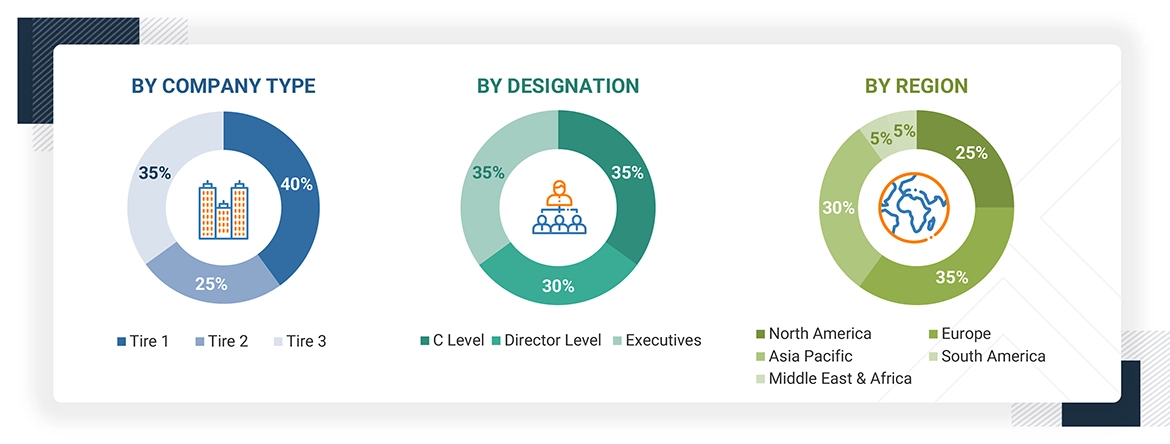
To know about the assumptions considered for the study, download the pdf brochure
Market Size Estimation
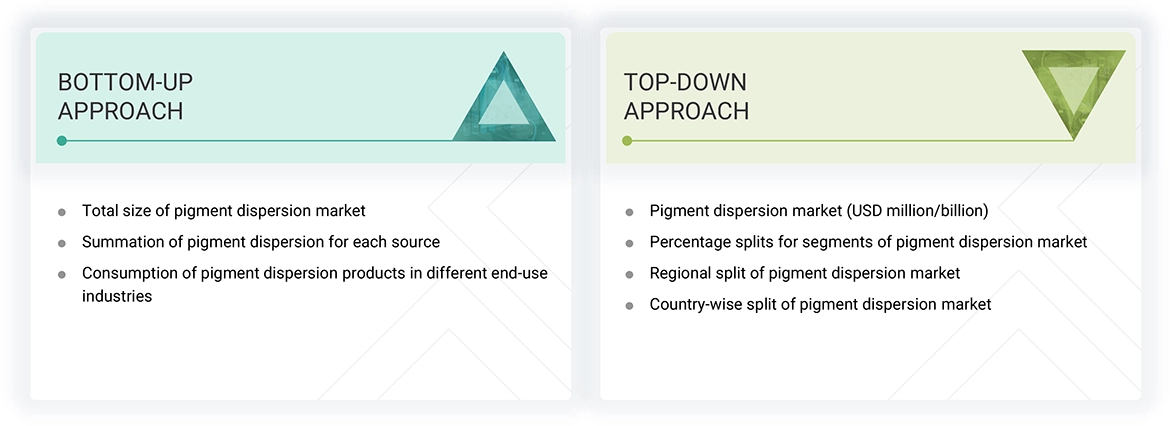
The bottom-up and top-down approaches have been used to estimate the pigment dispersion market by type, application, end-use industry, and region. The research methodology used to calculate the market size includes the following steps:
- The key players in the industry and markets were identified through extensive secondary research.
- In terms of value, the industry’s supply chain and market size were determined through primary and secondary research processes.
- All percentage shares, splits, and breakdowns were determined using secondary sources and verified through primary sources.
- All possible parameters that affect the markets covered in this research study were accounted for, viewed in extensive detail, verified through primary research, and analyzed to obtain the final quantitative and qualitative data.
- The research involved reviewing reports, reviews, and newsletters of leading market players, as well as conducting extensive interviews with leaders such as directors and marketing executives to gather their opinions.
The following figure illustrates the overall market size estimation process employed for this study.
Data Triangulation
After estimating the overall size of the pigment dispersion market using the process described above, the total market was divided into several segments and sub-segments. Data triangulation and market breakdown methods were used, where applicable, to finalize the overall market analysis and determine precise statistics for all segments and sub-segments. The data was triangulated by examining various factors and trends from both demand and supply perspectives. Additionally, the market size was validated using both top-down and bottom-up approaches.
Market Definition
Pigment dispersion is the process of evenly distributing pigment particles within a liquid or solid medium to achieve consistent color, stability, and performance in the final product. This process ensures that the pigments are finely broken down and evenly mixed without clumping or settling, making them suitable for use in paints, coatings, inks, plastics, and other applications where vibrant and stable coloration is needed.
Stakeholders
- Pigment Dispersion Manufacturers
- Raw Material Suppliers
- Equipment Suppliers
- Regulatory Bodies and Government Agencies
- Distributors and Suppliers
- End-use Industries
- Associations and Industrial Bodies
Report Objectives
- To define, describe, and forecast the size of the pigment dispersion market in terms of value and volume
- To provide detailed information regarding the key factors influencing the growth of the market (drivers, restraints, opportunities, and challenges)
- To forecast the market size based on type, application, end-use industry, and region
- To forecast the market size for the five main regions—North America, Europe, Asia Pacific, South America, and the Middle East & Africa, along with their key countries
- To strategically analyze micromarkets with respect to individual growth trends, prospects, and contributions to the total market
- To analyze opportunities for stakeholders and provide details of the competitive landscape for market leaders
- To strategically profile leading players and comprehensively analyze their key developments such as new product launches, expansions, and deals in the pigment dispersion market
- To strategically profile key players and comprehensively analyze their market shares and core competencies
- To study the impact of AI/Gen AI on the market under study, along with the macroeconomic outlook
Get the Full Pigment Dispersion Market Report
Full forecast, segment splits, and company analysis for all Pigment Dispersion Market.
- China Pigment Dispersion Market
- India Pigment Dispersion Market
- Japan Pigment Dispersion Market
- South Korea Pigment Dispersion Market
- Indonesia Pigment Dispersion Market
- Canada Pigment Dispersion Market
- Mexico Pigment Dispersion Market
- US Pigment Dispersion Market
- Germany Pigment Dispersion Market
- France Pigment Dispersion Market
- UK Pigment Dispersion Market
- Italy Pigment Dispersion Market
- Spain Pigment Dispersion Market
- South Africa Pigment Dispersion Market
- Brazil Pigment Dispersion Market
- Argentina Pigment Dispersion Market
- Rest Of Europe Pigment Dispersion Market
- Rest Of Asia Pacific Pigment Dispersion Market
- GCC Countries Pigment Dispersion Market
- -Rest Of GCC Countries Pigment Dispersion Market
- Rest Of South America Pigment Dispersion Market
Need a Tailored Report?
Customize this report to your needs
Get 10% FREE Customization
Customize This Report
