
India Plastic Hot & Cold Pipe Market (2024-2029)

The India Plastic Hot & Cold Pipe Market was valued at $332.2 Million in 2024 and projected to reach to $470.4 Million by 2029, representing a compound annual growth rate of 7.2%. India's plastic hot & cold pipe market is poised for substantial expansion, driven by rapid urbanization, government-backed infrastructure initiatives, and the construction sector's shift toward modern piping solutions.


| Market Size in | USD 26.32 MN |
| Market Forecast in | |
| CAGR | |
| Forecast Period | |
| Units Considered | Value (USD MN) |
India Plastic Hot & Cold Pipe Market Trends and Insights
- This expansion reflects India's accelerating infrastructure development, rising residential construction activity, and increasing adoption of energy-efficient piping solutions across commercial and industrial sectors.
- India's growing urbanization and government initiatives supporting smart cities and sustainable building practices are driving demand for durable, cost-effective plastic piping systems. The market in India is benefiting from the country's shift toward modern plumbing and HVAC systems in both new construction and renovation projects.
- India's plastic hot & cold pipe segment is gaining traction due to superior corrosion resistance, lower installation costs, and reduced maintenance requirements compared to traditional metal pipes.
- With a compound annual growth rate of 7.2% through 2029, India represents a significant growth opportunity within the Asia Pacific region, supported by rising disposable incomes, expanding commercial real estate, and heightened awareness of water and energy conservation..
Key Market Statistics
- CAGR (2024-2029) 7.2% CAGR
- Market Size, 2024 ~USD 332.2 Million
- Forecast, 2029 ~USD 470.4 Million
- Country India
India Plastic Hot & Cold Pipe Market Overview
Market Valuation :
India's plastic hot & cold pipe market is valued at USD 332.2 million in 2024, with strong growth momentum driven by infrastructure modernization and residential construction expansion across urban and semi-urban regions.
Robust CAGR Growth :
The Indian market is projected to grow at a CAGR of 7.2% from 2024 to 2029, outpacing the global average of 6.6%, reflecting India's accelerated adoption of advanced piping solutions and energy-efficient technologies.
Infrastructure Development :
Rising government investments in smart cities, affordable housing schemes, and commercial infrastructure projects are significantly boosting demand for reliable plastic piping systems across India's construction sector.
Energy Efficiency Focus :
Increasing awareness of sustainable building practices and thermal efficiency standards is driving adoption of high-performance plastic hot & cold pipes in residential, commercial, and industrial applications throughout India.
India Plastic Hot & Cold Pipe Market Dynamics
- The market's 7.2% CAGR reflects strong demand from residential complexes, commercial establishments, and industrial facilities seeking cost-effective and durable alternatives to traditional piping materials. By 2029, the market is expected to reach USD 470.4 million, supported by increasing consumer preference for energy-efficient systems, favorable building codes, and growing awareness of plastic pipes' advantages in thermal insulation and corrosion resistance.
- India's expanding middle class and rising disposable incomes will further accelerate adoption across both organized and unorganized construction segments..
Market Ecosystem
Related Ecosystem
Industrial Equipment
- HVAC System
- Fiberglass
- Actuators
- Cartridge Filters
- Electrostatic Precipitators
- Siemens ag
- GRUNDFOS GROUP
- ABB India Limited
- SCHNEIDER ELECTRIC SE
- Eaton Corporation plc
On Highway Off Highway Vehicles
- Internal Combustion Engine (ICE)
- Agricultural Tractors
- Crawler Excavator
- Battery Electric Vehicle (BEV)
- Excavators
- Visteon Corporation
- Deere & Company
- AB VOLVO PENTA
- Honda Motor Co., Ltd.
- Komatsu Ltd.
Key Takeaways
- India's plastic hot & cold pipe market is valued at USD 332.2 million in 2024 and will grow to USD 470.4 million by 2029, representing a 7.2% CAGR.
- India's rapid urbanization and government smart city initiatives are primary drivers of plastic piping adoption in residential and commercial construction.
- India's market benefits from cost advantages and superior durability of plastic pipes compared to traditional metal alternatives, reducing long-term maintenance expenses.
- India's growing focus on energy efficiency and water conservation is accelerating the shift toward modern plastic hot & cold piping systems in both new builds and retrofits.
Plastic Hot & Cold Pipe Market Report Scope
| Report Metric | Details |
|---|---|
| Base Year | 2024 |
| Fastest Growing Segment | WATER PLUMBING (Application) |
| Forecast Period | 2024-2029 |
| Growth Rate | CAGR of 6.6% from 2024 to 2029 |
| Largest Segment | RESIDENTIAL (End-Use Sector) |
| Market Size Base Year (Billions) | ~USD 7.24 (2024) |
| Revenue Forecast (Billions) | ~USD 9.96 (2029) |
| Segments Covered | Raw Material, Application, End-Use Sector |
India Plastic Hot & Cold Pipe Market Report Segmentation
3 segment dimensions are covered across the global market.
By Raw Material
- C-Pvc
- Pb
- Pe-Rt
- Pex
- Ppr
By Application
- Radiator Connection
- Underfloor Surface Heating & Cooling
- Water Plumbing
By End-Use Sector
- Automotive
- Chemicals & Petrochemicals
- Chemicals & Petroleum
- Commercial
- Industrial
- Oil & Gas
- Power Generation
- Residential
Target Audience
- Pipe Manufacturers & Suppliers : Manufacturers need India market data to assess production capacity requirements, identify growth segments, benchmark against competitors, and plan facility investments across high-demand regions.
- Construction & Real Estate Developers : Developers require market insights to understand piping material trends, cost dynamics, supplier availability, and specification standards for residential and commercial projects across India.
- Infrastructure & Engineering Firms : Engineering consultants need India-specific market intelligence to recommend appropriate piping solutions, evaluate supplier capabilities, and ensure compliance with local building codes and standards.
- Distributors & Wholesalers : Distribution partners require market forecasts and demand analysis to optimize inventory management, identify emerging markets within India, and plan channel expansion strategies.
- Investment & Strategy Consultants : Consultants advising on India's construction and infrastructure sectors need detailed market data to support investment theses, M&A strategies, and business development recommendations.
Reasons to Buy this Report
- Market Size & Growth Projections : Access precise valuation data for India's plastic hot & cold pipe market (USD 332.2M in 2024) with detailed 5-year forecasts to USD 470.4M, enabling accurate business planning and investment decisions.
- India-Specific Growth Drivers : Understand unique market catalysts including government infrastructure programs, smart city initiatives, affordable housing schemes, and regulatory standards shaping demand specifically within India's economy.
- Competitive Landscape Intelligence : Gain insights into India's competitive dynamics, local manufacturer strategies, distribution channels, and market consolidation trends to identify partnership and expansion opportunities.
- Sector-Specific Demand Analysis : Analyze demand patterns across India's residential, commercial, and industrial segments with segment-level forecasts to target high-growth applications and customer verticals.
- Strategic Market Entry Planning : Leverage India-focused market intelligence to develop localized go-to-market strategies, pricing models, and product positioning aligned with regional preferences and regulatory requirements.
Frequently asked questions
What is the current size of India's plastic hot & cold pipe market?
India's plastic hot & cold pipe market was valued at USD 332.2 million in 2024 and is expected to reach USD 470.4 million by 2029.
What is the projected growth rate for India's plastic hot & cold pipe market?
India's plastic hot & cold pipe market is projected to grow at a compound annual growth rate (CAGR) of 7.2% from 2024 to 2029.
What factors are driving growth in India's plastic hot & cold pipe market?
Key drivers include India's rapid urbanization, government smart city initiatives, rising residential and commercial construction activity, and increasing demand for cost-effective, energy-efficient piping solutions.
Why are plastic pipes gaining popularity in India compared to metal alternatives?
Plastic pipes are preferred in India due to superior corrosion resistance, lower installation and maintenance costs, durability, and alignment with India's sustainability and energy conservation goals.
Which sectors are driving demand for plastic hot & cold pipes in India?
Demand in India is driven by residential construction, commercial real estate development, HVAC systems, and industrial applications, supported by India's expanding middle class and infrastructure modernization.
RESEARCH METHODOLOGY
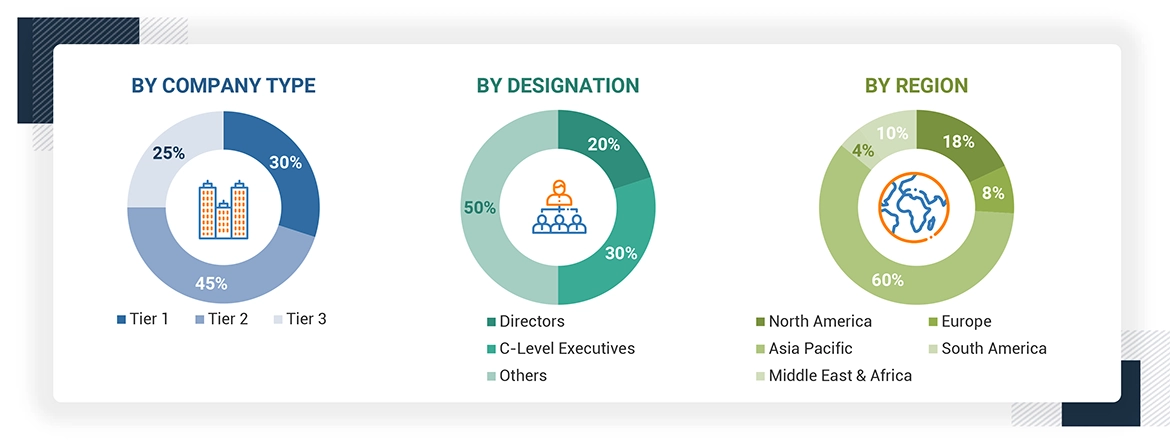
This research study involves the use of extensive secondary sources, directories, and databases, such as Hoovers, Bloomberg L.P., Factiva, ICIS, and OneSource, to identify and collect information useful for this technical, market-oriented, and commercial study of the global plastic hot and cold pipe market. Primary sources are mainly industry experts from core and related industries, preferred suppliers, manufacturers, distributors, service providers, and organizations related to all segments of the value chain of this industry. In-depth interviews were conducted with various primary respondents, including key industry participants, subject matter experts, C-level executives of key market players, and industry consultants, among other experts, to obtain and verify critical qualitative and quantitative information as well as assess growth prospects of the market.
Secondary Research
Secondary sources referred to for this research study include annual reports, press releases, and investor presentations of companies; white papers; certified publications; articles by recognized authors; and databases of various companies and associations. Secondary research was mainly used to obtain key information about the industry’s supply chain, the total pool of key players, market classification, and segmentation according to industry trends to the bottom-most level, regional markets, and key developments from both, market- and technology-oriented perspectives.
Primary Research
In the primary research process, various sources from both the supply and demand sides have been interviewed to obtain and verify qualitative and quantitative information for this report and analyze prospects. Primary sources from the supply side include industry experts such as CEOs, vice presidents, marketing directors, technology and innovation directors, and related executives from various leading companies and organizations operating in the plastic hot and cold pipe market. Primary sources from the demand side include experts and key persons.
In the primary research process, various sources from both the supply and demand sides have been interviewed to obtain and verify qualitative and quantitative information for this report and analyze prospects. Primary sources from the supply side include industry experts such as CEOs, vice presidents, marketing directors, technology and innovation directors, and related executives from various leading companies and organizations operating in the plastic hot and cold pipe market. Primary sources from the demand side include experts and key persons.
To know about the assumptions considered for the study, download the pdf brochure
Market Size Estimation
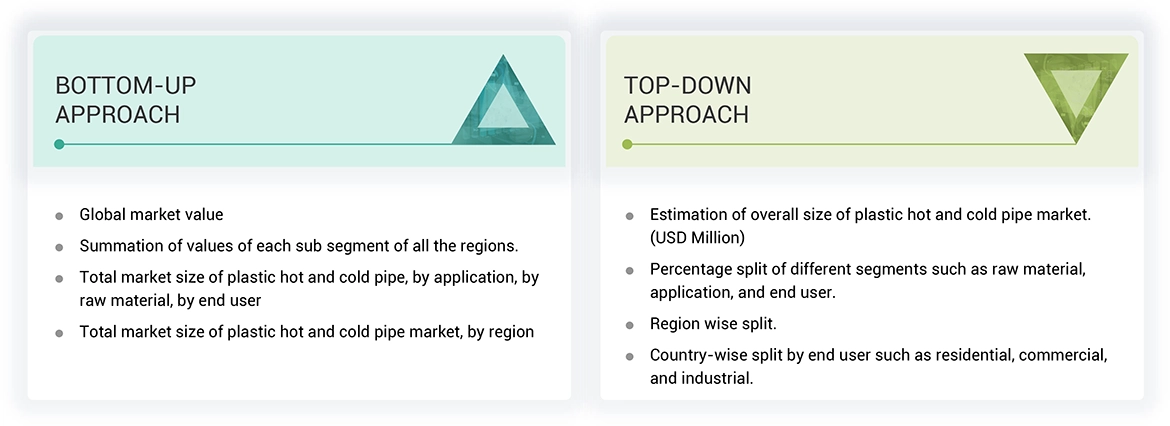
In the complete market engineering process, both top-down and bottom-up approaches have been extensively used along with several data triangulation methods to estimate and forecast the overall market segments listed in this report.
Top-down and bottom-up approaches have been used to estimate and validate the market size of plastic hot and cold pipe for various end user in each region. The key players in the market have been identified through secondary research, and their market share in respective regions has been determined through primary and secondary research. This entire procedure includes the study of annual and financial reports of the key market players and extensive interviews for insights from industry leaders such as CEOs, vice presidents, directors, and marketing executives. All percentage shares, splits, and breakdowns have been determined using secondary sources and verified through primary sources.
Plastic Hot & Cold Pipe Market : Top-Down and Bottom-Up Approach
Data Triangulation
After arriving at the overall market size from the estimation process explained above, the total market has been split into several segments and sub-segments. Data triangulation and market breakdown procedures have been used wherever applicable to complete the overall market engineering process and to arrive at the exact statistics for all segments and sub-segments. The data has been triangulated by studying various factors and trends from both the demand and supply sides. The market has been validated using both the top-down and bottom-up approaches. Then, it was verified through primary interviews. Hence, for every data segment, there are three sources—the top-down approach, the bottom-up approach, and expert interviews. When the values arrived at from the three points matched, the data was assumed to be correct.
Market Definition
Plastic pipes are cylindrical and hollow and have tubular sections. They allow the flow of fluids, such as water and slurries, gases, small masses of solids, and powders. Plastic hot and cold pipes are used for water plumbing, radiator connection, and underfloor surface heating and cooling applications. They are made of materials such as cross-linked polyethylene (PEX), polyethylene-raised temperature (PE-RT), polypropylene random copolymer (PPR), chlorinated polyvinyl chloride (C-PVC), and polybutylene (PB).
The most suitable pipes for hot and cold water supply and heating systems are cross-linked polyethylene (PEX) or solid wall polybutylene pipes, multi-layer pipes, and barrier pipes. They are often available in straight lengths or coiled shapes with nominal diameters ranging from 10 mm to 110 mm. Plastic pipes offer many advantages over steel, cast iron, and copper pipes. One of the prime advantages is that plastic is simple to cut and transform into any shape or size on the job site, reducing the labor costs required for their installation.
The market for plastic hot and cold pipe is defined as the sum of revenues generated by global companies from the sale of plastic hot and cold pipe. They cater to various end users, such as industrial, commercial, and residential. The regions considered for the plastic hot and cold pipe market study include Asia Pacific, Europe, North America, the Middle East & Africa, and South America.
Stakeholders
- Government organizations and regulatory agencies
- Investors/shareholders
- Shipping companies
- Organizations, forums, alliances, and associations related to the plastic hot and cold pipe market
- Plastic hot and cold pipe manufacturing companies
- Manufacturers and equipment user associations and groups
- Plastic pipes and fittings association
- Environmental research institutes
- Consulting companies in the energy and power domain
- Manufacturing industry
- Investment banks
- State and national regulatory authorities
- Venture capital firms
- Financial organizations
- Research Institutes and organizations
- Environment associations
Report Objectives
- To describe and forecast the plastic hot and cold pipe market in terms of value based on raw material, application, end user and region
- To describe and forecast the plastic hot and cold pipe market in terms of volume based on region
- To provide detailed information about the key factors such as drivers, restraints, opportunities, and challenges influencing the growth of the plastic hot and cold pipe market
- To strategically analyze the subsegments with respect to individual growth trends, prospects, and contributions of each segment to the overall market size
- To forecast the market size for five key regions: North America, Europe, Asia Pacific, Middle East & Africa, and South America, along with their key countries
- To strategically analyze micromarkets1 with respect to individual growth trends, prospects, and contributions to the total market
- To study the complete supply chain and allied industry segments and perform a supply chain analysis of the plastic hot and cold pipe market’ landscape
- To study market trends, patent analysis, trade analysis, tariff and regulatory landscape, Porter’s five forces analysis, ecosystem mapping, technologies, investment and funding scenario, key stakeholders & buying criteria, case studies pertaining to off plastic hot and cold pipe market
- To analyze the opportunities for various stakeholders by identifying the high-growth segments of the plastic hot and cold pipe market
- To profile the key players and comprehensively analyze their market positions in terms of ranking and core competencies2, along with detailing the competitive landscape for the market leaders
- To analyze competitive developments, such as contracts, collaborations, expansions, product launches, investments, and acquisitions, in the plastic hot and cold pipe market
Note: 1. Micromarkets are defined as the further segments and subsegments of the plastic hot and cold pipe market included in the report.
2. Core competencies of companies are captured in terms of their key developments and product portfolios, as well as key strategies adopted to sustain their position in the plastic hot and cold pipe market.
Available Customizations
MarketsandMarkets offers customizations according to the specific needs of the companies with the given market data.
The following customization options are available for the report:
Product Analysis
- Product matrix, which gives a detailed comparison of the product portfolio of each company
Regional Analysis
- Further breakdown of the plastic hot and cold pipe market, by country
Company Information
- Detailed analysis and profiling of additional market players (up to five)
Get the Full Plastic Hot & Cold Pipe Market Report
Full forecast, segment splits, and company analysis for all Plastic Hot & Cold Pipe Market.
- Germany Plastic Hot & Cold Pipe Market
- UK Plastic Hot & Cold Pipe Market
- Italy Plastic Hot & Cold Pipe Market
- France Plastic Hot & Cold Pipe Market
- Spain Plastic Hot & Cold Pipe Market
- Canada Plastic Hot & Cold Pipe Market
- Mexico Plastic Hot & Cold Pipe Market
- US Plastic Hot & Cold Pipe Market
- China Plastic Hot & Cold Pipe Market
- Japan Plastic Hot & Cold Pipe Market
- South Korea Plastic Hot & Cold Pipe Market
- Australia Plastic Hot & Cold Pipe Market
- Saudi Arabia Plastic Hot & Cold Pipe Market
- UAE Plastic Hot & Cold Pipe Market
- South Africa Plastic Hot & Cold Pipe Market
- Nigeria Plastic Hot & Cold Pipe Market
- Egypt Plastic Hot & Cold Pipe Market
- Brazil Plastic Hot & Cold Pipe Market
- Argentina Plastic Hot & Cold Pipe Market
- Rest Of Europe Plastic Hot & Cold Pipe Market
- Rest Of Asia Pacific Plastic Hot & Cold Pipe Market
- Algeria Plastic Hot & Cold Pipe Market
- GCC Countries Plastic Hot & Cold Pipe Market
- Morocco Plastic Hot & Cold Pipe Market
- Other GCC Countries Plastic Hot & Cold Pipe Market
- Rest Of South America Plastic Hot & Cold Pipe Market
Need a Tailored Report?
Customize this report to your needs
Get 10% FREE Customization
Customize This Report
