
China Point-of-Care Molecular Diagnostics Market (2025-2030)

The China Point-of-Care Molecular Diagnostics Market was valued at $193.9 Million in 2025 and projected to reach to $376.2 Million by 2030, representing a compound annual growth rate of 14.2%. China's point-of-care molecular diagnostics market is positioned for exceptional growth, expanding from USD 193.9 million in 2025 to USD 376.2 million by 2030.


| Market Size in | USD 26.32 MN |
| Market Forecast in | |
| CAGR | |
| Forecast Period | |
| Units Considered | Value (USD MN) |
China Point-of-Care Molecular Diagnostics Market Trends and Insights
- This represents a compound annual growth rate of 14.2%, significantly outpacing global averages, driven by China's aging population, rising infectious disease prevalence, and substantial government investment in healthcare infrastructure modernization.
- China's rapid urbanization and increasing healthcare accessibility in rural regions are accelerating adoption of rapid diagnostic solutions across hospitals, clinics, and community health centers. The Chinese market benefits from strong domestic manufacturing capabilities and government support for point-of-care testing innovation through initiatives like the National Health Commission's diagnostic standards.
- China's emphasis on pandemic preparedness and early disease detection has positioned molecular diagnostics as a critical healthcare priority.
- Between 2025 and 2030, China is expected to consolidate its position as a leading regional market, with expanding reimbursement policies and growing demand for decentralized testing driving sustained market growth..
Key Market Statistics
- CAGR (2025-2030) 14.2% CAGR
- Market Size, 2025 ~USD 193.9 Million
- Forecast, 2030 ~USD 376.2 Million
- Country China
China Point-of-Care Molecular Diagnostics Market Overview
Rapid Market Expansion :
China's point-of-care molecular diagnostics market is growing at 14.2% CAGR, nearly 35% faster than the global average of 10.5%, reflecting strong domestic demand and healthcare modernization initiatives.
Aging Population Driver :
China's rapidly aging demographic is fueling demand for rapid diagnostic solutions, with point-of-care molecular tests enabling faster disease detection and management in elderly populations across urban and rural areas.
Government Healthcare Investment :
Substantial government funding for healthcare infrastructure modernization and disease surveillance systems is accelerating adoption of point-of-care molecular diagnostics across Chinese hospitals and clinics.
Infectious Disease Prevalence :
Rising prevalence of infectious diseases in China, combined with pandemic preparedness initiatives, is driving urgent demand for rapid, accurate point-of-care molecular diagnostic solutions.
China Point-of-Care Molecular Diagnostics Market Dynamics
- This trajectory reflects structural advantages including government healthcare modernization programs, increasing healthcare spending, and widespread adoption of rapid diagnostic technologies in both urban medical centers and rural clinics. The market will be further propelled by China's focus on infectious disease surveillance, COVID-19 pandemic lessons, and the need for decentralized testing capabilities.
- Rising healthcare awareness among China's aging population and integration of molecular diagnostics into primary care settings will create sustained demand, positioning China as a critical growth engine for the global point-of-care molecular diagnostics industry..
Market Ecosystem
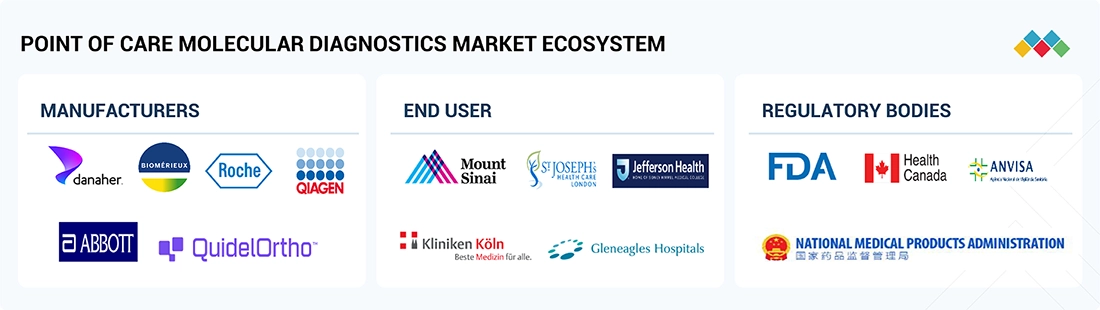
Point of Care Molecular Diagnostics Market: COMMERCIAL USE CASES ACROSS INDUSTRIES
| COMPANY | USE CASE DESCRIPTION | BENEFITS |
|---|---|---|
 |
Offers point of care molecular diagnostic platforms and assay kits for infectious disease detection in hospitals and clinics | Rapid and accurate results, supports decentralized testing, high sensitivity and specificity, streamlined workflow, enables timely clinical decision-making, scalable for high patient volumes |
 |
Provides POC molecular testing solutions for infectious diseases, including respiratory, gastrointestinal, and sepsis diagnostics | Broad pathogen coverage, fast turnaround time, easy-to-use systems for near-patient testing, reliable results, supports outbreak management and infection control |
 |
Supplies compact and integrated POC molecular diagnostic platforms for infectious disease detection | High accuracy and reproducibility, supports multiplex testing, automated sample-to-result workflow, reduces turnaround time, improves early detection and patient management |
 |
Offers portable POC molecular testing instruments and assay kits for infectious diseases, including respiratory and sexually transmitted infections | Quick results at or near the patient, user-friendly interface, high sensitivity, supports decentralized care, improves treatment initiation and clinical workflow |
 |
Provides integrated POC molecular diagnostic solutions including real-time PCR and cartridge-based platforms | Reliable and reproducible results, supports rapid pathogen detection, compact and easy-to-use design, enables decentralized testing, enhances diagnostic efficiency and patient outcomes |
Logos and trademarks shown above are the property of their respective owners. Their use here is for informational and illustrative purposes only.
Related Ecosystem
In Vitro Diagnostics
- Polymerase Chain Reaction (PCR)
- Enzyme-Linked Immunosorbent Assay (ELISA)
- Dna Microarrays
- Assay Kits
- Microarrays
- ROCHE HOLDINGS AG
- Thermo Fisher Scientific Inc.
- Danaher Corporation
- Abbott Laboratories
- Biomerieux s.a.
Medical Devices
- Polymerase Chain Reaction (PCR)
- Magnetic Resonance Imaging (MRI)
- Disposable Autoinjectors
- Pulse Oximeters
- Blood Pressure Monitors
- Medtronic plc
- Abbott Laboratories
- Stryker Corporation
- Becton, Dickinson and Company
- JOHNSON & JOHNSON
Key Takeaways
- China's point-of-care molecular diagnostics market will nearly double from USD 193.9M (2025) to USD 376.2M (2030), growing at 14.2% CAGR.
- China's aging demographics and infectious disease burden are primary catalysts for rapid adoption of point-of-care molecular testing solutions.
- Government healthcare modernization initiatives and reimbursement expansion are accelerating market penetration across China's urban and rural healthcare networks.
- China's domestic manufacturing ecosystem and regulatory support position the country as a key innovation hub for point-of-care molecular diagnostics in Asia Pacific.
Point-of-Care Molecular Diagnostics Market Report Scope
| Report Metric | Details |
|---|---|
| Base Year | 2025 |
| Fastest Growing Segment | SEPSIS (Disease Type) |
| Forecast Period | 2025-2030 |
| Growth Rate | CAGR of 10.5% from 2025 to 2030 |
| Largest Segment | RT-PCR (Technology) |
| Market Size Base Year (Billions) | ~USD 4.3 (2025) |
| Revenue Forecast (Billions) | ~USD 7.09 (2030) |
| Segments Covered | Product & Service, Technology, Sample Type, Application, End User, Disease Type |
China Point-of-Care Molecular Diagnostics Market Report Segmentation
6 segment dimensions are covered across the global market.
By Product & Service
- Assays & Kits
- Instruments & Analyzers
- Software & Services
By Technology
- Inaat
- Other Technologies
- Rt-Pcr
By Sample Type
- Blood Samples
- Other Sample Types
- Urine Samples
By Application
- Cancer
- Gastrointestinal Disorders
- Hepatitis
- Hospital-Acquired Infections
- Other Applications
- Respiratory Diseases
- Sexually Transmitted Diseases
By End User
- Hospitals
- Other End Users
- Physicians' Offices/Clinics
- Research Institutes
By Disease Type
- Gastroenteritis
- Meningoencephalitis
- Other Diseases
- Sepsis
CHINA: POINT OF CARE MOLECULAR DIAGNOSTICS MARKET, BY END USER, 2023–2030
| Segment | 2023 | 2024 | 2025 | 2026 | 2027 | 2028 | 2029 | 2030 | CAGR (%) |
|---|---|---|---|---|---|---|---|---|---|
| HOSPITALS | 114.1 | 125.5 | 139.1 | 155.7 | 176.1 | 201.1 | 231.5 | 269.3 | 14.1 |
| OTHER END USERS | 33.6 | 36 | 38.9 | 42.4 | 46.8 | 52.1 | 58.4 | 66.2 | 11.2 |
| PHYSICIANS' OFFICES/CLINICS | 100.2 | 109.4 | 120.2 | 133.4 | 149.6 | 169.3 | 193.1 | 222.4 | 13.1 |
| RESEARCH INSTITUTES | 10.2 | 10.7 | 11.4 | 12.3 | 13.3 | 14.6 | 16.2 | 18 | 9.6 |
| TOTAL | 258.1 | 281.7 | 309.6 | 343.8 | 385.7 | 437.1 | 499.2 | 576 | 13.2 |
Target Audience
- In Vitro Diagnostics Manufacturers : IVD companies need China-specific market data to develop localized product strategies, identify distribution partnerships, and allocate R&D resources for the rapidly expanding Chinese point-of-care molecular diagnostics segment.
- Healthcare System Administrators : Chinese hospital networks and healthcare administrators require market insights to evaluate procurement strategies, budget allocation for diagnostic infrastructure, and technology adoption timelines for point-of-care molecular testing.
- Private Equity & Investors : Investment firms targeting China's healthcare sector need validated market sizing and growth forecasts to identify acquisition targets, evaluate portfolio companies, and assess return potential in point-of-care diagnostics.
- Medical Device Distributors : Chinese and international distributors need market intelligence to assess channel opportunities, competitive positioning, demand forecasting, and sales strategy development for point-of-care molecular diagnostic products.
- Government & Policy Makers : Chinese health authorities and policy makers require market data to inform healthcare infrastructure planning, diagnostic technology adoption initiatives, and resource allocation for disease surveillance and prevention programs.
Reasons to Buy this Report
- Market Size & Growth Validation : Obtain precise market valuation for China (USD 193.9M in 2025) and verified 5-year forecast (USD 376.2M by 2030) to support investment decisions, business planning, and competitive positioning in this high-growth market.
- China-Specific Growth Drivers : Understand unique Chinese market dynamics including aging population trends, government healthcare policies, infectious disease patterns, and infrastructure investments that differentiate China from global markets.
- Competitive Intelligence : Identify market opportunities, competitive gaps, and localization strategies specific to China's regulatory environment, healthcare system structure, and customer preferences for point-of-care molecular diagnostics.
- Strategic Market Entry : Develop informed market entry or expansion strategies for China with data-driven insights on market maturity, adoption rates, pricing dynamics, and distribution channels unique to the Chinese healthcare landscape.
- Investment & Partnership Decisions : Make confident investment, partnership, and acquisition decisions in China's diagnostics sector backed by comprehensive market analysis, growth projections, and China-specific market intelligence.
Frequently asked questions
What is the current market size of point-of-care molecular diagnostics in China?
China's point-of-care molecular diagnostics market was valued at USD 193.9 million in 2025 and is projected to grow to USD 376.2 million by 2030.
What is the expected growth rate for China's point-of-care molecular diagnostics market?
China's market is expected to grow at a compound annual growth rate (CAGR) of 14.2% from 2025 to 2030, outpacing global growth rates.
What factors are driving growth in China's point-of-care molecular diagnostics market?
Key drivers include China's aging population, rising infectious disease prevalence, government healthcare modernization initiatives, expanding rural healthcare access, and pandemic preparedness investments.
How does China's market growth compare to global trends?
China's 14.2% CAGR significantly exceeds the global average of 10.5%, reflecting stronger domestic demand and government support for diagnostic innovation.
What role does government policy play in China's point-of-care molecular diagnostics market?
China's National Health Commission standards, reimbursement policies, and healthcare infrastructure investments are critical enablers of market expansion and technology adoption.
RESEARCH METHODOLOGY
The study involved estimating activities to determine the current size of the point-of-care molecular diagnostics market. Exhaustive secondary research was done to collect information on the point-of-care molecular diagnostics industry. The next step was to validate these findings, assumptions, and sizing with industry experts across the value chain using primary research. Different approaches, such as top-down and bottom-up, were employed to estimate the total market size. After that, the market breakup and data triangulation procedures were used to estimate the market size of the segments and subsegments of the point-of-care molecular diagnostics market.
Secondary Research
In the secondary research process, various secondary sources, such as annual reports, press releases, and investor presentations of companies; white papers; certified publications; articles by recognized authors; gold-standard & silver-standard websites; regulatory bodies; and databases like D&B Hoovers, Bloomberg Business, and Factiva, were referred to identify and collect information for this study.
Primary Research
In the primary research process, primary sources from both the supply and demand sides were interviewed to obtain qualitative and quantitative information for this report. Primary sources were mainly industry experts from the core and related industries and preferred suppliers, manufacturers, distributors, service providers, technology developers, researchers, and organizations related to all segments of this industry’s value chain. In-depth interviews were conducted with primary respondents, including key industry participants, subject-matter experts, C-level executives, and industry consultants, to obtain and verify critical qualitative and quantitative information and assess prospects.
Breakdown of Primaries
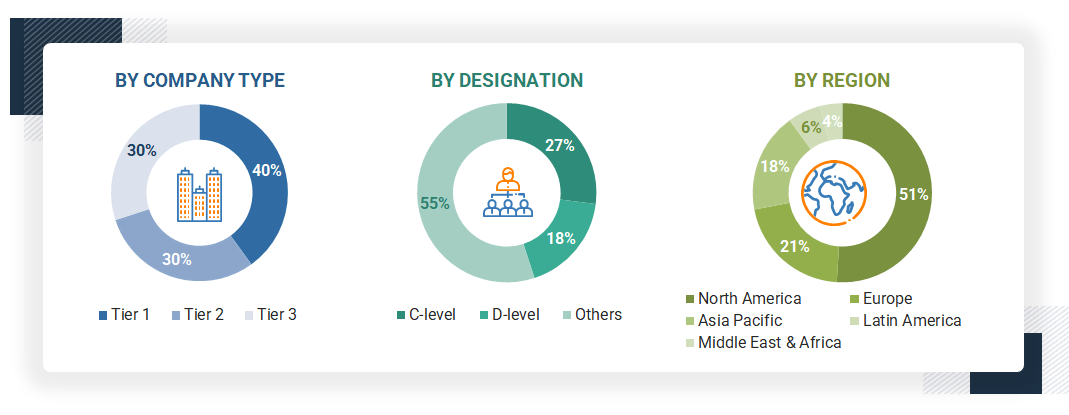
To know about the assumptions considered for the study, download the pdf brochure
Market Size Estimation
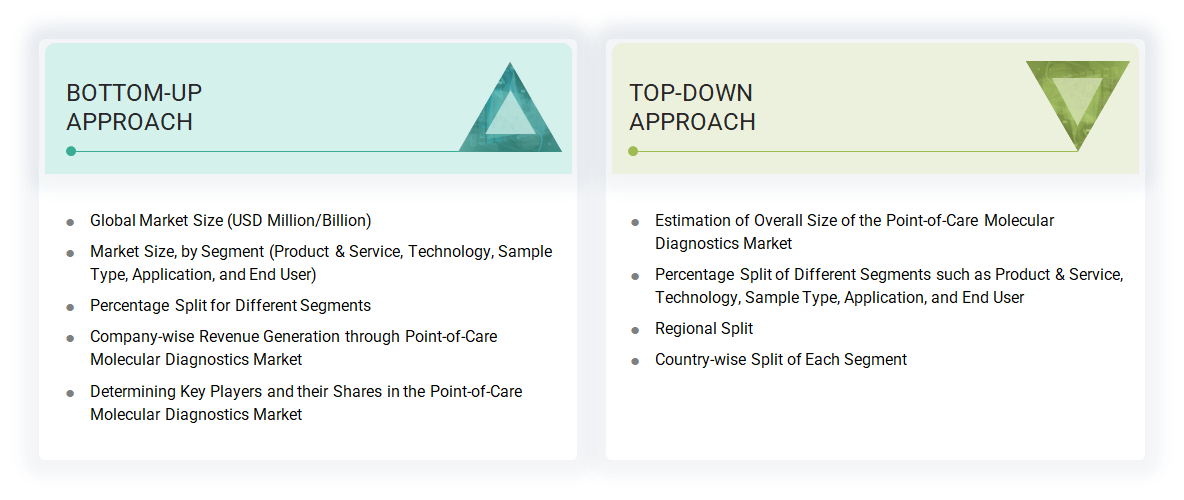
Both bottom-up and top-down approaches were used to estimate and validate the point-of-care molecular diagnostics market’s total size. These methods were also used extensively to estimate the size of various subsegments in tkehe mart. The research methodology used to estimate the market size includes the following:
- The key players in the industry have been identified through extensive secondary research.
- The revenues generated by leading players operating in the point-of-care molecular diagnostics market have been determined through primary and secondary research.
- All percentage shares, splits, and breakdowns have been determined using secondary sources and verified through primary sources.
Data Triangulation
After arriving at the overall market size by applying the abovementioned process, the total market was split into several segments and subsegments. To complete the overall market engineering process and arrive at the exact statistics for all segments and subsegments, data triangulation and market breakdown procedures were employed, wherever applicable. The data was triangulated by studying various factors and trends from both the demand and supply sides.
Market Definition
Point-of-care molecular diagnostics includes various portable point-of-care devices and assays used by healthcare professionals to detect and diagnose diseases in humans using different techniques to identify and analyze nucleic acids or proteins at the molecular level.
Stakeholders
- Manufacturers and distributors of point-of-care molecular diagnostics products
- Physicians’ offices
- Hospitals and clinics
- Research institutes
- Point-of-care molecular diagnostics service providers
- Government associations
- Venture capitalists and investors
Report Objectives
- To define, describe, segment, and forecast the point-of-care molecular diagnostics market by product & service, technology, sample type, application, end user, and region
- To provide detailed information regarding the major factors influencing market growth (such as drivers, restraints, opportunities, and challenges)
- To analyze micro markets with respect to individual growth trends, prospects, and contributions to the overall market
- To analyze opportunities for stakeholders and provide details of the competitive landscape for key players
- To forecast the size of the market segments with respect to five regions: North America, Europe, the Asia Pacific, Latin America, and the Middle East & Africa
- To profile the key players and comprehensively analyze their product portfolios, market positions, and core competencies
- To track and analyze company developments such as acquisitions, expansions, product launches & approvals, and other developments in the point-of-care molecular diagnostics market
- To benchmark players within the point-of-care molecular diagnostics market using the Company Evaluation Matrix framework, which analyzes market players on various parameters within the broad categories of business strategy, market share, and product offerings
- To study the impact of AI/Gen AI on the market, along with the macroeconomic outlook for each region
Get the Full Point-of-Care Molecular Diagnostics Market Report
Full forecast, segment splits, and company analysis for all Point-of-Care Molecular Diagnostics Market.
- US Point-of-Care Molecular Diagnostics Market
- Canada Point-of-Care Molecular Diagnostics Market
- Germany Point-of-Care Molecular Diagnostics Market
- UK Point-of-Care Molecular Diagnostics Market
- France Point-of-Care Molecular Diagnostics Market
- Italy Point-of-Care Molecular Diagnostics Market
- Spain Point-of-Care Molecular Diagnostics Market
- Japan Point-of-Care Molecular Diagnostics Market
- India Point-of-Care Molecular Diagnostics Market
- Brazil Point-of-Care Molecular Diagnostics Market
- Mexico Point-of-Care Molecular Diagnostics Market
- Rest Of Europe Point-of-Care Molecular Diagnostics Market
- Rest Of Asia Pacific Point-of-Care Molecular Diagnostics Market
- Rest Of Latin America Point-of-Care Molecular Diagnostics Market
- Ksa Point-of-Care Molecular Diagnostics Market
- UAE Point-of-Care Molecular Diagnostics Market
Need a Tailored Report?
Customize this report to your needs
Get 10% FREE Customization
Customize This Report
