
US Polyurethane Dispersions Market (2025-2030)

The US Polyurethane Dispersions Market was valued at $440.6 Million in 2025 and projected to reach to $599.9 Million by 2030, representing a compound annual growth rate of 6.4%. The US polyurethane dispersions market is poised for steady growth through 2030, supported by regulatory mandates favoring water-based solutions and increasing adoption across diverse industrial applications.


| Market Size in | USD 26.32 MN |
| Market Forecast in | |
| CAGR | |
| Forecast Period | |
| Units Considered | Value (USD MN) |
US Polyurethane Dispersions Market Trends and Insights
- This expansion in the US reflects strong demand across coatings, adhesives, and textile applications, driven by regulatory shifts toward water-based formulations and sustainability initiatives.
- The US market benefits from advanced manufacturing infrastructure and established end-user industries seeking eco-friendly alternatives to solvent-based products. Growth in the US polyurethane dispersions sector is underpinned by increasing adoption in automotive refinish, furniture, and industrial coatings throughout the 2025–2030 forecast period.
- The US chemical industry's focus on reducing volatile organic compound (VOC) emissions aligns with polyurethane dispersions' low-VOC profile, creating favorable market conditions.
- Additionally, the US construction and consumer goods sectors are accelerating their transition to water-based technologies, further supporting market expansion..
Key Market Statistics
- CAGR (2025-2030) 6.4% CAGR
- Market Size, 2025 ~USD 440.6 Million
- Forecast, 2030 ~USD 599.9 Million
- Country US
US Polyurethane Dispersions Market Overview
Market Size & Growth :
The US polyurethane dispersions market is valued at $440.6 million in 2025 and is projected to reach $599.9 million by 2030, growing at a CAGR of 6.4% during the forecast period.
Water-Based Regulatory Shift :
Stringent EPA regulations and VOC emission standards are driving US manufacturers to transition from solvent-based to water-based polyurethane dispersions, creating significant market expansion opportunities.
Key Application Segments :
Coatings, adhesives, and textile applications dominate the US market, with coatings representing the largest segment due to demand from automotive, construction, and industrial sectors.
Sustainability & Innovation :
US companies are increasingly investing in eco-friendly formulations and bio-based polyurethane dispersions to meet consumer demand and corporate sustainability commitments, driving product innovation.
US Polyurethane Dispersions Market Dynamics
- Manufacturers are responding to stricter environmental standards by developing low-VOC and sustainable formulations, positioning the market for continued expansion.
- The coatings segment will remain the primary growth driver, particularly in automotive refinish and protective coatings applications.
- Additionally, growing demand from the adhesives and textile industries, coupled with technological advancements in dispersion chemistry, will further accelerate market penetration.
- Strategic investments in R&D and capacity expansion by major players will strengthen competitive positioning in this evolving landscape..
Market Ecosystem
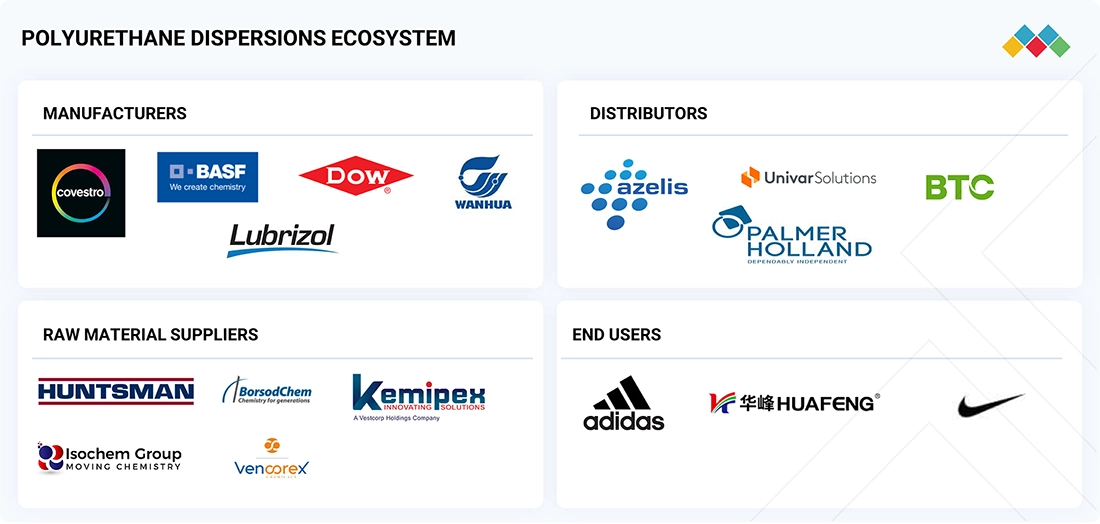
polyurethane-dispersions-market: COMMERCIAL USE CASES ACROSS INDUSTRIES
| COMPANY | USE CASE DESCRIPTION | BENEFITS |
|---|---|---|
 |
A leading synthetic leather manufacturer in China integrated Covestro’s Impranil waterborne PUDs into its coating and finishing lines for footwear, upholstery, and automotive interiors. | Reduced solvent emissions by 80–90%, improved coating uniformity, and increased line efficiency by 15–18%. |
 |
A major automotive OEM coatings supplier in Europe incorporated BASF’s waterborne polyurethane dispersions into clearcoats and basecoats to replace traditional solventborne systems. | Enabled significant VOC reduction (up to 70%), improved scratch resistance by 15–20%, and delivered superior UV durability. |
 |
A textile and sportswear coatings manufacturer in East Asia implemented Wanhua’s WanNature PUDs for waterproof–breathable performance fabrics. | Improved wash-fastness by 30–40%, enhanced stretch recovery, and increased print adhesion. Lower-temperature film formation reduced drying energy consumption by 10–12% and enabled compliance with global restricted substance lists (RSLs) for apparel exports. |
 |
A U.S.-based wood coatings producer adopted Lubrizol’s Sancure and Permax PUDs for parquet flooring and premium furniture finishes. These dispersions were selected for their balance of hardness, chemical resistance, and clarity. | Achieved 20–25% higher abrasion and chemical resistance, reduced yellowing, and improved blocking performance |
Logos and trademarks shown above are the property of their respective owners. Their use here is for informational and illustrative purposes only.
Related Ecosystem
Speciality Chemicals
- Corrosion Inhibitors
- Polyetheretherketone (PEEK)
- Acrylonitrile Butadiene Styrene (ABS)
- Epoxy Resin
- Polycarbonate
- Basf se
- DOW CHEMICAL COMPANY
- Evonik industries ag
- Clariant ag.
- Solvay sa
Key Takeaways
- The US polyurethane dispersions market is valued at $440.6 million in 2025 and will reach $599.9 million by 2030, growing at 6.4% CAGR.
- Water-based formulations and VOC reduction regulations are primary growth drivers for polyurethane dispersions adoption across US industries.
- The US automotive refinish, furniture, and industrial coatings sectors are the largest end-use segments fueling market expansion.
- Sustainability initiatives and eco-friendly product demand position the US market for steady growth through 2030.
Polyurethane Dispersions Market Report Scope
| Report Metric | Details |
|---|---|
| Base Year | 2025 |
| Fastest Growing Segment | HYBRID (Chemistry) |
| Forecast Period | 2025–2030 |
| Growth Rate | CAGR of 7.7% from 2025 to 2030 |
| Largest Segment | SOLVENT-FREE (Type) |
| Market Size Base Year (Billions) | ~USD 3 (2025) |
| Revenue Forecast (Billions) | ~USD 4.34 (2030) |
| Segments Covered | Type, Material, Chemistry, Product Type, Application |
US Polyurethane Dispersions Market Report Segmentation
5 segment dimensions are covered across the global market.
By Type
- Low Solvent
- Low-Solvent Polyurethane Dispersions
- Solvent-Free
- Solvent-Free Polyurethane Dispersions
By Material
- Anionic
- Cationic
- Hybrid
- Nonionic
- Self-Crosslinking
By Chemistry
- Anionic
- Cationic
- Hybrid
- Nonionic
- Self-Crosslinking
By Product Type
- One-Component (1K) Systems
- Two-Component (2K) Systems
By Application
- Adhesives & Sealants
- Leather Manufacturing & Finishing
- Other Applications
- Paints & Coatings
- Textile Finishing
US: POLYURETHANE DISPERSIONS MARKET, BY APPLICATION, 2025–2030
| Segment | 2025 | 2026 | 2027 | 2028 | 2029 | 2030 | CAGR (%) |
|---|---|---|---|---|---|---|---|
| ADHESIVES & SEALANTS | 87.1 | 92.5 | 98.2 | 104.5 | 111.3 | 118.6 | 6.4 |
| LEATHER MANUFACTURING & FINISHING | 35.4 | 37.5 | 39.8 | 42.3 | 44.9 | 47.8 | 6.2 |
| OTHER APPLICATIONS | 21.5 | 22.6 | 23.8 | 25.1 | 26.4 | 27.8 | 5.3 |
| PAINTS & COATINGS | 243.9 | 259.8 | 276.9 | 295.4 | 315.4 | 337.1 | 6.7 |
| TEXTILE FINISHING | 52.6 | 55.4 | 58.3 | 61.5 | 64.9 | 68.6 | 5.5 |
| TOTAL | 440.6 | 467.8 | 497.1 | 528.8 | 562.9 | 599.9 | 6.4 |
Target Audience
- Chemical Manufacturers : Polyurethane producers and dispersions manufacturers need US-specific market data to optimize production capacity, develop compliant formulations, and plan market entry or expansion strategies.
- Coatings & Adhesives Companies : Coating and adhesive manufacturers require detailed US market insights to identify raw material sourcing opportunities, forecast demand, and align product portfolios with regulatory and sustainability trends.
- Investment & Private Equity Firms : Investors evaluating acquisition targets or portfolio companies in the chemicals sector need accurate US market sizing and growth projections to assess investment returns and strategic fit.
- Regulatory & Compliance Officers : Corporate compliance teams need comprehensive understanding of EPA regulations and water-based formulation requirements to ensure product compliance and mitigate regulatory risks in the US market.
- Strategic Business Planners : Corporate strategists and business development teams require US market forecasts and segment analysis to inform long-term planning, M&A strategies, and resource allocation decisions.
Key Companies in the US Polyurethane Dispersions Market
| Company | HQ | Ownership | Strongest segments |
|---|---|---|---|
| COVESTRO AG | Germany | Public Company | Performance Materials – Polyurethanes (MDI, TDI, polyols),Performance Materials – Polycarbonates and base resins,Solutions & Specialties – Coatings, adhesives precursors, MDI specialties, polyols, |
| BASF | Germany | Public Company | Chemicals,Materials,Industrial Solutions, |
| DOW | United States | Public Company | Packaging & Specialty Plastics,Industrial Intermediates & Infrastructure,Performance Materials & Coatings, |
| WANHUA | China | Public Company | Polyurethane (isocyanates, polyether polyols, TPU elastomers),Petrochemicals (olefin derivatives, ethylene, chlorine chain),Fine Chemicals and New Materials, |
| LUBRIZOL | United States | Private Company | Lubricant Additives (Engine, Driveline, Industrial),Fuel Additives and Transportation Fluids,Specialty Polymers, CPVC, and Engineered Materials, |
| MITSUI CHEMICALS, INC. | Japan | Public Company | Basic & green materials (petrochemicals, basic chemicals, polyurethane raw materials),Life & healthcare solutions (vision care, nonwovens, agrochemicals, medical/dental),Mobility solutions (elastomers, performance and polypropylene compounds), |
| UBE CORPORATION | United States | Public Company | Mobility,Delivery,Freight, |
| DIC CORPORATION | United States | Public Company | Hardlines & Sporting Equipment,Apparel,Footwear & Cleats, |
| POLYNT S.P.A | Italy | Private Company | Organic anhydrides (phthalic, maleic, trimellitic),Special and general purpose plasticizers,Composite materials (UPR, SMC/BMC, gel coats, bonding pastes), |
| CHASE CORP. | United States | Private Company | Adhesives, Sealants and Additives,Industrial Tapes,Corrosion Protection and Waterproofing, |
COVESTRO AG
COVESTRO AG is a German public company founded in 1863, specializing in specialty chemicals and materials. With 17,806 employees, it operates as a major player in the chemical industry.
BASF
BASF is a German multinational public company founded in 1865, one of the world's largest chemical producers. The company employs 106,428 people globally across diverse chemical and materials segments.
DOW
DOW is an American public company founded in 1897, operating as a major global chemical and materials manufacturer. The company has 34,600 employees and serves numerous industrial and consumer markets.
WANHUA
WANHUA is a Chinese public company founded in 1978, operating in the chemical and materials sector. With 30,772 employees, it is a significant player in Asia's chemical industry.
LUBRIZOL
LUBRIZOL is an American private company founded in 1928, specializing in chemical additives and specialty products. The company operates with approximately 7,000 employees.
MITSUI CHEMICALS, INC.
MITSUI CHEMICALS, INC. is a Japanese public company founded in 1892, engaged in the production of chemicals and advanced materials. The company employs 16,967 people and serves global markets.
UBE CORPORATION
UBE CORPORATION is an American public company founded in 2009, employing 35,000 people in the chemical and materials sector.
DIC CORPORATION
DIC CORPORATION is an American public company founded in 1948, operating as a major chemical manufacturer with 68,400 employees.
POLYNT S.P.A
POLYNT S.P.A is an Italian private company founded in 1955, engaged in the production of specialty chemicals with 1,125 employees.
CHASE CORP.
CHASE CORP. is an American private company founded in 1946, operating in the specialty chemicals and materials sector with 859 employees.
Reasons to Buy this Report
- Accurate Market Sizing : Obtain precise valuation data for the US polyurethane dispersions market with verified 2025 baseline ($440.6M) and 2030 projections ($599.9M) to support strategic planning and investment decisions.
- Regulatory Landscape Intelligence : Understand EPA VOC standards and water-based formulation requirements specific to the US market, enabling compliance-driven product development and market positioning strategies.
- Segment-Specific Insights : Access detailed analysis of coatings, adhesives, and textile applications within the US market to identify high-growth opportunities and tailor go-to-market strategies by end-use sector.
- Competitive Benchmarking : Analyze US market dynamics, competitive positioning, and innovation trends to benchmark your company's performance and identify gaps in product offerings or market coverage.
- Growth Opportunity Identification : Leverage 6.4% CAGR projections and sustainability-driven demand trends to identify emerging opportunities in eco-friendly dispersions and capture market share in high-growth segments.
Frequently asked questions
What is the current size of the US polyurethane dispersions market?
The US polyurethane dispersions market is estimated at $440.6 million in 2025.
What is the projected market size for polyurethane dispersions in the US by 2030?
The US polyurethane dispersions market is forecast to reach $599.9 million by 2030.
What is the growth rate of the US polyurethane dispersions market?
The US polyurethane dispersions market is expected to grow at a compound annual growth rate (CAGR) of 6.4% from 2025 to 2030.
Which industries drive demand for polyurethane dispersions in the US?
The US automotive refinish, furniture, industrial coatings, adhesives, and textile industries are the primary drivers of polyurethane dispersions demand.
Why are polyurethane dispersions gaining traction in the US market?
Polyurethane dispersions are gaining traction in the US due to regulatory pressure to reduce VOC emissions, sustainability mandates, and the shift toward water-based formulations across manufacturing sectors.
RESEARCH METHODOLOGY
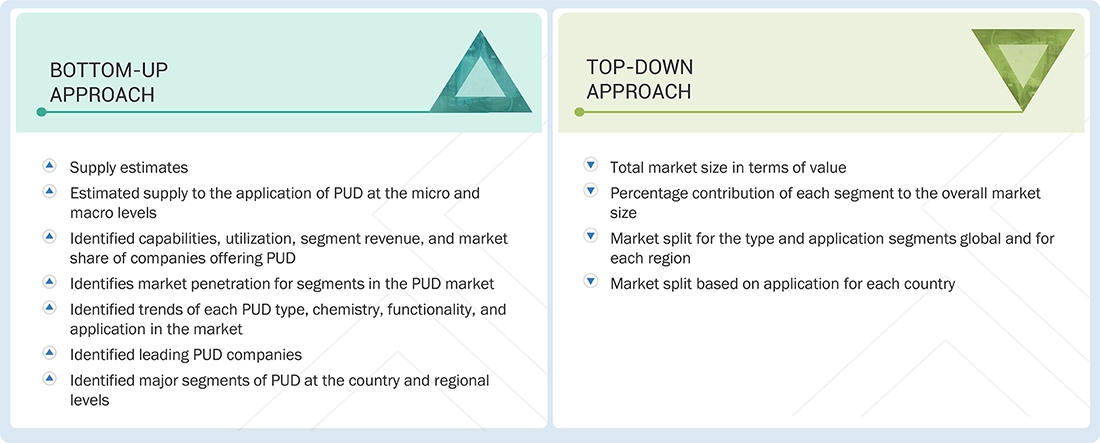
The study involved four major activities to estimate the current size of the global polyurethane dispersions market. Exhaustive secondary research was conducted to gather information on the market, the peer product market, and the parent product group market. The next step was to validate these findings, assumptions, and sizes with industry experts across the PUD value chain through primary research. The top-down and bottom-up approaches were employed to estimate the overall size of the polyurethane dispersions market. Following this, market breakdown and data triangulation procedures were employed to determine the size of various market segments and sub-segments.
Secondary Research
The market for companies offering polyurethane dispersions is determined by secondary data obtained from paid and unpaid sources, analyzing the product portfolios of major companies in the ecosystem, and evaluating companies based on their performance and quality. Various secondary sources, including Business Standard, Bloomberg, the World Bank, and Factiva, were consulted for identifying and collecting information for this study on the polyurethane dispersions market. Secondary sources also included annual reports, press releases, and investor presentations from vendors, as well as forums, certified publications, and whitepapers. The secondary research was utilized to gather critical information on the industry’s value chain, the total pool of key players, market classification, and segmentation from both market- and technology-oriented perspectives.
Primary Research
In the primary research process, various primary sources from both the supply and demand sides were interviewed to obtain qualitative and quantitative information for this report. The primary sources from the supply side included industry experts, such as Chief Executive Officers (CEOs), Vice Presidents (VPs), marketing directors, technology and innovation directors, and related key executives from several key companies and organizations operating in the polyurethane dispersions market. After completing the market engineering process (calculations for market statistics, market breakdown, market size estimations, market forecasting, and data triangulation), extensive primary research was conducted to gather information and verify and validate the critical numbers derived. Primary research was also conducted to identify the segmentation types, industry trends, and competitive landscape of polyurethane dispersions offered by various market players, as well as key market dynamics, including drivers, restraints, opportunities, challenges, and industry trends, and key player strategies. In the complete market engineering process, the top-down and bottom-up approaches and several data triangulation methods were extensively used to perform the market estimation and market forecasting for the overall market segments and subsegments listed in this report. Extensive qualitative and quantitative analysis was performed on the complete market engineering process to list the key information/insights throughout the report.
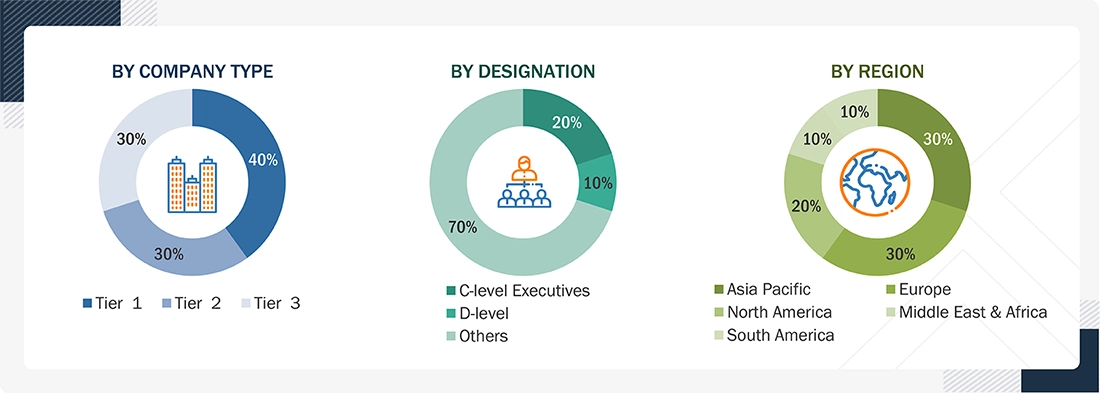
Notes: Other designations include sales, marketing, and product managers. Companies are classified into tiers based on their revenue—Tier 1: >USD 1 Billion; Tier 2: USD 500 million–1 Billion; and Tier 3: USD 500 million.
To know about the assumptions considered for the study, download the pdf brochure
Market Size Estimation
The top-down and bottom-up approaches were used to estimate and validate the size of the global polyurethane dispersions market. These approaches were also used extensively to estimate the size of various dependent market segments. The research methodology used to estimate the market size included the following:
Polyurethane Dispersions Market: Top-Down and Bottom-Up Approach
Data Triangulation
After determining the overall market size using market size estimation processes, the market was segmented into several segments and subsegments. The data triangulation and market breakdown procedures were employed, wherever applicable, to complete the overall market engineering process and arrive at the exact statistics of each market segment and subsegment. The data was triangulated by studying various factors and trends from both the demand and supply sides.
Market Definition
Polyurethane dispersions (PUDs) are advanced water-borne polymer systems designed to deliver high performance across a wide range of industrial and commercial applications. PUDs possess many desirable properties, including high film formability, physical performance properties, as well as excellent chemical resistance and environmental compatibility. There are several different types of PUD's available including anionic PUD's, cationic PUD's, nonionic PUD's, self-crosslinking PUD's and hybrid PUD's, each of which was developed for a specific purpose as to meet exacting performance requirements for use in a wide variety of applications including coatings, adhesives, leather finishing, textile, paper, automotive and industrial applications. The low VOC content, versatility, and wide range of adhesion properties make PUDs highly popular among manufacturers seeking a sustainable alternative to solvent-based polymers.
Key Stakeholders
- PUD manufacturers
- Raw material suppliers
- Converters & processors
- Distributors and traders
- Industry associations and regulatory bodies
- End users
Report Objectives
- To define, describe, and forecast the size of the global PUDs market, based on material type, temperature range, end-use industry, and region in terms of value and volume
- To provide detailed information on the significant drivers, restraints, opportunities, and challenges influencing the market
- To strategically analyze micromarkets concerning individual growth trends, prospects, and their contribution to the market
- To assess the growth opportunities in the market for stakeholders and provide details on the competitive landscape for market leaders
- To forecast the market size of segments and subsegments for North America, Europe, Asia Pacific, South America, and the Middle East & Africa
- To strategically profile key players and comprehensively analyze their market shares and core competencies
- To analyze competitive developments such as acquisitions, expansions, partnerships, and agreements in the polyurethane dispersions market
- To provide the impact of AI/Gen AI on the market
Available Customizations:
With the given market data, MarketsandMarkets offers customizations according to client-specific needs.
The following customization options are available for the polyurethane dispersions market report:
Product Analysis
- A product matrix that gives a detailed comparison of the product portfolio of each company
Regional Analysis
- A further breakdown of the polyurethane dispersions market for additional countries
Company Information
- Detailed analysis and profiling of additional market players (up to five)
Get the Full Polyurethane Dispersions Market Report
Full forecast, segment splits, and company analysis for all Polyurethane Dispersions Market.
- Germany Polyurethane Dispersions Market
- France Polyurethane Dispersions Market
- Italy Polyurethane Dispersions Market
- Spain Polyurethane Dispersions Market
- UK Polyurethane Dispersions Market
- China Polyurethane Dispersions Market
- Japan Polyurethane Dispersions Market
- India Polyurethane Dispersions Market
- South Korea Polyurethane Dispersions Market
- South Africa Polyurethane Dispersions Market
- Canada Polyurethane Dispersions Market
- Mexico Polyurethane Dispersions Market
- Argentina Polyurethane Dispersions Market
- Brazil Polyurethane Dispersions Market
- Rest Of Europe Polyurethane Dispersions Market
Need a Tailored Report?
Customize this report to your needs
Get 10% FREE Customization
Customize This Report
