
Australia Portable Ultrasound Market (2025-2030)

The Australia Portable Ultrasound Market was valued at $32.9 Million in 2025 and projected to reach to $48.2 Million by 2030, representing a compound annual growth rate of 8.0%. Australia's portable ultrasound market is positioned for steady growth driven by technological advancements and increasing healthcare accessibility across urban and remote regions.


| Market Size in | USD 26.32 MN |
| Market Forecast in | |
| CAGR | |
| Forecast Period | |
| Units Considered | Value (USD MN) |
Australia Portable Ultrasound Market Trends and Insights
- This growth trajectory reflects Australia's increasing adoption of point-of-care diagnostic technologies across hospitals, clinics, and remote healthcare facilities.
- Australia's advanced healthcare infrastructure and rising demand for portable diagnostic solutions are driving market expansion during the 2025–2030 forecast period. The portable ultrasound sector in Australia is benefiting from technological innovations, improved device portability, and enhanced imaging capabilities that enable faster clinical decision-making.
- Australia's aging population and growing prevalence of chronic diseases are creating sustained demand for accessible diagnostic tools.
- Additionally, Australia's investment in rural and remote healthcare delivery is accelerating adoption of portable ultrasound systems in underserved regions. Australia's market growth is supported by favorable reimbursement policies, increasing healthcare spending, and a strong emphasis on preventive care.
- The competitive landscape in Australia includes both established medical device manufacturers and emerging players offering cost-effective solutions tailored to the local healthcare system..
Key Market Statistics
- CAGR (2025-2030) 8.0% CAGR
- Market Size, 2025 ~USD 32.9 Million
- Forecast, 2030 ~USD 48.2 Million
- Country Australia
Australia Portable Ultrasound Market Overview
Market Valuation :
Australia's portable ultrasound market is valued at $32.9 million in 2025, with projected growth to $48.2 million by 2030, representing an 8% CAGR.
Remote Healthcare Adoption :
Increasing deployment of portable ultrasound devices across Australia's remote and regional healthcare facilities is driving market expansion, particularly in rural diagnostic centers.
Point-of-Care Diagnostics :
Australian hospitals and clinics are rapidly adopting point-of-care ultrasound technologies to improve diagnostic efficiency and reduce patient wait times in emergency and primary care settings.
Healthcare Infrastructure Advancement :
Australia's advanced healthcare infrastructure and government support for modernizing diagnostic capabilities are accelerating the integration of portable ultrasound systems across medical facilities.
Australia Portable Ultrasound Market Dynamics
- The 8% CAGR reflects strong demand from hospitals, private clinics, and emergency medical services seeking cost-effective diagnostic solutions.
- Government initiatives supporting rural healthcare infrastructure and the rising prevalence of chronic diseases are key growth catalysts. The forecast period through 2030 will see enhanced adoption of handheld and wireless ultrasound devices, particularly in point-of-care settings.
- Investment in healthcare digitalization and telemedicine integration will further propel market expansion.
- Australian healthcare providers' focus on improving diagnostic capabilities while managing costs positions portable ultrasound as a critical technology investment..
Market Ecosystem
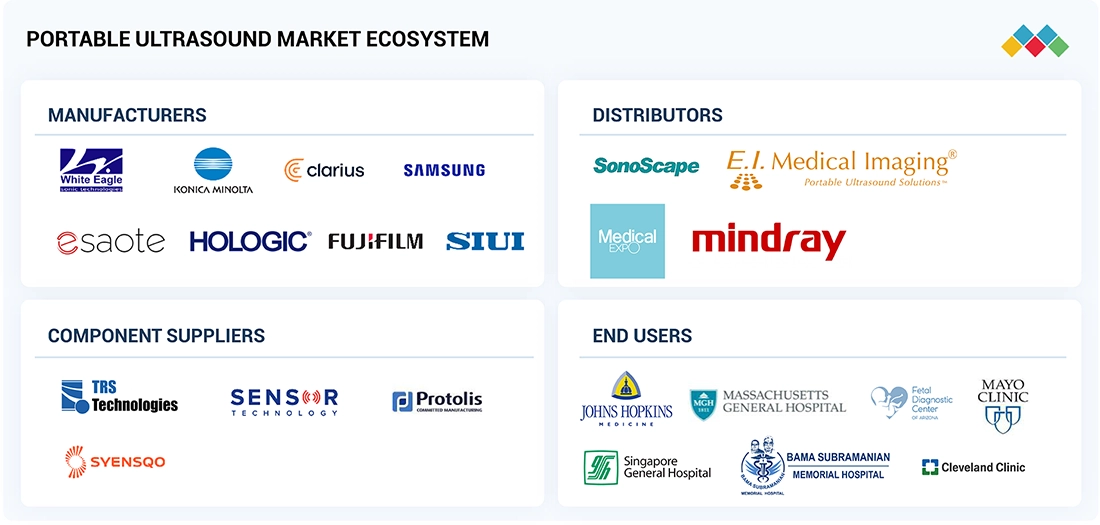
Portable Ultrasound Market: COMMERCIAL USE CASES ACROSS INDUSTRIES
| COMPANY | USE CASE DESCRIPTION | BENEFITS |
|---|---|---|
 |
Assessment of Volume Status in Nephrology Using Hand-Carried Ultrasound | Assist with determining intravascular volume |
 |
Handheld ultrasound for early detection of left ventricular dysfunction or valvular abnormalities during routine outpatient visits | Provides immediate insights without referring patients to echocardiography labs, speeding up decision-making |
 |
Pneumonia Diagnosis / Vaccine Effectiveness in Pediatric Public Health Settings | Portable ultrasound helps avoid ionizing radiation, reduce reliance on X-ray, and makes diagnostic tools usable in low-resource settings |
 |
Portable ultrasound used in maternity wards and rural clinics to monitor fetal growth, amniotic fluid, and detect complications | Expands access to prenatal care in underserved regions, reducing maternal and neonatal complications |
Logos and trademarks shown above are the property of their respective owners. Their use here is for informational and illustrative purposes only.
Related Ecosystem
Analytical And Scientific Instrumentation
Medical Devices
Key Takeaways
- Australia's portable ultrasound market is projected to grow from $32.9M (2025) to $48.2M (2030) at an 8.0% CAGR.
- Australia's aging population and chronic disease prevalence are key drivers of portable ultrasound adoption.
- Australia's remote healthcare initiatives are expanding portable ultrasound deployment in underserved regions.
- Australia's favorable reimbursement environment and healthcare spending support sustained market growth through 2030.
Portable Ultrasound Market Report Scope
| Report Metric | Details |
|---|---|
| Base Year | 2025 |
| Fastest Growing Segment | PHASED ARRAY (Type) |
| Forecast Period | 2025–2030 |
| Growth Rate | CAGR of 9% from 2025 to 2030 |
| Largest Segment | HOSPITALS & SURGICAL CENTERS (End User) |
| Market Size Base Year (Billions) | ~USD 2.5 (2025) |
| Revenue Forecast (Billions) | ~USD 3.84 (2030) |
| Segments Covered | Product Type, Type, Platform, End User, Application, Transducer/Probe Type |
Australia Portable Ultrasound Market Report Segmentation
6 segment dimensions are covered across the global market.
By Product Type
- Accessories
- Software & Services
- Systems & Consoles
- Transducers/Probes
By Type
- Curvilinear/Convex Array
- Liner Array
- Other Array Types
- Phased Array
By Platform
- Handheld
- Handheld Ultrasound
- Laptop Based
- Laptop-Based Ultrasound
- Tablet Based
- Tablet-Based Ultrasound
- Trolley/Cart Based
- Trolley/Cart-Based Portable Ultrasound
By End User
- Ambulatory Care Centers
- Hospitals & Surgical Centers
- Imaging Centers
- Other End Users
By Application
- Cardiology
- Obstetrics/Gynecology
- Orthopedic & Musculoskeletal
- Orthopedic And Musculoskeletal
- Other Applications
- Pain Management
- Pediatric
- Urology
- Vascular
By Transducer/Probe Type
- Curvilinear/Convex Array
- Linear Array
- Phased Array
AUSTRALIA: PORTABLE ULTRASOUND MARKET, BY END USER, 2023–2030
| Segment | 2023 | 2024 | 2025 | 2026 | 2027 | 2028 | 2029 | 2030 | CAGR (%) |
|---|---|---|---|---|---|---|---|---|---|
| AMBULATORY CARE CENTERS | 7.4 | 7.9 | 8.4 | 9 | 9.7 | 10.5 | 11.4 | 12.4 | 8.1 |
| HOSPITALS & SURGICAL CENTERS | 12.8 | 13.7 | 14.5 | 15.5 | 16.7 | 18 | 19.5 | 21.2 | 7.8 |
| IMAGING CENTERS | 5.8 | 6.2 | 6.7 | 7.2 | 7.8 | 8.4 | 9.2 | 10.1 | 8.5 |
| OTHER END USERS | 2.9 | 3 | 3.2 | 3.4 | 3.6 | 3.9 | 4.2 | 4.5 | 7 |
| TOTAL | 28.9 | 30.8 | 32.9 | 35.2 | 37.8 | 40.8 | 44.2 | 48.2 | 8 |
Target Audience
- Medical Device Manufacturers : Manufacturers need Australia-specific market data to assess market potential, identify distribution channels, and develop localized product strategies for the growing portable ultrasound segment.
- Healthcare Facility Operators : Hospital administrators and clinic managers require market insights to justify capital investments in portable ultrasound technology and benchmark adoption rates against peer institutions.
- Investment & Private Equity Firms : Investors evaluating healthcare technology opportunities in Australia need detailed market sizing and growth projections to assess portfolio companies and identify acquisition targets.
- Healthcare Consultants & Advisors : Consulting firms advising Australian healthcare organizations require comprehensive market data to develop strategic recommendations and support digital health transformation initiatives.
- Government & Policy Makers : Australian health department officials and policymakers need market intelligence to inform healthcare infrastructure planning, funding allocation, and regulatory framework development.
Key Companies in the Australia Portable Ultrasound Market
| Company | HQ | Ownership | Strongest segments |
|---|---|---|---|
| GE HEALTHCARE | United States | Public Company | Probes,System & Console,Software, |
| SIEMENS HEALTHINEERS AG | Germany | ||
| FUJIFILM CORPORATION | Japan | Public Company | System & Console,Probes,Software, |
| HOLOGIC, INC. | United States | ||
| SAMSUNG ELECTRONICS CO., LTD. | Korea, South | Public Company | Probes,System & Console,Software, |
| MINDRAY MEDICAL INTERNATIONAL LIMITED | China | Private Company | System & Console,Probes,Service, |
| ESAOTE SPA | Italy | Private Company | Systems & Console,Probes,Software, |
| CHISON MEDICAL TECHNOLOGIES CO., LTD. | China | Public Company | System & Console,Probes,Software, |
| NEUSOFT CORPORATION | China | Public Company | System & Console,Probes,Software, |
| KONICA MINOLTA, INC. | Japan | Public Company | Probes,System & Console,Software, |
GE HEALTHCARE
GE Healthcare is a public company headquartered in the United States with 54,000 employees, founded in 2022. The company operates in the healthcare sector providing medical technology and services.
SIEMENS HEALTHINEERS AG
Siemens Healthineers AG is a healthcare company based in Germany. The company provides medical technology, diagnostic imaging, and healthcare IT solutions.
FUJIFILM CORPORATION
Fujifilm Corporation is a Japanese public company founded in 1934 with 73,526 employees. The company operates across multiple sectors including healthcare, imaging, and materials technology.
HOLOGIC, INC.
Hologic, Inc. is a healthcare company based in the United States. The company develops and manufactures medical devices and diagnostic solutions.
SAMSUNG ELECTRONICS CO., LTD.
Samsung Electronics Co., Ltd. is a South Korean public company founded in 1969 with 128,735 employees. The company is a global leader in electronics, semiconductors, and consumer technology.
MINDRAY MEDICAL INTERNATIONAL LIMITED
Mindray Medical International Limited is a private Chinese company founded in 1991 with 8,400 employees. The company develops and manufactures medical devices and healthcare solutions.
ESAOTE SPA
Esaote SpA is an Italian private company founded in 1982 with 1,067 employees. The company specializes in medical imaging and diagnostic ultrasound systems.
CHISON MEDICAL TECHNOLOGIES CO., LTD.
Chison Medical Technologies Co., Ltd. is a public company based in China, founded in 1996 with 467 employees. The company manufactures medical imaging and ultrasound equipment.
NEUSOFT CORPORATION
Neusoft Corporation is a Chinese public company founded in 1991 with 23,737 employees. The company provides healthcare IT solutions, medical devices, and software services.
KONICA MINOLTA, INC.
Konica Minolta, Inc. is a Japanese public company founded in 1873 with 34,363 employees. The company operates in imaging technology, healthcare, and business solutions.
Reasons to Buy this Report
- Market Size & Growth Data : Access precise valuation figures for Australia's portable ultrasound market with detailed CAGR analysis, enabling accurate financial forecasting and investment planning specific to the Australian healthcare sector.
- Regional Adoption Insights : Understand penetration rates across Australian hospitals, clinics, and remote facilities to identify high-opportunity segments and tailor market entry strategies for different healthcare settings.
- Competitive Landscape Analysis : Gain intelligence on key players operating in Australia's portable ultrasound market, their market positioning, and competitive strategies to inform partnership and acquisition decisions.
- Healthcare Policy & Regulatory Context : Leverage insights into Australian healthcare regulations, government initiatives, and reimbursement policies that directly impact portable ultrasound adoption and market dynamics.
- Strategic Growth Opportunities : Identify emerging opportunities in rural healthcare expansion, telemedicine integration, and point-of-care diagnostics to develop targeted growth strategies for the Australian market.
Frequently asked questions
What is the current size of Australia's portable ultrasound market?
Australia's portable ultrasound market is valued at $32.9 million in 2025.
What is the projected market size for Australia's portable ultrasound sector by 2030?
Australia's portable ultrasound market is forecast to reach $48.2 million by 2030.
What is the growth rate of Australia's portable ultrasound market?
Australia's portable ultrasound market is expected to grow at a compound annual growth rate (CAGR) of 8.0% from 2025 to 2030.
What factors are driving growth in Australia's portable ultrasound market?
Key drivers include Australia's aging population, rising chronic disease prevalence, remote healthcare expansion, technological innovations, and favorable reimbursement policies.
Which healthcare settings in Australia are adopting portable ultrasound systems?
Portable ultrasound adoption in Australia spans hospitals, clinics, emergency departments, rural healthcare facilities, and remote medical centers.
RESEARCH METHODOLOGY
The research methodology utilized to examine the global portable ultrasound market is thoroughly detailed on the website. This section provides a clear understanding of the structure, processes, and practices employed for collecting and analyzing field data, ensuring its accuracy and reliability. This transparency allows various stakeholders to critically assess the credibility of the findings, conclusions, and recommendations presented in the report, enabling informed decision-making.
Secondary Research
We utilized a variety of sources for this secondary research, including D&B Hoovers, Bloomberg Businessweek, Factiva, white papers, annual reports, company filings, investor presentations, and SEC filings. This comprehensive approach allowed us to create an extensive database of key participants in the industry. The database contains the most relevant information about incumbent companies, multi-level market segmentation, industry trends within each segment, significant mergers and acquisitions, and the impact of groundbreaking technological developments in the portable ultrasound market.
Primary Research
The primary research involved both qualitative and quantitative techniques and was conducted in depth with participants from both the supply and demand sides through interviews.
On the supply side, interviews were held with high-level executives, including CEOs, vice presidents, marketing directors, sales directors, regional sales managers, and directors of technology and innovation, from leading companies and organizations that produce and deliver therapy products.
On the demand side, professionals interviewed included clinicians, procurement managers, purchasing managers, department heads, and subject-matter experts from hospitals, surgical centers, diagnostic centers, maternity centers, ambulatory centers, research institutions, and academia, as well as other end users.
Overall, this research provided valuable insights into market segmentation, key players, trends and dynamics, and growth drivers in the market.
A breakdown of the primary respondents is provided below:
The following is a breakdown of the primary respondents:
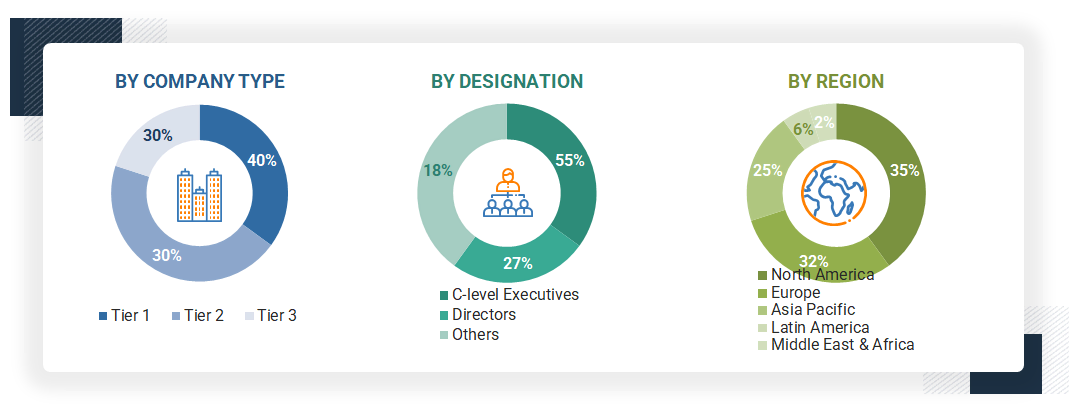
Note 1: Others include sales managers, marketing managers, business development managers, product managers, distributors, and suppliers.
Note 2: Companies are classified into tiers based on their total revenue. As of 2024, Tier 1 = >USD 1 billion, Tier 2 = < USD 500 million, and Tier 3 = < USD 100 million.
To know about the assumptions considered for the study, download the pdf brochure
Market Size Estimation
The report provides a comprehensive analysis of the portable ultrasound market. Key players were identified through both primary and secondary data sources. The secondary analysis relied on annual and financial reports from major companies in the market, while the primary research involved in-depth interviews with key opinion leaders, including CEOs, directors, and senior marketing executives.
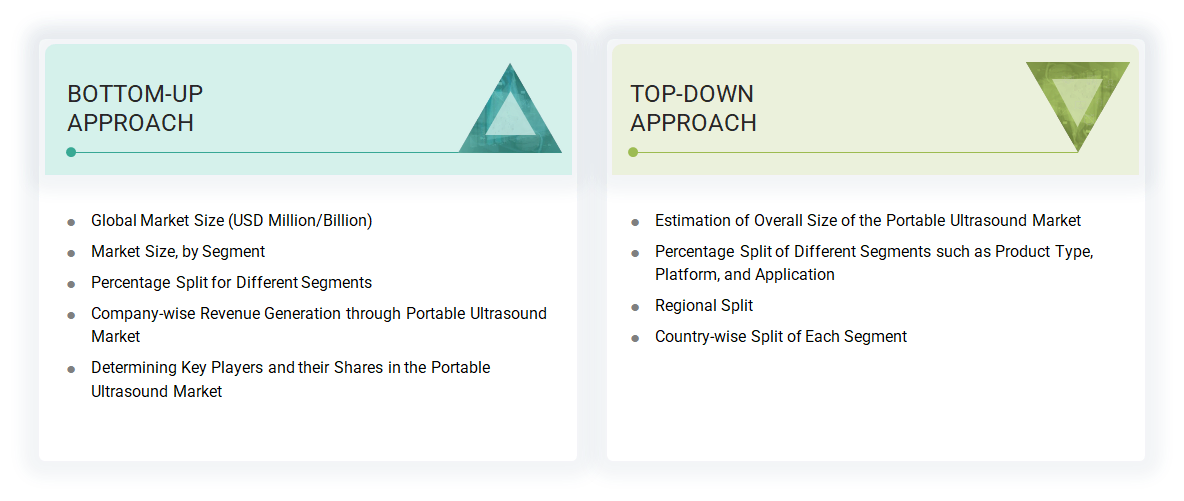
A segment-based approach was employed to determine the global market value, utilizing revenue data from leading solution and supplier providers. This process included the following steps:
- Identifying all key players in the global portable ultrasound market.
- Analyzing their reported annual revenues, whether specifically related to ultrasound or encompassing their overall business units or products.
The data was then projected to arrive at the overall value for the portable ultrasound market.
Data Triangulation
The research method employed involved segmenting the global portable ultrasound market into various participants and categories. Data triangulation and segmentation techniques ensured accurate information was available for all market segments. A series of analyses was conducted to examine both the demand and supply sides of the market. The combination of top-down and bottom-up approaches provided a comprehensive understanding of the portable ultrasound market.
Market Definition
The portable ultrasound market focuses on smaller, lighter ultrasound systems designed for easy maneuverability and accessibility in various healthcare settings. These portable ultrasound systems utilize sound waves generated by key transducer components to create real-time moving images of body structures, tissues, organs, and fluids based on echogenicity. The development and widespread use of portable ultrasounds have significantly increased their application in point-of-care diagnostics across fields such as emergency medicine, critical care, obstetrics, cardiology, and remote patient healthcare. Portable ultrasound systems are particularly useful when quick imaging is required, in non-traditional settings, or to enhance access to diagnostic imaging.
Stakeholders
- Healthcare institutions (hospitals and diagnostic centers)
- Research institutions
- Clinical research organizations
- Academic medical centers and universities
- Reference laboratories
- Accountable care organizations (ACOs)
- Research and consulting firms
- Contract research organizations (CROs) and contract manufacturing organizations (CMOs)
- Academic medical centers and universities
- Market research and consulting firms
- Group purchasing organizations (GPOs)
- Medical research laboratories
Report Objectives
- To define, describe, and forecast the global portable ultrasound market based on product, platform, application, end user, and region
- To provide detailed information regarding the major factors influencing the market growth (drivers, restraints, opportunities, and challenges), along with the current trends
- To strategically analyze micromarkets with respect to their individual growth trends, future prospects, and contributions to the total market
- To analyze opportunities in the market for stakeholders and provide details of the competitive landscape for market leaders
- To forecast the revenue of the market segments for five regions: North America (US and Canada), Europe (Germany, France, UK, Italy, Spain, and Rest of Europe), the Asia Pacific (China, Japan, India, South Korea, Australia, and Rest of Asia Pacific), Latin America (Brazil, Mexico, and Rest of Latin America), and the Middle East & Africa
- To profile the key players and comprehensively analyze their market shares and core competencies
- To track and analyze competitive developments in the portable ultrasound market, such as acquisitions, product launches, expansions, agreements, joint ventures, alliances, and collaborations
Get the Full Portable Ultrasound Market Report
Full forecast, segment splits, and company analysis for all Portable Ultrasound Market.
- US Portable Ultrasound Market
- Canada Portable Ultrasound Market
- Germany Portable Ultrasound Market
- UK Portable Ultrasound Market
- France Portable Ultrasound Market
- Italy Portable Ultrasound Market
- Spain Portable Ultrasound Market
- China Portable Ultrasound Market
- Japan Portable Ultrasound Market
- India Portable Ultrasound Market
- South Korea Portable Ultrasound Market
- Brazil Portable Ultrasound Market
- Mexico Portable Ultrasound Market
- Rest Of Europe Portable Ultrasound Market
- Rest Of Asia Pacific Portable Ultrasound Market
- Rest Of Latin America Portable Ultrasound Market
- GCC Countries Portable Ultrasound Market
Need a Tailored Report?
Customize this report to your needs
Get 10% FREE Customization
Customize This Report
