
Germany Preimplantation Genetic Testing Market (2025-2030)

The Germany Preimplantation Genetic Testing Market was valued at $46.2 Million in 2025 and projected to reach to $79.2 Million by 2030, representing a compound annual growth rate of 11.4%. Germany's preimplantation genetic testing market is positioned for sustained growth through 2030, driven by increasing fertility treatment demand and technological advancements in genetic screening.


| Market Size in | USD 26.32 MN |
| Market Forecast in | |
| CAGR | |
| Forecast Period | |
| Units Considered | Value (USD MN) |
Germany Preimplantation Genetic Testing Market Trends and Insights
- This growth trajectory reflects Germany's advanced healthcare infrastructure, strong regulatory framework, and increasing adoption of assisted reproductive technologies across the country.
- Germany's commitment to precision medicine and genetic screening in fertility treatments is driving market penetration among both patients and fertility clinics. The German PGT market benefits from high healthcare spending, well-established IVF centers, and growing awareness of genetic disorders among prospective parents.
- Germany's aging population and declining birth rates have intensified focus on reproductive health solutions, positioning PGT as a critical component of fertility management.
- Between 2025 and 2030, Germany is expected to see accelerated demand for non-invasive genetic testing and expanded clinical applications, supported by favorable reimbursement policies and technological innovation within the country. Germany's regulatory environment and emphasis on ethical genetic testing practices create a stable foundation for market growth.
- The country's leadership in European healthcare innovation ensures that Germany remains a key market for PGT service providers and diagnostic companies seeking to expand their presence in the region..
Key Market Statistics
- CAGR (2025-2030) 11.4% CAGR
- Market Size, 2025 ~USD 46.2 Million
- Forecast, 2030 ~USD 79.2 Million
- Country Germany
Germany Preimplantation Genetic Testing Market Overview
Market Valuation Growth :
Germany's PGT market is valued at $46.2 million in 2025, with a projected CAGR of 11.4% through 2030, reaching $79.2 million. This growth outpaces the global average of 10.5%, indicating strong regional momentum.
Advanced Healthcare Infrastructure :
Germany's sophisticated healthcare system and robust regulatory framework support widespread adoption of preimplantation genetic testing. The country's commitment to precision medicine drives innovation and accessibility in reproductive genetics.
Rising ART Adoption :
Increasing adoption of assisted reproductive technologies across Germany fuels demand for PGT services. Growing awareness among fertility clinics and patients about genetic screening benefits accelerates market penetration.
Regulatory Excellence :
Germany's stringent regulatory standards and ethical guidelines ensure high-quality PGT services. The country's strong compliance framework builds patient confidence and supports sustainable market expansion.
Germany Preimplantation Genetic Testing Market Dynamics
- The country's aging population and delayed childbearing trends encourage couples to seek advanced reproductive solutions, boosting PGT adoption rates across major fertility centers. The German market benefits from strong healthcare reimbursement policies and growing physician awareness of PGT benefits in reducing genetic disorders and improving IVF success rates.
- Continued investment in reproductive medicine infrastructure and expanding access to genetic testing services will further accelerate market growth, establishing Germany as a leading European hub for precision reproductive medicine..
Market Ecosystem
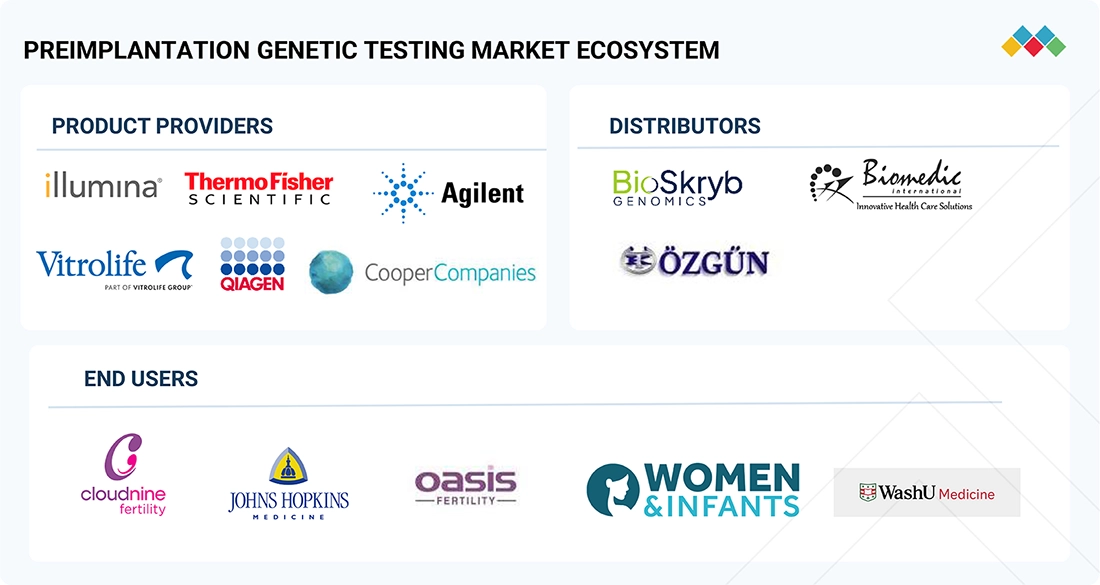
MARKET ECOSYSTEM
Related Ecosystem
Advanced Genetic Sequencing
- Polymerase Chain Reaction (PCR)
- Reagents
- Assay Kits
- Bioinformatics
- Flow Cytometry
- Thermo Fisher Scientific Inc.
- Illumina, Inc.
- Agilent Technologies, Inc.
- Qiagen N.V.
- Danaher Corporation
Biotechnology
- Reagents
- Polymerase Chain Reaction (PCR)
- Stem Cells
- Assay Kits
- Flow Cytometers
- Thermo Fisher Scientific Inc.
- Merck KGaA
- Danaher Corporation
- Agilent Technologies, Inc.
- Bio-Rad Laboratories, Inc.
Key Takeaways
- Germany's PGT market is valued at $46.2 million in 2025 and is forecast to grow to $79.2 million by 2030, representing an 11.4% CAGR.
- Germany's advanced healthcare infrastructure and high fertility clinic density position the country as a leading European market for preimplantation genetic testing services.
- Growing awareness of genetic disorders and favorable reimbursement policies in Germany are accelerating adoption of PGT among fertility patients and reproductive specialists.
- Germany's stringent regulatory standards and ethical framework for genetic testing ensure market stability and support long-term growth in precision reproductive medicine.
Preimplantation Genetic Testing Market Report Scope
| Report Metric | Details |
|---|---|
| Base Year | 2025 |
| Fastest Growing Segment | SINGLE GENE DISORDERS (Application) |
| Forecast Period | 2025–2030 |
| Growth Rate | CAGR of 10.5% from 2025 to 2030 |
| Largest Segment | PREIMPLANTATION GENETIC SCREENING (Procedure Type) |
| Market Size Base Year (Billions) | ~USD 0.69 (2025) |
| Revenue Forecast (Billions) | ~USD 1.14 (2030) |
| Segments Covered | Product & Service, Procedure Type, Technology, Application, Type, Type Of Cycle, End User |
Germany Preimplantation Genetic Testing Market Report Segmentation
7 segment dimensions are covered across the global market.
By Product & Service
- Instruments
- Reagents & Consumables
- Software & Services
By Procedure Type
- Preimplantation Genetic Diagnosis
- Preimplantation Genetic Screening
By Technology
- Comparative Genomic Hybridization
- Fluorescence In Situ Hybridization
- Next-Generation Sequencing
- Polymerase Chain Reaction
- Single-Nucleotide Polymorphism
By Application
- Aneuploidy
- Gender Identification
- Hla Typing
- Single Gene Disorders
- Structural Chromosomal Abnormalities
- X-Linked Disorders
By Type
- Deletions
- Duplications
- Inversions
- Translocations
By Type Of Cycle
- Fresh Donor
- Fresh Non-Donor
- Frozen Donor
- Frozen Non-Donor
By End User
- Diagnostic Laboratories
- Fertility Clinics
- Hospitals
- Other End Users
GERMANY: PREIMPLANTATION GENETIC TESTING MARKET, BY END USER, 2023–2030
| Segment | 2023 | 2024 | 2025 | 2026 | 2027 | 2028 | 2029 | 2030 | CAGR (%) |
|---|---|---|---|---|---|---|---|---|---|
| DIAGNOSTIC LABORATORIES | 8.1 | 8.8 | 9.7 | 10.8 | 12 | 13.5 | 15.2 | 17.1 | 12.1 |
| FERTILITY CLINICS | 23 | 24.9 | 27.3 | 30.2 | 33.5 | 37.4 | 41.9 | 47 | 11.5 |
| HOSPITALS | 5.8 | 6.2 | 6.7 | 7.4 | 8.1 | 9 | 10 | 11.1 | 10.5 |
| OTHER END USERS | 2.2 | 2.3 | 2.5 | 2.7 | 3 | 3.3 | 3.6 | 4 | 9.7 |
| TOTAL | 39 | 42.2 | 46.2 | 51 | 56.6 | 63.1 | 70.6 | 79.2 | 11.4 |
Target Audience
- Fertility Clinic Operators : German fertility centers need market intelligence to optimize PGT service offerings, understand competitive positioning, and identify growth opportunities within their regional market.
- Genetic Testing Providers : PGT service providers require Germany-specific market data to assess expansion opportunities, understand regulatory requirements, and develop targeted go-to-market strategies.
- Medical Device & Diagnostics Companies : Manufacturers of genetic testing equipment and diagnostic tools need regional market insights to identify partnership opportunities and optimize product positioning for German healthcare providers.
- Healthcare Investors & PE Firms : Investment professionals evaluating opportunities in German reproductive medicine require detailed market sizing, growth projections, and competitive analysis to inform investment decisions.
- Healthcare Policy & Regulatory Bodies : German health authorities and policy makers need comprehensive market data to inform reimbursement policies, regulatory frameworks, and strategic healthcare planning for reproductive genetics.
Key Companies in the Germany Preimplantation Genetic Testing Market
| Company | HQ | Ownership | Strongest segments |
|---|---|---|---|
| CIMARON LABEL | Pressure-sensitive paper labels,Film and durable labels,Specialty/custom applications, | ||
| THERMO FISHER SCIENTIFIC INC. | United States | Public Company | Laboratory Products and Biopharma Services,Life Sciences Solutions,Analytical Instruments, |
| AGILENT TECHNOLOGIES, INC. | United States | Public Company | Life Sciences and Diagnostics Markets,Agilent CrossLab,Applied Markets, |
| REVVITY | United States | Public Company | Reagents, Assays, and Consumables,Instruments and Detection/Imaging Platforms,Software, Subscriptions, and Informatics, |
| COOPERCOMPANIES | United States | Public Company | Spherical contact lenses,Toric and multifocal contact lenses,Fertility consumables, equipment, and services, |
| ABBOTT | United States | Public Company | Diagnostic Products,Medical Devices,Nutritional Products, |
| TAKARA BIO INC. | Japan | Private Company | Research reagents for genetic and cellular research,Instruments (PCR instruments and cellular analysis devices),In vitro diagnostics (including COVID-19 testing), |
| VITROLIFE | Sweden | Public Company | IVF media and oil,Labware (dishes, pipettes, tubes, VitroTemp, eWitness-related consumables),Cryopreservation solutions, |
CIMARON LABEL
Insufficient information provided to generate description.
THERMO FISHER SCIENTIFIC INC.
Thermo Fisher Scientific Inc. is a United States-based public company founded in 1956 with 125,000 employees. The company is a global leader in serving science, providing laboratory equipment, reagents, and analytical instruments.
AGILENT TECHNOLOGIES, INC.
Agilent Technologies, Inc. is a United States-based public company founded in 1999 with 18,000 employees. The company provides life sciences, diagnostics, and applied chemical markets with instruments and software.
REVVITY
Revvity is a United States-based public company founded in 1937 with 11,000 employees. The company provides analytical technologies and solutions for research, diagnostics, and applied markets.
COOPERCOMPANIES
CooperCompanies is a United States-based public company founded in 1958 with 15,000 employees. The company operates in the medical device sector, primarily focused on contact lenses and eye care products.
ABBOTT
Abbott is a United States-based public company founded in 1888 with 115,000 employees. The company is a diversified healthcare manufacturer producing pharmaceuticals, diagnostics, nutritional products, and medical devices.
TAKARA BIO INC.
Takara Bio Inc. is a Japan-based private company founded in 2002 with 1,779 employees. The company specializes in biotechnology research and development.
VITROLIFE
Vitrolife is a Sweden-based public company founded in 1989 with 1,103 employees. The company develops and manufactures products for assisted reproduction and embryo culture.
Reasons to Buy this Report
- Market-Specific Sizing & Forecasts : Access precise valuation data for Germany's PGT market with detailed 2025-2030 projections. Understand regional growth trajectories and CAGR metrics specific to German market dynamics.
- Competitive Landscape Intelligence : Identify key players, market share distribution, and competitive positioning within Germany's PGT sector. Benchmark your organization against regional competitors and emerging market entrants.
- Regulatory & Reimbursement Insights : Gain comprehensive understanding of Germany's healthcare regulations, reimbursement policies, and ethical frameworks governing PGT services. Navigate compliance requirements with confidence.
- Growth Driver Analysis : Understand the specific factors driving 11.4% CAGR in Germany, including ART adoption rates, demographic trends, and technological innovations shaping the regional market.
- Strategic Market Entry Planning : Develop informed market entry strategies with actionable insights on German fertility clinic networks, patient demographics, and distribution channels for PGT services.
Frequently asked questions
What is the current market size of preimplantation genetic testing in Germany?
Germany's PGT market was valued at $46.2 million in 2025 and is expected to reach $79.2 million by 2030, growing at an 11.4% compound annual growth rate.
What factors are driving growth in Germany's PGT market?
Germany's PGT market growth is driven by advanced healthcare infrastructure, high fertility clinic density, increasing awareness of genetic disorders, favorable reimbursement policies, and technological innovation in reproductive medicine.
How does Germany's regulatory environment impact the PGT market?
Germany's stringent regulatory standards and ethical framework for genetic testing create a stable, compliant market environment that supports sustainable growth and builds patient confidence in PGT services.
What is the forecast growth rate for Germany's PGT market through 2030?
Germany's PGT market is projected to grow at an 11.4% CAGR from 2025 to 2030, outpacing global average growth and reflecting strong regional demand for genetic testing in fertility treatments.
Which segments within Germany's PGT market are experiencing the fastest growth?
Non-invasive genetic testing methods and expanded clinical applications for chromosomal and monogenic disorder screening are experiencing accelerated adoption across Germany's fertility clinics and reproductive centers.
RESEARCH METHODOLOGY
This research extensively used secondary sources, directories, and databases to gather valuable information for analyzing the global preimplantation genetic testing market. In-depth interviews were conducted with various primary respondents, including key industry players, subject-matter experts (SMEs), C-level executives, and industry consultants, to obtain and verify important qualitative and quantitative data and evaluate the market’s growth prospects. The global market size estimated through secondary research was cross-checked with inputs from primary research to determine the final market size.
Secondary Research
Secondary research was mainly used to gather information for the detailed technical, market, and commercial analysis of the preimplantation genetic testing market. The secondary sources for this study include the World Health Organization (WHO), World Bank, Human Fertilization and Embryology Authority (HFEA), International Federation of Fertility Societies (IFFS), American Society for Reproductive Medicine (ASRM), Australia and New Zealand Assisted Reproduction Database (ANZARD), Centers for Disease Control and Prevention (CDC), Society for Assisted Reproductive Technology (SART), National Health Service (NHS), Indian Fertility Society (IFS), British Fertility Society (BFS), European Society of Human Reproduction and Embryology (ESHRE), Association for Fertility and Reproductive Health (AFRH), German Society of Reproductive Medicine (DGRM), Canadian Fertility & Andrology Society (CFAS), Indian Society for the Study of Reproduction and Fertility (ISSRF), Spanish Fertility Society (Sociedad Española de Fertilidad-SEF), Japan Society for Reproductive Medicine, National Registry of Assisted Reproductive Technology and Surrogacy Registry, Journal of Human Reproductive Sciences, American Congress of Obstetricians and Gynecologists (ACOG), European Society of Human Genetics (ESHG); ACS Journals; corporate filings such as annual reports, SEC filings, investor presentations, and financial statements; research journals; press releases; and trade, business, and professional associations.
Secondary data was collected and analyzed to determine the overall size of the global preimplantation genetic testing market, which was then validated through primary research. These sources also provided key information about major players, market classification, and segmentation based on industry trends, regional and country-level markets, market developments, and technological perspectives.
Primary Research
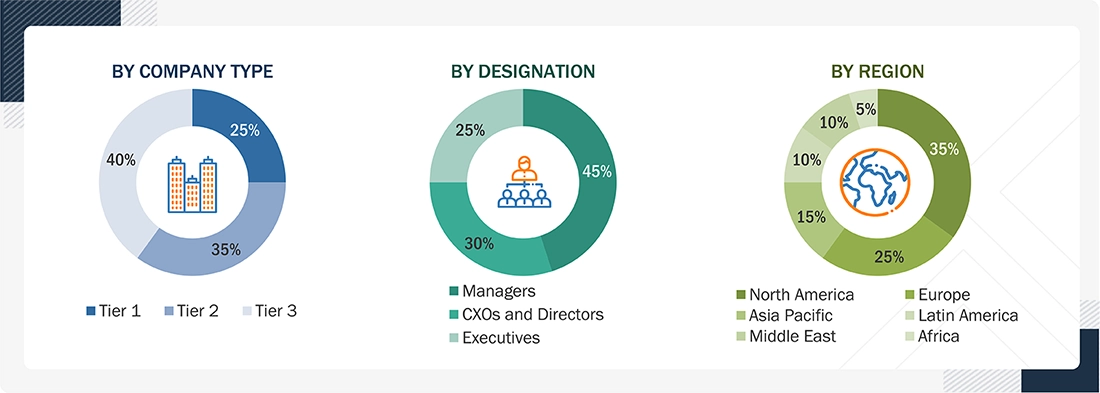
In-depth interviews were conducted with various primary respondents, including key industry participants, subject-matter experts (SMEs), C-level executives of key market players, and industry consultants, to obtain and verify critical qualitative & quantitative information and assess the market’s prospects. Various primary sources from the supply & demand sides of the market were interviewed to obtain qualitative and quantitative information.
To know about the assumptions considered for the study, download the pdf brochure
Market Size Estimation
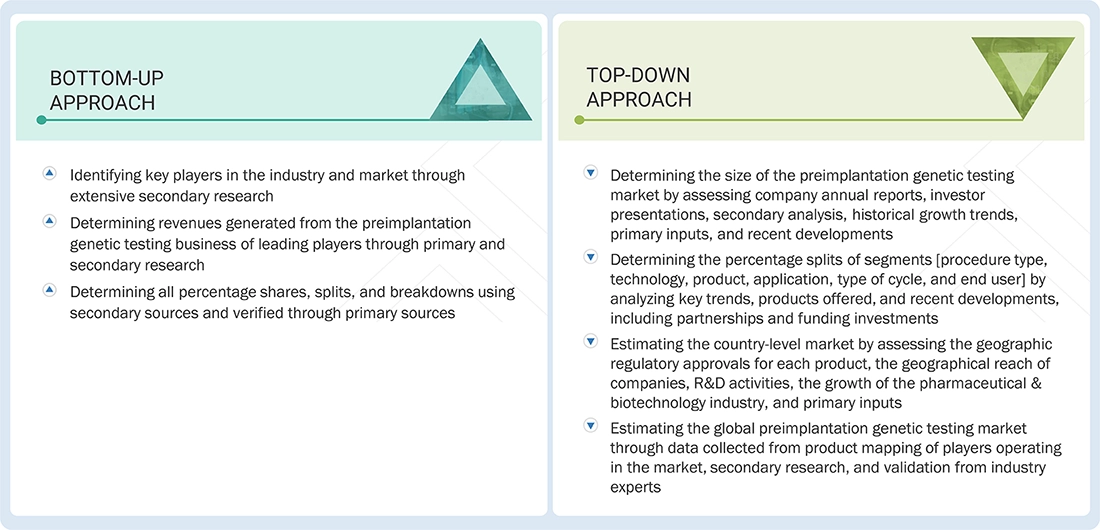
The top-down and bottom-up approaches were used to estimate & validate the total size of the preimplantation genetic testing market. These methods were also used extensively to estimate the size of various market segments.
Data Triangulation
After evaluating the overall market size through the market size estimation process, the total market was divided into several segments and subsegments. Data triangulation and market breakdown procedures were used, whenever applicable, to complete the overall market engineering process and obtain precise statistics for all segments and subsegments. The data was triangulated by analyzing various factors and trends from the demand and supply sides.
Market Definition
Preimplantation genetic testing (PGT) examines embryos during in vitro fertilization (IVF) before possible transfer to a woman's uterus. This is done to test a range of genetic problems that can cause implantation failure, miscarriage, and birth defects in a resulting child.
Preimplantation genetic testing refers to the three types of tests that may be performed on embryos during IVF:
- Preimplantation genetic screening for abnormal chromosome number (PGT-A)
- Preimplantation genetic testing for monogenic (individual) disease (PGT-M)
- Preimplantation genetic testing structural rearrangement (PGT-SR) for known chromosomal misarrangements such as inversion and translocation.
The study offers an in-depth analysis of the preimplantation genetic testing market, examining contemporary market trends and developments, as well as its potential growth from 2025 to 2030. It includes detailed market trends, the competitive landscape, market size, forecasts, and the analysis of the key preimplantation genetic testing product and service providers.
Stakeholders
- Contract research organizations (CROs)
- Contract development and manufacturing organizations (CDMOs)
- In vitro fertilization (IVF) centers and fertility clinics
- Life science companies
- Fertility clinics
- Academic & research institutes
- Private research institutes
- Venture capitalists & investors
- Market research & consulting firms
- Government associations
- Medical institutions & universities
- Hospitals & clinics
Report Objectives
- To define, describe, and forecast the preimplantation genetic testing market based on procedure type, technology, product & service, application, type of cycle, end user, and region
- To provide detailed information regarding the major factors influencing the market growth (such as drivers, restraints, opportunities, and challenges)
- To strategically analyze micromarkets concerning individual growth trends, prospects, and contributions to the overall preimplantation genetic testing market
- To analyze the opportunities in the market for stakeholders and provide details of the competitive landscape for market leaders
- To forecast the size of the market segments concerning six main regions, namely, North America, Europe, the Asia Pacific, Latin America, the Middle East, and Africa
- To strategically profile the key players in the preimplantation genetic testing market and comprehensively analyze their core competencies and market rankings
- To track and analyze competitive developments such as product launches, acquisitions, expansions, agreements, partnerships, and collaborations in the preimplantation genetic testing market
- To benchmark players within the preimplantation genetic testing market using the ‘Company Evaluation Matrix' framework, which analyzes market players based on various parameters within the broad categories of business and product strategy
Get the Full Preimplantation Genetic Testing Market Report
Full forecast, segment splits, and company analysis for all Preimplantation Genetic Testing Market.
- Canada Preimplantation Genetic Testing Market
- US Preimplantation Genetic Testing Market
- UK Preimplantation Genetic Testing Market
- France Preimplantation Genetic Testing Market
- Italy Preimplantation Genetic Testing Market
- Spain Preimplantation Genetic Testing Market
- China Preimplantation Genetic Testing Market
- Japan Preimplantation Genetic Testing Market
- India Preimplantation Genetic Testing Market
- Australia Preimplantation Genetic Testing Market
- South Korea Preimplantation Genetic Testing Market
- Brazil Preimplantation Genetic Testing Market
- Mexico Preimplantation Genetic Testing Market
- UAE Preimplantation Genetic Testing Market
- Rest Of Europe Preimplantation Genetic Testing Market
- Rest Of Asia Pacific Preimplantation Genetic Testing Market
- Rest Of Latin America Preimplantation Genetic Testing Market
- Kingdom Of Saudi Arabia Preimplantation Genetic Testing Market
- Rest Of GCC Countries Preimplantation Genetic Testing Market
- GCC Countries Preimplantation Genetic Testing Market
- Rest Of Middle East Preimplantation Genetic Testing Market
Need a Tailored Report?
Customize this report to your needs
Get 10% FREE Customization
Customize This Report
