
Mexico Process Automation and Instrumentation Market (2024-2029)

The Mexico Process Automation and Instrumentation Market was valued at $2715.1 Million in 2024 and projected to reach to $3388.7 Million by 2029, representing a compound annual growth rate of 4.5%. Mexico's Process Automation and Instrumentation Market is experiencing robust growth driven by industrial modernization efforts and the need for enhanced operational efficiency across manufacturing sectors.


| Market Size in | USD 26.32 MN |
| Market Forecast in | |
| CAGR | |
| Forecast Period | |
| Units Considered | Value (USD MN) |
Mexico Process Automation and Instrumentation Market Trends and Insights
- Mexico's market expansion is driven by increasing industrial modernization, growing demand for operational efficiency in manufacturing, and rising adoption of digital transformation initiatives across the semiconductor and electronics sectors.
- The country's strategic position within North America and its established manufacturing base position Mexico as a key hub for automation technology deployment. During the 2024-2029 forecast period, Mexico is expected to experience steady growth fueled by investments in smart factory infrastructure and process optimization technologies.
- Mexico's market growth, though slightly below the global CAGR of 5.9%, reflects the country's unique industrial dynamics and the gradual pace of automation adoption in certain sectors.
- Key industries in Mexico, including automotive, electronics assembly, and chemical processing, are increasingly integrating advanced instrumentation and control systems to enhance productivity and reduce operational costs..
Key Market Statistics
- CAGR (2024-2029) 4.5% CAGR
- Market Size, 2024 ~USD 2715.1 Million
- Forecast, 2029 ~USD 3388.7 Million
- Country Mexico
Mexico Process Automation and Instrumentation Market Overview
Market Valuation :
Mexico's Process Automation and Instrumentation Market reached USD 2,715.1 million in 2024, with strong growth trajectory through 2029.
Industrial Modernization Drive :
Mexican manufacturers are increasingly investing in automation technologies to enhance operational efficiency and remain competitive in global supply chains.
Digital Transformation Adoption :
Rising adoption of Industry 4.0 initiatives and digital transformation across Mexican manufacturing sectors is accelerating demand for advanced instrumentation solutions.
Steady Growth Momentum :
Mexico's market is projected to reach USD 3,388.7 million by 2029, growing at a CAGR of 4.5%, outpacing regional peers in automation investment.
Mexico Process Automation and Instrumentation Market Dynamics
- The country's strategic position in global supply chains is compelling manufacturers to adopt advanced automation and instrumentation technologies to maintain competitiveness and reduce production costs. Looking ahead to 2029, Mexico's market will benefit from accelerating digital transformation initiatives, increased foreign direct investment in manufacturing, and government support for industrial modernization programs.
- The convergence of rising labor costs, demand for product quality improvements, and the shift toward smart manufacturing will continue to propel market expansion, creating significant opportunities for automation solution providers and instrumentation vendors..
Market Ecosystem
Related Ecosystem
Industrial Automation
- Sensors
- Image Sensors
- Manufacturing Execution System (MES)
- Actuators
- Flow Sensors
- Siemens ag
- ABB India Limited
- Emerson Electric Co.
- HONEYWELL INTERNATIONAL INC.
- SCHNEIDER ELECTRIC SE
Industrial Iot
- Sensors
- Pressure Sensors
- Flow Sensors
- Gas Sensors
- Image Sensors
- Siemens ag
- ABB India Limited
- HONEYWELL INTERNATIONAL INC.
- Emerson Electric Co.
- SCHNEIDER ELECTRIC SE
Information System And Analytics
- Machine Learning
- Natural Language Processing (NLP)
- Sensors
- Software as A Service (SaaS)
- Data Loss Prevention (DLP)
- International Business Machines Corporation
- MICROSOFT CORPORATION
- Amazon.com, Inc.
- Oracle Corporation
Key Takeaways
- Mexico's Process Automation and Instrumentation Market is valued at USD 2,715.1 million in 2024 and will reach USD 3,388.7 million by 2029 at a 4.5% CAGR.
- Mexico's market growth is driven by industrial modernization, smart factory investments, and digital transformation across manufacturing sectors.
- Mexico's automotive, electronics assembly, and chemical processing industries are primary adopters of advanced automation and instrumentation technologies.
- Mexico's market growth rate of 4.5% is slightly below the global average of 5.9%, reflecting regional adoption dynamics and industrial maturity levels.
Process Automation and Instrumentation Market Report Scope
| Report Metric | Details |
|---|---|
| Base Year | 2024 |
| Fastest Growing Segment | HMI (Solution) |
| Forecast Period | 2024-2029 |
| Growth Rate | CAGR of 5.9% from 2024 to 2029 |
| Largest Segment | SOLUTIONS (Instrument And Solution) |
| Market Size Base Year (Billions) | ~USD 74.03 (2024) |
| Revenue Forecast (Billions) | ~USD 98.6 (2029) |
| Segments Covered | Instrument And Solution, Instrument, Type, Industry, Solution, Offering, Hardware Type |
Mexico Process Automation and Instrumentation Market Report Segmentation
7 segment dimensions are covered across the global market.
By Instrument And Solution
- Instruments
- Solutions
By Instrument
- Field Instruments
- Process Analyzers
By Type
- Co2 Analyzers
- Conductivity Analyzers
- Dissolved Oxygen Analyzers
- Drives And Motors
- Gas Analyzers
- Hydrogen Sulfide Analyzers
- I/O Modules
- Level Transmitters
- Liquid Analyzers
- Liquid Density Analyzers
- Mlss Analyzers
- Moisture Analyzers
- Other Field Instruments
- Oxygen Analyzers
- Ph Analyzers
- Pressure Transmitters
- Robot Controllers
- Safety Components
- Sensors And Actuators
- Temperature Transmitters
- Toc Analyzers
- Toxic Gas Analyzers
- Turbidity Analyzers
By Industry
- Chemicals
- Energy & Power
- Food & Beverages
- Metals & Mining
- Oil & Gas
- Pharmaceuticals
- Pulp & Paper
- Water & Wastewater Treatment
By Solution
- Dcs
- Functional Safety
- Hmi
- Mes
- Plc
- Scada
By Offering
- Hardware
- Services
- Software
By Hardware Type
- Advanced Panel-Based Hmis
- Advanced Pc-Based Hmis
- Basic Hmis
- Other Hardware Types
Target Audience
- Automation Equipment Manufacturers : Need Mexico-specific market data to assess market size, growth potential, and competitive positioning for manufacturing and distribution strategy development.
- Instrumentation Solution Providers : Require detailed insights into Mexico's industrial instrumentation demand, technology adoption rates, and customer segments to optimize product offerings and sales strategies.
- Investment & Private Equity Firms : Seek comprehensive Mexico market analysis to evaluate investment opportunities in automation and instrumentation companies operating in or targeting the Mexican market.
- Manufacturing & Industrial Companies : Need market intelligence on automation trends and instrumentation solutions available in Mexico to make informed capital expenditure and modernization decisions.
- Consulting & Systems Integration Firms : Require Mexico market data and growth forecasts to advise clients on digital transformation initiatives and automation implementation strategies in the region.
Reasons to Buy this Report
- Market-Specific Sizing & Forecasts : Access precise valuation data for Mexico's market (USD 2,715.1M in 2024) with detailed 5-year forecasts to support investment decisions and business planning.
- Competitive Landscape Intelligence : Understand Mexico-specific competitive dynamics, key players, and market positioning to identify partnership and expansion opportunities in this growing market.
- Growth Driver Analysis : Gain insights into Mexico's unique growth catalysts including industrial modernization, digital transformation adoption, and manufacturing sector dynamics driving 4.5% CAGR.
- Regional Market Segmentation : Detailed breakdown of Mexico's market by technology type, industry vertical, and application to identify high-potential segments for targeted market entry.
- Strategic Decision Support : Leverage Mexico-focused market intelligence to develop go-to-market strategies, pricing models, and product positioning tailored to local manufacturing needs.
Frequently asked questions
What is the current market size of Process Automation and Instrumentation in Mexico?
Mexico's Process Automation and Instrumentation Market was valued at USD 2,715.1 million in 2024.
What is the projected market size for Mexico by 2029?
Mexico's Process Automation and Instrumentation Market is projected to reach USD 3,388.7 million by 2029.
What is the CAGR for Mexico's Process Automation and Instrumentation Market?
Mexico's market is expected to grow at a compound annual growth rate (CAGR) of 4.5% from 2024 to 2029.
Which industries in Mexico are driving automation and instrumentation adoption?
Mexico's automotive, electronics assembly, chemical processing, and manufacturing sectors are the primary drivers of automation and instrumentation technology adoption.
How does Mexico's market growth compare to global trends?
Mexico's CAGR of 4.5% is slightly below the global CAGR of 5.9%, reflecting regional industrial dynamics and varying adoption rates across sectors.
RESEARCH METHODOLOGY
The study involved four major activities in estimating the current size of the process automation and instrumentation system market. Exhaustive secondary research has been done to collect information on the market, peer market, and parent market. To validate these findings, assumptions, and sizing with industry experts across the value chain through primary research has been the next step. Both top-down and bottom-up approaches have been employed to estimate the complete market size. After that, market breakdown and data triangulation methods have been used to estimate the market size of segments and subsegments. Two sources of information—secondary and primary—have been used to identify and collect information for an extensive technical and commercial study of the process automation and instrumentation market.
Secondary Research
Various secondary sources have been referred to in the secondary research process to identify and collect information important for this study. The secondary sources include annual reports, press releases, and investor presentations of companies; white papers; journals and certified publications; and articles from recognized authors, websites, directories, and databases. Secondary research has been conducted to obtain key information about the industry’s supply chain, the market’s value chain, the total pool of key players, market segmentation according to the industry trends (to the bottom-most level), regional markets, and key developments from market- and technology-oriented perspectives. The secondary data has been collected and analyzed to determine the overall market size, further validated by primary research.
Primary Research
Extensive primary research was conducted after gaining knowledge about the current scenario of the process automation and instrumentation market through secondary research. Several primary interviews were conducted with experts from the demand and supply sides across four major regions-North America, Europe, Asia Pacific and RoW. This primary data was collected through questionnaires, emails, and telephonic interviews.
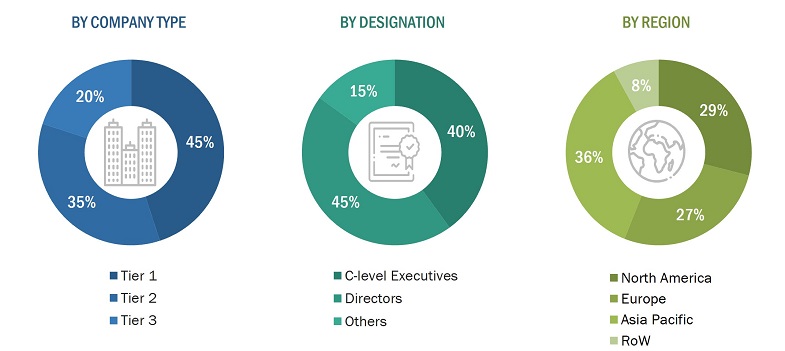
To know about the assumptions considered for the study, download the pdf brochure
Market Size Estimation
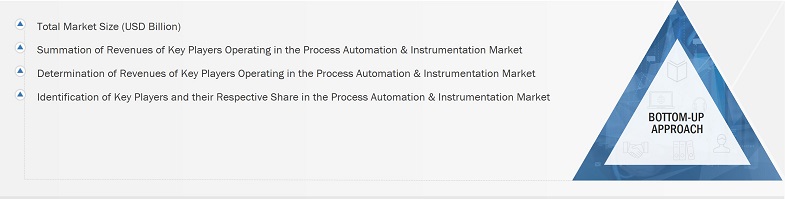
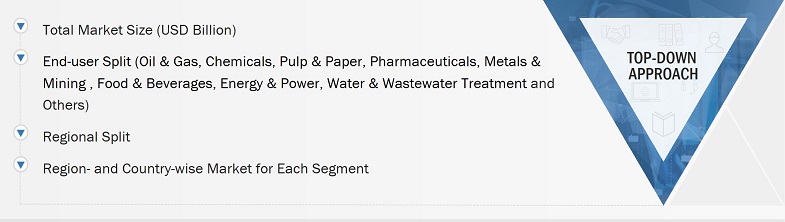
Both top-down and bottom-up approaches have been used to estimate and validate the total size of the process automation and instrumentation market. These methods have also been used extensively to estimate the size of various subsegments in the market. The following research methodology has been used to estimate the market size:
- Major players in the industry and markets have been identified through extensive secondary research.
- The industry’s value chain and market size (in terms of value) have been determined through primary and secondary research processes.
- All percentage shares, splits, and breakdowns have been determined using secondary sources and verified through primary sources.
Global Process Automation and Instrumentation Market Size: Bottom-Up Approach
Global Process Automation and Instrumentation Market Size: Top-down Approach
Data Triangulation
After arriving at the overall size of the process automation & instrumentation market from the market size estimation process explained above, the total market has been split into several segments and subsegments. Data triangulation and market breakdown procedures have been employed, wherever applicable, to complete the overall market engineering process and arrive at the exact statistics for all segments and subsegments of the market. The data has been triangulated by studying various factors and trends from both the demand and supply sides. Along with this, the market size has been validated using both top-down and bottom-up approaches.
Market Definition
Process automation and instrumentation involve the integration of hardware, software, and computer technologies to facilitate and control production. A process automation system (PAS) is a technology-driven solution designed to manage processes across different industries. The main end users are chemicals, oil & gas, pulp & paper, metals & mining, water & wastewater treatmeant and manufacturing. These systems enhance the efficiency and effectiveness of complex industrial processes by automating operations on manufacturing plants, thus ensuring production safe and effective work. Instrumentation devices such as transmitters and analyzers measure and monitor critical parameters such as level, pressure and temperature. By implementing process automation and instrument solutions, companies can reduce human involvement and accelerate time-to-market.
Stakeholders:
- Process Automation & Instrumentation solution and service providers
- Raw material suppliers
- System Integrators
- Original Equipment Manufacturers (OEM)
- Government organizations, forums, alliances, and associations
- Research organizations
- Consultants and Engineering Firms
- Technology standard organizations, forums, alliances, and associations
- Technology investors
- End-use industries (Oil & Gas, Chemicals, Pulp & Paper, Pharmaceuticals, Metals & Mining , Food & Beverages, Energy & Power, Water & Wastewater Treatment and Others)
- Venture capitalists, private equity firms, and startups
Report Objectives
- To define, describe and forecast the process automation and instrumentation market, in terms of instrument, solution, and industry.
- To describe and forecast the market, in terms of value, with regard to four main regions: North America, Europe, Asia Pacific, and Rest of the World (RoW) along with their respective countries
- To provide detailed information regarding major factors influencing the market growth (drivers, restraints, opportunities, and challenges)
- To provide a detailed overview of the value chain of process automation and instrumentation.
- To strategically analyze micromarkets with respect to individual growth trends, prospects, and contributions to the process automation and instrumentation market
- To analyze opportunities in the market for stakeholders by identifying high-growth segments of the process automation and instrumentation.
- To strategically profile key players and comprehensively analyze their market position in terms of ranking and core competencies, along with detailing the competitive landscape for market leaders
- To analyze competitive strategies, such as product launches, expansions, mergers and acquisitions, adopted by key market players in the process automation and instrumentation market.
Available Customizations:
With the given market data, MarketsandMarkets offers customizations according to the company’s specific needs. The following customization options are available for the report:/
Company Information:
- Detailed analysis and profiling of additional market players (up to 5)
Get the Full Process Automation and Instrumentation Market Report
Full forecast, segment splits, and company analysis for all Process Automation and Instrumentation Market.
- Rest Of Middle East Process Automation and Instrumentation Market
- US Process Automation and Instrumentation Market
- Canada Process Automation and Instrumentation Market
- Germany Process Automation and Instrumentation Market
- UK Process Automation and Instrumentation Market
- France Process Automation and Instrumentation Market
- Rest Of Europe Process Automation and Instrumentation Market
- China Process Automation and Instrumentation Market
- Japan Process Automation and Instrumentation Market
- India Process Automation and Instrumentation Market
- Rest Of Asia Pacific Process Automation and Instrumentation Market
- GCC Countries Process Automation and Instrumentation Market
Need a Tailored Report?
Customize this report to your needs
Get 10% FREE Customization
Customize This Report
