
Japan Proteins & Protein Crystals Market (2025-2030)

The Japan Proteins & Protein Crystals Market was valued at $3710 Million in 2025 and projected to reach to $5630 Million by 2030, representing a compound annual growth rate of 8.7%. Japan's proteins and protein crystals market is poised for sustained growth through 2030, supported by the country's robust pharmaceutical and biotechnology ecosystem.


| Market Size in | USD 26.32 MN |
| Market Forecast in | |
| CAGR | |
| Forecast Period | |
| Units Considered | Value (USD MN) |
Japan Proteins & Protein Crystals Market Trends and Insights
- Japan's advanced pharmaceutical and biotechnology infrastructure, combined with rising demand for protein-based therapeutics and structural biology research, is driving market expansion.
- The country's aging population and increasing prevalence of chronic diseases are accelerating adoption of protein therapeutics across Japan's healthcare system. Japan's market growth is supported by significant investments in drug discovery and development, particularly in protein crystallography for rational drug design.
- Japan's leading research institutions and pharmaceutical companies are leveraging protein crystal structures to develop innovative treatments, positioning Japan as a key player in the Asia Pacific region.
- The forecast period through 2030 reflects Japan's commitment to advancing precision medicine and biopharmaceutical innovation..
Key Market Statistics
- CAGR (2025-2030) 8.7% CAGR
- Market Size, 2025 ~USD 3710 Million
- Forecast, 2030 ~USD 5630 Million
- Country Japan
Japan Proteins & Protein Crystals Market Overview
Market Valuation :
Japan's proteins and protein crystals market is valued at USD 3,710 million in 2025, with strong growth trajectory driven by advanced pharmaceutical infrastructure and biotechnology innovation.
Growth Momentum :
The market is projected to reach USD 5,630 million by 2030, representing an 8.7% CAGR, slightly below the global average of 9.5%, reflecting Japan's mature but steady market expansion.
Therapeutic Demand :
Rising demand for protein-based therapeutics in Japan is fueled by aging population demographics, increased prevalence of chronic diseases, and growing adoption of biologics in clinical practice.
Research Excellence :
Japan's world-class structural biology research capabilities and investment in crystallography infrastructure position the country as a key hub for protein crystal development and pharmaceutical applications.
Japan Proteins & Protein Crystals Market Dynamics
- The aging population and rising healthcare expenditure are driving demand for innovative protein-based therapeutics, while Japan's leadership in structural biology research continues to attract investment and collaboration.
- Government initiatives promoting life sciences innovation and the expansion of contract research organizations (CROs) specializing in protein crystallography further strengthen market fundamentals. The market will benefit from increasing adoption of personalized medicine, growing partnerships between Japanese pharmaceutical companies and global biotech firms, and advancements in high-throughput protein production technologies.
- However, competition from other Asian markets and regulatory complexities may moderate growth rates.
- Strategic focus on rare disease therapeutics and biosimilar development will create new opportunities for market participants in Japan..
Market Ecosystem
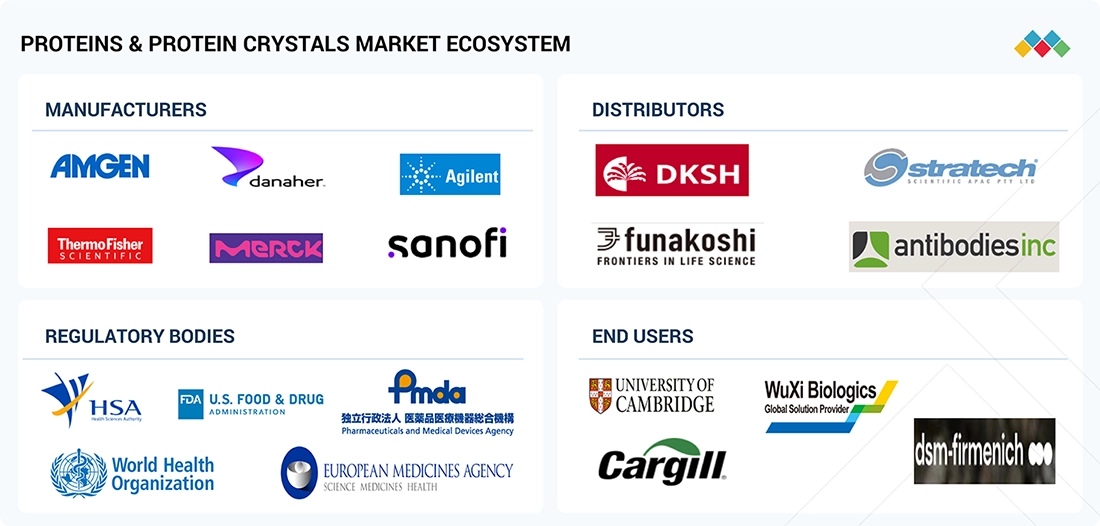
PROTEINS & PROTEIN CRYSTALS MARKET: COMMERCIAL USE CASES ACROSS INDUSTRIES
| COMPANY | USE CASE DESCRIPTION | BENEFITS |
|---|---|---|
 |
It produces monoclonal antibodies, hormones, and fusion proteins for disease treatment. | Provides targeted therapies with high efficacy and reduced side effects |
 |
It develops recombinant proteins and biologics for oncology and autoimmune disorders. | Advances personalized medicine and biopharmaceutical innovation |
 |
It offers structural proteins and reagents for research and bioprocessing applications. | Enables reliable scaffold formation and improved tissue modeling |
 |
Through innovative technologies like crystalline-sponge consumables, Merck helps push the boundaries of what is structurally resolvable, reducing material needs and speeding discovery. | Helps researchers speed up early-stage biologics and therapeutic development |
 |
Aplio i-series Ultrasound Systems – Incorporates Micro-Vascular Imaging (SMI) and contrast-enhanced ultrasound (CEUS) for vascular imaging in peripheral and abdominal applications | Enables visualization of low-velocity blood flow in micro vessels, enhances detection of vascular lesions and plaque morphology, supports real-time evaluation without ionizing radiation, and improves diagnostic accuracy in early vascular disease detection |
Logos and trademarks shown above are the property of their respective owners. Their use here is for informational and illustrative purposes only.
Related Ecosystem
Analytical And Scientific Instrumentation
- Environmental Testing
- Gas Chromatography
- Polymerase Chain Reaction (PCR)
- Automated Liquid Handling Systems
- Flow Cytometry
- Thermo Fisher Scientific Inc.
- Danaher Corporation
- Agilent Technologies, Inc.
- Merck KGaA
- Shimadzu Corporation
Key Takeaways
- Japan's proteins and protein crystals market will grow from USD 3,710M (2025) to USD 5,630M (2030) at an 8.7% CAGR.
- Japan's advanced biotech infrastructure and aging population are primary drivers of protein therapeutic adoption.
- Japan's pharmaceutical companies are investing heavily in protein crystallography for drug discovery and development.
- Japan is positioned as a leading Asia Pacific hub for structural biology research and protein-based innovation.
Proteins & Protein Crystals Market Report Scope
| Report Metric | Details |
|---|---|
| Base Year | 2025 |
| Fastest Growing Segment | STRUCTURAL PROTEINS (Product Type) |
| Forecast Period | 2025–2030 |
| Growth Rate | CAGR of 9.5% from 2025 to 2030 |
| Largest Segment | THERAPEUTIC PROTEINS (Product Type) |
| Market Size Base Year (Billions) | ~USD 610.05 (2025) |
| Revenue Forecast (Billions) | ~USD 960.37 (2030) |
| Segments Covered | Product Type, Type, Application, End User |
Japan Proteins & Protein Crystals Market Report Segmentation
4 segment dimensions are covered across the global market.
By Product Type
- Enzymatic Proteins
- Specialty Proteins
- Structural Proteins
- Therapeutic Proteins
By Type
- Analytical Proteins
- Coagulation Factors
- Cosmeceutical Proteins
- Drug Development
- Drug Development & Discovery
- Food Enzymes
- Formulation/Manufacturing
- Functional Food Proteins
- Hormones
- Industrial Enzymes
- Industrial Proteins
- Insulin
- Life Science Research
- Monoclonal Antibodies
- Nutritional Proteins
- Research Proteins
- Storage/Inventory Management
- Structural Proteins
By Application
- Agriculture & Animal Nutrition
- Bioenergy & Environmental
- Cosmeceuticals & Nutraceuticals
- Healthcare
- Industrial Processing
- Other Applications
- Tissue Engineering
By End User
- Biotechnology Industry
- Food & Beverage Industry
- Other End Users
- Pharma Industry
- Research, Academia, And Cros
Target Audience
- Pharmaceutical Companies : Japanese and international pharma firms need Japan-specific market data to assess protein therapeutic opportunities, evaluate market entry strategies, and benchmark competitive positioning in this mature biotech market.
- Biotechnology Firms : Biotech companies require detailed insights into Japan's protein crystallography capabilities, research partnerships, and funding landscape to identify collaboration opportunities and commercialization pathways.
- Contract Research Organizations : CROs and contract manufacturing organizations need market intelligence on Japan's protein production demand, regulatory requirements, and client base to expand service offerings and capture market share.
- Investment & Private Equity : Investors and PE firms evaluating opportunities in Japan's life sciences sector require comprehensive market data, growth forecasts, and competitive analysis to make informed investment decisions and identify acquisition targets.
- Academic & Research Institutions : Universities and research centers need market insights to align research initiatives with commercial opportunities, secure funding, and establish partnerships with industry players in Japan's protein research ecosystem.
Key Companies in the Japan Proteins & Protein Crystals Market
| Company | HQ | Ownership | Strongest segments |
|---|---|---|---|
| DANAHER CORPORATION | United States | Public Company | Biotechnology (bioprocessing, single-use, media, filtration, aseptic fill-finish),Life Sciences (mass spec, genomics, flow cytometry, microscopy, lab automation),Diagnostics (clinical instruments, consumables, software, services), |
| MERCK & CO., INC. | United States | Public Company | Oncology (Keytruda, Welireg, ADC collaborations, Lynparza alliance),Vaccines (Gardasil, pediatric and adult portfolio),Cardiovascular, pulmonary hypertension and other specialty brands, |
| AMGEN INC. | United States | Public Company | Immunology & Inflammation (Enbrel, Otezla, TEZSPIRE, rocatinlimab pipeline),Bone Health & Nephrology (Prolia, XGEVA, EVENITY, Aranesp, Parsabiv),Oncology & Hematology (KYPROLIS, BLINCYTO, Vectibix, IMDELLTRA, oncology with BeiGene), |
| ELI LILLY AND COMPANY | United States | Public Company | Cardiometabolic (diabetes, obesity, Jardiance alliance),Oncology,Immunology and Inflammation, |
| NOVO NORDISK A/S | Denmark | Public Company | Obesity therapies (including GLP-1 for weight management),Diabetes GLP-1 therapies,Insulin and insulin delivery (including smart pens and needles), |
| PFIZER INC. | India | Public Company | Internal medicine (cardiovascular, respiratory, gastro, neuroscience, women’s health, pain, nutrition, multivitamins),Anti-infectives and hospital-focused injectables,Vaccines, |
| THERMO FISHER SCIENTIFIC INC. | United States | Public Company | Life Sciences Solutions,Analytical Instruments,Specialty Diagnostics, |
| SANOFI | France | Public Company | Vaccines (pediatric, RSV, hexavalent, travel/endemic),Immunology & Inflammation therapies,Rare Diseases & Neurology, |
| AGILENT TECHNOLOGIES, INC. | United States | Public Company | Life Sciences and Diagnostics Markets,Agilent CrossLab,Applied Markets, |
| TAKEDA PHARMACEUTICAL COMPANY LIMITED | Japan | Public Company | Gastroenterology (Entyvio, Takecab/Vocinti, EOHILIA and related),Rare Diseases and Plasma-Derived Therapies (Takhzyro, Advate, Elaprase, Replagal, Vpriv, ADZYNMA, Gammagard Liquid/Kiovig, Hyqvia, Cuvitru, Flexbumin),Oncology (Adcetris, Leuplin/Enantone, Ninlaro, Iclusig, FRUZAQLA, Alunbrig and others), |
| BIOCON | India | Public Company | Generics (APIs and formulations),Biosimilars (oncology, diabetes, immunology),CRDMO and contract research, |
DANAHER CORPORATION
Danaher Corporation is a publicly traded U.S. conglomerate founded in 1969 with 59,000 employees. The company operates across diversified industrial and life sciences sectors.
MERCK & CO., INC.
Merck & Co., Inc. is a publicly traded pharmaceutical company founded in 1891 with 74,000 employees, engaged in the discovery, development, and distribution of medicines and vaccines.
AMGEN INC.
Amgen Inc. is a publicly traded biopharmaceutical company founded in 1980 with 31,500 employees, specializing in the development of human therapeutics.
ELI LILLY AND COMPANY
Eli Lilly and Company is a publicly traded pharmaceutical company founded in 1876 with 50,000 employees, focused on discovering and manufacturing medicines across multiple therapeutic areas.
NOVO NORDISK A/S
Novo Nordisk A/S is a publicly traded Danish pharmaceutical company founded in 1923 with 67,900 employees, specializing in diabetes care, obesity, and other chronic diseases.
PFIZER INC.
Pfizer Inc. is a publicly traded pharmaceutical company founded in 1950 with 1,244 employees, operating in India.
THERMO FISHER SCIENTIFIC INC.
Thermo Fisher Scientific Inc. is a publicly traded U.S. company founded in 1956 with 125,000 employees, providing laboratory equipment, reagents, and analytical instruments for research and diagnostics.
SANOFI
Sanofi is a publicly traded French pharmaceutical company founded in 1994 with 74,846 employees, engaged in the research, development, and distribution of medicines and vaccines.
AGILENT TECHNOLOGIES, INC.
Agilent Technologies, Inc. is a publicly traded U.S. company founded in 1999 with 18,000 employees, specializing in life sciences, diagnostics, and applied chemical markets.
TAKEDA PHARMACEUTICAL COMPANY LIMITED
Takeda Pharmaceutical Company Limited is a publicly traded Japanese pharmaceutical company founded in 1781 with 47,029 employees, focused on developing and commercializing innovative medicines.
BIOCON
Biocon is a publicly traded Indian biopharmaceutical company founded in 1978 with 16,447 employees, engaged in the development of biologics and biosimilars.
Reasons to Buy this Report
- Market-Specific Sizing : Obtain precise valuation data for Japan's proteins and protein crystals market with detailed 2025-2030 forecasts, enabling accurate budget allocation and investment planning specific to this high-value Asian market.
- Competitive Intelligence : Understand Japan's unique competitive landscape, including local pharmaceutical leaders, emerging biotech firms, and international players, to identify partnership and market entry opportunities tailored to Japanese market dynamics.
- Regulatory & Infrastructure Insights : Gain comprehensive understanding of Japan's regulatory environment, government support programs, and advanced research infrastructure that differentiate this market from global trends and impact business strategy.
- Demand Driver Analysis : Access detailed analysis of Japan-specific demand drivers including aging demographics, healthcare spending patterns, and adoption rates of protein therapeutics to inform product development and commercialization strategies.
- Growth Opportunity Mapping : Identify high-potential segments within Japan's market such as rare disease therapeutics, biosimilars, and structural biology research applications to prioritize resource allocation and maximize ROI.
Frequently asked questions
What is the current market size of proteins and protein crystals in Japan?
Japan's proteins and protein crystals market is valued at USD 3,710 million in 2025.
What is the projected market size for Japan by 2030?
Japan's market is projected to reach USD 5,630 million by 2030, growing at an 8.7% CAGR.
What factors are driving growth in Japan's proteins and protein crystals market?
Japan's market growth is driven by an aging population, rising chronic disease prevalence, advanced biotech infrastructure, and increased investment in protein-based drug discovery.
How does Japan's market compare to the global proteins and protein crystals market?
Japan's 8.7% CAGR is slightly below the global 9.5% CAGR, reflecting Japan's mature but steady market expansion within the Asia Pacific region.
What role does protein crystallography play in Japan's pharmaceutical industry?
Protein crystallography is central to Japan's rational drug design efforts, enabling pharmaceutical companies to develop innovative protein-based therapeutics and advance precision medicine.
RESEARCH METHODOLOGY
The research methodology for analyzing the global protein and protein crystals market is clearly detailed on the website, outlining the structured processes and best practices followed for data collection, validation, and analysis. This transparent and systematic approach ensures high accuracy and reliability of the insights presented. Such clarity allows stakeholders to assess the robustness of the findings, conclusions, and recommendations, ultimately enabling confident and well-informed decision-making.
Secondary Research
For this secondary research, we relied on diverse sources such as D&B Hoovers, Bloomberg Businessweek, Factiva, white papers, annual reports, company filings, investor presentations, and SEC filings. This in-depth approach helped build a robust database of key players in the industry. The database provides essential insights into established companies, detailed multi-level market segmentation, trends within each segment, notable mergers and acquisitions, and the impact of cutting-edge technological innovations shaping the protein and protein crystals market.
Primary Research
The primary research involved both qualitative and quantitative approaches and was conducted in depth with participants from both the supply and demand sides through interviews.
On the supply side, interviews were conducted with senior-level executives such as CEOs, vice presidents, marketing and sales directors, product managers, regional managers, and R&D heads from leading companies engaged in the production, purification, crystallization, and analysis of proteins and protein crystals.
On the demand side, professionals interviewed included research scientists, laboratory managers, bioprocess engineers, procurement specialists, and subject-matter experts from pharmaceutical and biotechnology companies, academic and research institutions, contract research organizations (CROs), and diagnostic laboratories, food & beverage industry, agriculture industry, animal nutrition industry, cosmetics & personal care industry, nutraceuticals industry, bioenergy / biofuels industry, environmental & waste management industry, among other end users.
Overall, this research provided valuable insights into market segmentation, key players, trends, dynamics, and growth of drivers in the market.
A breakdown of the primary respondents is provided below:

Note 1: Other designations include sales managers, marketing managers, business development managers, product managers, distributors, and suppliers.
Note 2: Companies are classified into tiers based on their total revenue. As of 2024 Tier 1 = >USD 1 billion, Tier 2 = < USD 500 million, and Tier 3 = < USD 100 million.
To know about the assumptions considered for the study, download the pdf brochure
Market Size Estimation
The report offers an in-depth analysis of the Protein and Protein crystals market, identifying key players through both primary and secondary research. Secondary research drew on annual and financial reports from major market companies, while primary research included detailed interviews with key opinion leaders such as CEOs, directors, and senior marketing executives.
To estimate the global market value, a segment-based methodology was applied, using revenue data from leading solutions and supplier providers. This involved:
- Identifying major participants in the global Protein and protein crystals market.
- Reviewing their reported annual revenues, whether directly related to protein and protein crystals or reflecting broader business units and product lines.
The data was then projected to arrive at the overall value for the Protein and Protein crystals market.
Global Protein and protein crystals market: Bottom-up Approach & Top-down Approach

Data Triangulation
The research approach involved dividing the global protein and protein crystals market into different participant groups and categories. Data triangulation and segmentation methods were applied to ensure the accuracy of information across all market segments. Multiple analyses were carried out to assess both the demand and supply aspects of the market. By combining top-down and bottom-up approaches, the study provided a comprehensive understanding of the Protein and protein crystals market.
Market Definition
The protein and protein crystals market encompasses a wide range of proteins and their crystallized forms used across pharmaceutical, biotechnology, industrial, and research applications. It includes enzymatic, therapeutic, structural, and specialty proteins tailored for specific functional roles. These products support diverse applications such as drug development, healthcare and diagnostics, tissue engineering, industrial biocatalysis, animal nutrition, bioenergy and environmental processes, agriculture, and cosmeceutical and nutraceutical formulations.
Stakeholders
- Protein and Reagent Manufacturers
- Crystallization Equipment and Consumable Suppliers
- Biopharmaceutical and Biotechnology Companies
- Contract Research Organizations (CROs)
- Research Institutions
- Raw Material and Reagent Suppliers
- Regulatory Authorities
Report Objectives
- To define, describe, and forecast the global Protein and protein crystals market based on product type, application, end user, and region
- To provide detailed information regarding the major factors influencing market growth (drivers, restraints, opportunities, and challenges), along with the current trends
- To strategically analyze micromarkets with respect to their individual growth trends, future prospects, and contributions to the total market
- To analyze opportunities in the market for stakeholders and provide details of the competitive landscape for market leaders
- To forecast the revenue of the market segments for five regions: North America (US and Canada), Europe (Germany, France, UK, Italy, Spain, and Rest of Europe), the Asia Pacific (China, Japan, India, South Korea, Australia, and Rest of Asia Pacific), Latin America (Brazil, Mexico, and Rest of Latin America), and the Middle East & Africa
- To profile the key players and comprehensively analyze their market shares and core competencies
- To track and analyze competitive developments in the Protein and protein crystals market, such as acquisitions, product launches, expansions, agreements, joint ventures, alliances, and collaborations
Get the Full Proteins & Protein Crystals Market Report
Full forecast, segment splits, and company analysis for all Proteins & Protein Crystals Market.
- US Proteins & Protein Crystals Market
- Canada Proteins & Protein Crystals Market
- Germany Proteins & Protein Crystals Market
- UK Proteins & Protein Crystals Market
- France Proteins & Protein Crystals Market
- Italy Proteins & Protein Crystals Market
- Spain Proteins & Protein Crystals Market
- China Proteins & Protein Crystals Market
- India Proteins & Protein Crystals Market
- Australia Proteins & Protein Crystals Market
- South Korea Proteins & Protein Crystals Market
- Brazil Proteins & Protein Crystals Market
- Mexico Proteins & Protein Crystals Market
Need a Tailored Report?
Customize this report to your needs
Get 10% FREE Customization
Customize This Report
