
Asia Pacific Pulse Oximeter Market (2025-2030)

The Asia Pacific Pulse Oximeter Market was valued at $870.4 Million in 2025 and projected to reach to $1609 Million by 2030, representing a compound annual growth rate of 9.2%. The Asia Pacific pulse oximeter market is positioned for sustained growth driven by expanding healthcare access, rising chronic disease burden, and digital health transformation across the region.


| Market Size in | USD 26.32 MN |
| Market Forecast in | |
| CAGR | |
| Forecast Period | |
| Units Considered | Value (USD MN) |
Asia Pacific Pulse Oximeter Market Trends and Insights
- Asia Pacific's growth trajectory reflects rising healthcare infrastructure investments, increasing prevalence of respiratory and cardiovascular diseases, and growing adoption of remote patient monitoring technologies across the region.
- The 9.2% compound annual growth rate in Asia Pacific outpaces the global average, driven by expanding middle-class populations and government initiatives to improve healthcare accessibility. Asia Pacific's pulse oximeter market benefits from accelerating digital health adoption and rising awareness of non-invasive monitoring devices in both developed and emerging economies.
- Key markets within Asia Pacific, including China, India, Japan, and Southeast Asia, are witnessing heightened demand from hospitals, clinics, and home healthcare settings.
- The forecast period through 2030 positions Asia Pacific as a critical growth engine, with technological innovations and cost-effective manufacturing capabilities further strengthening the region's market position..
Key Market Statistics
- CAGR (2025-2030) 9.2% CAGR
- Market Size, 2025 ~USD 870.4 Million
- Forecast, 2030 ~USD 1609 Million
- Geography Asia Pacific
Asia Pacific Pulse Oximeter Market Overview
Rapid Market Expansion :
Asia Pacific pulse oximeter market is projected to grow from USD 870.4 million in 2025 to USD 1,609.0 million by 2030, representing a robust 9.2% CAGR, outpacing the global growth rate of 8.7%.
Healthcare Infrastructure Investment :
Significant government and private sector investments in healthcare infrastructure across Asia Pacific countries are driving demand for advanced diagnostic devices, including pulse oximeters in hospitals and clinics.
Rising Disease Prevalence :
Increasing prevalence of respiratory and cardiovascular diseases in Asia Pacific populations, coupled with aging demographics, is creating sustained demand for continuous patient monitoring solutions.
Remote Patient Monitoring Adoption :
Growing adoption of telehealth and remote patient monitoring technologies across Asia Pacific is accelerating pulse oximeter integration into digital health ecosystems and home healthcare settings.
Asia Pacific Pulse Oximeter Market Dynamics
- Key markets including Japan, China, India, and Australia are investing heavily in healthcare modernization, creating opportunities for both traditional and connected pulse oximeter solutions.
- The region's younger population in emerging economies combined with aging demographics in developed markets creates diverse demand patterns. Technological advancements in wearable and non-invasive monitoring devices are reshaping the competitive landscape in Asia Pacific.
- Increasing healthcare awareness, government initiatives for disease prevention, and growing middle-class populations with disposable income are expected to sustain the 9.2% CAGR through 2030.
- Strategic partnerships between local manufacturers and global players will be critical for market penetration..
Market Ecosystem
Related Ecosystem
Medical Devices
- Polymerase Chain Reaction (PCR)
- Magnetic Resonance Imaging (MRI)
- Disposable Autoinjectors
- Pulse Oximeters
- Blood Pressure Monitors
- Medtronic plc
- Abbott Laboratories
- Stryker Corporation
- Becton, Dickinson and Company
- JOHNSON & JOHNSON
Key Takeaways
- Asia Pacific pulse oximeter market valued at USD 870.4M in 2025, expanding to USD 1,609M by 2030 at 9.2% CAGR
- Asia Pacific's growth rate exceeds global average, driven by healthcare infrastructure expansion and rising chronic disease prevalence
- Asia Pacific demand is fueled by remote patient monitoring adoption and government healthcare accessibility initiatives
- Asia Pacific's manufacturing capabilities and emerging economies position the region as a key growth driver through 2030
Pulse Oximeter Market Report Scope
| Report Metric | Details |
|---|---|
| Base Year | 2025 |
| Fastest Growing Segment | CONNECTED PULSE OXIMETERS (Technology) |
| Forecast Period | 2025–2030 |
| Growth Rate | CAGR of 8.7% from 2025 to 2030 |
| Largest Segment | ADULTS (Age Group) |
| Market Size Base Year (Billions) | ~USD 3.92 (2025) |
| Revenue Forecast (Billions) | ~USD 5.95 (2030) |
| Segments Covered | Product, Type, Technology, Age Group, End User |
Asia Pacific Pulse Oximeter Market Report Segmentation
5 segment dimensions are covered across the global market.
By Product
- Equipment
- Sensors
By Type
- Bedside/Tabletop Pulse Oximeters
- Disposable Sensors
- Fingertip Pulse Oximeters
- Handheld Pulse Oximeters
- Infants
- Neonatal
- Otc Home Use
- Portable Pulse Oximeters
- Prescription Home Use
- Reusable Sensors
- Wearable Pulse Oximeters
By Technology
- Connected Pulse Oximeters
- Conventional Pulse Oximeters
By Age Group
- Adult
- Adults
- Pediatric
By End User
- Ambulatory Care Centers
- Ambulatory Care Settings
- Home Care Settings
- Hospitals
- Other End User
- Other End Users
- Primary Centers
- Urgent Care Centers
Target Audience
- Medical Device Manufacturers : Manufacturers need Asia Pacific market intelligence to develop region-specific product strategies, identify high-growth markets, and optimize distribution channels across diverse healthcare systems.
- Healthcare Investors & PE Firms : Investment professionals require detailed market forecasts and growth drivers for Asia Pacific to evaluate portfolio opportunities, assess market attractiveness, and support due diligence activities.
- Hospital & Healthcare Providers : Healthcare institutions need market insights to benchmark procurement strategies, understand technology trends, and make informed purchasing decisions for pulse oximeter equipment and systems.
- Distributors & Retailers : Distribution partners require country-level market data and demand forecasts to optimize inventory management, identify growth opportunities, and develop targeted sales strategies across Asia Pacific.
- Government & Policy Makers : Healthcare policymakers and government agencies need market analysis to inform healthcare infrastructure planning, regulatory frameworks, and technology adoption initiatives across the region.
Key Companies in the Asia Pacific Pulse Oximeter Market
| Company | HQ | Ownership | Strongest segments |
|---|---|---|---|
| MEDTRONIC | Ireland | Public Company | Equipment (Bedside and multiparameter-integrated),Sensors (Reusable and disposable),Portable – Handheld, |
| MASIMO | United States | Private Company | Equipment – Bedside Monitors,Equipment – Portable (Handheld & Wearable),Equipment – Fingertip & Consumer, |
| NIHON KOHDEN CORPORATION | Japan | Public Company | Equipment – Bedside monitors with integrated SpO2,Equipment – Portable (handheld, wearable-capable, transport),Equipment – Fingertip/consumer-style oximeters, |
| KONINKLIJKE PHILIPS N.V. | Netherlands | Public Company | Equipment – Bedside monitors with integrated SpO2,Equipment – Portable (handheld and wearable clinical devices),Equipment – Fingertip/consumer-oriented devices, |
| ICU MEDICAL, INC. | United States | Public Company | Equipment – Bedside Pulse Oximeters and Multi-parameter Monitors,Sensors – Reusable and Disposable Oximetry Sensors,Portable – Handheld and Clinical Wearable Oximeters, |
| LEPU MEDICAL TECHNOLOGY (BEIJING) CO., LTD. | China | Public Company | Equipment – Bedside / Multiparameter Monitors,Equipment – Portable Handheld,Wearable Pulse Oximeters, |
| GE HEALTHCARE | United States | Public Company | Equipment – Bedside and multi-parameter monitors with integrated SpO2,Sensors and disposables,Portable – Handheld and transport oximeters, |
| CONTEC MEDICAL SYSTEMS CO., LTD. | China | Public Company | Portable – Fingertip,Portable – Handheld,Portable – Wearable, |
| DRäGERWERK AG & CO. KGAA | Germany | Public Company | Equipment – Bedside Monitors (Conventional & Connected),Equipment – Portable (Handheld & Wearable),Equipment – Fingertip & Basic Portable, |
| OSI SYSTEMS, INC. | United States | Public Company | Equipment – Bedside Monitors,Equipment – Portable (Handheld/Wearable),Sensors and Disposables, |
| A&D COMPANY, LIMITED | Japan | Public Company | Equipment – Portable Handheld,Equipment – Portable Wearable,Equipment – Portable Fingertip, |
MEDTRONIC
Medtronic is a publicly traded medical device company founded in 1949 and headquartered in Ireland, employing approximately 95,000 people globally.
MASIMO
Masimo is a private medical technology company established in 1989 in the United States with 2,200 employees specializing in patient monitoring solutions.
NIHON KOHDEN CORPORATION
Nihon Kohden Corporation is a Japanese public company founded in 1951 that employs 6,116 people and operates in the medical device sector.
KONINKLIJKE PHILIPS N.V.
Koninklijke Philips N.V. is a large multinational public company founded in 1891 in the Netherlands with 63,670 employees operating across healthcare and technology sectors.
ICU MEDICAL, INC.
ICU Medical, Inc. is a publicly traded medical device company founded in 1984 in the United States with 13,000 employees.
LEPU MEDICAL TECHNOLOGY (BEIJING) CO., LTD.
Lepu Medical Technology is a publicly traded Chinese medical device company founded in 1999 in Beijing with 8,689 employees.
GE HEALTHCARE
GE Healthcare is a publicly traded healthcare technology company founded in 2022 in the United States with 54,000 employees.
CONTEC MEDICAL SYSTEMS CO., LTD.
Contec Medical Systems is a publicly traded Chinese medical device company founded in 1996 with 1,712 employees.
DRäGERWERK AG & CO. KGAA
Drägerwerk AG & Co. KGaA is a publicly traded German medical and safety technology company founded in 1889 with 16,033 employees.
OSI SYSTEMS, INC.
OSI Systems, Inc. is a publicly traded technology company founded in 1987 in the United States with 7,337 employees.
A&D COMPANY, LIMITED
A&D Company, Limited is a large publicly traded Japanese company founded in 1920 with 64,394 employees operating in measurement and medical device sectors.
Countries within Asia Pacific - compare and drill down
| Country | 2025 size (native) |
|---|---|
| Japan | USD 449.8 Million |
| China | USD 387.5 Million |
| India | USD 296.4 Million |
| Australia | USD 216.7 Million |
| South Korea | USD 126.7 Million |
| Rest Of Asia Pacific | USD 131.8 Million |
Country market size visualization
Reasons to Buy this Report
- Regional Market Sizing & Forecasts : Obtain precise market valuations for Asia Pacific and individual country-level data through 2030, enabling accurate business planning and investment decisions specific to the region's growth trajectory.
- Competitive Landscape Analysis : Understand market dynamics, key players, and competitive positioning within Asia Pacific to identify partnership opportunities, market gaps, and strategic entry points for new products.
- Country-Specific Insights : Access detailed market analysis for major Asia Pacific markets including Japan, China, India, and Australia, with tailored insights on regulatory environments and local demand drivers.
- Growth Driver Identification : Leverage comprehensive analysis of healthcare infrastructure investments, disease prevalence trends, and technology adoption patterns driving the 9.2% CAGR across Asia Pacific.
- Strategic Decision Support : Make informed decisions on market entry, product development, and resource allocation with data-driven insights specific to Asia Pacific's unique healthcare landscape and growth opportunities.
Frequently asked questions
What is the current size of the Asia Pacific pulse oximeter market?
The Asia Pacific pulse oximeter market is valued at USD 870.4 million in 2025 and is projected to grow to USD 1,609.0 million by 2030.
What is the expected growth rate for Asia Pacific pulse oximeters?
Asia Pacific is expected to grow at a compound annual growth rate (CAGR) of 9.2% from 2025 to 2030, outpacing the global average.
Which countries drive the Asia Pacific pulse oximeter market?
Key markets within Asia Pacific include China, India, Japan, and Southeast Asian nations, which are experiencing heightened demand across hospitals, clinics, and home healthcare settings.
What factors are driving growth in the Asia Pacific pulse oximeter market?
Growth in Asia Pacific is driven by rising healthcare infrastructure investments, increasing chronic disease prevalence, digital health adoption, and government initiatives to improve healthcare accessibility.
How does Asia Pacific's pulse oximeter market compare to global trends?
Asia Pacific's 9.2% CAGR exceeds the global average of 8.7%, reflecting the region's accelerating healthcare modernization and expanding middle-class populations.
RESEARCH METHODOLOGY
This study involved the extensive use of both primary and secondary sources. The research process involved the study of various factors affecting the industry to identify the segmentation types, industry trends, key players, competitive landscape, fundamental market dynamics, and key player strategies.
Secondary Research
This research study used widespread secondary sources; directories, databases such as Dun & Bradstreet, Bloomberg BusinessWeek, and Factiva; white papers; annual reports; and companies’ house documents. Secondary research was used to identify and collect information for this extensive, technical, market-oriented, and commercial study of the global pulse oximeters market. It was also used to obtain important information about the top players, market classification, and segmentation according to industry trends to the bottom-most level, geographic markets, and key developments related to the market and technology perspectives. A database of the key industry leaders was also prepared using secondary research.
Primary Research
In the primary research process, various supply & demand sources were interviewed to obtain qualitative and quantitative information for this report. The primary sources from the supply side include industry experts such as CEOs, vice presidents, marketing and sales directors, technology and innovation directors, and related key executives from various key companies and organizations operating in the pulse oximeters market. The primary sources from the demand side include key executives from hospitals, physicians, clinicians, and research institutes.
A breakdown of the primary respondents is provided below:
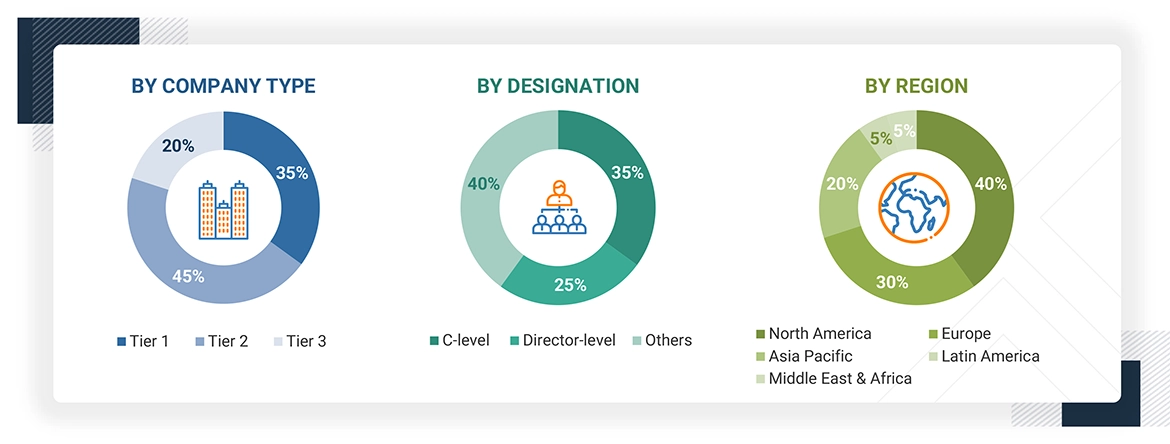
Note 1: C-level primaries include CEOs, CFOs, COOs, and VPs.
Note 2: Others include sales managers, marketing managers, business development managers, product managers, distributors, and suppliers.
Note 3: Companies are classified into tiers based on their total revenue. As of 2024, Tier 1 = >USD 10.00 billion, Tier 2 = USD 1.00 billion to USD 10.00 billion, and Tier 3 = < USD 1.00 billion.
To know about the assumptions considered for the study, download the pdf brochure
Market Size Estimation
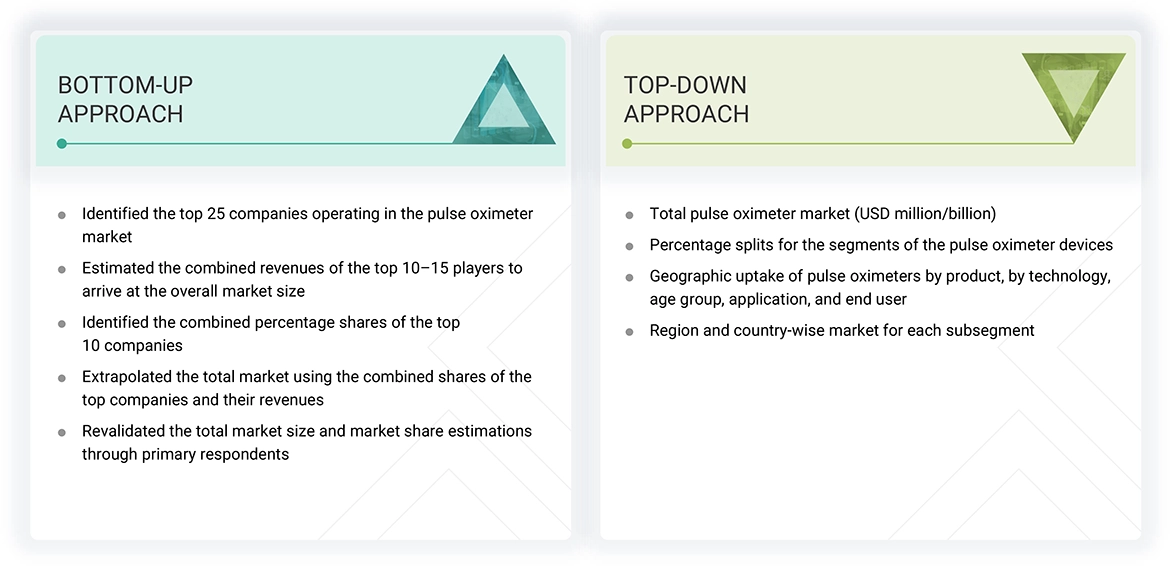
For the global market value, annual revenues were calculated based on the revenue mapping of major product manufacturers and OEMs active in the global pulse oximeter market. All the major product manufacturers were identified at the global and/or country/regional level. Revenue mapping for the respective business segments/sub-segments was made for the major players (who contribute at least 60-70% of the market share at the global level). Also, the global pulse oximeter market was split into various segments and sub-segments based on:
- List of major players operating in the pulse oximeter devices market at the regional and/or country level
- Product mapping of various pulse oximeter device manufacturers at the regional and/or country level
- Mapping of annual revenue generated by listed major players from the pulse oximeter segment (or the nearest reported business unit/product category)
- Revenue mapping of major players to cover at least 70-75% of the global market share as of 2024
- Extrapolation of the revenue mapping of the listed major players to derive the global market value of the respective segments/subsegments
- Summation of the market value of all segments/subsegments to arrive at the global pulse oximeter market
Data Triangulation
After arriving at the market size, the total pulse oximeters market was divided into several segments and subsegments. To complete the overall market engineering process and arrive at the exact statistics for all segments & subsegments, data triangulation and market breakdown procedures were employed, wherever applicable.
Market Definition
A pulse oximeter is a non-invasive medical device used to measure the blood's oxygen saturation level (SpO2) and pulse rate. It typically works by emitting light through a body part—usually a fingertip or earlobe—and detecting the amount of oxygenated and deoxygenated hemoglobin based on light absorption.
Stakeholders
- Medical device manufacturers
- Regulatory authorities (e.g., the US FDA and the EMA, among others)
- Hospitals & clinics
- Physicians & anesthesiologists
- Home healthcare providers
- Distributors & suppliers
- Research institutes & labs
- Health insurance companies
- Government health departments
- Patients & end-users
- Medical research institutes
- Business research & consulting service providers
Report Objectives
- To define, describe, segment, and forecast the pulse oximeters market by product, type, age group, technology, end user, and region.
- To provide detailed information about the factors influencing the market growth (such as drivers, restraints, opportunities, and challenges)
- To analyze micromarkets with respect to individual growth trends, prospects, and contributions to the overall pulse oximeter market
- To analyze market opportunities for stakeholders and provide details of the competitive landscape for key players
- To forecast the size of the pulse oximeters market in five regions (along with their respective key countries), namely, North America, Europe, the Asia Pacific, Latin America, and the Middle East & Africa
- To profile the key players in the pulse oximeters market and comprehensively analyze their core competencies and market shares
- To track and analyze competitive developments such as acquisitions, product launches, expansions, collaborations, agreements, partnerships, and R&D activities of the leading players in the pulse oximeters market
- To benchmark players within the pulse oximeters market using the Competitive Leadership Mapping framework, which analyzes market players on various parameters within the broad categories of business strategy, market share, and product offering
Get the Full Pulse Oximeter Market Report
Full forecast, segment splits, and company analysis for all Pulse Oximeter Market.
- Canada Pulse Oximeter Market
- US Pulse Oximeter Market
- Germany Pulse Oximeter Market
- France Pulse Oximeter Market
- UK Pulse Oximeter Market
- Italy Pulse Oximeter Market
- Spain Pulse Oximeter Market
- Japan Pulse Oximeter Market
- China Pulse Oximeter Market
- India Pulse Oximeter Market
- Australia Pulse Oximeter Market
- South Korea Pulse Oximeter Market
- Brazil Pulse Oximeter Market
- Mexico Pulse Oximeter Market
- UAE Pulse Oximeter Market
- Rest Of Europe Pulse Oximeter Market
- Rest Of Asia Pacific Pulse Oximeter Market
- Rest Of Latin America Pulse Oximeter Market
- Kingdom Of Saudi Arabia (Ksa) Pulse Oximeter Market
- Rest Of GCC Countries Pulse Oximeter Market
Need a Tailored Report?
Customize this report to your needs
Get 10% FREE Customization
Customize This Report
