
Germany Quantum Computing in Healthcare Market (2025-2030)

The Germany Quantum Computing in Healthcare Market was valued at $20 Million in 2025 and projected to reach to $100 Million by 2030, representing a compound annual growth rate of 38.0%. Germany's quantum computing in healthcare market is poised for exceptional growth as the country leverages its technological expertise and pharmaceutical leadership.

| Market Size in | USD 26.32 MN |
| Market Forecast in | |
| CAGR | |
| Forecast Period | |
| Units Considered | Value (USD MN) |
Germany Quantum Computing in Healthcare Market Trends and Insights
- Valued at $20.0 million in 2025, Germany's market is expected to expand to $100.0 million by 2030, reflecting a compound annual growth rate of 38.0%.
- This robust expansion is driven by Germany's strong pharmaceutical research infrastructure, advanced healthcare IT systems, and significant government investment in quantum technology initiatives. The German healthcare sector is increasingly adopting quantum computing applications for drug discovery, molecular simulation, and personalized medicine optimization.
- Germany's leadership in precision medicine and its established biotech ecosystem position the country as a key innovation hub for quantum-enabled healthcare solutions.
- By 2030, Germany is anticipated to capture substantial market share as enterprises scale quantum pilots into production environments and regulatory frameworks mature..
Key Market Statistics
- CAGR (2025-2030) 38.0% CAGR
- Market Size, 2025 ~USD 20 Million
- Forecast, 2030 ~USD 100 Million
- Country Germany
Germany Quantum Computing in Healthcare Market Overview
Market Valuation Growth :
Germany's quantum computing in healthcare market is valued at $20.0 million in 2025 and is projected to reach $100.0 million by 2030, representing a 5x increase over five years.
Strong CAGR Performance :
With a compound annual growth rate of 38.0%, Germany's market growth significantly outpaces global averages, driven by robust pharmaceutical R&D investments and digital health initiatives.
Pharmaceutical Research Leadership :
Germany's world-class pharmaceutical research infrastructure and biotech ecosystem position the country as a key hub for quantum computing applications in drug discovery and development.
Healthcare Digitalization :
Germany's advanced healthcare system and commitment to digital transformation create favorable conditions for quantum computing adoption in diagnostics, personalized medicine, and clinical research.
Germany Quantum Computing in Healthcare Market Dynamics
- The 38% CAGR reflects increasing investments from German healthcare institutions, biotech companies, and research organizations seeking quantum solutions for complex computational challenges in drug discovery and genomic analysis.
- Government support for quantum technology initiatives and collaboration between academic institutions and industry players will accelerate market expansion. By 2030, Germany is expected to establish itself as a European quantum computing hub in healthcare, attracting international partnerships and talent.
- The convergence of Germany's strong regulatory framework, advanced IT infrastructure, and commitment to precision medicine will drive adoption across hospitals, pharmaceutical companies, and research centers, positioning the country as a leader in quantum-enabled healthcare innovation..
Market Ecosystem
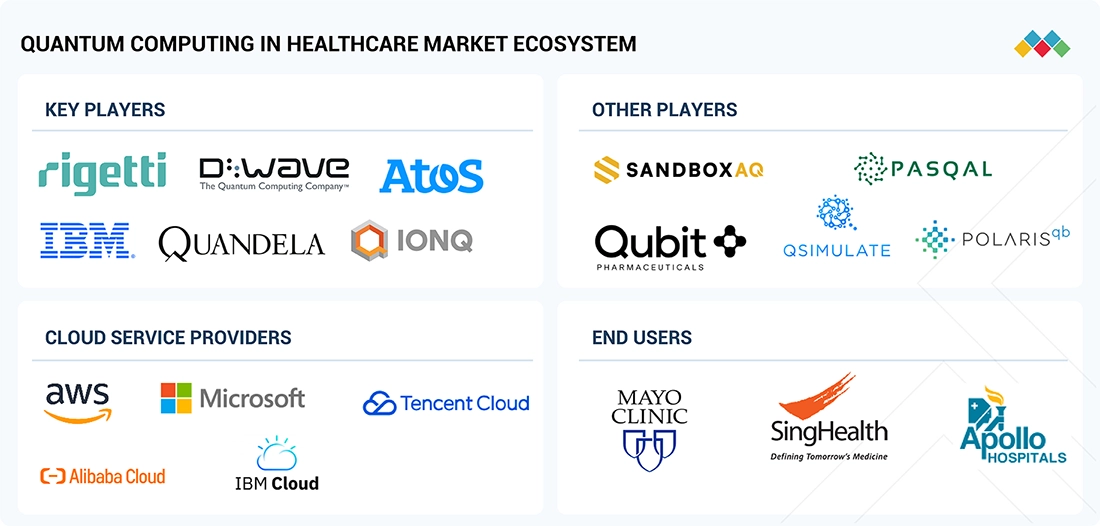
Quantum Computing in Healthcare Market: COMMERCIAL USE CASES ACROSS INDUSTRIES
| COMPANY | USE CASE DESCRIPTION | BENEFITS |
|---|---|---|
 |
The company develops algorithms for quantum computing that focus on application areas such as drug design, drug discovery | Accelerated drug development, more precise molecule modeling, reduced R&D time |
 |
Quantum machine learning for diagnostic imaging and genomics analysis | Improved accuracy in disease detection, personalized medicine advancements |
 |
Wave quantum hybrid technology enables faster and more efficient computer-aided drug design | Uses quantum-hybrid AI to enhance large language models for drug discovery |
 |
Quandela’s provides access to photonic quantum computing, enables developing, and deploying algorithms | Accelerating the discovery of new drugs, potentially leading to more effective treatments |
 |
Leveraging quantum hardware to address challenges in drug discovery | Facilitates the discovery of new pharmaceutical compounds, potentially reducing the time and cost |
Logos and trademarks shown above are the property of their respective owners. Their use here is for informational and illustrative purposes only.
Related Ecosystem
Healthcare Analytics
- Machine Learning
- Natural Language Processing (NLP)
- Blood Pressure Monitors
- Computed Tomography (CT)
- Magnetic Resonance Imaging (MRI)
- Oracle Corporation
- PHILIPS HEALTHCARE
- Siemens healthineers
- International Business Machines Corporation
- EPIC SYSTEMS CORPORATION
Healthcare It
- Computed Tomography (CT)
- Machine Learning
- Magnetic Resonance Imaging (MRI)
- Natural Language Processing (NLP)
- Predictive Analytics
- CERNER CORPORATION
- PHILIPS HEALTHCARE
- Oracle Corporation
- GE HealthCare Technologies Inc.
- Siemens healthineers
Key Takeaways
- Germany's quantum computing in healthcare market is projected to grow from $20.0M (2025) to $100.0M (2030) at a 38.0% CAGR.
- Germany's pharmaceutical and biotech sectors are primary drivers of quantum adoption for drug discovery and molecular modeling applications.
- Germany's advanced healthcare IT infrastructure and regulatory environment support accelerated quantum technology deployment across clinical and research settings.
- Germany is emerging as a European leader in quantum-enabled precision medicine, attracting investment and talent to the region by 2030.
Quantum Computing in Healthcare Market Report Scope
| Report Metric | Details |
|---|---|
| Base Year | 2025 |
| Fastest Growing Segment | HEALTHCARE PAYERS (End User) |
| Forecast Period | 2025–2030 |
| Growth Rate | CAGR of 37.9% from 2025 to 2030 |
| Largest Segment | CLOUD-BASED SOLUTIONS (Deployment) |
| Market Size Base Year (Billions) | ~USD 0.27 (2025) |
| Revenue Forecast (Billions) | ~USD 1.32 (2030) |
| Segments Covered | Component, Deployment, Technology, Application, End User |
Germany Quantum Computing in Healthcare Market Report Segmentation
5 segment dimensions are covered across the global market.
By Component
- Hardware
- Services
- Software
By Deployment
- Cloud-Based Solutions
- On-Premise Solutions
By Technology
- Other Technologies
- Quantum Annealing
- Quantum Machine Learning
- Superconducting Qubits
- Trapped Ions
By Application
- Cybersecurity & Data Encryption
- Drug Discovery & Development
- Genomics & Precision Medicine
- Healthcare Logistics & Scheduling
- Medical Diagnostics
- Other Applications
- Radiotherapy
- Risk Analysis
By End User
- Healthcare Payers
- Healthcare Providers
- Labs & Research Institutes
- Pharmaceutical & Biotechnology Companies
GERMANY: QUANTUM COMPUTING IN MARKET, BY END USER, 2023–2030
| Segment | 2023 | 2024 | 2025 | 2026 | 2027 | 2028 | 2029 | 2030 | CAGR (%) |
|---|---|---|---|---|---|---|---|---|---|
| HEALTHCARE PAYERS | 1 | 1.5 | 2.3 | 3.5 | 5.2 | 7.8 | 11.4 | 16.7 | 48.5 |
| HEALTHCARE PROVIDERS | 1.9 | 2.7 | 3.8 | 5.3 | 7.3 | 10.1 | 14 | 19.4 | 38.6 |
| LABS & RESEARCH INSTITUTES | 2.4 | 3.3 | 4.6 | 6.3 | 8.6 | 11.8 | 16.1 | 21.8 | 36.6 |
| PHARMACEUTICAL & BIOTECHNOLOGY COMPANIES | 5 | 6.8 | 9.3 | 12.7 | 17.2 | 23.2 | 31.3 | 42.1 | 35.2 |
| TOTAL | 10.3 | 14.4 | 20 | 27.8 | 38.4 | 52.9 | 72.8 | 100 | 38 |
Target Audience
- Pharmaceutical Companies : German and international pharma firms need market intelligence to evaluate quantum computing investments for accelerating drug discovery, optimizing clinical trials, and enhancing R&D efficiency.
- Healthcare Technology Investors : Venture capital and private equity firms focused on German healthtech require detailed market data to identify high-growth quantum computing opportunities and assess investment returns.
- Research Institutions : German universities and research centers need market insights to guide quantum computing research initiatives, secure funding, and establish partnerships with healthcare and pharmaceutical organizations.
- Healthcare Providers : German hospitals and healthcare systems require market analysis to understand quantum computing applications in diagnostics, personalized medicine, and operational optimization.
- Government & Policy Makers : German government agencies and policymakers need market intelligence to inform quantum technology initiatives, healthcare digitalization strategies, and competitive positioning in European innovation.
Key Companies in the Germany Quantum Computing in Healthcare Market
| Company | HQ | Ownership | Strongest segments |
|---|---|---|---|
| IBM | United States | ||
| MICROSOFT | United States | ||
| GOOGLE LLC | United States | ||
| ATOS SE | United States |
IBM
IBM is a multinational technology corporation that offers quantum computing systems, cloud services, and enterprise solutions across hardware, software, and infrastructure.
MICROSOFT
Microsoft is a global technology company that develops quantum computing hardware, software, and cloud services through its Azure Quantum platform.
GOOGLE LLC
Google LLC is a technology company that develops quantum processors, quantum algorithms, and quantum computing research through its Quantum AI division.
ATOS SE
Atos SE is a multinational IT services company that provides quantum computing solutions, simulation software, and enterprise technology services.
Reasons to Buy this Report
- Market Entry Strategy : Gain detailed insights into Germany's quantum computing healthcare landscape to develop targeted market entry strategies, identify key stakeholders, and understand competitive positioning within Europe's largest economy.
- Investment Decision Support : Access comprehensive data on market size, growth projections, and CAGR trends to support investment decisions in German quantum healthcare ventures, startups, and established pharmaceutical companies.
- Competitive Intelligence : Understand Germany's unique market dynamics, regulatory environment, and technological capabilities to benchmark against competitors and identify differentiation opportunities in quantum-enabled healthcare solutions.
- Partnership Identification : Identify potential collaboration opportunities with German research institutions, pharmaceutical firms, and healthcare providers leveraging quantum computing for drug discovery and clinical applications.
- Strategic Planning : Utilize Germany-specific market forecasts and growth drivers to inform long-term strategic planning, resource allocation, and product development roadmaps for quantum healthcare solutions.
Frequently asked questions
What is the current size of Germany's quantum computing in healthcare market?
Germany's quantum computing in healthcare market was valued at $20.0 million in 2025 and is projected to reach $100.0 million by 2030.
What is the expected growth rate for quantum computing in Germany's healthcare sector?
Germany's quantum computing in healthcare market is expected to grow at a compound annual growth rate (CAGR) of 38.0% from 2025 to 2030.
Which healthcare applications are driving quantum computing adoption in Germany?
Germany's primary quantum computing applications in healthcare include drug discovery, molecular simulation, personalized medicine optimization, and clinical trial design.
What factors are accelerating quantum computing adoption in Germany's healthcare market?
Germany's strong pharmaceutical research infrastructure, advanced healthcare IT systems, government quantum initiatives, and leadership in precision medicine are key growth catalysts.
How does Germany's quantum computing market compare to other European countries?
Germany is positioned as a leading European hub for quantum computing in healthcare, leveraging its biotech ecosystem, regulatory maturity, and significant R&D investment.
RESEARCH METHODOLOGY
The study involved several key activities in estimating the current size of the quantum computing in healthcare market. Extensive secondary research was conducted to gather information on this market. The next step was to validate the findings, assumptions, and size estimates by consulting industry experts throughout the value chain through primary research. We employed various methods, including top-down and bottom-up approaches, to estimate the overall market size. Following this, we utilized market segmentation and data triangulation techniques to determine the size of specific segments and subsegments within the quantum computing in healthcare market.
Secondary Research
This research study involved the wide use of secondary sources, directories, and databases such as Dun & Bradstreet, Bloomberg Business, and Factiva; white papers, annual reports, and companies’ house documents; investor presentations; and the SEC filings of companies. The market for companies providing quantum computing in healthcare solutions is assessed using secondary data from both paid and free sources. This involves analyzing the product portfolios of major players in the industry and evaluating these companies based on their performance and quality. Various resources were utilized in the secondary research process to gather information for this study. The sources include annual reports, press releases, investor presentations, white papers, academic journals, certified publications, articles by recognized authors, directories, and databases.
Secondary research was used to identify and collect information useful for the extensive, technical, market-oriented, and commercial study of the quantum computing in healthcare market. It was also used to obtain important information about the key players and market classification and segmentation according to industry trends to the bottom-most level, and key developments related to market and technology perspectives. A database of the key industry leaders was also prepared using secondary research.
Primary Research
In the primary research process, various primary sources from both the supply and demand sides were interviewed to obtain qualitative and quantitative information for this report. Primary sources are mainly industry experts from the core and related industries and preferred suppliers, manufacturers, distributors, technology developers, researchers, and organizations related to all segments of this industry’s value chain. In-depth interviews were conducted with various primary respondents, including key industry participants, subject-matter experts (SMEs), C-level executives of key market players, and industry consultants, among other experts, to obtain and verify the critical qualitative and quantitative information as well as assess prospects.
Primary research was conducted to identify segmentation types; industry trends; key players; and key market dynamics such as drivers, restraints, opportunities, challenges, industry trends, and strategies adopted by key players.
After completing the market engineering process, which includes calculations for market statistics, market breakdown, size estimations, forecasting, and data triangulation, extensive primary research was conducted. This research aimed to gather information and verify the critical numbers obtained during the market analysis. Additionally, primary research was conducted to identify different types of market segmentation, analyze industry trends, evaluate the competitive landscape of quantum computing in healthcare solutions offered by various players, and understand key market dynamics such as drivers, restraints, opportunities, challenges, industry trends, and strategies employed by key market participants.
In the complete market engineering process, the top-down and bottom-up approaches and several data triangulation methods were extensively used to perform the market estimation and market forecasting for the overall market segments and subsegments listed in this report. Extensive qualitative and quantitative analysis was performed on the complete market engineering process to list the key information/insights throughout the report.
A breakdown of the primary respondents:
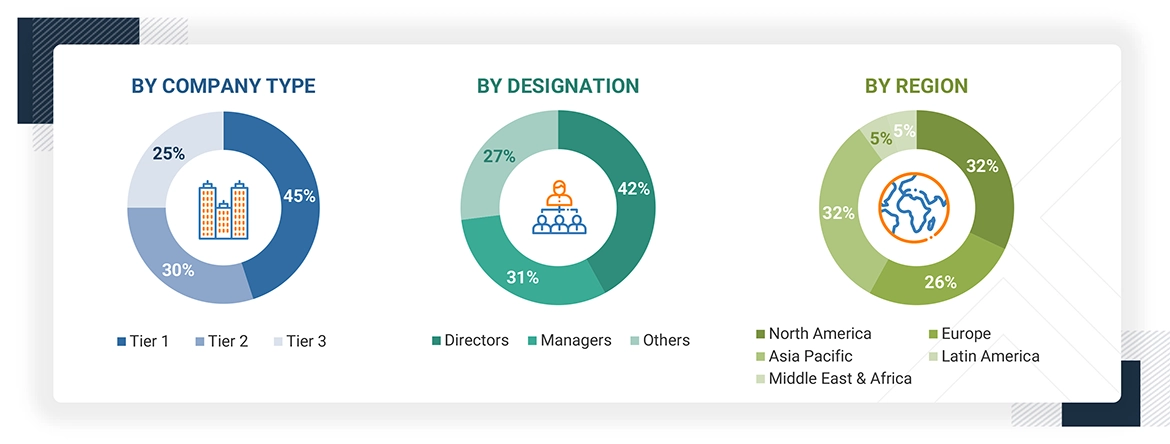
Note 1: Others include sales, marketing, and product managers.
Note 2: Tiers are defined based on a company’s total revenue. As of 2024: Tier 1 = >USD 1 billion, Tier 2 = USD 500 million to USD 1 billion, and Tier 3 = < USD 500 million.
To know about the assumptions considered for the study, download the pdf brochure
Market Size Estimation
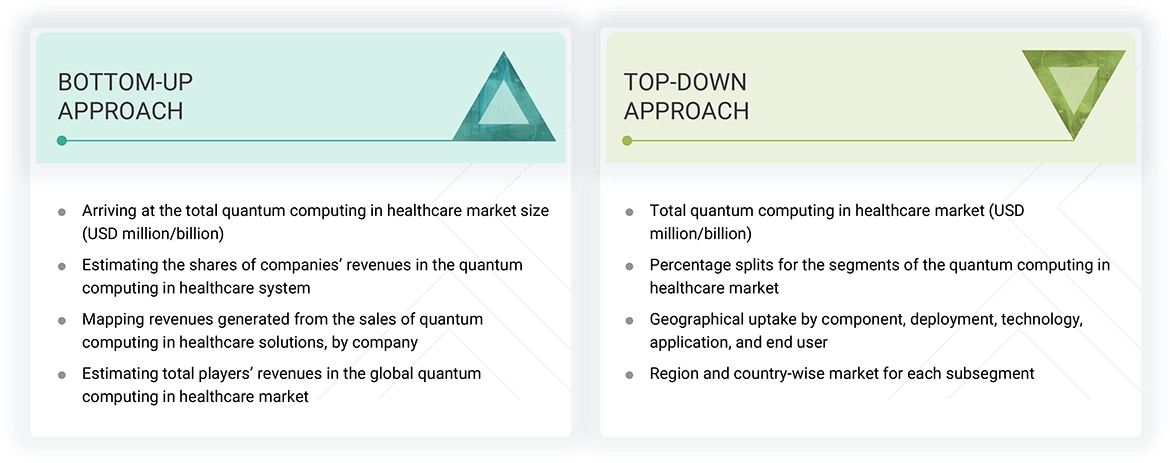
The market size estimates and forecasts provided in this study are derived through a mix of the bottom-up approach (revenue share analysis of leading players) and top-down approach (assessment of utilization/adoption/penetration trends, by component, application, deployment, technology, end user, and region).
Data Triangulation
After arriving at the overall market size using the market size estimation processes, the market was split into several segments and subsegments. Data triangulation and market breakdown procedures were employed to complete the overall market engineering process and arrive at the exact statistics of each market segment and subsegment. The data was triangulated by studying various factors and trends from both the demand and supply sides in the quantum computing in healthcare market.
Market Definition
The quantum computing in healthcare market refers to the application of quantum technologies to enhance medical research and healthcare delivery. It includes the use of quantum hardware, software, and services to accelerate tasks such as drug discovery, genetic analysis, disease modeling, and personalized treatment by processing complex data more efficiently than classical systems.
Stakeholders
- Healthcare providers
- Healthcare vendors
- Quantum computing service providers
- Healthcare payers
- Academic research institutes
- Pharmaceutical and biotechnology companies
- Diagnostic labs
- Imaging labs
- Government institutions
- Market research and consulting firms
- Venture capitalists and investors
Report Objectives
- To define, describe, and forecast the global quantum computing in healthcare market based on component, application, deployment, technology, end user, and region
- To provide detailed information regarding the factors influencing the growth of the market (such as the drivers, restraints, opportunities, and challenges)
- To strategically analyze micromarkets with respect to individual growth trends, prospects, and contributions to the overall quantum computing in healthcare market
- To analyze market opportunities for stakeholders and provide details of the competitive landscape for market leaders
- To forecast the size of the quantum computing in healthcare market in five main regions (along with their respective key countries): North America, Europe, the Asia Pacific, Latin America, and the Middle East & Africa
- To profile key players and comprehensively analyze their product portfolios, market positions, and core competencies in the market
- To track and analyze competitive developments such as product & service launches; expansions; partnerships, agreements, and collaborations; and acquisitions in the quantum computing in healthcare market
- To benchmark players within the quantum computing in healthcare market using the Company Evaluation Matrix framework, which analyzes market players on various parameters within the broad categories of business strategy, market share, and product offering
Get the Full Quantum Computing in Healthcare Market Report
Full forecast, segment splits, and company analysis for all Quantum Computing in Healthcare Market.
- US Quantum Computing in Healthcare Market
- Canada Quantum Computing in Healthcare Market
- UK Quantum Computing in Healthcare Market
- France Quantum Computing in Healthcare Market
- Italy Quantum Computing in Healthcare Market
- Spain Quantum Computing in Healthcare Market
- China Quantum Computing in Healthcare Market
- Japan Quantum Computing in Healthcare Market
- India Quantum Computing in Healthcare Market
- Brazil Quantum Computing in Healthcare Market
- Mexico Quantum Computing in Healthcare Market
- Rest Of Europe Quantum Computing in Healthcare Market
- Rest Of Asia Pacific Quantum Computing in Healthcare Market
- Rest Of Latin America Quantum Computing in Healthcare Market
Need a Tailored Report?
Customize this report to your needs
Get 10% FREE Customization
Customize This Report
