
Nordics Quantum Computing Market (2025-2030)

The Nordics Quantum Computing Market was valued at $60.7 Million in 2025 and projected to reach to $348.8 Million by 2030, representing a compound annual growth rate of 41.9%. The Nordics quantum computing market is positioned for transformative growth over the next five years, driven by robust regional investments in quantum research infrastructure and a concentration of leading technology companies.


| Market Size in | USD 26.32 MN |
| Market Forecast in | |
| CAGR | |
| Forecast Period | |
| Units Considered | Value (USD MN) |
Nordics Quantum Computing Market Trends and Insights
- This robust expansion reflects the Nordics' strong position as a technology innovation hub, driven by significant investments in quantum research infrastructure and a highly skilled workforce.
- The Nordics' quantum ecosystem benefits from government support, academic excellence, and strategic partnerships with global technology leaders. During the 2025-2030 forecast period, the Nordics quantum computing market will be shaped by increasing enterprise adoption, rising R&D spending, and the emergence of quantum-as-a-service platforms.
- The Nordics' commitment to digital transformation and sustainability initiatives positions the region as a critical player in quantum technology development.
- Key sectors including finance, pharmaceuticals, and energy are driving demand for quantum solutions across the Nordics, while the region's regulatory environment continues to support innovation and commercialization..
Key Market Statistics
- CAGR (2025-2030) 41.9% CAGR
- Market Size, 2025 ~USD 60.7 Million
- Forecast, 2030 ~USD 348.8 Million
- Country Nordics
Nordics Quantum Computing Market Overview
Exceptional Growth Trajectory :
The Nordics quantum computing market is projected to grow from $60.7 million in 2025 to $348.8 million by 2030, representing a 41.9% CAGR that exceeds global average growth rates.
Innovation Hub Status :
The Nordics region has established itself as a leading technology innovation center with substantial investments in quantum research infrastructure and world-class research institutions.
Skilled Workforce Advantage :
The region benefits from a highly educated and specialized workforce in quantum physics, computer science, and engineering, supporting rapid commercialization and development initiatives.
Strategic Research Investments :
Significant government and private sector funding in quantum research facilities across Nordic countries is accelerating technology breakthroughs and attracting international quantum computing companies.
Nordics Quantum Computing Market Dynamics
- The region's commitment to becoming a quantum innovation leader, combined with strong government support and academic excellence, creates a favorable ecosystem for market expansion.
- Key sectors including finance, pharmaceuticals, and materials science are increasingly exploring quantum applications, creating substantial commercial opportunities. Looking ahead, the Nordics is expected to maintain its competitive advantage through continued R&D investments, strategic partnerships with global quantum leaders, and the development of quantum-ready talent pipelines.
- The region's emphasis on sustainable technology and ethical AI development aligns with quantum computing's potential to solve complex computational challenges.
- Market participants should anticipate increased venture capital activity, corporate quantum initiatives, and potential acquisition opportunities as the market matures toward 2030..
Market Ecosystem
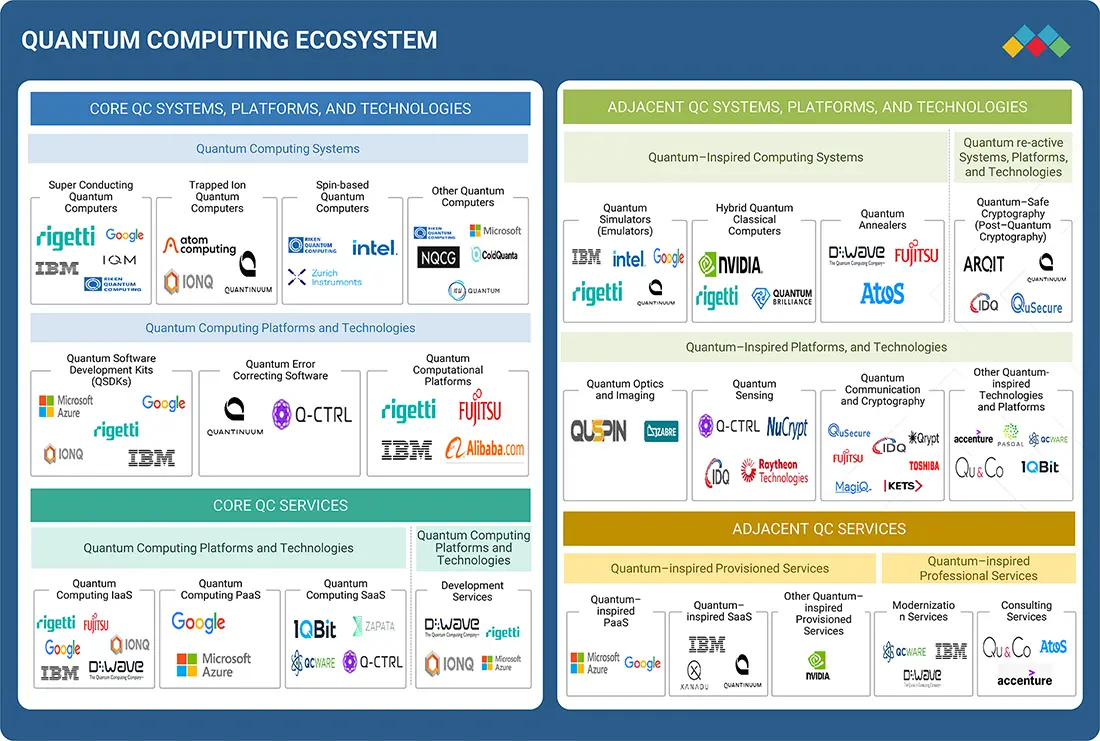
Quantum Computing Market: COMMERCIAL USE CASES ACROSS INDUSTRIES
| COMPANY | USE CASE DESCRIPTION | BENEFITS |
|---|---|---|
 |
IBM and Daimler AG are collaborating to apply quantum computing for optimizing chemical reactions and reactor design. The partnership aims to improve reaction efficiency, reduce energy use, and enhance reactor performance. This effort supports advanced material development for the automotive industry. | While specific outcomes of this collaboration may not be publicly available due to the early stage of quantum computing, it highlights how leading companies are actively exploring quantum computing for reactor design and optimization in the chemical industry. |
 |
BASF is developing new materials across industries using quantum techniques combined with classical computing to enhance cheminformatics and machine learning models predicting molecular properties. | Collaborating with Zapata, BASF benchmarks quantum-enhanced machine learning against classical methods using the Orquestra platform, focusing on feature selection and classification in supervised learning. |
Logos and trademarks shown above are the property of their respective owners. Their use here is for informational and illustrative purposes only.
Related Ecosystem
Automotive Systems
- Light Commercial Vehicles (LCVs)
- Battery Electric Vehicle (BEV)
- Hybrid Electric Vehicle (HEV)
- Agricultural Tractors
- Fuel Cell Electric Vehicle (FCEV)
- BOSCH LIMITED
- DENSO Corporation
- ZF FRIEDRICHSHAFEN AG
- Continental ag
- GORKOVSKY AVTOMOBILNY ZAVOD
Cloud Computing
- Software as A Service (SaaS)
- Natural Language Processing (NLP)
- Platform as A Service (PaaS)
- Machine Learning
- Supply Chain Management
- International Business Machines Corporation
- MICROSOFT CORPORATION
- Oracle Corporation
- Amazon.com, Inc.
Information System And Analytics
- Machine Learning
- Natural Language Processing (NLP)
- Sensors
- Software as A Service (SaaS)
- Data Loss Prevention (DLP)
- International Business Machines Corporation
- MICROSOFT CORPORATION
- Amazon.com, Inc.
- Oracle Corporation
Key Takeaways
- The Nordics quantum computing market will grow from $60.7M (2025) to $348.8M (2030) at a 41.9% CAGR, outpacing global growth trends.
- The Nordics' strong academic institutions and government funding create a competitive advantage in quantum research and development.
- Enterprise adoption in the Nordics across finance, pharmaceuticals, and energy sectors is accelerating quantum solution deployment.
- The Nordics' focus on sustainability and digital transformation positions the region as a leader in quantum technology commercialization.
Quantum Computing Market Report Scope
| Report Metric | Details |
|---|---|
| Base Year | 2025 |
| Fastest Growing Segment | TRAPPED ION (Technology) |
| Forecast Period | 2025-2030 |
| Growth Rate | CAGR of 41.8% from 2025 to 2030 |
| Largest Segment | CLOUD-BASED (Deployment) |
| Market Size Base Year (Billions) | ~USD 3.52 (2025) |
| Revenue Forecast (Billions) | ~USD 20.2 (2030) |
| Segments Covered | Offering, System, Technology, Type, Deployment, End-Use Industry, Application, Service |
Nordics Quantum Computing Market Report Segmentation
8 segment dimensions are covered across the global market.
By Offering
- Application Software
- Services
- Systems
By System
- Systems
By Technology
- Other Technologies
- Photonic Networks
- Quantum Annealing
- Superconducting Qubits
- Trapped Ion
By Type
- Consulting Services
- Quantum Computing As A Service (Qcaas)
By Deployment
- Cloud-Based
- On-Premises
By End-Use Industry
- Academic
- Academic Research
- Banking & Finance
- Chemicals
- Energy & Power
- Government
- Government Research
- Healthcare & Pharmaceuticals
- Space & Defense
- Transportation & Logistics
By Application
- Machine Learning
- Optimization
- Other Applications
- Simulation
By Service
- Consulting Service
- Qcaas
- Quantum Computing As A Service (Qcaas)
NORDICS: QUANTUM COMPUTING MARKET, BY END-USE INDUSTRY, 2025–2030
| Segment | 2025 | 2026 | 2027 | 2028 | 2029 | 2030 | CAGR (%) |
|---|---|---|---|---|---|---|---|
| ACADEMIC RESEARCH | 2 | 2.5 | 3.4 | 4.5 | 6.2 | 8.7 | 34.7 |
| BANKING & FINANCE | 17.7 | 24.5 | 34.1 | 47.4 | 65.9 | 95.1 | 40 |
| CHEMICALS | 4.3 | 6 | 8.2 | 11.3 | 15.5 | 22.1 | 38.4 |
| ENERGY & POWER | 2.5 | 3.6 | 5.3 | 7.7 | 11.1 | 16.8 | 46.4 |
| GOVERNMENT | 6.6 | 9.4 | 13.5 | 19.3 | 27.6 | 41 | 44.2 |
| HEALTHCARE & PHARMACEUTICALS | 6 | 8.7 | 12.4 | 17.9 | 25.6 | 38.2 | 45 |
| SPACE & DEFENSE | 13.6 | 19.1 | 26.7 | 37.4 | 52.6 | 76.5 | 41.2 |
| TRANSPORTATION & LOGISTICS | 8 | 11.5 | 16.5 | 23.7 | 34 | 50.6 | 44.5 |
| TOTAL | 60.7 | 85.3 | 120 | 169.1 | 238.5 | 348.8 | 41.9 |
Target Audience
- Quantum Technology Companies : Quantum hardware and software developers need Nordic market intelligence to identify expansion opportunities, understand regional customer requirements, and assess competitive positioning in this high-growth market.
- Venture Capital & Private Equity Firms : Investment firms targeting Nordic tech innovation require detailed market analysis to identify promising quantum startups, evaluate deal flow, and optimize portfolio allocation in the region.
- Enterprise Technology Leaders : Large corporations in finance, pharmaceuticals, and manufacturing need Nordic market insights to plan quantum computing adoption strategies and identify regional implementation partners.
- Government & Policy Makers : Nordic government agencies and policy bodies require market data to inform quantum research funding decisions, competitive positioning strategies, and technology development roadmaps.
- Strategic Consultants & Analysts : Management consulting firms and research analysts need comprehensive Nordic quantum market data to support client advisory work, competitive benchmarking, and strategic planning initiatives.
Reasons to Buy this Report
- Regional Market Sizing & Forecasts : Obtain precise market valuations specific to the Nordics region with detailed 2025-2030 projections, enabling accurate budget allocation and investment planning for Nordic market entry or expansion.
- Competitive Landscape Intelligence : Understand the competitive dynamics unique to the Nordic quantum ecosystem, including key players, market consolidation trends, and regional competitive advantages that differentiate this market.
- Growth Driver Analysis : Identify Nordic-specific growth catalysts including government initiatives, research funding, industry partnerships, and sector-specific quantum applications driving the 41.9% CAGR.
- Investment & Partnership Opportunities : Discover strategic investment targets, acquisition candidates, and partnership opportunities within the Nordic quantum computing ecosystem to accelerate market penetration.
- Regulatory & Policy Insights : Access Nordic-specific regulatory frameworks, government support programs, and policy developments that impact quantum computing commercialization and market growth trajectories.
Frequently asked questions
What is the projected market size for quantum computing in the Nordics by 2030?
The Nordics quantum computing market is projected to reach $348.8 million by 2030, growing from $60.7 million in 2025.
What is the CAGR for the Nordics quantum computing market?
The Nordics quantum computing market is expected to grow at a compound annual growth rate of 41.9% between 2025 and 2030.
Which industries are driving quantum computing adoption in the Nordics?
Finance, pharmaceuticals, energy, and manufacturing sectors are the primary drivers of quantum computing adoption across the Nordics.
What factors support quantum computing growth in the Nordics?
The Nordics' growth is supported by strong government funding, world-class research institutions, skilled talent, and strategic partnerships with global technology leaders.
How does the Nordics quantum market compare to global growth?
The Nordics quantum computing market CAGR of 41.9% is slightly higher than the global CAGR of 41.8%, reflecting the region's strong competitive position.
RESEARCH METHODOLOGY
The study involved four major activities in estimating the size of the quantum computing market. Exhaustive secondary research has been done to collect information on the market, peer, and parent markets. The next steps are to validate these findings, assumptions, and size with industry experts across the value chain through primary research. Both top-down and bottom-up approaches have been employed to estimate the global market size. After that, market breakdown and data triangulation have been used to estimate the market sizes of segments and subsegments.
Secondary Research
Secondary sources for this research study include corporate filings (such as annual reports, investor presentations, and financial statements), trade, business, and professional associations, white papers, certified publications, articles from recognized authors, directories, and databases. Secondary data was collected and analysed to determine the overall market size, further validated by primary research.
Primary Research
Extensive primary research was conducted after understanding and analysing the quantum computing market scenario through the secondary research process. Several primary interviews were conducted with key opinion leaders from the demand- and supply-side vendors across four major regions—North America, Asia Pacific, Europe, and RoW (including the Middle East, Africa, and South America). After interacting with industry experts, brief sessions were conducted with highly experienced independent consultants to reinforce the findings from our primary research. This and the in-house subject matter experts’ opinions have led us to the findings described in the remainder of this report.
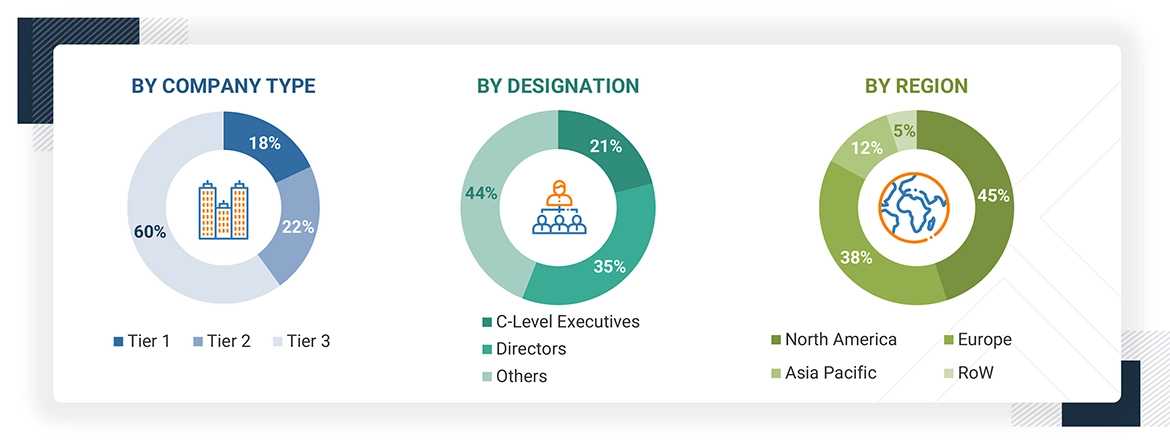
Note: Three tiers of the companies were defined based on their total/segmental revenue as of 2024; Tier 1 = >USD 1 billion, Tier 2 = USD 1 billion–USD 500 million, and Tier 3 = USD 500 million. Others include sales, marketing, and product managers.
To know about the assumptions considered for the study, download the pdf brochure
Market Size Estimation
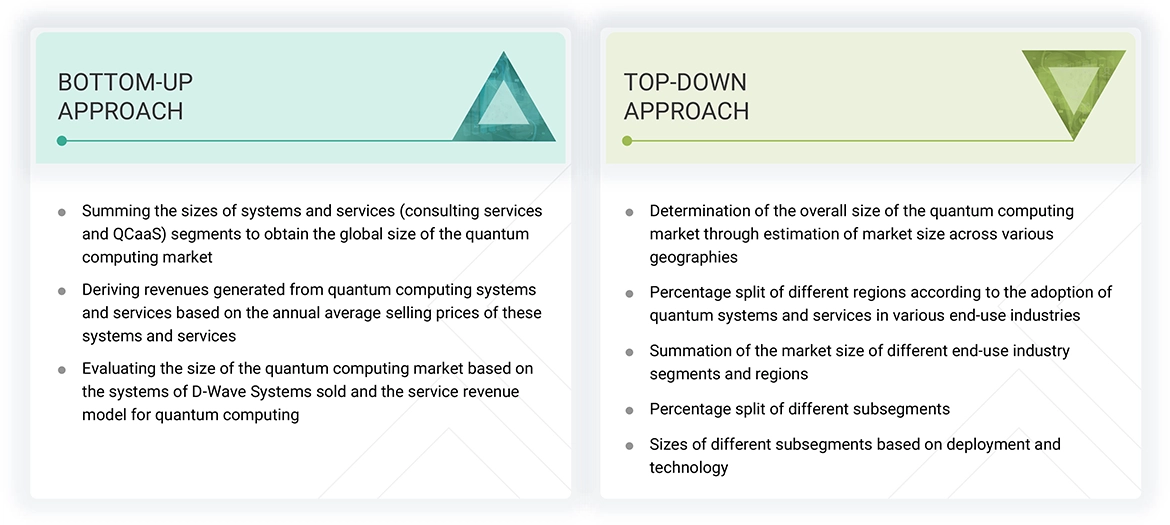
Both top-down and bottom-up approaches have been used to estimate and validate the total size of the quantum computing market. These methods have also been extensively used to estimate the sizes of various market subsegments. The research methodology used to estimate the market sizes includes the following:
- Identifying various applications that use or are expected to use the quantum computing market.
- Analyzing historical and current data pertaining to the size of the quantum computing market for each application
- Analyzing the average selling prices of quantum computing based on different technologies
- Studying various paid and unpaid sources, such as annual reports, press releases, white papers, and databases
- Identifying leading providers of quantum computing, studying their portfolios, and understanding features of their products and their underlying technologies, as well as the types of quantum computing products offered
- Tracking ongoing and identifying upcoming developments in the market through investments, research and development activities, product launches, expansions, and partnerships, and forecasting the market size based on these developments and other critical parameters
- Carrying out multiple discussions with key opinion leaders to understand the technologies used in quantum computing, and products wherein they are deployed, and analyzing the breakdown of the scope of work carried out by key manufacturers of quantum computing providers
- Verifying and cross-checking estimates at every level through discussions with key opinion leaders, such as CXOs, directors, and operations managers, and finally with domain experts at MarketsandMarkets
Quantum Computing Market : Top-Down and Bottom-Up Approach
Data Triangulation
The market has been split into several segments and subsegments after arriving at the overall market size, using the market size estimation processes explained above. Data triangulation and market breakdown procedures have been employed to complete the overall market engineering process and arrive at the exact statistics of each market segment and subsegment, wherever applicable. The data has been triangulated by studying various factors and trends from both the demand and supply sides.
Market Definition
Quantum computing involves phenomena such as quantum entanglement and quantum mechanics superposition that quantum computers use for their enhanced computing power. The improved computing power of quantum computers can be attributed to how data is represented. Conventional computers use bits that can either be 1s or 0s, while quantum computers use qubits (quantum bits), which can be both 0s and 1s simultaneously due to superposition. Quantum computing devices or quantum computers operate with nanoscale components at low temperatures, and they have the potential to address some of the most challenging computational problems.
Key Stakeholders
- Research organizations and universities
- Original equipment manufacturers (OEMs)
- Technology standard organizations, forums, alliances, and associations
- Analysts and strategic business planners
- Government bodies, venture capitalists, and private equity firms
- End users
Report Objectives
- To define, describe, segment, and forecast the quantum computing market in terms of value based on offering, deployment, technology, application, end-user, and region.
- To estimate the size of the market and its segments concerning four main regions, namely, North America, Europe, Asia Pacific, and the Rest of the World (RoW), along with their key countries.
- To provide detailed information regarding the key factors influencing market growth, such as drivers, restraints, opportunities, and challenges
- To offer a detailed analysis of the quantum computing value chain
- To analyze the opportunities in the market for stakeholders and provide a detailed competitive landscape of the market leaders
- To strategically profile the key players and comprehensively analyze their market ranking and core competencies
- To analyze key growth strategies such as expansions, contracts, joint ventures, acquisitions, product launches and developments, and research and development activities undertaken by players operating in the quantum computing market.
Available Customizations
With the given market data, MarketsandMarkets offers customizations according to the specific requirements of companies. The following customization options are available for the report:
Company Information:
- Detailed analysis and profiling of 34 market players
Get the Full Quantum Computing Market Report
Full forecast, segment splits, and company analysis for all Quantum Computing Market.
- UK Quantum Computing Market
- Germany Quantum Computing Market
- France Quantum Computing Market
- Italy Quantum Computing Market
- Spain Quantum Computing Market
- Poland Quantum Computing Market
- China Quantum Computing Market
- Japan Quantum Computing Market
- South Korea Quantum Computing Market
- India Quantum Computing Market
- Australia Quantum Computing Market
- Indonesia Quantum Computing Market
- Thailand Quantum Computing Market
- Vietnam Quantum Computing Market
- US Quantum Computing Market
- Canada And Mexico Quantum Computing Market
- Rest Of Europe Quantum Computing Market
- The Netherland Quantum Computing Market
- Malaysia Quantum Computing Market
- Rest Of Asia Pacific Quantum Computing Market
Need a Tailored Report?
Customize this report to your needs
Get 10% FREE Customization
Customize This Report
