
US Radiology AI Market (2025-2030)

The US Radiology AI Market was valued at $273.6 Million in 2025 and projected to reach to $798.1 Million by 2030, representing a compound annual growth rate of 23.9%. The US Radiology AI market is poised for substantial growth as healthcare providers increasingly prioritize diagnostic accuracy and operational efficiency.


| Market Size in | USD 26.32 MN |
| Market Forecast in | |
| CAGR | |
| Forecast Period | |
| Units Considered | Value (USD MN) |
US Radiology AI Market Trends and Insights
- The US healthcare system's adoption of artificial intelligence in radiology is driven by increasing demand for diagnostic accuracy, operational efficiency, and cost reduction across hospitals and imaging centers.
- In the US, regulatory clarity from the FDA and reimbursement pathways are accelerating clinical deployment of AI-powered diagnostic tools. The US market benefits from a mature healthcare infrastructure, significant investment in digital health innovation, and a large installed base of imaging equipment.
- US providers are increasingly integrating AI solutions for image analysis, workflow optimization, and clinical decision support.
- Between 2025 and 2030, the US is expected to lead North America in adoption rates, supported by favorable reimbursement policies and strong competition among vendors seeking to capture market share in this high-value segment..
Key Market Statistics
- CAGR (2025-2030) 23.9% CAGR
- Market Size, 2025 ~USD 273.6 Million
- Forecast, 2030 ~USD 798.1 Million
- Country US
US Radiology AI Market Overview
Market Valuation :
The US Radiology AI market is valued at $273.6 million in 2025, with strong growth trajectory positioning it as a key segment within the broader healthcare AI landscape.
Robust Growth Rate :
At 23.9% CAGR through 2030, the US market is expanding faster than many other healthcare technology segments, driven by FDA regulatory clarity and hospital adoption initiatives.
FDA Regulatory Support :
The US healthcare system benefits from established FDA pathways for AI medical devices, enabling faster market entry and accelerating adoption across imaging centers and hospital networks.
Projected Market Size :
The market is forecasted to reach $798.1 million by 2030, representing a 192% increase from 2025 and reflecting sustained investment in diagnostic automation and clinical efficiency.
US Radiology AI Market Dynamics
- Hospital systems and imaging centers are investing heavily in AI-powered solutions to address radiologist shortages, reduce diagnostic errors, and accelerate patient throughput.
- FDA regulatory clarity continues to facilitate product approvals, while reimbursement policies are gradually aligning to support AI adoption. Key drivers include rising healthcare costs, demand for faster diagnosis, and integration of AI into existing PACS systems.
- The competitive landscape is intensifying with both established medical device manufacturers and innovative startups entering the market.
- By 2030, AI-assisted radiology is expected to become standard practice across major US healthcare institutions, with significant implications for clinical workflows and patient outcomes..
Market Ecosystem
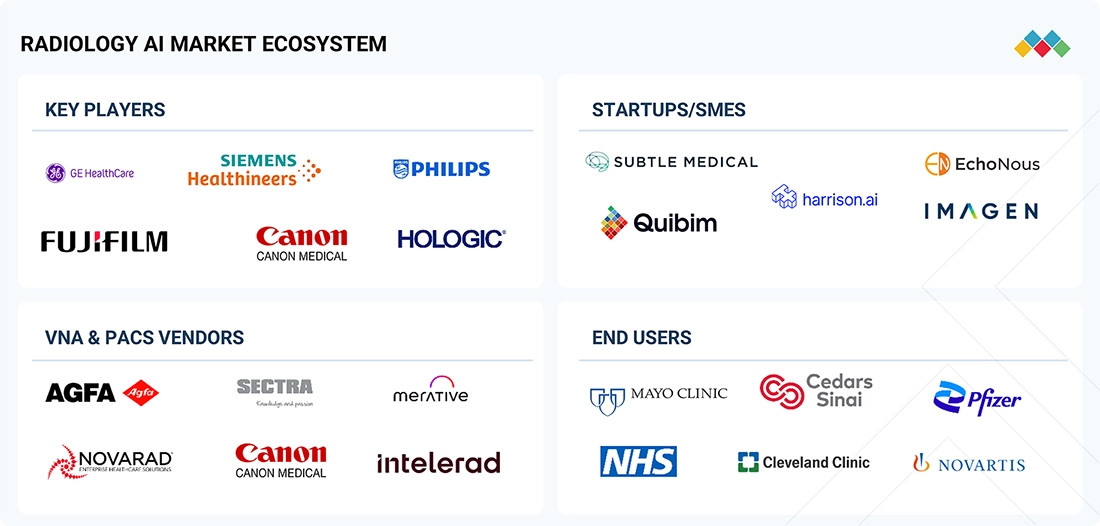
Radiology AI Market: COMMERCIAL USE CASES ACROSS INDUSTRIES
| COMPANY | USE CASE DESCRIPTION | BENEFITS |
|---|---|---|
 |
GE Healthcare Edison Platform, Critical Care Suite, LOGIQ E10, Imaging Insights, AI Orchestrator, and TrueFidelity CT deliver AI-powered imaging, workflow optimization, and clinical decision support. | Enhances diagnostic precision, accelerates image reconstruction, improves workflow efficiency, enables real-time analysis, integrates multi-source data, and supports scalable, patient-centric radiology solutions |
 |
Fujifilm’s REiLI platform uses advanced deep learning algorithms for organ segmentation, lesion detection, and quantitative feature extraction across CT, MRI, and X-ray imaging modalities. | Enhances diagnostic accuracy, supports early disease identification, minimizes manual interpretation time, and helps radiologists focus on complex or critical cases. |
 |
AI-Rad Companion and myExam Companion provide AI-powered, cloud-based workflows and guided diagnostics to enhance radiology imaging and reproducibility. | Reduces repetitive task burden, improves diagnostic precision, ensures consistent imaging results, accelerates reporting, and optimizes workflow efficiency across radiology departments |
 |
Philips AI Manager, CT Precise Image/Position, EPIQ CVx, IntelliSpace, SmartExam, SkyFlow Plus, SmartSpeed, and VitalEye optimize AI-powered imaging and workflow. | Improves diagnostic accuracy, reduces scan time, enhances reproducibility, automates planning, lowers radiation dose, streamlines workflow, and supports multi-modality radiology efficiency |
 |
Canon AiCE, AI-assisted Ultrasound, and Automation Platform deliver deep-learning image reconstruction, automated measurements, and AI-driven workflow optimization across CT, MRI, and ultrasound. | Enhances diagnostic clarity, reduces radiation dose, improves anatomical visualization, accelerates exams, automates prioritization, and streamlines radiology workflow efficiency |
Logos and trademarks shown above are the property of their respective owners. Their use here is for informational and illustrative purposes only.
Related Ecosystem
Diagnostic Imaging
- Magnetic Resonance Imaging (MRI)
- Computed Tomography (CT)
- CT Scanners
- Nuclear Imaging
- Positron Emission Tomography
- Siemens healthineers
- PHILIPS HEALTHCARE
- CANON INC.
- FUJIFILM Holdings Corporation
- UNITED IMAGING HEALTHCARE CO., LTD.
Healthcare It
- Computed Tomography (CT)
- Machine Learning
- Magnetic Resonance Imaging (MRI)
- Natural Language Processing (NLP)
- Predictive Analytics
- CERNER CORPORATION
- PHILIPS HEALTHCARE
- Oracle Corporation
- GE HealthCare Technologies Inc.
- Siemens healthineers
Key Takeaways
- The US Radiology AI market will nearly triple from $273.6M (2025) to $798.1M (2030), representing a 23.9% CAGR.
- US healthcare providers are prioritizing AI adoption for diagnostic accuracy and operational efficiency across imaging departments.
- FDA regulatory pathways and reimbursement coverage are key enablers of US market growth through 2030.
- The US represents the largest and fastest-growing radiology AI market in North America, driven by technology investment and clinical demand.
Radiology AI Market Report Scope
| Report Metric | Details |
|---|---|
| Base Year | 2025 |
| Fastest Growing Segment | WORKFLOW OPTIMIZATION (Function) |
| Forecast Period | 2025–2030 |
| Growth Rate | CAGR of 24.5% from 2025 to 2030 |
| Largest Segment | HOSPITALS (End User) |
| Market Size Base Year (Billions) | ~USD 0.76 (2025) |
| Revenue Forecast (Billions) | ~USD 2.27 (2030) |
| Segments Covered | Offering, Function, Modality, Indication, End User |
US Radiology AI Market Report Segmentation
5 segment dimensions are covered across the global market.
By Offering
- On-Device Software
- Software/
- Software/ SaaS
- Software/SaaS
By Function
- Diagnostic Imaging & Interpretation
- Monitoring & Follow-Up
- Other Functions
- Reporting & Documentation
- Research & Clinical Development
- Screening & Triage
- Treatment Planning & Intervention Support
- Workflow Optimization
By Modality
- Ct
- Mammography
- Mri
- Other Modalities
- Ultrasound
- X-Ray
By Indication
- Cardiology
- Neurology
- Oncology
- Orthopedics
- Other Indications
- Pulmonology/Respiratory Diseases
- Women’S Health
By End User
- Diagnostic Imaging Centers
- Hospitals
- Other End Users
US: RADIOLOGY AI MARKET, BY END USER, 2023–2030
| Segment | 2023 | 2024 | 2025 | 2026 | 2027 | 2028 | 2029 | 2030 | CAGR (%) |
|---|---|---|---|---|---|---|---|---|---|
| DIAGNOSTIC IMAGING CENTERS | 39.58 | 49.23 | 61.22 | 76.14 | 94.7 | 117.78 | 146.49 | 182.19 | 24.4 |
| HOSPITALS | 114.82 | 142.12 | 175.91 | 217.74 | 269.51 | 333.59 | 412.9 | 511.08 | 23.8 |
| OTHER END USERS | 23.89 | 29.51 | 36.46 | 45.03 | 55.62 | 68.7 | 84.85 | 104.79 | 23.5 |
| TOTAL | 178.29 | 220.86 | 273.59 | 338.91 | 419.83 | 520.07 | 644.24 | 798.05 | 23.9 |
Target Audience
- Medical Device Manufacturers : Need comprehensive US market data to develop go-to-market strategies, assess competitive positioning, and identify opportunities for radiology AI product launches and expansion.
- Healthcare IT Investors : Require detailed market sizing, growth projections, and trend analysis to evaluate investment opportunities in US-based radiology AI startups and established healthcare technology companies.
- Hospital & Imaging Center Executives : Seek market intelligence on available solutions, vendor capabilities, ROI benchmarks, and adoption best practices to inform procurement decisions and digital transformation initiatives.
- Healthcare Consultants & Advisors : Need authoritative US market data and forecasts to support client advisory work, strategic planning, and competitive analysis within the radiology and diagnostic imaging sector.
- Regulatory & Policy Professionals : Require market context and adoption trends to inform FDA policy development, reimbursement discussions, and healthcare AI governance frameworks specific to the US market.
Key Companies in the US Radiology AI Market
| Company | HQ | Ownership | Strongest segments |
|---|---|---|---|
| SIEMENS HEALTHINEERS AG | Germany | Public Company | On-Device AI (embedded in CT/MRI/X-ray, acquisition and processing),SaaS Workflow & Reporting (enterprise imaging, workflow orchestration, structured reporting),CDSS & Triage Algorithms (onco, cardio, neuro indications), |
| MICROSOFT | United States | Public Company | SaaS – Workflow, CDSS, Reporting (Radiology AI–linked),SaaS – Acquisition and Processing Services,On-Device – Edge/Modality-Adjacent AI, |
| KONINKLIJKE PHILIPS N.V. | Netherlands | Public Company | On-Device AI (embedded in CT/MRI/X-ray and acquisition/processing),SaaS – Workflow Orchestration and Reporting,SaaS – CDSS (Onco/Cardio/Neuro), |
| GE HEALTHCARE | United States | ||
| FUJIFILM HOLDINGS CORPORATION | Japan | Public Company | On-Device AI (Acquisition/Processing on CT, MRI, X-ray),SaaS – Workflow and Reporting,SaaS – CDSS and Triage, |
| CANON MEDICAL SYSTEMS CORPORATION (CANON INC.) | Japan | ||
| SHANGHAI UNITED IMAGING HEALTHCARE CO., LTD. | China | Public Company | On-Device AI (embedded in CT/MRI/X-ray acquisition and processing),SaaS / Cloud AI (workflow, CDSS, reporting, remote tools),Triage and Workflow Orchestration, |
| HOLOGIC, INC. | United States | Private Company | On-Device AI (embedded in 3D mammography, DXA, and acquisition/processing),SaaS AI (workflow, triage, CDSS, reporting layers), |
| ENLITIC, INC. | United States | Public Company | SaaS – ENDEX data standardization,SaaS – ENCOG anonymization,SaaS – Migratek and routing, |
| NANOX | Canada | Public Company | On-Device,SaaS,Triage, |
SIEMENS HEALTHINEERS AG
Siemens Healthineers AG is a German public company founded in 1896 that employs 72,369 people. The company operates in the healthcare technology sector.
MICROSOFT
Microsoft is a United States-based public company founded in 1975 with 228,000 employees. The company is a major technology corporation.
KONINKLIJKE PHILIPS N.V.
Koninklijke Philips N.V. is a Dutch public company founded in 1891 with 63,670 employees. The company operates in the healthcare and technology sectors.
GE HEALTHCARE
GE Healthcare is a United States-based company operating in the healthcare sector.
FUJIFILM HOLDINGS CORPORATION
Fujifilm Holdings Corporation is a Japanese public company founded in 1934 with 73,526 employees. The company operates across imaging, healthcare, and related technology sectors.
CANON MEDICAL SYSTEMS CORPORATION (CANON INC.)
Canon Medical Systems Corporation is a Japanese company operating as part of Canon Inc. in the medical imaging and healthcare technology sector.
SHANGHAI UNITED IMAGING HEALTHCARE CO., LTD.
Shanghai United Imaging Healthcare Co., Ltd. is a Chinese public company founded in 2011 with 8,703 employees. The company operates in medical imaging and healthcare technology.
HOLOGIC, INC.
Hologic, Inc. is a United States-based private company founded in 1985 with 7,070 employees. The company operates in the medical device and healthcare technology sector.
ENLITIC, INC.
Enlitic, Inc. is a United States-based public company founded in 2014. The company operates in healthcare technology.
NANOX
Nanox is a Canadian public company founded in 2011 with 390 employees. The company operates in medical imaging technology.
Reasons to Buy this Report
- Market Size & Growth Data : Access precise valuation metrics for the US market ($273.6M in 2025) and 5-year forecasts, enabling accurate financial planning and investment decisions for stakeholders.
- Regulatory Landscape Insights : Understand FDA approval pathways, reimbursement trends, and compliance requirements specific to the US market, reducing market entry risks for new products and solutions.
- Competitive Intelligence : Identify key players, market share distribution, and competitive positioning within the US radiology AI ecosystem to inform strategic partnerships and differentiation strategies.
- End-User Adoption Patterns : Gain insights into hospital, imaging center, and healthcare provider adoption rates, pain points, and purchasing criteria specific to the US healthcare system.
- Investment & Growth Opportunities : Discover high-potential segments, emerging use cases, and geographic hotspots within the US market to guide capital allocation and expansion strategies through 2030.
Frequently asked questions
What is the current size of the US Radiology AI market?
The US Radiology AI market was valued at $273.6 million in 2025 and is expected to reach $798.1 million by 2030.
What is the projected growth rate for the US Radiology AI market?
The US Radiology AI market is projected to grow at a compound annual growth rate (CAGR) of 23.9% from 2025 to 2030.
What factors are driving growth in the US Radiology AI market?
Key drivers include FDA regulatory approval pathways, reimbursement coverage expansion, demand for diagnostic accuracy, operational efficiency gains, and widespread adoption across US hospitals and imaging centers.
How does the US Radiology AI market compare to other North American regions?
The US dominates the North American radiology AI market, representing the largest segment with the highest adoption rates and investment levels in the region.
Which US healthcare segments are adopting radiology AI most rapidly?
Large hospital systems, integrated health networks, and specialized imaging centers in the US are leading adoption, driven by capital availability and clinical demand for AI-powered diagnostic tools.
RESEARCH METHODOLOGY
The study involved major activities to estimate the current size of the radiology AI market. Exhaustive secondary research was done to collect information on the market and its different subsegments. The next step was to validate these findings, assumptions, and sizing with industry experts across the value chain through primary research. Both top-down and bottom-up approaches were employed to estimate the complete market size. Thereafter, market breakdown and data triangulation procedures were used to estimate the market size of the segments and subsegments of the radiology AI market.
Secondary Research
This research study involved the wide use of secondary sources, directories, and databases such as Dun & Bradstreet, Bloomberg Business, and Factiva; white papers, annual reports, and companies’ house documents; investor presentations; and the SEC filings of companies. The market for companies providing Radiology AI solutions is assessed using secondary data from both paid and free sources. This involves analyzing the product portfolios of major industry players and evaluating these companies based on their performance and quality. Various resources were utilized in the secondary research process to gather information for this study. The sources include annual reports, press releases, investor presentations, white papers, academic journals, certified publications, articles by recognized authors, directories, and databases. The secondary research process involved consulting various secondary sources to identify and collect information relevant to the study. These sources included annual reports, press releases, investor presentations from radiology AI vendors, forums, certified publications, and white papers. The secondary research was used to obtain critical information on the industry’s value chain, the total pool of key players, market classification, and segmentation from the market and technology-oriented perspectives.
Primary Research
In the primary research process, various sources from both the supply and demand sides were interviewed to obtain qualitative and quantitative information for this report. Primary sources are mainly industry experts from the core and related industries and preferred suppliers, manufacturers, technology developers, researchers, and organizations related to all segments of this industry’s value chain. In-depth interviews were conducted with various primary respondents, including key industry participants, subject-matter experts (SMEs), C-level executives of key market players, and industry consultants, among other experts, to obtain and verify the critical qualitative and quantitative information as well as assess prospects.
Primary research was conducted to identify segmentation types, industry trends, key players, and key market dynamics such as drivers, restraints, opportunities, challenges, and strategies adopted by key players.
After completing the market engineering process, which includes calculations for market statistics, market breakdown, size estimations, forecasting, and data triangulation, extensive primary research was conducted. This research aimed to gather information and verify the critical numbers obtained during the market analysis. Additionally, primary research was conducted to identify different types of market segmentation, analyze industry trends, evaluate the competitive landscape of radiology AI solutions offered by various players, and understand key market dynamics such as drivers, restraints, opportunities, challenges, industry trends, and strategies employed by key market participants.
In the market engineering process, the top-down and bottom-up approaches, along with several data triangulation methods, were extensively employed to perform market estimation and forecasting for the overall market segments and subsegments outlined in this report. Extensive qualitative and quantitative analysis was performed on the complete market engineering process to list the key information/insights throughout the report.
Breakdown of Primary Respondents:
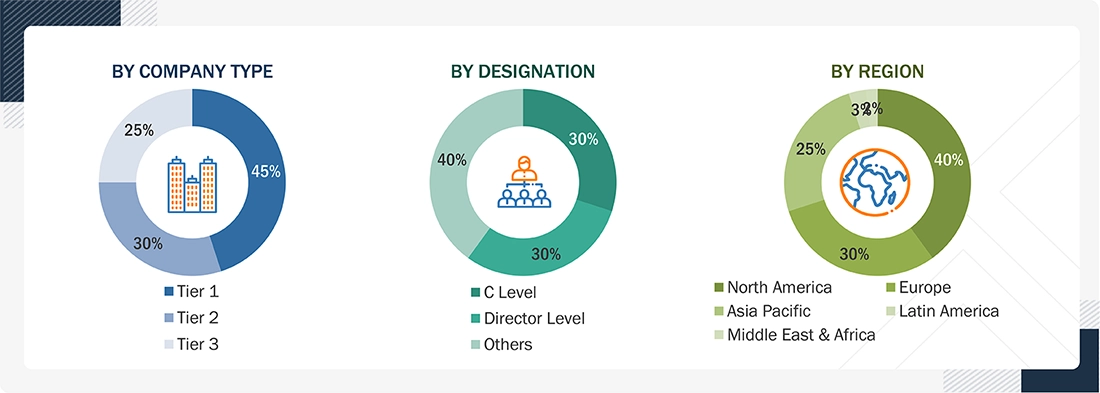
Note 1: Others include sales managers, marketing managers, and product managers.
Note 2: Tiers are defined based on a company’s total revenue, as of 2025: Tier 1 = >USD 1 billion, Tier 2 = USD 500 million to USD 1 billion, and Tier 3 = < USD 500 million
To know about the assumptions considered for the study, download the pdf brochure
Market Size Estimation
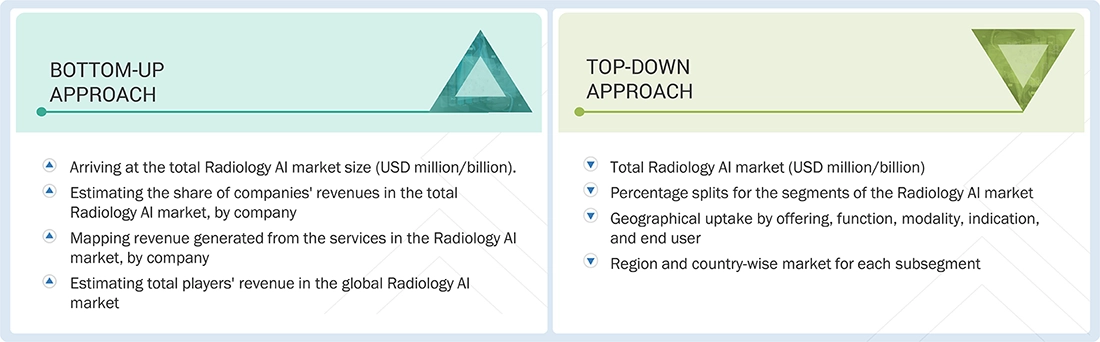
The market size estimates and forecasts provided in this study are derived through a mix of the bottom-up approach (revenue share analysis of leading players) and the top-down approach (assessment of utilization/adoption/penetration trends, by offering, function, modality, indication, end user, and region).
Data Triangulation
After arriving at the overall market size, using the market size estimation processes, the market was split into several segments and subsegments. To complete the overall market engineering process and determine the exact statistics for each market segment and subsegment, data triangulation and market breakdown procedures were employed, as applicable. The data was triangulated by studying various factors and trends from both the demand and supply sides in the radiology AI market.
Market Definition
Radiology AI solutions are specifically designed to support, enhance, and automate radiology practices. These AI-driven solutions utilize advanced algorithms, including machine learning, deep learning, and computer vision, to support medical imaging acquisition, enhancement, analysis, interpretation, and reporting across various modalities, such as X-ray, CT, MRI, ultrasound, and mammography. They support image segmentation and quantification, lesion detection, diagnostic support, workflow optimization, predictive analytics, and clinical decision support. They integrate with existing PACS and RIS platforms to improve diagnostic accuracy, efficiency, and standardization. In addition to supporting clinical decision-making, Radiology AI solutions enable triage, quality assurance, and predictive analytics by identifying subtle imaging patterns that indicate disease risk, progression, or response to therapy, enhancing overall imaging workflow performance.
Stakeholders
- Radiology AI Providers
- OEM Vendors
- Cloud Providers
- Radiologists & Imaging Specialists
- Hospitals
- Diagnostic & Imaging Centers
- Clinics & Outpatient Settings
- Specialty Centers
- Hardware Providers
- Startups & Innovators
- Academic and Research Institutions
- Patients & Patient Advocacy Groups
Report Objectives
- To define, describe, and forecast the global radiology AI market, by offering, function, modality, indication, end user, and region
- To provide detailed information regarding the major factors influencing the growth of the market (such as drivers, restraints, opportunities, and challenges)
- To analyze micromarkets with respect to individual growth trends, prospects, and contributions to the overall radiology AI market
- To assess the radiology AI market with regard to Porter’s Five Forces, regulatory landscape, value chain, ecosystem map, patent protection, and key stakeholders’ buying criteria
- To analyze opportunities in the market for stakeholders and provide details of the competitive landscape for market leaders
- To forecast the size of the radiology AI market with respect to five main regions, namely, North America, Europe, Asia Pacific, Latin America, and the Middle East & Africa
- To profile the key players in the radiology AI market and comprehensively analyze their core competencies and market shares
- To track and analyze competitive developments such as collaborations, agreements, partnerships, acquisitions, expansions, product launches and enhancements, and R&D activities in the radiology AI market.
Get the Full Radiology AI Market Report
Full forecast, segment splits, and company analysis for all Radiology AI Market.
- Canada Radiology AI Market
- Germany Radiology AI Market
- France Radiology AI Market
- UK Radiology AI Market
- Italy Radiology AI Market
- Spain Radiology AI Market
- Japan Radiology AI Market
- China Radiology AI Market
- India Radiology AI Market
- South Korea Radiology AI Market
- Australia Radiology AI Market
- Brazil Radiology AI Market
- Mexico Radiology AI Market
- Saudi Arabia Radiology AI Market
- UAE Radiology AI Market
- South Africa Radiology AI Market
- Rest Of Europe Radiology AI Market
- Rest Of Asia Pacific Radiology AI Market
- Rest Of Latin America Radiology AI Market
- GCC Countries Radiology AI Market
- Rest Of GCC Countries Radiology AI Market
Need a Tailored Report?
Customize this report to your needs
Get 10% FREE Customization
Customize This Report
