
North America Railway Testing Market (2025-2030)

The North America Railway Testing Market was valued at $388.5 Million in 2025 and projected to reach to $529.2 Million by 2030, representing a compound annual growth rate of 4.5%. North America's railway testing market is poised for steady growth through 2030, driven by critical infrastructure renewal programs and heightened safety standards.


| Market Size in | USD 26.32 MN |
| Market Forecast in | |
| CAGR | |
| Forecast Period | |
| Units Considered | Value (USD MN) |
North America Railway Testing Market Trends and Insights
- North America's railway testing sector is driven by aging infrastructure modernization, stringent safety regulations, and increased investment in rail network upgrades across the United States and Canada.
- The region's commitment to enhancing operational efficiency and passenger safety continues to fuel demand for advanced testing solutions and diagnostic technologies. In North America, the railway testing market benefits from established rail networks and significant government funding initiatives aimed at infrastructure renewal.
- North America's transportation authorities are increasingly adopting non-destructive testing, predictive maintenance, and digital inspection technologies to extend asset lifespan and reduce operational downtime.
- Between 2025 and 2030, North America is expected to see accelerated adoption of automated testing systems and real-time monitoring solutions, positioning the region as a key growth market within the global railway testing landscape..
Key Market Statistics
- CAGR (2025-2030) 4.5% CAGR
- Market Size, 2025 ~USD 388.5 Million
- Forecast, 2030 ~USD 529.2 Million
- Geography North America
North America Railway Testing Market Overview
Infrastructure Modernization Drive :
North America's aging railway infrastructure is undergoing significant modernization, with the U.S. and Canada investing heavily in track upgrades, signaling systems, and rolling stock replacements, driving demand for comprehensive testing solutions.
Regulatory Compliance Pressure :
Stringent safety regulations from the FRA (Federal Railroad Administration) and Transport Canada mandate rigorous testing protocols, creating sustained demand for specialized testing services and equipment across the region.
Regional Market Growth :
The North America railway testing market is expanding at 4.5% CAGR, growing from $388.5 million in 2025 to $529.2 million by 2030, outpacing global growth in select segments.
Cross-Border Rail Initiatives :
Increased collaboration on U.S.-Canada rail corridors and freight network optimization projects are spurring investments in testing infrastructure and validation services across North American borders.
North America Railway Testing Market Dynamics
- The region's mature rail networks require continuous modernization to meet contemporary operational demands, with testing services becoming integral to project execution.
- Investment in passenger rail expansion, particularly in the Northeast Corridor and Canadian networks, alongside freight optimization initiatives, will sustain market expansion.
- Government funding initiatives and public-private partnerships are expected to accelerate testing service adoption, particularly for non-destructive testing, performance validation, and safety certification across both countries..
Market Ecosystem
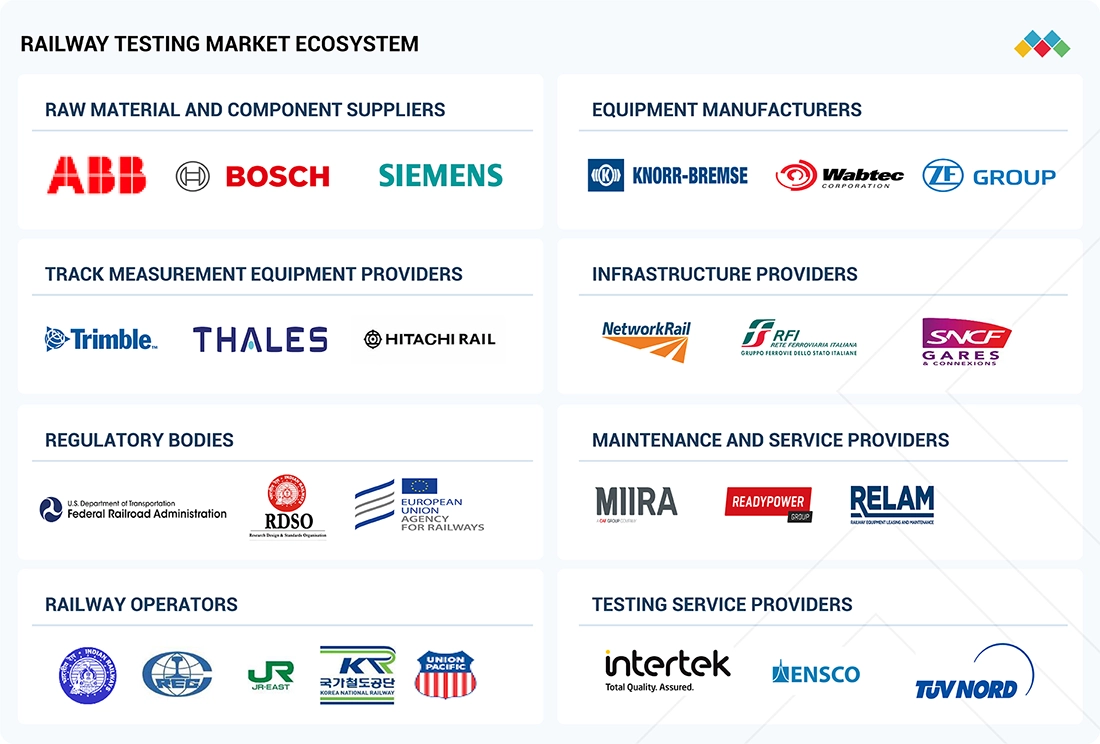
Railway Testing Market: COMMERCIAL USE CASES ACROSS INDUSTRIES
| COMPANY | USE CASE DESCRIPTION | BENEFITS |
|---|---|---|
 |
Provides brake testing systems that allow operators to certify braking performance as networks run tighter headways and higher frequency services | Strengthens operational reliability by reducing brake related service disruptions |
 |
Supplies drivetrain and axle testing platforms that help depots validate traction components as fleets transition to higher power density propulsion systems | Improves drivetrain readiness for upgraded service patterns |
 |
Deploys digital and wayside condition monitoring tools that support real time inspection as corridors shift toward data driven maintenance | Enables earlier fault detection and higher asset availability |
 |
Offers electrical test benches that validate inverter and converter performance as operators integrate newer electric and hybrid traction technologies | Supports safe and efficient commissioning of modern propulsion systems |
 |
Provides torsional testing systems that help assess drivetrain stability under rising load variability across mixed traffic corridors | Enhances propulsion system reliability during intensive daily operations |
Logos and trademarks shown above are the property of their respective owners. Their use here is for informational and illustrative purposes only.
Related Ecosystem
Locomotives And Rolling Stock
- Sensors
- Passenger Information System (PIS)
- Cartesian Robots
- Flow Sensors
- Gas Sensors
- Siemens ag
- Alstom s.a.
- Hitachi, Ltd.
- Knorr-bremse ag
- RAILPROS
Logistics And Transportation
- Internal Combustion Engine (ICE)
- Crawler Excavator
- Fuel Cell
- Light Commercial Vehicles (LCVs)
- Sensors
- Siemens ag
- Alstom s.a.
- Hitachi, Ltd.
- Godrej Industries Limited
- ABB India Limited
Key Takeaways
- North America's railway testing market is valued at $388.5 million in 2025 and will reach $529.2 million by 2030, growing at 4.5% CAGR.
- North America's aging rail infrastructure and regulatory compliance requirements are primary drivers of testing market expansion through 2030.
- North America is increasingly adopting predictive maintenance and automated testing technologies to improve safety and operational efficiency.
- Government infrastructure investment and modernization initiatives across North America are expected to sustain market growth over the forecast period.
Railway Testing Market Report Scope
| Report Metric | Details |
|---|---|
| Base Year | 2025 |
| Fastest Growing Segment | RAILWAY POWER SUPPLY TESTING EQUIPMENT (Electrification Testing Equipment) |
| Forecast Period | 2025–2030 |
| Growth Rate | CAGR of 4.6% from 2025 to 2030 |
| Largest Segment | ROLLING STOCK TEST EQUIPMENT (End Use) |
| Market Size Base Year (Billions) | ~USD 3.9 (2025) |
| Revenue Forecast (Billions) | ~USD 4.88 (2030) |
| Segments Covered | Superstructure Testing Equipment, Application, Electrification Testing Equipment, End Use, Use Case |
North America Railway Testing Market Report Segmentation
5 segment dimensions are covered across the global market.
By Superstructure Testing Equipment
- Electronics And Daq Testing Equipment
- Other Superstructure Testing Equipment
- Rail Mechanical Testing Equipment
- Sleepers/Crossties, Fastening Testing Equipment
- Sleepers/Crossties, Fastenings Testing Equipment
- Switches/Turnouts Testing Equipment
- Track Measurement Equipment
By Application
- Design & Development
- Manufacturing & Fabrication
- Post-Delivery & Upkeep Inspection
- Pre-Delivery Testing
By Electrification Testing Equipment
- Contact Line Test Equipment
- On-Board Electronics Test Equipment
- Railway Power Supply Testing Equipment
- Traction Power Supply & Substation Testing Equipment
By End Use
- Other Test Equipment
- Rolling Stock Test Equipment
- Track/Infrastructure Test Equipment
By Use Case
- Control Command
- Operational Telematics
- Train Control
Target Audience
- Railway Infrastructure Operators : U.S. and Canadian rail operators need market intelligence to understand testing service requirements, vendor capabilities, and cost structures for infrastructure modernization and compliance projects.
- Testing Service Providers : Companies offering railway testing solutions require regional market data to identify growth opportunities, competitive positioning, and customer demand patterns specific to North American rail networks.
- Equipment & Technology Manufacturers : Rail equipment manufacturers need insights into North American testing standards, validation requirements, and market trends to align product development with regional regulatory and operational demands.
- Government & Transportation Agencies : Federal and state transportation departments require market analysis to inform infrastructure investment decisions, funding allocation, and policy development for rail modernization initiatives.
- Investment & Consulting Firms : Private equity, venture capital, and management consultants need regional market data to evaluate investment opportunities, assess portfolio companies, and develop growth strategies in North American rail testing.
Key Companies in the North America Railway Testing Market
| Company | HQ | Ownership | Strongest segments |
|---|---|---|---|
| MTS SYSTEMS | United States | Private Company | Superstructure testing equipment,Electrification testing equipment,Railway sensors and measurement systems, |
| HEXAGON AB | Sweden | Public Company | Superstructure testing equipment and monitoring (track, civil structures, tunnels),Electrification testing and clearance verification,Use case: construction verification and commissioning, |
| TRIMBLE INC. | United States | Public Company | Superstructure testing (track, geometry, civil structures) – hardware plus analytics,Electrification testing (catenary, power supply) – data capture and integration,Use-case software (asset management, safety, and performance analytics), |
| INTERTEK PLC | United Kingdom | Public Company | Superstructure testing equipment & services,Electrification testing equipment & services,Use-case: Infrastructure owners & operators, |
| RICARDO | United Kingdom | Private Company | Rail consultancy, assurance, and safety testing services,Superstructure testing equipment and related services,Electrification and power systems testing, |
| ILLINOIS TOOL WORKS INC. | United States | Public Company | Superstructure testing equipment,Electrification testing equipment,Software, analytics, and integrated use-case solutions, |
| ROBERT BOSCH GMBH | India | Private Company | Superstructure testing equipment,Electrification testing equipment,Digital and IoT-based railway testing and monitoring, |
| KINGSINE ELECTRIC AUTOMATION CO., LTD. | China | Public Company | Electrification testing equipment (protection, substation, traction power),Superstructure and trackside testing interfaces,Portable multi-purpose test platforms for commissioning and maintenance, |
MTS SYSTEMS
MTS Systems is a private company founded in 1966 and headquartered in the United States with 3,600 employees. The company specializes in testing and simulation systems for various industrial applications.
HEXAGON AB
Hexagon AB is a Swedish public company founded in 1975 with 16,118 employees. It provides digital solutions and enterprise software across multiple industries including manufacturing, construction, and public safety.
TRIMBLE INC.
Trimble Inc. is a publicly traded U.S. company founded in 1978 with 11,500 employees. The company develops positioning, navigation, and mobile solutions for industries including construction, agriculture, and transportation.
INTERTEK PLC
Intertek PLC is a British public company established in 1885 with 45,425 employees. It provides quality and safety solutions, testing, inspection, and certification services across diverse global industries.
RICARDO
Ricardo is a British private company established in 1915 with 2,600 employees. The company provides engineering consulting and technology solutions primarily for the automotive and energy sectors.
ILLINOIS TOOL WORKS INC.
Illinois Tool Works Inc. is a U.S. public company founded in 1912 with 43,000 employees. The company manufactures diversified products and engineered systems across welding, polymers, construction, and specialty segments.
ROBERT BOSCH GMBH
Robert Bosch GmbH is a private company founded in 1886 with 412,774 employees operating in India. The company is a global supplier of technology and services in automotive, industrial, consumer goods, and energy sectors.
KINGSINE ELECTRIC AUTOMATION CO., LTD.
Kingsine Electric Automation Co., Ltd. is a Chinese public company founded in 1999. The company operates in the electrical automation and industrial control sectors.
Countries within North America - compare and drill down
| Country | 2025 size (native) |
|---|
Country market size visualization
Reasons to Buy this Report
- Regional Market Sizing & Forecasts : Obtain precise valuation data specific to North America ($388.5M in 2025) with detailed 5-year projections, enabling accurate budget allocation and investment planning for regional operations.
- Regulatory & Compliance Insights : Understand FRA and Transport Canada requirements driving testing demand, with analysis of how stringent safety mandates create market opportunities and competitive advantages in the region.
- Infrastructure Investment Tracking : Access intelligence on U.S. and Canadian rail modernization projects, funding announcements, and capital expenditure trends that directly influence testing service demand across North America.
- Competitive Landscape Analysis : Identify key testing service providers, technology leaders, and market consolidation trends specific to North America, with strategic positioning recommendations for market entry or expansion.
- Growth Opportunity Identification : Discover high-potential segments within North American railway testing (non-destructive testing, digital validation, freight optimization) with segment-specific growth rates and market gaps.
Frequently asked questions
What is the current size of the railway testing market in North America?
The North America railway testing market is estimated at $388.5 million in 2025.
What is the projected market size for North America's railway testing sector by 2030?
North America's railway testing market is forecast to reach $529.2 million by 2030.
What is the growth rate of the railway testing market in North America?
The North America railway testing market is expected to grow at a compound annual growth rate of 4.5% from 2025 to 2030.
What factors are driving growth in North America's railway testing market?
North America's market growth is driven by aging infrastructure modernization, stringent safety regulations, government funding for rail upgrades, and adoption of predictive maintenance technologies.
Which technologies are gaining adoption in North America's railway testing sector?
North America is increasingly adopting non-destructive testing, automated inspection systems, real-time monitoring solutions, and digital diagnostic technologies for railway asset management.
RESEARCH METHODOLOGY
The study involved four major activities in estimating the current size of the railway testing market. Exhaustive secondary research was done to collect information on the market, the peer market, and the parent market. The next step was to validate these findings, assumptions, and sizing with the industry experts across value chains through primary research. The top-down approach was employed to estimate the complete market size. Thereafter, market breakdown and data triangulation processes were used to estimate the market size of segments and subsegments.
Secondary Research
Secondary sources referred to for this research study included railway services and equipment for testing, test equipment and track measurment industry organizations [American Railway Association (ARA), Brazilian Association of the Railroad Suppliers (ABIFER), China Railway Society (CRS), China Academy of Railway Sciences (CARS), Gulf Cooperation Council (GCC), Indian Railway Conference Association (IRCA), Indian Railway Institute of Electrical Engineering (IRIEEN), International Union of Railways (UIC), Japan Association of Rolling Stock Industries (JARI), Mexican Association of Railway], corporate filings (such as annual reports, investor presentations, and financial statements), and company websites, whitepapers, and databases, and articles from recognized associations and government publishing sources. The secondary data was collected and analyzed to arrive at the overall market size, which was further validated by primary research.
Primary Research
Extensive primary research was conducted after acquiring an understanding of the railway testing market through secondary research. Several primary interviews were conducted with market experts from the demand side (railway operators, system integrators, country-level government associations, and trade associations) and supply side (OEMs and component manufacturers) across major regions, namely North America, Europe, Asia Pacific, and the Rest of the World. Approximately 40% and 60% of primary interviews were conducted from the demand and supply sides, respectively. The primary data was collected through questionnaires, emails, and telephonic interviews. In the canvassing of primaries, various departments within organizations, such as sales, operations, and administration, were considered to provide a holistic viewpoint in this report.
Brief sessions with highly experienced independent consultants were conducted to reinforce findings from primaries after interacting with industry experts. This, along with the in-house subject matter experts’ opinions, led to the findings, as described in the remainder of this report.
In the primary research process, various primary sources from the supply and demand sides were interviewed to obtain qualitative and quantitative information for the report. The primary sources from the supply side included industry experts, such as Vice Presidents (VPs), marketing directors, technology and innovation directors, and related key executives from various key companies and organizations. The primary sources from the demand side included end users, such as Chief Information Officers (CIOs), consultants, service professionals, technicians and technologists, and managers at public and investor-owned utilities.
Breakdown of Primaries
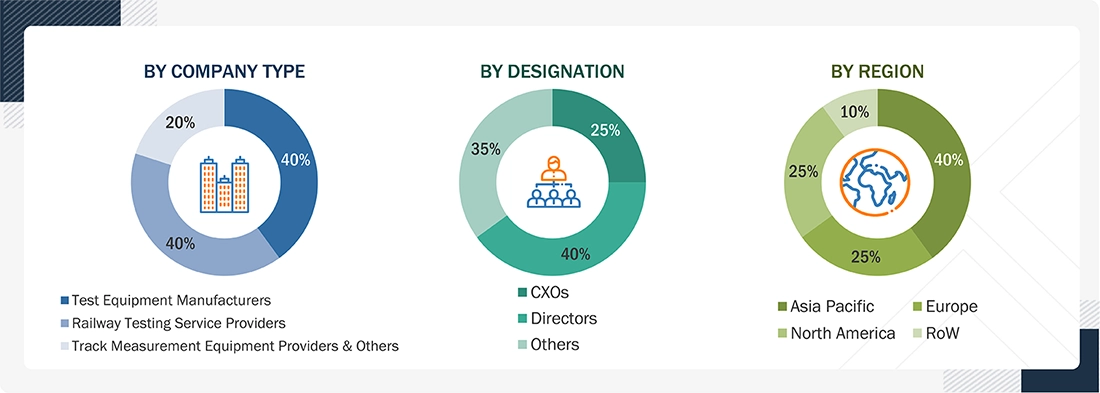
Note: Others include Sales Managers and Product Managers.
To know about the assumptions considered for the study, download the pdf brochure
Market Size Estimation
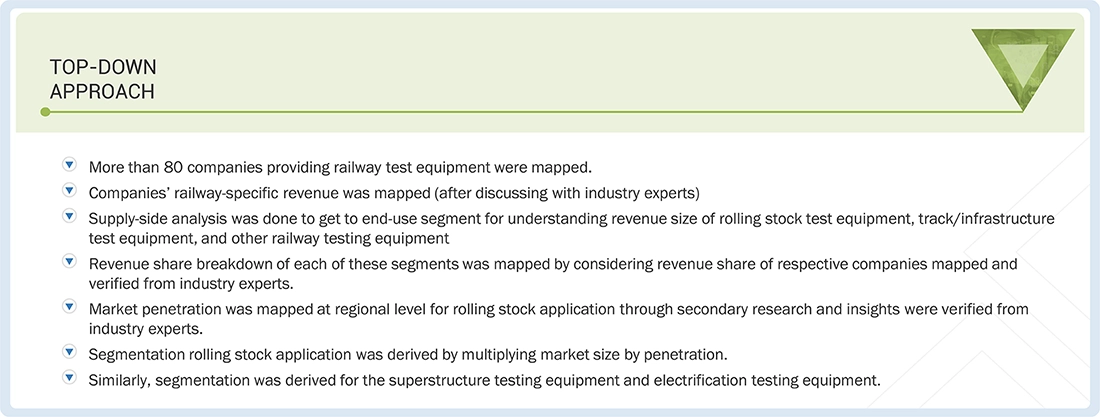
Top-Down Approach:
The top-down methodology was followed to estimate the size of the railway testing market by application. More than 80 companies were covered, and their railway-specific revenue was mapped after discussing with industry experts. Supply side analysis was done, by end use, for understanding the revenue size of railway rolling stock test equipment, track/infrastructure testing equipment, and other test equipment. Revenue share breakdown for each of these segments was mapped by considering the revenue share of respective companies, mapped & verified by industry experts. Market penetration was mapped at the regional level for rolling stock applications through secondary research, and insights were verified from industry experts. Segmentation for rolling stock applications was derived by multiplying the market size by the penetration. Similarly, segmentation was derived for the super-structured testing equipment (Rail mechanical testing equipment, electronics and DAQ testing equipment, switches/turnouts testing equipment, sleepers/crossties, fastenings testing equipment, track measurement equipment, other superstructure testing equipment) and electrification testing equipment (On-board electronics test equipment, contact lines test equipment, traction power supply & substation testing equipment, railway power supply testing equipment).
Data Triangulation
After arriving at the overall market size using the market size estimation processes as explained above, the market was split into several segments and subsegments. To complete the overall market engineering process and arrive at the exact statistics of each market segment and subsegment, data triangulation and market breakdown procedures were employed, wherever applicable. The data was triangulated by studying various factors and trends from both the demand and supply sides.
Market Definition
The railway testing market refers to the industry that produces and supplies specialized tools, systems, and devices for testing and monitoring railway infrastructure, such as tracks, rolling stock, and overhead lines, to ensure safety, quality, and efficiency. This market includes a wide range of products, from handheld tools to sophisticated, automated systems for on-track and in-lab measurements. The market’s growth is driven by factors like the need for enhanced safety, the increasing complexity of rail operations, and advancements in digital and sensor technologies.
Report Objectives
- To segment and forecast the railway testing market in terms of value (USD Million)
- To define, describe, and forecast the market based on end use, superstructure test equipment, electrification test equipment, application, use case, and region
- To analyze regional markets for growth trends, prospects, and their contribution to the overall market
- To define, describe, and forecast the size of the railway testing market with respect to growth trends and prospects, and determine the contribution of the segments to the total market
- To segment the market and forecast its size, by value, based on region (Asia Pacific, Europe, North America, and the Rest of the World (RoW)
- To segment and forecast the market size, by value, based on end use (Rolling stock test equipment, track/infrastructure test equipment, other test equipment)
- To segment and forecast the market size, by value, based on superstructure testing equipment (Rail mechanical testing equipment, electronics and DAQ testing equipment, switches/turnouts testing equipment, sleepers/crossties, fastenings testing equipment, track measurement equipment, other superstructure testing equipment)
- To segment and forecast the market size, by value, based on application (Design & development, manufacturing & fabrication, pre-delivery testing, post-delivery & upkeep inspection)
- To provide detailed information regarding the major factors (drivers, challenges, restraints, and opportunities) influencing the market growth
- To strategically analyze markets with respect to individual growth trends, prospects, and contribution to the total market
- To analyze opportunities for stakeholders and the competitive landscape for market leaders
-
To study the following with respect to the market:
- Supply Chain Analysis
- Ecosystem Analysis
- Technology Analysis
- HS Code
- Case Study Analysis
- Patent Analysis
- Regulatory Landscape
- Key Stakeholders & Buying Criteria
- Funding, by Application
- Key Conferences & Events
- To strategically profile key players and comprehensively analyze their market share and core competencies
- To analyze the impact of AI on the market
- To track and analyze competitive developments, such as deals (mergers & acquisitions, partnerships, collaborations), product developments, and other activities carried out by key industry participants
Get the Full Railway Testing Market Report
Full forecast, segment splits, and company analysis for all Railway Testing Market.
Need a Tailored Report?
Customize this report to your needs
Get 10% FREE Customization
Customize This Report
