
Japan Relay Market (2024-2029)

The Japan Relay Market was valued at $739.3 Million in 2024 and projected to reach to $1051 Million by 2029, representing a compound annual growth rate of CAGR 6.0%. Japan's relay market is poised for steady expansion driven by critical infrastructure modernization and the nation's energy transition priorities.


| Market Size in | USD 26.32 MN |
| Market Forecast in | |
| CAGR | |
| Forecast Period | |
| Units Considered | Value (USD MN) |
Japan Relay Market Trends and Insights
- Japan's relay market is driven by the country's advanced electrical infrastructure, aging power grid modernization initiatives, and increasing demand for grid stability solutions.
- Japan's strategic focus on renewable energy integration and smart grid technologies is accelerating relay adoption across utility and industrial segments. The Japanese relay market benefits from stringent safety regulations and high-quality manufacturing standards that position Japan as a technology leader in the Asia Pacific region.
- Japan's investment in grid resilience, particularly following past infrastructure challenges, has created sustained demand for protective relay systems.
- By 2029, Japan's relay market expansion will be supported by continued infrastructure upgrades, industrial automation growth, and the transition toward decentralized energy systems..
Key Market Statistics
- CAGR (2024-2029) CAGR 6.0%
- Market Size, 2024 ~USD 739.3 Million
- Forecast, 2029 ~USD 1051 Million
- Country Japan
Japan Relay Market Overview
Market Size & Growth :
Japan's relay market is valued at USD 739.3 million in 2024, with a projected CAGR of 6.0% through 2029, reaching USD 1,051.0 million. This steady growth reflects Japan's commitment to infrastructure modernization and energy security.
Grid Modernization Driver :
Japan's aging power grid infrastructure is undergoing significant modernization initiatives. Relays play a critical role in enhancing grid stability, protection systems, and enabling smart grid technologies across the nation's electrical networks.
Renewable Energy Integration :
Japan's strategic pivot toward renewable energy sources, including solar and wind, requires advanced relay systems for grid management and fault protection. This transition is a key growth catalyst for the relay market through 2029.
Advanced Electrical Infrastructure :
Japan's sophisticated electrical infrastructure and high technological adoption rate drive demand for next-generation relay solutions, including digital and intelligent relays that support grid automation and real-time monitoring capabilities.
Japan Relay Market Dynamics
- The aging power grid requires substantial investment in protective relay systems to ensure reliability and support the integration of renewable energy sources.
- Government initiatives promoting smart grid development and grid resilience will continue to fuel demand for advanced relay technologies through 2029. The market will benefit from Japan's technological leadership in electrical equipment manufacturing and increasing adoption of IoT-enabled relay systems.
- As utilities invest in grid digitalization and automation, demand for intelligent relays with remote monitoring and diagnostic capabilities will accelerate.
- This positions Japan's relay market for consistent growth, supported by both domestic infrastructure needs and export opportunities in Asia-Pacific..
Market Ecosystem
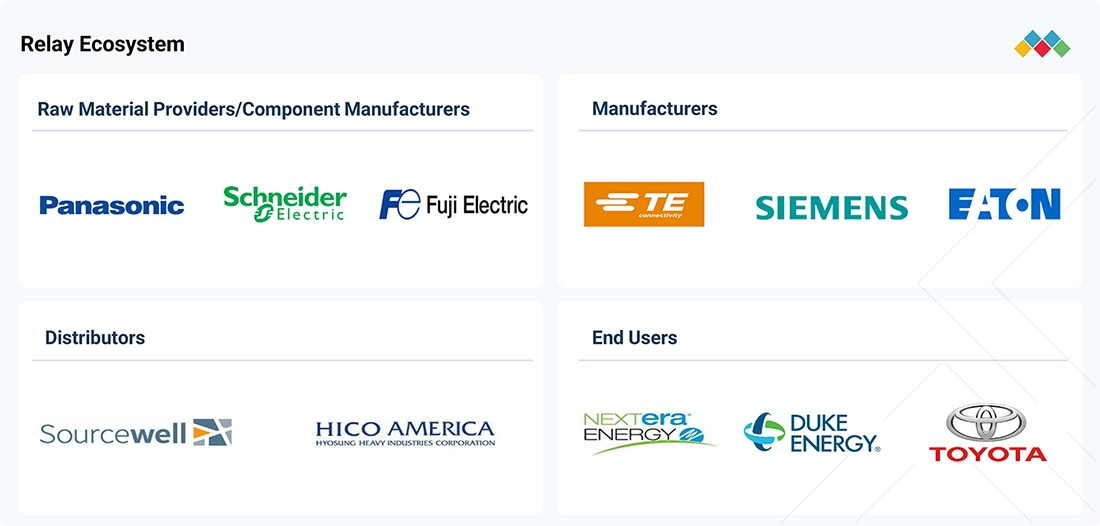
RELAY MARKET: COMMERCIAL USE CASES ACROSS INDUSTRIES
| COMPANY | USE CASE DESCRIPTION | BENEFITS |
|---|---|---|
 |
The water department of a large city, which is responsible for delivering nearly 1 billion gallons of drinking water daily to the city and its suburbs, operates multiple pumping stations and two purification plants. However, the protection and control systems at these facilities have not seen major updates since the early to mid-2000s. In April 2019, a city engineer reported that they were experiencing issues with their aging Multilin 469 motor protection relays. In light of these challenges, GE and the water department agreed that updating these outdated protection relays was essential to maintain operational efficiency and ensure the reliability of the water supply infrastructure. | Upgrading from Multilin 469 to Multilin 869 relays significantly improved operational reliability, system visibility, and motor protection across pumping stations and purification plants. The new relays reduced the risk of unexpected equipment failures and water supply disruptions by providing advanced diagnostics, faster fault detection, and improved communication capabilities. The retrofit process required minimal panel modifications, lowering installation time and costs. Configuration migration support from GE minimized errors and downtime. Overall, the upgrade enhanced asset protection, extended equipment life, and strengthened the reliability of critical water infrastructure operations. |
 |
Neutral Earthing Resistors (NERs) were installed at the Dugald River Zinc Mine in Australia. Annual periodic maintenance checks were made to verify the resistance and integrity of the NERs during shutdowns. However, this type of testing only ensures NER integrity at the time of the check, and a failure could occur at any time between checks, without the team being aware of it. This was a concern for the electrical engineers, and the Fuse co team was consulted for advice. | The installation of the SE-330AU relay enabled continuous, real-time monitoring of Neutral Earthing Resistor health, eliminating reliance on periodic manual inspections alone. This significantly reduced the risk of undetected NER failures that could compromise system safety and protection integrity. Immediate fault detection and alerting improved response times and prevented operation under hazardous floating conditions. Enhanced visibility into neutral-to-earth parameters strengthened fault current control and system stability. Overall, the solution increased operational safety, reduced unplanned downtime, minimized maintenance uncertainties, and ensured greater reliability of the mine’s electrical infrastructure. |
Logos and trademarks shown above are the property of their respective owners. Their use here is for informational and illustrative purposes only.
Related Ecosystem
Automotive Electronics And Electrical Equipment
- Battery Electric Vehicle (BEV)
- Light Commercial Vehicles (LCVs)
- Fuel Cell Electric Vehicle (FCEV)
- Sensors
- Hybrid Electric Vehicle (HEV)
- BOSCH LIMITED
- DENSO Corporation
- Continental ag
- Panasonic Holdings Corporation
- Texas Instruments Incorporated
Decarbonization
- Battery Electric Vehicle (BEV)
- Energy Management Systems
- Fuel Cell
- Fuel Cell Electric Vehicle (FCEV)
- Geographical Information System (GIS)
- TotalEnergies SE
- Siemens ag
- Mitsui & Co., Ltd.
- General Electric Company
- Thyssenkrupp ag
Energy Storage
- Energy Harvesting
- HVAC System
- Applicant Tracking System
- Battery Electric Vehicle (BEV)
- Carboxymethyl Cellulose (CMC)
- MOMENTIVE PERFORMANCE MATERIALS INC.
- Panasonic Holdings Corporation
- Lg corp
- ABB India Limited
- FDK Corporation
Key Takeaways
- Japan's relay market is valued at USD 739.3 million in 2024 and will reach USD 1,051.0 million by 2029 at a 6.0% CAGR.
- Japan's aging power infrastructure and grid modernization initiatives are primary drivers of relay market growth through 2029.
- Japan's renewable energy integration and smart grid adoption are accelerating demand for advanced protective relay systems.
- Japan's stringent safety standards and manufacturing excellence position the country as a regional technology leader in relay solutions.
Relay Market Report Scope
| Report Metric | Details |
|---|---|
| Base Year | 2024 |
| Fastest Growing Segment | REED (Type) |
| Forecast Period | 2024–2029 |
| Growth Rate | CAGR of 7% from 2024 to 2029 |
| Largest Segment | INDUSTRIAL (Vertical) |
| Market Size Base Year (Billions) | ~USD 10.13 (2024) |
| Revenue Forecast (Billions) | ~USD 14.21 (2029) |
| Segments Covered | Type, Voltage Range, Mounting Type, Application, Vertical, Equipment, Industry, Vehicle Type, Energy Source, Energy |
Japan Relay Market Report Segmentation
10 segment dimensions are covered across the global market.
By Type
- Electromechanical
- Other Types
- Reed
- Solar
- Solid State
- Thermal
- Time
- Wind
By Voltage Range
- High
- Low
- Medium
By Mounting Type
- Din Rail
- Other Mounting Types
- Panel
- Pcb
- Plug-In
By Application
- Control
- Monitoring
- Protection
By Vertical
- Energy
- Industrial
- Other Verticals
- Residential & Commercial
By Equipment
- Building Equipment
- Household Appliances
By Industry
- Automotive
- Food & Beverage
- Food & Beverages
- Medical
- Mining
- Semiconductors
- Waste Treatment
By Vehicle Type
- Conventional
- EV
By Energy Source
- Conventional
- Renewables
By Energy
- Generation
- Transmission & Distribution
JAPAN: RELAY MARKET FOR INDUSTRIAL, BY INDUSTRY, 2024–2030
| Segment | 2024 | 2025 | 2026 | 2027 | 2028 | 2029 | 2030 | CAGR (%) |
|---|---|---|---|---|---|---|---|---|
| AUTOMOTIVE | 152.4 | 162.1 | 172.8 | 184.5 | 197.3 | 211.3 | 229.5 | 7.1 |
| FOOD & BEVERAGES | 11.5 | 11.7 | 12 | 12.3 | 12.5 | 12.8 | 13.3 | 2.5 |
| MEDICAL | 65.2 | 68.2 | 71.3 | 74.7 | 78.3 | 82.2 | 87.5 | 5 |
| MINING | 16.1 | 16.4 | 16.7 | 17 | 17.4 | 17.7 | 18.3 | 2.1 |
| SEMICONDUCTORS | 51.9 | 54.2 | 56.7 | 59.4 | 62.3 | 65.4 | 69.6 | 5 |
| WASTE TREATMENT | 135.5 | 141.6 | 148.2 | 155.2 | 162.7 | 170.8 | 181.8 | 5 |
| TOTAL | 432.6 | 454.3 | 477.7 | 503 | 530.5 | 560.3 | 599.9 | 5.6 |
Target Audience
- Relay Manufacturers & Suppliers : Manufacturers need Japan-specific market data to assess market potential, plan production capacity, and develop localized product strategies for grid modernization and renewable energy applications.
- Utility Companies & Grid Operators : Japanese utilities require market insights to benchmark relay procurement strategies, evaluate technology trends, and plan infrastructure investments aligned with grid modernization and renewable integration goals.
- Electrical Equipment Distributors : Distributors operating in Japan need market forecasts to optimize inventory management, identify growth segments, and develop sales strategies for relay products across utility and industrial sectors.
- Investment & Private Equity Firms : Investors evaluating opportunities in Japan's energy sector need comprehensive market data to assess relay market attractiveness, identify acquisition targets, and evaluate growth potential through 2029.
- Technology & Consulting Firms : Consultants advising on Japan's energy transition and grid modernization require detailed market intelligence to support client strategies, competitive positioning, and technology adoption recommendations.
Key Companies in the Japan Relay Market
| Company | HQ | Ownership | Strongest segments |
|---|---|---|---|
| PANASONIC HOLDINGS CORPORATION | Japan | Public Company | Energy (cylindrical EV batteries, storage, dry/secondary batteries),HVAC & Cold Chain (air-conditioners, heat pumps, showcases, commercial refrigeration),Electric Works (lighting, wiring devices, solar PV, fuel cells, building materials), |
| HONGFA | China | Public Company | Relays (power, automotive, signal, solid-state, high-voltage DC, reed, high-frequency, latching, industrial),Low/medium-voltage electrical devices and complete equipment,Connectors and precision parts, |
| TE CONNECTIVITY | Ireland | Public Company | Transportation Solutions (automotive, commercial vehicles, e-mobility, autosport, rail),Industrial Solutions (automation, energy, aerospace, defense, medical, intelligent buildings),Data and Devices (5G, data centers, IoT connectivity, personal electronics), |
| OMRON CORPORATION | Japan | Public Company | Industrial Automation (sensors, safety, motion, robotics, automation systems),Device & Module Solutions (relays, switches, connectors, sensors, power supplies),Healthcare (cardiovascular, respiratory, pain management, remote monitoring), |
| GE VERNOVA INC. | United States | Public Company | Power (gas, nuclear, hydro, steam),Wind (onshore and offshore),Electrification (grid, power conversion, solar and storage, software), |
| FUJI ELECTRIC CO., LTD. | Japan | Public Company | Power Semiconductors,AC Drives, Motors, Servo, PLC, HMI,UPS, Power Supplies, Solar Inverters, Data Center Solutions, |
| ABB | Switzerland | Public Company | Electrification,Motion,Automation, |
| SCHNEIDER ELECTRIC | France | Public Company | Low- and medium-voltage products and systems,Building management, power metering, and HVAC/cooling,Industrial automation and variable speed drives, |
| SENSATA TECHNOLOGIES, INC | United States | Public Company | Automotive sensors and sensor-rich solutions,Industrial sensors, controls, and protection,Aerospace, defense, and commercial equipment, |
| SIEMENS | Germany | Public Company | Digital Industries (automation, PLM, simulation),Smart Infrastructure (grid, building, electrification),Mobility (rail systems, automation, services), |
| EATON | Ireland | Public Company | Electrical Americas,Electrical Global,Aerospace, |
| ROCKWELL AUTOMATION | United States | Public Company | Intelligent Devices,Software & Control,Lifecycle Services, |
| MITSUBISHI ELECTRIC CORPORATION | Japan | Public Company | Factory Automation (FA) systems and industrial controls,Building systems (elevators, escalators, building management),Air conditioning, refrigeration, and residential equipment, |
PANASONIC HOLDINGS CORPORATION
Panasonic Holdings Corporation is a Japanese multinational electronics company founded in 1918 with 183,685 employees. Operating as a public company, it manufactures a diverse range of consumer and industrial electronic products and solutions.
HONGFA
Hongfa is a Chinese public company established in 1984 with 18,190 employees. The company operates in the electronics and manufacturing sector.
TE CONNECTIVITY
TE Connectivity is a public company incorporated in Ireland and founded in 1941, employing 80,000 people. It specializes in connectivity and sensor solutions for various industries.
OMRON CORPORATION
Omron Corporation is a Japanese public company founded in 1933 with 26,050 employees. The company manufactures automation equipment, electronic components, and industrial control systems.
GE VERNOVA INC.
GE Vernova Inc. is a United States-based public company founded in 2023 with 78,000 employees. It operates in the energy and industrial technology sector.
FUJI ELECTRIC CO., LTD.
Fuji Electric Co., Ltd. is a Japanese public company established in 1923 with 26,955 employees. The company manufactures electrical equipment, power systems, and industrial automation products.
ABB
ABB is a Swiss multinational public company founded in 1883 with 112,700 employees. It specializes in robotics, power, and automation technologies serving diverse industrial sectors.
SCHNEIDER ELECTRIC
Schneider Electric is a French multinational public company founded in 1836 with 158,122 employees. The company provides energy management and automation solutions for residential, commercial, and industrial applications.
SENSATA TECHNOLOGIES, INC
Sensata Technologies, Inc. is a United States public company founded in 1916 with 16,700 employees. It manufactures sensors and controls for automotive, industrial, and aerospace applications.
SIEMENS
Siemens is a German multinational public company founded in 1847 with 310,312 employees. The company provides products and services in electrification, automation, and digitalization across multiple industries.
EATON
Eaton is a public company incorporated in Ireland and founded in 1911 with 97,303 employees. It manufactures electrical components, power management systems, and industrial equipment.
ROCKWELL AUTOMATION
Rockwell Automation is a United States public company founded in 1903 with 26,000 employees. The company provides industrial automation and information technology solutions.
MITSUBISHI ELECTRIC CORPORATION
Mitsubishi Electric Corporation is a Japanese multinational public company founded in 1921 with 150,386 employees. It manufactures electrical and electronic equipment, industrial systems, and consumer products.
Reasons to Buy this Report
- Market Size & Forecast Data : Access precise market valuation for Japan at USD 739.3M (2024) with detailed 5-year forecasts. Make informed investment and expansion decisions based on Japan-specific growth projections and CAGR analysis.
- Grid Modernization Insights : Understand Japan's aging infrastructure replacement cycle and modernization timelines. Identify opportunities in protective relay systems, digital relays, and smart grid solutions driving market expansion.
- Renewable Energy Opportunity : Gain competitive intelligence on relay demand from Japan's renewable energy transition. Analyze how solar, wind, and grid integration projects create new market segments and customer acquisition channels.
- Regional Market Dynamics : Benchmark Japan's 6% CAGR against global 7% growth. Understand local market drivers, regulatory environment, and competitive landscape specific to Japan's energy sector.
- Strategic Planning & Positioning : Develop targeted go-to-market strategies for Japan's relay market. Identify key customer segments, distribution channels, and technology trends to maximize market penetration and revenue growth.
Frequently asked questions
What is the current size of Japan's relay market?
Japan's relay market is estimated at USD 739.3 million in 2024 and is expected to grow to USD 1,051.0 million by 2029.
What is the projected growth rate for Japan's relay market?
Japan's relay market is projected to grow at a compound annual growth rate (CAGR) of 6.0% from 2024 to 2029.
What are the main drivers of growth in Japan's relay market?
Japan's relay market growth is driven by power grid modernization, renewable energy integration, smart grid deployment, and industrial automation expansion.
How does Japan's relay market compare to other Asia Pacific countries?
Japan's relay market benefits from advanced infrastructure, stringent safety regulations, and high manufacturing standards that position it as a regional technology leader in the Asia Pacific region.
What applications dominate Japan's relay market?
Japan's relay market is dominated by protective relays for utility grids, industrial power systems, renewable energy installations, and smart grid infrastructure applications.
RESEARCH METHODOLOGY
The research process for this technical, market-oriented, and commercial study of the relay market involved systematic collection, validation, and analysis of information related to relay technologies, product types, mounting types, voltage ratings, applications, end users, and industry developments. Extensive secondary research was conducted using annual reports, investor presentations, technical papers, regulatory publications, industry databases, company websites, product catalogs, and financial reports to identify key market participants, technology trends, market developments, and competitive strategies. The findings were further validated through primary interviews with executives from relay manufacturers, electrical equipment manufacturers, automotive OEMs, industrial automation companies, utilities, distributors, and industry experts to assess market estimates, product adoption, pricing trends, customer requirements, and competitive positioning. Key market players and their market positions were established through a combination of secondary research and primary research involving senior executives, business development managers, product specialists, and technical experts across the relay ecosystem.
Secondary Research
In the secondary research process, various sources were referred to for identifying and collecting information relevant to the study. Secondary sources included annual reports, investor presentations, press releases, company websites, technical papers, industry journals, regulatory publications, product catalogs, and recognized market databases. Publications and datasets from organizations such as the International Energy Agency (IEA), International Electrotechnical Commission (IEC), IEEE, CIGRE, and national energy and electricity regulatory authorities were reviewed to understand developments in power transmission and distribution, grid modernization, renewable energy integration, industrial automation, electrification, and relay standards and regulations. Secondary research was primarily conducted to obtain information on the relay value chain, key market participants, product developments, technology trends, application and end-user demand, manufacturing capabilities, distribution networks, pricing trends, and regional market developments.
Primary Research
During the primary research phase, relay manufacturers, electrical equipment manufacturers, utilities, distributors, industrial automation companies, automotive OEMs, and industry experts were interviewed to obtain qualitative and quantitative insights into the relay market. Interviews were conducted to validate market estimates, product adoption, pricing trends, regional demand, competitive positioning, customer requirements, and technology developments. Primary interviews also helped assess demand across electromechanical, solid-state, reed, and other relay types; adoption of different mounting configurations; demand for low-, medium-, and high-voltage relays; application trends across industrial, automotive, power, commercial, and other sectors; and emerging opportunities associated with electrification, automation, renewable energy, and grid modernization. The findings were validated against company disclosures, industry statistics, regulatory publications, technical sources, and market data to refine market estimates, segment shares, regional forecasts, and competitive assessments.
Breakdown of Primary Profiles
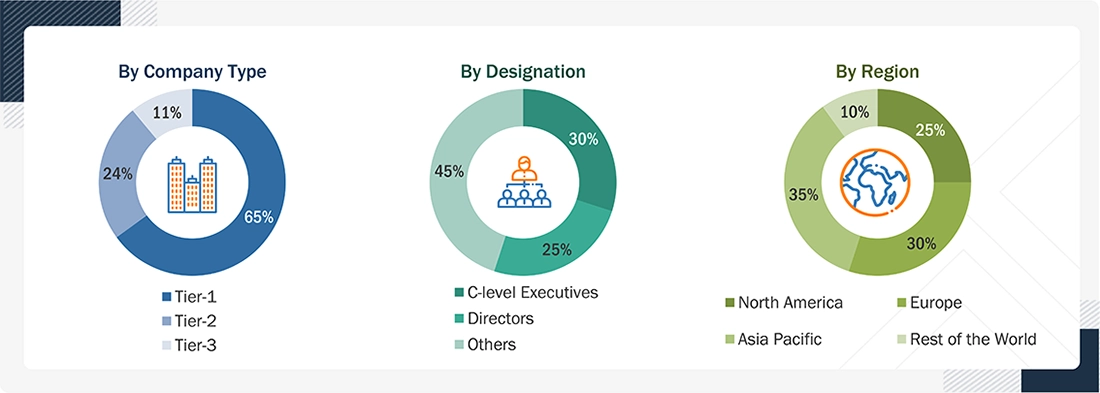
Note: Others include sales managers, engineers, and regional managers.
Tier 1 Company: Revenue > USD 5 billion, Tier 2 Company: Revenue between USD 1 and USD 5 billion, and Tier 3 Company: Revenue < USD 1 billion.
To know about the assumptions considered for the study, download the pdf brochure
Market Size Estimation
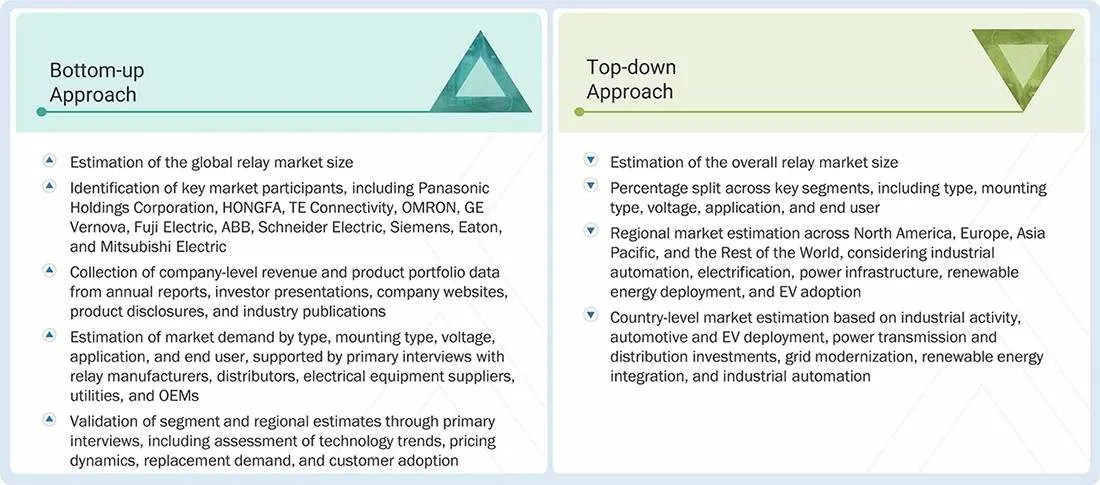
Both top-down and bottom-up approaches have been used to estimate and validate the size of the relay market and its dependent submarkets. The key players in the market have been identified through secondary research, and their market shares in the respective segments have been obtained through both primary and secondary research. The research methodology includes the study of annual and financial reports of top market players and interviews with industry experts, such as chief executive officers, vice presidents, directors, sales managers, product managers, and marketing executives, for key quantitative and qualitative insights related to the relay market.
Bottom-up Approach
- Market size is estimated based on the total demand and sales of relays across key countries and end-use industries.
- The number of relevant relay units deployed across applications such as industrial automation, automotive, power transmission & distribution, renewable energy, electronics, commercial equipment, and other applications is identified using secondary research and industry data.
- The number of relay units is multiplied by the average selling price (ASP) of relays by type, voltage rating, application, and region to estimate the total market value.
- Estimated market revenues are further segmented by relay type, mounting type, voltage, application, end user, and region based on company-level and industry-level data.
- The country-level estimates are aggregated to determine regional and global relay market size.
- Key assumptions, including average selling prices, unit deployment, replacement rates, and adoption of different relay technologies, are validated through primary interviews with relay manufacturers, distributors, OEMs, utilities, and industry experts.
- The resulting market size is further cross-checked and validated through secondary research and data triangulation.
Top-down Approach
- Estimating the overall global relay market by analyzing industrial automation investments, automotive production, EV adoption, power transmission and distribution investments, renewable energy capacity additions, grid modernization, and electrical equipment demand.
- Allocating the market across relay types, mounting types, voltage ratings, applications, and end users based on adoption patterns, relay consumption, product preferences, industry trends, and company-level data.
- Distributing market estimates across North America, Europe, Asia Pacific, and the Rest of the World based on industrial activity, automotive production, electrification investments, renewable energy capacity additions, power infrastructure development, and regional market dynamics.
- Further splitting regional markets into country-level markets based on industrial production, automotive and EV deployment, power infrastructure investments, manufacturing activity, and market penetration of different relay technologies.
- Validating the final market estimates through primary interviews with relay manufacturers, electrical equipment OEMs, utilities, distributors, and industry experts to validate regional demand trends, product adoption, pricing, and end-user requirements, followed by data triangulation to ensure consistency and accuracy.
Global Relay Market Size: Bottom-up Approach and Top-down Approach
Data Triangulation
The process of determining the overall market size involved the methodologies described earlier, followed by segmenting the market into multiple segments and subsegments. To finalize the comprehensive market analysis and obtain precise statistics for each market segment and subsegment, data triangulation and market breakdown procedures were applied wherever appropriate. Data triangulation was accomplished by examining factors and trends from both the demand and supply sides of the relay ecosystem, including relay production and sales, unit shipments, industrial automation investments, automotive and EV production, power transmission and distribution investments, renewable energy capacity additions, grid modernization, product adoption, pricing trends, replacement demand, and regional market dynamics.
Market Definition
A relay is an electrically operated switching device used to control, switch, isolate, or protect electrical circuits by opening or closing contacts in response to an electrical input signal. Relays are widely used across power systems, industrial automation, automotive, telecommunications, electronics, renewable energy, and commercial applications. Depending on the operating principle and construction, relays include electromechanical, solid-state, reed, and other specialized types. Relays can also be differentiated by mounting configuration, voltage rating, contact arrangement, switching capacity, and application.
The relay market encompasses the total revenue generated globally from the sale of relays across different types, including electromechanical, solid-state, reed, and other relay types. The market covers applications such as industrial automation, automotive, power transmission & distribution, renewable energy, electronics, commercial equipment, and other applications. The study includes relays across different mounting types, including panel mount and other mounting configurations, and voltage categories, including low-, medium-, and high-voltage relays. The market covers North America, Europe, Asia Pacific, and the Rest of the World.
Key Stakeholders
- Energy utilities
- Automotive relay manufacturers
- State and national regulatory authorities
- Organizations, forums, alliances, and associations
- Investors/Shareholders
- Manufacturers’ associations
- Relay raw material and component manufacturers
- Relay manufacturers, dealers, and suppliers
- Electrical equipment manufacturers’ associations and groups
- Power utilities and other end-user companies
- Consulting companies in the energy and power domain
- EV relay manufacturers
Report Objectives
- To define, describe, segment, and forecast the relay market, in terms of value, by type, application, voltage range, mounting type, vertical, and region
- To forecast the market sizes for four major regions-North America, Europe, Asia Pacific, and the Rest of the World-along with their key countries
- To forecast the relay market, by region, in terms of volume
- To provide detailed information regarding key drivers, restraints, opportunities, and challenges influencing the growth of the market
- To strategically analyze the micromarkets with respect to individual growth trends, prospects, and contributions to the overall market size
- To provide the supply chain analysis, trends/disruptions impacting customer business, market map, ecosystem analysis, tariffs and regulations, pricing analysis, patent analysis, case study analysis, technology analysis, key conferences and events, trade analysis, Porter’s Five Forces analysis, key stakeholders and buying criteria, and regulatory analysis of the relay market
- To analyze opportunities for stakeholders in the relay market and present a competitive landscape of the market
- To benchmark market players using the company evaluation matrix, which analyzes market players based on business and product strategies adopted by them
- To compare key market players in terms of market share, product specifications, and applications
- To strategically profile key players and comprehensively analyze their market ranking and core competencies
- To analyze competitive developments in the relay market, such as contracts & agreements, investments & expansions, mergers & acquisitions, product launches, partnerships, joint ventures, and collaborations
- To study the impact of AI/Gen AI on the market under study, along with the macroeconomic outlook for each region
Available customizations:
With the given market data, MarketsandMarkets offers customizations based on the company’s specific needs. The following customization options are available for the report:
PRODUCT ANALYSIS
- Product Matrix, which provides a detailed comparison of the product portfolio of each company
COMPANY INFORMATION
- Detailed analyses and profiling of additional market players (up to 5)
Get the Full Relay Market Report
Full forecast, segment splits, and company analysis for all Relay Market.
Need a Tailored Report?
Customize this report to your needs
Get 10% FREE Customization
Customize This Report
