
Brazil Research Use (RUO) Recombinant Protein Market (2026-2031)

The Brazil Research Use (RUO) Recombinant Protein Market was valued at $3.45 Million in 2026 and projected to reach to $4.88 Million by 2031, representing a compound annual growth rate of 7.2%. Brazil's RUO Recombinant Protein Market is poised for steady growth driven by expanding life sciences research infrastructure and increasing pharmaceutical innovation activities.


| Market Size in | USD 26.32 MN |
| Market Forecast in | |
| CAGR | |
| Forecast Period | |
| Units Considered | Value (USD MN) |
Brazil Research Use (RUO) Recombinant Protein Market Trends and Insights
- Brazil's market expansion is driven by increasing investment in life sciences research, growing pharmaceutical development activities, and rising demand for high-quality recombinant proteins in academic and industrial laboratories.
- The country's expanding biotechnology sector and government support for research infrastructure are key catalysts positioning Brazil as a significant player in the Latin American RUO recombinant protein landscape. During the forecast period from 2026 to 2031, Brazil is expected to experience steady market growth fueled by enhanced research capabilities and collaborations between domestic and international institutions.
- Brazil's growing focus on personalized medicine, vaccine development, and diagnostic innovation is creating sustained demand for recombinant proteins across research applications.
- The market in Brazil reflects broader regional trends while maintaining unique characteristics tied to the country's scientific ecosystem and regulatory environment..
Key Market Statistics
- CAGR (2026-2031) 7.2% CAGR
- Market Size, 2026 ~USD 3.45 Million
- Forecast, 2031 ~USD 4.88 Million
- Country Brazil
Brazil Research Use (RUO) Recombinant Protein Market Overview
Market Size & Growth :
Brazil's RUO Recombinant Protein Market is valued at USD 3.45 million in 2026, expanding to USD 4.88 million by 2031 at a CAGR of 7.2%, outpacing the global growth rate of 7%.
Research Investment Surge :
Increasing government and private sector investment in life sciences research across Brazil is driving demand for high-quality recombinant proteins in academic and industrial laboratories.
Pharmaceutical Development Hub :
Brazil's growing pharmaceutical development activities and biopharmaceutical sector expansion are creating sustained demand for recombinant proteins in drug discovery and development pipelines.
Quality & Standardization Focus :
Rising emphasis on high-quality, standardized recombinant proteins for research applications is positioning Brazil as an emerging market for premium protein suppliers and contract research organizations.
Brazil Research Use (RUO) Recombinant Protein Market Dynamics
- The country's growing biotechnology sector and rising investment in R&D facilities are creating robust demand for recombinant proteins across academic institutions, contract research organizations, and pharmaceutical companies.
- Government initiatives supporting scientific research and the development of local biotech capabilities further strengthen market prospects.
- By 2031, the market is expected to reach USD 4.88 million, reflecting Brazil's strategic importance in Latin America's life sciences landscape and its commitment to advancing research capabilities..
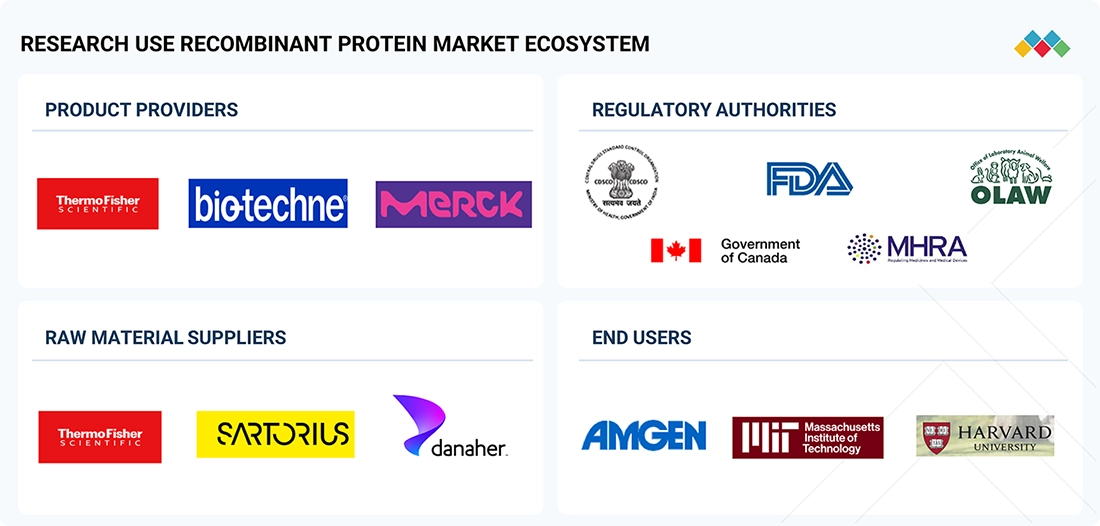
Market Ecosystem
RESEARCH USE (RUO) RECOMBINANT PROTEIN MARKET: COMMERCIAL USE CASES ACROSS INDUSTRIES
| COMPANY | USE CASE DESCRIPTION | BENEFITS |
|---|---|---|
 |
R&D Systems Fluorokines fluorescent-labeled recombinant proteins applied in flow-cytometric detection of CARs, immune checkpoint receptors, and antigen-binding cells for immuno-oncology and cell therapy research | Direct and specific target staining | Streamlined receptor-expression analysis | Supports CAR-T characterization | Reduced assay complexity |
 |
Gibco PeproTech cytokines and growth factors applied in primary cell expansion, stem cell differentiation, organoid and 3D culture, cell-signaling studies, and investigational CAR-T workflows | Reliable cell culture supplementation | Supports disease modeling and drug discovery | Enables cell expansion and differentiation | Broad application versatility |
Logos and trademarks shown above are the property of their respective owners. Their use here is for informational and illustrative purposes only.
Related Ecosystem
Biotechnology
- Reagents
- Polymerase Chain Reaction (PCR)
- Stem Cells
- Assay Kits
- Flow Cytometers
- Thermo Fisher Scientific Inc.
- Merck KGaA
- Danaher Corporation
- Agilent Technologies, Inc.
- Bio-Rad Laboratories, Inc.
Key Takeaways
- Brazil's RUO recombinant protein market is valued at USD 3.45 million in 2026 and will reach USD 4.88 million by 2031.
- Brazil demonstrates a 7.2% CAGR, outpacing the global average and reflecting strong regional demand.
- Brazil's biotechnology sector expansion and research infrastructure investments are primary growth drivers.
- Brazil's focus on vaccine development and personalized medicine is accelerating recombinant protein adoption in research applications.
Research Use (RUO) Recombinant Protein Market Report Scope
| Report Metric | Details |
|---|---|
| Base Year | 2026 |
| Fastest Growing Segment | CYTOKINES & CHEMOKINES (Product) |
| Forecast Period | 2026-2031 |
| Growth Rate | CAGR of 7% from 2026 to 2031 |
| Largest Segment | LYOPHILIZED RECOMBINANT PROTEINS (Product Formulation) |
| Market Size Base Year (Billions) | ~USD 1.11 (2026) |
| Revenue Forecast (Billions) | ~USD 1.55 (2031) |
| Segments Covered | Product, Product Formulation, Species, Host Cell, Application, End User |
Brazil Research Use (RUO) Recombinant Protein Market Report Segmentation
6 segment dimensions are covered across the global market.
By Product
- Cytokines & Chemokines
- Ecm & Adhesion Proteins
- Enzymes
- Growth Factors
- Other Recombinant Proteins
- Receptors & Ligands
- Recombinant Antigens
By Product Formulation
- Liquid Recombinant Proteins
- Lyophilized Recombinant Proteins
By Species
- Human
- Mouse
- Non-Human Primate
- Non-Human Primate (Nhp)
- Other Species
- Rat
By Host Cell
- Bacterial Cells
- Insect Cells
- Mammalian Cells
- Other Host Cells
- Yeast & Fungi Cells
By Application
- Cancer Research
- Cell Culture & Differentiation
- Drug Discovery
- Infectious Disease & Vaccine Research
- Other Applications
- Stem Cell Research
By End User
- Academic & Research Institutes
- Cros
- Other End Users
- Pharmaceutical & Biotechnology Companies
Target Audience
- Pharmaceutical Companies : Brazilian and multinational pharma firms need market intelligence to optimize R&D investments, identify recombinant protein sourcing opportunities, and plan product development strategies.
- Biotechnology Firms : Local and international biotech companies require Brazil-specific market data to assess growth potential, competitive landscape, and opportunities for recombinant protein product launches.
- Contract Research Organizations : CROs operating in Brazil need detailed market insights to understand demand for recombinant proteins, identify client segments, and expand service offerings in the research sector.
- Research Institutions & Universities : Academic and government research organizations in Brazil need market data to justify funding requests, benchmark research capabilities, and identify collaboration opportunities.
- Investors & Venture Capitalists : Investment firms evaluating opportunities in Brazil's life sciences sector require market-specific data to assess growth potential, identify promising startups, and make informed funding decisions.
Reasons to Buy this Report
- Market-Specific Growth Data : Access precise market sizing and forecasting for Brazil's RUO Recombinant Protein segment with country-specific CAGR analysis, enabling accurate business planning and investment decisions.
- Competitive Positioning Strategy : Understand Brazil's unique market dynamics, local research infrastructure, and pharmaceutical development trends to identify competitive advantages and market entry opportunities.
- Investment & Expansion Planning : Leverage detailed Brazil market insights to evaluate expansion potential, assess local demand drivers, and prioritize resource allocation in Latin America's largest life sciences market.
- Supplier & Partnership Identification : Identify key growth segments and research institutions in Brazil to establish strategic partnerships, distribution channels, and supply agreements with local stakeholders.
- Risk Mitigation & Forecasting : Utilize country-specific market projections and growth drivers to mitigate risks, forecast revenue potential, and develop targeted marketing strategies for the Brazilian market.
Frequently asked questions
What is the current market size of RUO recombinant proteins in Brazil?
Brazil's RUO recombinant protein market is estimated at USD 3.45 million in 2026.
What is the projected market size for Brazil by 2031?
Brazil's RUO recombinant protein market is forecast to reach USD 4.88 million by 2031.
What is the CAGR for Brazil's RUO recombinant protein market?
Brazil's market is expected to grow at a CAGR of 7.2% from 2026 to 2031.
What factors are driving growth in Brazil's RUO recombinant protein market?
Key drivers include increased life sciences research investment, pharmaceutical development activities, biotechnology sector expansion, and growing demand for recombinant proteins in academic and industrial research.
How does Brazil's market growth compare to global trends?
Brazil's 7.2% CAGR exceeds the global CAGR of 7%, indicating stronger regional market momentum and increased adoption of recombinant proteins in research applications.
RESEARCH METHODOLOGY
This research study extensively utilized secondary sources, directories, and databases to identify and collect valuable information for analyzing the research use recombinant protein market. In-depth interviews were conducted with various primary respondents, including key industry participants, subject-matter experts (SMEs), C-level executives of key market players, and industry consultants, to obtain and verify critical qualitative & quantitative information and assess the growth prospects of the market. The global market size estimated through secondary research was triangulated with inputs from primary research to determine the final market size.
Secondary Research
Secondary research was primarily used to identify and collect information for the comprehensive technical, market-oriented, and commercial study of the research use recombinant protein market. The secondary sources used for this study include the Antibody Society, Pharmaceutical Research and Manufacturers of America (PhRMA), National Institutes of Health (NIH), Centers for Disease Control and Prevention (CDC), National Center for Biotechnology Information (NCBI), American Medical Association (AMA), Recombinant Antibody Network (RAN) National Cancer Institute (NCI), Association of Medical Laboratory Immunologists (AMLI), American Society of Clinical Oncology (ASCO), United States Department of Agriculture (USDA), United States Food & Drug Administration (US FDA), American Association for Cancer Research (AACR), Biomolecular Interaction Network Database, European Medicines Agency (EMA), British Society for Immunology (BSI), and Institute for Molecular Medicine. Secondary research also included the use of academic journals and company websites; corporate & regulatory filings, such as annual reports, SEC filings, investor presentations, and financial statements; business magazines & research journals; press releases; and trade, business, and professional associations, among others. Secondary data were collected and analyzed to determine the overall size of the research use recombinant protein market, which was subsequently validated through primary research. These sources were also used to gather key information about major players, market classification, and segmentation based on industry trends, regional/country-level markets, market developments, and technological perspectives.
Primary Research
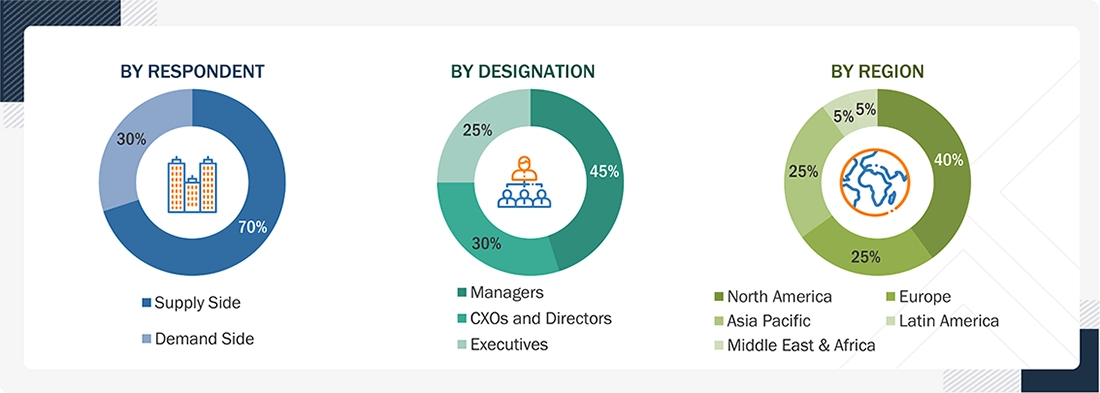
In-depth interviews were conducted with various primary respondents, including key industry participants, subject-matter experts (SMEs), C-level executives of key market players, and industry consultants, to obtain and verify critical qualitative & quantitative information and assess the market’s prospects. Various primary sources from the supply & demand sides of the market were interviewed to obtain qualitative and quantitative information.
To know about the assumptions considered for the study, download the pdf brochure
Market Size Estimation
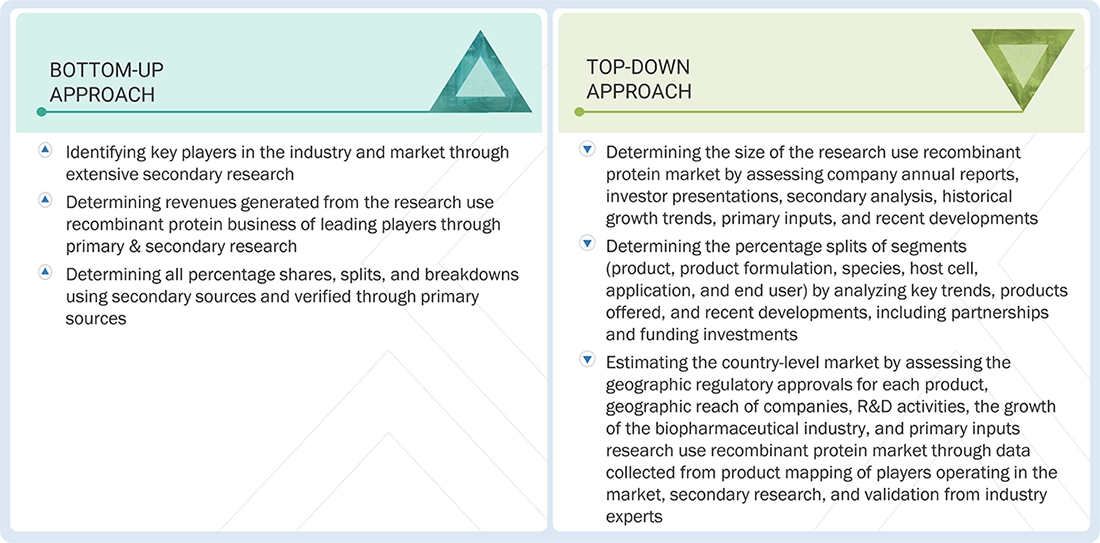
The top-down and bottom-up approaches were used to estimate & validate the total size of the research use recombinant protein market. These methods were also used extensively to estimate the size of various market segments.
Research Use (RUO) Recombinant Protein Market : Top-Down and Bottom-Up Approach
Data Triangulation
After evaluating the overall market size through the market size estimation process, the total market was divided into several segments and subsegments. Data triangulation and market breakdown procedures were used, whenever applicable, to complete the overall market engineering process and obtain precise statistics for all segments and subsegments. The data was triangulated by analyzing various factors and trends from the demand and supply sides.
Market Definition
The research use recombinant protein is defined as a recombinant protein supplied as a finished off-the-shelf consumable for research applications such as basic/academic research, drug discovery & translational research, and preclinical research. Lyophilized and liquid formulations of research use recombinant proteins are considered in the report scope. These proteins originate from different species, including human, mouse/murine, and non-human primates, among others. Research use recombinant proteins are expressed in different types of hosts such as bacterial cells, mammalian cells, insect cells, and yeast & fungi, among others, which are also considered in the report scope.
Key Stakeholders
- Pharmaceutical & biotechnology companies
- Contract research organizations (CROs)
- Life science companies
- Academic & research institutes
- Private research institutes
- Venture capitalists & investors
- Market research & consulting firms
- Medical institutions & universities
Report Objectives
- To define, describe, and forecast the research use recombinant protein market based on product, product formulation, species, host cell, application, end user, and region
- To provide detailed information regarding the major factors influencing the market growth (such as drivers, restraints, opportunities, and challenges)
- To strategically analyze micromarkets concerning individual growth trends, prospects, and contributions to the overall market
- To analyze the opportunities in the market for stakeholders and provide details of the competitive landscape for market leaders
- To forecast the size of the market segments concerning six main regions, namely, North America, Europe, Asia Pacific, Latin America, the Middle East, and Africa
- To strategically profile the key players in the market and comprehensively analyze their core competencies and market rankings
- To track and analyze competitive developments such as product launches, acquisitions, expansions, agreements, partnerships, and collaborations in the market
- To benchmark players within the research use recombinant protein market using the ‘Company Evaluation Matrix' framework, which analyzes market players based on various parameters within the broad categories of business and product/service strategy
Available customizations:
With the given market data, MarketsandMarkets offers customizations per the company’s specific needs. The following customization options are available for this report:
Geographical Analysis
- Further breakdown of the Rest of Europe research use recombinant protein market, by country
- Further breakdown of the Rest of Asia Pacific research use recombinant protein market, by country
- Further breakdown of the Rest of Latin America research use recombinant protein market, by country
- Further breakdown of the Rest of Middle East research use recombinant protein market, by country
Company Information
- Detailed analysis and profiling of additional market players (up to five)
Get the Full Research Use (RUO) Recombinant Protein Market Report
Full forecast, segment splits, and company analysis for all Research Use (RUO) Recombinant Protein Market.
- US Research Use (RUO) Recombinant Protein Market
- Canada Research Use (RUO) Recombinant Protein Market
- Germany Research Use (RUO) Recombinant Protein Market
- UK Research Use (RUO) Recombinant Protein Market
- France Research Use (RUO) Recombinant Protein Market
- Italy Research Use (RUO) Recombinant Protein Market
- Spain Research Use (RUO) Recombinant Protein Market
- China Research Use (RUO) Recombinant Protein Market
- Japan Research Use (RUO) Recombinant Protein Market
- India Research Use (RUO) Recombinant Protein Market
- Australia Research Use (RUO) Recombinant Protein Market
- South Korea Research Use (RUO) Recombinant Protein Market
- Mexico Research Use (RUO) Recombinant Protein Market
- Saudi Arabia Research Use (RUO) Recombinant Protein Market
- UAE Research Use (RUO) Recombinant Protein Market
- Rest Of Europe Research Use (RUO) Recombinant Protein Market
- Rest Of Asia Pacific Research Use (RUO) Recombinant Protein Market
- Rest Of Latin America Research Use (RUO) Recombinant Protein Market
- Rest Of GCC Countries Research Use (RUO) Recombinant Protein Market
- GCC Countries Research Use (RUO) Recombinant Protein Market
- Rest Of Middle East Research Use (RUO) Recombinant Protein Market
Need a Tailored Report?
Customize this report to your needs
Get 10% FREE Customization
Customize This Report
