
Rest Of Asia Pacific Rigid Endoscopes Market (2025-2030)

The Rest Of Asia Pacific Rigid Endoscopes Market was valued at $27.5 Million in 2025 and projected to reach to $35.4 Million by 2030, representing a compound annual growth rate of 5.1%. The Rest Of Asia Pacific rigid endoscopes market is poised for steady expansion driven by increasing surgical volumes and healthcare modernization initiatives across the region.


| Market Size in | USD 26.32 MN |
| Market Forecast in | |
| CAGR | |
| Forecast Period | |
| Units Considered | Value (USD MN) |
Rest Of Asia Pacific Rigid Endoscopes Market Trends and Insights
- Rest Of Asia Pacific is experiencing steady demand for rigid endoscopy equipment driven by increasing surgical procedures, rising healthcare infrastructure investment, and growing adoption of minimally invasive techniques across emerging economies in the region.
- The market in Rest Of Asia Pacific benefits from expanding hospital networks, improving reimbursement policies, and heightened awareness of diagnostic and therapeutic endoscopic procedures among healthcare providers and patients alike. Rest Of Asia Pacific's rigid endoscopes market is characterized by a diverse competitive landscape with both established multinational manufacturers and regional players competing for market share.
- Throughout the forecast period from 2025 to 2030, Rest Of Asia Pacific is expected to witness accelerated growth as healthcare systems modernize and surgical volumes increase.
- Key factors supporting expansion in Rest Of Asia Pacific include rising geriatric populations, increasing prevalence of chronic diseases requiring endoscopic intervention, and government initiatives to enhance surgical capabilities in underserved areas..
Key Market Statistics
- CAGR (2025-2030) 5.1% CAGR
- Market Size, 2025 ~USD 27.5 Million
- Forecast, 2030 ~USD 35.4 Million
- Country Rest Of Asia Pacific
Rest Of Asia Pacific Rigid Endoscopes Market Overview
Market Size & Growth :
Rest Of Asia Pacific rigid endoscopes market valued at USD 27.5 million in 2025, expanding at 5.1% CAGR to reach USD 35.4 million by 2030, outpacing global growth rate of 4.9%.
Surgical Procedure Surge :
Increasing volume of minimally invasive surgical procedures across emerging economies in Rest Of Asia Pacific is driving demand for advanced rigid endoscopy equipment and instrumentation.
Healthcare Infrastructure Investment :
Rising government and private sector investments in healthcare infrastructure across Rest Of Asia Pacific countries are expanding access to modern surgical facilities and endoscopic technologies.
Adoption of Minimally Invasive Techniques :
Growing preference for minimally invasive surgery in Rest Of Asia Pacific due to reduced patient recovery time, lower infection rates, and improved clinical outcomes is accelerating rigid endoscope adoption.
Rest Of Asia Pacific Rigid Endoscopes Market Dynamics
- Rising awareness of minimally invasive procedures, coupled with improving healthcare infrastructure in emerging economies, creates significant growth opportunities for rigid endoscopy equipment manufacturers and suppliers. Key growth drivers include expanding middle-class populations seeking advanced medical treatments, government healthcare reforms, and rising private hospital investments.
- The region's competitive pricing environment and growing medical device manufacturing capabilities position Rest Of Asia Pacific as an attractive market for both established and emerging endoscopy solution providers through 2030..
Market Ecosystem
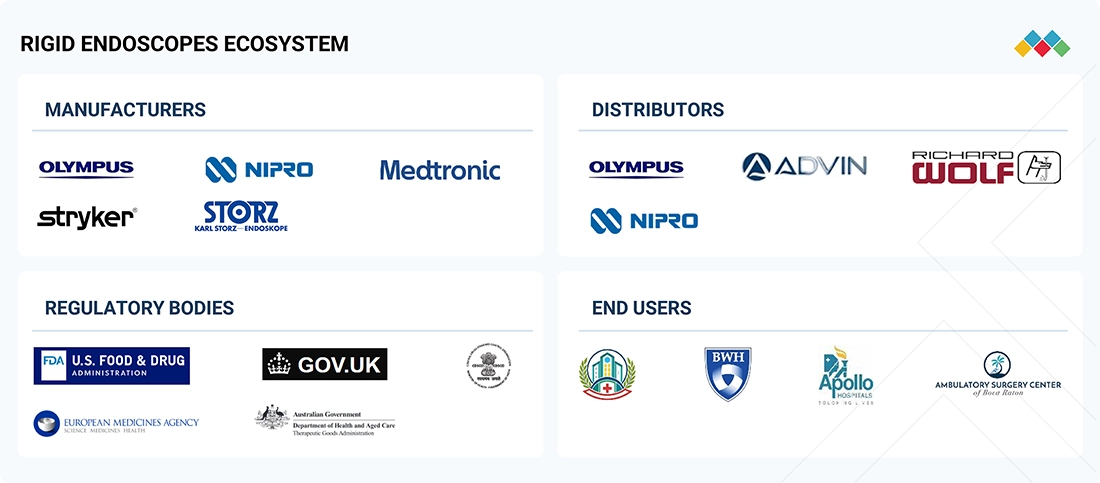
Rigid Endoscopes Market: COMMERCIAL USE CASES ACROSS INDUSTRIES
| COMPANY | USE CASE DESCRIPTION | BENEFITS |
|---|---|---|
 |
Rigid laparoscopes in 5 mm and 10 mm with 0°/30°/45° angles for minimally invasive general surgery and related specialties; designed for HD imaging across the chain and compatible with autoclave reprocessing | Superior HD resolution and contrast with aspherical lenses for distortion-free viewing, uniform illumination, and robust autoclavable construction backed by long-term warranty emphasis. |
 |
HOPKINS rod-lens rigid telescopes used across arthroscopy, hysteroscopy, and other specialties, offered in 4 mm diameters with 0° and 30° viewing options, featuring fiber-optic light transmission and autoclavable designs with matched sheaths | High image quality with optimal brightness and contrast from the HOPKINS rod-lens system, scratch-resistant components, and reliable sterilization compatibility for OR workflows |
 |
Rigid scopes that provide visualization of internal anatomy during general endoscopic procedures, integrated within Stryker surgical visualization platforms used across multiple specialties | Clear intraoperative visualization with 4K platform integration and fluorescence options that enhance identification of critical anatomy and overall image clarity |
 |
4KO rigid arthroscopes and laparoscopes designed to pair with LENS HD or LENS 4K systems for sports medicine and general surgery visualization | Increased brightness and optimized color transmission for improved image quality, with durable stainless-steel/titanium construction and compatibility with autoclave and low-temperature sterilization modes |
 |
Full HD-compatible rigid endoscopes for laparoscopy and ENT/arthroscopy with stainless-steel construction; complemented by 2D/3D camera platforms for minimally invasive surgery | Uniform illumination via high-quality fiber optics, fully autoclavable designs, and 3D platforms that improve depth perception, suturing, and hand-eye coordination while reducing fogging through sterile-handling concepts |
Logos and trademarks shown above are the property of their respective owners. Their use here is for informational and illustrative purposes only.
Related Ecosystem
Medical Devices
Key Takeaways
- Rest Of Asia Pacific's rigid endoscopes market is valued at USD 27.5 million in 2025 and will grow to USD 35.4 million by 2030 at a 5.1% CAGR.
- Rest Of Asia Pacific is driven by expanding healthcare infrastructure, increasing surgical volumes, and rising adoption of minimally invasive procedures across emerging economies.
- Rest Of Asia Pacific benefits from government healthcare initiatives, improving reimbursement frameworks, and growing awareness of endoscopic diagnostic and therapeutic applications.
- Rest Of Asia Pacific's competitive landscape includes both multinational and regional manufacturers, with market consolidation and technological innovation shaping the sector through 2030.
Rigid Endoscopes Market Report Scope
| Report Metric | Details |
|---|---|
| Base Year | 2025 |
| Fastest Growing Segment | NEUROENDOSCOPY (Application) |
| Forecast Period | 2025–2030 |
| Growth Rate | CAGR of 4.9% from 2025 to 2030 |
| Largest Segment | SURGICAL USAGE (Clinical Usage) |
| Market Size Base Year (Billions) | ~USD 1.83 (2025) |
| Revenue Forecast (Billions) | ~USD 2.32 (2030) |
| Segments Covered | Type, Clinical Usage, Application, End User |
Rest Of Asia Pacific Rigid Endoscopes Market Report Segmentation
4 segment dimensions are covered across the global market.
By Type
- Arthroscopes
- Cystoscopes
- Gynecology Endoscopes
- Laparoscopes
- Neuroendoscopes
- Other Rigid Endoscopes
- Urology Endoscopes
By Clinical Usage
- Diagnostic Usage
- Surgical Usage
By Application
- Arthroscopy
- Laparoscopy
- Neuroendoscopy
- Other Applications
- Urology
- Urology Endoscopy
By End User
- Ambulatory Surgery Centers
- Clinics
- Hospitals
- Other End Users
Target Audience
- Medical Device Manufacturers : Rigid endoscope and surgical instrument manufacturers need Rest Of Asia Pacific-specific market data to identify growth opportunities, optimize product portfolios, and plan regional manufacturing and distribution strategies.
- Healthcare Distributors & Suppliers : Medical equipment distributors require detailed Rest Of Asia Pacific market insights to assess demand trends, forecast inventory needs, and identify high-potential countries for business expansion and partnerships.
- Hospital & Surgical Center Operators : Healthcare facility administrators need market intelligence on endoscopy equipment trends and pricing in Rest Of Asia Pacific to make informed procurement decisions and capital equipment investments.
- Private Equity & Investment Firms : Investors evaluating healthcare sector opportunities in Rest Of Asia Pacific require market sizing, growth forecasts, and competitive analysis to assess investment viability and portfolio company valuations.
- Healthcare Consultants & Analysts : Industry consultants and research professionals need Rest Of Asia Pacific-specific endoscopy market data to support client advisory work, competitive benchmarking, and strategic healthcare market assessments.
Key Companies in the Rest Of Asia Pacific Rigid Endoscopes Market
| Company | HQ | Ownership | Strongest segments |
|---|---|---|---|
| OLYMPUS CORPORATION | Japan | Public Company | Laparoscopes,Cystoscopes,Arthroscopes, |
| STRYKER | United States | Public Company | Laparoscopes,Arthroscopes,Cystoscopes, |
| SMITH+NEPHEW | United Kingdom | Public Company | Laparoscopes,Arthroscopes,Cystoscopes, |
| MEDTRONIC | Ireland | Public Company | Laparoscopes,Arthroscopes,Cystoscopes, |
| NIPRO | Japan | Public Company | Laparoscopes,Arthroscopes,Cystoscopes, |
| CONMED CORPORATION | United States | Public Company | Laparoscopes,Arthroscopes,Cystoscopes, |
| FUJIFILM CORPORATION | Japan | Public Company | Laparoscopes,Arthroscopes,Cystoscopes, |
| HOLOGIC, INC. | United States | Private Company | Laparoscopes,Arthroscopes,Cystoscopes, |
OLYMPUS CORPORATION
Olympus Corporation is a Japanese public company founded in 1919 with 28,138 employees. The company operates as a diversified manufacturer and technology provider across multiple industrial sectors.
STRYKER
Stryker is a United States-based public company founded in 1941 with 56,000 employees. The company is a leading provider of medical devices and surgical equipment.
SMITH+NEPHEW
Smith+Nephew is a United Kingdom-based public company founded in 1856 with 16,988 employees. The company manufactures and distributes medical devices and healthcare products.
MEDTRONIC
Medtronic is an Ireland-based public company founded in 1949 with 95,000 employees. The company is a global leader in medical technology, services, and solutions.
NIPRO
Nipro is a Japanese public company founded in 1947 with 38,593 employees. The company manufactures and distributes medical devices and pharmaceutical products.
CONMED CORPORATION
ConMed Corporation is a United States-based public company founded in 1970 with 3,900 employees. The company manufactures and distributes surgical devices and equipment.
FUJIFILM CORPORATION
Fujifilm Corporation is a Japanese public company founded in 1934 with 73,526 employees. The company operates across imaging, medical systems, and industrial technology sectors.
HOLOGIC, INC.
Hologic, Inc. is a United States-based private company founded in 1985 with 7,070 employees. The company develops and manufactures medical diagnostic and surgical devices.
Reasons to Buy this Report
- Regional Market Sizing & Forecasts : Obtain precise market valuation for Rest Of Asia Pacific (USD 27.5M in 2025) with detailed 5-year projections to 2030, enabling accurate business planning and investment decisions specific to this high-growth region.
- Competitive Landscape Intelligence : Understand market dynamics, competitive positioning, and growth opportunities unique to Rest Of Asia Pacific, helping manufacturers and distributors identify untapped segments and strategic expansion opportunities.
- Growth Driver Analysis : Gain insights into region-specific factors driving 5.1% CAGR including surgical procedure volumes, healthcare infrastructure investments, and minimally invasive adoption rates across Rest Of Asia Pacific countries.
- Strategic Market Entry Planning : Leverage Rest Of Asia Pacific-focused data to develop targeted market entry strategies, partnership opportunities, and product positioning aligned with regional healthcare trends and regulatory requirements.
- Investment & Expansion Decisions : Make informed capital allocation decisions for Rest Of Asia Pacific operations with comprehensive market forecasts, growth trajectories, and emerging opportunity identification through 2030.
Frequently asked questions
What is the market size of rigid endoscopes in Rest Of Asia Pacific in 2025?
The rigid endoscopes market in Rest Of Asia Pacific is estimated at USD 27.5 million in 2025.
What is the projected market size for rigid endoscopes in Rest Of Asia Pacific by 2030?
Rest Of Asia Pacific's rigid endoscopes market is forecast to reach USD 35.4 million by 2030.
What is the CAGR for the rigid endoscopes market in Rest Of Asia Pacific?
The rigid endoscopes market in Rest Of Asia Pacific is expected to grow at a CAGR of 5.1% from 2025 to 2030.
What are the primary growth drivers for rigid endoscopes in Rest Of Asia Pacific?
Key growth drivers in Rest Of Asia Pacific include expanding healthcare infrastructure, increasing surgical procedures, rising adoption of minimally invasive techniques, improving reimbursement policies, and growing geriatric populations requiring endoscopic interventions.
Who are the main competitors in the Rest Of Asia Pacific rigid endoscopes market?
Rest Of Asia Pacific's rigid endoscopes market features both established multinational manufacturers and regional players competing through product innovation, pricing strategies, and distribution network expansion.
RESEARCH METHODOLOGY
The research study involved major activities in estimating the current market size for the rigid endoscopes market. Exhaustive secondary research was done to collect information on the rigid endoscopes industry. The next step was to validate these findings, assumptions, and sizing with industry experts across the value chain using primary research. Different approaches, including top-down and bottom-up methods, were employed to estimate the total market size. After that, the market breakup and data triangulation procedures were used to estimate the market size of the segments and subsegments of the rigid endoscopes market.
Secondary Research
The secondary research process involved the widespread use of secondary sources, directories, databases (such as Bloomberg Businessweek, Factiva, and D&B Hoovers), white papers, annual reports, investor presentations, SEC filings of companies and publications from government sources, such as National Institutes of Health (NIH), US FDA, US Census Bureau, World Health Organization (WHO), International Trade Administration (ITA), Global Burden of Disease Study, and Centers for Medicare and Medicaid Services (CMS) were referred to identify and collect information for the global rigid endoscopes market study. It was also used to obtain important information about key players and market classification & segmentation, according to industry trends, and to identify key developments related to market and technology perspectives, down to the most detailed level. A database of the key industry leaders was also prepared using secondary research.
Primary Research
In the primary research process, various sources from both the supply and demand sides were interviewed to gather qualitative and quantitative information for this report. The primary sources on the supply side include industry experts such as CEOs, vice presidents, marketing and sales directors, technology & innovation directors, and other key executives from major companies and organizations in the rigid endoscopes market. The primary sources on the demand side include ambulatory surgical centers, hospitals, clinics, and other end users. Primary research was conducted to validate market segmentation, identify key players, and gather insights on industry trends and key market dynamics.
A breakdown of the primary respondents is provided below:
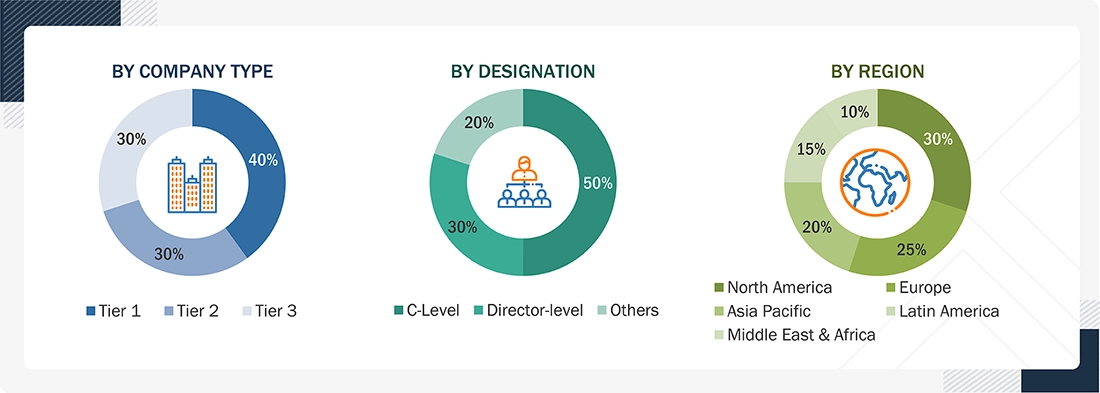
Notes: C-level primaries include CEOs, CFOs, COOs, and VPs.
*Others include Sales Managers, Marketing Managers, Business Development Managers, Product Managers, Distributors, and Suppliers.
Companies are classified into tiers based on their total revenue. The tiers are as follows:
Tier 1 = > USD 10.00 billion, Tier 2 = USD 1.00 billion to USD 10.00 billion, and Tier 3 = < USD 1.00 billion
Source: MarketsandMarkets Analysis
To know about the assumptions considered for the study, download the pdf brochure
Market Size Estimation
For the global market value, annual revenue figures were calculated based on the revenue mapping of major product manufacturers and OEMs active in the worldwide rigid endoscopes market. All leading product manufacturers were identified at both the global and country/regional levels. Revenue mapping was conducted for the respective business segments and subsegments for these key players. Additionally, the global rigid endoscopes market was divided into various segments and sub-segments based on:
- List of major players operating in the products market at the regional and/or country level
- Product mapping of various rigid endoscope manufacturers at the regional and/or country level
- Mapping of annual revenue generated by listed major players from rigid endoscopes (or the nearest reported business unit/product category)
- Extrapolation of the revenue mapping of the listed major players to derive the global market value of the respective segments/subsegments
- Summation of the market value of all segments/subsegments to arrive at the global rigid endoscopes market
The data mentioned above was consolidated and supplemented with detailed inputs and analysis from MarketsandMarkets, and is presented in this report.
Market Size Estimation (Bottom-Up & Top-down Approaches)
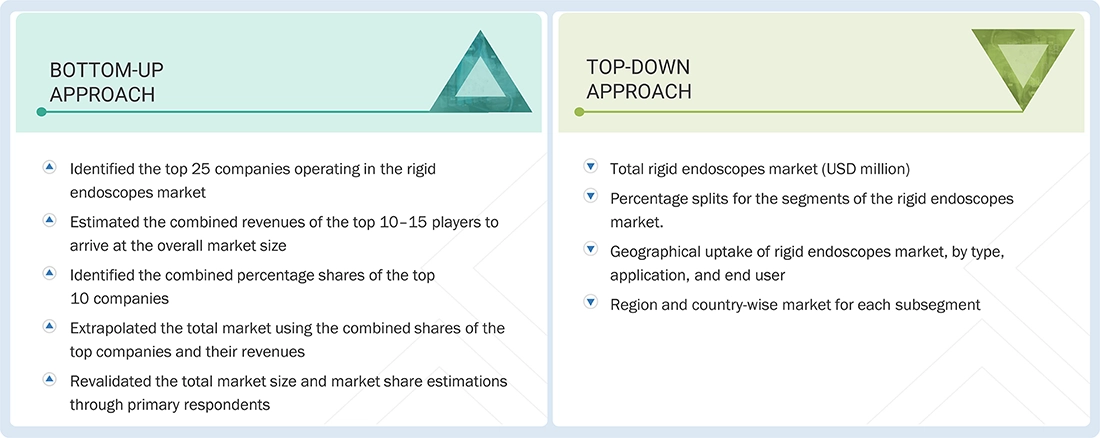
Data Triangulation
After determining the overall size of the global rigid endoscopes market using the methodology above, the market was segmented into several categories and subcategories. The data triangulation and market breakdown procedures were employed, wherever applicable, to complete the overall market engineering process and arrive at the exact market value data for the key segments and subsegments. The extrapolated market data was triangulated by studying various macro indicators and regional trends from both demand- and supply-side participants.
Market Definition
Rigid endoscopes are non-flexible, tubular instruments equipped with lens systems and light sources, enabling direct visualization and access to internal body cavities. Primarily used in minimally invasive surgeries such as laparoscopy, arthroscopy, and cystoscopy, they offer superior image quality, stability, and precision for diagnostic and therapeutic procedures.
Stakeholders
- Manufacturers of endoscopes and related devices
- Suppliers and distributors of endoscopy devices
- Hospitals, diagnostic centers, and medical colleges
- Independent surgeons and private physicians
- Ambulatory surgery centers
- Teaching hospitals and academic medical centers
- Government bodies/Municipal corporations
- Business research and consulting service providers
- Venture capitalists
Report Objectives
- To define, describe, segment, and forecast the rigid endoscopes market by type, application, end user, and region
- To provide detailed information about the factors influencing market growth (such as drivers, restraints, opportunities, and challenges)
- To analyze micromarkets with respect to individual growth trends, prospects, and contributions to the overall rigid endoscopes market
- To analyze market opportunities for stakeholders and provide details of the competitive landscape for key players
- To forecast the size of the rigid endoscopes market in five main regions (along with their respective key countries), namely, North America, Europe, the Asia Pacific, Latin America, and the Middle East & Africa
- To profile the key players in the rigid endoscopes market and comprehensively analyze their core competencies and market shares
- To track and analyze competitive developments such as acquisitions, product launches, expansions, collaborations, agreements, partnerships, and R&D activities of the leading players in the rigid endoscopes market
- To benchmark players within the rigid endoscopes market using the Competitive Leadership Mapping framework, which analyzes market players on various parameters within the broad categories of business strategy, market share, and product offerings
Get the Full Rigid Endoscopes Market Report
Full forecast, segment splits, and company analysis for all Rigid Endoscopes Market.
- US Rigid Endoscopes Market
- Canada Rigid Endoscopes Market
- Germany Rigid Endoscopes Market
- UK Rigid Endoscopes Market
- France Rigid Endoscopes Market
- Italy Rigid Endoscopes Market
- Spain Rigid Endoscopes Market
- China Rigid Endoscopes Market
- Japan Rigid Endoscopes Market
- India Rigid Endoscopes Market
- Australia Rigid Endoscopes Market
- South Korea Rigid Endoscopes Market
- Brazil Rigid Endoscopes Market
- Mexico Rigid Endoscopes Market
- Rest Of Europe Rigid Endoscopes Market
- Rest Of Latin America Rigid Endoscopes Market
Need a Tailored Report?
Customize this report to your needs
Get 10% FREE Customization
Customize This Report
