
South Korea Robotic Vision Market (2025-2030)

The South Korea Robotic Vision Market was valued at $236.1 Million in 2025 and projected to reach to $359.1 Million by 2030, representing a compound annual growth rate of 8.8%. South Korea's robotic vision market is experiencing robust expansion driven by the country's advanced manufacturing base and commitment to Industry 4.0 technologies.


| Market Size in | USD 26.32 MN |
| Market Forecast in | |
| CAGR | |
| Forecast Period | |
| Units Considered | Value (USD MN) |
South Korea Robotic Vision Market Trends and Insights
- South Korea's advanced manufacturing ecosystem and leadership in semiconductor and electronics production drive robust demand for vision-enabled automation solutions.
- The country's investment in Industry 4.0 technologies and smart factory initiatives accelerates adoption of robotic vision systems across automotive, electronics, and precision manufacturing sectors. South Korea's competitive advantage in robotics and machine vision integration supports sustained market expansion through 2030.
- South Korea's government support for automation and AI-driven manufacturing, combined with the presence of major industrial robot and electronics manufacturers, creates a favorable environment for robotic vision technology deployment.
- South Korea's 8.8% compound annual growth rate reflects strong industrial modernization trends and increasing labor costs driving factory automation investments..
Key Market Statistics
- CAGR (2025-2030) 8.8% CAGR
- Market Size, 2025 ~USD 236.1 Million
- Forecast, 2030 ~USD 359.1 Million
- Country South Korea
South Korea Robotic Vision Market Overview
Manufacturing Leadership :
South Korea's dominance in semiconductor and electronics manufacturing creates exceptional demand for robotic vision systems, with major players like Samsung and SK Hynix driving automation investments across production facilities.
Industry 4.0 Adoption :
Government initiatives and corporate investments in smart factory technologies position South Korea as a frontrunner in deploying AI-powered vision solutions for quality control and autonomous manufacturing processes.
Strong CAGR Performance :
South Korea's robotic vision market grows at 8.8% CAGR from 2025-2030, slightly outpacing the global average of 8.7%, reflecting accelerated digital transformation in the region.
Export-Driven Growth :
As a global technology exporter, South Korea's robotic vision adoption extends beyond domestic manufacturing to support competitive positioning in international markets for electronics and precision components.
South Korea Robotic Vision Market Dynamics
- With a market size of $236.1 million in 2025 growing to $359.1 million by 2030, the sector benefits from continuous investments by leading semiconductor and electronics manufacturers seeking to enhance production efficiency and product quality.
- The integration of AI and machine learning into vision systems is accelerating adoption across automotive, electronics, and precision manufacturing sectors.
- Government support for smart factory initiatives and the presence of world-class technology companies create a favorable ecosystem for innovation and market penetration..
Market Ecosystem
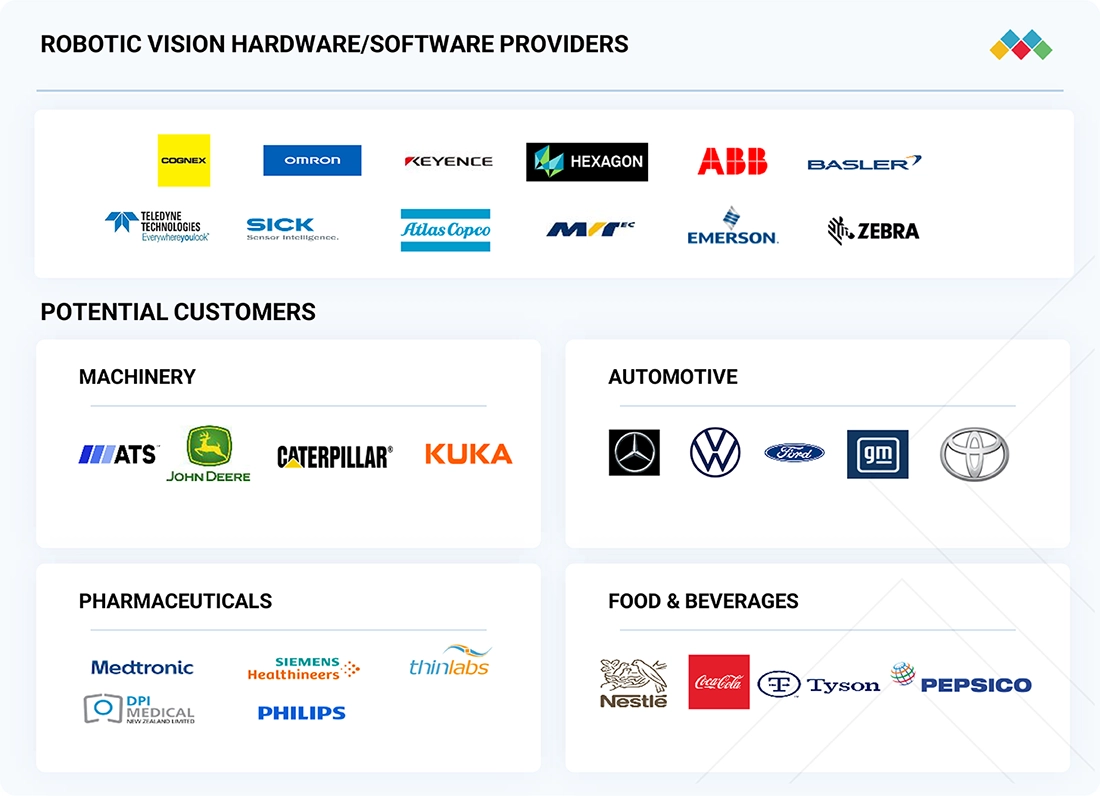
Robotic Vision Market: COMMERCIAL USE CASES ACROSS INDUSTRIES
| COMPANY | USE CASE DESCRIPTION | BENEFITS |
|---|---|---|
 |
Integrated iRVision for bin picking, part location, inspection, and robot guidance with 2D/3D sensors | Faster cycle times, higher accuracy, simplified programming, less fixturing, real-time inspection |
 |
Cobots with onboard vision for material handling, assembly, inspection, logistics | Rapid deployment, flexible programming, improved safety, reliable defect detection, consistent quality |
 |
Advanced Vision Solutions for process optimization, autonomous inspection, and smart data analytics in robotics | High-res 1D/2D/3D sensing, quick software integration, reliable QA, scalable to complex tasks, real-time processing |
 |
Vision-guided robots for pick-and-place, bin picking, high-speed defect detection, multi-inspection support | Fast, one-click calibration, 3D high-precision, flexible AI-based inspections, reduced labor, improved yield |
 |
Vision-guided robotic solutions for flexible manufacturing, barcode reading, deep learning-based inspection | Superior accuracy/speed, easy system integration, automated code reading, robust defect detection, production optimization |
Logos and trademarks shown above are the property of their respective owners. Their use here is for informational and illustrative purposes only.
Related Ecosystem
Communication And Connectivity Technology
- Sensors
- Smart Card & Readers
- Cellular Network
- Femtocell
- Image Sensors
- Cisco Systems, Inc.
- HUAWEI TECHNOLOGIES CO LTD
- Lenovo
- CommScope Holding Company, Inc.
- Nokia corporation
Drones And Robotics
- Sensors
- Articulated Robots
- Cartesian Robots
- Scara Robots
- Actuators
- ABB India Limited
- KUKA AG
- MOMENTIVE PERFORMANCE MATERIALS INC.
- Fanuc Corporation
- STAUBLI INTERNATIONAL AG
Key Takeaways
- South Korea's robotic vision market reaches $236.1 million in 2025 with projected growth to $359.1 million by 2030.
- South Korea demonstrates an 8.8% CAGR, driven by advanced manufacturing and Industry 4.0 adoption across key industrial sectors.
- South Korea's semiconductor and electronics leadership creates strong demand for precision vision-guided automation systems.
- South Korea's government initiatives and labor cost pressures accelerate investment in robotic vision technology deployment.
Robotic Vision Market Report Scope
| Report Metric | Details |
|---|---|
| Base Year | 2025 |
| Fastest Growing Segment | 3D VISION SYSTEMS (Type) |
| Forecast Period | 2025-2030 |
| Growth Rate | CAGR of 8.7% from 2025 to 2030 |
| Largest Segment | 2D VISION SYSTEMS (Type) |
| Market Size Base Year (Billions) | ~USD 3.29 (2025) |
| Revenue Forecast (Billions) | ~USD 4.99 (2030) |
| Segments Covered | Component, Component Type, Imaging Spectrum, Industry, Type |
South Korea Robotic Vision Market Report Segmentation
5 segment dimensions are covered across the global market.
By Component
- Cameras
- Frame Grabbers
- Led Lighting Systems
- Optics
- Other Hardware Components
- Processors & Controllers
- Software
By Component Type
- Cameras
- Frame Grabbers
- Led Lighting Systems
- Optics
- Other Hardware Components
- Processors & Controllers
By Imaging Spectrum
- Visible
- Visible+ Ir
By Industry
- Automotive
- Electronics & Semiconductors
- Food & Beverages
- Healthcare
- Logistics
- Metals & Machinery
- Other Industries
- Rubber & Plastics
By Type
- 2D Vision Systems
- 3D Vision Systems
Target Audience
- Semiconductor Manufacturers : South Korean semiconductor companies require detailed market insights to benchmark their vision system investments against competitors and identify emerging automation technologies to maintain production leadership.
- Electronics OEMs : Electronics manufacturers in South Korea need market data to evaluate robotic vision adoption ROI, understand technology trends, and plan capital expenditures for quality control and manufacturing automation.
- Vision System Vendors : Technology providers targeting South Korea's market require comprehensive data on customer segments, adoption rates, and competitive positioning to develop localized solutions and optimize sales strategies.
- Investment & Private Equity Firms : Investors evaluating opportunities in South Korea's manufacturing technology sector need market sizing, growth projections, and sector dynamics to assess portfolio companies and identify acquisition targets.
- Government & Policy Makers : South Korean government agencies and industrial policy bodies use market intelligence to evaluate Industry 4.0 initiative effectiveness, allocate innovation funding, and support domestic technology competitiveness.
Reasons to Buy this Report
- Market Size & Growth Validation : Obtain precise valuation data for South Korea's robotic vision market ($236.1M in 2025) with 8.8% CAGR forecasts through 2030, enabling accurate investment planning and revenue projections specific to this high-growth market.
- Competitive Landscape Intelligence : Understand the competitive dynamics within South Korea's semiconductor and electronics manufacturing sectors, identifying key players and their vision system adoption strategies to inform market entry or expansion decisions.
- Industry 4.0 Opportunity Assessment : Evaluate the depth of Industry 4.0 implementation across South Korean manufacturers, revealing untapped opportunities for vision-enabled automation solutions and technology partnerships in smart factory ecosystems.
- Regional Export Potential : Leverage insights into South Korea's export-driven manufacturing model to identify cross-border opportunities and understand how domestic vision technology adoption influences international market demand.
- Strategic Investment Decisions : Make informed decisions about R&D investments, partnerships, and market positioning in South Korea by understanding sector-specific growth drivers, regulatory environment, and technology adoption timelines.
Frequently asked questions
What is the current size of South Korea's robotic vision market?
South Korea's robotic vision market is valued at $236.1 million in 2025, representing significant growth potential within the Asia Pacific region.
What is the projected market size for South Korea's robotic vision sector by 2030?
South Korea's robotic vision market is forecast to reach $359.1 million by 2030, reflecting sustained industrial automation investment.
What is the growth rate for South Korea's robotic vision market?
South Korea's robotic vision market is expected to grow at a compound annual growth rate of 8.8% from 2025 to 2030.
Which industries drive robotic vision adoption in South Korea?
South Korea's automotive, semiconductor, electronics manufacturing, and precision engineering sectors are primary drivers of robotic vision system adoption.
What factors support growth in South Korea's robotic vision market?
South Korea's advanced manufacturing infrastructure, government Industry 4.0 initiatives, rising labor costs, and technological expertise in robotics support market expansion.
RESEARCH METHODOLOGY
The study involved four main activities to estimate the current size of the robotic vision market. Extensive secondary research was conducted to gather information on the market, related markets, and the overall robotic vision landscape. These findings, along with assumptions and projections, were validated through primary research that included interviews with industry experts and key stakeholders across the value chain. Both top-down and bottom-up approaches were used to estimate the overall market size. Afterwards, market breakdown and data triangulation techniques helped determine the sizes of various segments and subsegments. Two primary sources, secondary and primary, were utilized to perform a comprehensive technical and commercial assessment of the robotic vision market.
Secondary Research
The secondary research process involved consulting various secondary sources to gather the necessary information for this study. These sources included annual reports, press releases, investor presentations by companies; white papers; journals and reputable publications; and articles from recognized authors, websites, directories, and databases. Secondary research was performed to acquire key information about the industry’s supply chain, the market’s value chain, the overall pool of key players, market segmentation based on industry trends (down to the most detailed level), regional markets, and significant developments from both market and technology perspectives. The collected secondary data was analyzed to estimate the overall market size, which was further validated through primary research.
Primary Research
After understanding the current state of the robotic vision market through secondary research, extensive primary research was conducted. Several interviews were carried out with experts from the demand and supply sides across four major regions: North America, Europe, the Asia Pacific, and the RoW. This primary data was gathered through questionnaires, emails, and phone calls.
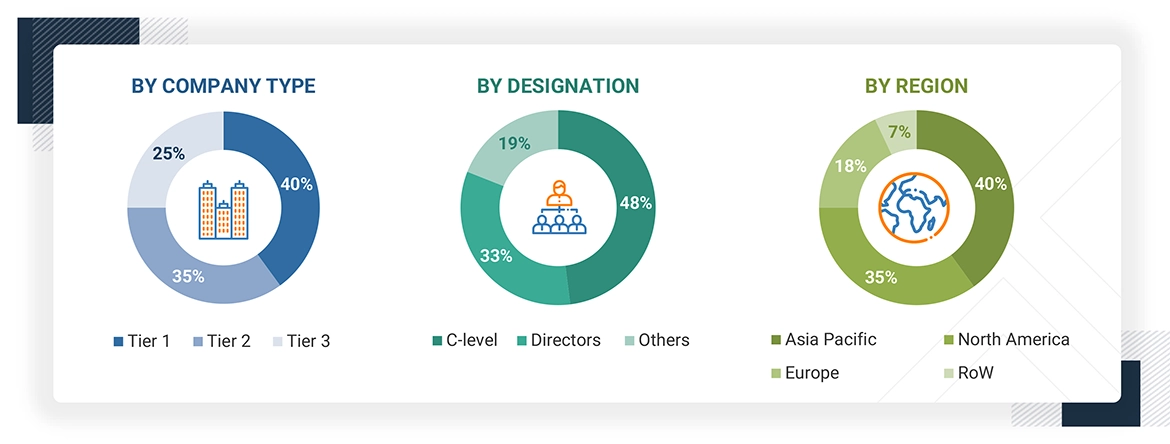
Note: Three tiers of companies have been defined based on their total revenue as of 2024: tier 3: revenue less than USD 500 million; tier 2: revenue between USD 500 million and USD 1 billion; and tier 1: revenue more than USD 1 billion. Other designations include sales managers, marketing managers, and product managers.
To know about the assumptions considered for the study, download the pdf brochure
Market Size Estimation
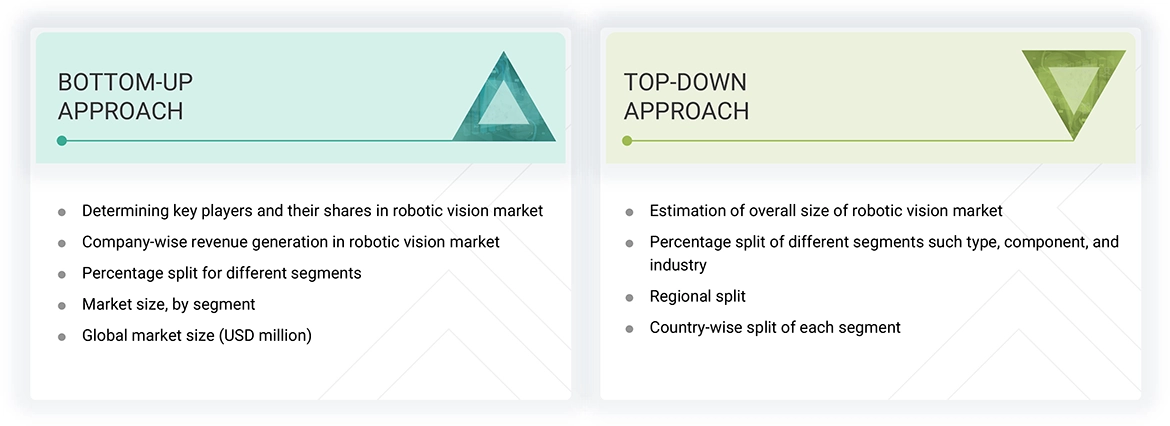
Both top-down and bottom-up approaches were employed to estimate and validate the overall size of the robotic vision market. These methods have also been widely used to determine the size of various subsegments within the market. The following research methodology was applied to estimate the market size:
- Major players in the industry and markets were identified through extensive secondary research.
- The industry’s value chain and market size (in terms of value) were determined through primary and secondary research processes.
- All percentage shares, splits, and breakdowns were determined using secondary sources and verified through primary sources.
Robotic Vision Market : Top-Down and Bottom-Up Approach
Data Triangulation
After arriving at the overall size of the robotic vision market using the market size estimation process explained above, the total market was split into several segments and subsegments. Data triangulation and market breakdown procedures were employed, wherever applicable, to complete the overall market engineering process and arrive at the exact statistics for all segments and subsegments of the market. The data was triangulated by studying various factors and trends from both the demand and supply sides. The market size was also validated using both top-down and bottom-up approaches.
Market Definition
The integration of machine vision systems with industrial robots is called robotic vision. It involves combining advanced imaging and computer vision technologies with robotic systems to help machines perceive, interpret, and interact with their environment. This includes using cameras, sensors, and complex algorithms to capture and analyze visual data, enabling robots to perform tasks such as object recognition, navigation, inspection, and manipulation with high accuracy. The technology covers both 2D and 3D vision systems, which provide depth perception and spatial awareness essential for industries like manufacturing, automotive, logistics, and healthcare. By utilizing artificial intelligence and machine learning, robotic vision improves automation by supporting real-time decision-making and adapting to changing environments. It plays a key role in advancing Industry 4.0, boosting productivity, quality control, and safety in various operational areas.
Key Stakeholders
- Raw material and manufacturing equipment suppliers
- Government bodies, venture capitalists, and private equity firms
- Robotic vision manufacturers
- Robotic vision distributors
- Robotic vision industry associations
- Professional service/solution providers
- Research institutions and organizations
- Standards organizations and regulatory authorities related to the robotic vision market
- System integrators
- Technology consultants
Report Objectives
- To define, describe, and forecast the robotic vision market, in terms of type, component, industry, and region, in terms of value
- To forecast the market, by component, in terms of volume
- To describe and forecast the market, in terms of value, with regard to four central regions: North America, Europe, Asia Pacific, and Rest of the World (RoW), along with their respective countries
- To provide detailed information regarding major factors such as drivers, restraints, opportunities, and challenges influencing market growth
- To provide a detailed overview of the robotic vision value chain
- To strategically analyze micromarkets with respect to individual growth trends, prospects, and contributions to the robotic vision market
- To analyze opportunities in the market for stakeholders by identifying high-growth segments of the robotic vision market
- To strategically profile key players and comprehensively analyze their market position in terms of ranking and core competencies, along with detailing the competitive landscape for market leaders
- To analyze competitive strategies, such as product launches, expansions, mergers, and acquisitions, adopted by key players in the robotic vision market
Available customizations:
With the given market data, MarketsandMarkets offers customizations according to the company’s specific needs. The following customization options are available for the report:
Company Information:
- Detailed analysis and profiling of additional market players (up to 5)
Get the Full Robotic Vision Market Report
Full forecast, segment splits, and company analysis for all Robotic Vision Market.
- US Robotic Vision Market
- Canada Robotic Vision Market
- Mexico Robotic Vision Market
- Germany Robotic Vision Market
- UK Robotic Vision Market
- France Robotic Vision Market
- Italy Robotic Vision Market
- Spain Robotic Vision Market
- Netherlands Robotic Vision Market
- Switzerland Robotic Vision Market
- China Robotic Vision Market
- Japan Robotic Vision Market
- India Robotic Vision Market
- Australia Robotic Vision Market
- Indonesia Robotic Vision Market
- Singapore Robotic Vision Market
- Nordics Robotic Vision Market
- Rest Of Europe Robotic Vision Market
- Rest Of Asia Pacific Robotic Vision Market
- Bahrain Robotic Vision Market
- Kuwait Robotic Vision Market
- Oman Robotic Vision Market
- Qatar Robotic Vision Market
- Rest Of Middle East Robotic Vision Market
- Saudi Arabia Robotic Vision Market
- UAE Robotic Vision Market
- Argentina Robotic Vision Market
- Brazil Robotic Vision Market
- Other South American Countries Robotic Vision Market
- Other African Countries Robotic Vision Market
- South Africa Robotic Vision Market
Need a Tailored Report?
Customize this report to your needs
Get 10% FREE Customization
Customize This Report
