
Brazil Rubber Process Oil Market (2025-2030)

The Brazil Rubber Process Oil Market was valued at $34.5 Million in 2025 and projected to reach to $41.7 Million by 2030, representing a compound annual growth rate of 3.9%. Brazil's rubber process oil market is poised for steady expansion through 2030, driven by the country's robust automotive sector and tire manufacturing capabilities.


| Market Size in | USD 26.32 MN |
| Market Forecast in | |
| CAGR | |
| Forecast Period | |
| Units Considered | Value (USD MN) |
Brazil Rubber Process Oil Market Trends and Insights
- This growth trajectory reflects Brazil's strengthening position as a key player in South America's chemical and material sectors, driven by increasing demand from the automotive and tire manufacturing industries.
- Brazil's robust industrial base and expanding rubber processing capabilities position the country as a critical market for process oils used in elastomer production and tire compounding. The Brazilian rubber process oil market benefits from the country's established tire manufacturing ecosystem and growing vehicle production.
- Brazil's market growth outpaces the global average of 2.6% CAGR, indicating strong regional demand dynamics and industrial expansion.
- Between 2025 and 2030, Brazil is expected to capture increasing market share within South America, supported by infrastructure investments and rising consumption in industrial applications.
- The market's resilience reflects Brazil's strategic importance in Latin American rubber processing and chemical manufacturing..
Key Market Statistics
- CAGR (2025-2030) 3.9% CAGR
- Market Size, 2025 ~USD 34.5 Million
- Forecast, 2030 ~USD 41.7 Million
- Country Brazil
Brazil Rubber Process Oil Market Overview
Market Size & Growth :
Brazil's rubber process oil market is valued at USD 34.5 million in 2025, with projected growth to USD 41.7 million by 2030, demonstrating a robust CAGR of 3.9% outpacing the global average of 2.6%.
Automotive & Tire Industry Drivers :
Brazil's thriving automotive and tire manufacturing sectors are primary demand catalysts, with domestic production and regional exports fueling consistent consumption of rubber process oils in tire compounds and elastomer applications.
Regional Market Leadership :
As South America's largest chemical and material market, Brazil commands significant influence over regional rubber process oil supply chains, positioning it as a strategic hub for manufacturers and distributors across the continent.
Industrial Expansion Opportunities :
Growing industrialization, infrastructure development, and increased vehicle production in Brazil create sustained demand for high-quality rubber process oils across manufacturing and processing facilities.
Brazil Rubber Process Oil Market Dynamics
- The 3.9% CAGR reflects strong domestic demand coupled with regional export opportunities across South America.
- Investment in advanced tire technologies and sustainable rubber formulations will further accelerate market growth. The market benefits from Brazil's established chemical infrastructure, skilled workforce, and strategic geographic position.
- Increasing focus on vehicle electrification and high-performance tire compounds will create new applications for specialized rubber process oils.
- Market players should anticipate growing competition and opportunities in premium product segments catering to evolving automotive standards..
Market Ecosystem

RUBBER PROCESS OIL MARKET: COMMERCIAL USE CASES ACROSS INDUSTRIES
| COMPANY | USE CASE DESCRIPTION | BENEFITS |
|---|---|---|
 |
Manufactures RPO for tire production, helping rubber compounds achieve improved flexibility, uniform mixing, and better processing during manufacturing | Enhances tire performance, increases durability, ensures smoother manufacturing, and extends tire lifespan while improving safety and road handling |
 |
Manufactures RPO for automotive tires and high-performance rubber products, ensuring consistent material properties under various conditions | Improves grip, enhances safety, supports high-performance applications, and maintains consistent quality across batches |
 |
Manufactures RPO for oil-extended polymers used in industrial rubber products, including conveyor belts, gaskets, and seals | Reduces production costs, improves processing efficiency, enhances elasticity, and extends product lifespan under harsh conditions |
 |
Manufactures RPO for consumer rubber products such as footwear soles, flexible toys, and household rubber items | Increases flexibility and comfort, improves product durability, maintains integrity under repeated use, and enhances overall consumer satisfaction |
 |
Manufactures RPO for specialty tires and high-performance rubber compounds used in sports and off-road vehicles | Provides superior heat resistance, enhances wear performance, improves handling, and supports the development of high-performance and niche rubber products |
Logos and trademarks shown above are the property of their respective owners. Their use here is for informational and illustrative purposes only.
Related Ecosystem
Speciality Chemicals
- Corrosion Inhibitors
- Polyetheretherketone (PEEK)
- Acrylonitrile Butadiene Styrene (ABS)
- Epoxy Resin
- Polycarbonate
- Basf se
- DOW CHEMICAL COMPANY
- Evonik industries ag
- Clariant ag.
- Solvay sa
Key Takeaways
- Brazil's rubber process oil market is valued at USD 34.5 million in 2025 and will reach USD 41.7 million by 2030.
- Brazil's 3.9% CAGR significantly exceeds the global growth rate of 2.6%, indicating stronger regional demand.
- Brazil's tire manufacturing and automotive sectors are primary drivers of rubber process oil consumption.
- Brazil represents a strategic growth opportunity within South America's chemical and material markets.
Rubber Process Oil Market Report Scope
| Report Metric | Details |
|---|---|
| Base Year | 2025 |
| Fastest Growing Segment | TREATED DISTILLATE AROMATIC EXTRACT (TDAE) (Type) |
| Forecast Period | 2025–2030 |
| Growth Rate | CAGR of 2.6% from 2025 to 2030 |
| Largest Segment | TIRES (Application) |
| Market Size Base Year (Billions) | ~USD 2.19 (2025) |
| Revenue Forecast (Billions) | ~USD 2.49 (2030) |
| Segments Covered | Viscosity, Application, Type |
Brazil Rubber Process Oil Market Report Segmentation
3 segment dimensions are covered across the global market.
By Viscosity
- High Viscosity
- Low Viscosity
- Medium Viscosity
By Application
- Industrial Rubber Products
- Oil-Extended Polymers
- Other Applications
- Thermoplastic Elastomers (Tpe)
- Tires
By Type
- Distillate Aromatic Extract (Dae)
- Mild Extracted Solvate (Mes)
- Naphthenic
- Paraffinic
- Residual Aromatic Extract (Rae) And Treated Residual Aromatic Extract (Trae)
- Treated Distillate Aromatic Extract (Tdae)
Target Audience
- Tire & Rubber Manufacturers : Brazilian and regional tire producers need market data to optimize rubber formulations, source quality process oils, and plan production capacity aligned with growing automotive demand.
- Chemical Distributors & Suppliers : Distributors operating in Brazil require localized market insights to forecast demand, manage inventory, identify growth segments, and develop targeted sales strategies for rubber process oils.
- Automotive OEMs & Suppliers : Vehicle manufacturers and tier-1 suppliers need Brazil-specific data on rubber material trends and process oil specifications to ensure supply chain reliability and product performance.
- Investment & Private Equity Firms : Investors evaluating opportunities in Brazil's chemical sector require detailed market analysis, growth projections, and competitive positioning to assess acquisition and expansion targets.
- Strategic Business Planners : Corporate strategists in chemicals and materials need Brazil market data to inform market entry decisions, partnership development, and long-term business planning in South America.
Key Companies in the Brazil Rubber Process Oil Market
| Company | HQ | Ownership | Strongest segments |
|---|---|---|---|
| AZELIS HOLDINGS SA | Belgium | Private Company | Food & Nutrition Ingredients,Personal Care & Home Care Ingredients,Pharma & Healthcare Ingredients, |
| SINOPEC | China | ||
| PETROCHINA COMPANY LIMITED | China | Public Company | Oil, Gas and New Energy Resource,Refining, Chemicals and New Materials,Sales (Refined and Non-oil Products, Trading), |
| CHEVRON CORPORATION | United States | Public Company | Upstream (crude oil and natural gas, including LNG and gas-to-liquids),Downstream (refining, marketing, lubricants, petrochemicals, additives, renewable fuels),All Other (cash management, debt financing, insurance, real estate, technology), |
| EXXON MOBIL CORPORATION | United States | Public Company | Upstream (crude oil and natural gas),Energy Products (fuels, aromatics, catalysts, licensing),Chemical Products (olefins, polyolefins, intermediates), |
| SHELL PLC | United Kingdom | Public Company | Integrated Gas (including LNG and GTL),Upstream (oil, gas, and NGLs),Marketing (mobility, lubricants, commercial fuels, decarbonization services), |
| APAR INDUSTRIES LTD. | India | Public Company | Conductors and related turnkey T&D solutions,Transformer and specialty oils, liquid paraffins, petroleum jelly, process oils,Power, telecom, fiber optic, and specialty cables, |
| PANAMA PETROCHEM LTD. | India | Public Company | White / liquid paraffin oils and petroleum jellies,Paraffin, slack, and micro waxes,Rubber process and industrial oils, |
| GANDHAR OIL REFINERY (INDIA) LIMITED | India | Public Company | White oils, waxes, and jellies (consumer and healthcare focused),Process and insulating oils (transformer and rubber processing oils),Lubricants (automotive and industrial oils), |
| HINDUSTAN PETROLEUM CORPORATION LIMITED | India | Public Company | Middle distillates (diesel, kerosene, ATF, LDO, MTO, lube base stocks),Light distillates (LPG, motor spirit, naphtha, solvents, hexane, propylene),Heavy distillates (bitumen, furnace oil, low sulphur heavy stock), |
| INDIAN OIL CORPORATION LTD | India | Public Company | Sale of Petroleum Products,Sale of Gas (including LPG and city gas distribution),Sale of Petrochemicals, |
| IDEMITSU KOSAN CO., LTD. | Japan | Public Company | Fuel Oil (incl. SAF, synthetic fuel, biofuels, carbon offset fuel, service stations),Basic Chemicals (olefins, aromatics),Functional Materials (lubricants, functional chemicals, electronic materials, bitumen, agri-bio), |
| REPSOL | Spain | Public Company | Industrial (refining, trading, fuels wholesale, hydrogen, sustainable and synthetic fuels),Upstream (oil and gas exploration and production, low-carbon geological solutions),Customer (mobility/gas stations, retail power and gas, lubricants, LPG, biofuels), |
AZELIS HOLDINGS SA
AZELIS HOLDINGS SA is a private company based in Belgium, founded in 2001. With 1,325 employees, the company operates in the specialty chemicals sector.
SINOPEC
SINOPEC is a major Chinese energy and petrochemical company.
PETROCHINA COMPANY LIMITED
PETROCHINA COMPANY LIMITED is a Chinese public company founded in 1999, with 367,173 employees. It is one of the world's largest oil and gas producers and suppliers.
CHEVRON CORPORATION
CHEVRON CORPORATION is a U.S.-based public energy company founded in 1879, employing 43,039 people. The company is engaged in oil and gas exploration, production, refining, and marketing.
EXXON MOBIL CORPORATION
EXXON MOBIL CORPORATION is a U.S. public company founded in 1870 with 57,900 employees. It is one of the world's largest integrated oil and gas companies, operating across exploration, production, refining, and chemical segments.
SHELL PLC
SHELL PLC is a United Kingdom-based public company founded in 1897 with 84,000 employees. It is a global energy company engaged in oil, gas, and renewable energy operations.
APAR INDUSTRIES LTD.
APAR INDUSTRIES LTD. is an Indian public company founded in 1958 with 2,155 employees. The company operates in the electrical and petrochemical industries.
PANAMA PETROCHEM LTD.
PANAMA PETROCHEM LTD. is an Indian public company founded in 1975 with 191 employees, operating in the petrochemical sector.
GANDHAR OIL REFINERY (INDIA) LIMITED
GANDHAR OIL REFINERY (INDIA) LIMITED is an Indian public company founded in 1992 with 410 employees, engaged in oil refining operations.
HINDUSTAN PETROLEUM CORPORATION LIMITED
HINDUSTAN PETROLEUM CORPORATION LIMITED is an Indian public company founded in 1910 with 8,049 employees. It is a major integrated oil and gas company involved in refining, marketing, and exploration.
INDIAN OIL CORPORATION LTD
INDIAN OIL CORPORATION LTD is an Indian public company founded in 1959 with 29,941 employees. It is one of India's largest oil and gas companies, operating across refining, marketing, and exploration.
IDEMITSU KOSAN CO., LTD.
IDEMITSU KOSAN CO., LTD. is a Japanese public company founded in 1911 with 14,392 employees. It operates in oil refining, petrochemicals, and energy sectors.
REPSOL
REPSOL is a Spanish public company founded in 1927 with 24,881 employees. It is an integrated energy company engaged in oil and gas exploration, production, refining, and marketing.
Reasons to Buy this Report
- Localized Market Intelligence : Gain Brazil-specific insights on market size, growth trajectories, and competitive dynamics unavailable in global reports, enabling precise strategic planning for the Brazilian market.
- Automotive Sector Opportunity Assessment : Understand demand patterns from Brazil's automotive and tire manufacturing industries, identifying high-growth segments and customer requirements specific to local production ecosystems.
- Regional Expansion Strategy : Leverage Brazil's position as South America's chemical hub to develop regional distribution and partnership strategies that extend market reach across neighboring countries.
- Competitive Benchmarking : Analyze Brazil-specific competitive landscape, pricing strategies, and market share distribution to identify differentiation opportunities and competitive advantages in this growing market.
- Investment & Growth Planning : Support capital allocation decisions and business development initiatives with data-driven forecasts showing 3.9% CAGR through 2030, validating long-term investment viability in Brazil.
Frequently asked questions
What is the current size of Brazil's rubber process oil market?
Brazil's rubber process oil market is estimated at USD 34.5 million in 2025, based on verified market data.
What is the projected market size for Brazil by 2030?
Brazil's rubber process oil market is forecast to reach USD 41.7 million by 2030, representing growth of approximately USD 7.2 million over the five-year period.
How does Brazil's growth rate compare to global trends?
Brazil's CAGR of 3.9% outpaces the global CAGR of 2.6%, demonstrating stronger market expansion in the country compared to worldwide averages.
Which industries drive rubber process oil demand in Brazil?
Brazil's tire manufacturing, automotive production, and industrial rubber processing sectors are the primary consumers of rubber process oils.
Why is Brazil significant for the South American rubber process oil market?
Brazil's established manufacturing infrastructure, large automotive industry, and regional economic influence make it a critical market for rubber process oils in South America.
RESEARCH METHODOLOGY
This research encompassed four primary actions in assessing the present market size of rubber process oil. Comprehensive secondary research was conducted to gather information on the market, the peer market, and the parent market. The subsequent stage involved corroborating these findings, assumptions, and dimensions with industry specialists throughout the rubber process oil value chain via primary research. The total market size is ascertained with both top-down and bottom-up methodologies. Subsequently, market segmentation analysis and data triangulation were employed to ascertain the dimensions of the market segments and subsegments.
Secondary Research
The research approach employed to assess and project the rubber process oil market initiates with the collection of revenue data from prominent suppliers using secondary research. In the course of the secondary research, many secondary sources, such as Hoovers, Bloomberg Businessweek, Factiva, the World Bank, and industry magazines, were utilized to identify and compile information for this study. The secondary sources comprised annual reports, press releases, and investor presentations from corporations; white papers; accredited periodicals; writings by esteemed authors; announcements from regulatory agencies; trade directories; and databases. Vendor offerings have been considered to ascertain market segmentation.
Primary Research
The rubber process oil market comprises several stakeholders, such as manufacturers, suppliers, traders, associations, and regulatory organizations, in the supply chain. The demand side of this market consists of tire manufacturers, synthetic rubber producers, industrial rubber product makers, oil-extended polymer producers, and TPE manufacturers. These sectors use RPOs for improving processability, flexibility, and filler dispersion in rubber compounds. The supply side is made up of refiners and specialty oil producers that supply aromatic, paraffinic, naphthenic, and treated RPO grades derived from base oils and extract streams. Supply availability depends on refinery output, feedstock availability, and the capacity of manufacturers to produce specific RPO types and viscosities. Various primary sources from both the supply and demand sides of the market were interviewed to obtain qualitative and quantitative information. The following is the breakdown of the primary respondents:
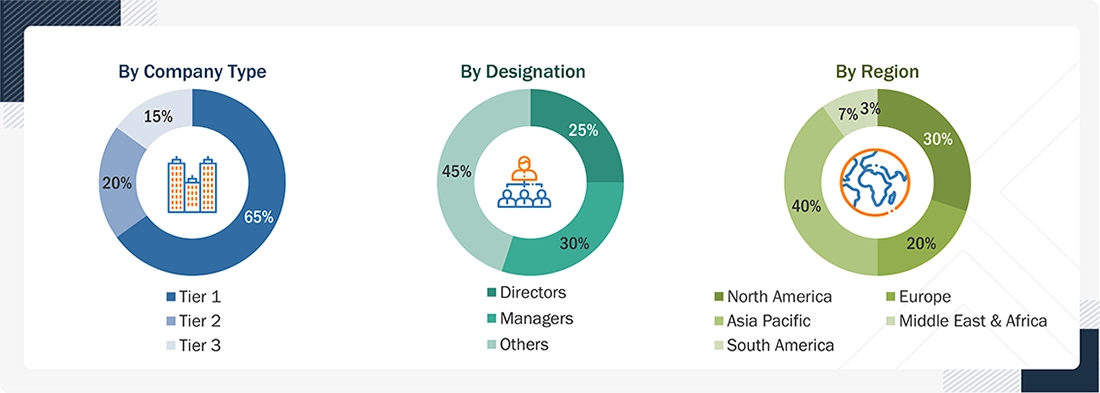
To know about the assumptions considered for the study, download the pdf brochure
Market Size Estimation
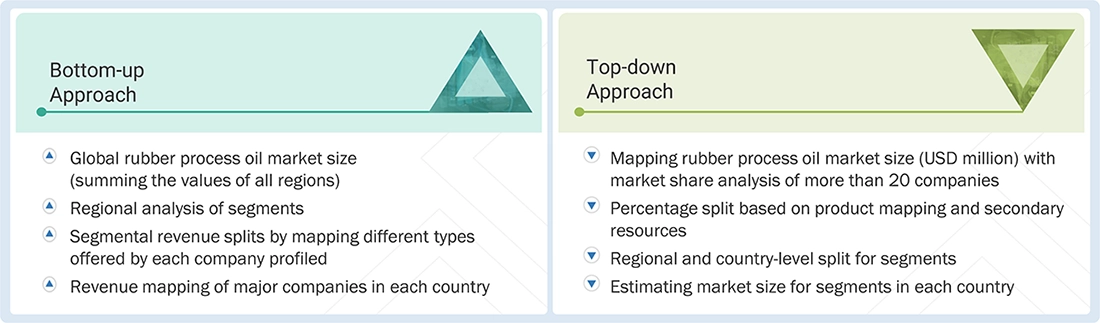
Both the top-down and bottom-up approaches were used to estimate and validate the total size of the rubber process oil market. These methods were also used extensively to determine the size of various sub-segments in the market. The research methodology used to estimate the market size included the following:
- The key players were identified through extensive primary and secondary research.
- The value chain and market size of the rubber process oil market, in terms of value, were determined through primary and secondary research.
- All percentage shares, splits, and breakdowns were determined using secondary sources and verified through primary sources.
- All possible parameters that affect the market covered in this research study were accounted for, viewed in extensive detail, verified through primary research, and analyzed to obtain the final quantitative and qualitative data.
- The research included the study of reports, reviews, and newsletters of top market players, along with extensive interviews for opinions from key leaders, such as CEOs, directors, and marketing executives.
Rubber Process Oil Market : Top-Down and Bottom-Up Approach
Data Triangulation
After arriving at the overall market size using the market size estimation processes as explained above, the market was split into several segments and subsegments. To complete the overall market engineering process and arrive at the exact statistics of each market segment and subsegment, data triangulation and market breakdown procedures were employed, wherever applicable. The market size was calculated globally by summing up the country-level and regional-level data.
Market Definition
Rubber process oil is a petroleum-derived processing aid used in the compounding of natural and synthetic rubber to improve mixing, soften the rubber matrix, enhance filler dispersion, and support smoother extrusion or molding. It functions as a plasticizer that helps achieve uniform viscosity, better elasticity, and consistent mechanical properties in finished rubber products. RPOs are produced in several grades—such as Treated Distillate Aromatic Extract (TDAE), Distillate Aromatic Extract (DAE), Mild Extraction Solvate (MES), Residual Aromatic Extract (RAE), and Treated RAE (TRAE), along with paraffinic and naphthenic oils—each selected based on compatibility, desired softness, regulatory requirements, and end-use performance needs. These oils are integral to manufacturing tires, oil-extended polymers, industrial rubber goods, and various elastomer-based applications.
Key Stakeholders
- Rubber Process Oil Manufacturers
- Rubber Process Oil Suppliers
- Rubber Process Oil Traders and Distributors
- Investment Banks and Private Equity Firms
- Raw Material Suppliers
- Government and Research Organizations
- Consulting Companies/Consultants in the Chemicals and Materials Sectors
- Industry Associations
- Contract Manufacturing Organizations (CMOs)
- NGOs and Venture Capitalists
Report Objectives
- To define, describe, and forecast the size of the global rubber process oil market in terms of value
- To provide detailed information regarding the key factors, such as drivers, restraints, opportunities, and industry-specific challenges, influencing the growth of the global rubber process oil market
- To analyze and forecast the size of various segments (application, viscosity, and type) of the rubber process oil market based on five major regions—North America, Asia Pacific, Europe, the Middle East & Africa, and South America, along with key countries in each of these regions
- To strategically profile the key players in the market and comprehensively analyze their core competencies
Available customizations:
With the given market data, MarketsandMarkets offers customizations according to client-specific needs.
The following customization options are available for the report:
- Additional country-level analysis of the rubber process oil market
- Profiling of additional market players (up to 5)
Product Analysis
-
Product matrix, which gives a detailed comparison of the product portfolio of each company.
Get the Full Rubber Process Oil Market Report
Full forecast, segment splits, and company analysis for all Rubber Process Oil Market.
- China Rubber Process Oil Market
- Japan Rubber Process Oil Market
- India Rubber Process Oil Market
- South Korea Rubber Process Oil Market
- Indonesia Rubber Process Oil Market
- Thailand Rubber Process Oil Market
- Canada Rubber Process Oil Market
- Mexico Rubber Process Oil Market
- US Rubber Process Oil Market
- Russia Rubber Process Oil Market
- Germany Rubber Process Oil Market
- UK Rubber Process Oil Market
- France Rubber Process Oil Market
- Spain Rubber Process Oil Market
- Italy Rubber Process Oil Market
- Iran Rubber Process Oil Market
- Argentina Rubber Process Oil Market
- Colombia Rubber Process Oil Market
- Rest Of Europe Rubber Process Oil Market
- Rest Of Aisa Pacific Rubber Process Oil Market
- GCC Countries Rubber Process Oil Market
- –Rest Of GCC Countries Rubber Process Oil Market
- Rest Of South America Rubber Process Oil Market
Need a Tailored Report?
Customize this report to your needs
Get 10% FREE Customization
Customize This Report
