
Qatar SaaS Management Market (2025-2030)

The Qatar SaaS Management Market was valued at $95.3 Million in 2025 and projected to reach to $200.1 Million by 2030, representing a compound annual growth rate of 16.0%. Qatar's SaaS Management Market is poised for sustained expansion through 2030, fueled by government-led digital transformation initiatives and increasing cloud adoption among enterprises.


| Market Size in | USD 26.32 MN |
| Market Forecast in | |
| CAGR | |
| Forecast Period | |
| Units Considered | Value (USD MN) |
Qatar SaaS Management Market Trends and Insights
- This accelerated growth in Qatar reflects the nation's strategic digital transformation initiatives and increasing enterprise adoption of cloud-based software solutions across public and private sectors.
- Qatar's investment in technology infrastructure and Vision 2030 initiatives are driving organizations to modernize their software asset management practices. The SaaS Management Market in Qatar is being propelled by rising demand for cost optimization, license compliance, and vendor management solutions among enterprises.
- Qatar's growing fintech, energy, and telecommunications sectors are particularly active in deploying SaaS management platforms to streamline operations and reduce software expenditure.
- Between 2025 and 2030, Qatar is expected to see heightened competition among regional and global SaaS management vendors seeking to capture market share in this high-growth economy..
Key Market Statistics
- CAGR (2025-2030) 16.0% CAGR
- Market Size, 2025 ~USD 95.3 Million
- Forecast, 2030 ~USD 200.1 Million
- Country Qatar
Qatar SaaS Management Market Overview
Market Valuation Growth :
Qatar's SaaS Management Market is valued at $95.3 million in 2025 and is projected to reach $200.1 million by 2030, demonstrating a robust 16% CAGR that outpaces the global average of 15.4%.
Digital Transformation Momentum :
Qatar's strategic digital transformation initiatives, aligned with Vision 2030, are driving accelerated adoption of cloud-based software solutions across both public and private sector enterprises.
Enterprise Cloud Adoption :
Increasing enterprise adoption of SaaS management platforms in Qatar reflects growing recognition of operational efficiency, cost optimization, and scalability benefits among organizations across multiple sectors.
Regional Growth Leadership :
Qatar's 16% CAGR positions it as a high-growth market within the GCC region, driven by government digitalization programs, foreign direct investment, and expanding multinational corporate presence.
Qatar SaaS Management Market Dynamics
- The nation's strategic investments in technology infrastructure, coupled with Vision 2030 objectives, create favorable conditions for SaaS vendors and managed service providers.
- Enterprise organizations across finance, energy, telecommunications, and public administration sectors are progressively migrating to cloud-based software solutions to enhance operational efficiency and reduce capital expenditure.
- The market's 16% CAGR reflects Qatar's commitment to becoming a digitally advanced economy and the growing sophistication of local IT procurement practices..
Market Ecosystem
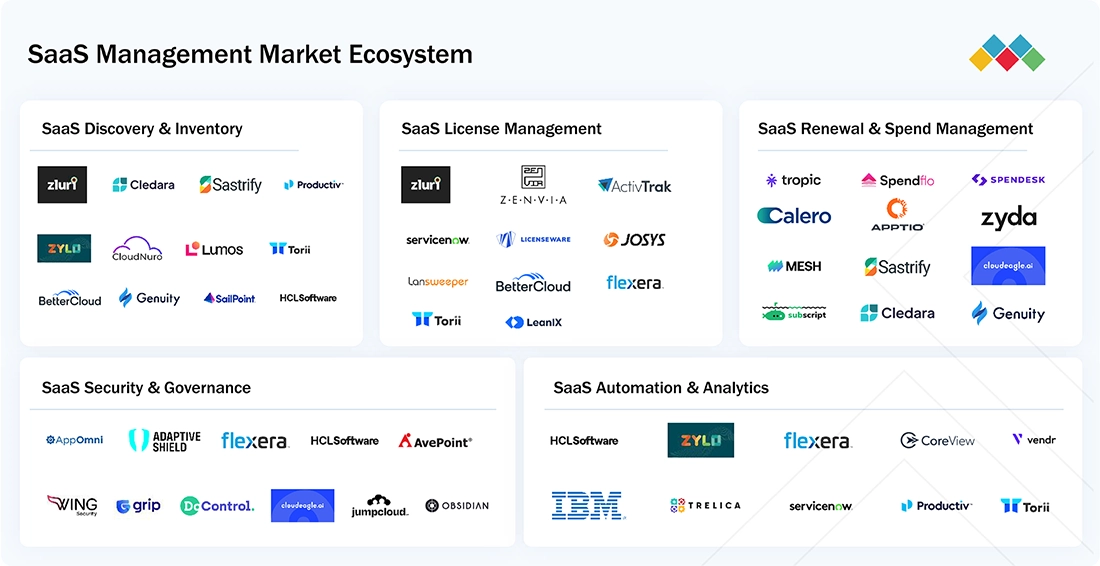
saas-management-market: COMMERCIAL USE CASES ACROSS INDUSTRIES
| COMPANY | USE CASE DESCRIPTION | BENEFITS |
|---|---|---|
 |
U, Inc. used Applogie to discover, monitor, and optimize its SaaS subscriptions, gaining real-time visibility into usage, costs, duplicate licenses, and renewal cycles across its fragmented SaaS landscape. | Reduced SaaS spend by over USD 15,000, eliminated unused and duplicate subscriptions, strengthened renewal governance with automated alerts, and improved overall visibility and control of its SaaS portfolio. |
 |
Pie Insurance used BetterCloud to automate user onboarding and offboarding, gain centralized visibility of its SaaS environment, and streamline access and license management across dozens of cloud applications. | Achieved 600+ hours in annual time savings, reduced onboarding/offboarding time to ~20 minutes, improved IT support ratios, minimized security risks, and freed IT teams to focus on strategic initiatives. |
 |
Jiminny used Cledara to centralize visibility of its 65+ SaaS applications, detect untracked subscriptions, assign tool ownership, and streamline invoice and spend management across departments. | Unified SaaS visibility, discovered ~15% hidden subscriptions, improved financial control through centralized spend tracking, eliminated redundant tools, and strengthened governance with clear ownership. |
 |
Instructure used Zylo to consolidate SaaS applications into a single platform, monitor spend and license utilization in real time, optimize renewals, and enhance access governance through Okta integration. | Centralized SaaS oversight, improved cost efficiency by removing redundant tools, optimized license usage, strengthened governance and compliance, and enhanced access control via Okta integration. |
Logos and trademarks shown above are the property of their respective owners. Their use here is for informational and illustrative purposes only.
Related Ecosystem
Cloud Computing
Software And Services
Key Takeaways
- Qatar's SaaS Management Market is projected to more than double from $95.3 million in 2025 to $200.1 million by 2030, driven by enterprise digital transformation.
- Qatar's 16.0% CAGR outpaces global growth, reflecting accelerated cloud adoption and software asset management prioritization in the region.
- Key sectors in Qatar including energy, fintech, and telecommunications are primary drivers of SaaS management platform adoption and investment.
- Qatar's Vision 2030 strategic initiatives and government digital transformation programs are catalyzing enterprise demand for SaaS management solutions.
SaaS Management Market Report Scope
| Report Metric | Details |
|---|---|
| Base Year | 2025 |
| Fastest Growing Segment | MANUFACTURING & INDUSTRIAL IOT (Vertical) |
| Forecast Period | 2025–2030 |
| Growth Rate | CAGR of 15.4% from 2025 to 2030 |
| Largest Segment | PLATFORMS (Offering) |
| Market Size Base Year (Billions) | ~USD 4.58 (2025) |
| Revenue Forecast (Billions) | ~USD 9.37 (2030) |
| Segments Covered | Offering, Type, Deployment Mode, Business Function, Vertical |
Qatar SaaS Management Market Report Segmentation
5 segment dimensions are covered across the global market.
By Offering
- Platforms
- Services
By Type
- Implementation & Integration
- Managed Services
- Professional Services
- SaaS Automation & Analytics
- SaaS Discovery & Inventory
- SaaS License Management
- SaaS Renewal & Spend Management
- SaaS Security & Governance
- Strategic Advisory Services
- Support & Maintenance
- Training & Advisory
By Deployment Mode
- Cloud
- Hybrid
- On-Premises
By Business Function
- Finance & Accounting
- Hr
- It Asset Management
- Legal & Procurement
- Marketing & Sales Operations
- Security, Risk & Compliance
By Vertical
- Bfsi
- Education
- Energy & Utilities
- Government & Public Sector
- Healthcare & Life Sciences
- Manufacturing & Industrial IoT
- Media & Entertainment
- Other Verticals
- Retail & E-Commerce
- Retail & Ecommerce
- Technology & Software
- Telecommunications
- Transportation & Logistics
QATAR: SAAS MANAGEMENT MARKET, BY VERTICAL, 2025–2030
| Segment | 2025 | 2026 | 2027 | 2028 | 2029 | 2030 | CAGR (%) |
|---|---|---|---|---|---|---|---|
| BFSI | 14 | 16.3 | 18.8 | 21.1 | 23.5 | 26.1 | 13.3 |
| EDUCATION | 4.1 | 4.8 | 5.7 | 6.4 | 7.2 | 8.1 | 14.7 |
| ENERGY & UTILITIES | 3.7 | 4.3 | 5 | 5.6 | 6.3 | 7.1 | 13.7 |
| GOVERNMENT & PUBLIC SECTOR | 5.7 | 6.8 | 8 | 9.2 | 10.5 | 11.9 | 15.8 |
| HEALTHCARE & LIFE SCIENCES | 15.3 | 18.5 | 22.2 | 25.7 | 29.8 | 34.3 | 17.5 |
| MANUFACTURING & INDUSTRIAL IOT | 7.8 | 9.6 | 11.8 | 14 | 16.7 | 19.8 | 20.6 |
| MEDIA & ENTERTAINMENT | 4.2 | 5.1 | 6.2 | 7.2 | 8.4 | 9.7 | 18.3 |
| OTHER VERTICALS | 1.5 | 1.8 | 2.1 | 2.4 | 2.8 | 3.1 | 15.6 |
| RETAIL & E-COMMERCE | 9.8 | 11.8 | 14 | 16.1 | 18.5 | 21.2 | 16.6 |
| TECHNOLOGY & SOFTWARE | 21 | 24.8 | 29.2 | 33.2 | 37.7 | 42.7 | 15.2 |
| TELECOMMUNICATIONS | 5.4 | 6.5 | 7.7 | 8.8 | 10.1 | 11.5 | 16.2 |
| TRANSPORTATION & LOGISTICS | 2.7 | 3.1 | 3.5 | 3.8 | 4.1 | 4.5 | 11 |
| TOTAL | 95.3 | 113.4 | 134.2 | 153.6 | 175.8 | 200.1 | 16 |
Target Audience
- SaaS Vendors & Software Providers : Evaluate Qatar's market potential, identify growth opportunities, and develop localized go-to-market strategies to capture share in this 16% CAGR growth market.
- Enterprise IT Decision Makers : Benchmark your organization's cloud adoption against Qatar market trends, understand competitive SaaS solutions available locally, and optimize software portfolio investments.
- Management Consulting Firms : Support client digital transformation initiatives with Qatar-specific market data, competitive intelligence, and insights into cloud adoption readiness across sectors.
- Investment & Private Equity Firms : Assess investment opportunities in Qatar's SaaS ecosystem, evaluate portfolio company growth potential, and identify acquisition targets in this high-growth market segment.
- Government & Policy Advisors : Inform digital transformation policy development and procurement strategies with comprehensive market intelligence on SaaS adoption trends and enterprise readiness in Qatar.
Key Companies in the Qatar SaaS Management Market
| Company | HQ | Ownership | Strongest segments |
|---|---|---|---|
| IBM | United States | Public Company | Software (Hybrid Cloud & AI Platforms),Consulting (Strategy, Technology, Operations),Infrastructure (Servers, Storage, Lifecycle Services), |
| CHECK POINT SOFTWARE | Israel | Public Company | Mesh Network Security (firewalls, gateways, AI-powered security management),Workspace Security Platform (email, endpoint, mobile, browser, XDR),Threat Exposure Management and AI Security Platforms, |
| AVEPOINT | United States | Public Company | Control Suite (governance, policy, SaaS optimization),Resilience Suite (backup, BaaS, ransomware recovery),Modernization Suite (legacy migration, AI-ready experiences), |
| QUEST SOFTWARE | United States | Private Company | AD Management, Microsoft Platform & Unified Identity Security,Data Protection, Data Operations & Governance,Database Management & Performance Monitoring, |
| SAILPOINT TECHNOLOGIES | United States | Private Company | IdentityNow (SaaS identity security platform),IdentityIQ (on-premise identity security),SailPoint Identity Services and related SaaS subscriptions, |
| SERVICENOW | United States | Public Company | IT Service & Operations Management (incl. OT management),Security Operations & Integrated Risk,Customer & Field Service / Sales & Order Management, |
| FRESHWORKS | United States | Public Company | Customer Experience (Freshdesk Omni, Freshdesk, Freshchat, Freshcaller),Employee Experience / ITSM (Freshservice, Freshservice for Business Teams),Sales & Marketing (Freshsales, Freshmarketer), |
| CALERO | United States | Private Company | Fixed Communications Expense Management,Mobile Communications Expense Management,Managed Mobility Services & Enterprise Mobility Management, |
| RAMP | United States | Public Company | Data Collaboration & Clean Rooms,Activation & People-Based Marketing,Identity Resolution & Graph, |
IBM
IBM is a United States-based public company founded in 1911 with 264,300 employees. It is a global technology and consulting corporation.
CHECK POINT SOFTWARE
Check Point Software is an Israeli public company founded in 1993 with 6,825 employees. It specializes in cybersecurity solutions.
AVEPOINT
AvePoint is a United States-based public company founded in 2001 with 3,443 employees. It provides cloud governance and data management solutions.
QUEST SOFTWARE
Quest Software is a United States-based private company founded in 1987 with 3,814 employees. It provides database management and IT operations software.
SAILPOINT TECHNOLOGIES
SailPoint Technologies is a United States-based private company founded in 2005 with 1,676 employees. It specializes in identity governance and access management solutions.
SERVICENOW
ServiceNow is a United States-based public company founded in 2004 with 29,187 employees. It offers cloud-based workflow and IT service management solutions.
FRESHWORKS
Freshworks is a United States-based public company founded in 2010 with 4,500 employees. It provides customer engagement and business software solutions.
CALERO
Calero is a United States-based private company founded in 1983 with 104 employees. It offers telecom expense management and optimization solutions.
RAMP
Ramp is a United States-based public company founded in 2018 with 1,300 employees. It offers corporate spend management and financial operations software.
Reasons to Buy this Report
- Market-Specific Growth Projections : Access detailed forecasts showing Qatar's SaaS Management Market expanding from $95.3M to $200.1M by 2030, enabling accurate business planning and investment decisions tailored to this high-growth market.
- Competitive Landscape Intelligence : Understand Qatar-specific vendor positioning, market share distribution, and competitive dynamics to identify partnership opportunities and market entry strategies in this emerging SaaS hub.
- Sector-Specific Adoption Insights : Gain insights into SaaS adoption patterns across Qatar's key sectors including finance, energy, telecommunications, and government, enabling targeted go-to-market strategies for your solutions.
- Government & Policy Context : Understand how Qatar's Vision 2030 digital transformation initiatives and government digitalization programs are shaping SaaS demand, regulatory environment, and procurement opportunities.
- Investment & Expansion Planning : Make informed decisions about market entry, resource allocation, and partnership development in Qatar with comprehensive data on market size, growth trajectory, and enterprise readiness.
Frequently asked questions
What is the current size of Qatar's SaaS Management Market?
Qatar's SaaS Management Market is valued at $95.3 million in 2025 and is expected to grow to $200.1 million by 2030.
What is the growth rate for SaaS Management in Qatar?
Qatar's SaaS Management Market is growing at a compound annual growth rate (CAGR) of 16.0% from 2025 to 2030.
Which industries are driving SaaS Management adoption in Qatar?
Energy, fintech, telecommunications, and government sectors in Qatar are primary drivers of SaaS management platform adoption and investment.
How does Qatar's SaaS Management growth compare to global trends?
Qatar's 16.0% CAGR exceeds the global average of 15.4%, indicating stronger regional demand for SaaS management solutions.
What factors are accelerating SaaS Management adoption in Qatar?
Qatar's Vision 2030 initiatives, digital transformation programs, cost optimization pressures, and license compliance requirements are key growth catalysts.
RESEARCH METHODOLOGY
The research methodology for the global SaaS management market report involved the use of extensive secondary sources and directories, as well as various reputed open-source databases, to identify and collect useful information for this technical and market-oriented study. In-depth interviews were conducted with various primary respondents, including SaaS discovery & inventory providers, SaaS license management providers, SaaS renewal & spend management providers, SaaS security and governance providers, SaaS automation & analytics providers, enterprise end users, high-level executives of multiple companies offering SaaS management solutions & services, and industry consultants to obtain and verify critical qualitative and quantitative information and assess the market prospects and industry trends.
Secondary Research
During the secondary research process, various secondary sources were consulted to identify and collect information for the study. The secondary sources included annual reports, press releases, and investor presentations of companies, white papers, certified publications such as Journal on Managing Software-as-a-Service: Pricing and operations, and articles from recognized associations and government publishing sources, including but not limited to Global TECHSPO Series Event, Adobe Summit 2026, CyberTech Global Tel Aviv (Expo Tel Aviv), and ARRtist summit.
The secondary research was utilized to gather key information about the industry’s value chain, the market’s monetary chain, the overall pool of key players, market classification and segmentation based on industry trends, and regional markets, as well as key developments from both market- and technology-oriented perspectives.
Primary Research
In the primary research process, a diverse range of stakeholders from both the supply and demand sides of the SaaS management ecosystem were interviewed to gather qualitative and quantitative insights specific to this market. From the supply side, key industry experts, such as chief executive officers (CEOs), vice presidents (VPs), marketing directors, technology & innovation directors, as well as technical leads from vendors offering SaaS management solutions & services, were consulted. Additionally, system integrators, service providers, and IT service firms that implement and support the SaaS management solutions were included in the study. On the demand side, input from IT decision-makers, infrastructure managers, and business heads of prominent enterprise end users was collected to understand the user perspectives and adoption challenges within targeted industries.
The primary research ensured that all crucial parameters affecting the SaaS management market, including technological advancements, evolving use cases, and regulatory and compliance needs, were considered. Each factor was thoroughly analyzed, verified through primary research, and evaluated to obtain precise quantitative and qualitative data for this market.
Once the initial phase of market engineering was completed, including detailed calculations for market statistics, segment-specific growth forecasts, and data triangulation, a second round of primary research was conducted. This step was crucial for refining and validating critical data points, such as SaaS management offerings (platform & services), industry adoption trends, the competitive landscape, and key market dynamics like demand drivers (AI-powered telemetry enhances SaaS license optimization and spend efficiency, evolving SaaS pricing models accelerate adoption of intelligent monitoring systems, and cross-cloud complexity accelerates adoption of centralized SaaS management), challenges (shadow SaaS usage creates gaps in compliance and lifecycle transparency and fragmented policies and limited automation scalability undermine governance consistency), opportunities (leveraging analytics for real-time FinOps dashboarding and cross-tool optimization, no-code workflow automation strengthens enterprise adoption and operational flexibility, and predictive AI models advance renewal planning and anomaly detection across SaaS portfolios), and restraints (fragmented hybrid environments and legacy integration silos hindering unified SaaS lifecycle control and performance bottlenecks in distributed SaaS data streams constrain analytics capabilities).
In the comprehensive market engineering process, the top-down and bottom-up approaches, along with several data triangulation methods, were extensively employed to perform market estimation and forecasting for the overall market segments and subsegments listed in this report. Extensive qualitative and quantitative analysis was performed on the complete market engineering process to record the critical information/insights throughout the report.
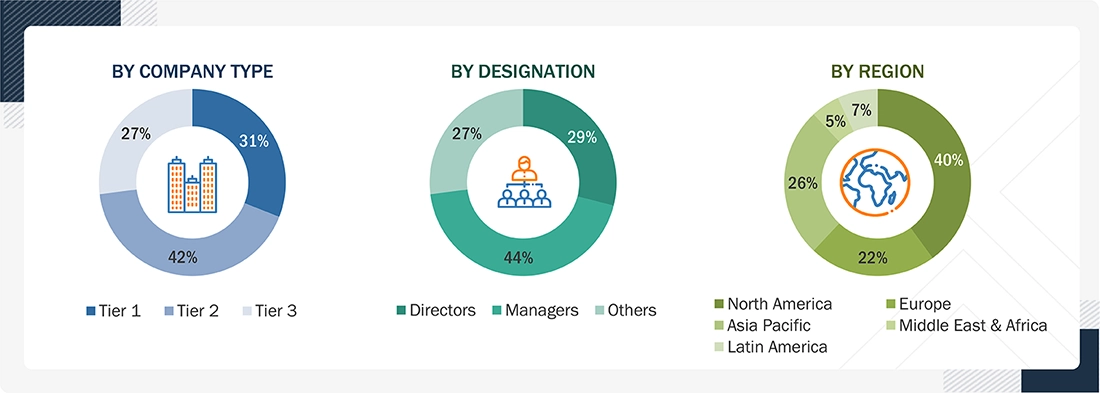
Note: Three tiers of companies are defined based on their total revenue as of 2024; tier 1 = revenue more than USD 500 million, tier 2 = revenue between USD 500 million and 100 million, tier 3 = revenue less than USD 100 million
Source: MarketsandMarkets Analysis
To know about the assumptions considered for the study, download the pdf brochure
Market Size Estimation
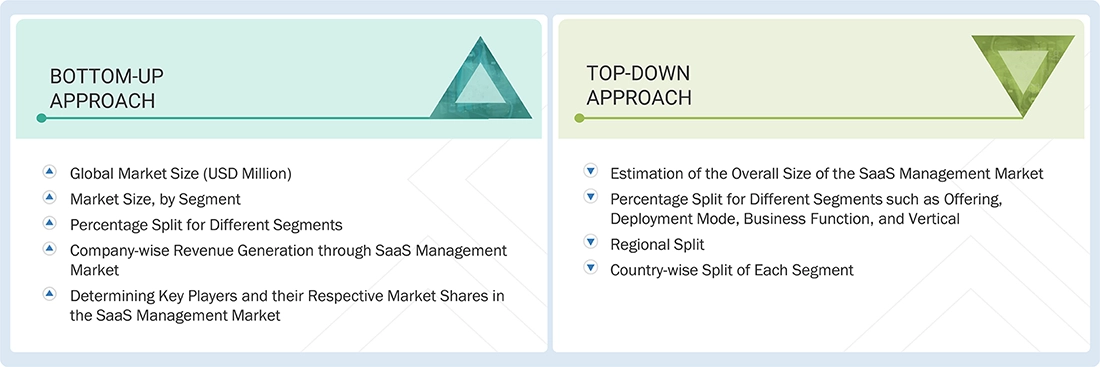
The top-down and bottom-up approaches were employed to estimate and forecast the SaaS Management market, as well as its dependent submarkets. This multi-layered analysis was further reinforced through data triangulation, which incorporated primary and secondary research inputs. The market figures were also validated against the existing MarketsandMarkets repository for accuracy.
SaaS Management Market : Top-Down and Bottom-Up Approach
Data Triangulation
The market was divided into several segments and subsegments after determining the overall market size using the market size estimation processes described above. To complete the overall market engineering process and determine the exact statistics for each market segment and subsegment, data triangulation and market segmentation procedures were employed, wherever applicable. The overall market size was then used in the top-down approach to estimate the size of other individual markets by applying percentage splits to the market segmentation.
Market Definition
Zylo defines SaaS management as a strategic approach to controlling and optimizing the growing ecosystem of cloud-based applications within an organization. The practice focuses on continuous visibility into SaaS usage, licensing, and expenditure, enabling enterprises to identify redundancies, reduce waste, and strengthen governance. By consolidating insights across departments, SaaS management supports data-driven decision-making and ensures that technology investments are aligned with operational efficiency and business goals.
Key Stakeholders
- SaaS management solution providers
- SaaS management service providers
- SaaS license management providers
- SaaS governance vendors
- Cloud service providers
- Enterprise end users
- Government agencies
- Distributors and value-added resellers (VARs)
- Government agencies
- Independent software vendors (ISVs)
- Managed service providers
- Support & maintenance service providers
- System integrators (SIs)/Migration service providers
- Technology providers
Report Objectives
- To define, describe, and forecast the SaaS management market, by offering, deployment mode, business function, and vertical
- To provide detailed information related to the major factors (drivers, restraints, opportunities, and challenges) influencing market growth
- To analyze the micromarkets with respect to individual growth trends, prospects, and their contribution to the total market
- To analyze the opportunities in the market for stakeholders by identifying the high-growth segments of the SaaS management market
- To analyze the opportunities in the market and provide details of the competitive landscape for stakeholders and market leaders
- To forecast the market size of segments for the five main regions: North America, Europe, Asia Pacific, the Middle East & Africa, and Latin America
- To profile the key players and comprehensively analyze their market ranking and core competencies
- To analyze the competitive developments, such as partnerships, product launches, and mergers & acquisitions, in the SaaS management market
- To analyze the impact of macroeconomic factors on the SaaS management market across all regions
Customization Options
With the given market data, MarketsandMarkets offers customizations based on the company’s specific needs. The following customization options are available for the report.
Product analysis
- Product comparative analysis, which gives a detailed comparison of innovative products being offered by prominent vendors
Geographic analysis
- Further breakup of additional European countries by offering, deployment mode, business function, and vertical
- Further breakup of additional Asia Pacific countries by offering, deployment mode, business function, and vertical
- Further breakup of additional Middle East & African countries by offering, deployment mode, business function, and vertical
- Further breakup of additional Latin American countries by offering, deployment mode, business function, and vertical
Company information
- Detailed analysis and profiling of additional market players (up to five)
Get the Full SaaS Management Market Report
Full forecast, segment splits, and company analysis for all SaaS Management Market.
- Japan SaaS Management Market
- South Korea SaaS Management Market
- Brazil SaaS Management Market
- Mexico SaaS Management Market
- Saudi Arabia SaaS Management Market
- UAE SaaS Management Market
- South Africa SaaS Management Market
- Rest Of Europe SaaS Management Market
- US SaaS Management Market
- Canada SaaS Management Market
- UK SaaS Management Market
- Germany SaaS Management Market
- France SaaS Management Market
- Italy SaaS Management Market
- China SaaS Management Market
- India SaaS Management Market
Need a Tailored Report?
Customize this report to your needs
Get 10% FREE Customization
Customize This Report
