
US Direct-to-Device (D2D) Market (2025-2030)

The US Direct-to-Device (D2D) Market was valued at $303.9 Million in 2025 and projected to reach to $810.8 Million by 2030, representing a compound annual growth rate of 21.7%. The US Direct-to-Device market within Aerospace & Defence is positioned for sustained growth through 2030, driven by escalating defence budgets, modernization of legacy systems, and the critical need for secure, low-latency connectivity in autonomous platforms.


| Market Size in | USD 26.32 MN |
| Market Forecast in | |
| CAGR | |
| Forecast Period | |
| Units Considered | Value (USD MN) |
US Direct-to-Device (D2D) Market Trends and Insights
- This represents a compound annual growth rate of 21.7%, reflecting strong demand for advanced connectivity and autonomous systems across US defence and aerospace platforms.
- The US market is driven by increased military modernization initiatives, heightened focus on real-time data transmission, and integration of D2D technologies in next-generation aircraft and defence systems. US aerospace and defence contractors are increasingly adopting D2D solutions to enhance operational efficiency, reduce latency, and improve inter-platform communication capabilities.
- The forecast period through 2030 anticipates accelerated adoption as the US Department of Defence prioritizes digital transformation and network-centric warfare capabilities.
- Investment in unmanned systems, satellite communications, and distributed defence networks continues to propel US market growth, positioning the country as a critical hub for D2D innovation and deployment in the global aerospace and defence landscape..
Key Market Statistics
- CAGR (2025-2030) 21.7% CAGR
- Market Size, 2025 ~USD 303.9 Million
- Forecast, 2030 ~USD 810.8 Million
- Country US
US Direct-to-Device (D2D) Market Overview
Market Valuation Growth :
The US D2D market in Aerospace & Defence is valued at $303.9 million in 2025, with projections reaching $810.8 million by 2030, representing a 21.7% CAGR and demonstrating significant investment momentum in advanced connectivity solutions.
Defence Modernization Drivers :
US Department of Defence modernization initiatives and increased spending on autonomous systems, real-time data connectivity, and next-generation aircraft platforms are primary catalysts accelerating D2D adoption across military and commercial aerospace segments.
Technology Integration Expansion :
Growing integration of D2D capabilities in unmanned aerial vehicles (UAVs), fighter jets, satellite communications, and ground-to-air systems reflects the US military's strategic focus on enhanced operational connectivity and mission-critical data transmission.
Competitive Landscape Intensification :
Major US defence contractors and aerospace OEMs are investing heavily in D2D infrastructure, creating a competitive ecosystem that drives innovation, reduces deployment timelines, and accelerates market penetration across military and civilian applications.
US Direct-to-Device (D2D) Market Dynamics
- Government contracts, military procurement cycles, and increased R&D investments in next-generation communication technologies will continue to fuel market expansion.
- The integration of 5G and beyond-5G technologies into defence infrastructure further strengthens growth prospects. Looking ahead, the US market will benefit from heightened geopolitical tensions necessitating advanced defence capabilities, increased collaboration between government agencies and private sector innovators, and regulatory frameworks supporting secure D2D deployments.
- Strategic partnerships, technology standardization efforts, and the emergence of specialized D2D solution providers will reshape the competitive landscape, creating substantial opportunities for stakeholders positioned to address the unique requirements of US aerospace and defence applications..
Market Ecosystem
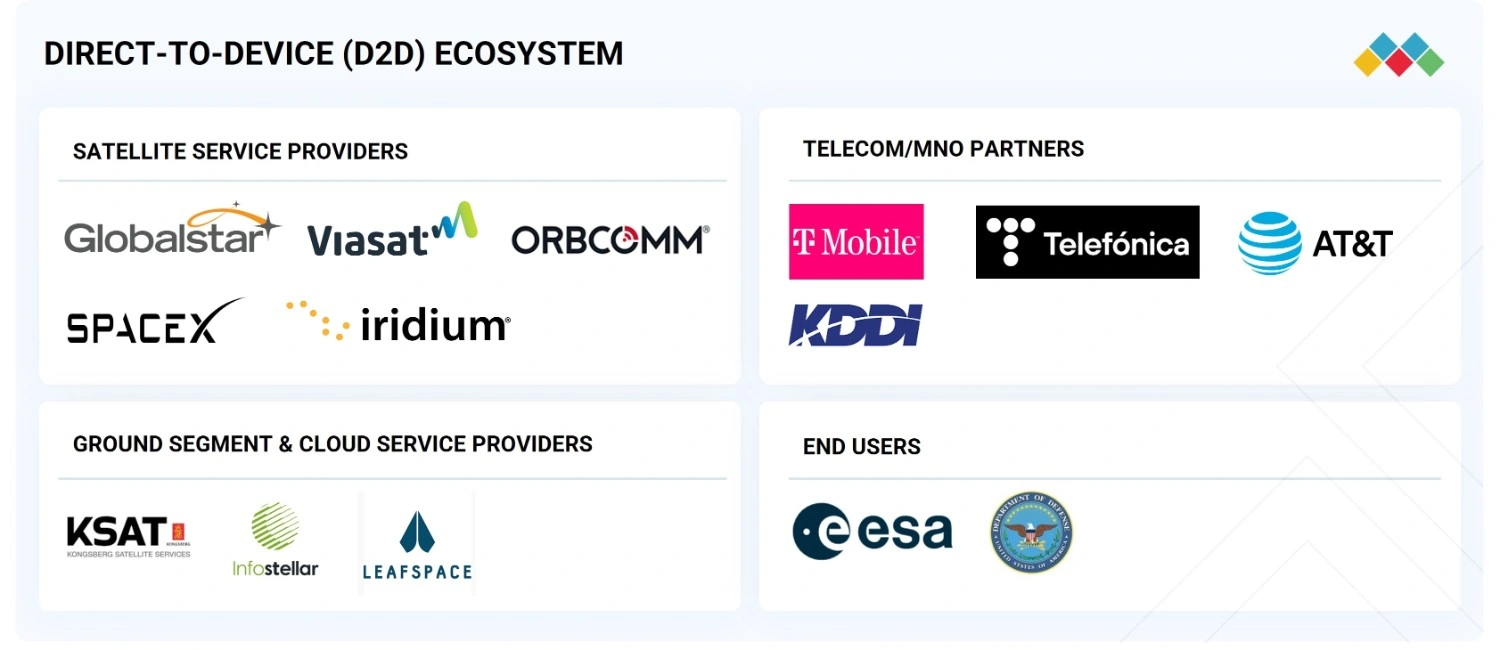
Direct-to-Device (D2D) Market: COMMERCIAL USE CASES ACROSS INDUSTRIES
| COMPANY | USE CASE DESCRIPTION | BENEFITS |
|---|---|---|
 |
Enabled satellite-to-smartphone connectivity for emergency and remote communications | Provides truly global coverage with reliable, low-latency messaging |
 |
Supported smartphone emergency SOS services and IoT asset tracking via L/S-band | Delivers cost-effective solutions with mass-market device integration |
 |
Provided satellite services extended to enterprise and IoT devices | Ensures high-capacity, secure connectivity for both consumer and business |
 |
Facilitated Direct-to-IoT services for logistics, fleet tracking, and asset monitoring | Enhances efficiency and reduces costs with continuous IoT data relays |
 |
Enabled Direct-to-Cell and IoT connectivity using LEO mega-constellations | Offers scalable, high-speed, low-latency services with global reach |
Logos and trademarks shown above are the property of their respective owners. Their use here is for informational and illustrative purposes only.
Related Ecosystem
Space
- C-Band
- Small Satellite
- Antennas
- Ka-Band
- Microsatellite
- AIRBUS
- L3Harris Technologies, Inc.
- Thales group
- Northrop Grumman Corporation
- LOCKHEED MARTIN CORPORATION
Key Takeaways
- The US D2D market is valued at $303.9 million in 2025 and is forecast to grow to $810.8 million by 2030, representing a 21.7% CAGR.
- US military modernization and digital transformation initiatives are primary drivers of D2D adoption across defence platforms and aerospace systems.
- Real-time data transmission and inter-platform communication capabilities are critical factors accelerating D2D technology integration in the US aerospace and defence sector.
- The US market is positioned as a global leader in D2D innovation, supported by substantial defence spending and advanced technology infrastructure.
Direct-to-Device (D2D) Market Report Scope
| Report Metric | Details |
|---|---|
| Base Year | 2025 |
| Fastest Growing Segment | L2 (150–600 MS) (Latency Class) |
| Forecast Period | 2025–2030 |
| Growth Rate | CAGR of 35.6% from 2025 to 2030 |
| Largest Segment | LEO (Orbit) |
| Market Size Base Year (Billions) | ~USD 0.58 (2025) |
| Revenue Forecast (Billions) | ~USD 2.64 (2030) |
| Segments Covered | Service Type, Customer Type, Frequency, Orbit, Latency Class |
US Direct-to-Device (D2D) Market Report Segmentation
5 segment dimensions are covered across the global market.
By Service Type
- Direct-To-Cell
- Direct-To-IoT
By Customer Type
- Consumer
- Enterprise Network
- Government & Defense
By Frequency
- L-Band
- S-Band
- Vhf/Uhf
By Orbit
- Geo
- Leo
- Multi-Orbit
By Latency Class
- L1 (< 150 Ms)
- L2 (150–600 Ms)
- L3 (600 Ms–10 S)
- L4 (> 10 S)
Target Audience
- Defence Contractors & Primes : Major US defence contractors require detailed market intelligence to inform product development roadmaps, bid strategies for government contracts, and investment decisions in D2D capabilities for military platforms.
- Aerospace OEMs : Commercial and military aircraft manufacturers need US-specific market data to evaluate D2D integration opportunities, assess competitive threats, and align product portfolios with evolving customer requirements.
- Government & Military Agencies : US Department of Defence, military branches, and federal agencies utilize market research to inform procurement strategies, technology roadmaps, and budget justifications for D2D infrastructure investments.
- Technology & Telecom Providers : Communications technology companies and telecom providers targeting the US defence sector require market insights to identify partnership opportunities, develop compliant solutions, and penetrate the aerospace and defence vertical.
- Investment & Private Equity Firms : Investors evaluating opportunities in the US aerospace and defence technology sector need comprehensive market analysis to assess growth potential, identify acquisition targets, and structure investment theses in D2D solutions.
Key Companies in the US Direct-to-Device (D2D) Market
| Company | HQ | Ownership | Strongest segments |
|---|---|---|---|
| IRIDIUM COMMUNICATIONS INC. | United States | Public Company | Direct-to-IoT,Direct-to-Cell,Government & Defense D2D Services, |
| GLOBALSTAR | United States | Public Company | Direct-to-IoT (commercial IoT, asset tracking, modules),Direct-to-Device safety and messaging (SPOT family),Enterprise and government MSS services, |
| VIASAT, INC. | United States | Public Company | Direct to IoT,Direct to Cell,Government & Defense D2D Services, |
| ORBCOMM | United States | Private Company | Direct-to-IoT – Transportation & Supply Chain Assets,Direct-to-IoT – Maritime & AIS Data Services,Direct-to-IoT – Heavy Equipment & Fixed Asset Monitoring, |
| SPACEX | United States | Public Company | Direct to Cell – Consumer,Direct to Cell – Enterprise Network,Direct to Cell – Government & Defense, |
| ECHOSTAR CORPORATION | United States | Public Company | Direct to IoT – Enterprise Network,Direct to IoT – Government & Defense,Direct to IoT – Consumer, |
| AST & SCIENCE, LLC | United States | Public Company | Direct to Cell,Direct to IoT,Government & Defense / R&D and Other, |
IRIDIUM COMMUNICATIONS INC.
Iridium Communications Inc. is a United States-based public company with 975 employees that operates in the satellite communications industry.
GLOBALSTAR
Globalstar is a United States public company founded in 1993 with 477 employees, operating in the satellite communications sector.
VIASAT, INC.
Viasat, Inc. is a United States public company founded in 1986 with 7,000 employees, providing satellite communications and technology services.
ORBCOMM
Orbcomm is a United States private company founded in 1993 with 739 employees, operating in the satellite communications and IoT industry.
SPACEX
SpaceX is a United States public company founded in 2002 with 22,000 employees, specializing in space launch services and satellite technology.
ECHOSTAR CORPORATION
EchoStar Corporation is a United States public company founded in 1980 with 12,100 employees, operating in satellite broadcasting and communications.
AST & SCIENCE, LLC
AST & Science, LLC is a United States public company founded in 2017 with 1,126 employees, developing satellite-based mobile connectivity solutions.
Reasons to Buy this Report
- Strategic Market Sizing : Obtain precise valuation data specific to the US market segment, enabling accurate budget allocation, investment decisions, and competitive positioning within the American aerospace and defence D2D ecosystem.
- Growth Trajectory Intelligence : Access detailed CAGR analysis and five-year forecasts tailored to US market dynamics, allowing stakeholders to anticipate market inflection points and capitalize on emerging opportunities before competitors.
- Regulatory & Policy Insights : Understand US-specific regulatory frameworks, government procurement processes, and defence policy drivers influencing D2D adoption, ensuring compliance and alignment with federal acquisition requirements.
- Competitive Landscape Mapping : Identify key US-based players, market consolidation trends, and competitive differentiation strategies specific to the American aerospace and defence sector, informing partnership and acquisition strategies.
- Technology Adoption Patterns : Gain insights into US military and commercial aerospace adoption patterns for D2D technologies, including platform preferences, integration timelines, and emerging use cases driving market demand.
Frequently asked questions
What is the current size of the US D2D market in Aerospace & Defence?
The US Direct-to-Device market in Aerospace & Defence is valued at $303.9 million in 2025 and is expected to grow significantly through 2030.
What is the projected growth rate for the US D2D market through 2030?
The US D2D market is projected to grow at a compound annual growth rate (CAGR) of 21.7% from 2025 to 2030, reaching $810.8 million.
What are the primary drivers of D2D adoption in the US aerospace and defence sector?
Key drivers include US military modernization initiatives, demand for real-time data transmission, network-centric warfare capabilities, and integration with unmanned systems and satellite communications.
How does the US D2D market compare to global trends?
The US market grows at 21.7% CAGR, which is lower than the global CAGR of 35.6%, indicating that while the US is a significant market, other regions are experiencing faster growth rates.
Which US defence and aerospace applications are driving D2D market growth?
Applications include unmanned aerial systems, next-generation aircraft platforms, satellite communications networks, distributed defence systems, and real-time command and control infrastructure.
RESEARCH METHODOLOGY
This research study involves the use of extensive secondary sources, directories, and databases (e.g., Hoovers, Bloomberg Business, Factiva, and OneSource) to identify and collect information useful for this technical, market-oriented, and commercial study of the Direct-to-Device (D2D) market. Primary sources include several industry experts from the core and related industries and preferred suppliers, manufacturers, distributors, technology developers, IP vendors, standards, and organizations related to all the segments of this industry’s value chain. In-depth interviews have been conducted with various primary respondents, including key industry participants, subject matter experts (SMEs), C-level executives of key market players, and industry consultants to obtain and verify critical qualitative and quantitative information, as well as to assess the prospects.
Secondary Research
In the secondary research process, various secondary sources have been referred to for identifying and collecting information for this study. The secondary sources include annual reports, press releases, and investor presentations of companies; white papers, journals, and certified publications and articles from recognized authors; and websites, directories, and databases. Secondary research has mainly been used to obtain key information about the industry’s supply chain, the market’s value chain, major players, market classification, and segmentation according to the industry trends to the bottommost level, geographic markets, and key developments from both market- and technology-oriented perspectives. The secondary data has been collected and analyzed to arrive at the overall market size, which has further been validated by primary research.
Primary Research
Extensive primary research has been conducted after obtaining information about the current scenario of the Direct-to-Device (D2D) market through secondary research. Several primary interviews have been conducted with market experts from the demand and supply sides across North America, Europe, the Asia Pacific, the Middle East, and the Rest of the World. This primary data has been collected through questionnaires, emails, and telephonic interviews.
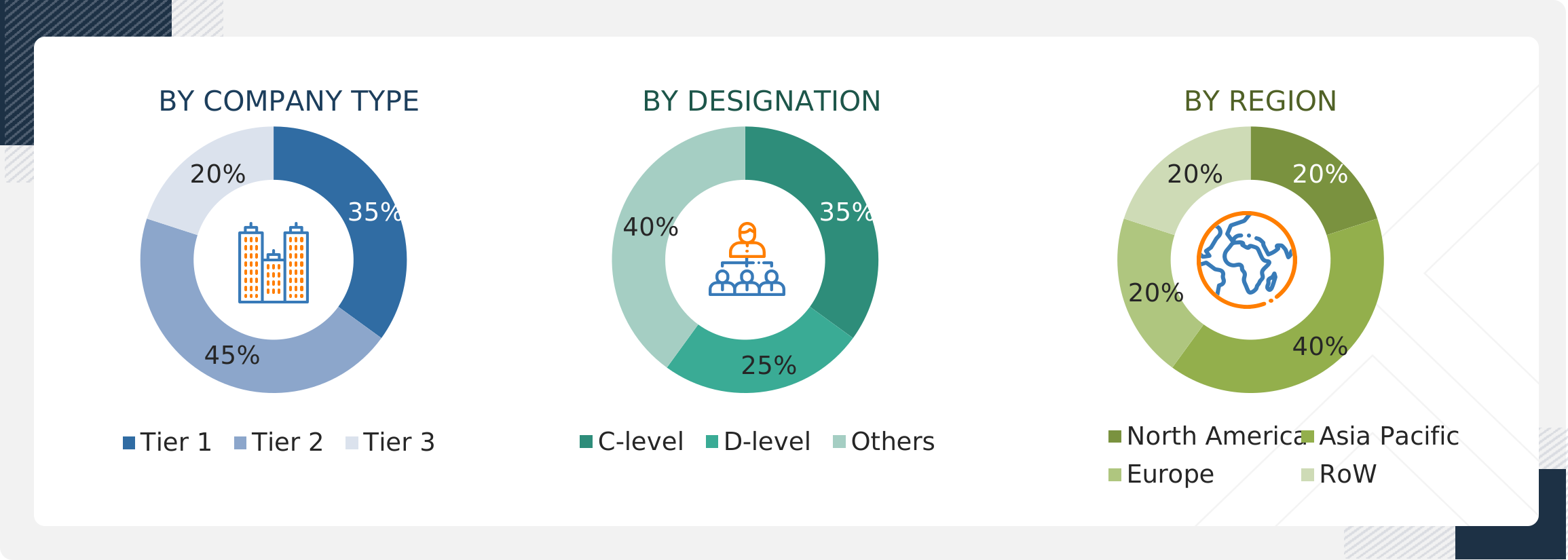
Note: Tiers of companies are based on their revenue in 2024. Tier 1: company revenue greater than USD 1 billion; Tier 2: company revenue between USD 100 million and USD 1 billion; and Tier 3: company revenue less than USD 100 million.
To know about the assumptions considered for the study, download the pdf brochure
Market Size Estimation
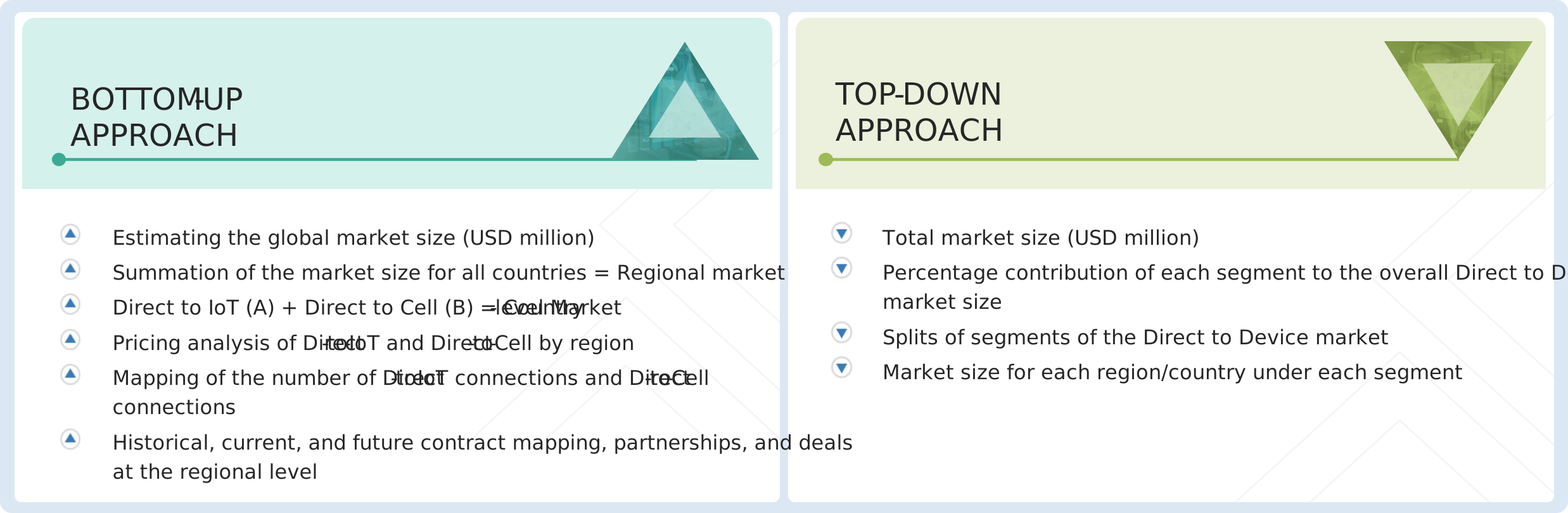
Both the top-down and bottom-up approaches have been used to estimate and validate the size of the D2D market.
The research methodology used to estimate the market size also includes the following details:
- Key players in the market have been identified through secondary research, and their market ranking has been determined through primary and secondary research. This includes a study of annual and financial reports of the top market players and extensive interviews with industry experts who are knowledgeable about Direct-to-Device (D2D).
- The top-down and bottom-up approaches have been used to estimate and validate the size of the global market and the dependent submarkets in the overall market.
Direct-to-Device (D2D) Market: Top-Down and Bottom-Up Approach
Data Triangulation
After arriving at the overall size of the Direct-to-Device (D2D) market from the estimation process explained above, the total market has been split into several segments and subsegments. The data triangulation and market breakdown procedures explained below have been implemented, wherever applicable, to complete the overall market engineering process and arrive at the exact statistics for various market segments and subsegments. The data has been triangulated by studying various factors and trends from the demand and supply sides. Along with this, the D2D market size has been validated using the top-down and bottom-up approaches.
Market Definition
The D2D refers to satellite services that connect directly to end-user devices such as smartphones, sensors, and machines without relying on traditional fixed ground infrastructure. It covers three key segments: Direct-to-Cell, which provides voice, messaging, and data services directly to standard smartphones using satellite-enabled cellular bands; Direct-to-Broadband, which offers high-speed internet via compact user terminals; and Direct-to-IoT, which enables low-bandwidth data transfer for sensors, trackers, and machines using integrated or low-power satellite modules.
Key Stakeholders
- Mobile Network Operators (MNOs)
- Satellite Operators
- Device Manufacturers (Handsets & IoT Devices)
- Chipset & Technology Providers
- Regulators & Government Agencies
- Defense & Emergency Agencies
- Enterprise & Industrial Users
- Commercial Organizations
- Research Institutions
Report Objectives
- To define, describe, segment, and forecast the size of the Direct-to-Device (D2D) market based on service type, customer type, latency class, orbit, frequency, and region
- To forecast sizes of various segments of the market with respect to major regions, namely, North America, Europe, the Asia Pacific, the Middle East, and the Rest of the World, along with major countries in each of these regions
- To identify and analyze key drivers, restraints, opportunities, and challenges influencing the growth of the market across the globe
- To identify industry trends, market trends, and technology trends that are currently prevailing in the market
- To provide an overview of the regulatory landscape with respect to D2D regulations across regions
- To analyze micro markets with respect to individual growth trends, prospects, and their contribution to the overall market
- To analyze opportunities in the market for stakeholders by identifying key market trends
- To profile key market players and comprehensively analyze their market shares and core competencies
- To analyze the degree of competition in the market by identifying key growth strategies, such as acquisitions, product launches, contracts, and partnerships, adopted by leading market players
- To identify detailed financial positions, key products, and unique selling points of leading companies in the market
- To provide a detailed competitive landscape of the market, along with market ranking analysis, market share analysis, and revenue analysis of key players
Available customizations
Along with the market data, MarketsandMarkets offers customizations as per the specific needs of companies. The following customization options are available for the report:
Product Analysis
- Product matrix, which gives a detailed comparison of the product portfolio of each company
Regional Analysis
- Further breakdown of the market segments at the country level
Company Information
- Detailed analysis and profiling of additional market players (up to 5)
Get the Full Direct-to-Device (D2D) Market Report
Full forecast, segment splits, and company analysis for all Direct-to-Device (D2D) Market.
- Canada Direct-to-Device (D2D) Market
- UK Direct-to-Device (D2D) Market
- Germany Direct-to-Device (D2D) Market
- France Direct-to-Device (D2D) Market
- Spain Direct-to-Device (D2D) Market
- Italy Direct-to-Device (D2D) Market
- China Direct-to-Device (D2D) Market
- India Direct-to-Device (D2D) Market
- Japan Direct-to-Device (D2D) Market
- Australia Direct-to-Device (D2D) Market
- South Korea Direct-to-Device (D2D) Market
- UAE Direct-to-Device (D2D) Market
- Saudi Arabia Direct-to-Device (D2D) Market
- Rest Of Middle East Direct-to-Device (D2D) Market
Need a Tailored Report?
Customize this report to your needs
Get 10% FREE Customization
Customize This Report
