Direct-to-Device (D2D) Market by Service Type (Direct to IoT, Direct to Cell), Customer Type (Consumer, Enterprise Network, Government & Defense), Latency Class, Frequency, Orbit and Region - Global Forecast to 2030

icon1
USD 2.64 BN
MARKET SIZE, 2030
icon2
CAGR 35.6%
(2025-2030)
icon3
237
REPORT PAGES
icon4
217
MARKET TABLES

OVERVIEW

Source: Secondary Research, Interviews with Experts, MarketsandMarkets Analysis

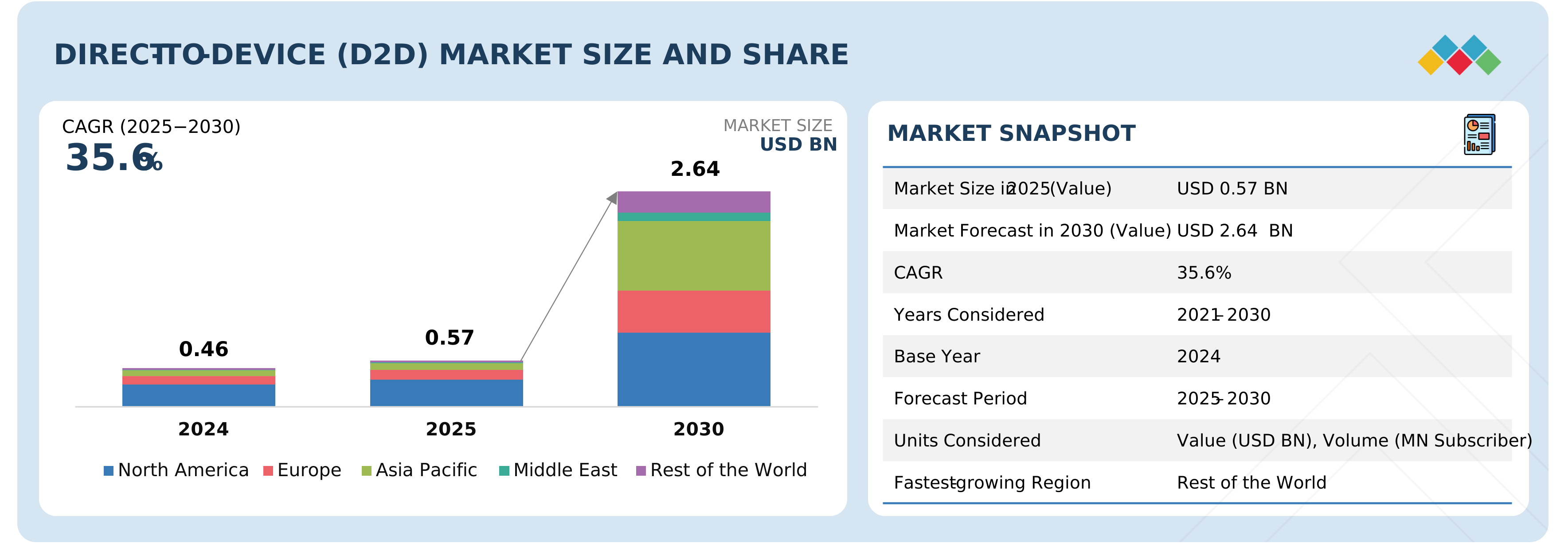
The Direct-to-Device (D2D) Market is estimated at USD 0.57 billion in 2025 and is projected to reach USD 2.64 billion by 2030, at a CAGR of 35.6%. The D2D subscriber volume for the consumer segment is anticipated to grow from 0.6 million in 2025 to 23.5 million by 2030. The D2D Industry is driven by the growing demand to eliminate connectivity gaps and provide seamless global coverage. It is further accelerated by the rapid proliferation of IoT devices and smartphones requiring always-on, low-latency communication.

KEY TAKEAWAYS

  • BY SERVICE TYPE
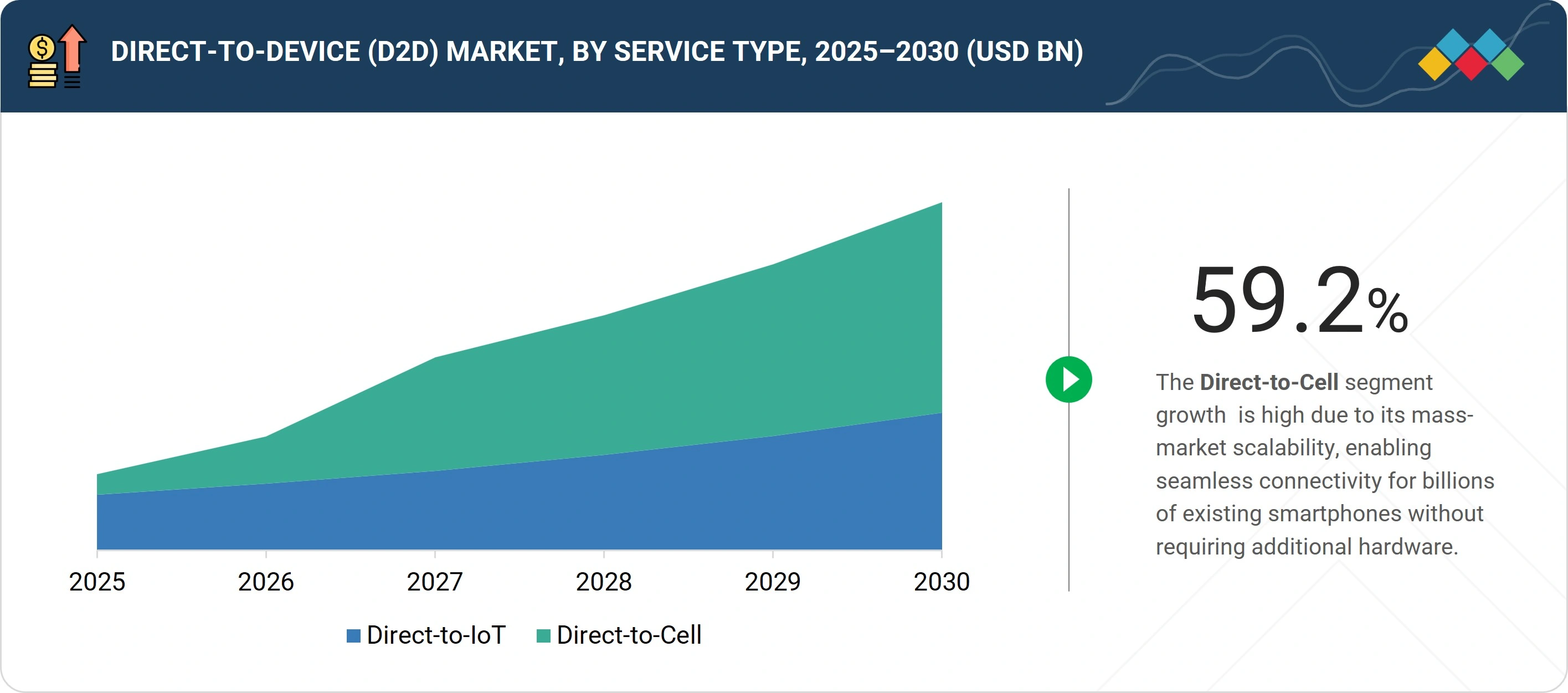
    The market is segmented into Direct-to-cell and Direct-to-IoT by service type.The rapid adoption of digital technologies in industries based on remote operations is propelling D2IoT demand.
  • BY CUSTOMER TYPE
    Growing need for operational efficiency and digital transformation is driving the growth of enterprise network segment.
  • BY FREQUENCY
    The combination of moderate spectrum availability and increasing operator interest positions S-band as a growth driver for mainstream D2D services.
  • BY ORBIT
    The scalability of LEO constellations, combined with declining launch costs, is driving widespread deployments by both private and public operators.
  • BY LATENCY CLASS
    L3 latency class lower infrastructure requirements and ability to support bulk or intermittent data transfer make it a cost-efficient option for niche applications.
  • BY REGION
    North America is expected to have the largest market share for D2D, supported by the presence of key market players in the region.
  • COMPETITIVE LANDSCAPE
    Major players in the D2D market have adopted both organic and inorganic strategies, including partnerships and investments. Iridium Communications Inc. and Globalstar are among the key players in the D2D market.

The future growth of the Direct-to-Device (D2D) market is likely to be fueled by the large-scale deployment of satellite constellations, increasing integration of multi-orbit networks, and expanding adoption across consumer, enterprise, and government sectors. With smartphones and IoT devices becoming satellite-ready through 3GPP NTN standards, D2D services are expected to evolve from emergencies and niche use cases to mainstream connectivity solutions.

TRENDS & DISRUPTIONS IMPACTING CUSTOMERS' CUSTOMERS

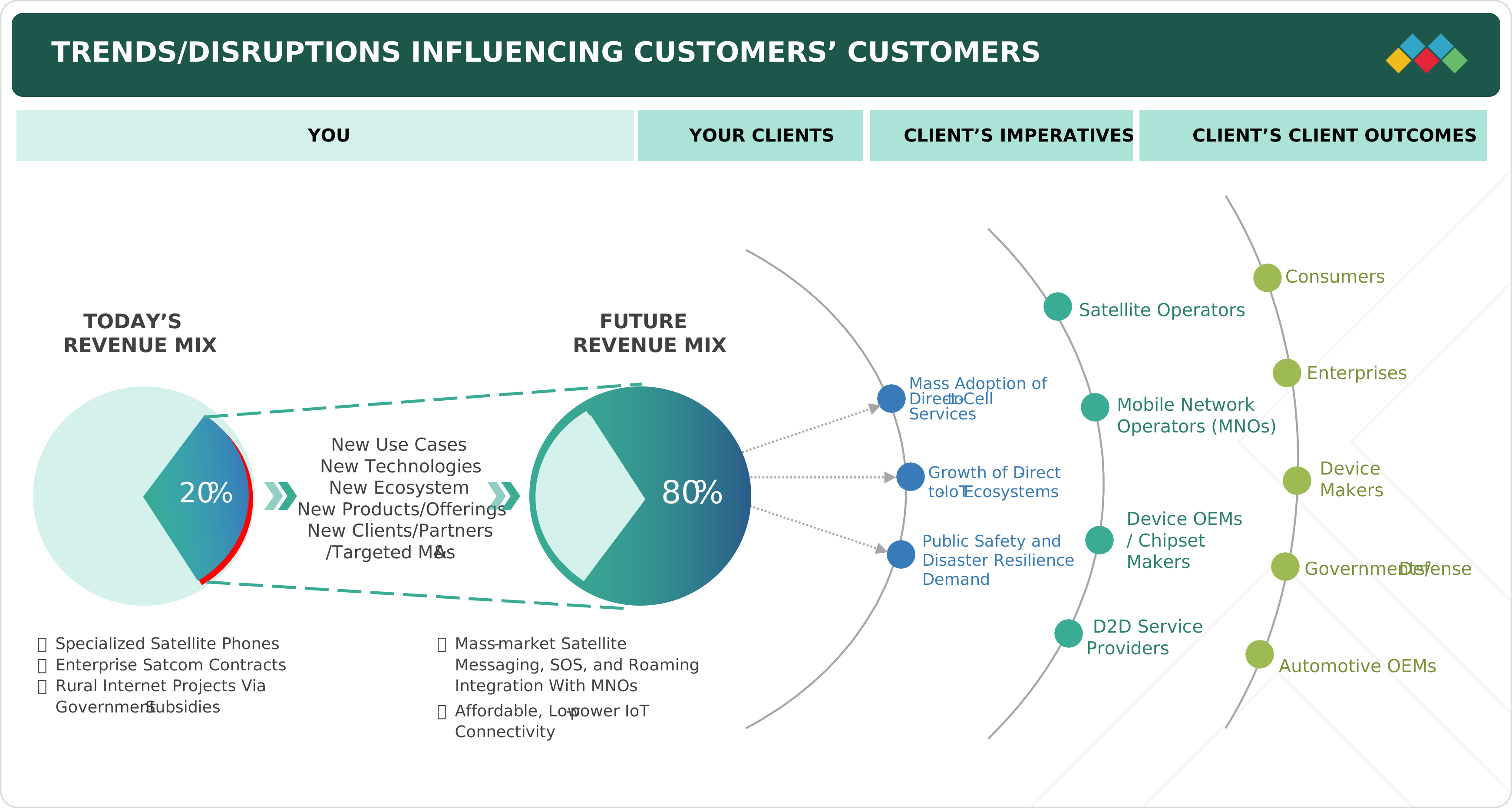
The impact on consumers’ business emerges from customer trends or disruptions. Trends and disruptions impacting customer business often stem from strong demand for Direct-to-IoT and Direct-to-Cell services. The Direct-to-Device (D2D) market is driven by the growing demand to eliminate connectivity gaps and provide seamless global coverage. It is further accelerated by the rapid proliferation of IoT devices and smartphones requiring low-latency communication.
Source: Secondary Research, Interviews with Experts, MarketsandMarkets Analysis

MARKET DYNAMICS

Drivers
Impact
Level
  • Growing demand for emergency communication and disaster resilience
  • Proliferation of IoT & connected devices
RESTRAINTS
Impact
Level
  • Spectrum & regulatory complexity
  • Ecosystem readiness and device integration
OPPORTUNITIES
Impact
Level
  • Growing IoT & industrial applications
  • Expansion of digital inclusion and rural connectivity
CHALLENGES
Impact
Level
  • Latency and network integration challenges
  • High operational dependency on satellite launches

Source: Secondary Research, Interviews with Experts, MarketsandMarkets Analysis

Driver: Growing Demand for Emergency Communication and Disaster Resilience

The increasing frequency of natural disasters, climate-related events, and infrastructure outages has underscored the need for resilient communication systems, driving adoption of D2D solutions. In disaster situations, terrestrial networks are often the first to fail due to power disruptions, damaged towers, or network congestion, leaving affected populations and emergency responders without reliable communication. D2D addresses this issue by enabling smartphones to connect directly to satellites for essential services.

Restraint: Spectrum & Regulatory Complexity

One of the most significant restraints in the D2D market is the spectrum allocation and regulatory approval. Unlike traditional mobile networks, D2D services operate at the intersection of terrestrial and non-terrestrial communications, requiring harmonized use of spectrum bands across different jurisdictions. This creates a complex environment where mobile network operators (MNOs), satellite providers, and national regulators must coordinate to avoid interference, ensure compatibility, and comply with international frameworks established by bodies.

Opportunity: Growing IoT & Industrial Applications

The proliferation of IoT devices and industrial applications represents one of the strongest growth opportunities for the D2D market. Industrial sectors such as logistics, agriculture, oil & gas, mining, and defense increasingly depend on real-time connectivity to monitor and manage operations. These activities occur in remote or harsh environments where terrestrial networks are unavailable. D2D satellite solutions directly address this challenge by providing global connectivity for IoT modules and sensors without the need for additional ground infrastructure.

Challenge: High Operational Dependency on Satellite Launches

Operational delays and launch risks represent a critical challenge in the D2D market, given the industry’s dependence on large-scale satellite constellations for global coverage. The deployment of these constellations requires precision planning, long production cycles, and complex coordination across multiple supply chains. Even minor delays in satellite manufacturing, integration, or launch schedules can cause cascading effects, postponing service availability and slowing the ability of providers to meet commercial commitments.

Direct-to-Device (D2D) Market: COMMERCIAL USE CASES ACROSS INDUSTRIES

COMPANY USE CASE DESCRIPTION BENEFITS
Enabled satellite-to-smartphone connectivity for emergency and remote communications Provides truly global coverage with reliable, low-latency messaging
Supported smartphone emergency SOS services and IoT asset tracking via L/S-band Delivers cost-effective solutions with mass-market device integration
Provided satellite services extended to enterprise and IoT devices Ensures high-capacity, secure connectivity for both consumer and business
Facilitated Direct-to-IoT services for logistics, fleet tracking, and asset monitoring Enhances efficiency and reduces costs with continuous IoT data relays
Enabled Direct-to-Cell and IoT connectivity using LEO mega-constellations Offers scalable, high-speed, low-latency services with global reach

Logos and trademarks shown above are the property of their respective owners. Their use here is for informational and illustrative purposes only.

MARKET ECOSYSTEM

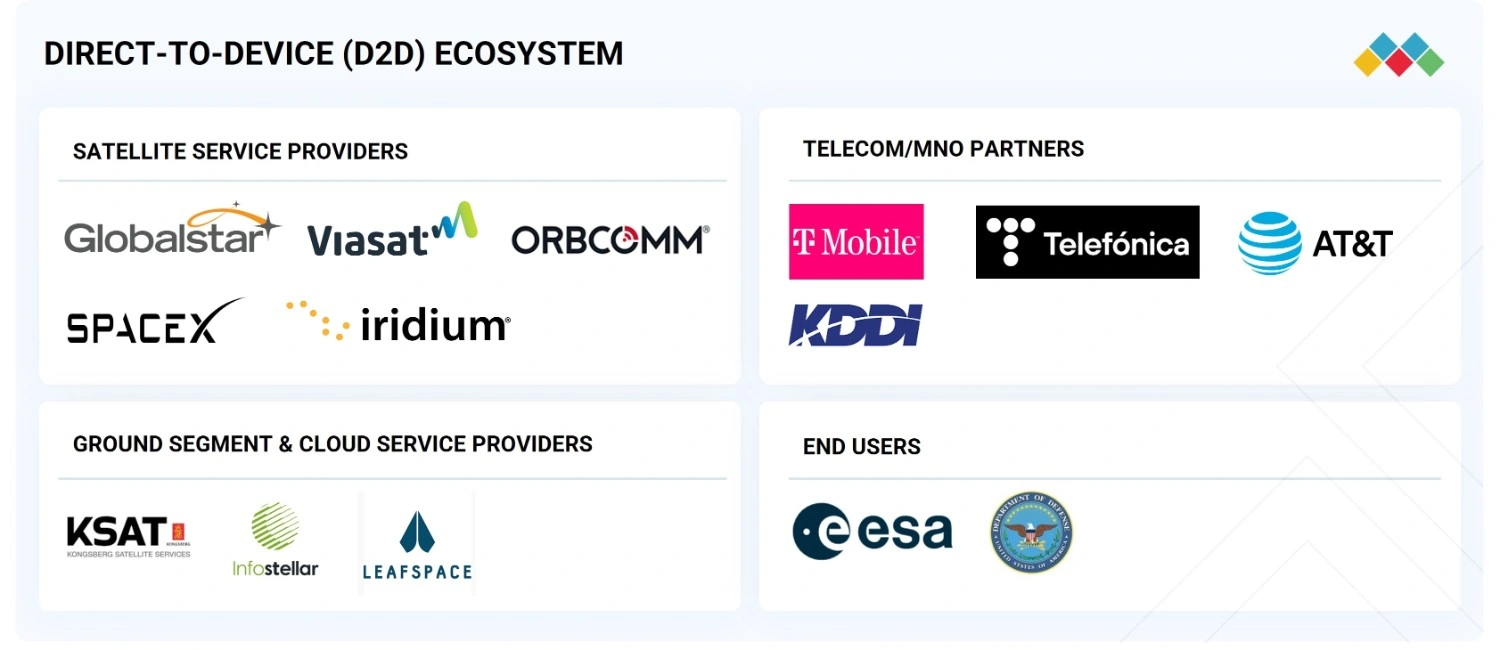
The key stakeholders in the market ecosystem are satellite service providers, telecom/mno partners, ground segment & cloud service providers, and end users. The following figure lists some players working in the Direct-to-Device (D2D) market ecosystem. Startups and industries working on D2D services also play a crucial role in shaping the market's direction and future growth.

Logos and trademarks shown above are the property of their respective owners. Their use here is for informational and illustrative purposes only.

MARKET SEGMENTS

Source: Secondary Research, Interviews with Experts, MarketsandMarkets Analysis

Direct-to-Device (D2D) Market, By Service Type

Based on service type, the direct-to-IoT (D2IoT) segment is expected to account for the largest market share in the Direct-to-Device (D2D) market during the forecast period. The growth is driven by its central role in enterprise and industrial adoption.

Direct-to-Device (D2D) Market, By Frequency

The L-band segment is projected to hold the largest market share of the Direct-to-Device (D2D) market during the forecast period, owing to its proven reliability and suitability for mobile and IoT applications. L-band frequencies, which operate in the 1–2 GHz range, are highly resilient in challenging conditions, including heavy rainfall, dense vegetation, and maritime environments.

Direct-to-Device (D2D) Market, By Customer Type

Based on customer type, the enterprise network segment is projected to dominate the Direct-to-Device (D2D) market share in 2025. Enterprise demand for Direct-to-IoT services is particularly strong, as it enables predictive maintenance, asset tracking, and smart infrastructure deployment. This sustained enterprise-led adoption positions the segment as the primary growth engine within the D2D customer landscape.

Direct-to-Device (D2D) Market, By Orbit

The LEO segment is estimated to dominate the Direct-to-Device (D2D) market during the forecast period. The LEO satellites have benefits including low latency, quicker signal transmission, and enhanced service quality for mobile as well as IoT devices which make them particularly suitable for real-time applications such as voice, messaging, and low-to-high data IoT connectivity.

Direct-to-Device (D2D) Market, By Latency Class

The L3 class segment is expected to be dominant in the Direct-to-Device (D2D) market due to its suitability for IoT and non-real-time applications that require reliable connectivity without the high cost of ultra-low latency infrastructure.

REGION

Asia Pacific to be second fastest-growing region in global Direct-to-Device (D2D) market during forecast period

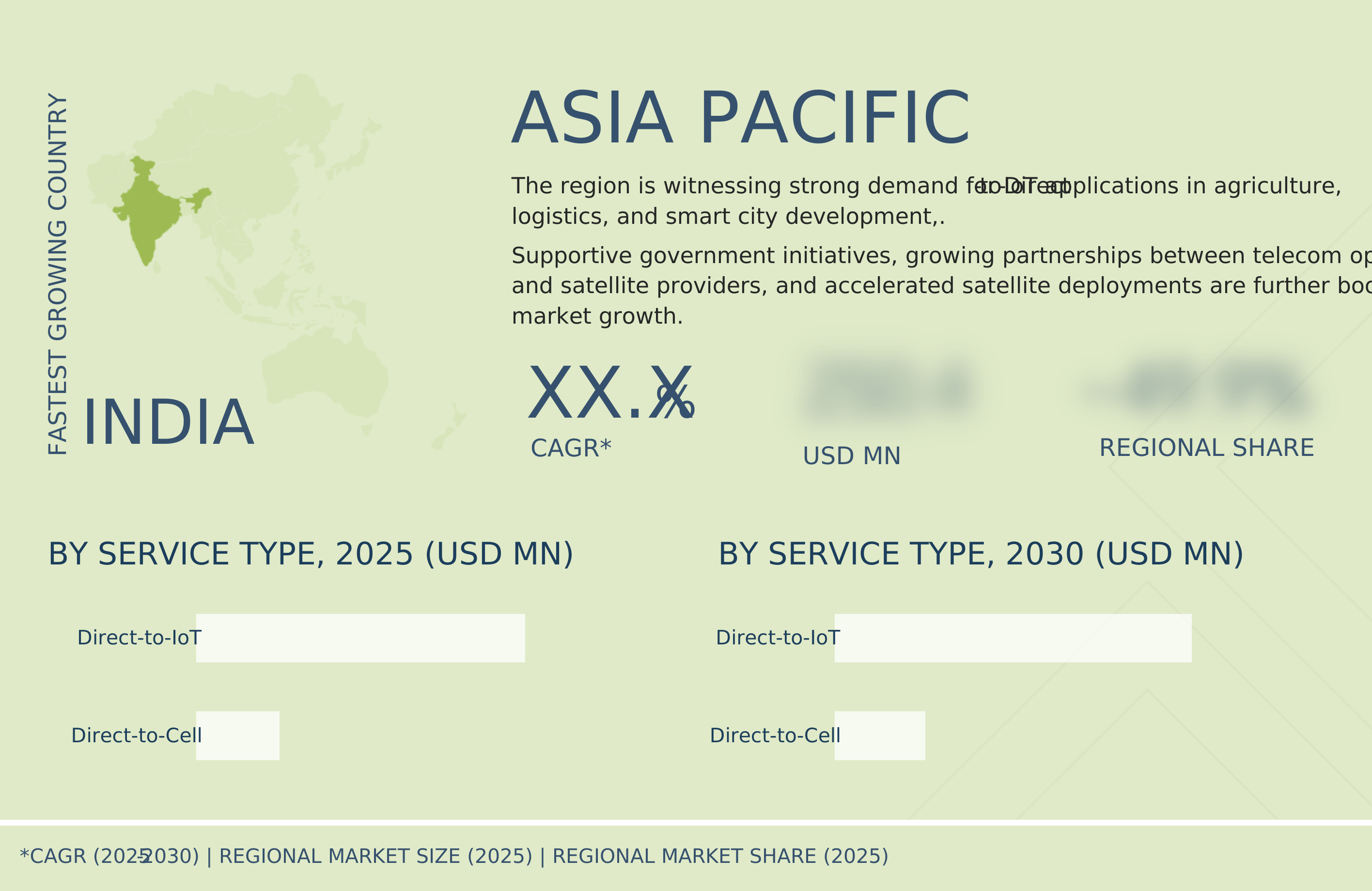
Asia Pacific is projected to be the second fastest-growing region in the global Direct-to-Device (D2D) market during the forecast period, driven by its vast population, rapid digital adoption, and expanding mobile subscriber base. The region is witnessing strong demand for Direct-to-IoT applications in agriculture, logistics, and smart city development, alongside rising consumer adoption of Direct-to-Cell services for emergency connectivity.

Direct-to-Device (D2D) Market: COMPANY EVALUATION MATRIX

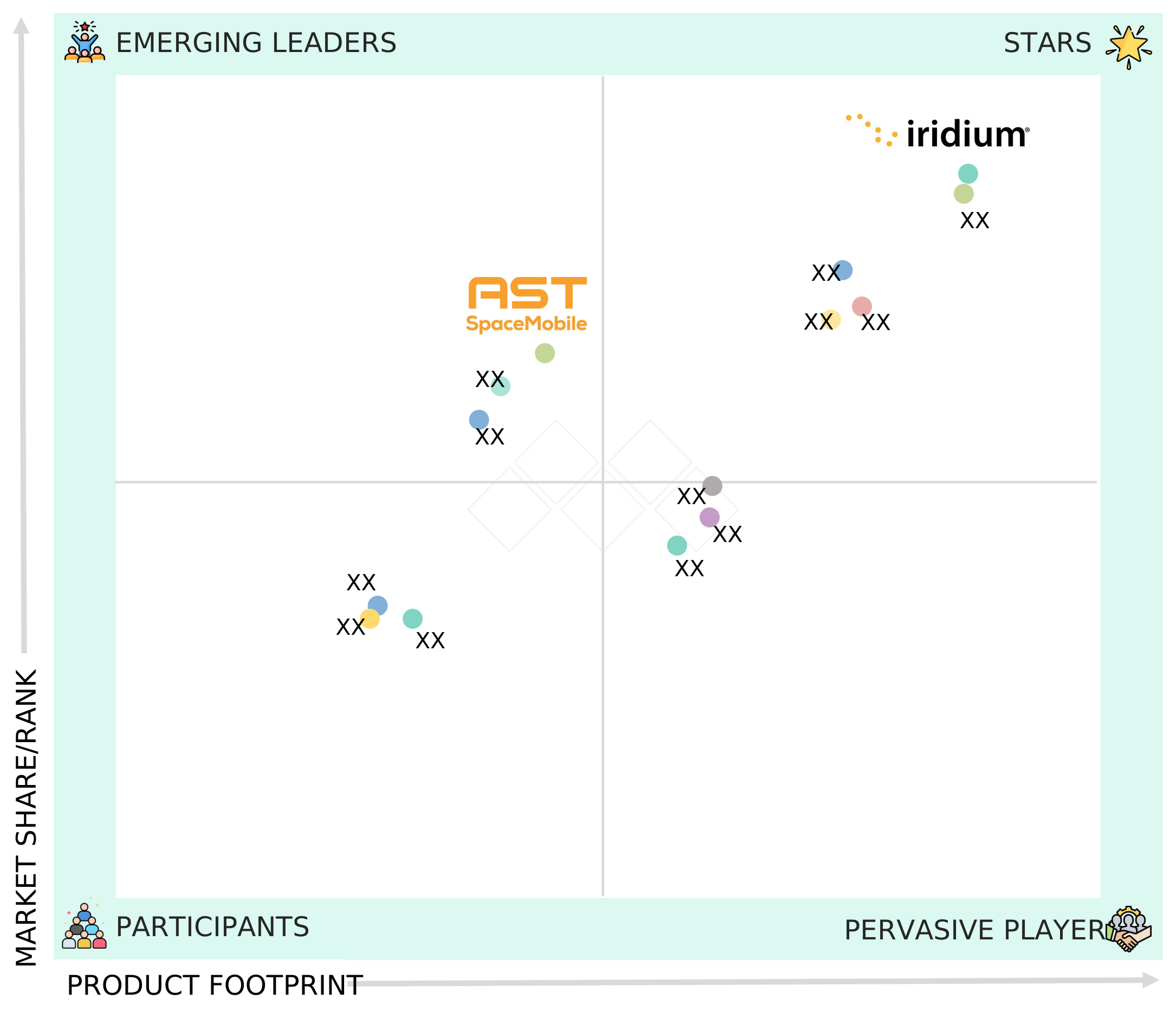
The company evaluation matrix for Direct-to-Device (D2D) market evaluates players based on product footprint and market share. It highlights their competitive positioning and ranks them according to market strength and growth strategies. Iridium Communications Inc. leads the Direct-to-device market with a strong service portfolio, advanced satellite technologies, and broad customer base, while AST Spacemobile is recognized as an emerging leader in this market.

Source: Secondary Research, Interviews with Experts, MarketsandMarkets Analysis

KEY MARKET PLAYERS

List of Top Direct-to-Device (D2D) Companies

MARKET SCOPE

REPORT METRIC DETAILS
Market Size in 2024 (Value) USD 0.46 BILLION
Market Forecast in 2030 (value) USD 2.64 BILLION
Growth Rate CAGR of 35.6% from 2025 to 2030
Years Considered 2021–2030
Base Year 2024
Forecast Period 2025–2030
Units Considered Value (USD Billion), Volume (Million Subscribers)
Report Coverage Revenue forecast, company ranking, competitive landscape, growth factors, and trends
Segments Covered • By Customer Type- Consumer, Enterprise Network, and Government & Defense • By Orbit- LEO, GEO, and Multi Orbit • By Service Type- Direct-to-IoT, and Direct-to-Cell • By Frequency- UHF/VHF-band, L-band, S-band • By Latency Class- L1 (<150Ms), L2 (150-600Ms), L3 (600Ms-10s), L4 (>10s)
Regions Covered North America, Europe, Asia Pacific, Middle East, and Rest of the World

WHAT IS IN IT FOR YOU: Direct-to-Device (D2D) Market REPORT CONTENT GUIDE

DELIVERED CUSTOMIZATIONS

We have successfully delivered the following deep-dive customizations:

CLIENT REQUEST CUSTOMIZATION DELIVERED VALUE ADDS
Leading Manufacturer Additional segment breakdown for countries Additional country-level market sizing tables for segments/sub-segments covered at the regional/global level to gain an understanding of market potential by each country
Emerging Leader Additional company profiles Competitive information on targeted players to gain granular insights on direct competition
Regional Market Leader Additional country market estimates Additional country-level deep dive for a more targeted understanding of the total addressable market

RECENT DEVELOPMENTS

  • November 2025 : Space42 (UAE) and Viasat (US) partnered to explore a shared, multi-tenant, multi-orbit 5G Non-Terrestrial Network (NTN) built on open, 3GPP-based architecture.
  • September 2025 : SpaceX (US) entered into a purchase agreement with EchoStar Corporation(US) for 50 MHz of exclusive S-band spectrum in the US as well as global Mobile Satellite Service (MSS) spectrum licenses.
  • September 2025 : EchoStar (US) agreed to sell its AWS-4 and H-block spectrum licenses to SpaceX (US) in Hawthorne, California, for about USD 17 billion.
  • June 2025 : Vi (India) and AST & Science, LLC (US) announced a strategic partnership to deliver direct-to-smartphone satellite mobile services across India.
  • December 2024 : Ukraine’s largest mobile operator, Kyivstar (Ukraine), partnered with SpaceX’s (US) Starlink to enhance national connectivity through satellite services.


Table of Contents

Exclusive indicates content/data unique to MarketsandMarkets and not available with any competitors.

TITLE
PAGE NO
1
INTRODUCTION


23
2
RESEARCH METHODOLOGY


27
3
EXECUTIVE SUMMARY


38
 
3.1
KEY INSIGHTS AND MARKET HIGHLIGHTS


3.2
TRENDS & DISRUPTIONS IMPACTING CUSTOMER BUSINESS


3.3
HIGH-GROWTH SEGMENTS & EMERGING FRONTIERS


3.4
SNAPSHOT: GLOBAL MARKET SIZE, GROWTH RATE, AND FORECAST


4
PREMIUM INSIGHTS


42
5
MARKET OVERVIEW
Rising IoT and satellite launches drive market growth amid regulatory and integration challenges.


45
 
5.1
INTRODUCTION


5.2
MARKET DYNAMICS


5.2.1
DRIVERS


5.2.1.1
Growing demand for emergency communication and disaster resilience


5.2.1.2
Proliferation of IoT and connected devices


5.2.1.3
Standardization of 3GPP NTN


5.2.1.4
Increase in number of satellite launches


5.2.2
RESTRAINTS


5.2.2.1
Spectrum and regulatory complexity


5.2.2.2
Ecosystem readiness and device integration



5.2.3
OPPORTUNITIES


5.2.3.1
Proliferation of IoT and industrial applications


5.2.3.2
Expansion of digital inclusion and rural connectivity


5.2.4
CHALLENGES


5.2.4.1
Latency and network integration challenges


5.2.4.2
High operational dependency on satellite launches
 
 
5.3
VALUE CHAIN ANALYSIS


5.3.1
SATELLITE NETWORK ACCESS


5.3.2
SERVICE CONNECTIVITY HARDWARE & INFRASTRUCTURE


5.3.3
NETWORK MANAGEMENT & CONTROL LAYER


5.3.4
COMMERCIAL SERVICE ENABLEMENT


5.3.5
SERVICE PRODUCTIZATION & CHANNEL DELIVERY


5.3.6
SERVICE DELIVERY INTERFACE


5.4
ECOSYSTEM ANALYSIS


5.4.1
SATELLITE SERVICE PROVIDERS (CORE SERVICE OPERATORS)


5.4.2
TELECOM/MNOS


5.4.3
GROUND SEGMENT & CLOUD SERVICE PROVIDERS


5.4.4
END USERS


5.5
REGULATORY LANDSCAPE


5.5.1
REGULATORY BODIES, GOVERNMENT AGENCIES, AND OTHER ORGANIZATIONS


5.5.2
REGULATORY FRAMEWORK


5.5.2.1
North America


5.5.2.2
Europe


5.5.2.3
Asia Pacific


5.5.2.4
Middle East


5.5.2.5
Latin America & Africa
 
 
5.6
KEY STAKEHOLDERS & BUYING CRITERIA


5.6.1
KEY STAKEHOLDERS IN BUYING PROCESS


5.6.2
BUYING CRITERIA


5.7
CASE STUDY ANALYSIS


5.7.1
APPLE INVESTED IN GLOBALSTAR TO UPGRADE GROUND STATIONS AND DEVELOP NEW GENERATION OF SATELLITES


5.7.2
LYNK GLOBAL IS DEVELOPING PROPRIETARY SATELLITE CONSTELLATION DESIGNED TO DELIVER DIRECT-TO-DEVICE SERVICES WITHOUT REQUIRING SPECIALIZED CHIPS


5.7.3
AST SPACEMOBILE DEMONSTRATED ITS SATELLITE-TO-PHONE SERVICE WITH AT&T TO TARGET MOBILITY MARKETS


5.8
KEY CONFERENCES & EVENTS, 2025–2026


5.9
PRICING ANALYSIS


5.9.1
INDICATIVE REVENUE PER USER, BY SERVICE TYPE


5.9.2
AVERAGE REVENUE TREND PER USER, BY REGION, 2021–2024


5.10
MARKET SCENARIO ANALYSIS


5.11
VOLUME DATA


5.12
MACROECONOMIC OUTLOOK


5.12.1
INTRODUCTION


5.12.2
NORTH AMERICA


5.12.3
EUROPE


5.12.4
ASIA PACIFIC


5.12.5
MIDDLE EAST


5.12.6
LATIN AMERICA


5.12.7
AFRICA


5.13
INVESTMENT & FUNDING SCENARIO


5.14
SPACEX: DETAILED ANALYSIS


5.14.1
REVENUE BREAKDOWN


5.14.2
OPERATIONAL SATELLITES


5.14.3
BUSINESS MODELS


5.14.4
SATELLITE SPECIFICATIONS


5.14.5
VALUATION AND GROWTH RATE


5.14.6
STARSHIP AND STARLINK V3 SPECIFICATIONS


5.14.7
DEVELOPMENTS AND PROJECTIONS


5.15
DIRECT-TO-DEVICE (D2D) MARKET: ADOPTION BARRIERS & INTERNAL CHALLENGES


5.16
TECHNOLOGY ANALYSIS


5.16.1
KEY TECHNOLOGIES


5.16.1.1
Multi-orbit architectures


5.16.1.2
Miniaturized and low-power chipsets


5.16.1.3
High-throughput satellites


5.16.2
COMPLEMENTARY TECHNOLOGIES


5.16.2.1
Phased array & beamforming


5.16.2.2
Software-defined payloads


5.16.3
ADJACENT TECHNOLOGIES


5.16.3.1
AI-driven network orchestration


5.16.3.2
Cloud-native edge integration
 
 
5.17
IMPACT OF MEGATRENDS


5.17.1
INTEGRATION OF SATELLITES INTO GLOBAL MOBILE ECOSYSTEM


5.17.2
SURGE IN PARTNERSHIPS BETWEEN SATELLITE OPERATORS AND MNOS


5.18
TECHNOLOGY ROADMAP


5.19
ADOPTION OF AI IN SPACE BY MAJOR COUNTRIES


5.20
IMPACT OF AI ON SPACE: USE CASES


5.21
IMPACT OF AI/GENERATIVE AI ON DIRECT-TO-DEVICE (D2D) MARKET


5.21.1
NETWORK OPTIMIZATION & TRAFFIC MANAGEMENT


5.21.2
SPECTRUM & INTERFERENCE MANAGEMENT


5.21.3
DYNAMIC BEAMFORMING & COVERAGE EXPANSION


5.21.4
INTELLIGENT DEVICE INTEGRATION & USER EXPERIENCE


5.21.5
SECURITY, FRAUD DETECTION, AND DATA PROTECTION


5.21.6
DISASTER RESPONSE & HUMANITARIAN CONNECTIVITY


5.21.7
SERVICE INNOVATION & NEW BUSINESS MODELS
 
 
6
DIRECT-TO-DEVICE (D2D) MARKET, BY SERVICE TYPE
Market Size & Growth Rate Forecast Analysis to 2030 in USD Million | 4 Data Tables


84
 
6.1
INTRODUCTION


6.2
DIRECT-TO-IOT


6.2.1
INCREASING INDUSTRIAL DIGITALIZATION AND REMOTE ASSET MONITORING TO DRIVE MARKET


6.2.2
LOW DATA VOLUME (KB/MB PER YEAR)


6.2.3
MEDIUM DATA VOLUME (KB/MB PER YEAR)


6.2.4
HIGH DATA VOLUME (KB/MB PER YEAR)


6.3
DIRECT-TO-CELL


6.3.1
INCREASING DEMAND FOR UNIVERSAL COVERAGE AND CONSUMER CONNECTIVITY TO DRIVE MARKET


6.3.2
VOICE


6.3.3
MESSAGING


6.3.4
DATA/INTERNET
 
 
7
DIRECT-TO-DEVICE (D2D) MARKET, BY CUSTOMER TYPE
Market Size & Growth Rate Forecast Analysis to 2030 in USD Million | 5 Data Tables


89
 
7.1
INTRODUCTION


7.2
CONSUMER


7.2.1
NEED FOR UNIVERSAL ACCESS AND RURAL CONNECTIVITY TO BOOST DEMAND


7.3
ENTERPRISE NETWORK


7.3.1
FOCUS ON OPERATIONAL EFFICIENCY AND DIGITAL TRANSFORMATION TO DRIVE DEMAND


7.3.2
BUSINESS CONNECTIVITY


7.3.3
INDUSTRIAL CONNECTIVITY


7.4
GOVERNMENT & DEFENSE


7.4.1
RESILIENCE AND SECURITY IN CRITICAL OPERATIONS TO BOOST DEMAND


7.4.2
EMERGENCY RESPONSE


7.4.3
MILITARY COMMUNICATION
 
 
8
DIRECT-TO-DEVICE (D2D) MARKET, BY FREQUENCY
Market Size & Growth Rate Forecast Analysis to 2030 in USD Million | 5 Data Tables


94
 
8.1
INTRODUCTION


8.2
VHF/UHF


8.2.1
WIDE COVERAGE AND PENETRATION OF VHF/UHF FREQUENCIES TO DRIVE DEMAND


8.3
L-BAND


8.3.1
PROVEN RELIABILITY AND DEVICE COMPATIBILITY OF L-BAND FREQUENCY TO DRIVE DEMAND


8.4
S-BAND


8.4.1
HIGH-CAPACITY SERVICES AND INTEGRATION WITH NTN STANDARDS TO DRIVE DEMAND
 
 
9
DIRECT-TO-DEVICE (D2D) MARKET, BY ORBIT
Market Size & Growth Rate Forecast Analysis to 2030 in USD Million | 4 Data Tables


98
 
9.1
INTRODUCTION


9.2
LEO


9.2.1
FOCUS ON LOW LATENCY AND SCALABILITY TO DRIVE DEMAND


9.3
GEO


9.3.1
DEMAND FOR WIDE COVERAGE AND ESTABLISHED INFRASTRUCTURE TO DRIVE MARKET


9.4
MULTI-ORBIT


9.4.1
FOCUS ON ELIMINATING REDUNDANCY AND SERVICE FLEXIBILITY TO DRIVE DEMAND
 
 
10
DIRECT-TO-DEVICE (D2D) MARKET, BY LATENCY CLASS
Market Size & Growth Rate Forecast Analysis to 2030 in USD Million | 2 Data Tables


102
 
10.1
INTRODUCTION


10.2
L1 (< 150 MS)


10.2.1
INCREASING REAL-TIME COMMUNICATION NEEDS TO DRIVE DEMAND


10.3
L2 (150–600 MS)


10.3.1
EMPHASIS ON SCALABLE IOT DEPLOYMENTS TO DRIVE DEMAND


10.4
L3 (600 MS–10 S)


10.4.1
NEED FOR NON-TIME-CRITICAL MONITORING TO DRIVE DEMAND


10.5
L4 (> 10 S)


10.5.1
ATTENTION TO BATCH DATA AND ULTRA-LOW-POWER USE NEED TO DRIVE DEMAND
 
 
11
DIRECT-TO-DEVICE (D2D) MARKET, BY REGION
Market Size & Growth Rate Forecast Analysis to 2030 in USD Million | 100 Data Tables


106
 
11.1
INTRODUCTION


11.2
NORTH AMERICA


11.2.1
US


11.2.1.1
Nationwide connectivity mandates and technology maturity to drive market


11.2.2
CANADA


11.2.2.1
Demand for increased geographic scale to drive market
 
 
11.3
EUROPE


11.3.1
UK


11.3.1.1
Regulatory momentum and operator innovation to drive market


11.3.2
GERMANY


11.3.2.1
Multi-orbit satellite synergies to drive market


11.3.3
FRANCE


11.3.3.1
Strategic investments and EU integration to drive market


11.3.4
SPAIN


11.3.4.1
Increasing investments in research and development to drive market


11.3.5
ITALY


11.3.5.1
Established space service ecosystem to drive market
 
 
11.4
ASIA PACIFIC


11.4.1
CHINA


11.4.1.1
State control and robust domestic technology ecosystem to drive market


11.4.2
INDIA


11.4.2.1
Need for scale of connectivity and cost efficiency to drive market


11.4.3
JAPAN


11.4.3.1
Focus on national security and emergency preparedness to drive market


11.4.4
AUSTRALIA


11.4.4.1
Need for subsidizing satellite broadband to drive market


11.4.5
SOUTH KOREA


11.4.5.1
Need for bridging connectivity gaps to drive market
 
 
11.5
MIDDLE EAST


11.5.1
GCC COUNTRIES


11.5.1.1
UAE


11.5.1.2
Saudi Arabia


11.5.2
REST OF MIDDLE EAST


11.6
REST OF THE WORLD


11.6.1
LATIN AMERICA


11.6.1.1
Growing need for connectivity to drive growth


11.6.2
AFRICA


11.6.2.1
Digital inclusion and remote sectoral growth to drive growth
 
12
COMPETITIVE LANDSCAPE
Deep-dive on Company Evaluation, Market Positioning, and Strategic Competitive Intelligence


142
 
12.1
INTRODUCTION


12.2
KEY PLAYER STRATEGIES/RIGHT TO WIN, 2020–2025


12.3
REVENUE ANALYSIS OF TOP FIVE PLAYERS, 2020–2024


12.4
MARKET SHARE ANALYSIS, 2024


12.5
COMPANY EVALUATION MATRIX: KEY PLAYERS, 2024


12.5.1
STARS


12.5.2
EMERGING LEADERS


12.5.3
PERVASIVE PLAYERS


12.5.4
PARTICIPANTS


12.5.5
COMPANY FOOTPRINT


12.5.5.1
Company footprint


12.5.5.2
Service type footprint


12.5.5.3
Customer type footprint


12.5.5.4
Orbit footprint


12.5.5.5
Region footprint
 
 
12.6
COMPANY EVALUATION MATRIX: STARTUPS/SMES, 2024


12.6.1
PROGRESSIVE COMPANIES


12.6.2
RESPONSIVE COMPANIES


12.6.3
DYNAMIC COMPANIES


12.6.4
STARTING BLOCKS


12.6.5
COMPETITIVE BENCHMARKING


12.6.5.1
Competitive benchmarking of startups/SMEs


12.6.5.2
List of startups/SMEs
 
 
12.7
BRAND/PRODUCT COMPARISON


12.8
COMPANY VALUATION AND FINANCIAL METRICS


12.9
COMPETITIVE SCENARIO


12.9.1
SERVICE LAUNCHES


12.9.2
DEALS


12.9.3
OTHER DEVELOPMENTS
 
 
13
COMPANY PROFILES
In-depth Company Profiles of Leading Market Players with detailed Business Overview, Product and Service Portfolio, Recent Developments, and Unique Analyst Perspective (MnM View)


173
 
13.1
KEY PLAYERS


13.1.1
IRIDIUM COMMUNICATIONS INC.


13.1.1.1
Business overview


13.1.1.2
Services offered


13.1.1.3
Recent developments


13.1.1.4
MnM view


13.1.2
GLOBALSTAR


13.1.3
VIASAT, INC.


13.1.4
ORBCOMM


13.1.5
SPACEX


13.1.6
ECHOSTAR CORPORATION


13.1.7
SATELIO IOT SERVICES, SL


13.1.8
OQ TECHNOLOGY


13.1.9
MYRIOTA


13.1.10
AST & SCIENCE, LLC


13.1.11
LYNK GLOBAL, INC.


13.1.12
ASTROCAST


13.1.13
SPACE42 PLC (SPACE42)


13.1.14
FLEET SPACE TECHNOLOGIES PTY LTD


13.1.15
KINÉIS


13.2
OTHER PLAYERS


13.2.1
FOSSA SYSTEMS S.L.


13.2.2
OMNISPACE, LLC


13.2.3
LACUNA SPACE LTD.


13.2.4
PLAN-S


13.2.5
APOGEO SPACE SRL.


13.2.6
HUBBLE NETWORKS


13.2.7
1NCE PTE LTD


13.2.8
TOTUM


13.2.9
TERRESTAR SOLUTIONS INC.


13.2.10
HELLO SPACE


13.3
MOBILE NETWORK OPERATORS (MNOS)


13.3.1
T-MOBILE USA, INC.


13.3.2
AT&T


13.3.3
TELEFONICA SA.


13.3.4
VERIZON


13.3.5
KDDI CORPORATION
 
 
14
APPENDIX


231
 
14.1
DISCUSSION GUIDE


14.2
COMPANY LONGLIST


14.3
KNOWLEDGESTORE: MARKETSANDMARKETS’ SUBSCRIPTION PORTAL


14.4
CUSTOMIZATION OPTIONS


14.5
RELATED REPORTS


14.6
AUTHOR DETAILS


LIST OF TABLES


TABLE 1
USD EXCHANGE RATES, 2019–2024


TABLE 2
COMPARISON BETWEEN DIFFERENT BUSINESS MODELS


TABLE 3
ROLE OF COMPANIES IN MARKET ECOSYSTEM


TABLE 4
NORTH AMERICA: REGULATORY BODIES, GOVERNMENT AGENCIES, AND OTHER ORGANIZATIONS


TABLE 5
EUROPE: REGULATORY BODIES, GOVERNMENT AGENCIES, AND OTHER ORGANIZATIONS


TABLE 6
ASIA PACIFIC: REGULATORY BODIES, GOVERNMENT AGENCIES, AND OTHER ORGANIZATIONS


TABLE 7
MIDDLE EAST: REGULATORY BODIES, GOVERNMENT AGENCIES, AND OTHER ORGANIZATIONS


TABLE 8
REST OF THE WORLD: REGULATORY BODIES, GOVERNMENT AGENCIES, AND OTHER ORGANIZATIONS


TABLE 9
INFLUENCE OF STAKEHOLDERS ON BUYING PROCESS, BY CUSTOMER TYPE (%)


TABLE 10
KEY BUYING CRITERIA, BY CUSTOMER TYPE


TABLE 11
KEY CONFERENCES & EVENTS, 2025–2026


TABLE 12
INDICATIVE REVENUE PER USER, BY SERVICE TYPE, 2024 (USD PER MONTH)


TABLE 13
AVERAGE REVENUE TREND, BY REGION, 2021–2024 (USD)


TABLE 14
DIRECT-TO-DEVICE (D2D) MARKET, VOLUME DATA, BY REGION (2025–2030)


TABLE 15
STARSHIP SPECIFICATIONS


TABLE 16
STARLINK V3 SPECIFICATIONS


TABLE 17
SPACEX: DEVELOPMENTS AND PROJECTIONS


TABLE 18
ADOPTION BARRIERS & INTERNAL CHALLENGES


TABLE 19
DIRECT-TO-DEVICE (D2D) MARKET, BY SERVICE TYPE, 2021–2024 (USD MILLION)


TABLE 20
DIRECT-TO-DEVICE (D2D) MARKET, BY SERVICE TYPE, 2025–2030 (USD MILLION)


TABLE 21
USE CASE: DIRECT-TO-IOT LEVERAGES 3GPP NB-IOT NTN STANDARDS, ENABLING EXISTING IOT DEVICES TO ROAM ONTO LEO CONSTELLATIONS WHEN TERRESTRIAL NETWORKS FAIL


TABLE 22
USE CASE: LYNK GLOBAL PARTNERED WITH GLOBE TELECOM TO EXTEND SATELLITE-TO-PHONE CONNECTIVITY IN PHILIPPINES


TABLE 23
DIRECT-TO-DEVICE (D2D) MARKET, BY CUSTOMER TYPE, 2021–2024 (USD MILLION)


TABLE 24
DIRECT-TO-DEVICE (D2D) MARKET, BY CUSTOMER TYPE, 2025–2030 (USD MILLION)


TABLE 25
USE CASE: APPLE DEMONSTRATED DIRECT-TO-CELL FOR CONSUMER SAFETY


TABLE 26
USE CASE: TELEFÓNICA PARTNERED WITH SATELIOT FOR CONTINUOUS IOT TRACKING IN AGRICULTURE & LOGISTICS


TABLE 27
USE CASE: GOVERNMENTS AND DEFENSE AGENCIES COMBINE D2C SERVICES FOR PUBLIC SAFETY AND EMERGENCY RESPONSE WITH X-BAND SATELLITE CONNECTIVITY FOR SECURE DEFENSE OPERATIONS


TABLE 28
DIRECT-TO-DEVICE (D2D) MARKET, BY FREQUENCY, 2021–2024 (USD MILLION)


TABLE 29
DIRECT-TO-DEVICE (D2D) MARKET, BY FREQUENCY, 2025–2030 (USD MILLION)


TABLE 30
USE CASE: MYRIOTA AND LACUNA SPACE DEPLOYED DIRECT-TO-SATELLITE IOT SOLUTIONS USING VHF/UHF BANDS


TABLE 31
USE CASE: APPLE’S EMERGENCY SOS FEATURE, IN PARTNERSHIP WITH GLOBALSTAR, ENABLED STANDARD IPHONES TO TRANSMIT EMERGENCY MESSAGES DIRECTLY VIA GLOBALSTAR’S L/S-BAND LEO SATELLITES


TABLE 32
USE CASE: TELEFÓNICA, IN COLLABORATION WITH SATELIOT, ENABLED EXISTING NB-IOT DEVICES TO ROAM ONTO SATELIOT’S S-BAND LEO CONSTELLATION AUTOMATICALLY


TABLE 33
DIRECT-TO-DEVICE (D2D) MARKET, BY ORBIT, 2021–2024 (USD MILLION)


TABLE 34
DIRECT-TO-DEVICE (D2D) MARKET, BY ORBIT, 2025–2030 (USD MILLION)


TABLE 35
USE CASE: LEO SATELLITES ENABLED D2CELL SERVICES BY DIRECTLY CONNECTING STANDARD, UNMODIFIED SMARTPHONES TO SATELLITE NETWORK


TABLE 36
USE CASE: GEO SATELLITES DELIVERED NEAR-REAL-TIME D2IOT SERVICES USING L-BAND M2M SOLUTIONS


TABLE 37
DIRECT-TO-DEVICE (D2D) MARKET, BY LATENCY CLASS, 2021–2024 (USD MILLION)


TABLE 38
DIRECT-TO-DEVICE (D2D) MARKET, BY LATENCY CLASS, 2025–2030 (USD MILLION)


TABLE 39
DIRECT-TO-DEVICE (D2D) MARKET, BY REGION, 2021–2024 (USD MILLION)


TABLE 40
DIRECT-TO-DEVICE (D2D) MARKET, BY REGION, 2025–2030 (USD MILLION)


TABLE 41
NORTH AMERICA: DIRECT-TO-DEVICE (D2D) MARKET, BY COUNTRY, 2021–2024 (USD MILLION)


TABLE 42
NORTH AMERICA: DIRECT-TO-DEVICE (D2D) MARKET, BY COUNTRY, 2025–2030 (USD MILLION)


TABLE 43
NORTH AMERICA: DIRECT-TO-DEVICE (D2D) MARKET, BY CUSTOMER TYPE, 2021–2024 (USD MILLION)


TABLE 44
NORTH AMERICA: DIRECT-TO-DEVICE (D2D) MARKET, BY CUSTOMER TYPE, 2025–2030 (USD MILLION)


TABLE 45
NORTH AMERICA: DIRECT-TO-DEVICE (D2D) MARKET, BY SERVICE TYPE, 2021–2024 (USD MILLION)


TABLE 46
NORTH AMERICA: DIRECT-TO-DEVICE (D2D) MARKET, BY SERVICE TYPE, 2025–2030 (USD MILLION)


TABLE 47
US: DIRECT-TO-DEVICE (D2D) MARKET, BY CUSTOMER TYPE, 2021–2024 (USD MILLION)


TABLE 48
US: DIRECT-TO-DEVICE (D2D) MARKET, BY CUSTOMER TYPE, 2025–2030 (USD MILLION)


TABLE 49
US: DIRECT-TO-DEVICE (D2D) MARKET, BY SERVICE TYPE, 2021–2024 (USD MILLION)


TABLE 50
US: DIRECT-TO-DEVICE (D2D) MARKET, BY SERVICE TYPE, 2025–2030 (USD MILLION)


TABLE 51
CANADA: DIRECT-TO-DEVICE (D2D) MARKET, BY CUSTOMER TYPE, 2021–2024 (USD MILLION)


TABLE 52
CANADA: DIRECT-TO-DEVICE (D2D) MARKET, BY CUSTOMER TYPE, 2025–2030 (USD MILLION)


TABLE 53
CANADA: DIRECT-TO-DEVICE (D2D) MARKET, BY SERVICE TYPE, 2021–2024 (USD MILLION)


TABLE 54
CANADA: DIRECT-TO-DEVICE (D2D) MARKET, BY SERVICE TYPE, 2025–2030 (USD MILLION)


TABLE 55
EUROPE: DIRECT-TO-DEVICE (D2D) MARKET, BY COUNTRY, 2021–2024 (USD MILLION)


TABLE 56
EUROPE: DIRECT-TO-DEVICE (D2D) MARKET, BY COUNTRY, 2025–2030 (USD MILLION)


TABLE 57
EUROPE: DIRECT-TO-DEVICE (D2D) MARKET, BY CUSTOMER TYPE, 2021–2024 (USD MILLION)


TABLE 58
EUROPE: DIRECT-TO-DEVICE (D2D) MARKET, BY CUSTOMER TYPE, 2025–2030 (USD MILLION)


TABLE 59
EUROPE: DIRECT-TO-DEVICE (D2D) MARKET, BY SERVICE TYPE, 2021–2024 (USD MILLION)


TABLE 60
EUROPE: DIRECT-TO-DEVICE (D2D) MARKET, BY SERVICE TYPE, 2025–2030 (USD MILLION)


TABLE 61
UK: DIRECT-TO-DEVICE (D2D) MARKET, BY CUSTOMER TYPE, 2021–2024 (USD MILLION)


TABLE 62
UK: DIRECT-TO-DEVICE (D2D) MARKET, BY CUSTOMER TYPE, 2025–2030 (USD MILLION)


TABLE 63
UK: DIRECT-TO-DEVICE (D2D) MARKET, BY SERVICE TYPE, 2021–2024 (USD MILLION)


TABLE 64
UK: DIRECT-TO-DEVICE (D2D) MARKET, BY SERVICE TYPE, 2025–2030 (USD MILLION)


TABLE 65
GERMANY: DIRECT-TO-DEVICE (D2D) MARKET, BY CUSTOMER TYPE, 2021–2024 (USD MILLION)


TABLE 66
GERMANY: DIRECT-TO-DEVICE (D2D) MARKET, BY CUSTOMER TYPE, 2025–2030 (USD MILLION)


TABLE 67
GERMANY: DIRECT-TO-DEVICE (D2D) MARKET, BY SERVICE TYPE, 2021–2024 (USD MILLION)


TABLE 68
GERMANY: DIRECT-TO-DEVICE (D2D) MARKET, BY SERVICE TYPE, 2025–2030 (USD MILLION)


TABLE 69
FRANCE: DIRECT-TO-DEVICE (D2D) MARKET, BY CUSTOMER TYPE, 2021–2024 (USD MILLION)


TABLE 70
FRANCE: DIRECT-TO-DEVICE (D2D) MARKET, BY CUSTOMER TYPE, 2025–2030 (USD MILLION)


TABLE 71
FRANCE: DIRECT-TO-DEVICE (D2D) MARKET, BY SERVICE TYPE, 2021–2024 (USD MILLION)


TABLE 72
FRANCE: DIRECT-TO-DEVICE (D2D) MARKET, BY SERVICE TYPE, 2025–2030 (USD MILLION)


TABLE 73
SPAIN: DIRECT-TO-DEVICE (D2D) MARKET, BY CUSTOMER TYPE, 2021–2024 (USD MILLION)


TABLE 74
SPAIN: DIRECT-TO-DEVICE (D2D) MARKET, BY CUSTOMER TYPE, 2025–2030 (USD MILLION)


TABLE 75
SPAIN: DIRECT-TO-DEVICE (D2D) MARKET, BY SERVICE TYPE, 2021–2024 (USD MILLION)


TABLE 76
SPAIN: DIRECT-TO-DEVICE (D2D) MARKET, BY SERVICE TYPE, 2025–2030 (USD MILLION)


TABLE 77
ITALY: DIRECT-TO-DEVICE (D2D) MARKET, BY CUSTOMER TYPE, 2021–2024 (USD MILLION)


TABLE 78
ITALY: DIRECT-TO-DEVICE (D2D) MARKET, BY CUSTOMER TYPE, 2025–2030 (USD MILLION)


TABLE 79
ITALY: DIRECT-TO-DEVICE (D2D) MARKET, BY SERVICE TYPE, 2021–2024 (USD MILLION)


TABLE 80
ITALY: DIRECT-TO-DEVICE (D2D) MARKET, BY SERVICE TYPE, 2025–2030 (USD MILLION)


TABLE 81
ASIA PACIFIC: DIRECT-TO-DEVICE (D2D) MARKET, BY COUNTRY, 2021–2024 (USD MILLION)


TABLE 82
ASIA PACIFIC: DIRECT-TO-DEVICE (D2D) MARKET, BY COUNTRY, 2025–2030 (USD MILLION)


TABLE 83
ASIA PACIFIC: DIRECT-TO-DEVICE (D2D) MARKET, BY CUSTOMER TYPE, 2021–2024 (USD MILLION)


TABLE 84
ASIA PACIFIC: DIRECT-TO-DEVICE (D2D) MARKET, BY CUSTOMER TYPE, 2025–2030 (USD MILLION)


TABLE 85
ASIA PACIFIC: DIRECT-TO-DEVICE (D2D) MARKET, BY SERVICE TYPE, 2021–2024 (USD MILLION)


TABLE 86
ASIA PACIFIC: DIRECT-TO-DEVICE (D2D) MARKET, BY SERVICE TYPE, 2025–2030 (USD MILLION)


TABLE 87
CHINA: DIRECT-TO-DEVICE (D2D) MARKET, BY CUSTOMER TYPE, 2021–2024 (USD MILLION)


TABLE 88
CHINA: DIRECT-TO-DEVICE (D2D) MARKET, BY CUSTOMER TYPE, 2025–2030 (USD MILLION)


TABLE 89
CHINA: DIRECT-TO-DEVICE (D2D) MARKET, BY SERVICE TYPE, 2021–2024 (USD MILLION)


TABLE 90
CHINA: DIRECT-TO-DEVICE (D2D) MARKET, BY SERVICE TYPE, 2025–2030 (USD MILLION)


TABLE 91
INDIA: DIRECT-TO-DEVICE (D2D) MARKET, BY CUSTOMER TYPE, 2021–2024 (USD MILLION)


TABLE 92
INDIA: DIRECT-TO-DEVICE (D2D) MARKET, BY CUSTOMER TYPE, 2025–2030 (USD MILLION)


TABLE 93
INDIA: DIRECT-TO-DEVICE (D2D) MARKET, BY SERVICE TYPE, 2021–2024 (USD MILLION)


TABLE 94
INDIA: DIRECT-TO-DEVICE (D2D) MARKET, BY SERVICE TYPE, 2025–2030 (USD MILLION)


TABLE 95
JAPAN: DIRECT-TO-DEVICE (D2D) MARKET, BY CUSTOMER TYPE, 2021–2024 (USD MILLION)


TABLE 96
JAPAN: DIRECT-TO-DEVICE (D2D) MARKET, BY CUSTOMER TYPE, 2025–2030 (USD MILLION)


TABLE 97
JAPAN: DIRECT-TO-DEVICE (D2D) MARKET, BY SERVICE TYPE, 2021–2024 (USD MILLION)


TABLE 98
JAPAN: DIRECT-TO-DEVICE (D2D) MARKET, BY SERVICE TYPE, 2025–2030 (USD MILLION)


TABLE 99
AUSTRALIA: DIRECT-TO-DEVICE (D2D) MARKET, BY CUSTOMER TYPE, 2021–2024 (USD MILLION)


TABLE 100
AUSTRALIA: DIRECT-TO-DEVICE (D2D) MARKET, BY CUSTOMER TYPE, 2025–2030 (USD MILLION)


TABLE 101
AUSTRALIA: DIRECT-TO-DEVICE (D2D) MARKET, BY SERVICE TYPE, 2021–2024 (USD MILLION)


TABLE 102
AUSTRALIA: DIRECT-TO-DEVICE (D2D) MARKET, BY SERVICE TYPE, 2025–2030 (USD MILLION)


TABLE 103
SOUTH KOREA: DIRECT-TO-DEVICE (D2D) MARKET, BY CUSTOMER TYPE, 2021–2024 (USD MILLION)


TABLE 104
SOUTH KOREA: DIRECT-TO-DEVICE (D2D) MARKET, BY CUSTOMER TYPE, 2025–2030 (USD MILLION)


TABLE 105
SOUTH KOREA: DIRECT-TO-DEVICE (D2D) MARKET, BY SERVICE TYPE, 2021–2024 (USD MILLION)


TABLE 106
SOUTH KOREA: DIRECT-TO-DEVICE (D2D) MARKET, BY SERVICE TYPE, 2025–2030 (USD MILLION)


TABLE 107
MIDDLE EAST: DIRECT-TO-DEVICE (D2D) MARKET, BY COUNTRY/REGION, 2021–2024 (USD MILLION)


TABLE 108
MIDDLE EAST: DIRECT-TO-DEVICE (D2D) MARKET, BY COUNTRY/REGION, 2025–2030 (USD MILLION)


TABLE 109
MIDDLE EAST: DIRECT-TO-DEVICE (D2D) MARKET, BY CUSTOMER TYPE, 2021–2024 (USD MILLION)


TABLE 110
MIDDLE EAST: DIRECT-TO-DEVICE (D2D) MARKET, BY CUSTOMER TYPE, 2025–2030 (USD MILLION)


TABLE 111
MIDDLE EAST: DIRECT-TO-DEVICE (D2D) MARKET, BY SERVICE TYPE, 2021–2024 (USD MILLION)


TABLE 112
MIDDLE EAST: DIRECT-TO-DEVICE (D2D) MARKET, BY SERVICE TYPE, 2025–2030 (USD MILLION)


TABLE 113
UAE: DIRECT-TO-DEVICE (D2D) MARKET, BY CUSTOMER TYPE, 2021–2024 (USD MILLION)


TABLE 114
UAE: DIRECT-TO-DEVICE (D2D) MARKET, BY CUSTOMER TYPE, 2025–2030 (USD MILLION)


TABLE 115
UAE: DIRECT-TO-DEVICE (D2D) MARKET, BY SERVICE TYPE, 2021–2024 (USD MILLION)


TABLE 116
UAE: DIRECT-TO-DEVICE (D2D) MARKET, BY SERVICE TYPE, 2025–2030 (USD MILLION)


TABLE 117
SAUDI ARABIA: DIRECT-TO-DEVICE (D2D) MARKET, BY CUSTOMER TYPE, 2021–2024 (USD MILLION)


TABLE 118
SAUDI ARABIA: DIRECT-TO-DEVICE (D2D) MARKET, BY CUSTOMER TYPE, 2025–2030 (USD MILLION)


TABLE 119
SAUDI ARABIA: DIRECT-TO-DEVICE (D2D) MARKET, BY SERVICE TYPE, 2021–2024 (USD MILLION)


TABLE 120
SAUDI ARABIA: DIRECT-TO-DEVICE (D2D) MARKET, BY SERVICE TYPE, 2025–2030 (USD MILLION)


TABLE 121
REST OF MIDDLE EAST: DIRECT-TO-DEVICE (D2D) MARKET, BY CUSTOMER TYPE, 2021–2024 (USD MILLION)


TABLE 122
REST OF MIDDLE EAST: DIRECT-TO-DEVICE (D2D) MARKET, BY CUSTOMER TYPE, 2025–2030 (USD MILLION)


TABLE 123
REST OF MIDDLE EAST: DIRECT-TO-DEVICE (D2D) MARKET, BY SERVICE TYPE, 2021–2024 (USD MILLION)


TABLE 124
REST OF MIDDLE EAST: DIRECT-TO-DEVICE (D2D) MARKET, BY SERVICE TYPE, 2025–2030 (USD MILLION)


TABLE 125
REST OF THE WORLD: DIRECT-TO-DEVICE (D2D) MARKET, BY REGION, 2021–2024 (USD MILLION)


TABLE 126
REST OF THE WORLD: DIRECT-TO-DEVICE (D2D) MARKET, BY REGION, 2025–2030 (USD MILLION)


TABLE 127
REST OF THE WORLD: DIRECT-TO-DEVICE (D2D) MARKET, BY CUSTOMER TYPE, 2021–2024 (USD MILLION)


TABLE 128
REST OF THE WORLD: DIRECT-TO-DEVICE (D2D) MARKET, BY CUSTOMER TYPE, 2025–2030 (USD MILLION)


TABLE 129
REST OF THE WORLD: DIRECT-TO-DEVICE (D2D) MARKET, BY SERVICE TYPE, 2021–2024 (USD MILLION)


TABLE 130
REST OF THE WORLD: DIRECT-TO-DEVICE (D2D) MARKET, BY SERVICE TYPE, 2025–2030 (USD MILLION)


TABLE 131
LATIN AMERICA: DIRECT-TO-DEVICE (D2D) MARKET, BY CUSTOMER TYPE, 2021–2024 (USD MILLION)


TABLE 132
LATIN AMERICA: DIRECT-TO-DEVICE (D2D) MARKET, BY CUSTOMER TYPE, 2025–2030 (USD MILLION)


TABLE 133
LATIN AMERICA: DIRECT-TO-DEVICE (D2D) MARKET, BY SERVICE TYPE, 2021–2024 (USD MILLION)


TABLE 134
LATIN AMERICA: DIRECT-TO-DEVICE (D2D) MARKET, BY SERVICE TYPE, 2025–2030 (USD MILLION)


TABLE 135
AFRICA: DIRECT-TO-DEVICE (D2D) MARKET, BY CUSTOMER TYPE, 2021–2024 (USD MILLION)


TABLE 136
AFRICA: DIRECT-TO-DEVICE (D2D) MARKET, BY CUSTOMER TYPE, 2025–2030 (USD MILLION)


TABLE 137
AFRICA: DIRECT-TO-DEVICE (D2D) MARKET, BY SERVICE TYPE, 2021–2024 (USD MILLION)


TABLE 138
AFRICA: DIRECT-TO-DEVICE (D2D) MARKET, BY SERVICE TYPE, 2025–2030 (USD MILLION)


TABLE 139
KEY PLAYER STRATEGIES/RIGHT TO WIN, 2020–2025


TABLE 140
DIRECT-TO-DEVICE (D2D) MARKET: DEGREE OF COMPETITION


TABLE 141
SERVICE TYPE FOOTPRINT


TABLE 142
CUSTOMER TYPE FOOTPRINT


TABLE 143
ORBIT FOOTPRINT


TABLE 144
REGION FOOTPRINT


TABLE 145
COMPETITIVE BENCHMARKING OF STARTUPS/SMES


TABLE 146
LIST OF STARTUPS/SMES


TABLE 147
DIRECT-TO-DEVICE (D2D) MARKET: SERVICE LAUNCHES, OCTOBER 2020–SEPTEMBER 2025


TABLE 148
DIRECT-TO-DEVICE (D2D) MARKET: DEALS, OCTOBER 2020–SEPTEMBER 2025


TABLE 149
DIRECT-TO-DEVICE (D2D) MARKET: OTHER DEVELOPMENTS, OCTOBER 2020–SEPTEMBER 2025


TABLE 150
IRIDIUM COMMUNICATIONS INC.: COMPANY OVERVIEW


TABLE 151
IRIDIUM COMMUNICATIONS INC.: SERVICES OFFERED


TABLE 152
IRIDIUM COMMUNICATIONS INC.: DEALS


TABLE 153
GLOBALSTAR: COMPANY OVERVIEW


TABLE 154
GLOBALSTAR: SERVICES OFFERED


TABLE 155
GLOBALSTAR: DEALS


TABLE 156
VIASAT, INC.: COMPANY OVERVIEW


TABLE 157
VIASAT, INC.: SERVICES OFFERED


TABLE 158
VIASAT, INC.: SERVICE LAUNCHES


TABLE 159
VIASAT, INC.: DEALS


TABLE 160
VIASAT, INC.: OTHER DEVELOPMENTS


TABLE 161
ORBCOMM: COMPANY OVERVIEW


TABLE 162
ORBCOMM: SERVICES OFFERED


TABLE 163
ORBCOMM: DEALS


TABLE 164
SPACEX: COMPANY OVERVIEW


TABLE 165
SPACEX: SERVICES OFFERED


TABLE 166
SPACEX: SERVICE LAUNCHES


TABLE 167
SPACEX: DEALS


TABLE 168
ECHOSTAR CORPORATION: COMPANY OVERVIEW


TABLE 169
ECHOSTAR CORPORATION: SERVICES OFFERED


TABLE 170
ECHOSTAR CORPORATION: DEALS


TABLE 171
ECHOSTAR CORPORATION: OTHER DEVELOPMENTS


TABLE 172
SATELIO IOT SERVICES, SL: COMPANY OVERVIEW


TABLE 173
SATELIO IOT SERVICES, SL: SERVICES OFFERED


TABLE 174
SATELIO IOT SERVICES, SL: DEALS


TABLE 175
OQ TECHNOLOGY: COMPANY OVERVIEW


TABLE 176
OQ TECHNOLOGY: SERVICES OFFERED


TABLE 177
OQ TECHNOLOGY: DEALS


TABLE 178
OQ TECHNOLOGY: OTHER DEVELOPMENTS


TABLE 179
MYRIOTA: COMPANY OVERVIEW


TABLE 180
MYRIOTA: SERVICES OFFERED


TABLE 181
MYRIOTA: DEALS


TABLE 182
MYRIOTA: OTHER DEVELOPMENTS


TABLE 183
AST & SCIENCE, LLC: COMPANY OVERVIEW


TABLE 184
AST & SCIENCE, LLC: SERVICES OFFERED


TABLE 185
AST & SCIENCE, LLC: DEALS


TABLE 186
LYNK GLOBAL, INC.: COMPANY OVERVIEW


TABLE 187
LYNK GLOBAL, INC.: SERVICES OFFERED


TABLE 188
LYNK GLOBAL, INC.: DEALS


TABLE 189
LYNK GLOBAL, INC.: OTHER DEVELOPMENTS


TABLE 190
ASTROCAST: COMPANY OVERVIEW


TABLE 191
ASTROCAST: SERVICES OFFERED


TABLE 192
ASTROCAST: DEALS


TABLE 193
ASTROCAST: OTHER DEVELOPMENTS


TABLE 194
SPACE42 PLC (SPACE42): COMPANY OVERVIEW


TABLE 195
SPACE42 PLC (SPACE42): SERVICES OFFERED


TABLE 196
SPACE42 PLC (SPACE42): DEALS


TABLE 197
FLEET SPACE TECHNOLOGIES PTY LTD: COMPANY OVERVIEW


TABLE 198
FLEET SPACE TECHNOLOGIES PTY LTD: SERVICES OFFERED


TABLE 199
FLEET SPACE TECHNOLOGIES PTY LTD: DEALS


TABLE 200
FLEET SPACE TECHNOLOGIES PTY LTD: OTHER DEVELOPMENTS


TABLE 201
KINÉIS: COMPANY OVERVIEW


TABLE 202
KINÉIS: SERVICES OFFERED


TABLE 203
KINÉIS: DEALS


TABLE 204
T-MOBILE USA, INC.: COMPANY OVERVIEW


TABLE 205
T-MOBILE USA, INC.: SERVICES OFFERED


TABLE 206
T-MOBILE USA, INC.: DEALS


TABLE 207
AT&T: COMPANY OVERVIEW


TABLE 208
AT&T: SERVICES OFFERED


TABLE 209
TELEFONICA SA: COMPANY OVERVIEW


TABLE 210
TELEFONICA SA: SERVICES OFFERED


TABLE 211
TELEFONICA SA: DEALS


TABLE 212
VERIZON: COMPANY OVERVIEW


TABLE 213
VERIZON: SERVICES OFFERED


TABLE 214
VERIZON: DEALS


TABLE 215
KDDI CORPORATION: COMPANY OVERVIEW


TABLE 216
KDDI CORPORATION: SERVICES OFFERED


TABLE 217
KDDI CORPORATION: DEALS


LIST OF FIGURES


FIGURE 1
RESEARCH DESIGN MODEL


FIGURE 2
RESEARCH DESIGN


FIGURE 3
BOTTOM-UP APPROACH


FIGURE 4
TOP-DOWN APPROACH


FIGURE 5
DATA TRIANGULATION


FIGURE 6
KEY INSIGHTS AND MARKET HIGHLIGHTS


FIGURE 7
TRENDS AND DISRUPTIONS IMPACTING CUSTOMER BUSINESS


FIGURE 8
MARKET SIZE OF DIRECT-TO-DEVICE SEGMENTS IN 2025


FIGURE 9
NORTH AMERICA TO REGISTER HIGHEST GROWTH DURING FORECAST PERIOD


FIGURE 10
DIRECT-TO-DEVICE (D2D) MARKET: BUSINESS MODELS


FIGURE 11
DIRECT-TO-DEVICE (D2D) MARKET: DRIVERS, RESTRAINTS, OPPORTUNITIES, AND CHALLENGES


FIGURE 12
VALUE CHAIN ANALYSIS


FIGURE 13
ECOSYSTEM ANALYSIS


FIGURE 14
INFLUENCE OF STAKEHOLDERS ON BUYING PROCESS, BY CUSTOMER TYPE


FIGURE 15
KEY BUYING CRITERIA, BY CUSTOMER TYPE


FIGURE 16
AVERAGE REVENUE TREND PER USER, BY REGION, 2021–2024 (USD)


FIGURE 17
SUBSCRIBER COUNT FOR DIRECT-TO-DEVICE SERVICES: MARKET PERSPECTIVE IN VARIOUS SCENARIOS, 2025–2030


FIGURE 18
INVESTMENT & FUNDING SCENARIO, 2021–2025


FIGURE 19
GLOBAL SPACE PRIVATE INVESTMENT, BY TYPE, 2020–2024 (USD MILLION)


FIGURE 20
SPACEX: REVENUE BREAKDOWN, BY SEGMENT, 2020–2024 (USD MILLION)


FIGURE 21
SPACEX: NUMBER OF OPERATIONAL SATELLITES, 2020–2030


FIGURE 22
SPACEX: V2 MINI SATELLITE SPECIFICATIONS


FIGURE 23
SPACEX: VALUATION AND GROWTH RATE, 2020–2025


FIGURE 24
EMERGING TECHNOLOGY TRENDS


FIGURE 25
EVOLUTION OF TECHNOLOGY, 2020–2040


FIGURE 26
ADOPTION OF AI IN SPACE BY MAJOR COUNTRIES


FIGURE 27
DIRECT-TO-DEVICE (D2D) MARKET: IMPACT OF AI/GEN AI


FIGURE 28
DIRECT-TO-DEVICE (D2D) MARKET, BY SERVICE TYPE, 2025 VS. 2030 (USD MILLION)


FIGURE 29
DIRECT-TO-DEVICE (D2D) MARKET, BY CUSTOMER TYPE, 2025 VS. 2030 (USD MILLION)


FIGURE 30
DIRECT-TO-DEVICE (D2D) MARKET, BY FREQUENCY, 2025 VS. 2030 (USD MILLION)


FIGURE 31
DIRECT-TO-DEVICE (D2D) MARKET, BY ORBIT, 2025 VS. 2030 (USD MILLION)


FIGURE 32
DIRECT-TO-DEVICE (D2D) MARKET, BY LATENCY CLASS, 2025 VS. 2030 (USD MILLION)


FIGURE 33
DIRECT-TO-DEVICE (D2D) MARKET: REGIONAL SNAPSHOT


FIGURE 34
NORTH AMERICA: DIRECT-TO-DEVICE (D2D) MARKET SNAPSHOT


FIGURE 35
EUROPE: DIRECT-TO-DEVICE (D2D) MARKET SNAPSHOT


FIGURE 36
ASIA PACIFIC: DIRECT-T-DEVICE (D2D) MARKET SNAPSHOT


FIGURE 37
MIDDLE EAST: DIRECT-TO-DEVICE (D2D) MARKET SNAPSHOT


FIGURE 38
REST OF THE WORLD: DIRECT-TO-DEVICE (D2D) MARKET SNAPSHOT


FIGURE 39
REVENUE ANALYSIS OF TOP FIVE PLAYERS, 2021–2024 (USD MILLION)


FIGURE 40
MARKET SHARE ANALYSIS OF KEY PLAYERS, 2024


FIGURE 41
DIRECT-TO-DEVICE (D2D) MARKET: COMPANY EVALUATION MATRIX (KEY PLAYERS), 2024


FIGURE 42
COMPANY FOOTPRINT


FIGURE 43
DIRECT-TO-DEVICE (D2D) MARKET: COMPANY EVALUATION MATRIX (STARTUPS/SMES), 2024


FIGURE 44
BRAND/PRODUCT COMPARISON


FIGURE 45
FINANCIAL METRICS OF PROMINENT MARKET PLAYERS, 2025


FIGURE 46
VALUATION OF PROMINENT MARKET PLAYERS, 2025


FIGURE 47
IRIDIUM COMMUNICATIONS INC.: COMPANY SNAPSHOT


FIGURE 48
GLOBALSTAR: COMPANY SNAPSHOT


FIGURE 49
VIASAT, INC.: COMPANY SNAPSHOT


FIGURE 50
ECHOSTAR CORPORATION: COMPANY SNAPSHOT


FIGURE 51
AST & SCIENCE, LLC: COMPANY SNAPSHOT


FIGURE 52
SPACE42 PLC (SPACE42): COMPANY SNAPSHOT


FIGURE 53
T-MOBILE USA, INC.: COMPANY SNAPSHOT


FIGURE 54
AT&T: COMPANY SNAPSHOT


FIGURE 55
TELEFONICA SA: COMPANY SNAPSHOT


FIGURE 56
VERIZON: COMPANY SNAPSHOT


FIGURE 57
KDDI CORPORATION: COMPANY SNAPSHOT


Methodology

This research study involves the use of extensive secondary sources, directories, and databases (e.g., Hoovers, Bloomberg Business, Factiva, and OneSource) to identify and collect information useful for this technical, market-oriented, and commercial study of the Direct-to-Device (D2D) market. Primary sources include several industry experts from the core and related industries and preferred suppliers, manufacturers, distributors, technology developers, IP vendors, standards, and organizations related to all the segments of this industry’s value chain. In-depth interviews have been conducted with various primary respondents, including key industry participants, subject matter experts (SMEs), C-level executives of key market players, and industry consultants to obtain and verify critical qualitative and quantitative information, as well as to assess the prospects.

Secondary Research

In the secondary research process, various secondary sources have been referred to for identifying and collecting information for this study. The secondary sources include annual reports, press releases, and investor presentations of companies; white papers, journals, and certified publications and articles from recognized authors; and websites, directories, and databases. Secondary research has mainly been used to obtain key information about the industry’s supply chain, the market’s value chain, major players, market classification, and segmentation according to the industry trends to the bottommost level, geographic markets, and key developments from both market- and technology-oriented perspectives. The secondary data has been collected and analyzed to arrive at the overall market size, which has further been validated by primary research.

Primary Research

Extensive primary research has been conducted after obtaining information about the current scenario of the Direct-to-Device (D2D) market through secondary research. Several primary interviews have been conducted with market experts from the demand and supply sides across North America, Europe, the Asia Pacific, the Middle East, and the Rest of the World. This primary data has been collected through questionnaires, emails, and telephonic interviews.
Direct-to-Device (D2D) Market
 Size, and Share

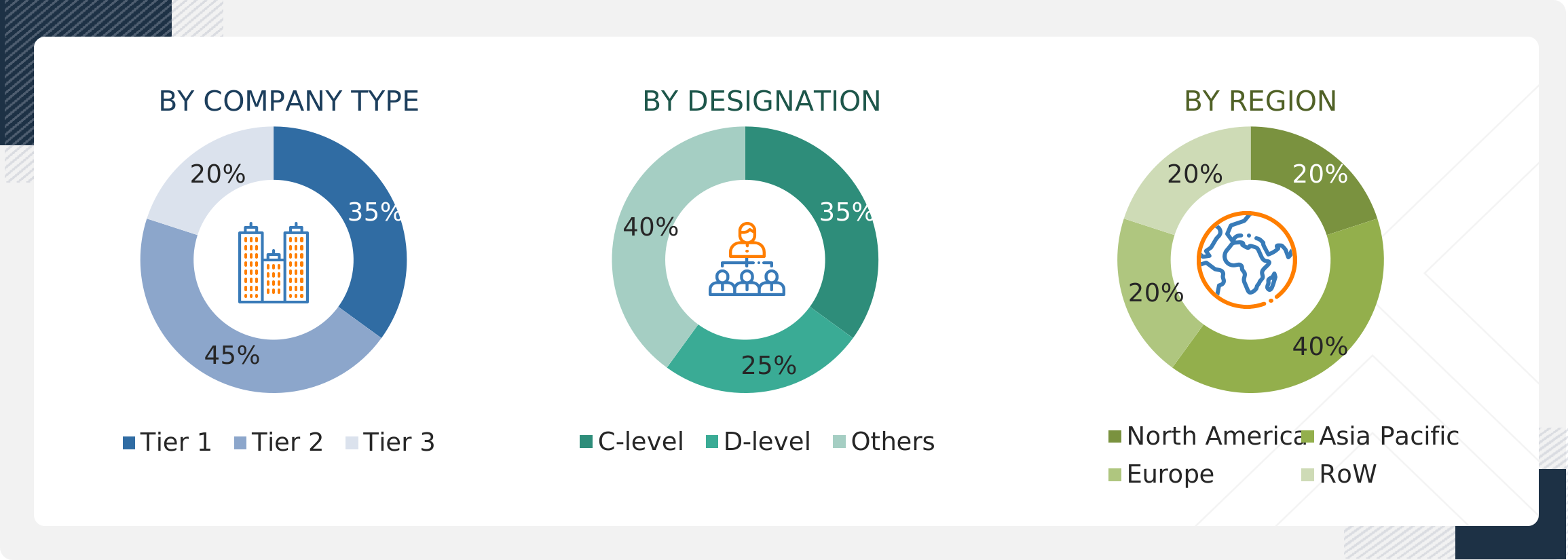
Note: Tiers of companies are based on their revenue in 2024. Tier 1: company revenue greater than USD 1 billion; Tier 2: company revenue between USD 100 million and USD 1 billion; and Tier 3: company revenue less than USD 100 million.

To know about the assumptions considered for the study, download the pdf brochure

Market Size Estimation

Both the top-down and bottom-up approaches have been used to estimate and validate the size of the D2D market.

The research methodology used to estimate the market size also includes the following details:

  • Key players in the market have been identified through secondary research, and their market ranking has been determined through primary and secondary research. This includes a study of annual and financial reports of the top market players and extensive interviews with industry experts who are knowledgeable about Direct-to-Device (D2D).
  • The top-down and bottom-up approaches have been used to estimate and validate the size of the global market and the dependent submarkets in the overall market.

Direct-to-Device (D2D) Market: Top-Down and Bottom-Up Approach
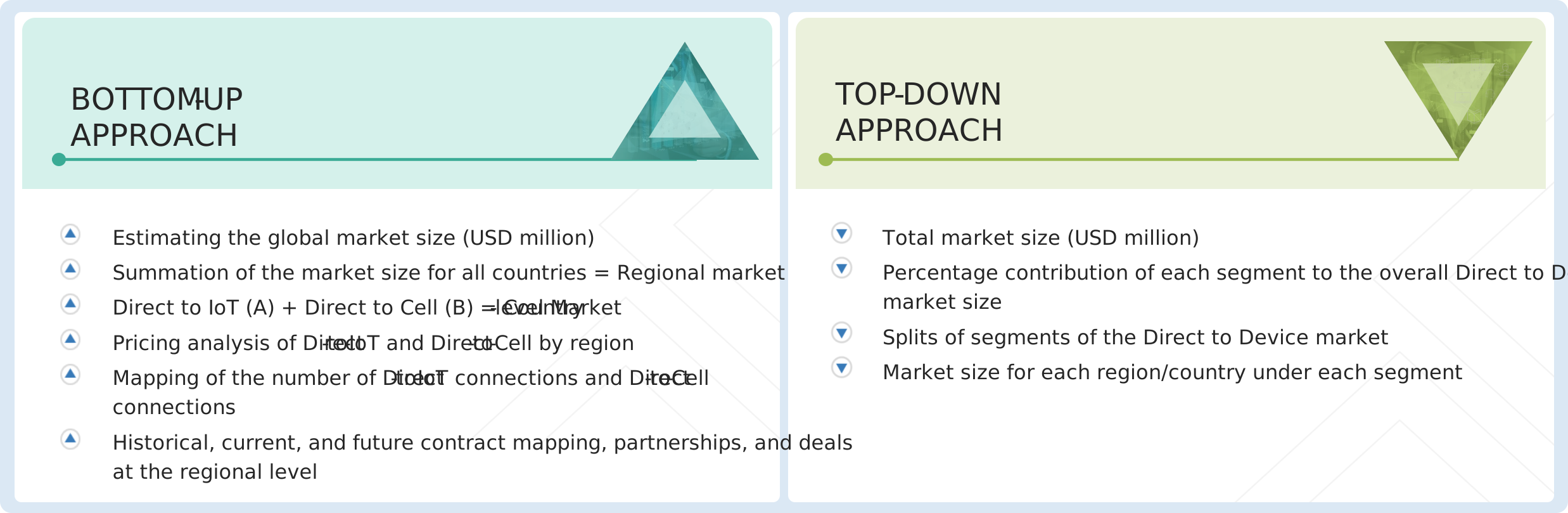
Direct-to-Device (D2D) Market Top Down and Bottom Up Approach

Data Triangulation

After arriving at the overall size of the Direct-to-Device (D2D) market from the estimation process explained above, the total market has been split into several segments and subsegments. The data triangulation and market breakdown procedures explained below have been implemented, wherever applicable, to complete the overall market engineering process and arrive at the exact statistics for various market segments and subsegments. The data has been triangulated by studying various factors and trends from the demand and supply sides. Along with this, the D2D market size has been validated using the top-down and bottom-up approaches.

Market Definition

The D2D market refers to satellite services that connect directly to end-user devices such as smartphones, sensors, and machines without relying on traditional fixed ground infrastructure. It covers three key segments: Direct-to-Cell, which provides voice, messaging, and data services directly to standard smartphones using satellite-enabled cellular bands; Direct-to-Broadband, which offers high-speed internet via compact user terminals; and Direct-to-IoT, which enables low-bandwidth data transfer for sensors, trackers, and machines using integrated or low-power satellite modules.

Key Stakeholders

  • Mobile Network Operators (MNOs)
  • Satellite Operators
  • Device Manufacturers (Handsets & IoT Devices)
  • Chipset & Technology Providers
  • Regulators & Government Agencies
  • Defense & Emergency Agencies
  • Enterprise & Industrial Users
  • Commercial Organizations
  • Research Institutions

Report Objectives

  • To define, describe, segment, and forecast the size of the Direct-to-Device (D2D) market based on service type, customer type, latency class, orbit, frequency, and region
  • To forecast sizes of various segments of the market with respect to major regions, namely, North America, Europe, the Asia Pacific, the Middle East, and the Rest of the World, along with major countries in each of these regions
  • To identify and analyze key drivers, restraints, opportunities, and challenges influencing the growth of the market across the globe
  • To identify industry trends, market trends, and technology trends that are currently prevailing in the market
  • To provide an overview of the regulatory landscape with respect to D2D regulations across regions
  • To analyze micro markets with respect to individual growth trends, prospects, and their contribution to the overall market
  • To analyze opportunities in the market for stakeholders by identifying key market trends
  • To profile key market players and comprehensively analyze their market shares and core competencies
  • To analyze the degree of competition in the market by identifying key growth strategies, such as acquisitions, product launches, contracts, and partnerships, adopted by leading market players
  • To identify detailed financial positions, key products, and unique selling points of leading companies in the market
  • To provide a detailed competitive landscape of the market, along with market ranking analysis, market share analysis, and revenue analysis of key players

Available customizations

Along with the market data, MarketsandMarkets offers customizations as per the specific needs of companies. The following customization options are available for the report:

Product Analysis

  • Product matrix, which gives a detailed comparison of the product portfolio of each company

Regional Analysis

  • Further breakdown of the market segments at the country level

Company Information

  • Detailed analysis and profiling of additional market players (up to 5)


Personalize This Research

  • Triangulate with your Own Data
  • Get Data as per your Format and Definition
  • Gain a Deeper Dive on a Specific Application, Geography, Customer or Competitor
  • Any level of Personalization
Request A Free Customisation

Let Us Help You

  • What are the Known and Unknown Adjacencies Impacting the Direct-to-Device (D2D) Market
  • What will your New Revenue Sources be?
  • Who will be your Top Customer; what will make them switch?
  • Defend your Market Share or Win Competitors
  • Get a Scorecard for Target Partners
Customized Workshop Request

Custom Market Research Services

We Will Customise The Research For You, In Case The Report Listed Above Does Not Meet With Your Requirements

Get 10% Free Customisation

Growth opportunities and latent adjacency in Direct-to-Device (D2D) Market

DMCA.com Protection Status