
South Korea Satellite Propellant Tanks Market (2026-2031)

The South Korea Satellite Propellant Tanks Market was valued at $1.3 Million in 2026 and projected to reach to $18.2 Million by 2031, representing a compound annual growth rate of 56.0%. South Korea's satellite propellant tanks market is poised for transformative growth driven by the nation's ambitious space exploration roadmap and commercial satellite sector expansion.


| Market Size in | USD 26.32 MN |
| Market Forecast in | |
| CAGR | |
| Forecast Period | |
| Units Considered | Value (USD MN) |
South Korea Satellite Propellant Tanks Market Trends and Insights
- This remarkable 56% compound annual growth rate reflects South Korea's strategic investments in space infrastructure and satellite manufacturing capabilities.
- South Korea's aerospace sector is increasingly focused on indigenous satellite development and launch systems, driving demand for advanced propellant tank solutions. The market expansion in South Korea is underpinned by government initiatives supporting space exploration and commercial satellite operations.
- South Korea's growing constellation of communication and Earth observation satellites necessitates reliable, high-performance propellant storage systems.
- Between 2026 and 2031, South Korea is expected to become a significant regional player in satellite propellant tank manufacturing and integration, supported by technological advancement and increased private sector participation in the space economy..
Key Market Statistics
- CAGR (2026-2031) 56.0% CAGR
- Market Size, 2026 ~USD 1.3 Million
- Forecast, 2031 ~USD 18.2 Million
- Country South Korea
South Korea Satellite Propellant Tanks Market Overview
Explosive Growth Trajectory :
South Korea's satellite propellant tanks market is projected to grow from $1.3 million in 2026 to $18.2 million by 2031, representing a 56% CAGR—nearly 6x the global average of 9.6%.
Indigenous Space Program Expansion :
South Korea's strategic focus on developing domestic satellite manufacturing and launch capabilities is driving unprecedented demand for advanced propellant tank technologies and indigenous supply chain development.
Government Investment Acceleration :
Increased government funding for the Korea Aerospace Research Institute (KARI) and commercial space ventures is accelerating infrastructure development and creating new opportunities for propellant tank manufacturers.
Regional Leadership Positioning :
South Korea is establishing itself as a key aerospace hub in Northeast Asia, with propellant tank technology becoming critical to competitive satellite constellation and deep-space exploration initiatives.
South Korea Satellite Propellant Tanks Market Dynamics
- Government initiatives supporting indigenous launch vehicle development and satellite manufacturing are creating sustained demand for high-performance propellant storage solutions.
- The 56% CAGR reflects both increased domestic consumption and emerging export opportunities as South Korean aerospace companies establish regional competitiveness. Looking ahead to 2031, market expansion will be fueled by next-generation satellite constellation projects, lunar exploration programs, and growing private sector participation in space ventures.
- Strategic partnerships between government agencies, research institutions, and commercial manufacturers will accelerate technology advancement and localization of propellant tank production, positioning South Korea as a critical player in the Asia-Pacific aerospace supply chain..
Market Ecosystem
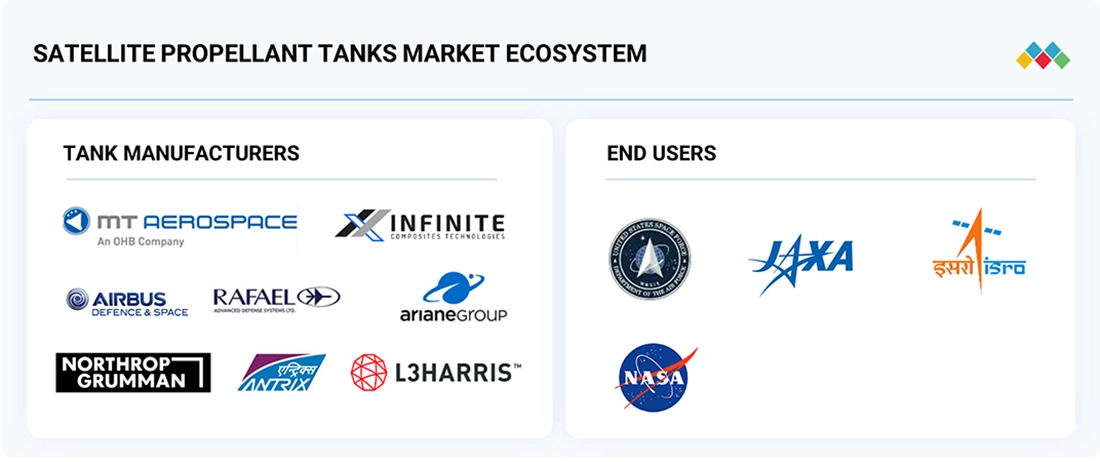
SATELLITE PROPELLANT TANKS MARKET: COMMERCIAL USE CASES ACROSS INDUSTRIES
| COMPANY | USE CASE DESCRIPTION | BENEFITS |
|---|---|---|
 |
Satellite operators with aging GEO assets require life extension solutions to maintain mission continuity without full satellite replacement. Northrop Grumman’s Mission Extension Vehicle (MEV) enables on-orbit servicing by docking with existing satellites and providing propulsion, attitude control, and station-keeping support using integrated propellant tank and pressure vessel systems. | Improves satellite lifespan without replacement, reduces capital expenditure, and enhances asset utilization. Supports reliable long-duration operations with high structural integrity, leak prevention, and thermal stability, ensuring mission continuity. |
 |
GEO satellite platforms require high-pressure propellant tanks capable of supporting long mission durations while maintaining structural integrity under thermal cycling and launch constraints. Airbus’ Eurostar platform integrates advanced metallic and composite tank configurations optimized for weight reduction and fatigue resistance. | Enhances mission life and operational reliability while reducing launch mass. Improves fuel efficiency and lifecycle durability, enabling sustained GEO operations and strengthening performance in long-duration satellite missions. |
 |
Large-scale LEO constellations require compact, lightweight, and cost-efficient propulsion tank systems that can be produced at high volumes. SpaceX’s Starlink program integrates krypton-based electric propulsion tanks designed for scalability and efficient mass production across thousands of satellites. | Enables high-volume manufacturing with reduced per-unit cost while maintaining safety and performance standards. Supports scalable constellation deployment, improves operational efficiency, and ensures consistent propulsion performance across large satellite fleets. |
Logos and trademarks shown above are the property of their respective owners. Their use here is for informational and illustrative purposes only.
Related Ecosystem
Space
- C-Band
- Small Satellite
- Antennas
- Ka-Band
- Microsatellite
- AIRBUS
- L3Harris Technologies, Inc.
- Thales group
- Northrop Grumman Corporation
- LOCKHEED MARTIN CORPORATION
Key Takeaways
- South Korea's satellite propellant tanks market will grow from $1.3M (2026) to $18.2M (2031), representing a 56% CAGR.
- South Korea's government-backed space programs and satellite constellation initiatives are primary growth catalysts for propellant tank demand.
- South Korea is positioning itself as a regional aerospace hub, with indigenous satellite manufacturing driving localized propellant tank production.
- South Korea's market growth significantly outpaces the global 9.6% CAGR, indicating accelerated regional space sector development.
Satellite Propellant Tanks Market Report Scope
| Report Metric | Details |
|---|---|
| Base Year | 2026 |
| Fastest Growing Segment | LARGE (>2,000 KG) (Satellite Mass) |
| Forecast Period | 2026–2031 |
| Growth Rate | CAGR of 9.6% from 2026 to 2031 |
| Largest Segment | SMALL (1–1,200 KG) (Satellite Mass) |
| Market Size Base Year (Billions) | ~USD 0.73 (2026) |
| Revenue Forecast (Billions) | ~USD 1.16 (2031) |
| Segments Covered | Architecture, Capacity, Satellite Mass, Material, Propellant Type, Type, Satellite Orbit |
South Korea Satellite Propellant Tanks Market Report Segmentation
7 segment dimensions are covered across the global market.
By Architecture
- High-Pressure Vessels
- Pmd Tanks
- Positive-Expulsion Tanks
By Capacity
- 101–250 L
- 251–500 L
- 501–1000 L
- 51–100 L
- 5–50 L
- <5 L
- >1,000 L
By Satellite Mass
- Large (>2,000 Kg)
- Medium (1,200–2,000 Kg)
- Medium (1,201–2,000 Kg)
- Small (1–1,200 Kg)
By Material
- Aluminium Alloys
- Aluminum Alloys
- Composite Materials
- Composite Overwrapped
- Other Materials
- Stainless Steel & Nickel Alloys
- Titanium Alloys
By Propellant Type
- Chemical Propellants
- Cold-Gas Propellants
- Electric Propellants
- Other Propellants
By Type
- Argon
- Green Monopropellants
- Htp
- Hydrazine
- Krypton
- Xenon
By Satellite Orbit
- Leo
- Meo & Geo
Target Audience
- South Korean Aerospace Manufacturers : Propellant tank producers and satellite manufacturers need market intelligence to optimize production capacity, identify supply chain gaps, and capitalize on government contracts and commercial opportunities.
- Government & Space Agencies : KARI, Ministry of Science and ICT, and related agencies require market data to inform space program budgeting, technology roadmaps, and policies supporting indigenous propellant tank development.
- International Aerospace Companies : Global manufacturers and suppliers seeking to enter or expand in South Korea's market need localized insights on regulatory requirements, competitive dynamics, and partnership opportunities.
- Private Space Venture Investors : Korean and international investors in commercial space startups need market forecasts and growth drivers to evaluate investment opportunities in satellite and launch vehicle propulsion systems.
- Materials & Component Suppliers : Suppliers of specialized materials, valves, and components for propellant tanks need demand forecasts and customer intelligence specific to South Korea's aerospace manufacturing ecosystem.
Key Companies in the South Korea Satellite Propellant Tanks Market
| Company | HQ | Ownership | Strongest segments |
|---|---|---|---|
| AIRBUS | United States | Public Company | Capacity: 101-250 L and 251-500 L tanks,Capacity: >500 L including >1000 L,Capacity: 5-100 L (5-50, 51-100 L), |
| NORTHROP GRUMMAN | United States | Public Company | <5 L capacity tanks,5–50 L capacity tanks,51–100 L capacity tanks, |
| L3HARRIS TECHNOLOGIES, INC. | United States | Public Company | <5 L capacity tanks,5-50 L capacity tanks,51-100 L capacity tanks, |
| MOOG INC. | United States | Public Company | Chemical propellant tanks (PMD and positive-expulsion, 51–500 L),Chemical propellant tanks (>500 L and >1000 L, GEO/HEO),Electric propulsion xenon/krypton tanks (5–250 L, HPV/PMD), |
| APPLIED AEROSPACE & DEFENSE | United States | Public Company | <5 L and 5-50 L tanks for smallsats and cubesats,51-250 L tanks for medium LEO/MEO platforms,251-1000 L tanks for launch vehicle stages and GEO-class buses, |
| EATON | Ireland | Public Company | <5 L tanks & micro-sat propulsion content,5–50 L tanks & content,51–100 L tanks & content, |
AIRBUS
Airbus is a major American aerospace company founded in 1998 with 166,876 employees. Operating as a public company, Airbus is one of the world's largest aircraft manufacturers and aerospace contractors.
NORTHROP GRUMMAN
Northrop Grumman is an American defense and aerospace company founded in 1939 with 95,000 employees. As a public company, it provides advanced systems and technologies for military, civil, and commercial applications.
L3HARRIS TECHNOLOGIES, INC.
L3Harris Technologies, Inc. is an American defense contractor founded in 1895 with 45,000 employees. As a public company, it provides advanced defense and commercial technologies across multiple sectors.
MOOG INC.
Moog Inc. is an American aerospace and defense company founded in 1951 with 13,500 employees. Operating as a public company, it manufactures motion control products and systems for aerospace and industrial applications.
APPLIED AEROSPACE & DEFENSE
Applied Aerospace & Defense is an American public aerospace and defense company founded in 2022 with 1,542 employees. The company provides advanced aerospace and defense solutions and technologies.
EATON
Eaton is a multinational industrial company headquartered in Ireland, founded in 1911 with 97,303 employees. Operating as a public company, it provides power management solutions across aerospace, defense, and commercial sectors.
Reasons to Buy this Report
- Market Entry Strategy for South Korea : Identify optimal entry points and partnership opportunities in South Korea's rapidly expanding aerospace sector with detailed competitive landscape analysis and government procurement insights specific to the Korean market.
- Investment Decision Support : Make informed capital allocation decisions with comprehensive financial projections, growth drivers, and risk assessments tailored to South Korea's unique space industry dynamics and regulatory environment.
- Competitive Intelligence on Korean Players : Understand the capabilities, market positioning, and strategic initiatives of South Korean propellant tank manufacturers and aerospace suppliers competing in this high-growth segment.
- Supply Chain Localization Roadmap : Develop sourcing and manufacturing strategies aligned with South Korea's push for indigenous propellant tank production and government incentives for domestic aerospace supply chain development.
- Technology and Innovation Tracking : Stay ahead of emerging propellant tank technologies and innovations being developed by South Korean research institutions and commercial manufacturers for next-generation satellite applications.
Frequently asked questions
What is the current size of South Korea's satellite propellant tanks market?
South Korea's satellite propellant tanks market was valued at $1.3 million in 2026 and is projected to reach $18.2 million by 2031.
What is driving growth in South Korea's satellite propellant tanks market?
South Korea's growth is driven by government space initiatives, indigenous satellite development programs, and increasing commercial satellite operations requiring advanced propellant storage solutions.
How does South Korea's market growth compare to global trends?
South Korea's 56% CAGR significantly exceeds the global market CAGR of 9.6%, indicating accelerated regional aerospace and space sector development.
Which sectors in South Korea are driving propellant tank demand?
South Korea's communication satellite programs, Earth observation initiatives, and government-supported space exploration projects are primary demand drivers for propellant tank solutions.
What is the forecast market size for South Korea by 2031?
South Korea's satellite propellant tanks market is forecasted to reach $18.2 million by 2031, representing a 14-fold increase from the 2026 baseline.
RESEARCH METHODOLOGY
The study involved four major activities in estimating the current size of the satellite propellant tanks market. Exhaustive secondary research was done to collect information on the satellite propellant tanks market, its adjacent markets, and its parent market. The next step was to validate these findings, assumptions, and sizing with industry experts across the value chain through primary research. Demand-side analysis was conducted to estimate the overall market size. After that, market breakdown and data triangulation procedures were employed to estimate the sizes of various segments and subsegments within the satellite propellant tanks market.
Secondary Research
During the secondary research process, various sources were consulted to identify and collect information for this study. Secondary sources included government sources, such as SIPRI; corporate filings, including annual reports, press releases, and investor presentations from companies; white papers, journals, and certified publications; and articles from recognized authors, directories, and databases.
Primary Research
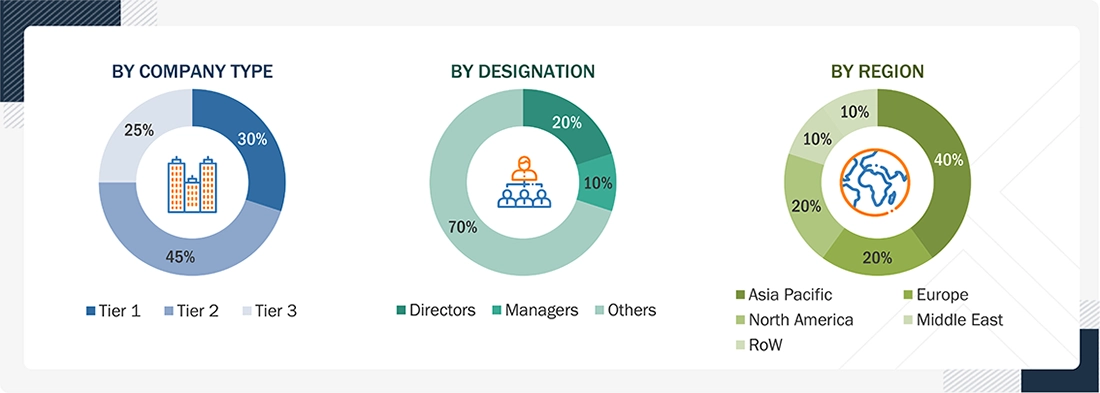
Extensive primary research was conducted after acquiring information regarding the satellite propellant tanks market scenario through secondary research. Several primary interviews were conducted with market experts from the demand and supply sides across major countries of North America, Europe, Asia Pacific, and the Rest of the world. Primary data was collected through questionnaires, emails, and telephonic interviews.
To know about the assumptions considered for the study, download the pdf brochure
Market Size Estimation
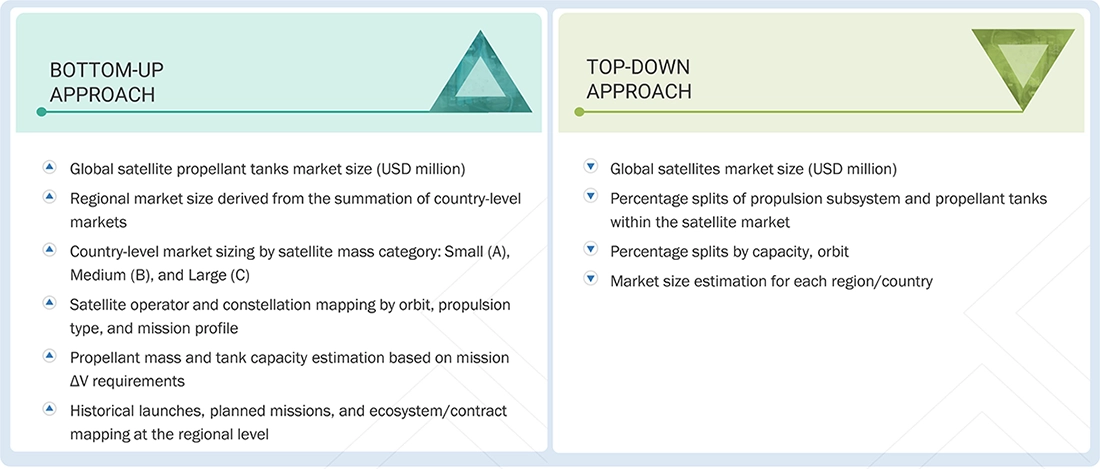
The top-down and bottom-up approaches were used to estimate and validate the size of the satellite propellant tanks market. The research methodology used to estimate the size of the market included the following details:
- Key players in the satellite propellant tanks market were identified through secondary research, and their market shares were determined through a combination of primary and secondary research. This included a study of the annual and financial reports of the top market players, as well as extensive interviews with leaders, including directors, engineers, marketing executives, and other key stakeholders of leading companies operating in the market.
- All percentage shares, splits, and breakdowns were determined using secondary sources and verified through primary sources.
- All possible parameters that affect the markets covered in this research study were accounted for, viewed in extensive detail, verified through primary research, and analyzed to obtain the final quantitative and qualitative data on the satellite propellant tanks market. This data was consolidated, enhanced with detailed inputs, analyzed by MarketsandMarkets, and presented in this report.
Satellite Propellant Tanks Market : Top-Down and Bottom-Up Approach
Data Triangulation
After determining the overall market size, the total market was divided into several segments and subsegments. The data triangulation and market breakdown procedures explained below were implemented, wherever applicable, to complete the overall market engineering process and arrive at the estimated market numbers for the market segments and subsegments. The data was triangulated by studying various factors and trends from the demand and supply sides. Additionally, the market size was validated using top-down and bottom-up approaches.
Market Definition
Satellite propellant tanks are space-qualified storage vessels used on satellites to hold and deliver propellants for orbit raising, station-keeping, attitude control, and end-of-life maneuvers. It is analyzed by capacity (total internal volume per tank), material type (all-metal shells such as titanium or aluminum, and hybrid metal-plus-CFRP overwrapped designs), and tank type/architecture (PMD surface-tension tanks, positive-expulsion diaphragm tanks, and no-internal-device tanks commonly used for gas propellants like xenon).
Key Stakeholders
- Government and Research Organizations
- Satellite Propellant Tanks Manufacturers
- Satellite and Spacecraft Manufacturers
- Satellite Propulsion System Providers
- Defense and National Security Agencies
- Civil Space Agencies
- Commercial Satellite Operators
- Launch Service Providers
- Raw Material and Advanced Materials Suppliers
- Academic Institutions and Research Universities
Report Objectives
- To define, describe, and forecast the size of the satellite propellant tanks market based on Architecture, Satellite Mass, Propellant, Satellite Orbit, Material, Capacity, and region
- To forecast the size of the various segments of the Satellite Propellant Tanks market based on five regions—North America, Europe, Asia Pacific, the Middle East, and the Rest of the World, along with key countries in each region
- To identify and analyze key drivers, restraints, opportunities, and challenges influencing the growth of the market
- To identify industry trends, market trends, and technology trends prevailing in the market
- To analyze micro markets with respect to individual technological trends, prospects, and their contribution to the overall market
- To provide a detailed competitive landscape of the market and analyze competitive growth strategies such as product launches and developments, contracts, partnerships, agreements, and collaborations adopted by key players in the market
- To identify the detailed financial positions, product portfolios, and key developments of leading companies in the market
- To strategically profile key market players and comprehensively analyze their market rank and core competencies
Available customizations:
MarketsandMarkets offers the following customizations for this market report:
- Additional country-level analysis of the satellite propellant tanks market
- Profiling of other market players (up to five)
Product Analysis
- Product matrix, which provides a detailed comparison of the product portfolio of each company in the satellite propellant tanks market
Get the Full Satellite Propellant Tanks Market Report
Full forecast, segment splits, and company analysis for all Satellite Propellant Tanks Market.
- Canada Satellite Propellant Tanks Market
- US Satellite Propellant Tanks Market
- UK Satellite Propellant Tanks Market
- Germany Satellite Propellant Tanks Market
- Italy Satellite Propellant Tanks Market
- Russia Satellite Propellant Tanks Market
- France Satellite Propellant Tanks Market
- China Satellite Propellant Tanks Market
- India Satellite Propellant Tanks Market
- Japan Satellite Propellant Tanks Market
- Australia Satellite Propellant Tanks Market
- UAE Satellite Propellant Tanks Market
- Saudi Arabia Satellite Propellant Tanks Market
- Israel Satellite Propellant Tanks Market
- Turkey Satellite Propellant Tanks Market
Need a Tailored Report?
Customize this report to your needs
Get 10% FREE Customization
Customize This Report
