
Malaysia Semiconductor Chemicals Market (2025-2030)

The Malaysia Semiconductor Chemicals Market was valued at $933.9 Million in 2025 and projected to reach to $1695.5 Million by 2030, representing a compound annual growth rate of 12.7%. Malaysia's semiconductor chemicals market is poised for sustained growth through 2030, driven by expanding semiconductor manufacturing capacity and increasing foreign direct investment in the electronics sector.


| Market Size in | USD 26.32 MN |
| Market Forecast in | |
| CAGR | |
| Forecast Period | |
| Units Considered | Value (USD MN) |
Malaysia Semiconductor Chemicals Market Trends and Insights
- Valued at USD 933.9 million in 2025, Malaysia's market is expected to expand to USD 1,695.5 million by 2030, reflecting a compound annual growth rate of 12.7%.
- This growth trajectory underscores Malaysia's strategic importance in global semiconductor supply chains and its increasing demand for specialized chemical inputs. The expansion of Malaysia's semiconductor chemicals market is driven by the country's robust electronics manufacturing base and rising investments in advanced semiconductor fabrication.
- Malaysia's chemical suppliers are responding to heightened demand for high-purity materials, photoresists, and process chemicals essential for modern chip production.
- Between 2025 and 2030, Malaysia is expected to capture significant market share within Asia Pacific, supported by regional trade agreements and proximity to major semiconductor hubs. Malaysia's competitive advantage in semiconductor chemicals stems from its established industrial infrastructure, skilled workforce, and favorable regulatory environment.
- The country's market growth reflects broader trends in semiconductor miniaturization and the transition to advanced manufacturing nodes, positioning Malaysia as an increasingly vital player in the global semiconductor chemicals supply network..
Key Market Statistics
- CAGR (2025-2030) 12.7% CAGR
- Market Size, 2025 ~USD 933.9 Million
- Forecast, 2030 ~USD 1695.5 Million
- Country Malaysia
Malaysia Semiconductor Chemicals Market Overview
Market Valuation Growth :
Malaysia's semiconductor chemicals market is valued at USD 933.9 million in 2025 and is projected to reach USD 1,695.5 million by 2030, demonstrating robust expansion driven by increased semiconductor manufacturing activities.
Strong CAGR Performance :
With a CAGR of 12.7% from 2025 to 2030, Malaysia's market growth slightly outpaces the global average of 12.6%, reflecting the country's strengthening position in semiconductor supply chains.
Regional Manufacturing Hub :
Malaysia serves as a critical node in Asia Pacific's electronics manufacturing ecosystem, hosting major semiconductor fabrication and assembly operations that drive demand for specialized chemicals.
Supply Chain Integration :
The country's strategic location and established infrastructure position it as a key supplier of semiconductor chemicals to regional and global semiconductor manufacturers and assembly facilities.
Malaysia Semiconductor Chemicals Market Dynamics
- The country's established position as a regional manufacturing hub, combined with government initiatives supporting high-tech industries, creates favorable conditions for market expansion.
- Rising demand for advanced packaging materials, photoresists, and specialty chemicals from local and regional semiconductor producers will fuel market growth.
- Additionally, Malaysia's competitive advantages in labor costs and logistics infrastructure support continued industry investment and chemical consumption growth..
Market Ecosystem
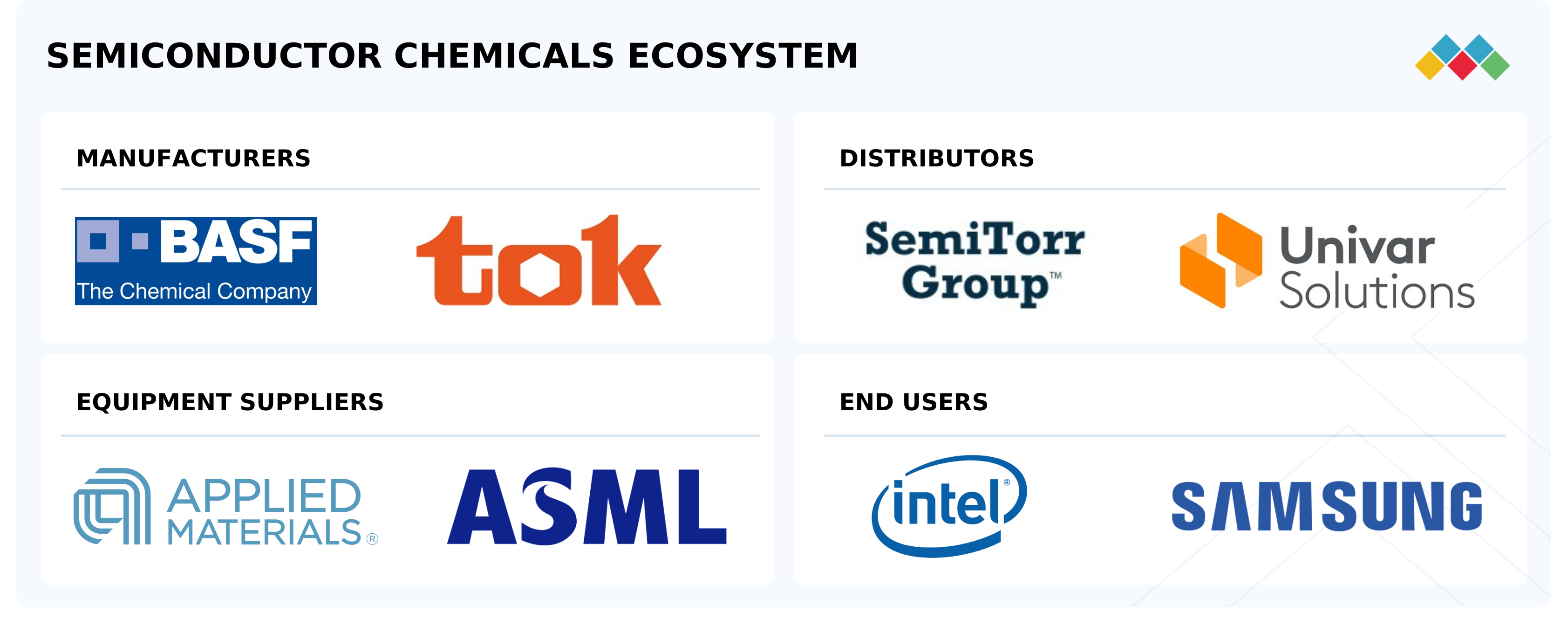
Semiconductor Chemicals Market: COMMERCIAL USE CASES ACROSS INDUSTRIES
| COMPANY | USE CASE DESCRIPTION | BENEFITS |
|---|---|---|
 |
Utilization of advanced photoresists and high-purity etching chemicals for <5nm and 3nm chip production | Enables extreme ultraviolet (EUV) lithography, higher transistor density, reduced defect rates, improved yield |
 |
Adoption of ultra-clean wet chemicals and slurries for next-gen integrated circuits | Improved process reliability, enhanced energy efficiency, scalability for AI and HPC chips |
 |
Use of deposition and doping chemicals in DRAM and NAND flash manufacturing | Higher memory density, faster data transfer speeds, lower power consumption |
 |
Specialty chemicals for analog and power semiconductor production | Increased durability, heat resistance, and performance of automotive and industrial semiconductors |
 |
Development of EUV-compatible photoresists and cleaning solutions | Supports advanced lithography, enables smaller node production, ensures compatibility with next-gen EUV tools |
 |
Use of advanced solvents and etching chemicals in 3D NAND memory stacks | Achieves greater storage capacity, enhanced reliability, and reduced cost per bit |
Logos and trademarks shown above are the property of their respective owners. Their use here is for informational and illustrative purposes only.
Related Ecosystem
Speciality Chemicals
- Corrosion Inhibitors
- Polyetheretherketone (PEEK)
- Acrylonitrile Butadiene Styrene (ABS)
- Epoxy Resin
- Polycarbonate
- Basf se
- DOW CHEMICAL COMPANY
- Evonik industries ag
- Clariant ag.
- Solvay sa
Key Takeaways
- Malaysia's semiconductor chemicals market will grow from USD 933.9 million in 2025 to USD 1,695.5 million by 2030 at a 12.7% CAGR.
- Malaysia's established electronics manufacturing base and proximity to regional semiconductor hubs drive sustained demand for specialized chemicals.
- Malaysia's market expansion is supported by investments in advanced fabrication facilities and the transition to next-generation chip production nodes.
- Malaysia's strategic position within Asia Pacific makes it a key supplier hub for semiconductor chemicals serving regional and global markets.
Semiconductor Chemicals Market Report Scope
| Report Metric | Details |
|---|---|
| Base Year | 2025 |
| Fastest Growing Segment | SOLVENTS (Type) |
| Forecast Period | 2025–2030 |
| Growth Rate | CAGR of 12.6% from 2025 to 2030 |
| Largest Segment | INTEGRATED CIRCUITS (ICS) (End Use) |
| Market Size Base Year (Billions) | ~USD 16.16 (2025) |
| Revenue Forecast (Billions) | ~USD 29.25 (2030) |
| Segments Covered | Type, Application, End Use |
Malaysia Semiconductor Chemicals Market Report Segmentation
3 segment dimensions are covered across the global market.
By Type
- Acid & Base Chemicals
- Adhesives
- High-Performance Polymers
- Other Types
- Solvents
By Application
- Cleaning
- Deposition
- Doping
- Etching
- Other Applications
- Photoresist
By End Use
- Discrete Semiconductor
- Integrated Circuits (Ics)
- Optoelectronics
- Sensors
MALAYSIA: SEMICONDUCTOR CHEMICALS MARKET, BY APPLICATION, 2025–2030
| Segment | 2025 | 2026 | 2027 | 2028 | 2029 | 2030 | CAGR (%) |
|---|---|---|---|---|---|---|---|
| CLEANING | 151 | 169.4 | 190.3 | 214.3 | 240.8 | 271.3 | 12.4 |
| DEPOSITION | 131.3 | 147.4 | 165.9 | 187 | 210.4 | 237.4 | 12.6 |
| DOPING | 114.9 | 129.1 | 145.4 | 164 | 184.7 | 208.5 | 12.7 |
| ETCHING | 168.9 | 190.1 | 214.4 | 242.1 | 273 | 308.6 | 12.8 |
| OTHER APPLICATIONS | 100.6 | 112.7 | 126.5 | 142.3 | 159.7 | 179.7 | 12.3 |
| PHOTORESIST | 267.3 | 301 | 339.7 | 383.9 | 433.1 | 490 | 12.9 |
| TOTAL | 933.9 | 1049.8 | 1182.1 | 1333.5 | 1501.7 | 1695.5 | 12.7 |
Target Audience
- Chemical Manufacturers & Suppliers : Companies producing semiconductor chemicals need Malaysia-specific market data to identify growth opportunities, assess demand for specialty chemicals, and develop localized distribution and sales strategies.
- Semiconductor Equipment Providers : Equipment manufacturers serving semiconductor fabs require insights into Malaysia's manufacturing expansion and chemical consumption trends to align product offerings and support regional customers.
- Investment & Private Equity Firms : Investors evaluating opportunities in Malaysia's electronics and chemicals sectors need detailed market sizing and growth forecasts to assess investment returns and portfolio diversification potential.
- Strategic Business Planners : Corporate strategists and business development teams need Malaysia market intelligence to inform expansion decisions, partnership opportunities, and competitive positioning in the Asia Pacific region.
- Market Research & Consulting Professionals : Analysts and consultants require country-specific data on Malaysia's semiconductor chemicals market to support client advisory services, competitive benchmarking, and industry trend analysis.
Key Companies in the Malaysia Semiconductor Chemicals Market
| Company | HQ | Ownership | Strongest segments |
|---|---|---|---|
| TOKYO OHKA KOGYO CO., LTD. | Japan | ||
| JSR CORPORATION | Japan | ||
| BASF | Germany | ||
| SOLVAY | Belgium | ||
| HONEYWELL INTERNATIONAL INC. | United States | ||
| FUJIFILM HOLDINGS CORPORATION | Japan | ||
| EASTMAN CHEMICAL COMPANY | United States | ||
| MERCK KGAA (EMD ELECTRONICS) | United States | ||
| SUMITOMO CHEMICAL CO., LTD. | Japan | ||
| SK INC. | South Korea | Public Company | High Performance Polymers,Acid & Base Chemicals,Adhesives, |
| DUPONT | United States | Public Company | High Performance Polymers,Acid & Base Chemicals,Adhesives, |
| RESONAC HOLDINGS CORPORATION | Japan | Public Company | High Performance Polymers,Acid & Base Chemicals,Adhesives, |
| MITSUBISHI CHEMICAL CORPORATION | Japan | Public Company | High Performance Polymers,Solvents,Acid & Base Chemicals, |
| PARKER HANNIFIN CORP | United States | Public Company | High Performance Polymers,Adhesives,Acid & Base Chemicals, |
TOKYO OHKA KOGYO CO., LTD.
Tokyo Ohka Kogyo Co., Ltd. is a Japanese chemical company specializing in photoresists and fine chemicals used in semiconductor and electronics manufacturing.
JSR CORPORATION
JSR Corporation is a Japanese chemical manufacturer producing synthetic rubbers, plastics, and specialty materials for industrial applications.
BASF
BASF is a German multinational chemical company and one of the world's largest producers of chemicals, plastics, and performance products.
SOLVAY
Solvay is a Belgian chemical company manufacturing specialty polymers, advanced materials, and chemical solutions for various industrial sectors.
HONEYWELL INTERNATIONAL INC.
Honeywell International Inc. is a United States-based diversified technology and manufacturing company producing aerospace, building, and performance materials products.
FUJIFILM HOLDINGS CORPORATION
Fujifilm Holdings Corporation is a Japanese multinational company with operations in imaging, information systems, and chemical products including specialty materials.
EASTMAN CHEMICAL COMPANY
Eastman Chemical Company is a United States-based specialty chemical manufacturer producing advanced materials, additives, and fibers for various industries.
MERCK KGAA (EMD ELECTRONICS)
Merck KGaA (EMD Electronics) is a United States-based division of the German Merck Group specializing in electronic and specialty chemicals.
SUMITOMO CHEMICAL CO., LTD.
Sumitomo Chemical Co., Ltd. is a Japanese chemical company producing petrochemicals, fine chemicals, and agricultural products for global markets.
SK INC.
SK Inc. is a South Korean conglomerate founded in 1949 with 47,639 employees, operating as a public company in energy, chemicals, and telecommunications sectors.
DUPONT
DuPont is a United States-based public company founded in 2015 with 15,000 employees, specializing in specialty chemicals and advanced materials.
RESONAC HOLDINGS CORPORATION
Resonac Holdings Corporation is a Japanese public company founded in 1939 with 21,525 employees, producing specialty chemicals and advanced materials.
MITSUBISHI CHEMICAL CORPORATION
Mitsubishi Chemical Corporation is a Japanese public company founded in 1933 with 56,678 employees, manufacturing chemicals, plastics, and specialty materials.
PARKER HANNIFIN CORP
Parker Hannifin Corp is a United States-based public company founded in 1917 with 57,950 employees, specializing in motion and control technologies and fluid systems.
Reasons to Buy this Report
- Market-Specific Sizing Data : Access precise valuation figures for Malaysia's semiconductor chemicals market with detailed 2025-2030 forecasts, enabling accurate budgeting and investment planning specific to this high-growth regional market.
- Competitive Intelligence : Understand Malaysia's market dynamics relative to global trends, with localized insights into manufacturing capacity, chemical consumption patterns, and competitive positioning within Asia Pacific.
- Investment Decision Support : Leverage country-specific growth projections and CAGR analysis to identify expansion opportunities, facility locations, and market entry strategies tailored to Malaysia's semiconductor ecosystem.
- Supply Chain Optimization : Gain insights into Malaysia's role in regional semiconductor supply chains, enabling better sourcing decisions, distribution planning, and partnership development with local manufacturers.
- Strategic Planning Resources : Utilize Malaysia-focused market intelligence to develop targeted business strategies, product portfolios, and go-to-market approaches aligned with regional demand drivers and growth catalysts.
Frequently asked questions
What is the current size of Malaysia's semiconductor chemicals market?
Malaysia's semiconductor chemicals market is valued at USD 933.9 million in 2025 and is projected to reach USD 1,695.5 million by 2030.
What is the growth rate of Malaysia's semiconductor chemicals market?
Malaysia's semiconductor chemicals market is expected to grow at a compound annual growth rate (CAGR) of 12.7% from 2025 to 2030.
What factors are driving growth in Malaysia's semiconductor chemicals market?
Malaysia's market growth is driven by robust electronics manufacturing, investments in advanced fabrication facilities, rising demand for high-purity materials, and the country's strategic position within Asia Pacific semiconductor supply chains.
Which chemical products are most in demand in Malaysia's semiconductor market?
Malaysia's semiconductor industry demands high-purity materials, photoresists, process chemicals, and specialty chemicals essential for advanced chip manufacturing and next-generation production nodes.
How does Malaysia's market compare to other Asia Pacific countries?
Malaysia's semiconductor chemicals market represents a significant segment within Asia Pacific, supported by established manufacturing infrastructure, skilled workforce, and favorable trade positioning that enhance its competitive advantage in the regional supply chain.
RESEARCH METHODOLOGY
The study involved four major activities in estimating the market size of the semiconductor chemicals market. Exhaustive secondary research was done to collect information on the market, the peer market, and the parent market. The next step was to validate these findings, assumptions, and sizing with industry experts across the value chain through primary research. Both top-down and bottom-up approaches were employed to estimate the complete market size. Thereafter, the market breakdown and data triangulation procedures were used to estimate the market size of the segments and subsegments.
Secondary Research
In the secondary research process, various secondary sources have been referred to for identifying and collecting information for this study. These secondary sources include annual reports, press releases, investor presentations of companies, white papers, certified publications, trade directories, certified publications, articles from recognized authors, gold standard and silver standard websites, and databases.
Secondary research has been used to obtain key information about the industry’s value chain and monetary chain, the total pool of key semiconductor chemical market players, classification and segmentation according to industry trends to the bottom-most level, and regional markets. It was also used to obtain information about key developments from a market-oriented perspective.
Primary Research
The semiconductor chemicals market comprises several stakeholders in the value chain, which include chemical manufacturers, equipment suppliers, distributors, and end users. Various primary sources from the supply and demand sides of the semiconductor chemicals market have been interviewed to obtain qualitative and quantitative information. The primary interviewees from the demand side include key opinion leaders in end-use sectors. The primary sources from the supply side include manufacturers, associations, and institutes involved in the semiconductor chemicals industry.
Primary interviews were conducted to gather insights such as market statistics, data of revenue collected from the products and services, market breakdowns, market size estimations, market forecasting, and data triangulation. Primary research also helped in understanding the various trends related to type, end-use, application, and region. Stakeholders from the demand side, such as CIOs, CTOs, and CSOs, were interviewed to understand the buyer’s perspective on the suppliers, products, component providers, and their current usage of semiconductor chemicals and future outlook of their business, which will affect the overall market.
The breakdown of profiles of the primary interviewees is illustrated in the figure below:
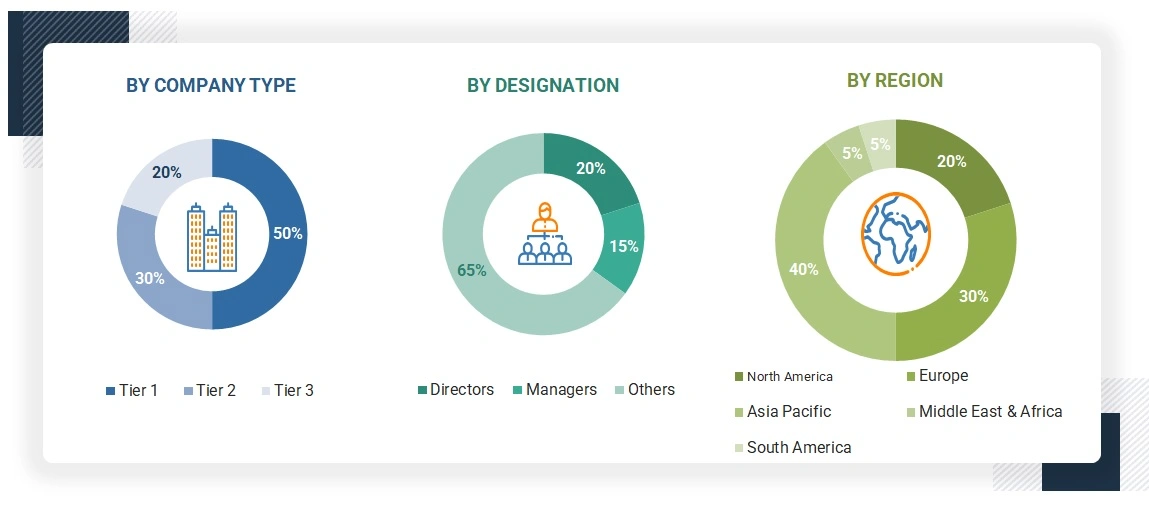
Note: Tier 1, Tier 2, and Tier 3 companies are classified based on their market revenue in 2024 available in the public domain, product portfolios, and geographical presence.
Other designations include sales representatives, production heads, and technicians.
To know about the assumptions considered for the study, download the pdf brochure
Market Size Estimation
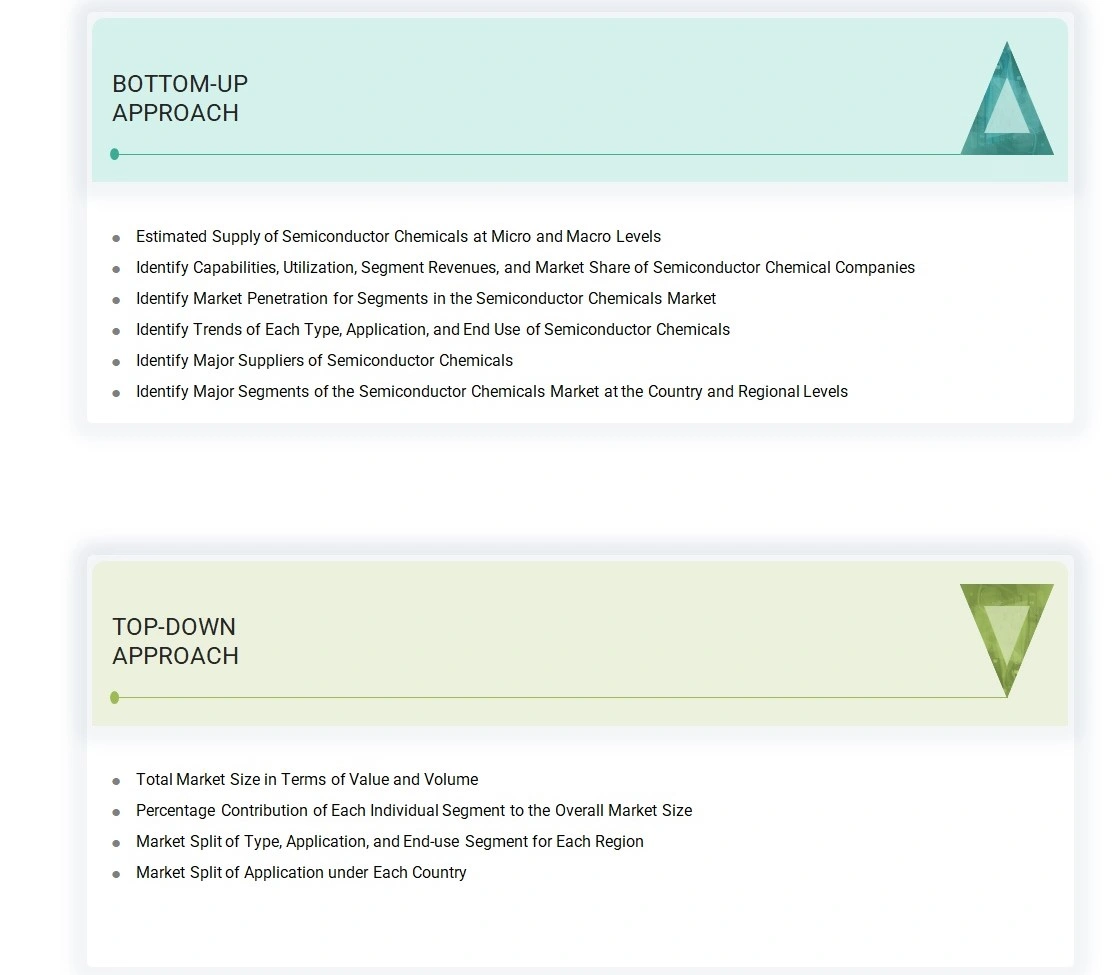
The top-down approach was used to estimate and validate the size of various submarkets for the region’s semiconductor chemicals market. The research methodology used to estimate the market size included the following steps:
- The key players in the industry have been identified through extensive secondary research
- The supply chain of the industry has been determined through primary and secondary research
- All percentage shares, splits, and breakdowns based on type, end-use, application, and region were determined using secondary sources and verified through primary sources
- All possible parameters that affect the markets covered in this research study were accounted for, viewed in extensive detail, verified through primary research, and analyzed to get the final quantitative and qualitative data. This data was consolidated and added with detailed inputs and analysis, and presented in this report
Source: Secondary Research, Interviews with Experts, and MarketsandMarkets Analysis
Data Triangulation
After arriving at the total market size from the estimation process above, the overall market has been split into several segments and subsegments. To complete the overall market engineering process and arrive at the exact statistics for all the segments and subsegments, the data triangulation and market breakdown procedures have been employed, wherever applicable. The data has been triangulated by studying various factors and trends from both the demand and supply sides. Along with this, the market size has been validated by using both the top-down and bottom-up approaches and primary interviews. Hence, for every data segment, there have been three sources: the top-down approach, the bottom-up approach, and expert interviews. The data was assumed correct when the values arrived from the three sources matched.
Market Definition
Semiconductor chemicals are high-purity specialty chemicals used in the manufacturing of semiconductor devices. These chemicals play a critical role in various fabrication processes such as photolithography, etching, doping, deposition, and wafer cleaning. They include solvents, acids, bases, photoresists, dopants, and advanced materials tailored for nanoscale precision and contamination-free environments. Semiconductor chemicals are essential for producing integrated circuits (ICs), discrete semiconductors, sensors, and optoelectronic components. With the ongoing advancement of electronics, miniaturization of chip nodes, and growing applications in 5G, AI, IoT, and automotive sectors, the demand for reliable and high-performance semiconductor chemicals continues to rise globally.
Stakeholders
- Semiconductor Chemical Manufacturers
- Semiconductor Chemical Traders, Distributors, and Suppliers
- Government and Private Research Organizations
- Associations and Industrial Bodies
- R&D Institutions
- Environmental Support Agencies
Report Objectives
- To define, describe, and forecast the size of semiconductor chemicals, in terms of value and volume
- To provide detailed information regarding the major factors (drivers, opportunities, restraints, and challenges) influencing the growth of the market
- To estimate and forecast the market size based on type, end use, application, and region
- To forecast the size of the market with respect to major regions, namely, North America, Europe, Asia Pacific, and the Rest of the World, along with their key countries
- To strategically analyze micromarkets with respect to individual growth trends, prospects, and their contribution to the overall market
- To analyze opportunities in the market for stakeholders and provide a competitive landscape of market leaders
- To track and analyze recent development such as product launches, expansions, investments, collaborations, and partnerships in the market
- To strategically profile the key market players and comprehensively analyze their core competencies
Available customizations:
Along with the given market data, MarketsandMarkets offers customizations according to the company’s specific needs. The following customization options are available for the report:
Regional Analysis
- Further breakdown of a region with respect to a particular country or additional end use
Company Information
- Detailed analysis and profiles of additional market players
Tariff & Regulations
- Regulations and impact on semiconductor chemicals
By End-use Industry Analysis
- Market size for the semiconductor chemicals market in terms of value and volume
Get the Full Semiconductor Chemicals Market Report
Full forecast, segment splits, and company analysis for all Semiconductor Chemicals Market.
- Rest Of Asia Pacific Semiconductor Chemicals Market
- Others In Row Semiconductor Chemicals Market
- China Semiconductor Chemicals Market
- Japan Semiconductor Chemicals Market
- Taiwan Semiconductor Chemicals Market
- South Korea Semiconductor Chemicals Market
- Vietnam Semiconductor Chemicals Market
- Canada Semiconductor Chemicals Market
- Mexico Semiconductor Chemicals Market
- US Semiconductor Chemicals Market
- Germany Semiconductor Chemicals Market
- Netherlands Semiconductor Chemicals Market
- UK Semiconductor Chemicals Market
- Israel Semiconductor Chemicals Market
- Ireland Semiconductor Chemicals Market
- Brazil Semiconductor Chemicals Market
- South Africa Semiconductor Chemicals Market
- Rest Of Europe Semiconductor Chemicals Market
Need a Tailored Report?
Customize this report to your needs
Get 10% FREE Customization
Customize This Report
